
Tracking Atlatls in Manitoba

Tracking Atlatls in Manitoba

By Kevin Brownlee, past Curator of Archaeology


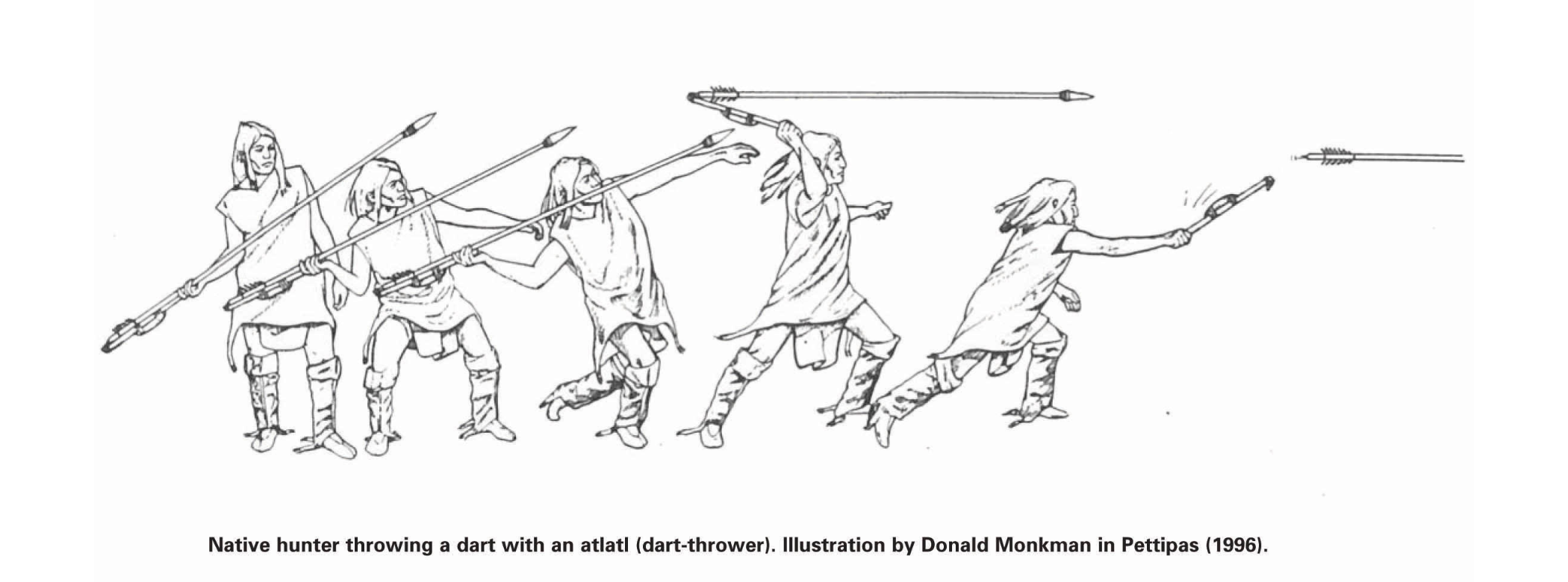
You may ask yourself what is an atlatl? An atlatl is a hunting tool that is in two parts, a dart or very thin spear and a throwing board which is used to propel the dart. In most of North America it was the hunting tool of choice for many thousands of years. Archaeologists often use the size of projectile points as indication of which hunting tool was used. To the best of our knowledge somewhere around 3,000 years before present the bow and arrow was introduced. For about 1,000 years atlatls and bows and arrows were used together. Somewhere around 2,000 years ago the atlatl fell out of favour and the bow and arrow was the main hunting tool. Exceptions to this exist in the arctic and in the southern states and Mesoamerica, where the atlatl continued to be used until European Contact.

An illustration depicting a person through five stages of movement launching a long dart over their head with an atlatl.
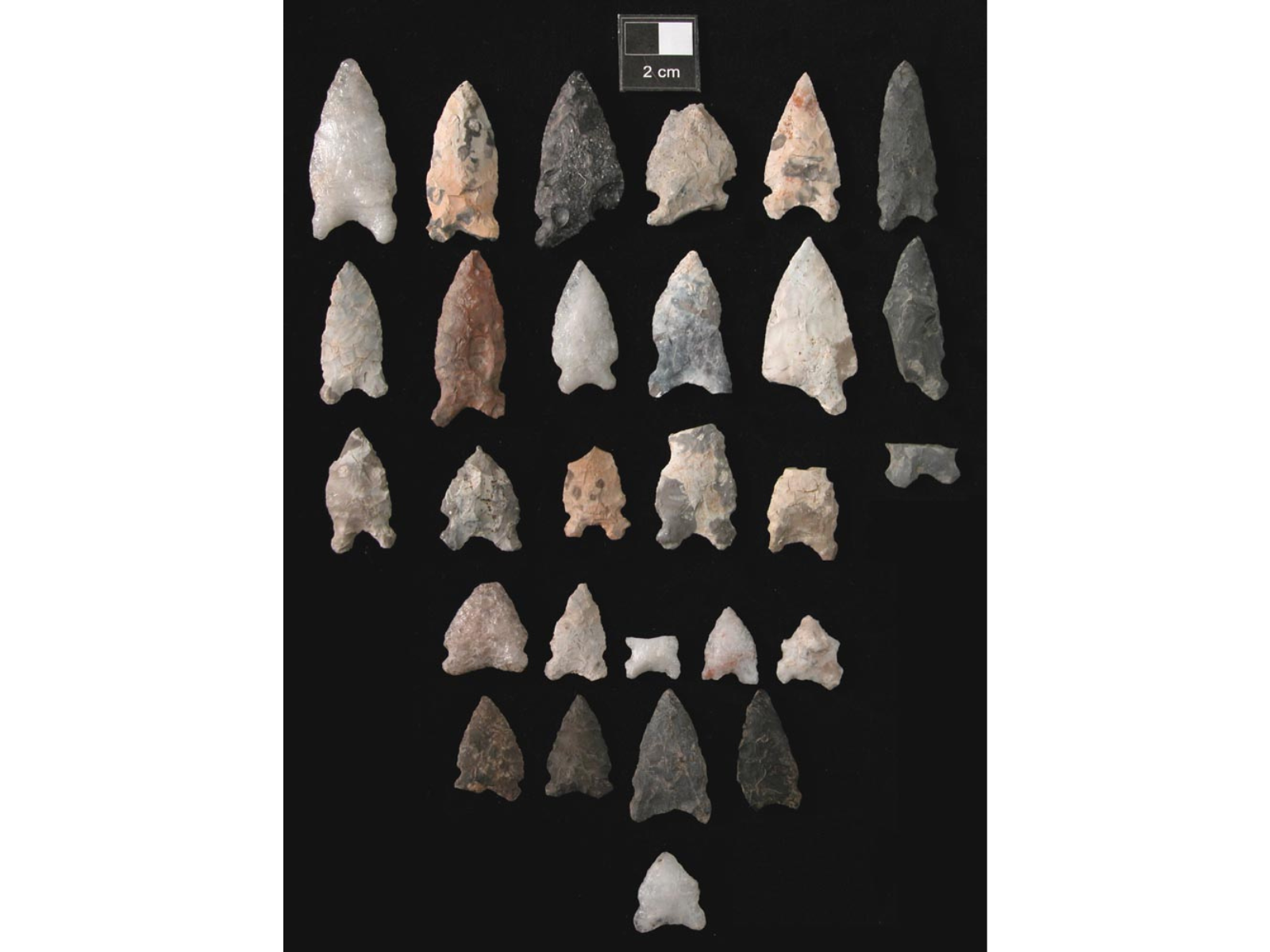
A selection of 28 stone spear points of varying colours and sizes on a black background.

The parts of an atlatl are mostly made from perishable materials like wood, hide, and sinew. The most common evidence of the atlatl in Manitoba is midsized stone spear points. While this may be the archaeological interpretation it is almost impossible to know for certain what hunting tool a spear point was attached. Some of these points could have been attached to thrusting spears, or used for other purposes. To positively know what a spear point was attached to you would need excellent preservation of the wood shaft which has not occurred in Manitoba.


Image: Stone Spear Points likely used with an atlatl.

Another clue that atlatls were used in Manitoba is the recovery of stone or antler atlatl weights. It appears that these may not have been always used with atlatls since they are uncommon. In the entire 2.5 million artefacts held by The Manitoba Museum only 17 are atlatl weights. In comparison the collection includes over 8,500 projectile points many of which we believe were used with the atlatl.

A long, thin shaft with a handle of leather straps on one end, and a point for a dart to attach for launching at the other end. A flattish stone is attached to the third of the shaft closest to the handle to serve as a counterweight.

Preproduction Atlatl (note stone weight).

Rocket lands in Science Gallery

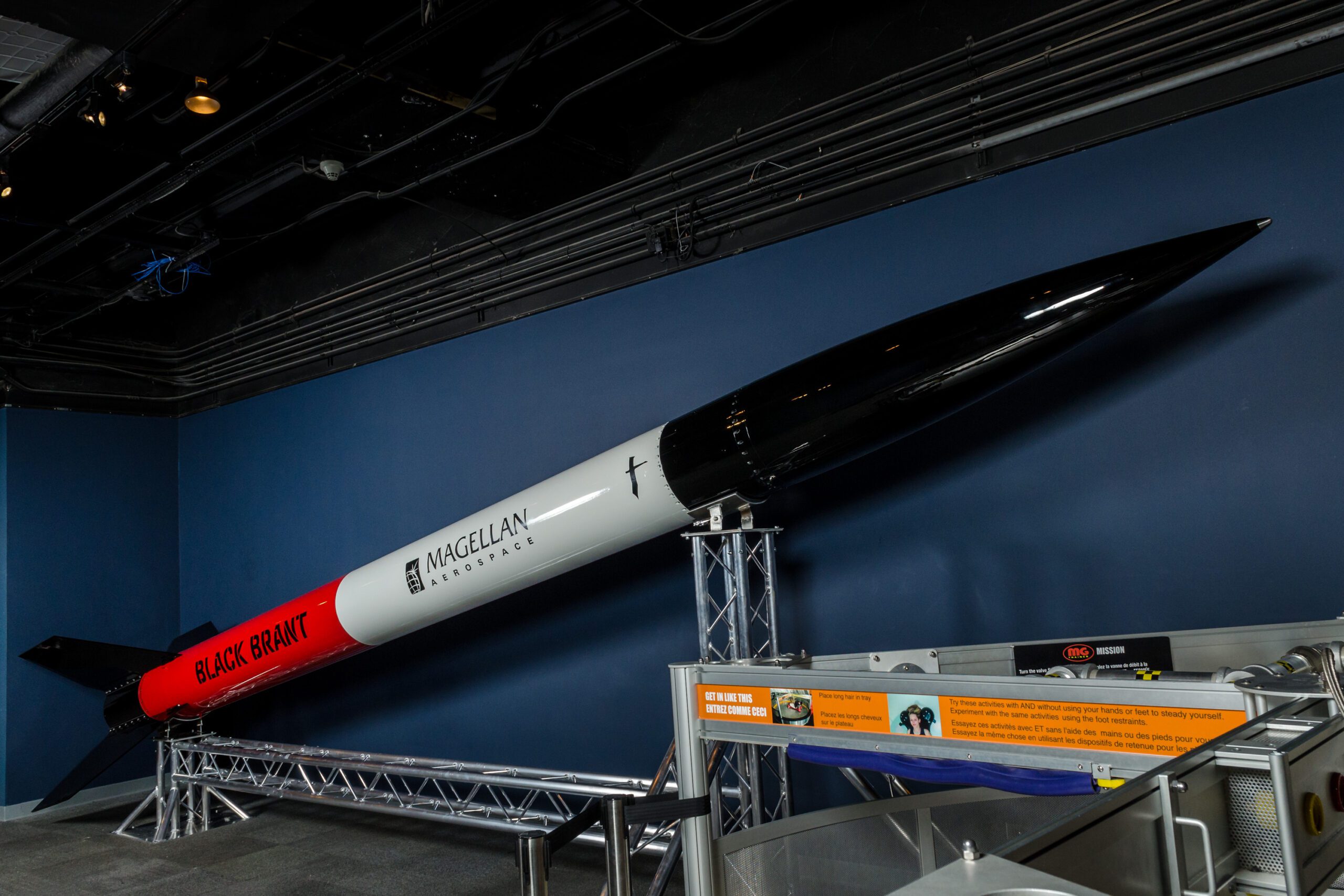
Did you know that one of the most successful small rocket programs in the world is run from right here in Winnipeg? Magellan Aerospace (formerly Bristol Aerospace) builds the Black Brant series of sounding rockets for customers around the world. Payloads launched by Black Brants have been studying the upper atmosphere and near-space environment for over 50 years, and have even been launched from right here in Manitoba (at the Churchill Rocket Range on the northern coast of Manitoba). So it’s no surprise that we’ve always wanted a real rocket for the Science Gallery. Well, now we have one!

Black Brant 5C Rocket in the Science Gallery.

Magellan has loaned the Manitoba Museum a real Black Brant 5C rocket, and it was delivered and installed in the Science Gallery on February 4, 2013. It was a big job getting the rocket into the building, since even disassembled the main motor case wouldn’t fit into the elevator. A team of engineers from Magellan and Museum staff carried it through the parkade and down the stairs to its final resting place. At 9.5-metres (31′) long and nearly 360 kilograms (800 lbs.), this is the single largest artifact in the Science Gallery.

The Black Brant exhibit will officially open this March, with interpretive panels and video footage of the rocket in action. However, you can see the rocket in place now, in the Science Gallery’s space wing next to the Planetarium entrance.

The Old Museum Lives On

By Dr. Graham Young, past Curator of Palaeontology & Geology


Winnipeg has a long and complicated history of museums featuring natural history collections. Our current museum was a centennial project, opened in 1970, but we are very fortunate that we possess vestiges of those earlier museums, such as minerals from the Carnegie Library collection and mounted animals from some of the early taxidermists (read more in blog “Anniversary for a Museum Outlaw”, here). The most visible and best-documented of these “inheritances” are pieces that were exhibited in the old Manitoba Museum, which occupied part of the Winnipeg Civic Auditorium from 1932 until about 1970.

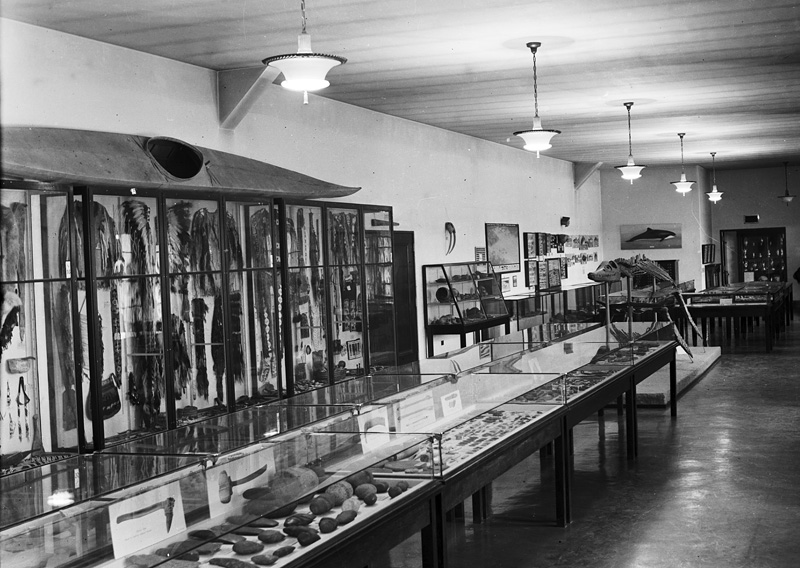
Black and white image of museum display cases showcasing various Indigenous artifacts, including a kayak.

We have a good record of specimens from the old museum because they were numbered, with the numbers listed in a book. We also have good knowledge of how some of these pieces were exhibited thanks to a set of photographs that are digitally filed at the Museum. I am not certain of the dates of these photos; some seem to be from the 1930s when specific exhibits were being installed, while others are from the 1940s or 1950s and show finished exhibits.

The old museum was not large, but it was clearly a pleasant place to spend an afternoon examining cabinets of archaeological artifacts, First Nations clothing, stuffed birds, and fossils. It was very much a “cabinet of curiosities” of the old school, and a good one. Sometimes when I look at these photos I feel a bit sad, and wish that we had been able to keep that old museum as well as building this newer one.


Image: Some of the exhibits at the old Manitoba Museum.

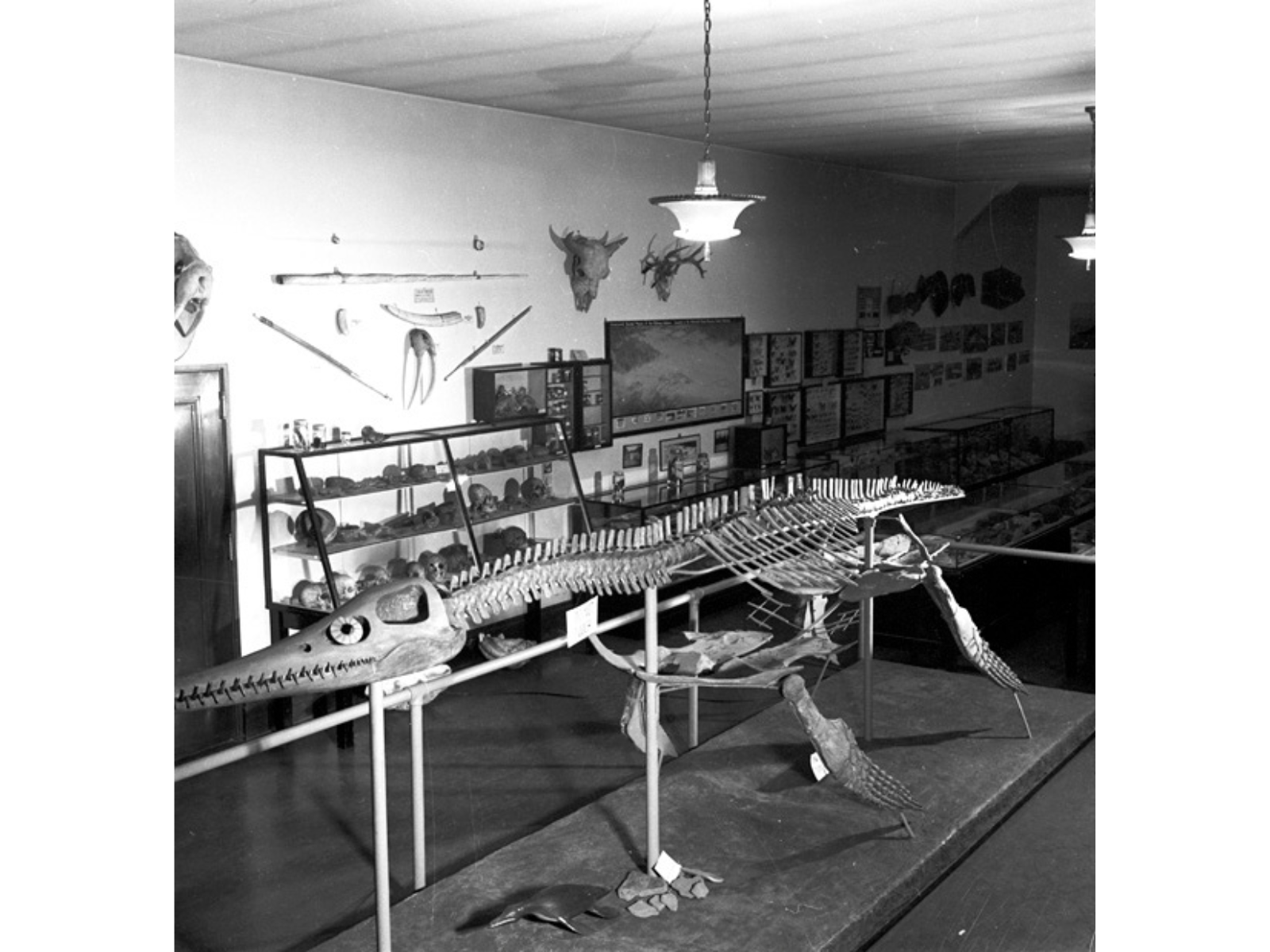
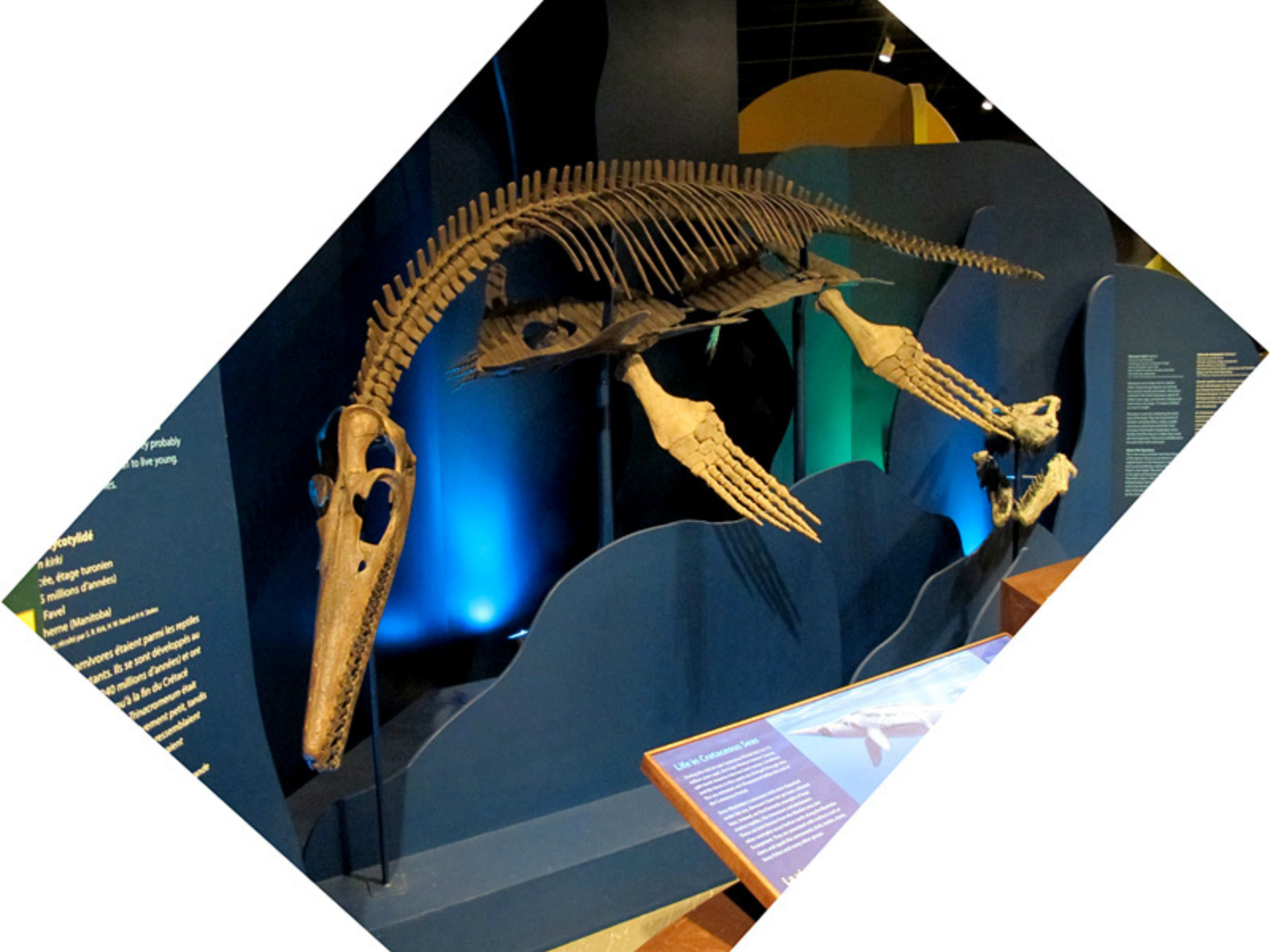
In a way, though, we have kept some of that old Museum, in the specimens and artifacts we inherited. It is intriguing that, even after all this time, many of those fossils are still the best examples we have for particular groups, and several of them are in the Earth History Gallery or have been selected for temporary exhibits. The most obvious of these is our mounted Cretaceous plesiosaur, Trinacromerum kirki.

A black and white image of an old museum gallery showing a plesiosaur fossil on display in the front and centre of the image.

The plesiosaur as exhibited in the old Manitoba Museum after 1937.

A full plesiosaur fossil specimen on display in the Manitoba Museum's Earth History Gallery.

The plesiosaur on exhibit last week.

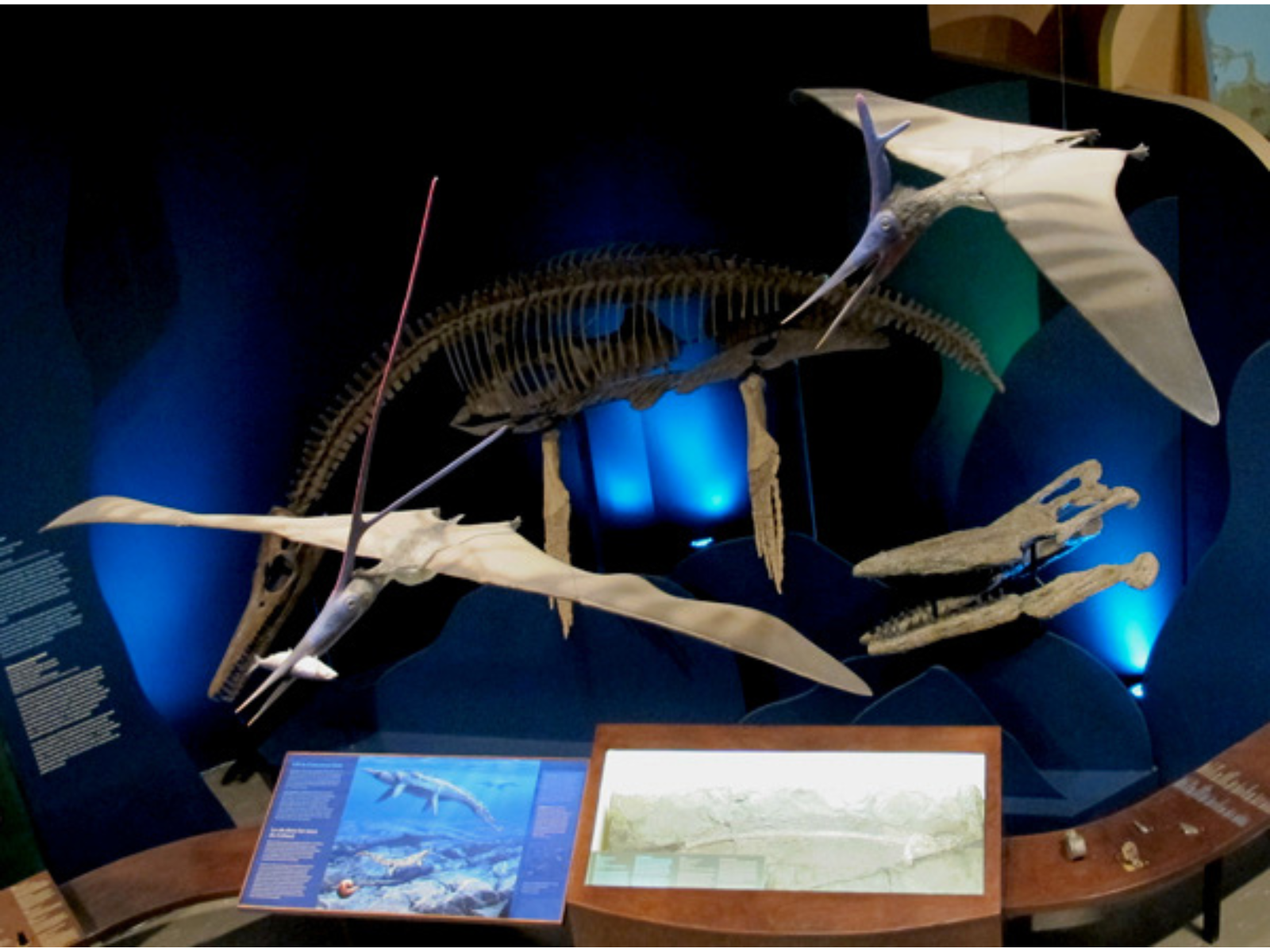
The plesiosaur fossil (and aquatic dinosaur) on display next to the skull of a mosasaur, with pterosaur, long-beaked flying dinosaur ,models suspended above.
The plesiosaur is now exhibited near a mosasaur skull, with beautiful reconstructions of the pterosaur Nyctosaurus suspended above.
This specimen, collected from the Manitoba Escarpment near Treherne in 1932, was a highlight of the old museum. After several re-mountings (including a more accurate replica skull), it remains a focus of our Earth History Gallery today. Skeletons of large extinct creatures never go out of style, but what other fossils can also be traced to the old museum?
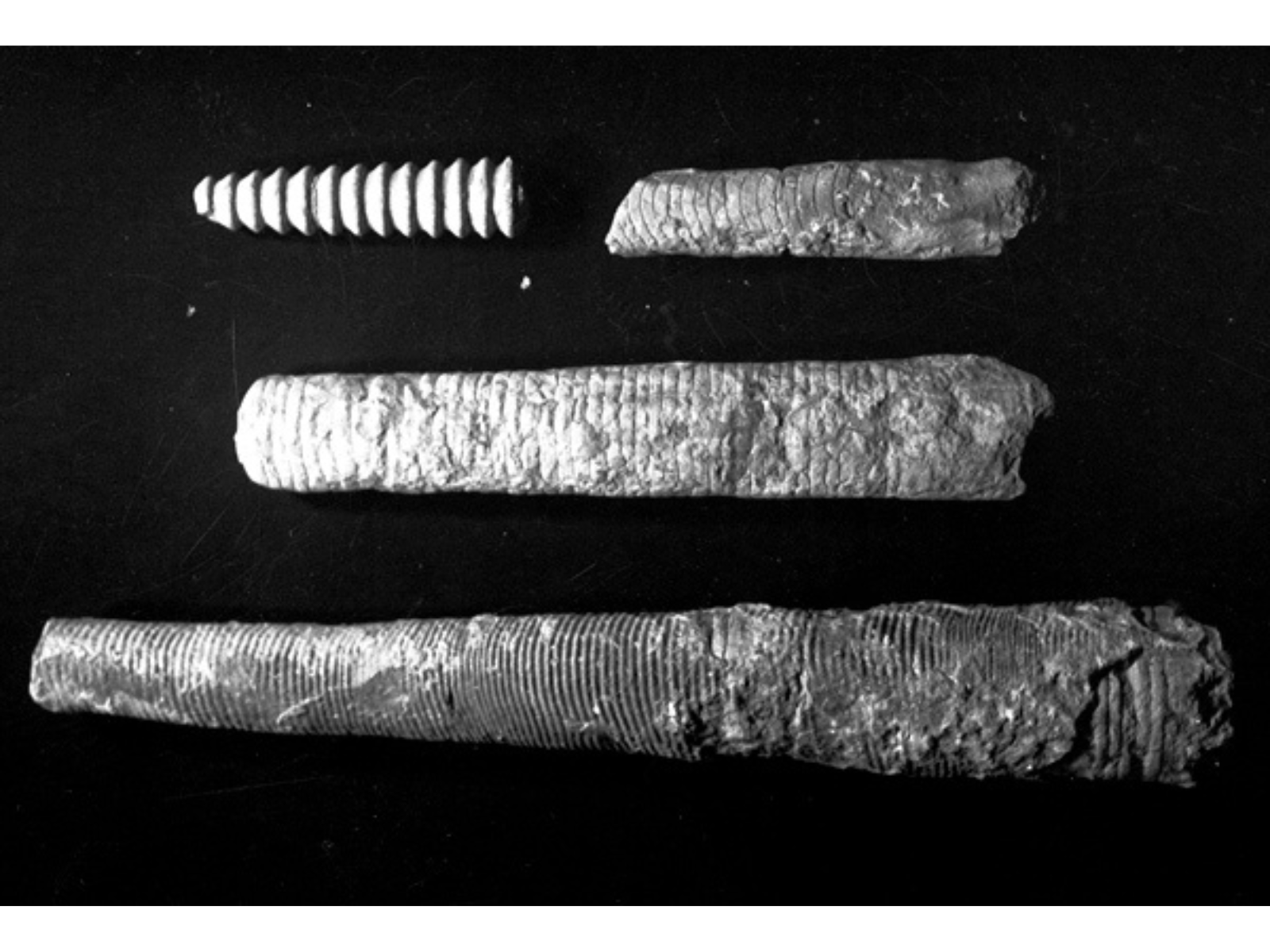
The exhibits there featured some beautiful specimens of cephalopods (relatives of octopus and squid) of Ordovician age (about 450 million years old). Ordovician cephalopods are familiar to many Winnipeggers because cut sections through these fossils are often seen in Tyndall Stone walls. Although the cut fossils are common, complete cephalopods are very rarely found nowadays, because the stone is cut directly out of the quarry walls.

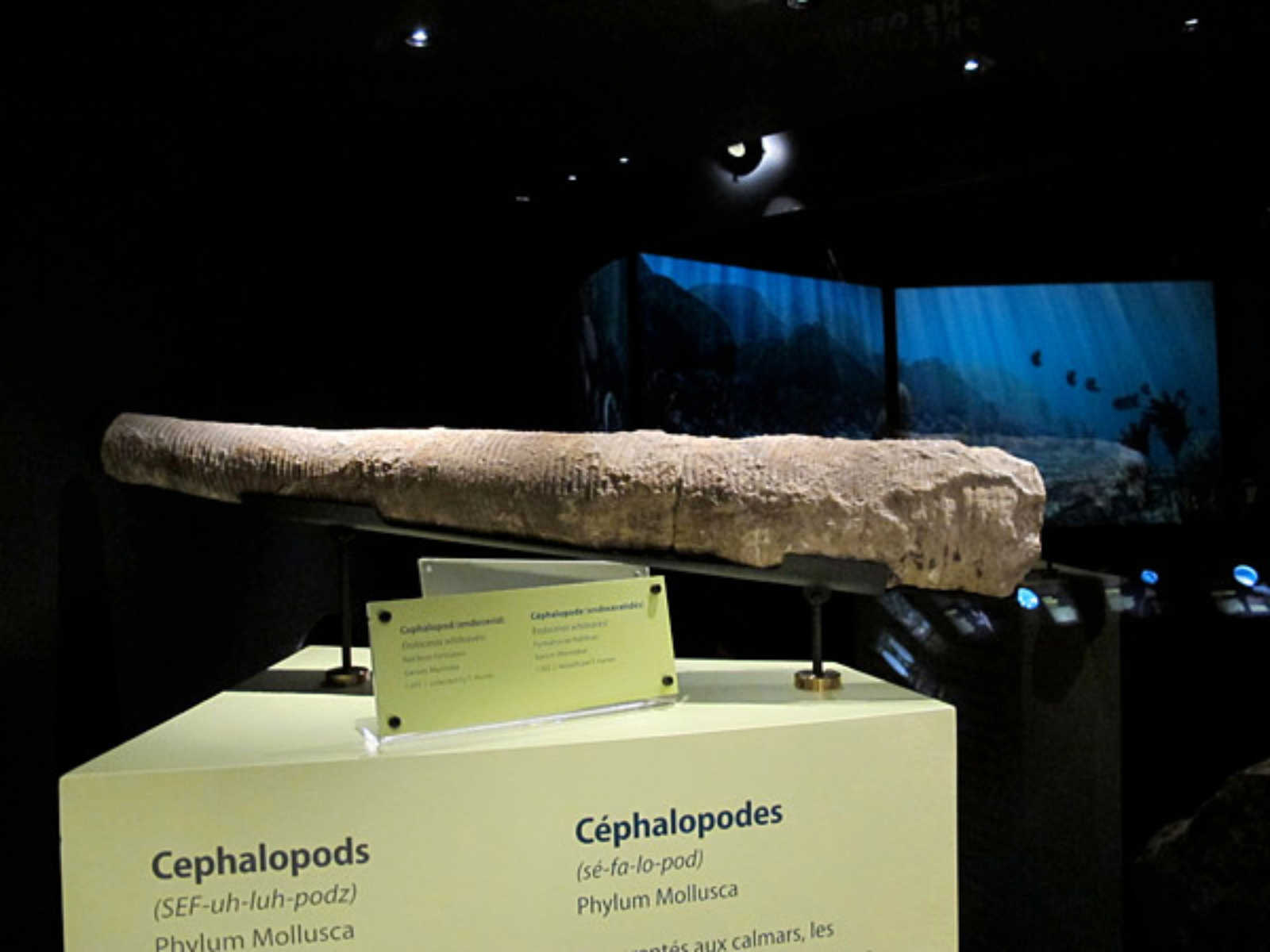
In the early years of quarrying, however, the work was done by hand. Three-dimensional fossils were extracted more commonly, and as a result many of our best large Tyndall Stone fossils come from the old collections. This is particularly striking in the Ancient Seas exhibit of our Earth History Gallery, where the finest endocerid cephalopod is one that was on exhibit in the old museum, and where some of the other fossils also came from old collections.

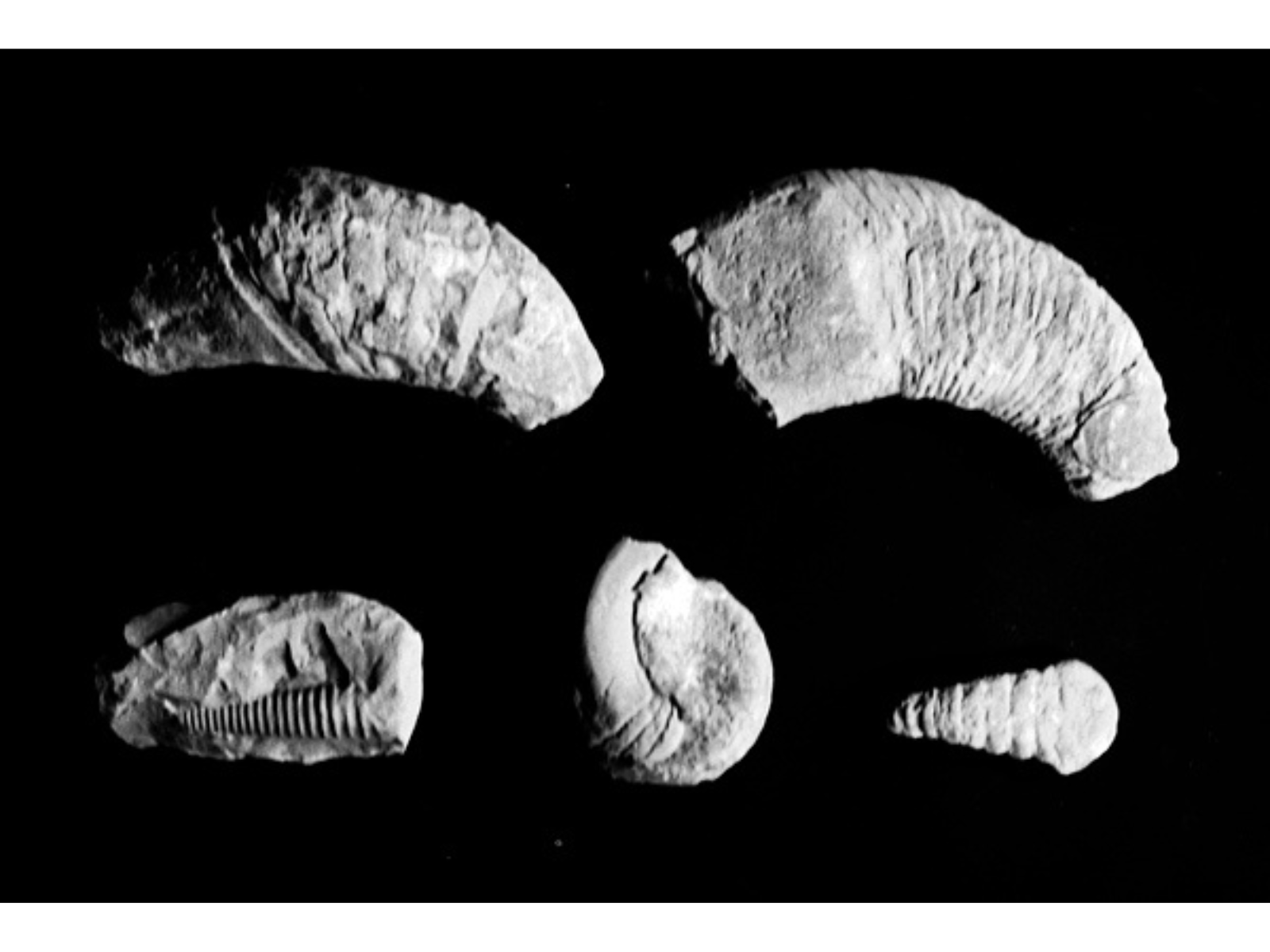
Four oblong specimens against a black background.

Ordovician cephalopods in the old museum. We have all of these specimens in our collection; look at the next photo for another image of the largest one!

A conical fossil specimen of a cephalopod on display in the Earth History Gallery.

The endocerid from the old museum is one of the highlighted specimens in the Ancient Seas exhibit.

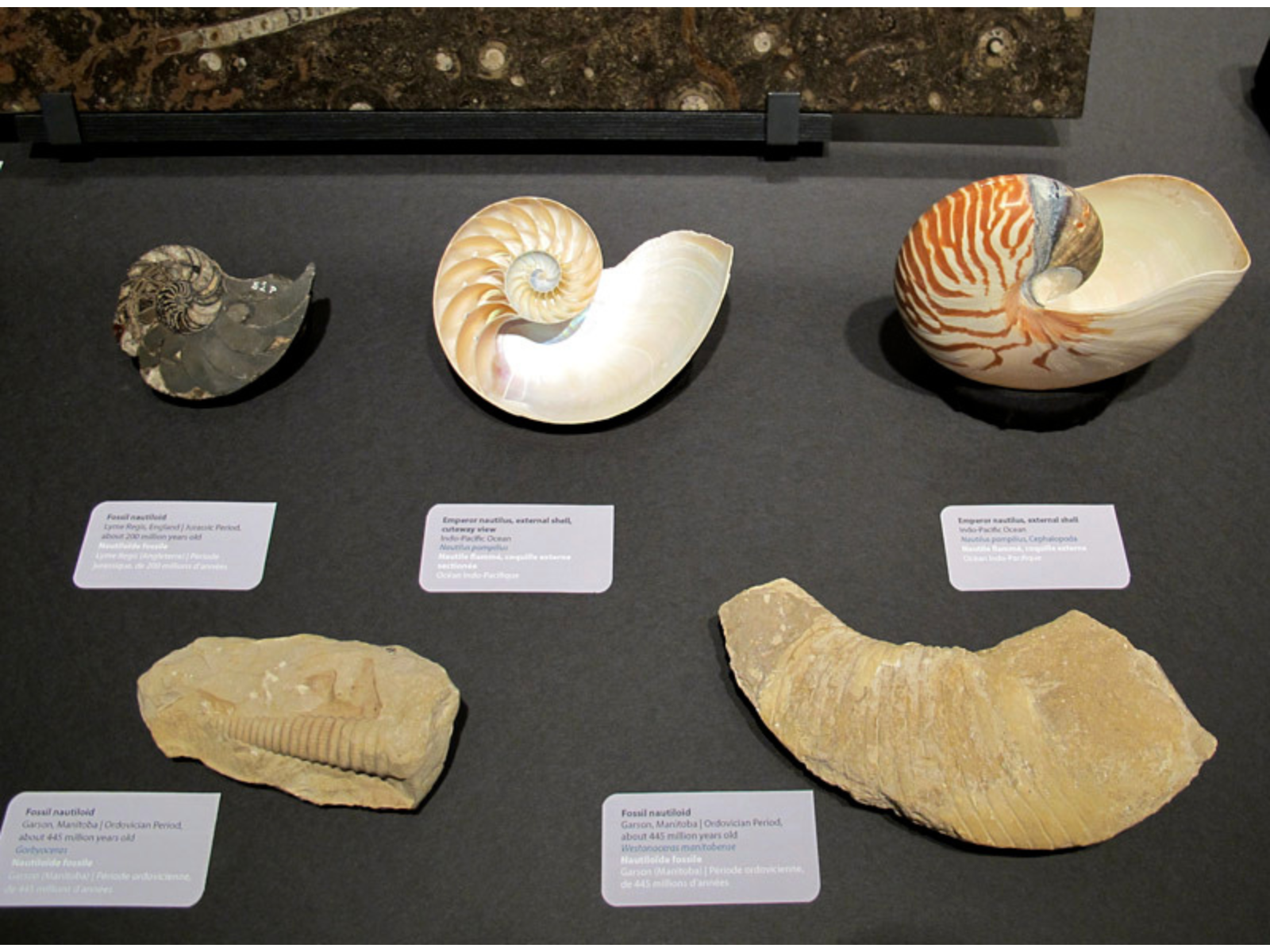
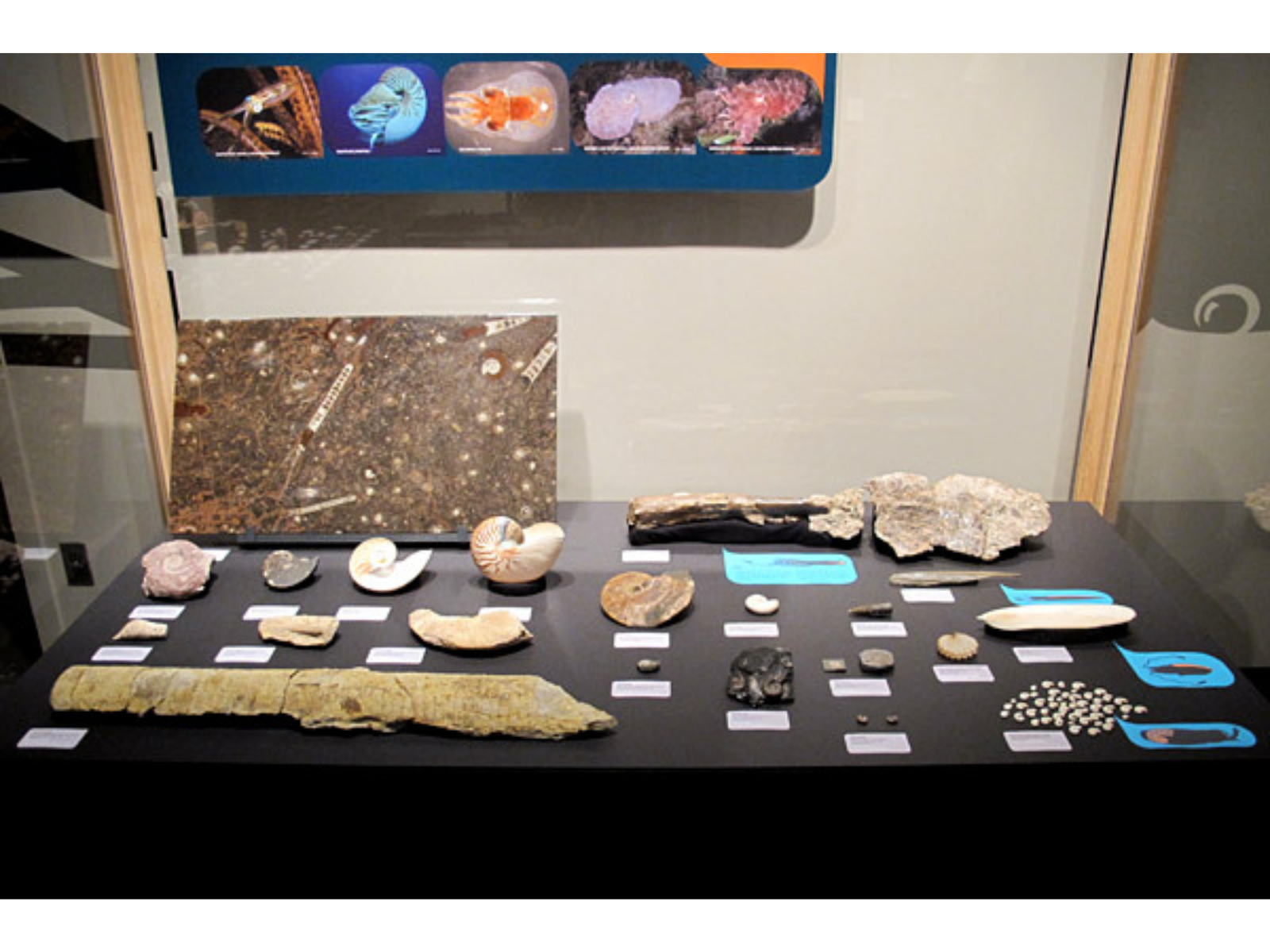
Other specimens from the old museum make appearances almost every time we do a temporary exhibit in the Discovery Room, featuring  geology or paleontology pieces. Right at the moment, the cephalopod case in our Marvellous Molluscs exhibit (read more here) includes a pair of fossils from that source. Looking at the old photographs, I was fascinated to discover that two “old friends” that shared a case in the old museum are right beside one another in this current exhibit!

There is something very pleasing about seeing them together like this, 70 years or so after that previous photo. In this way at least, the old museum lives on.

Five cephalopod specimens against a black background.

A group of Tyndall Stone cephalopods in the old museum. Note the specimens at top right and bottom left.

Five cephalopods on display next to small labels in museum exhibit.

Part of the cephalopod exhibit in Marvellous Molluscs, with the two old museum specimens in front.

A glass display case containing a number of sea fossil specimens.

If People Were Like Pollinators…

I was recently watching the hilarious yet scientifically accurate video on the mating habits of bees done by Isabella Rossellini (see more here). Coincidentally, I’ve also been reading about the quite bizarre and sometimes gruesome life cycles of wild pollinators for my upcoming Prairie Pollination exhibit. Inspired by Isabella, I found myself wondering what it would be like if people were like pollinators…

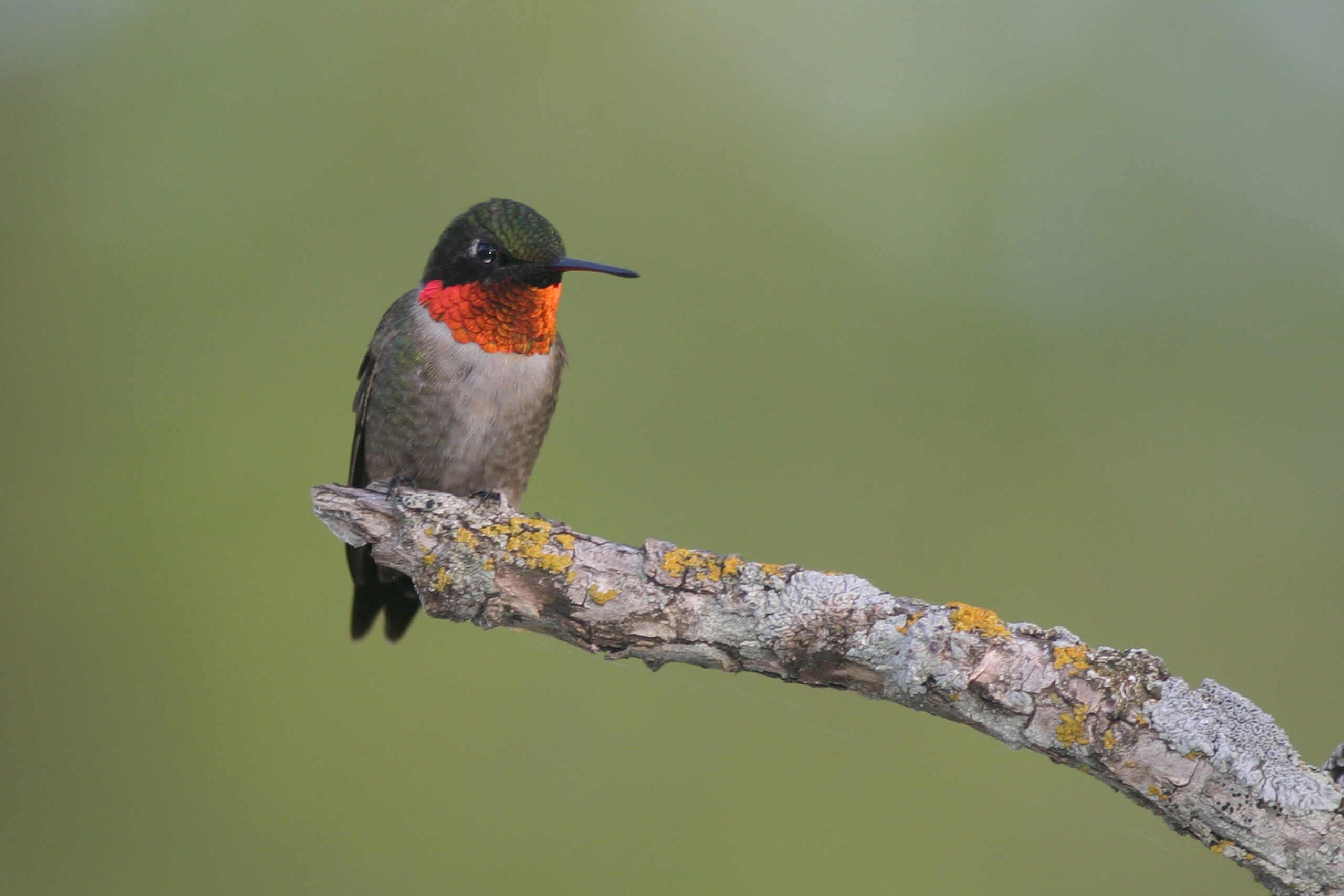
A hummingbird with a red throat and otherwise grey to black colouring perched on the end of a branch.

If people were like hummingbird pollinators, we would run as fast as a car drives on the highway.  A 150 lb person would drink at least 300 lbs of soda and maple syrup every day (woo hoo sugar rush!).  When the sun set we would enter a state of torpor, collapse on our beds and remain completely immobile until the sun rose and warmed us up.


Image: A male Ruby-throated Hummingbird. Credit: Christian Artuso. Used with permission.

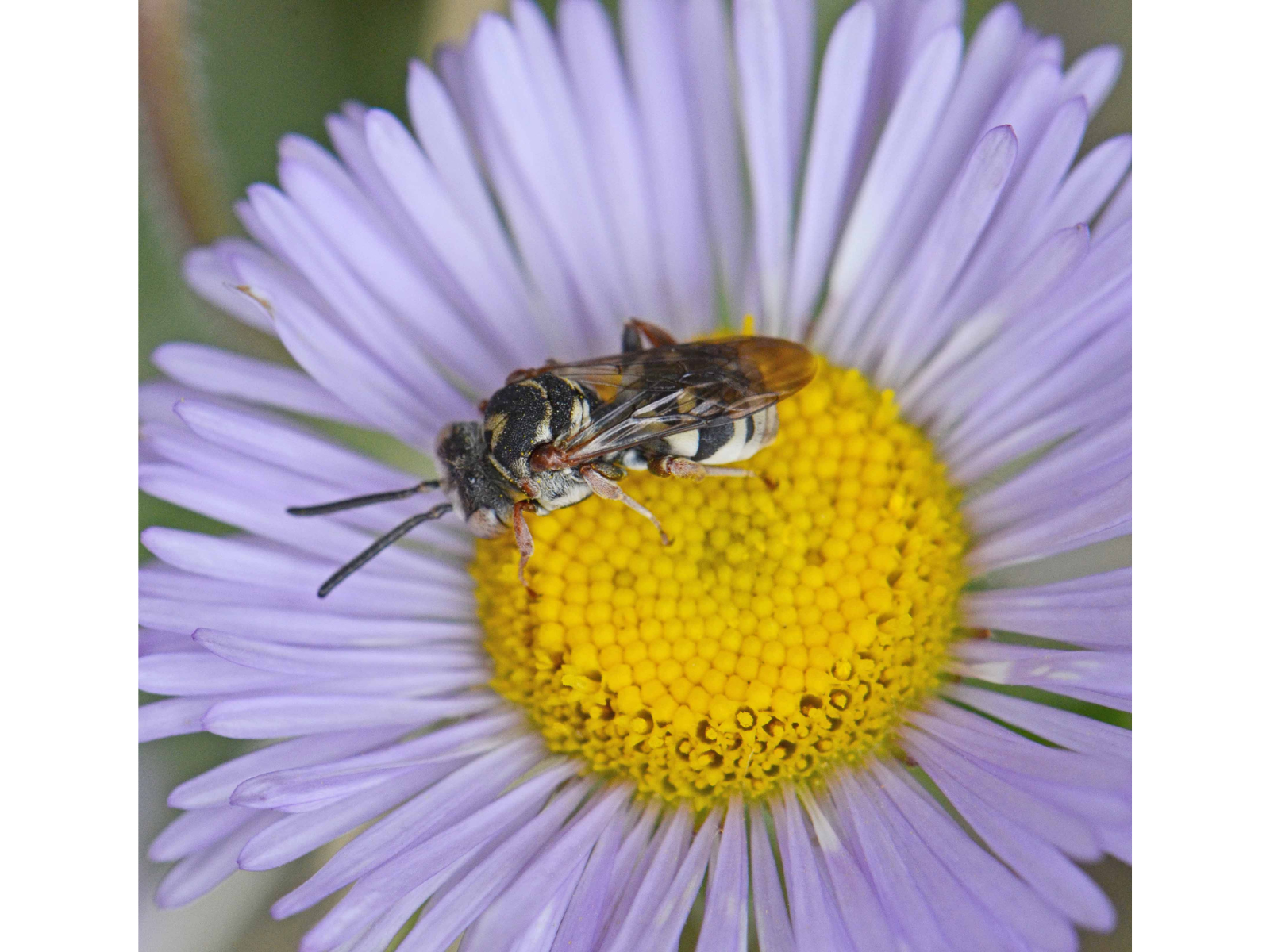
Close-up on a striped insect on the yellow centre of a flower. The many thin petals are a pale purple-white.

As opposed to the frenetic, sugar-fueled travails of the hummingbird, life for a mother bee would be a lot like a horror movie. As you were coming home from the hospital, new baby in hand, a Cuckoo Bee might stalk you. It would break into your house while you were asleep and deposit its baby into your baby’s crib. Then the Cuckoo Bee baby would eat your baby and crawl around your house eating all the baby food that you bought. Horrifying!


Image: A Cuckoo Bee on a Fleabane. Credit: Diane Wilson. Used with permission.

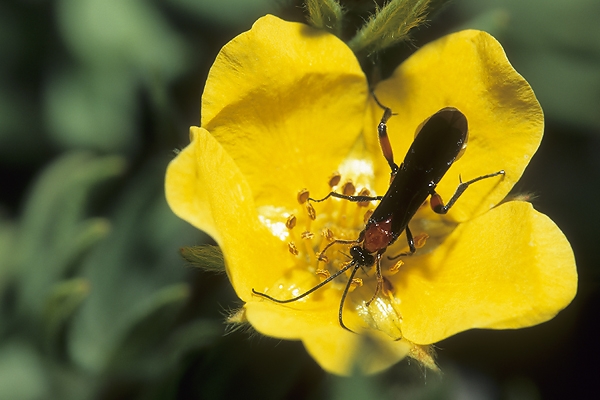
A long-bodied insect on a small yellow flower.

While shopping at the grocery store, you might get attacked by an external parasite like a Braconid Wasp (Braconidae). An adult would glue an egg to your back in that little spot that you can’t quite reach. The hatched parasite would survive by sucking your blood but fortunately usually not enough to kill you. Instead you would be weakened and perhaps if you are in poor health and are unable to convince someone to take it off, die an early death. You would also look ridiculous with that thing hanging on your back!


Image: Braconid wasp on a Cinquefoil. Credit: Bryan Reynolds. Used with permission.

A very small insect on the yellow centre of a yellow flower.

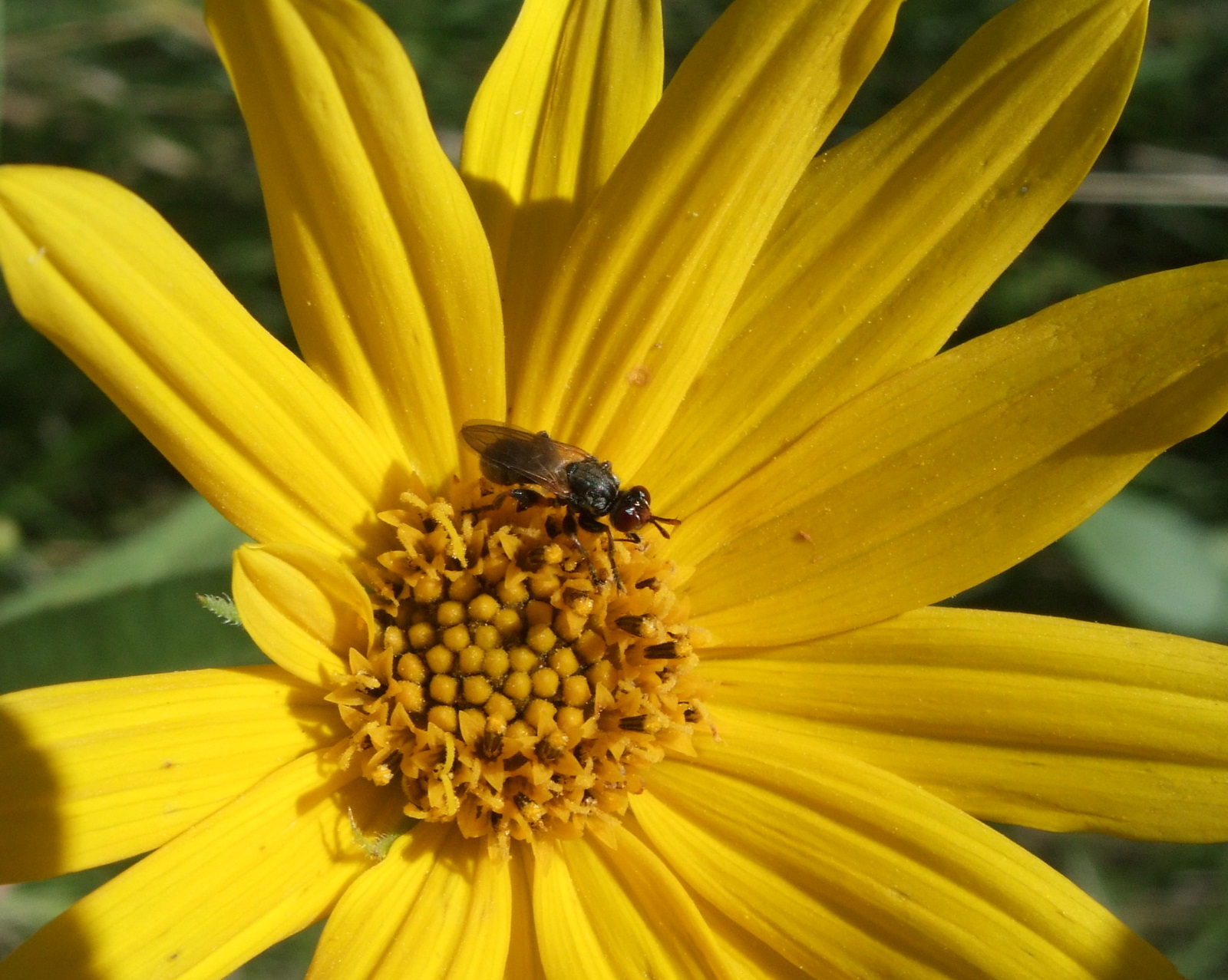
Alternatively, a Thick-headed Fly (Conipidae) or an Ichneumonid Wasp (Ichneumonidae) might jump on you and quickly inject one of their eggs into your body.  You would go about your business for a while and then get sicker and sicker as the hatched larva began eating you from the inside out until you collapsed and died.  At your funeral the parasitic larvae would burst out of your chest to the horror of all.  Yes, I know that’s the plot of the movie Alien but that is the actual fate of some insects!


Image: Thick-headed Fly on a Sunflower. Credit: Bill Dean. Used with permission.

Ironically, some parasites of bees and butterflies are pollinators in their own right so their existence is ultimately beneficial to wildflowers in an ecosystem. In fact, the abundance of some of these parasites is actually an indicator of the overall health of the pollinator population. Essentially, if there aren’t enough bees to support their parasites then the population of bees must really be in trouble. Further, they may actually help improve the resilience and productivity of an ecosystem the way other top carnivores like wolves and sharks do. Unfortunately this topic has been virtually unstudied so we really don’t understand the true impact of pollinator parasites on ecosystem functioning. So don’t hate parasites because they kill – they’re just part of the sometimes morbid circle of life that we humans seldom see.

Dr. Diana Bizecki Robson

Dr. Diana Bizecki Robson

Curator of Botany

Dr. Bizecki Robson obtained a Master’s Degree in Plant Ecology at the University of Saskatchewan studying rare plants of the mixed grass prairies. After working as an environmental consultant and sessional lecturer…
Meet Dr. Bizecki Robson

Peguis Pipe visits Peguis First Nation

By Maureen Matthews, past Curator of Anthropology


On Saturday, December 1st, 2012, the Peguis First Nation hosted a Hunters’ and Gatherers’ Feast in honour of high school students who had successfully completed a course in bush skills. They were also honouring Chief Glenn Hudson and celebrating the inauguration of a new beaded otter fur Chief’s hat made by women in the community. There were about 250 people in the community hall for the event, which featured the Loud Eagle Drum Group and numerous dancers. For the first time in many years, an old friend returned to the community; a black pipestone horse’s head pipe bowl which once belonged to the founder of the First Nation, Chief Peguis (1774-1864), and is now in the keeping of The Manitoba Museum.

Chief Peguis’ pipe bowl has been in the Hudson’s Bay Company (HBC) Collection for more than 80 years and has been at The Manitoba Museum since the HBC Gallery opened in 2000. According to available records, the pipe was purchased from Charles Prince of St. Peter’s, a great-grandson of Chief Peguis, by William Flett, on behalf of the Hudson’s Bay Company. It was last on public display in 1936 at the Leipzig Fair in Germany.

Last summer the Museum, with community partners, set up a special display in honour of the 200th anniversary of the Selkirk Settlement and, in the course of identifying appropriate artifacts, we came upon Peguis’ pipe. It was not part of the display because pipes like this have an important Anishinaabe ceremonial role. ‘Pipes, opwaaganag’ are grammatically animate. They are spoken to as if they were persons and are considered ‘wiikaanag, ritual brothers’ by those with whom they share ceremonies. We eventually got in touch with Chief Glenn Hudson to ask what we could do to make the pipe known to the community. This invitation to the Hunters’ and Gatherers’ Feast is the result and we are honoured to have been invited.

As Curator of Ethnology, it was my pleasure to take the pipe to the community for the day. The video attached shows the ceremonial entrance of the pipe, a welcome song played by the Loud Eagle Drum Group in honour of the pipe and community members lined up to view the pipe. The feast, which featured wild foods including elk, moose, deer, rabbit, goose, and wild rice, was fabulous. Thank you all.


—————————————————- 30 —————————————————-

“Relics of Interest”

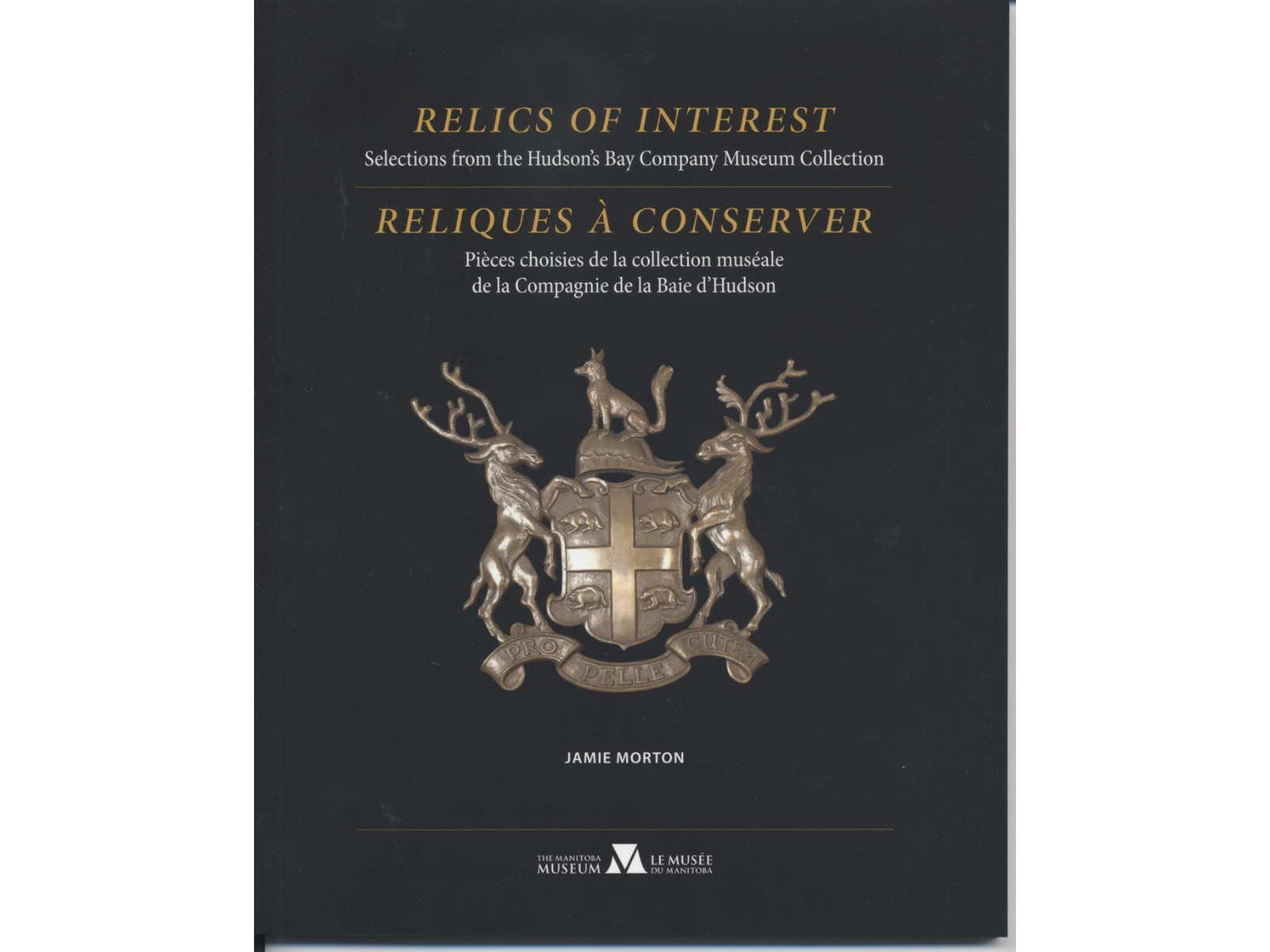
A dark-coloured book cover with the Hudson's Bay Company crest in the centre. The title reads, "Relics of Interest: Selections from the Hudson’s Bay Company Museum Collection" written by Jamie Morton.

By Dr. Jamie Morton, past Curator of the Hudson’s Bay Company Museum Collection


Since my last blog entry, I have continued to learn more about the HBC Museum Collection. Two conference papers – one for the 2012 Rupert’s Land Colloquium in May 2012, and the other for the 18th Inuit Studies Conference in October 2012 – helped to focus my research in specific directions, and opened up many new questions about the collection. Most of the summer, and part of the fall, was occupied in writing and preparing an illustrated book which highlights and places in context a sample of the objects in the HBC Museum Collection. Relics of Interest: Selections from the Hudson’s Bay Company Museum Collection, arrived back from the printers in late October, and went on sale on December 3. Copies are available at the Museum Shop at The Manitoba Museum; please contact the Museum Shop for more information.

As mentioned in April’s blog entry (titled “Anniversaries and Anthropologists”, read here), the HBC Historical Exhibition, later the Museum Collection, was initiated in 1920, when the London Committee of the HBC authorized the collection and purchase of “relics of interest,” to create and present a collection symbolizing the Company’s contribution to the evolution of Canada. Since then, objects and collections that relate to the HBC and its role in Canadian development have been added, by donation and by purchase, to form today’s HBC Museum Collection of approximately 26,000 objects. The book follows loosely the four-part mandate followed at the initiation of the Collection – to present “the history of the Hudson’s Bay Company, life in the fur trade, the story of the pioneer settlers and the customs, dress and industries of the aboriginal tribes.” The book is organized around a selection of the objects that have been collected to symbolize these four themes.

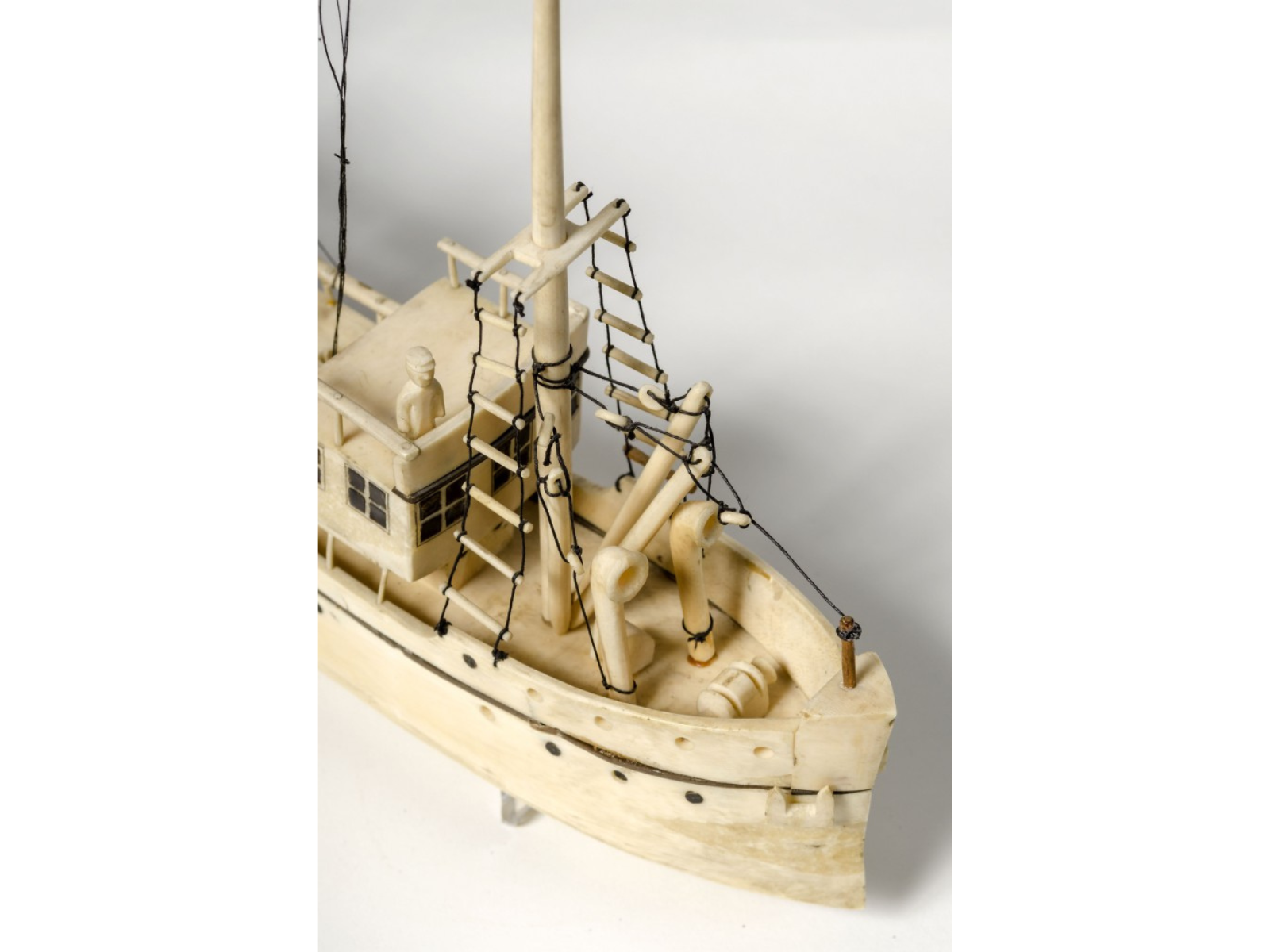
Close-up on a small ivory model of a ship.

Ch.1: A Chukchi [Siberia] ivory model of the SS Baychimo, TMM HBC 73-298.

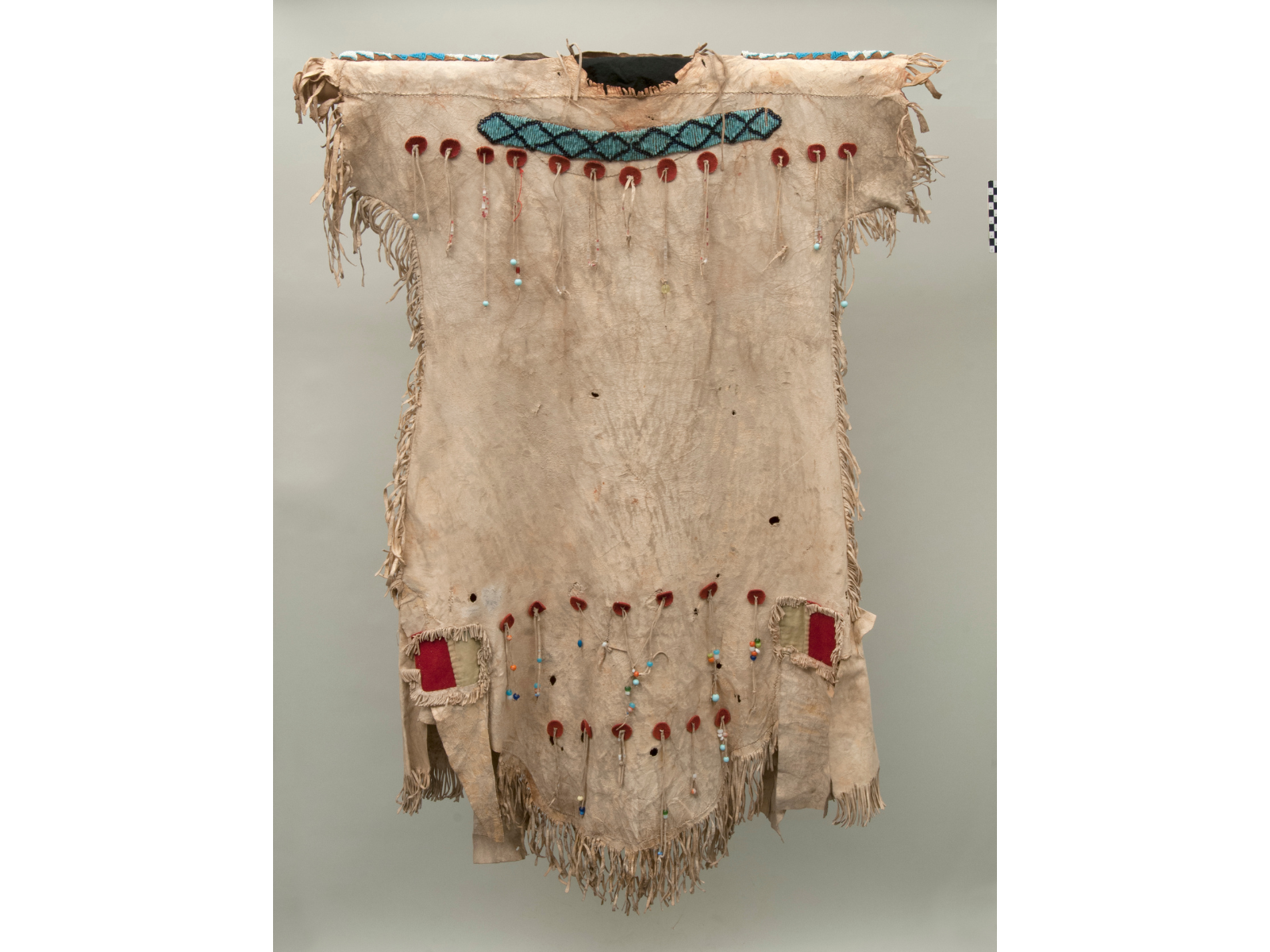
A hide dress displayed on a dress form, with red and blue detailing around the top and bottom.

Ch.2: Plains hide dress, attributed to the collection of Sir George Simpson, TMM HBC 2265.

One of the challenges was choosing a small but appropriate sample – there are so many things that could be used to represent each of the four themes identified at the establishment of the HBC Historical Exhibition. It was important to reflect the diversity of the collection, evoking the wide geographic and temporal range of the Company’s operations, and its economic and cultural impact. The featured objects come from across Canada, Great Britain, the United States, and even Siberia. They date from the early nineteenth century to the mid-twentieth century, produced in factories, fur trade posts, and indigenous communities, by a wide range of women and men. Often the stories of how objects arrived in the HBC Museum Collection – their provenance – are as important as the objects themselves, and the book offers some of these stories.

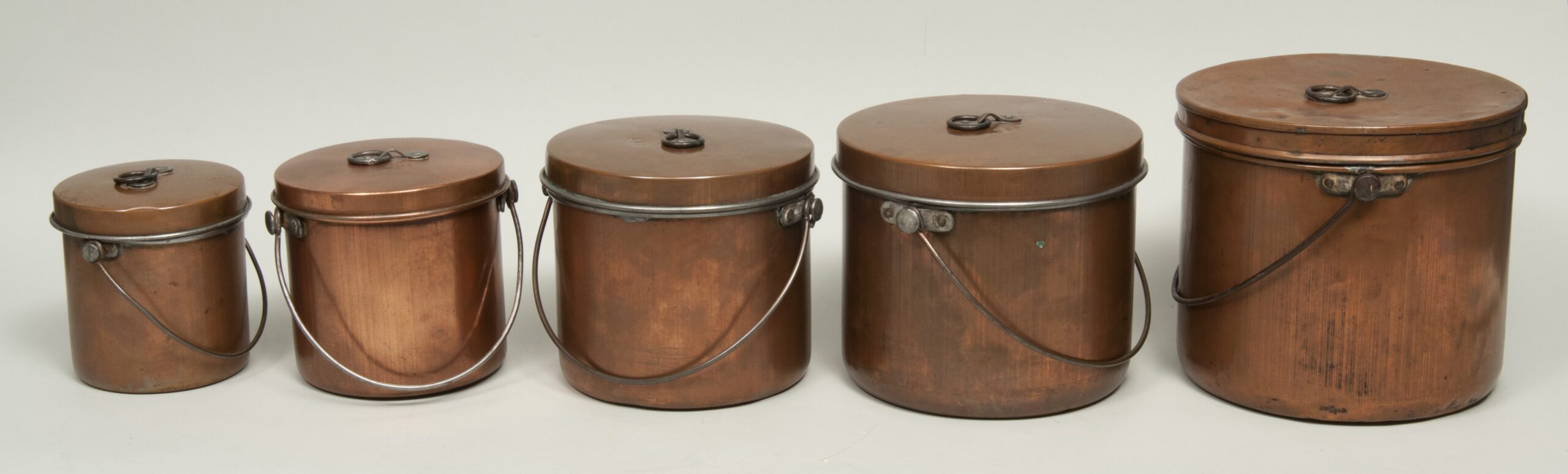
Ch.3: HBC copper kettles, TMM HBC 1314-1318.

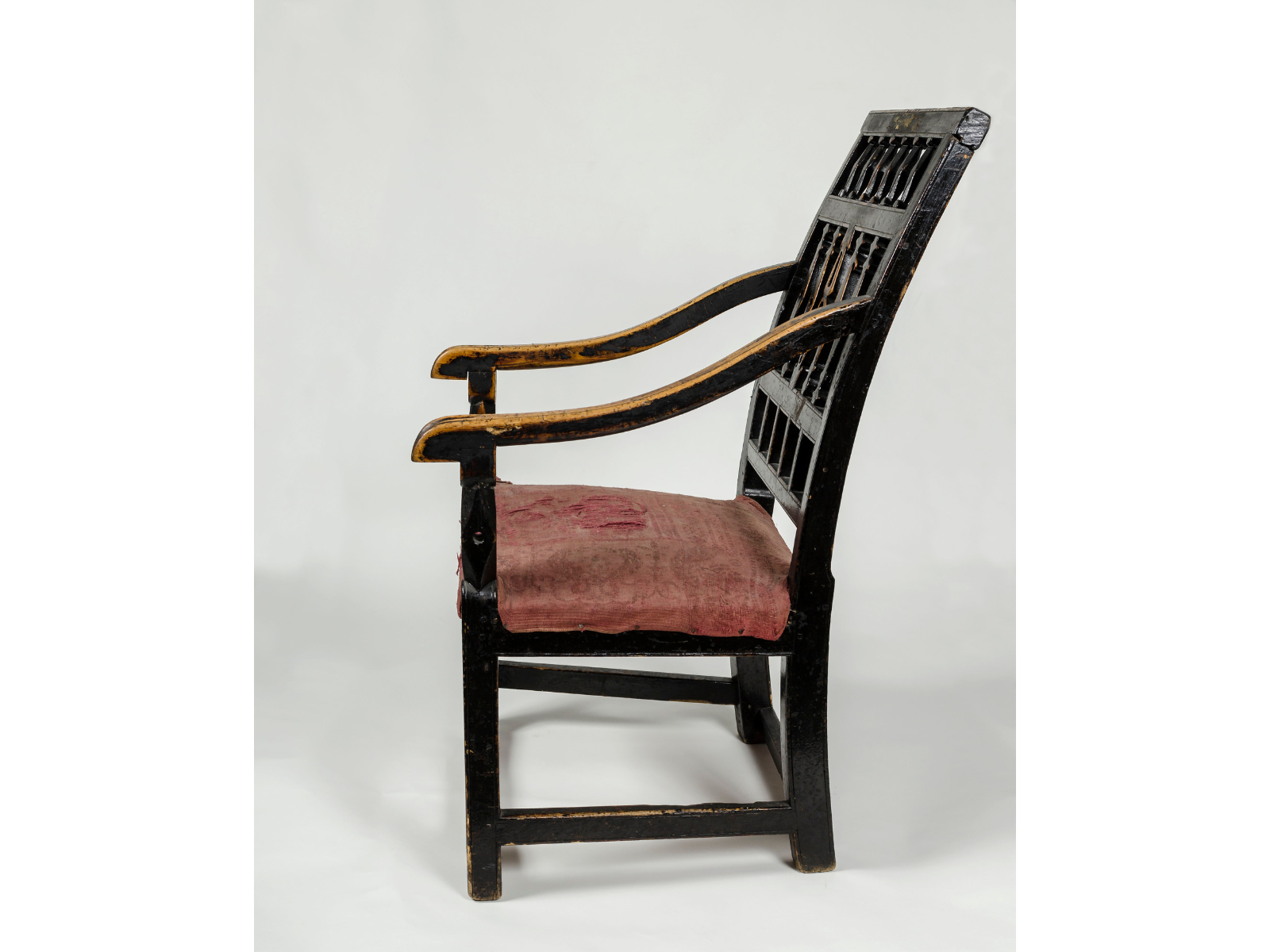
A dark-coloured dining chair chair from the side. The back curves up and backwards, and the two arms slant down towards the front, with visible wear on the top of them from use. The seat is upholstered in a worn red fabric.

One of the more distinctive features of this collection is the way in which it was consciously assembled by the HBC, to symbolize the themes that Company employees considered important. It is enlightening to consider how the symbolic values attached to certain objects and groups of objects have changed over the ninety-three years the HBC Museum Collection has existed. Aesthetic considerations have remained strong throughout – the desire to assemble symbolic “treasures.” More recently these have been challenged by the interpretive power of objects – how effectively they represent larger themes in the economic and social history of the HBC, Manitoba, and Canada. The opportunity, and the challenge, presented by this fine collection, selected to symbolize an early twentieth century corporation, is how best to utilize it in support of defining provincial and national identity into the twenty-first century.


Image: Ch.4: HBC country-made chair, TMM HBC 2427.

Artifacts in Strange Places

By Kathy Nanowin, past Manager of Conservation


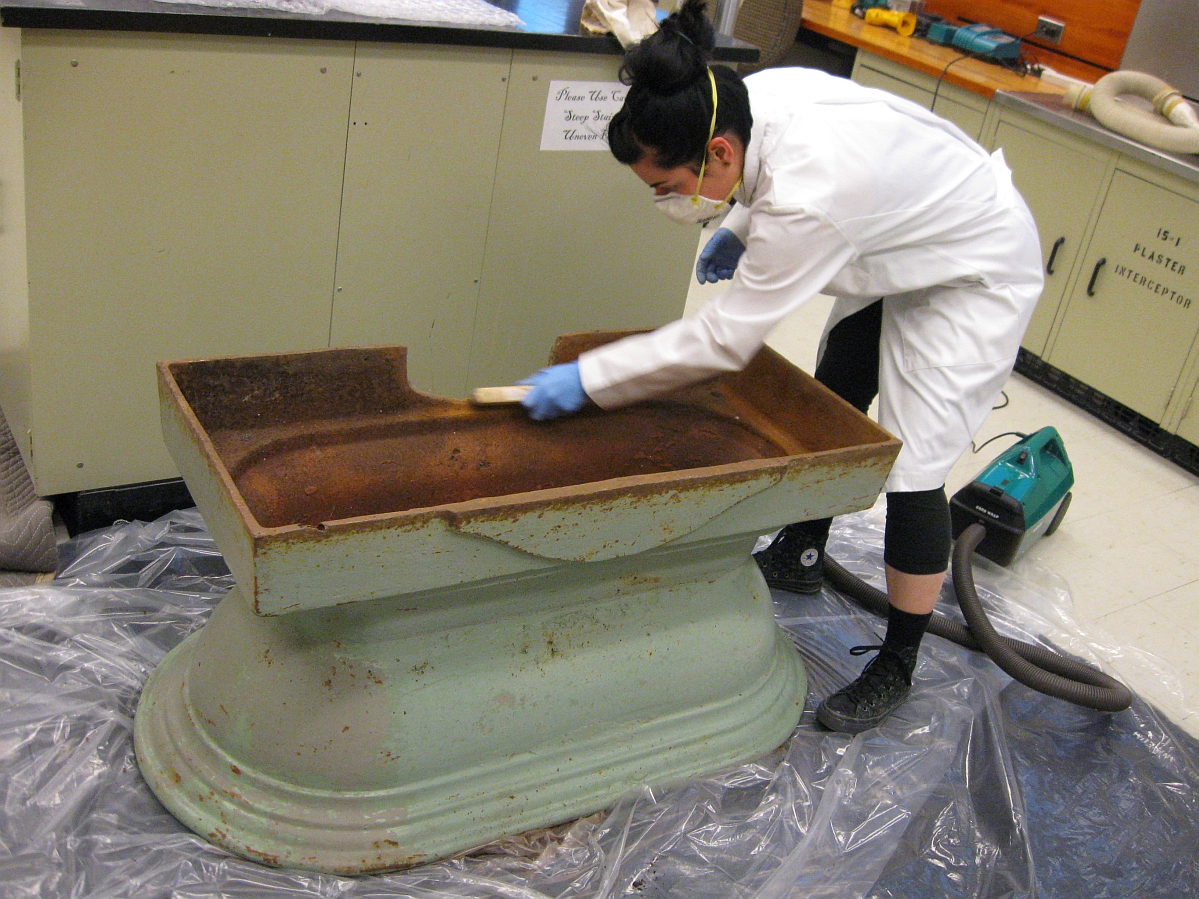
Recently, Collections and Conservation staff spent some time in two of our more unusual storage locations, in order to improve the conditions of artifacts there.

Due to overcrowding in TMM’s climate-controlled collection storage areas, there are artifacts located in less than ideal conditions. Staff worked on several artifacts in these areas, cataloguing, condition reporting, photographing, and finally covering them up with polyethylene after a good vacuuming.

An individual wearing a white lab coat holding the hose and nozzle of a vacuum cleaner to a large dusty sign.

This large neon sign was vacuumed before being covered with polyethylene.

A portion of a large sign, half vacuumed. One half is very dimmed with dust, the other is clean and blue with white lettering.

There was a lot of dust to be removed.

The most important factors in deciding to place these objects here are the materials of which they are made (least sensitive to environmental changes or extremes), robustness of the artifacts, and their size – sometimes there just isn’t room in the other storage areas.

The Manitoba Museum is not unique in having to store collection objects in areas where there is little climate control. It is, of course, incumbent upon us to do the best we can in these kinds of spaces. Although covering the objects with plastic does reduce visibility, and hence the ability to spot detrimental changes in condition such as corrosion, that is offset by the protection against dust, which can be damaging in some cases, as well as disfiguring. Having observed the conditions in these spaces, we know the risk of dust falling on the objects is certain, whereas we’ve not encountered the high humidity that would initiate rust.

A large metal egg grader next to an orange vacuum cleaner.

This egg grader is large and robust, suitable for storage in less stringent conditions.

The metal egg grader now tightly wrapped in clear polysthylene.

The egg grader was vacuumed then wrapped in polyethylene.

We always strive to improve the care of our collections wherever we can. All in all, although these storage spaces are not great, the artifacts are now better protected, as well as better documented.

The Urban Gallery

Guest blog by Alexandra Kroeger, Practicum student from the University of Winnipeg


Lately I’ve been conducting an informal survey amongst family and friends on what they know about the Urban Gallery. On the bright side, most people do know what the Urban Gallery is. Even if they don’t know it by name, as soon as I explain it as, “You know. The street? With the theatre?” people know exactly what I’m talking about. If the person was around in the 70s, they’ll probably add, “didn’t they used to sell candy there?” (They did.)

Once I ask what the Urban Gallery represents, however, I start getting blank looks. For the record, those who answer “Winnipeg in the 1920s!” are absolutely correct. But even these perceptive individuals would be surprised to learn that originally, there was a lot more to the Urban Gallery.

View down a staircase towards the drugstore of the Urban Gallery in the Manitoba Museum.

When the gallery was being planned in the early 1970s, the people on the committee kept coming back to the idea of contrasts in cities. Winnipeg is particularly rich in contrasts, one of the more obvious being the sharp divide between the north and south ends of the city. This contrast was particularly stark in the 1920s. Wages hadn’t kept up with rising costs of living, leaving the poor (who generally lived on the north side of the CPR tracks) barely able to get by, while the rich (who generally lived south of the tracks) got richer and richer. These kinds of tensions, along with post-war economic conditions, led to the 1919 General Strike.The Urban Gallery is set the year after the Strike, but things haven’t quite changed yet. The railroad tracks still divide the south end from the north end. The south end has a theatre, high-end clothing store and lavishly-furnished parlour; the north end, a garment factory, Chinese laundry, and a cramped boarding house.

The Bletcher and McDougall Pharmacy, where at one point visitors could buy candy.

When the gallery was being planned in the early 1970s, the people on the committee kept coming back to the idea of contrasts in cities. Winnipeg is particularly rich in contrasts, one of the more obvious being the sharp divide between the north and south ends of the city. This contrast was particularly stark in the 1920s. Wages hadn’t kept up with rising costs of living, leaving the poor (who generally lived on the north side of the CPR tracks) barely able to get by, while the rich (who generally lived south of the tracks) got richer and richer. These kinds of tensions, along with post-war economic conditions, led to the 1919 General Strike. The Urban Gallery is set the year after the Strike, but things haven’t quite changed yet. The railroad tracks still divide the south end from the north end. The south end has a theatre, high-end clothing store and lavishly-furnished parlour; the north end, a garment factory, Chinese laundry, and a cramped boarding house.

Another theme the planners wanted to explore was the past, present, and future of the city. The reconstructed buildings and businesses were supposed to represent the past, and then there were supposed to be two other components to the gallery. The Exhibition Hall by the All People’s Mission was originally an actual exhibition hall occupied by temporary exhibits on different aspects of our city’s history, and how they would affect the present. The third and last component of the gallery was “Cities of the Future,” which would have asked people to think about cities of the present and how they might develop. I haven’t figured out whether or not the Cities of the Future exhibit was actually built, but maybe a reader might have some insight.

I just want to close with a few of my favourite facts about the gallery.

Storefront of a recreation of the Gum Sahn Laundry. Inside a mannequin is positioned to be working on the laundry.

The Gum Sahn Laundry.

Exterior of the recreation of the All [Peoples Mission in the Manitoba Museum Urban Gallery.

The All People’s Mission, possibly based on the 1904 building on Stella Ave.

Close up on an illuminated sign with a handprint and text reading "Madame Taro".

Madame Taro wasn’t only a fortune teller…

The exterior of Proscenium Theatre in the Urban Gallery.

There wasn’t an actual Proscenium Theatre in Winnipeg, but Winnipeg did draw several vaudeville greats.

Both the Bank of Montreal and the All People’s Mission were actual buildings in Winnipeg. The BMO building was built in the 1880s and torn down in the early 1970s – just in time to reuse some of the material from the building in the gallery. The All People’s Mission in the gallery might have been based off of the old building at Stella and Powers., though we’re not quite certain on that point.

In a particularly ironic case of contrast, the mannequin whose room overlooks the All People’s Mission in the gallery is more than just a fortune teller. Madame Taro tells fortunes, but she also provides “other services” – If you know what I mean.

There wasn’t actually a Proscenium Theatre in Winnipeg at any time in its history, but there were lots of others. Alexander Pantages used his Winnipeg theatre (which is right down the street from the museum) to test out acts for his vaudeville circuit; if it didn’t do well in Winnipeg, it didn’t make the cut. Winnipeg also drew some vaudeville greats, including Charlie Chaplin, Buster Keaton, and Stan Laurel. The story goes that Bob Hope even learned to play golf here!

Showing You the Door

By Dr. Graham Young, past Curator of Palaeontology & Geology


When I started this blog a couple of years ago, one of my main intentions was to share the various items and phenomena that are within close reach of my desk, here on the 4th floor of the Museum tower. With that in mind, and since at lunchtime on New Year’s Eve we have reached a point in the year where serious and scholarly content should not be expected, I have decided to provide you with an annotated view of my office door.

In general, this curator’s door is far from curated, in the sense of having organized content. Rather, it is an odd mixture of items that I have randomly decided to exhibit, pieces that other people decided should be placed on my door, and things that seem to have flown in and stuck there all by themselves. With that in mind, the following is an annotated pictorial guide to items that can be seen on my door right now.

An office door covered in various posters, photos, and stickers. Overlaid on the image are the numbers one through sixteen identifying each item.

1, 2. When I started work at the Museum almost 20 years ago, the “Curator of Geology” plate was already on the door. As I was a part-time term employee for the first few years, I didn’t think that I should waste the Museum’s funds by requesting a personal nameplate. After a year or so, however, we made a “temporary” plate by laminating a laser-printed output to cardstock. I am, of course, still using the temporary plate, as it works just fine and I still like to avoid wasting money!

3, 4. For some unknown reason, the door suggests that my office is both Room 417 and Room 418. The 417 is, however, struck through with pen, indicating that 418 may be the accurate number.

5. When I started here, the Museum was called the Manitoba Museum of Man and Nature, and the name and logo had been very nicely laminated to my door. I really like our new name, but I also like being surrounded by reminders of history.

A printed photo of a yellow sign reading, "Danger / Unexploded bombs in this area / Keep out".

6-8. My door seems to have acquired a variety of warning signs, perhaps in the hope that potential visitors will leave me to peacefully contemplate the riddles of the universe (note: these haven’t worked so far!). Actually, numbers 6 and 8 are copies of signs seen near Churchill, and are reminders of northern fieldwork. Number 7 is a joke sign produced by former Curator of Zoology Gavin Hanke, when he was making a “bear warning” sign for the Parklands/Mixed Woods Gallery. Some thoughtful person has, with a pencil, modified “Irate Curator” to “Pirate Curator”, which brings to mind all sorts of interesting images.  Arrr.

9. This sticker promotes the “International Year of the Reef 1997”. Sadly, evidence would suggest that this was one of the less successful International Years.

10. The definition of forthwith came from the brain of my friend Dave Rudkin. With this in mind, I am always happy to state that I will produce a document “forthwith.”

11. This lovely pen-and-ink sketch of the Ordovician branching coral Pragnellia arborescens is by Museum artist and preparator Debbie Thompson. It depicts the holotype of this species, specimen I-206.

A small sign bearing a definition of forthwith, reading, "adj. - from FOR-THWITH, originally meaning to be completed in time for THWITH, an ancient druidic feast of no fixed date; now used to refer to any unspecified moment in the future and hence to completion of any task for which it would be unwise to provide a deadline."

A pen and ink sketch of a coral with four branches reaching upwards.

12. A photo of the head (cranidium) of a Silurian trilobite from the Gaspé Peninsula of Québec is there to remind me of two things. First, it is an image I took 30 years ago using what is now ancient technology (a large-format film camera), and its tone and beauty demonstrate that new methods are not always the best methods. Second, since it is from a research project that I never completed, it is a reminder not to keep taking on new projects that I will not be able to finish!

13. The obligatory dinosaur cartoon.

14.  This is a Velociraptor-free workplace, and there have been no incidents since this sign was put up almost a month ago.

The half moon shape of a fossilized trilobite head.

A printed sign showing a silhouette of a velociraptor with a circle around it and a line striking through. Text reads, "This is a velociraptor-free workplace / it has proudly been / 12 / days since the last incident".

15. I produced this version of the Canadian flag for my other blog a couple of years ago, after reading Michael Flanders’ pronouncement from the 1960s that our flag looked like a dinosaur footprint.

16. This was a nice poster of a pyrite crystal, but it is sadly becoming greenish and tattered, and I really should replace it!

Adventures of a Conservator in Training

By Jessica VanOostwaard, Conservation Intern

An aged open trunk or large suitcase with the open lid facing the camera. Various worn stickers and labels are peeling around the lid.

As a requirement for the Collections Conservation and Management program at Fleming College in Peterborough Ontario, all students are required to participate in a 15 week internship at an institution of their choice. I was elated to learn that my request to carry out my internship at The Manitoba Museum was accepted. In September I arrived in Winnipeg eager to learn, and The Manitoba Museum did not disappoint.

During my time at the Museum I was able to put my knowledge to work and carried out a number of treatments on some very interesting artifacts in addition to helping collections personnel with gallery maintenance.


Image: The labels on this travelling case were falling off; now, they are secure

Two corroding brass clock hands (removed from the clock).

Corrosion plagued these brass clock hands.

Two shiney brass clock hands (removed from the clock).

With some care, they are as good as new.

My time at the museum was not only spent treating the artifacts in the museum’s collection but also helping out with other collection work that needed to be done. Whether it was making mounts for “The World is their Oyster: Marvelous Molluscs” exhibit, venturing down into the secluded sub-basement to help organize Archaeology storage boxes or protecting the artifacts by making boxes and monitoring for pesky insects, The Manitoba Museum provided me with useful experience that will be invaluable in my future career, and for that I would like to thank everyone at the Museum for a wonderful opportunity.