

What's Growing in Storage?

What’s Growing in Storage?

By Lisa May, past Conservator


While perusing the collection in storage Roland Sawatzky, Curator of History, discovered something growing…

Artifacts are donated to The Manitoba Museum from all walks of life. Some may still be in their original packaging, never touched, while others may be very well used. Artifacts, regardless of their overall condition, can be very sensitive to the environments in which they are stored. The museum uses dedicated HVAC units to keep the temperature and humidity of the rooms at conservation standards.

When artifacts arrive at the museum they must acclimatize to their new environment and sometimes this may cause funny things to happen. During Roland’s visit to the storage room he discovered two wooden collar boxes with a strange white substance on them. As he was concerned it was mould growth he brought them immediately to the conservation lab to be assessed.

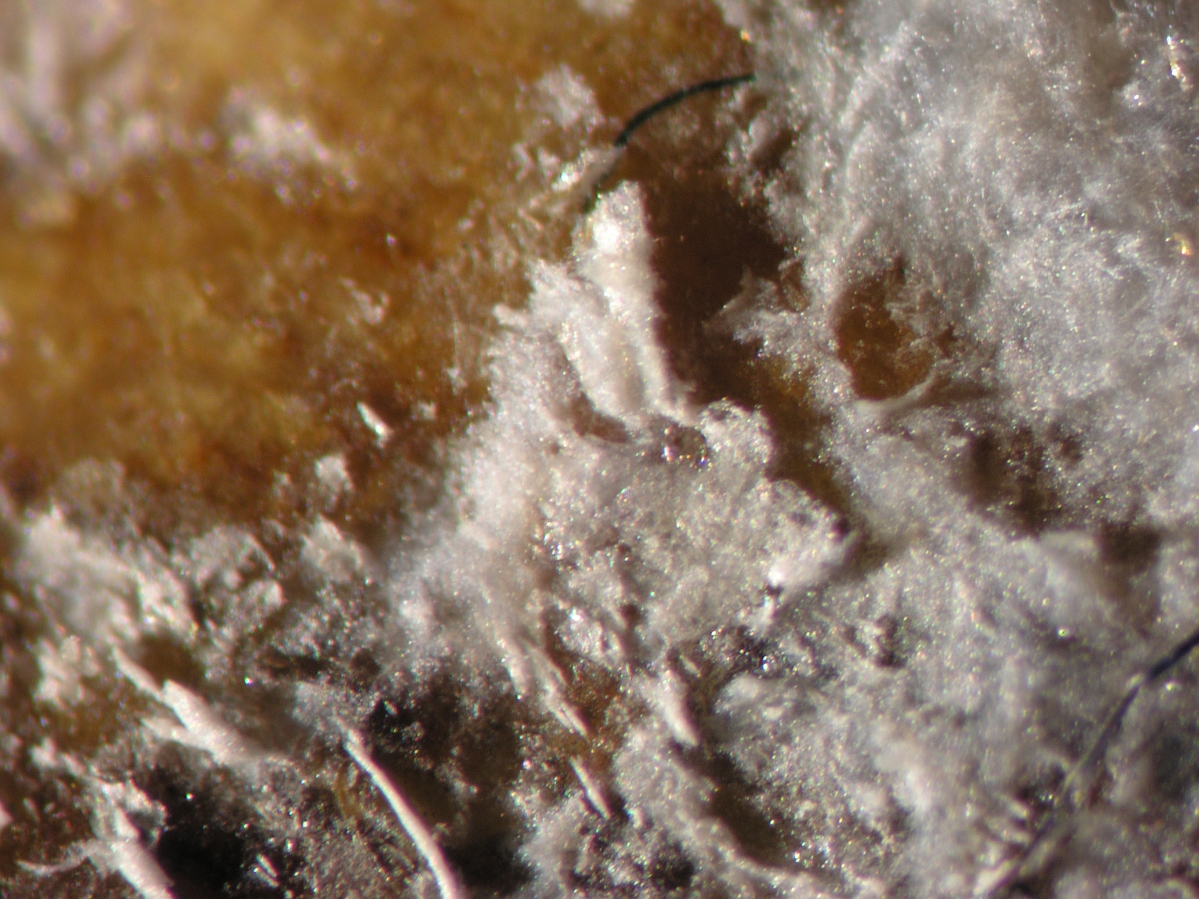
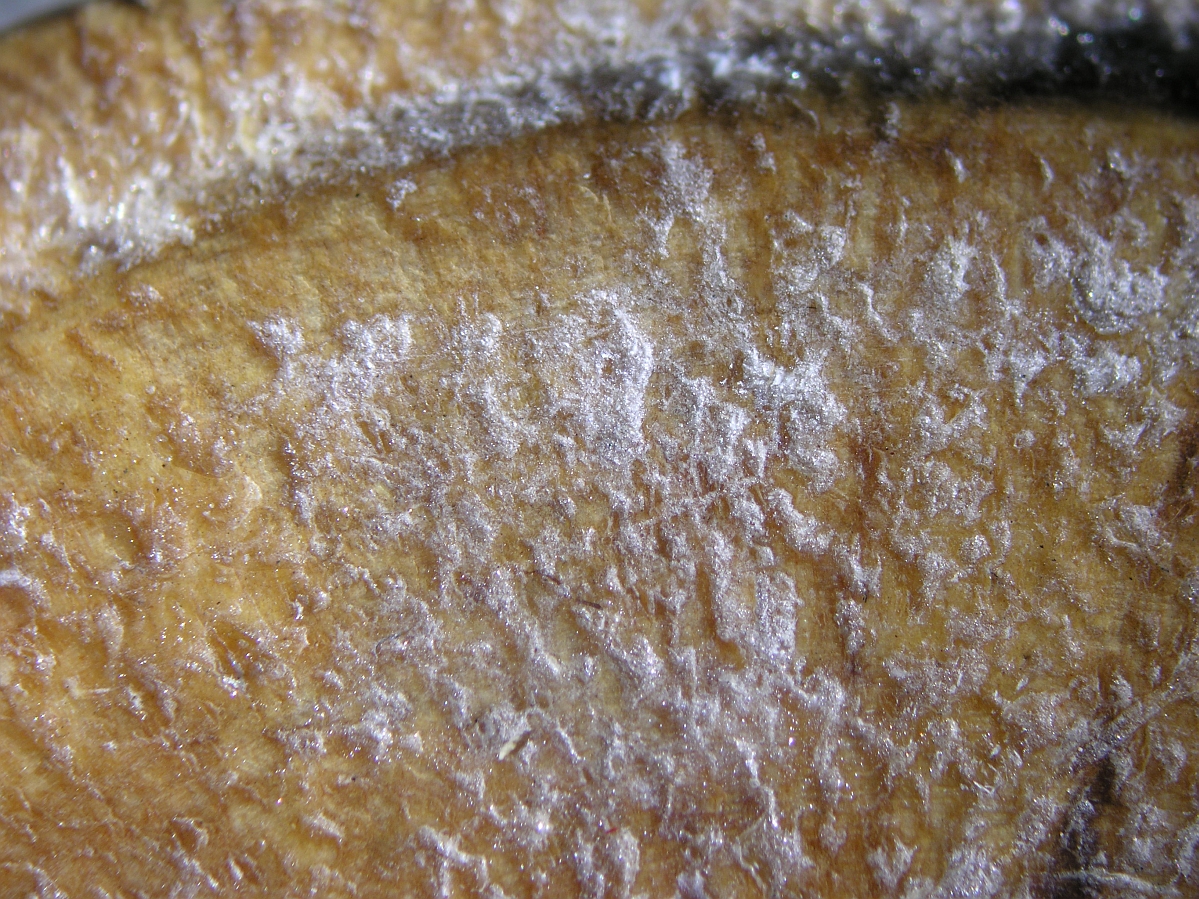
Close up on white crystals growing on a wooden surface.

Closeup image of crystals on the wood surface.

Close up on a white crystalline substance with sparkly flecks inside it.

Another closeup view. It does look similar to mould, but it’s not.

The substance, found not to be mould, was white coloured crystals growing on the finished areas of the wooden boxes. It appeared to be a component within the finish or varnish which had leached to the surfaces. This most likely occurred while the artifacts adapted to their new environment. In this case, the crystals were cleaned from the objects and luckily caused no harm (i.e.: staining) to their surfaces.

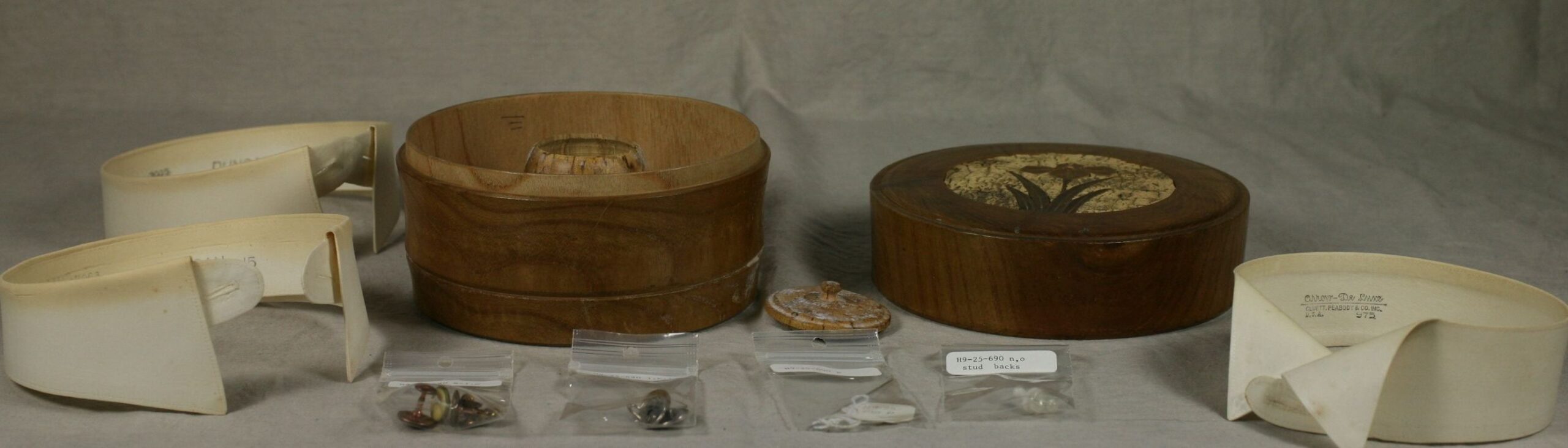
Two wooden collar storage boxes positioned next to three aged-white collars and small baggies with collar studs.

The collar boxes and contents after cleaning.

In the darkness of The Manitoba Museum storage rooms unexpected things can occur in our controlled environmental conditions. Fortunately, with eagle-eyed and talented staff we do our best to resolve issues when they arise so the collection is preserved for future generations to enjoy.

When a Small Thing Means a Lot

As summer comes to a close, I am finally getting an opportunity to go through some of my fieldwork photos. I ran across this one of a culvert that connected a large marsh with a roadside ditch along Highway 6 just south of Tan Lake  (about 30 kilometres north of St. Martin Junction).

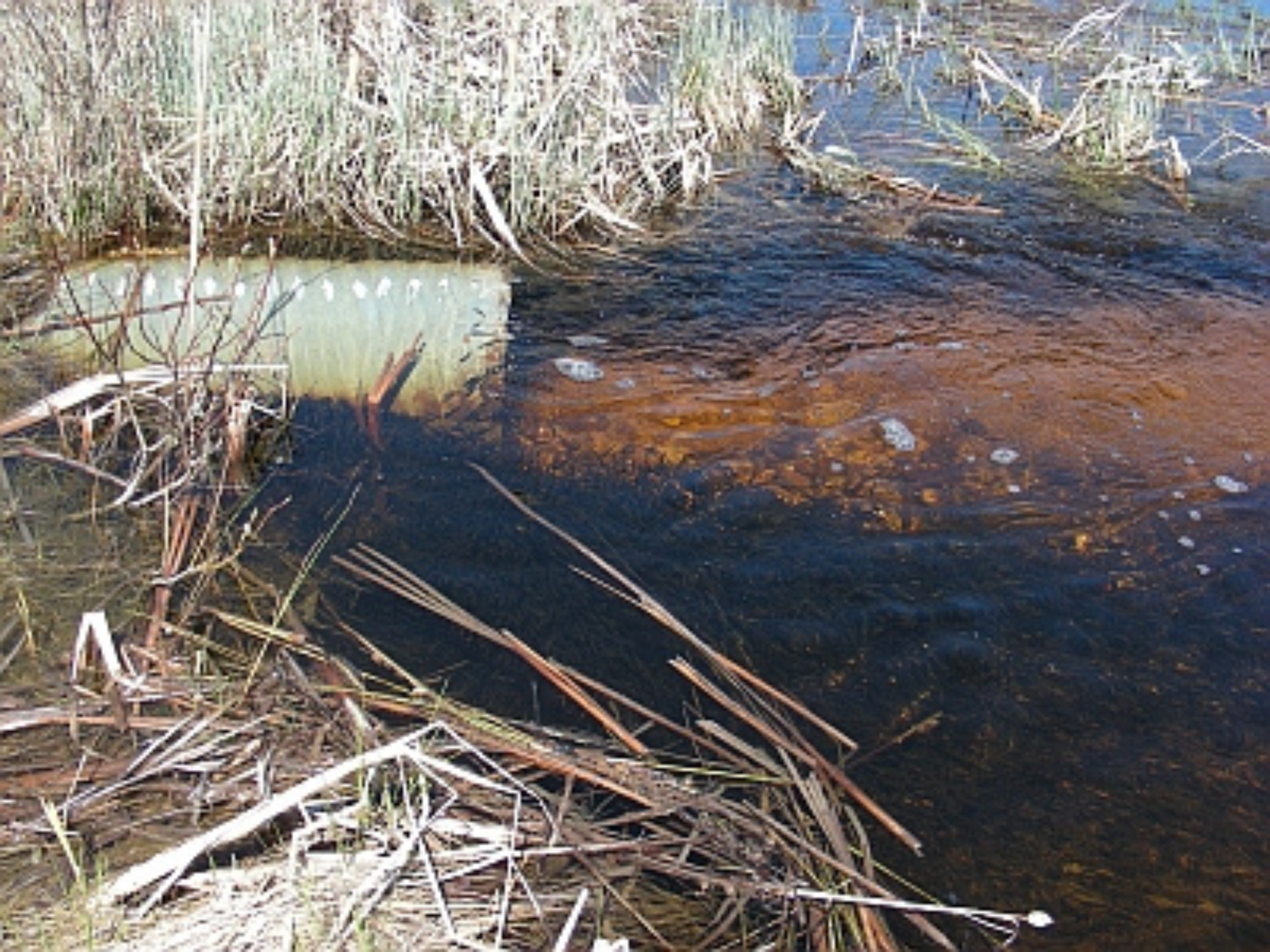
Looking down to a culvert with a school of fish either side of the pipe.

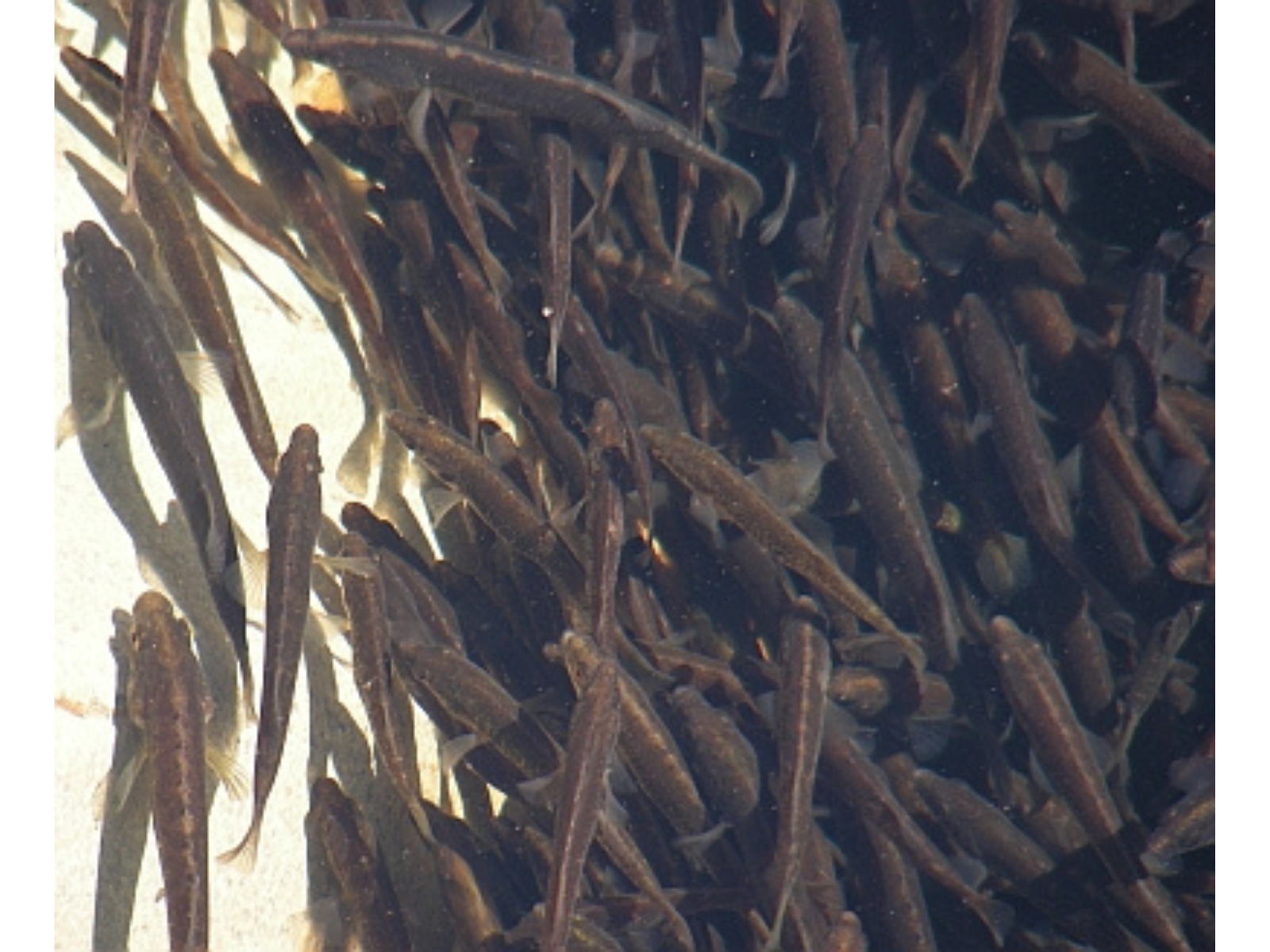
The large dark cloud in the water on either side of the culvert is a school of brook stickleback (Culaea inconstans), a common non-game fish found in ponds, marshes, bogs, and streams across most of Manitoba. In spring, these small fishes (to about 60 mm long) move from larger bodies of water to smaller ones where the females lay eggs in nests built and guarded by the males.

So finding migrating brook sticklebacks is not particularly noteworthy, but from the photos I estimate there are about 8,000 individuals in this one school!! This is an incredible number of fish in a small area. This huge mass of fish got me thinking about the number of small animals that we tend to take for granted. We pay attention to the billions of mosquitoes (although not so many this year!) and the 1.2 million people in Manitoba, but what about the small vertebrates like sticklebacks that don’t seem to have much impact on us?


Image: Clouds of brook sticklebacks in a roadside ditch, May 15 2011.

Brook sticklebacks, like many small fishes, are an annual species, meaning that individuals born one summer are the adult breeders in the next. Very few last more than two summers. This is a huge turnover in biomass – think about that school of 8,000 fishes, and a brand new one of those every year in just that one place! This kind of turnover is very important for nutrient cycling within the ecosystem. These small fishes grow fast and eat a lot of insects and aquatic larvae, and are themselves food for larger fishes, birds and mammals.
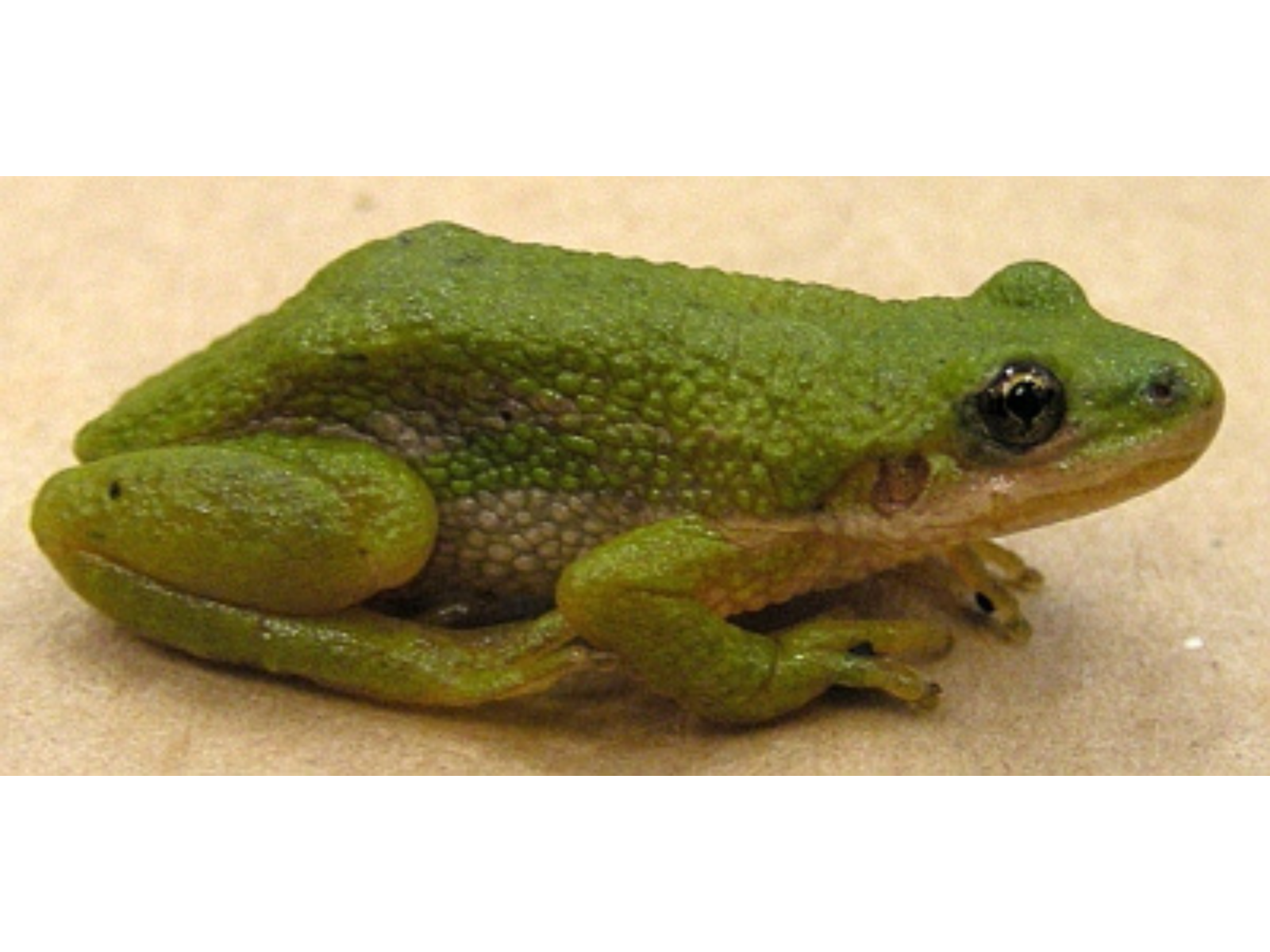
We hear a good many frogs in spring as they call for mates, but tend not to think about them for the rest of the year as they become less noticeable. But they are there all year, and in large numbers. During my fieldwork, I hear boreal chorus frogs (Pseudacris maculata) all along Highway 6. If we take a 50 metre swath on either side of the highway to cover roadside ditches, and conservatively estimate one singing frog for every 500 square metres, that would mean 200 calling frogs for every kilometre of road. Calling frogs are male, so with equal sex ratios we have 400 chorus frogs each kilometre, or about 300,000 chorus frogs in the ditches along Highway 6 from Winnipeg to Thompson! And there are thousands of kilometres of roadside ditches all across the province.

Close-up view of a school of small, thin fish.

Brook stickleback are very common, but many of us don’t know they even exist or we take them for granted.

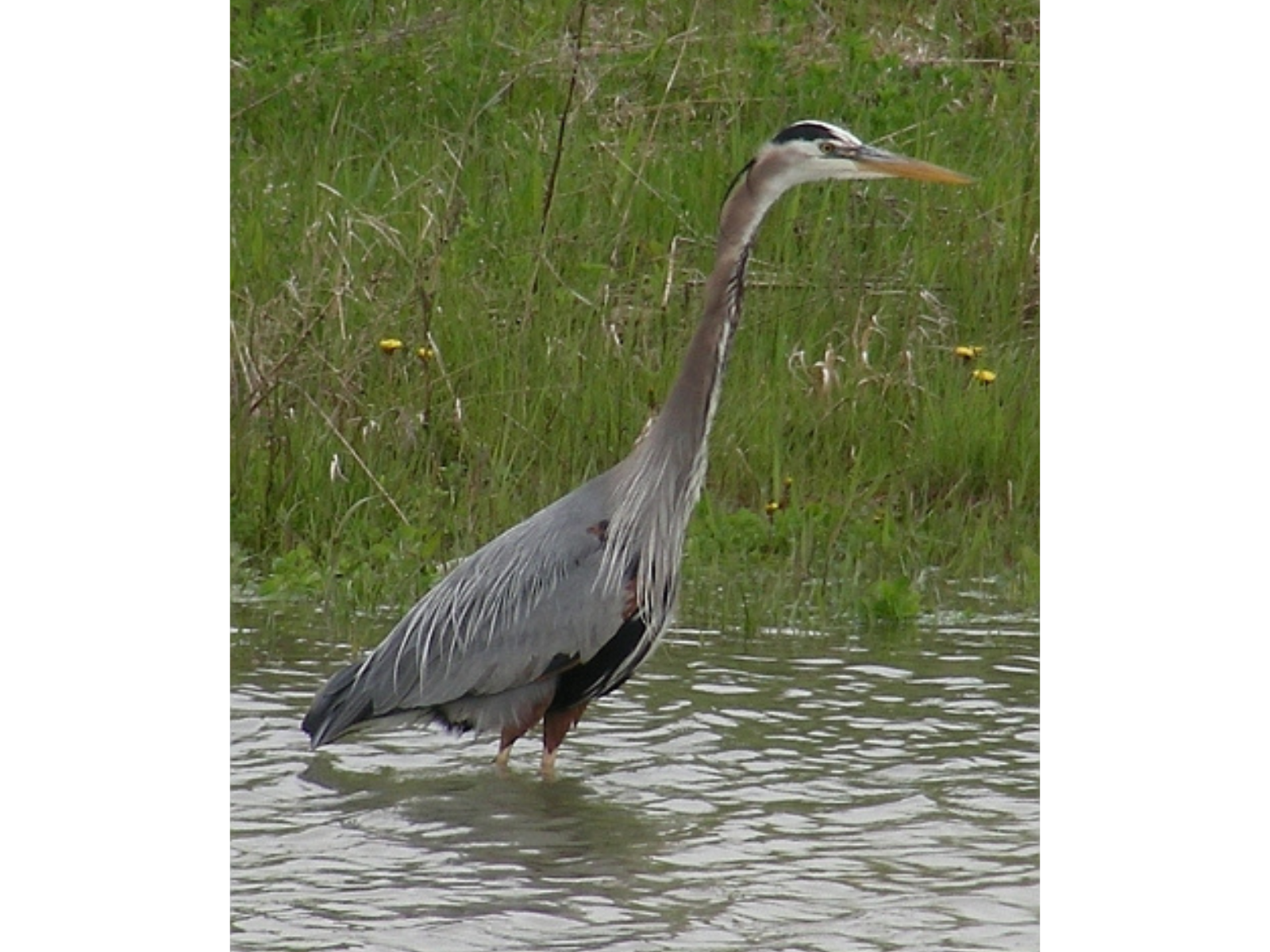
A great blue heron wading in shallow water.

The large numbers of small fishes and frogs cycle nutrients up to more conspicuous top predators like this great blue heron.

If somewhat less than one tenth of the range of boreal chorus frogs in Manitoba is suitable habitat, there are almost 50 billion square metres of chorus frog living space in the province. Even at the conservative estimate of one pair per 500 square metres, there would be almost 100 million chorus frogs in Manitoba! In June, with an additional 100 or more tadpoles per pair, there could be as many as 5 billion individuals in the province’s chorus frog population at its peak. That is a lot of bugs eaten and a lot of food available for other more conspicuous animals that we enjoy in our travels.
 

Image: A boreal chorus frog from north of Flin Flon. These small frogs (about 25 mm long) are extremely common in Manitoba and come in a variety of colour patterns from green to brown and plain, striped or spotted.
Even if these rough estimates are off by two orders of magnitude, there are still millions of chorus frogs in Manitoba, just as there are additional millions of individuals of other species of frogs and small fishes (like brook stickleback). These under-appreciated, inconspicuous animals in our fields and forests play a huge role in maintaining a functioning environment. Our tiny fishes and frogs are living examples of when a small thing means a lot.

Dr. Randy Mooi

Dr. Randy Mooi

Curator of Zoology

Dr. Mooi received his Ph.D. in zoology from the University of Toronto working on the evolutionary history of coral reef fishes. Following a postdoctoral fellowship in the Division of Fishes of the Smithsonian Institution…
Meet Dr. Randy Mooi

Bright Fireball Seen Across Southern Manitoba

On August 23 at about 9:35 pm, a bright fireball was seen across southern Manitoba and several U.S. States. We are collecting reports of the object to determine where it came from and also where any pieces might have landed. If you say this object, please email us at skyinfo@manitobamuseum.ca with the details.

Please include the following information:

  • Where you were when you saw it;
  • The direction you were facing when you first saw it;
  • Whether the object was moving left-to-right, right-to-left, or up-and-down, and at what angle
  • How high above the horizon it was – use the degree scale, where 0 is the horizon, 90 is straight overhead. So, halfway up the sky is 45 degrees, a third of the way up from the horizon is 30 degrees, etc.
  • Any other details – colour, sound, how long you saw it for, etc.

Your reports can help us track down this object, which was probably a small asteroid burning up in the atmosphere.

Scott Young

Scott Young

Planetarium Astronomer

Scott is the Planetarium Astronomer at the Manitoba Museum, developing astronomy and science programs. He has been an informal science educator for thirty years, working in the planetarium and science centre field both at The Manitoba Museum and also at the Alice G. Wallace Planetarium in Fitchburg, Massachusetts. Scott is an active amateur astronomer and a past-President of the Royal Astronomical Society of Canada.

Guest Column: Churchill

By Dr. Graham Young, past Curator of Palaeontology & Geology


When we got back from Churchill a couple of weeks ago, Debbie Thompson handed me a piece that she felt inspired to write. This was her first visit to the Hudson Bay coast, and as an artist her perspective is quite different from mine.

It’s always depressing leaving a place that fills a void in my soul. There is a solitude here that tugs on my spirit, yearning for acknowledgment

There is a sensual beauty in the eroded and smooth curves of these ancient rocks. There is a harsh beauty reflected in the black spruce. There is a sad beauty in derelict buildings of the past. Forgotten to decay, or to be torn down to reveal a scar. And there is a radiant beauty in the voices of the people here, ringing with a subtle, ancient lightness.

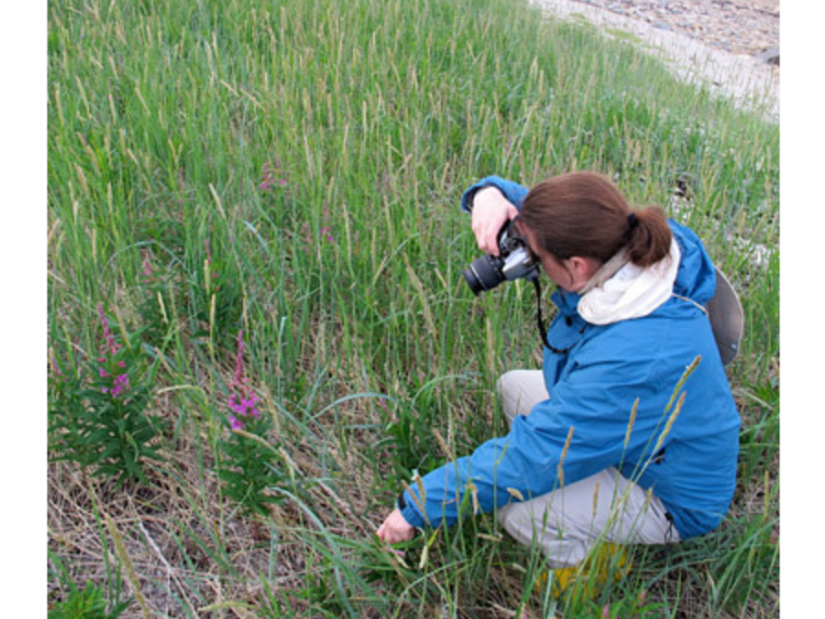
Debbie Thompson wearing a blue jacket and holding a camera up to her eye, crouches to take a photo of the nature in front of her.

Debbie Thompson in her natural element.

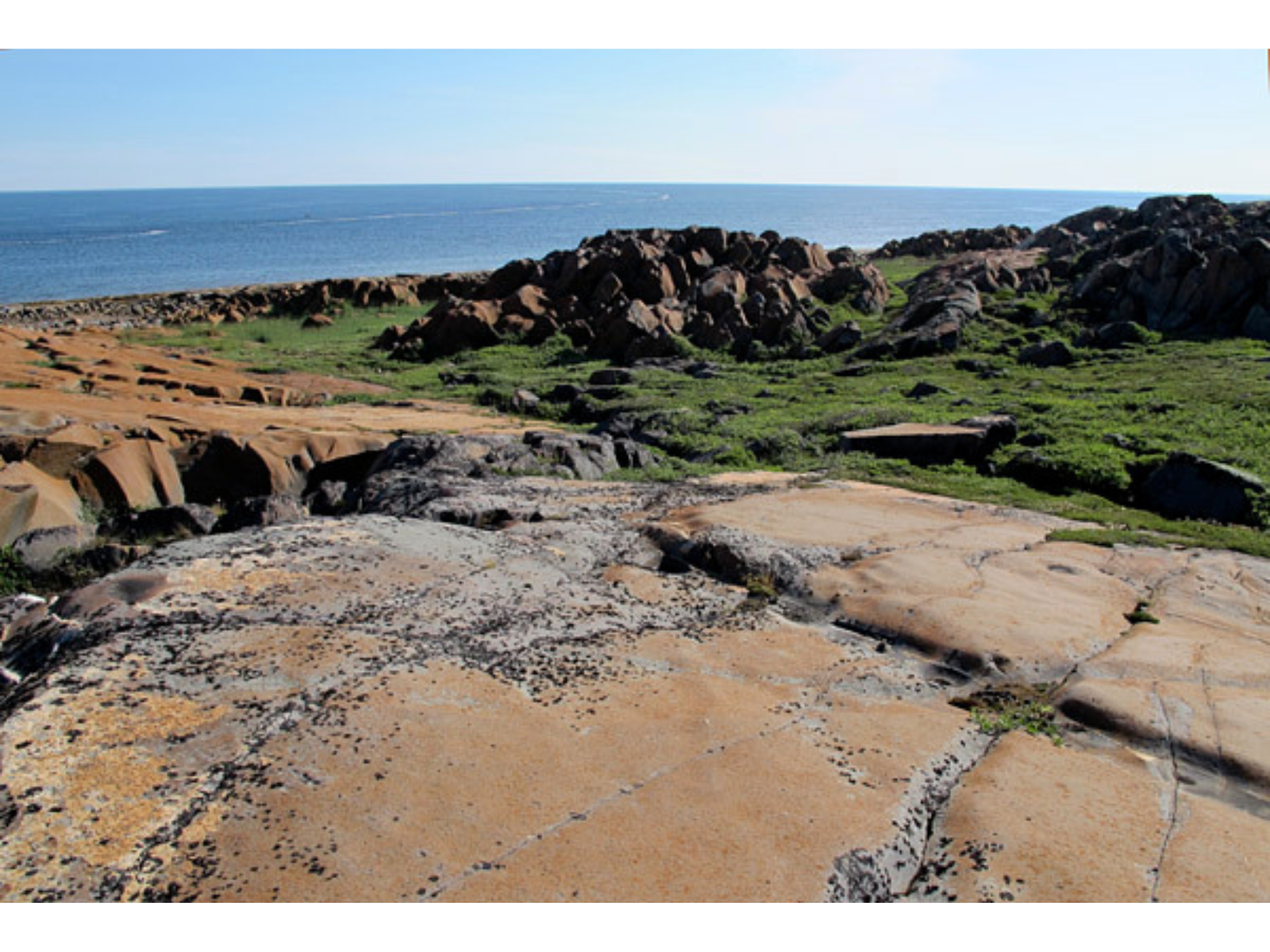
View out over a reddish rocky landscape leading towards a body of water.

Churchill quartzite and Hudson Bay.

The weather is harsh, the insects unflagging, the land unforgiving. But it is beautiful, quiet, and serene when I choose it to be so. There is a different pace up here. It must be the ebb and flow of these ocean tides and the koanic sweeps of bows and bends of timeless rocks. Why rush … nothing else does.

These grey stones, a riddle in form solely, should be a reflection of my soul. They do not change in a day, but over time are never the same. Yet are always present in some form.

That something so beautiful and graceful is birthed of relentless time and the harshest of trials … could not my very essence aspire to such a virtue?

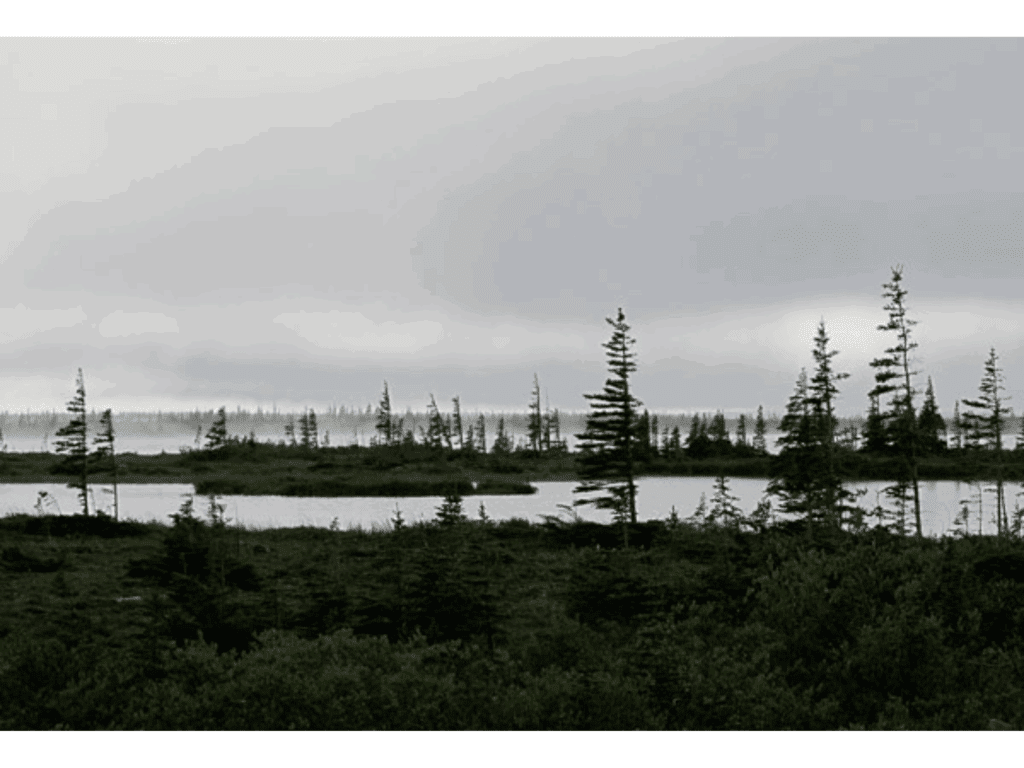
Photo looking out towards a landscape dotted by bodies of water and grass and trees.

Lakes near Bird Cove.

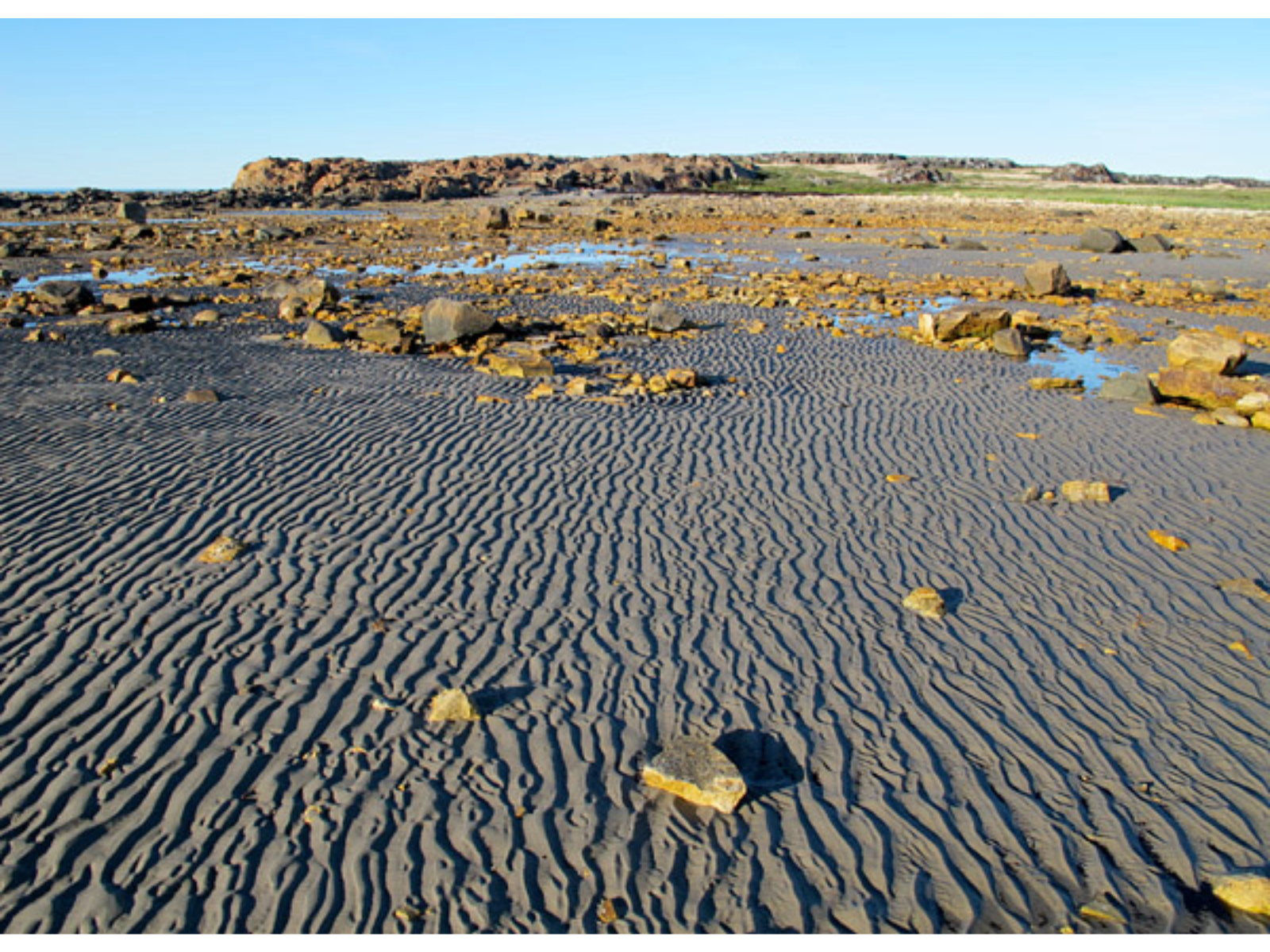
Looking out over a sandy beach dotted with stones and spaces of shallow water.

The shore east of Halfway Point.

(photos by me)

Museum Mystery: Who was Lizzie Crawford?

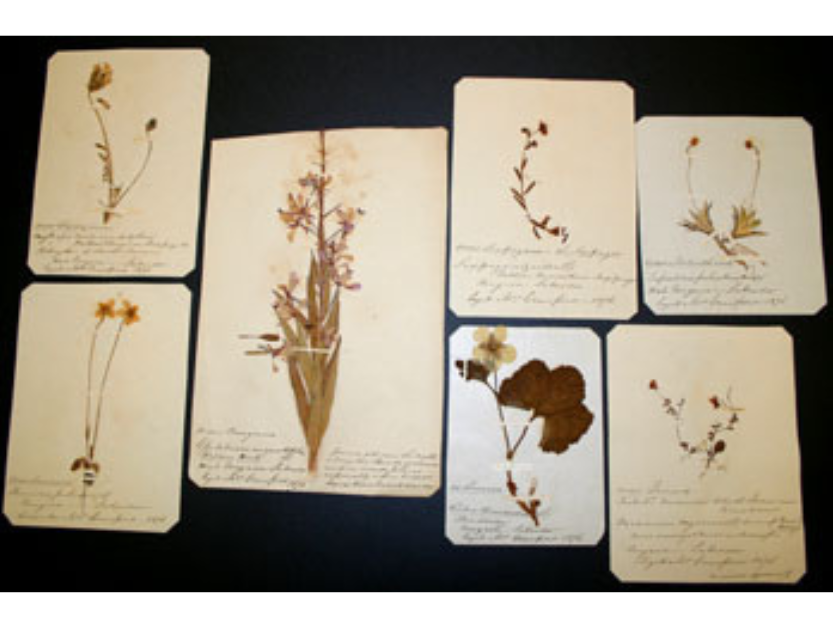
While examining the backlog of uncatalogued plants in my lab I came across a very old and intriguing collection: 28 vascular plants from Ungava, Labrador collected in 1876 by a Mrs. Lizzie Crawford. Immediately my curiosity was aroused. Who was this mysterious woman? Why was she collecting plants in Canada’s north so long ago? How on earth did her specimens end up at the Manitoba Museum? Clearly figuring all this out was going to require some serious detective work.

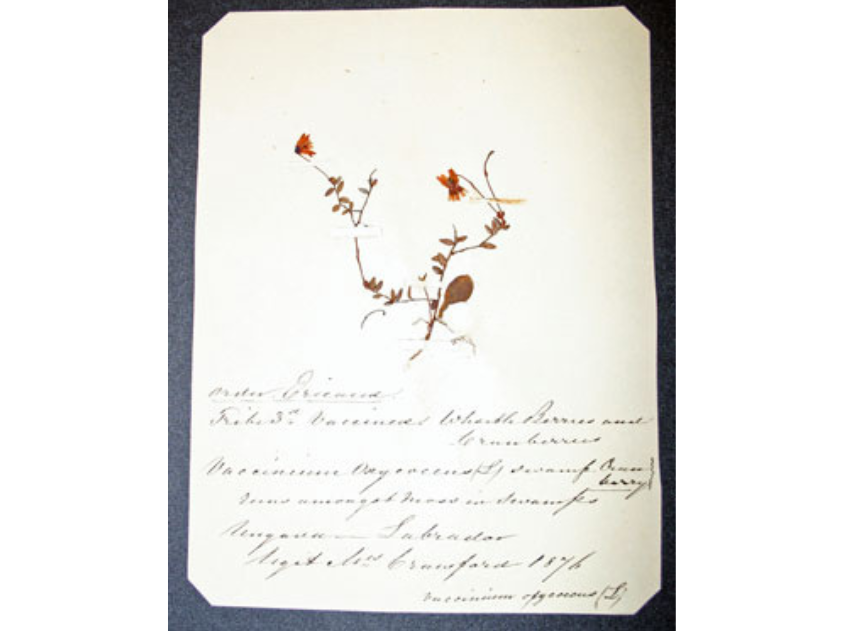
By examining the collection I was able to come to some conclusions about who Mrs. Crawford was and what she was like. First, she was clearly an educated woman as she was both literate (her penmanship is lovely) and able to correctly identify the scientific (Latin) names of the plants she collected. Second, she had access to natural history books and enough leisure time to engage in a hobby, suggesting that her family was somewhat well-off. Third, she was a nature lover and probably a bit of an adventurer. She described the habitat of one plant as being “amongst moss in swamps” so she was probably willing to hike in inhospitable places in search of interesting plants. I surmised that she was probably from an upper-middle class family and that her presence in Labrador was most likely as a visitor or temporary resident. Although her husband was of Scottish ancestry, she is not necessarily Scottish as her maiden name was not indicated.

Seven pressed plant specimens.

Some of Lizzie Crawford’s pressed plants from Labrador.

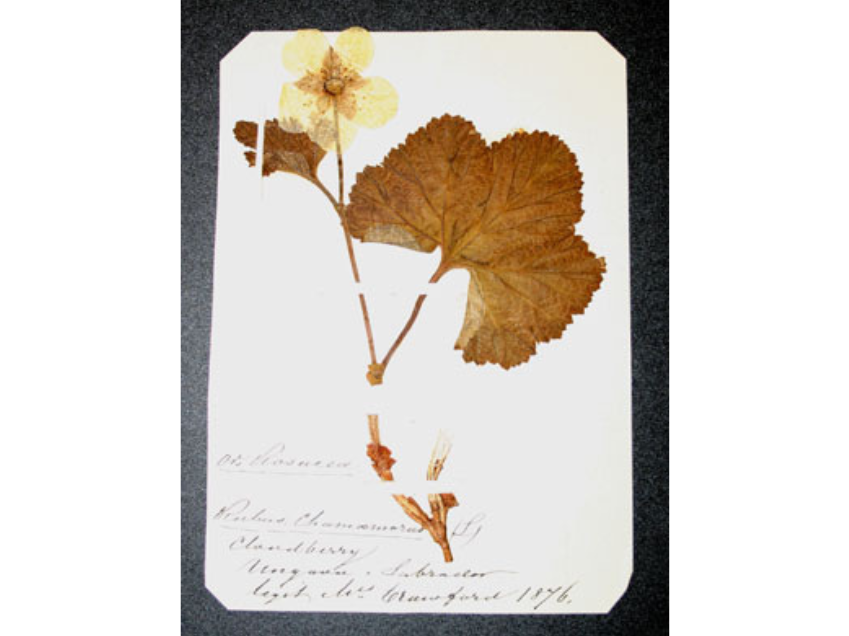
A pressed plant specimen with handwritten details written on the paper below it.

A specimen of swamp cranberry collected “amongst moss in swamps”.

Next I needed to know a little bit more about the history of Labrador. What kinds of people were living in northern Labrador in 1876? I began searching history publications for information about Scottish immigrants. I determined that there were three likely professions for Mrs. Crawford’s husband: missionary, merchant, or employee of the Hudson’s Bay Company (HBC). I decided to explore the HBC archives since a link to this company might explain how the specimens ended up in Manitoba.

A pressed plant specimen with handwritten details written on the paper below it.

I quickly hit the jackpot: a Robert Crawford had worked for the HBC from 1854-1877, mainly at various forts in Ontario. However, from 1875-1877 he worked at Fort Chimo in the Ungava district of what is now Labrador! This couldn’t be a coincidence; I was sure I had found Lizzie’s husband. I hit a snag however as the Record of Employment (ROE) indicated that his wife was named Mary. Fortunately, there was a question mark after the “Mary(?)” indicating some uncertainty. Maybe the record of employment was wrong. I decided to search Ontario’s marriage records as the ROE indicated that Mr. Crawford’s wife’s family was from Brockville, Ontario. I was able to determine that Robert Crawford married an Elizabeth Miles in 1863. Victory! I was right! I felt like dancing. In fact, I think I did.


Image: A faded but beautiful cloudberry specimen.

A pressed plant specimen with handwritten details written on the paper below it.

Armed with her maiden name I was able to determine that her father also worked for the HBC and was no other than Robert Seaborn Miles, an Englishman who rose to the position of Chief Factor. Her mother was Elizabeth “Betsey” Sinclair who had at one time been the “country wife” of Sir George Simpson, Governor-in-Chief of Rupert’s Land from 1821 to 1860. Country wives were the First Nations or Metis common-law wives of fur traders. In fact, Lizzie had a half sister, named Maria, who had been fathered by Sir George. In another interesting twist, one of Lizzie Crawford’s aunts was Mary (Sinclair) Inkster, wife of John Inkster. The Inkster’s home and general store was one of the first residences in Winnipeg and has been preserved as the Seven Oaks House Museum on Rupertsland Blvd. Therefore, anyone who is related to John and Mary are distant cousins of Lizzie Crawford.


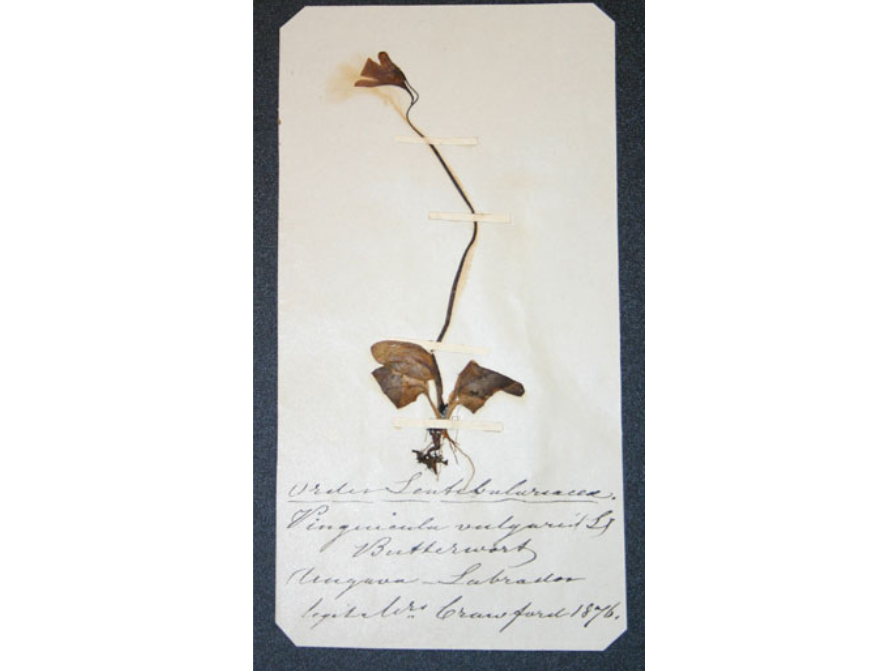
Image: The butterwort (Pinguicula vulgaris) specimen collected by Lizzie Crawford.

So how did the specimens end up at the Manitoba Museum? I needed to track the Crawfords movements after Mr. Crawford retired from the HBC in 1878. Using the internet I was able to find enough documents to piece some of the puzzle together. The Crawfords moved to Indian Head (now part of Saskatchewan) in 1882 to open a general store and Mr. Crawford entered politics, becoming a member of the first council of the Northwest Territories from 1886-1888. During this time the Crawfords may have been involved in the Manitoba Historical and Scientific Society (MHSS), which established in 1879. I suspect that the 28 specimens that I have were given to the MHSS directly by the Crawfords or by their daughter Maggie, eventually ending up here at the Museum. Additional specimens of Mrs. Crawford ended up in herbaria at the University of Montreal and the Canadian Museum of Nature. In fact, Dr. John Macoun (the naturalist with the Geological Survey of Canada), mentioned one of her specimens (Pinguicula vulgaris) in his list of the flora of Labrador in the book “Labrador Coast: A journal of two summer cruises to that region” by A. S. Packard in 1891.

It would be wonderful to find some of Lizzie’s descendants to show them her specimens and also see if they have any old journals, books, letters, or diaries that would tell me more about Lizzie’s collecting activities and why she was interested in natural history. If you are somehow related to Lizzie or Robert Crawford please feel free to get in touch with me as this Museum mystery is still not fully solved.

Dr. Diana Bizecki Robson

Dr. Diana Bizecki Robson

Curator of Botany

Dr. Bizecki Robson obtained a Master’s Degree in Plant Ecology at the University of Saskatchewan studying rare plants of the mixed grass prairies. After working as an environmental consultant and sessional lecturer…
Meet Dr. Bizecki Robson

Hands On: Practising Emergency Response

The 37th annual Canadian Association for Conservation conference was held in Winnipeg in May 2010. Conservator Lisa May attended a two-day pre-conference workshop entitled “Advanced Issues in Emergency Preparedness and Response”. As part of this workshop, Jane Dalley from Heritage Conservation Service (Winnipeg, MB), instructed a hands-on component. Workshop participants experienced how to handle, stabilize and clean water damaged items.

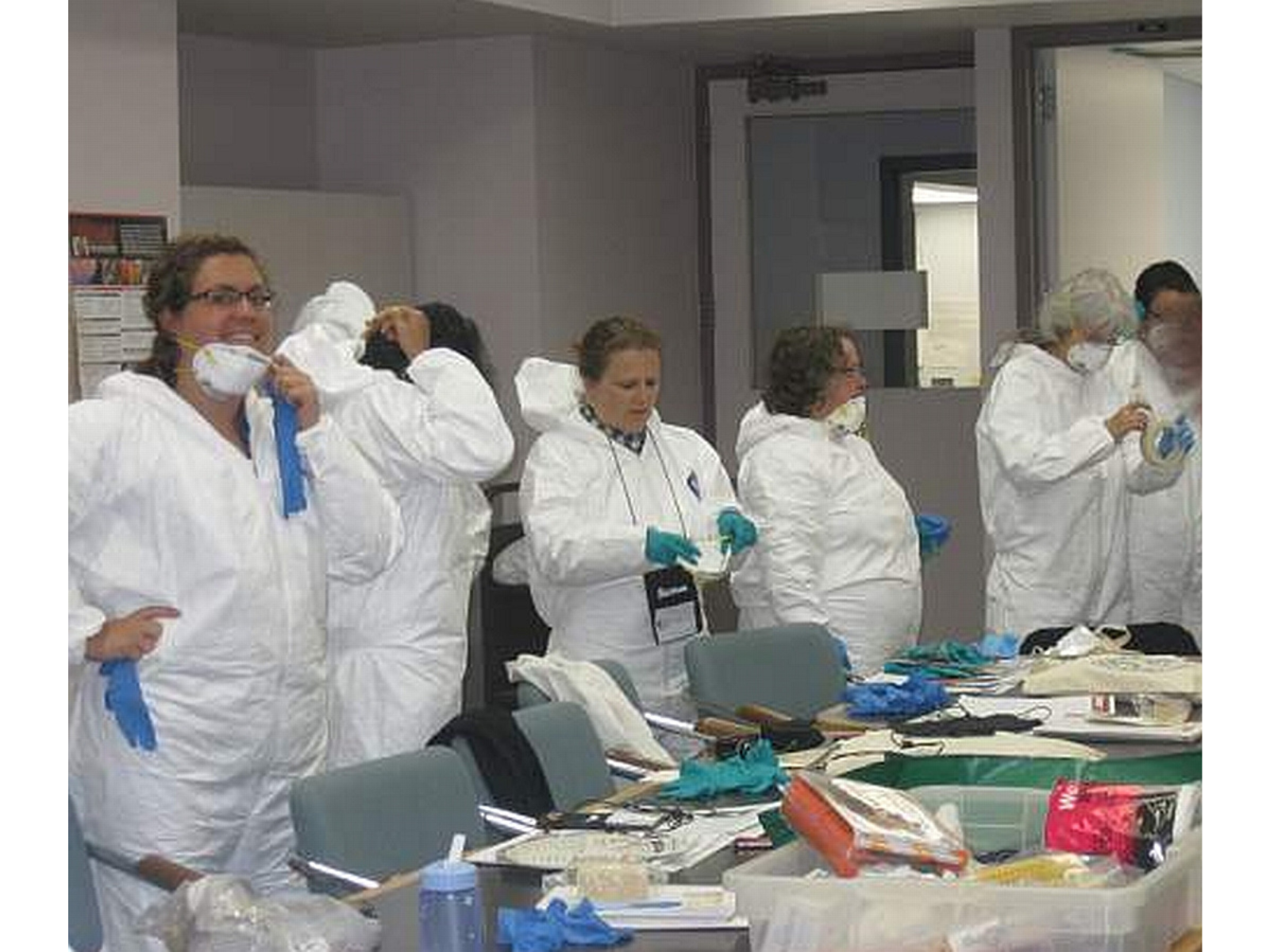
A row of people suiting up in white protective clothing and face masks.

Participants wear protective clothing. In an emergency scenario, there could be dust, mould, and water

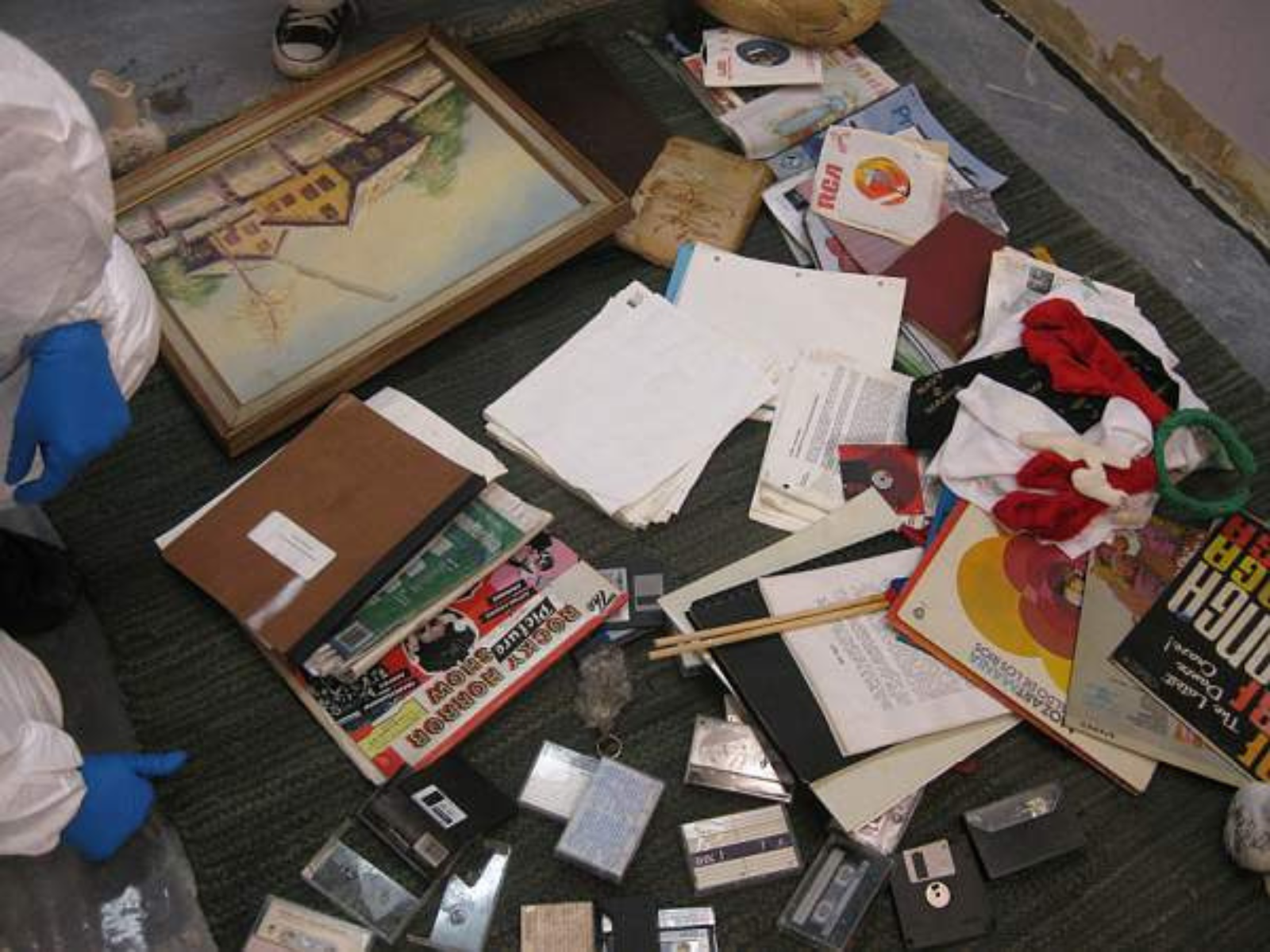
A variety of objects including a rug, painting, notebooks, cassette tapes, floppy dusks, and more piled on the floor.

A variety of objects made of different materials had to be rescued.

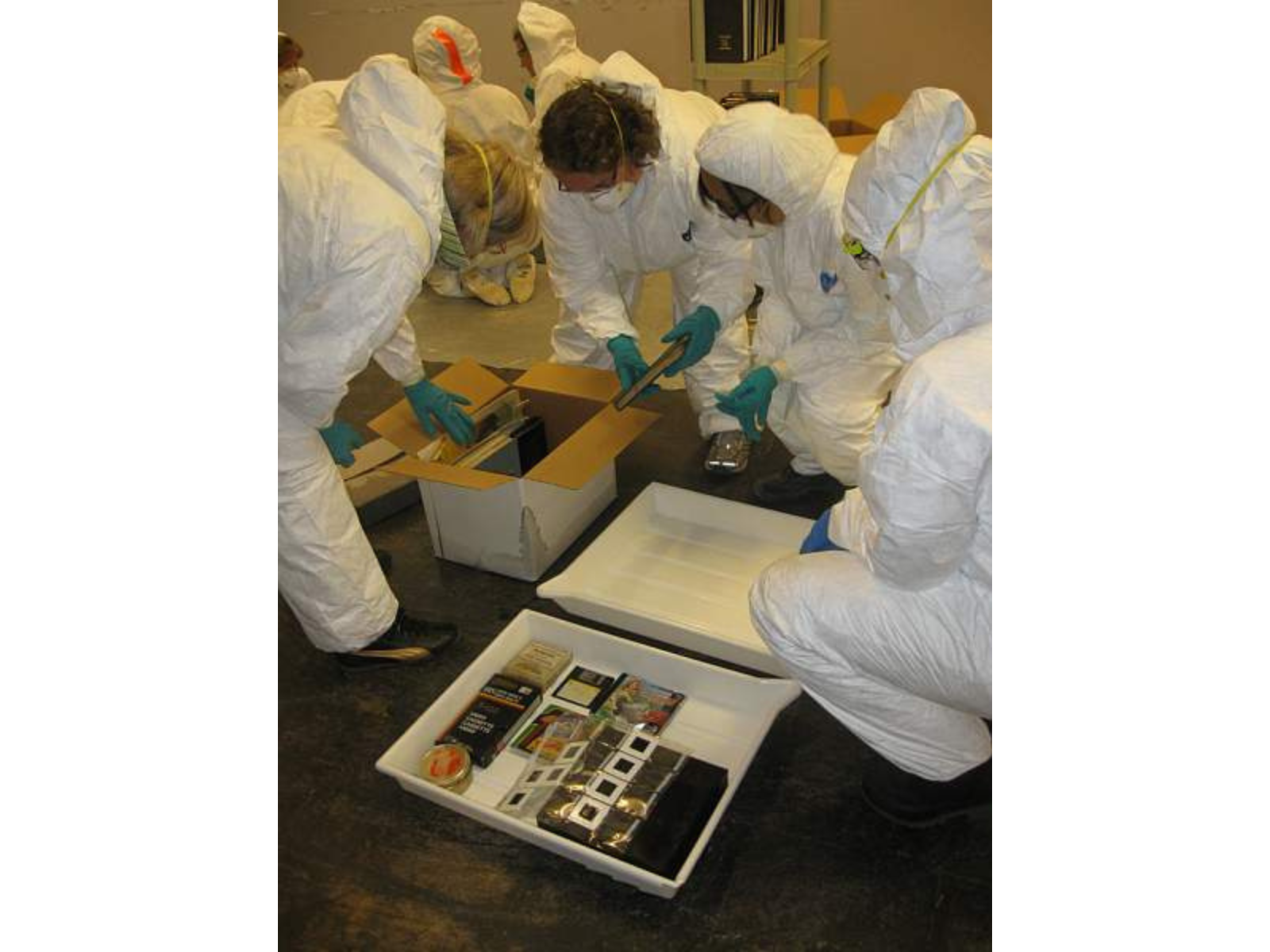
Four people wearing white protective clothing sorting various artifacts into trays and boxes.

The different materials are triaged and separated according to how they will be treated.

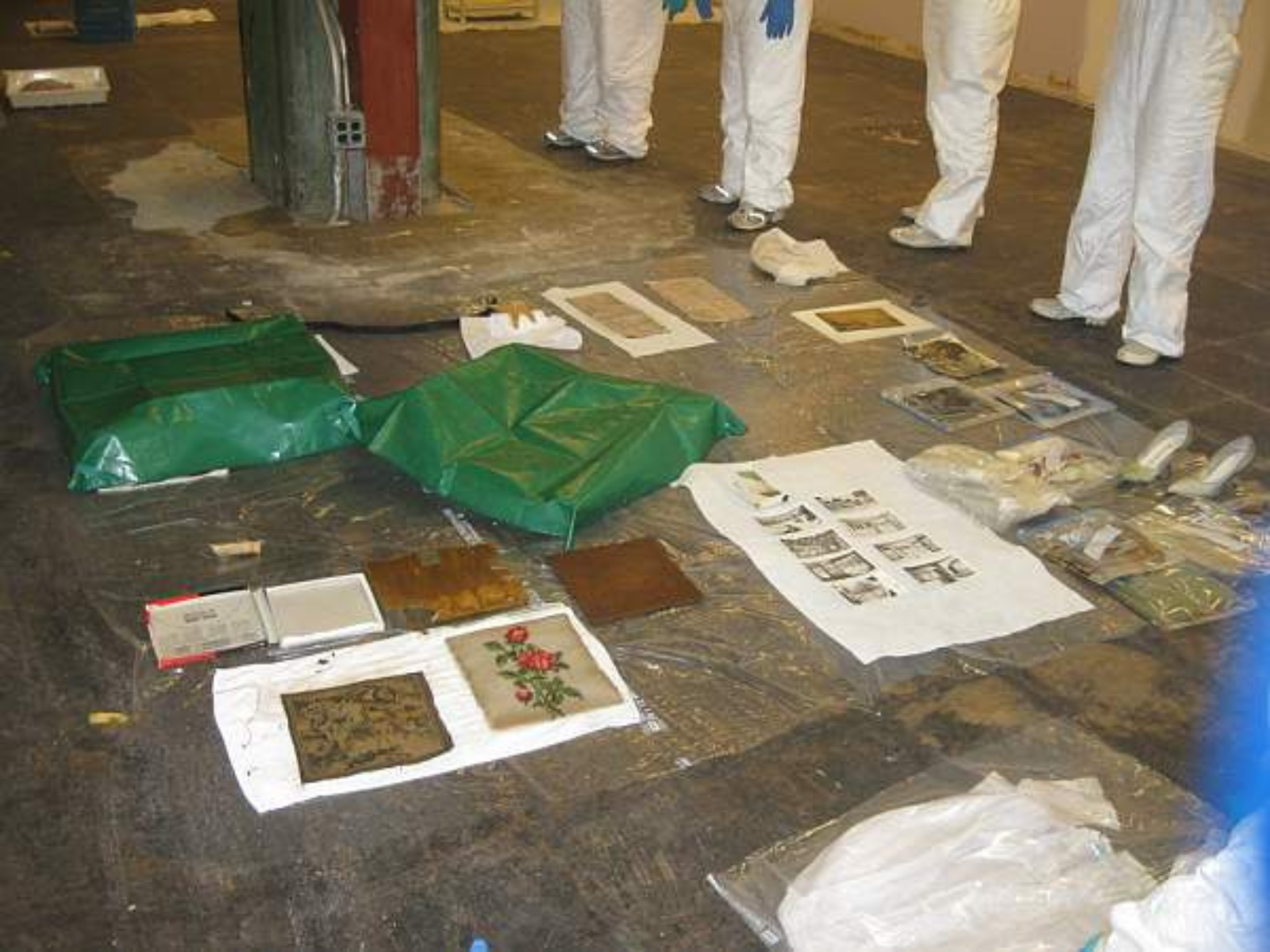
A series of painting an photographs laid out on paper towels on the floor. In the background the legs of four people wearing protective clothing can be seen.

In one room, wet objects are laid to dry on paper towels and clear polyethylene.

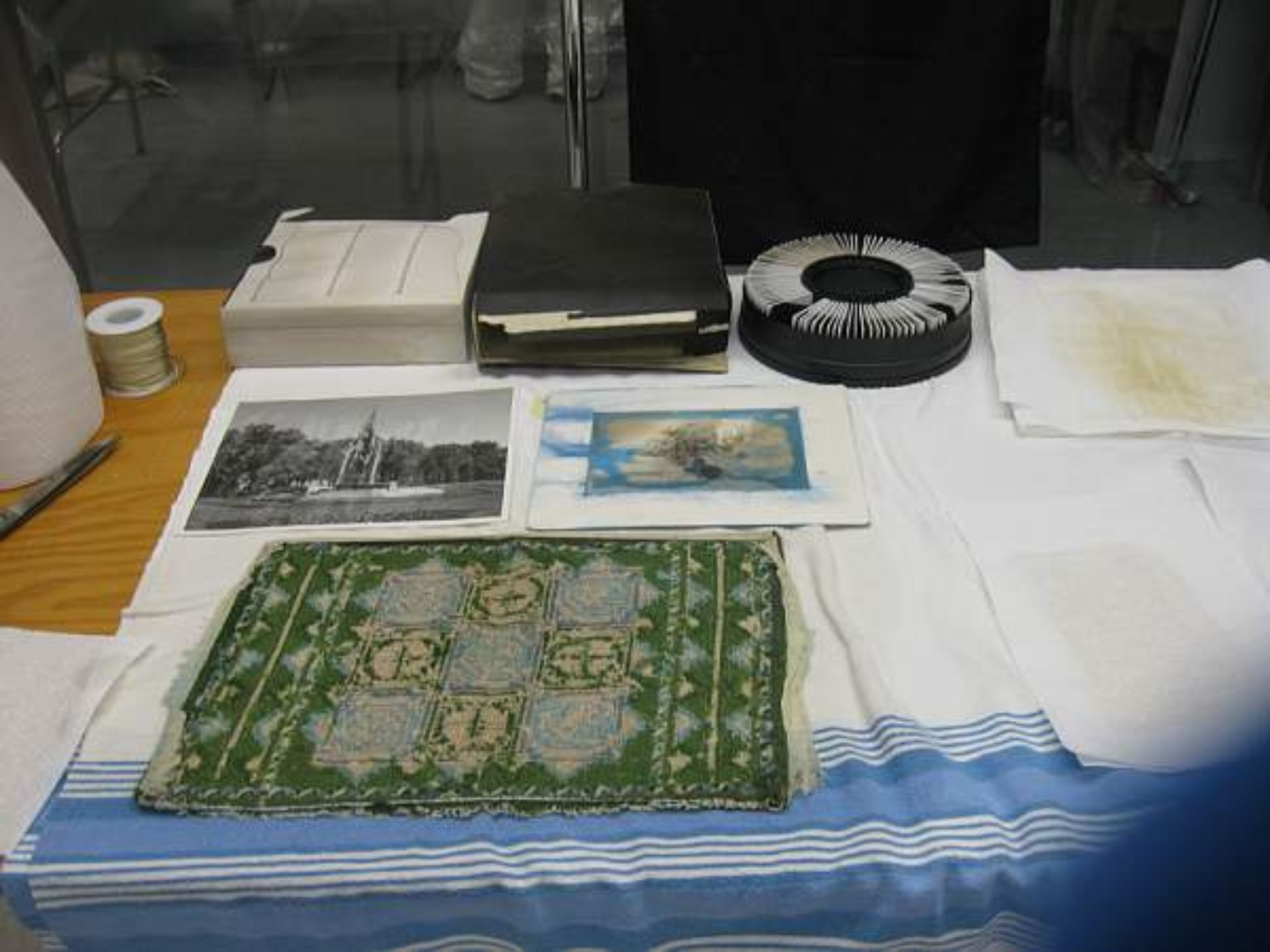
A small tapestry and two prints laid out on a cotton sheet.

In another space, things are drying on a cotton sheet. Notice dye has run on the print.

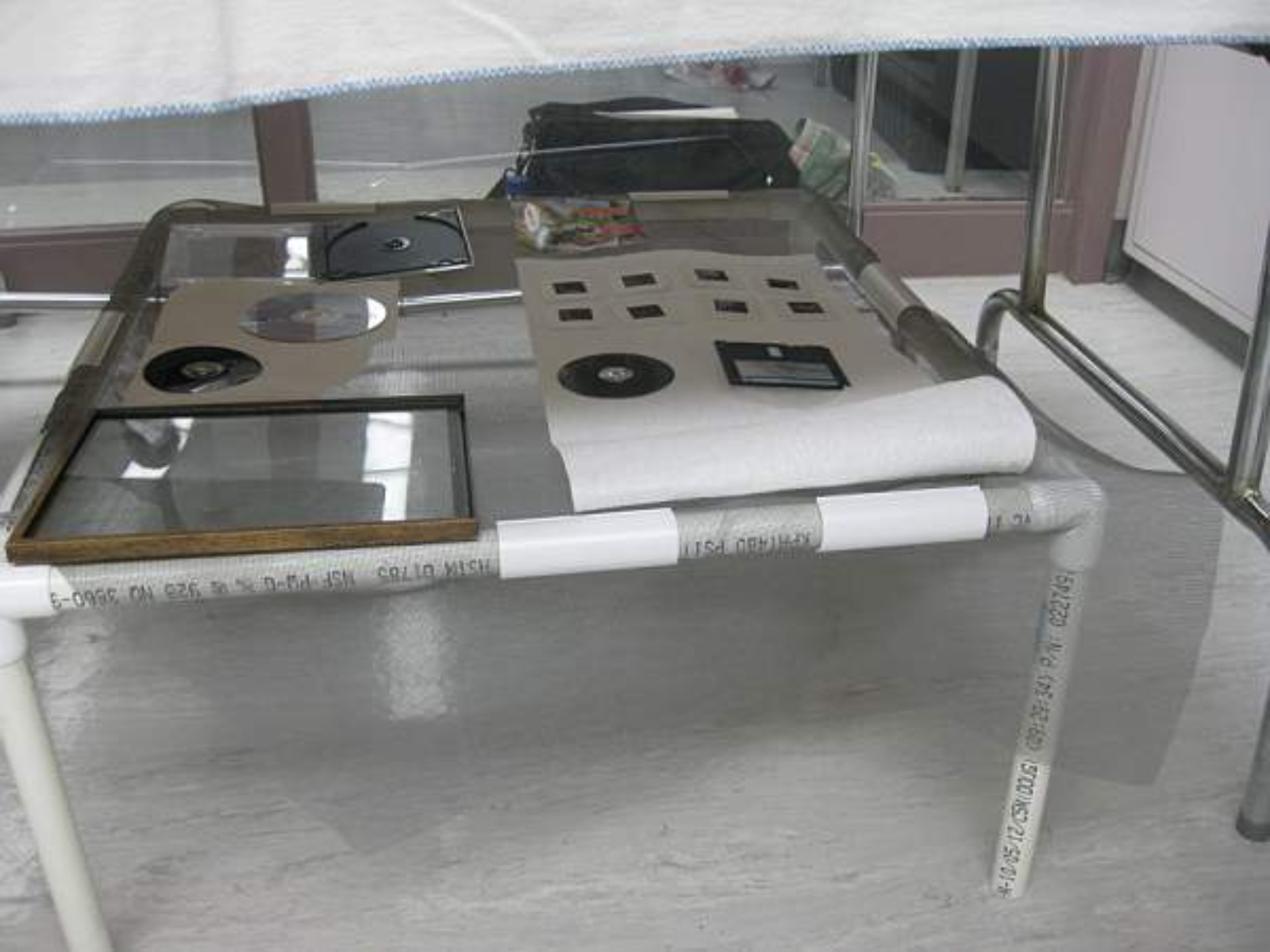
Objects like CDs, CD cases, floppy disks, and film slides laid on a small table made from pipe and netting.

Still more objects are laid out on a homemade table made from plumbing pipe.

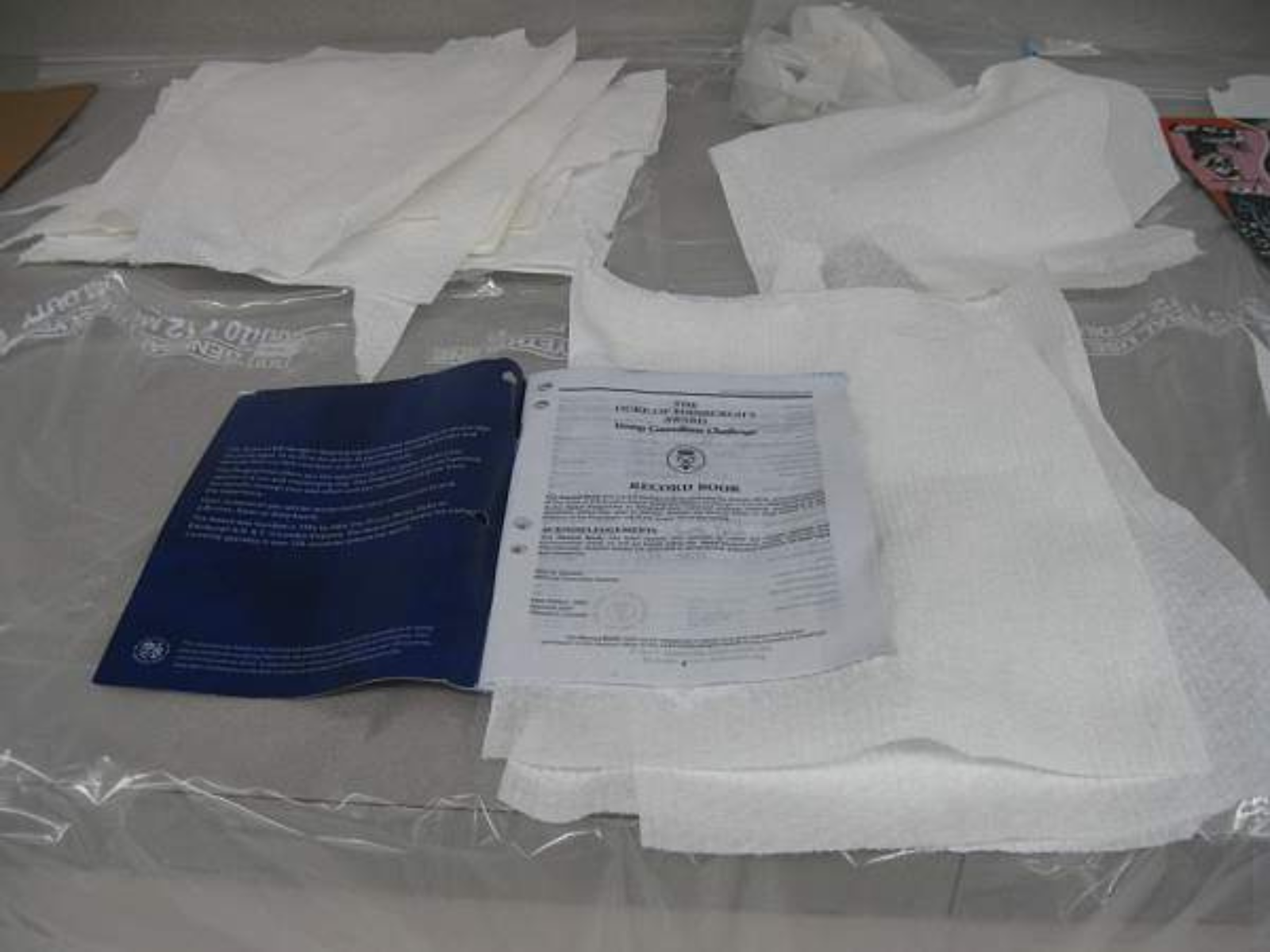
A wet notebook with paper towels inserted between each page to aid in drying.

Paper towels are placed between pages to speed drying.

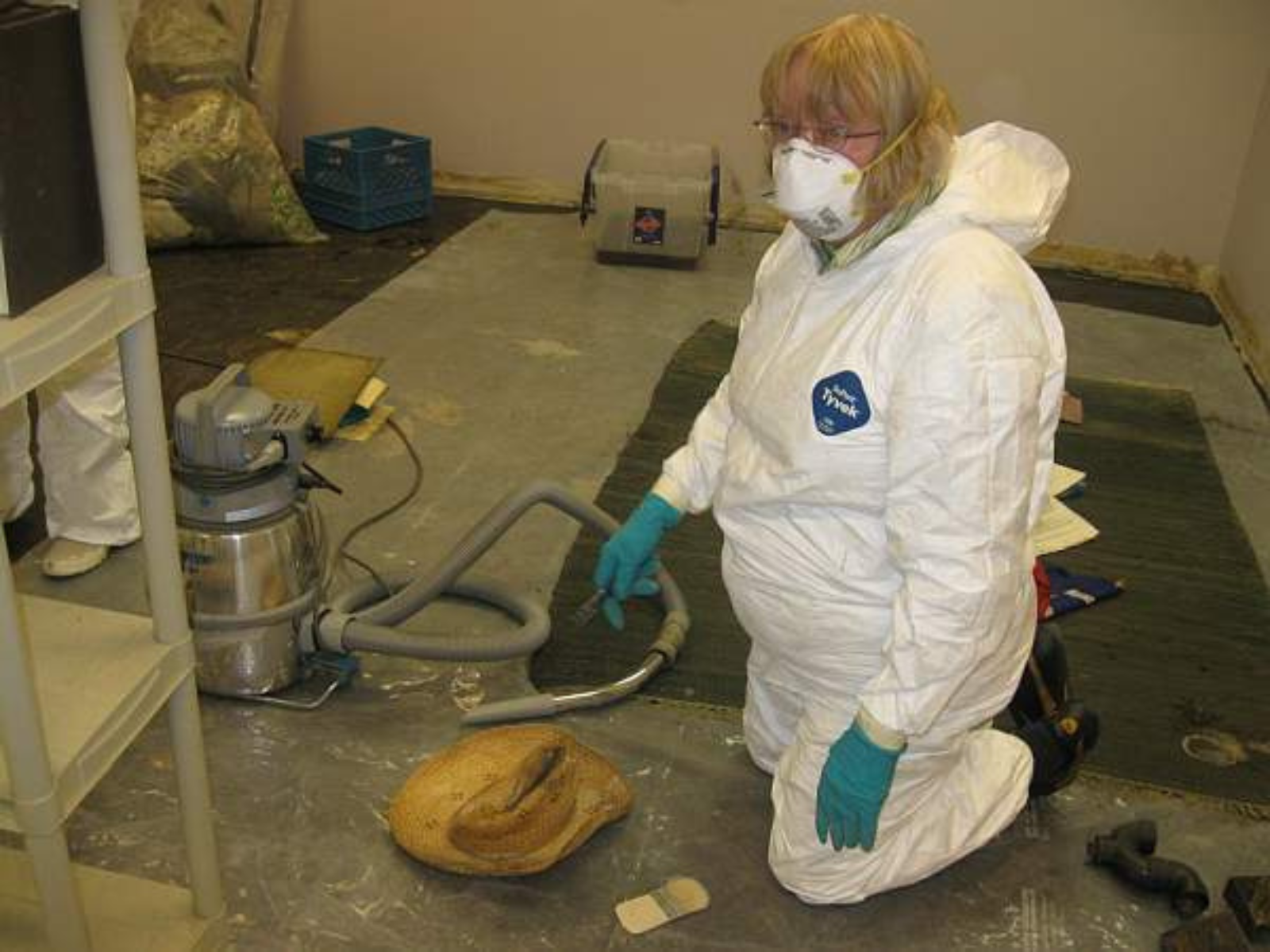
An individual wearing white protective clothing, blue rubber gloves, and a white face mask kneels on the ground next to a shop vac and an old and worn straw hat.

A shop vac is useful in a flood or leak.

This was just one part of the workshop. Lectures and discussion to share experiences and questions were an invaluable aspect, but hands-on practice opportunities are rarer. Thanks go to the Canadian Conservation Institute, helped by local organizer Ala Rekrut from the Archives of Manitoba for presenting this professional development opportunity.

So Much Sun, So Little Time!

By Dr. Graham Young, past Curator of Palaeontology & Geology


This past week, I again appreciated the relationship between fieldwork and weather. In previous visits to Churchill, we usually had breaks in the outdoor work because of the region’s varied and often unpleasant weather. This year, I had anticipated that we would meet similar conditions, and that I would be able to fit some blog posts into the time at the research station waiting for rain/sleet/snow to clear.

But of course this was not to be, courtesy of unpredictable weather conditions. This time, we were met by the longest run of fine weather I have ever seen on the Hudson Bay coast. We could occasionally complain that it was unusually hot (i.e., a pleasant mid 20s Celsius), and the flies WERE horrible whenever the wind died down, but really we had nothing to complain about.

Silhouettes of three people walking through shallow water on a beach, backlit by the sun.

Crossing a tidal flat in the early evening.

View into the back of a covered pickup truck with neatly placed containers and boxes.

Debbie keeps the back of the truck in remarkable order. I have never before seen a geological field vehicle looking this tidy.

No two days were the same, but a typical day went like this:

6:30 am – The northern sun has already been beating through our window for hours. It is time to struggle out of bed, shave, and face the day.

7 am – Breakfast. Food is very good and plentiful at the Churchill Northern Studies Centre, so this is always a pleasant experience, with eggs, potatoes, bacon, coffee, fruit, cinnamon buns, … roughing it in the field! After breakfast we will make sandwiches, then load gear into the truck.

8 am – Drive 25 km down the gravel road to our main study site. Unload collecting gear, attach kneepads, load shotguns, fill water pails from a pond on the tidal flat. The rock we are seeking is a not quite in-place bedrock, but its loose blocks have a very distinctive appearance and appear to come from just under our feet. I select a likely spot on the shore and pick up and split every piece of this rock type within reach, wetting the surfaces in the pail and examining with a hand lens for tiny fossils.

9, 10, 11 am – We continue to repeat the splitting and examining processes. I occasionally stand up, grumble about leg and knee pain, and scan the horizon for polar bears (Ed is holding a shotgun and acting as full-time bear patrol; my scanning is of marginal importance, but it makes me feel useful). I go and take a look whenever Debbie or Matt call out about a fossil they have found.

An individual seated crossed-legged on a rocky surface next to a black bucket. They have the hood of their top up, and a rimmed hat.

Matt works through the blocks of stone on one little patch of shore. The shirt and hat protect him from both sun and biting flies.

Individuals standing and seated scattered around a rocky outcropping look for specimens. In the distance is a body of water.

Matt, Sean, Debbie, and Dave, collecting on the shore in the hot sun.

12:30 – Lunch. I find a nice rounded boulder low on the shore, and pull out the sandwich that I made at breakfast. Sandwiches always taste so much better when inhaled with sea air!

1 pm – A quick run to town to purchase supplies. There is always something we need for this sort of work, and town is nearby, so it makes a welcome break.

2 pm – Back on the shore, we are splitting rock. The sun has become hot and blinding, and this gets to be sleepy work. If the tide is out, maybe we will take a little breather at 3 and walk lower on the shore to examine fossils in the bedrock of the intertidal zone.

4 pm – We begin to pack up. Every likely slab that we had set aside is re-examined to determine if it is worthy of transport back to the research station. The good ones are wrapped in foam and carefully placed into bins. These fossils are easily abraded, and it would be a shame if we wrecked them after they have survived in good shape for 450 million years or so!

5 pm – Back at the Centre, we unload the gear and rocks, and wash up a bit to make ourselves marginally presentable. If there is time, we will examine a few of our finds before dinner.

Three individuals standing in a work room/laboratory sorting fossils and specimens.

Sorting fossils and gear in the lab in the old part of the Churchill Northern Studies Centre.

Standing water collected in a dip in the gravel road.

Our evening drives took us over several of Churchill’s interesting roads! This one is near Halfway Point.

In individual wearing a red jacket and a rimmed beige hat with mosquitoes swarming around their head.

5:30 pm – Dinner! In the cafeteria, it is time to talk about our discoveries of the day, plan for tomorrow, and maybe talk to the Centre staff and other scientists about what they have been doing.

6:30 pm – We are back to the truck, ready to pay a visit to one of the field sites from previous years. The weather is so wonderful, the light is perfect for photography, and we need to look at some of the sites on the shore to see if they have changed or “new” fossils have popped up. This is no hardship at all: one evening we wade through a quiet mist toward the middle of Bird Cove, another time we head along the beach ridges east of Halfway Point, and on a third occasion we travel down “Polar Bear Alley” near the former dump site. Everywhere the scenery is gorgeous, the animal life is interesting, the bears are not in evidence (this is important when we are out on foot!), and even the malevolent mosquitoes only trouble us for relatively brief intervals.


Image: Sometimes the mosquitoes WERE bad: evening feeding time with Dave.

9, 10, 11 pm – After our final return to the Centre, we spend a bit more time working on our fossil collections, perhaps socialize over a beer, and then return to our rooms to download some of the hundreds of photographs.

It has been a perfect field day, but also perfectly jam-packed. The only thing we could wish for more of is time. I wish that this particular batch of Churchill fieldwork could last a month, not just nine days; then I would really have enough time to appreciate the experience.

Back in Churchill

By Dr. Graham Young, past Curator of Palaeontology & Geology


We arrived in Churchill last night after a long hiatus; I hadn’t been here in six years. I hadn’t really thought that I missed the place, since I get to think about it so often, but when I hit the ground I was again shocked by how strikingly beautiful it all is.

Three people wearing backpacks boarding a plane from the tarmac. The last person in line turns to look back towards the photographer.

Boarding the plane from the runway in Winnipeg, are (L-R) Dave Rudkin, Matt Demski, and Ed Dobrzanski.

Looking out over a body of water towards a partially emerged shipwreck lit by sunlight breaking through dark clouds.

In the sunset, the long-wrecked Ithica appears to be under way!

I am here with some old “Churchill hands” (Dave Rudkin and Ed Dobrzanski) and some newcomers to the place (Debbie Thompson and Matt Demski). Sean Robson will join us later. I plan to post a few short pieces here to document our progress; we will have to see how this works.

We took a drive at sunset to get acclimated. Today so far has consisted of unpacking and organizing gear and driving to town for a few supplies. But that was not without its excitements; we saw a big white wolf on the way there, and a polar bear mother and cub on the drive back!

This afternoon, the real work begins. It is a pity that the weather has turned cooler with rain threatened, but hey, this is Churchill!

Wide-view shot of several people standing around taking photos and exploring on rocky ground near a parked pickup truck.

Taking photos at Halfway Point.

An individual crouches down near the rocky ground holding a camera. Behind them a truck with a covered bed is parked with the back hatch open, and in the foreground is a standing individual wearing a red baseball cap.

Matt and Debbie.

Two polar bears walking away over a raised rocky area towards a treeline.

This morning’s bears (photo by Dave Rudkin, Royal Ontario Museum).

Confessions of a Genuine Science Geek

For the last several weeks I have been recording the pollinators of wild flowers in Birds Hill Provincial Park. One rather windy and uneventful day I was able to reflect on my chosen profession and was forced to conclude that I am a science geek. I remembered an old episode of the Simpsons where Bart discovers a comet. While searching the heavens with Bart, Principal Seymour Skinner says, “There’s nothing more exciting than science! You get all the fun of sitting still, being quiet, writing down numbers, paying attention – science has it all!” That pretty much describes what I’ve been doing for the last seven years: sitting quietly, waiting for an insect to land on a flower, and writing down the number of flowers she/he visits. In the winter I identify plants and insects, study the data I collected, make graphs, run statistical analyses, and write scientific papers. The funny part is that I really do find it exciting. It’s fun to find out if the patterns you surmised while in the field were real or indistinguishable from nature’s background noise. Plus, there’s nothing more thrilling than correctly identifying a mysterious species of sedge! Hence my revelation and this confession.

A small, six-petaled purple flower with a yellow centre.

I love staring at the delicate Blue-eyed grass flowers!

View looking out over a prairie grassland, with a single fir tree in the mid ground, and a tree line in the distance.

My summertime office.

I know that to some (probably all those extroverted people out there) my job sounds dull and tedious (a bit like watching paint dry, perhaps).  But for an introvert like me, who is energized by solitude, it’s actually the perfect job.  Being in a crowded, noisy environment with lots of people around would just drain me.

Perhaps I’m being a little too self depracating though.  Having a job where you’re constantly stuck indoors on beautiful summer days isn’t that great either.  I get to watch all sorts of wildlife while I do my work, smell fragrant wildflowers and feel the wind on my face.  Plus I don’t need to take any vitamin D tablets (skin cancer’s a possibility though).  The fact of the matter is some people pay money to do what I get paid to do: observing and photographing wildlife.  I can’t imagine too many people paying money to be a lawyer or a stockbroker for a day.


Image: One of the facinating creatures I share my work space with: a crab spider.

I also take solace in the fact that the specimens and data I collect will probably be studied long after I’m dead.  Not everyone can say that about their life’s work.  So even though I am a science geek, I don’t mind at all.

Dr. Diana Bizecki Robson

Dr. Diana Bizecki Robson

Curator of Botany

Dr. Bizecki Robson obtained a Master’s Degree in Plant Ecology at the University of Saskatchewan studying rare plants of the mixed grass prairies. After working as an environmental consultant and sessional lecturer…
Meet Dr. Bizecki Robson

… packed up and ready to go …

By Dr. Graham Young, past Curator of Palaeontology & Geology


In a couple of weeks we will be doing fieldwork near Churchill, collecting fossils on the shore of Hudson Bay. We will be flying up, and therefore have a limited checked baggage allowance. Paleontological fieldwork is not a lightweight pursuit, so the mound of gear shown above was shipped off this morning, taking the slow surface route by truck and train (Churchill has no road link to the rest of Canada).

A stack of boxed supplies packed for transport. At the base a large blue crate, with two blue rubber bins on top of it. Topping off the pile, a long light-coloured wood crate and a red toolbox.

We tried to limit what we are taking, but these crates and boxes together weigh about 260 pounds (more than 100 kg). They hold hammers, chisels, pry bars, bags, packing materials, gumboots, pails, brushes … all the heavy or bulky paraphernalia associated with successful fieldwork. And if that fieldwork is successful, they will be returning to the Museum much heavier still, loaded with samples!

As we were packing up, I started to think about the history of some of the items we are taking. We were cleaning cloth field bags, some of which have tags showing that they date back to provincial survey fieldwork in the 1950s and 60s. That blue crate in the photo has been to Churchill many times in the past 15 years (including the trip when we found the giant trilobite), and was itself inherited from an earlier generation of Museum scientists. Some of the tools are also becoming rather “aged.”

At some point, should some of our everyday scientific items be assessed, to determine if they will become artifacts in a different Museum collection?