
The Amazing Criddles, Pt. 2 - Wawanesa Site Visit

The Amazing Criddles, Pt. 2 – Wawanesa Site Visit

One of the lesser known aspects of museum work involves the lending and borrowing of artifacts and specimens. This isn’t to say you can borrow the Nonsuch for a lovely family sailing holiday, but other museums and heritage sites often work with us to make the most of our collections. Lower Fort Garry has several pieces of our HBC Museum Collection onsite to illustrate the rich history of the fur trade, for instance. Loans can be short little stints for special events or drag on for decades as the original paperwork yellows in its file folder. As I wrapped up cataloguing all of the Criddle collection, I realized that one remaining artifact had been on loan to the Sipiweske Museum since 1991. Other than a black and white photograph, we had no data on this object – a telescope used by Percy Criddle to observe Halley’s Comet in 1910– which meant…a ROAD TRIP!!!

All objects in our collection need to be catalogued and undergo a condition report, so your friendly neighbourhood cataloguer (me) and our conservator extraordinaire (Carolyn) headed off on an adventure towards the quiet, picturesque town of Wawanesa, 202 kilometres west of Winnipeg, to visit the elusive Criddle telescope.

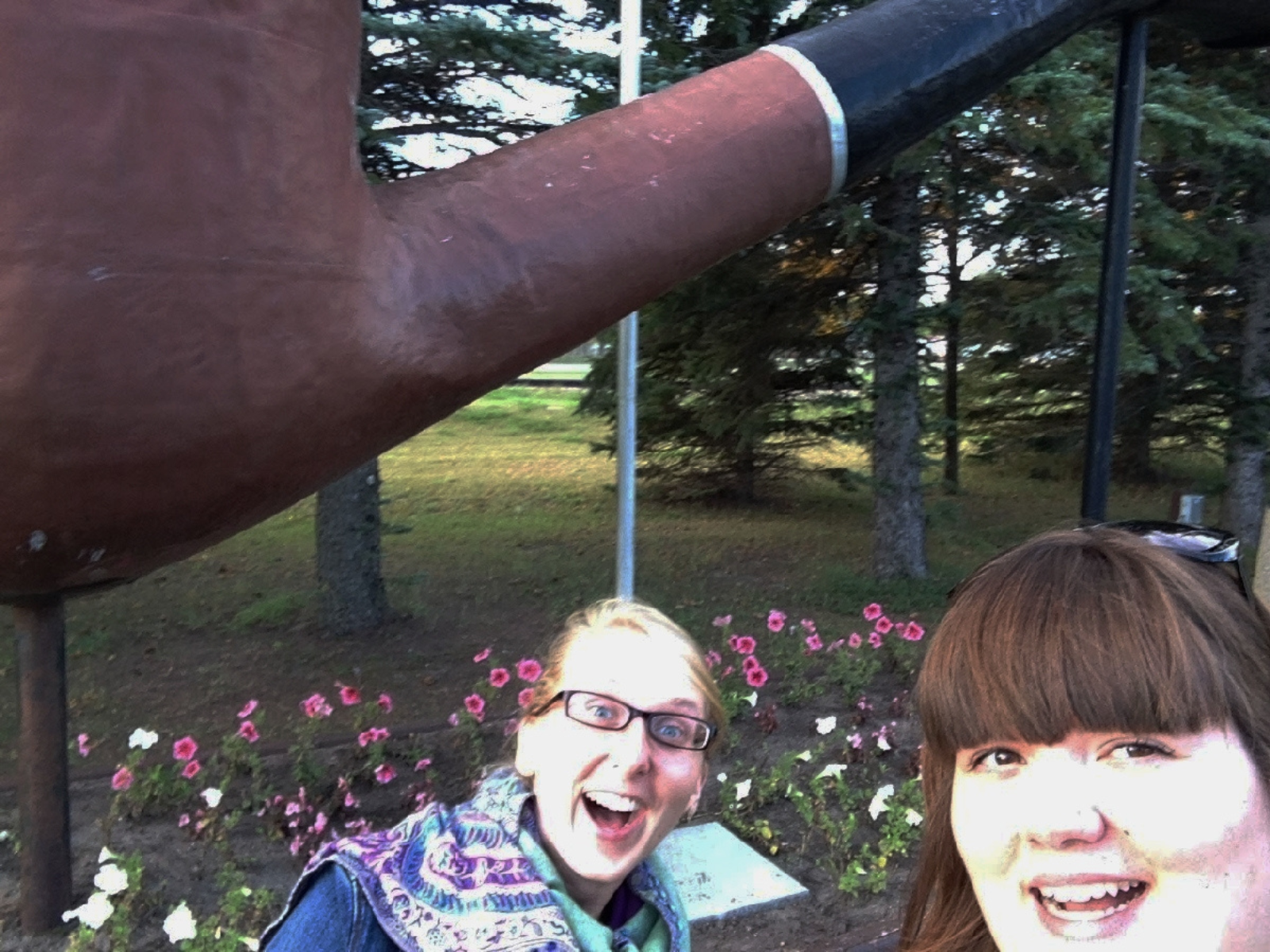
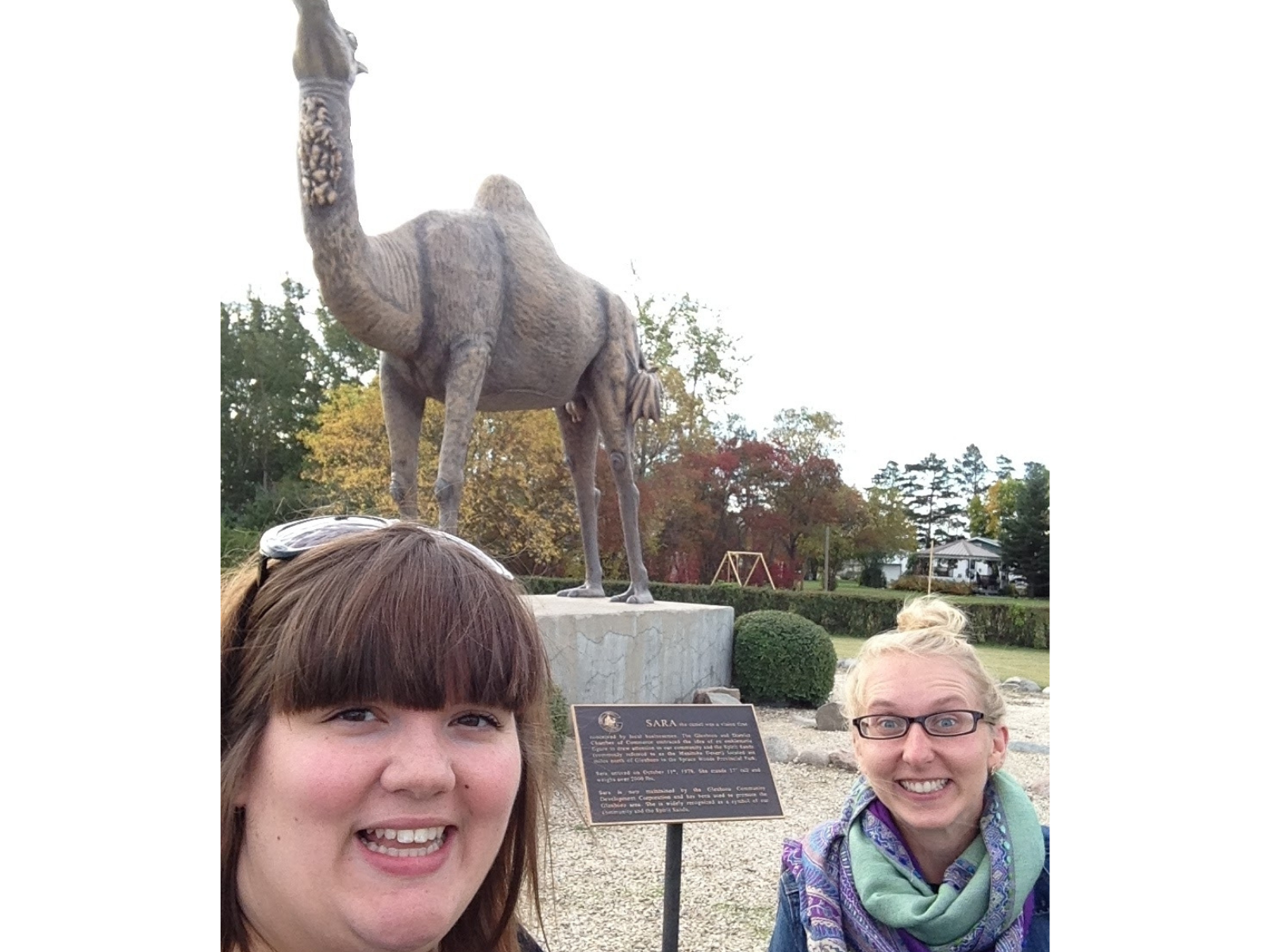
We were making good time, so I decided to show Carolyn some of my favourite stops along Highway 2, including the World’s Largest Smoking Pipe in St. Claude (my grandpa’s hometown!) and Sara the 17 foot tall Camel in Glenboro.

A smiling selfie taken by Cortney of herself and Carolyn in front of a giant brown and black smoking pipe statue.

A smiling selfie taken by Cortney of herself and Carolyn in front of a statue of a giant single-humped camel.

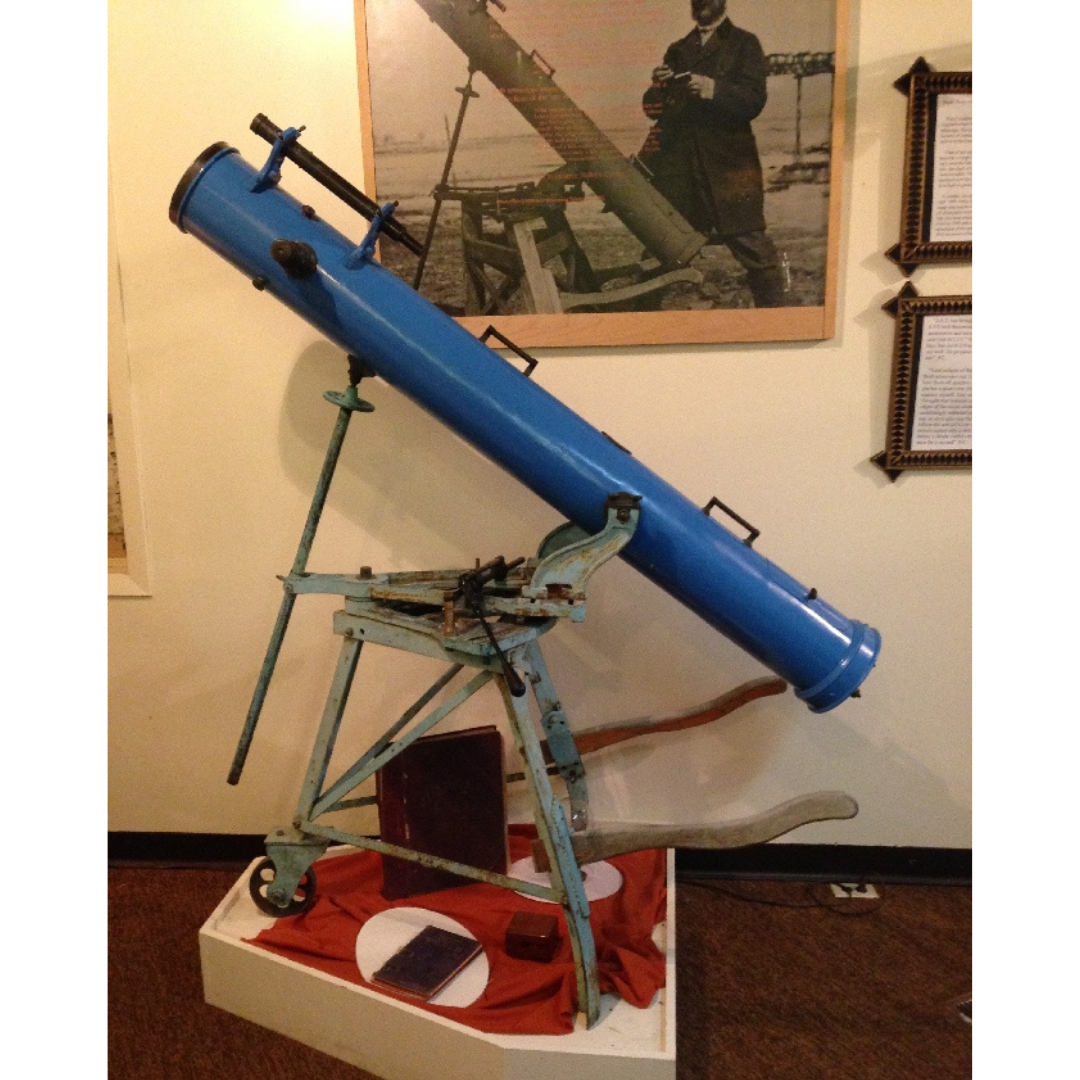
Arriving in Wawanesa, we headed to the Sipiweske Museum and made our way through the winding galleries until we arrived at the telescope. We wasted no time getting to work, examining the 130 year old telescope from every angle. This Browning telescope was made in London and brought over to Percy Criddle in 1885 by his friend and benefactor, J.A. Tulk.

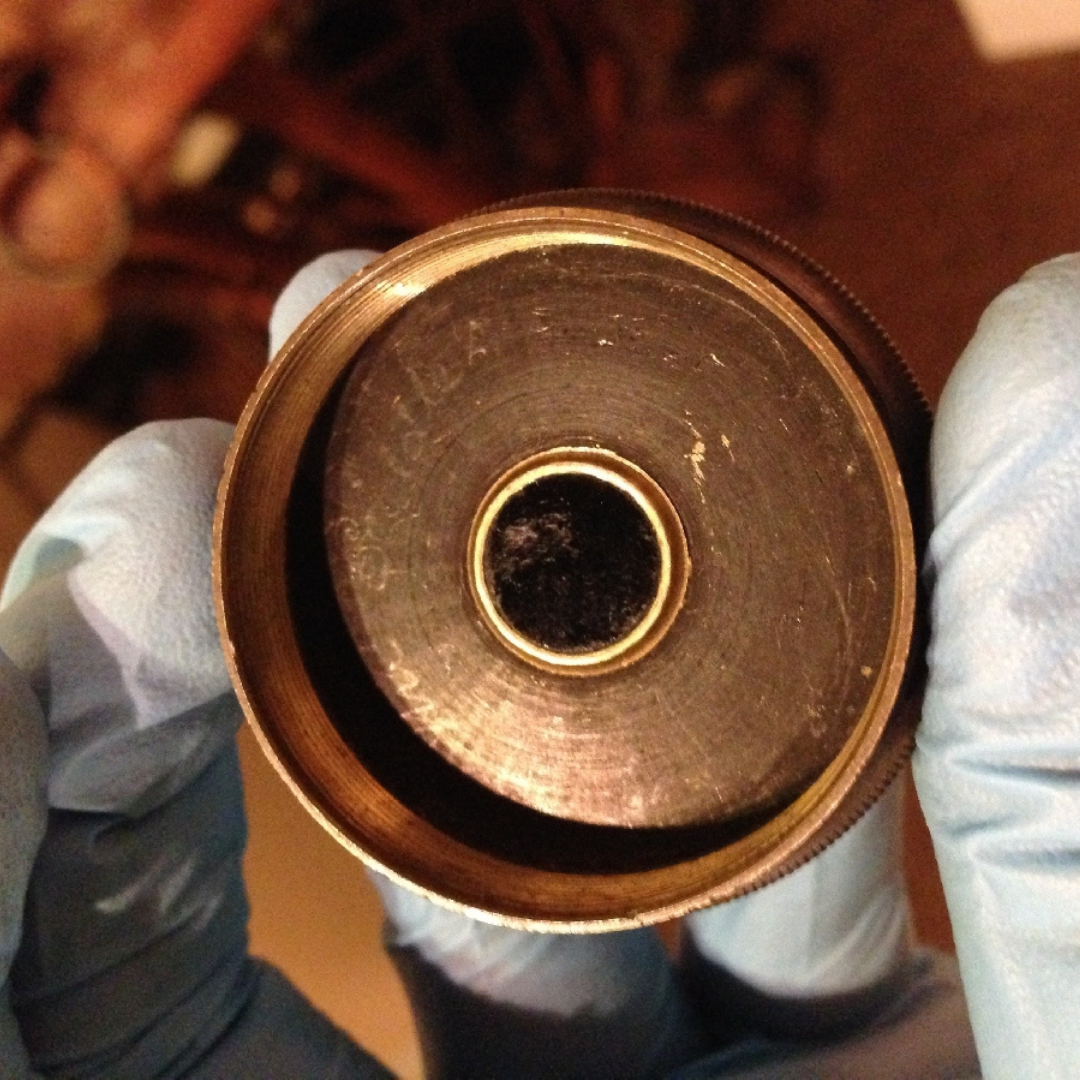
Pulling apart the eyepieces, I found a lovely surprise – Percy Criddle’s name, written in his own hand inside a lens piece, preserved for all this time. He treasured this telescope and observed many celestial events with it, including the passing of Halley’s Comet and a lunar eclipse.

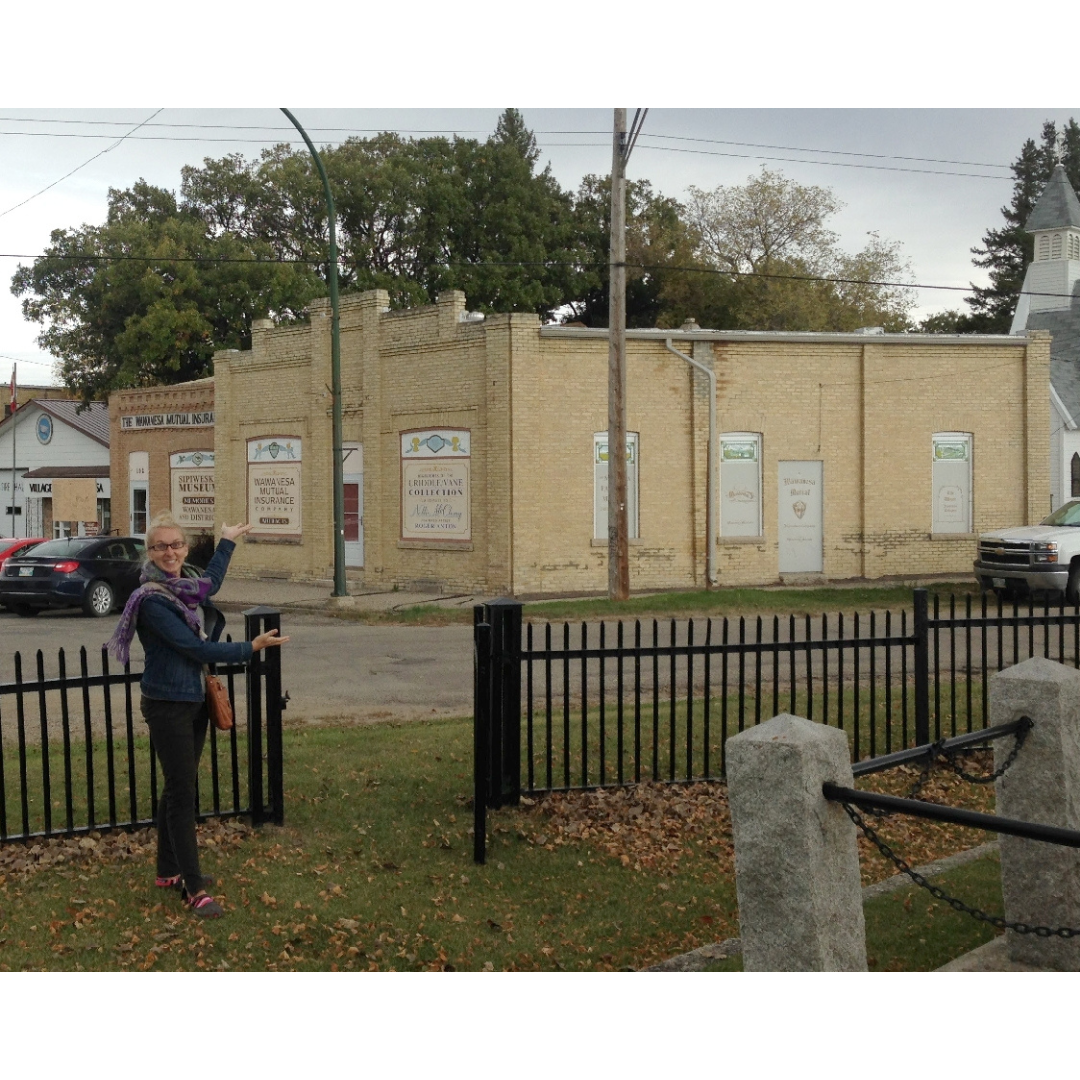
Carolyn stand in a fenced yard gesturing towards a stone building across the street - the museum.

A blue telescope on display on a small pedestal in a museum.

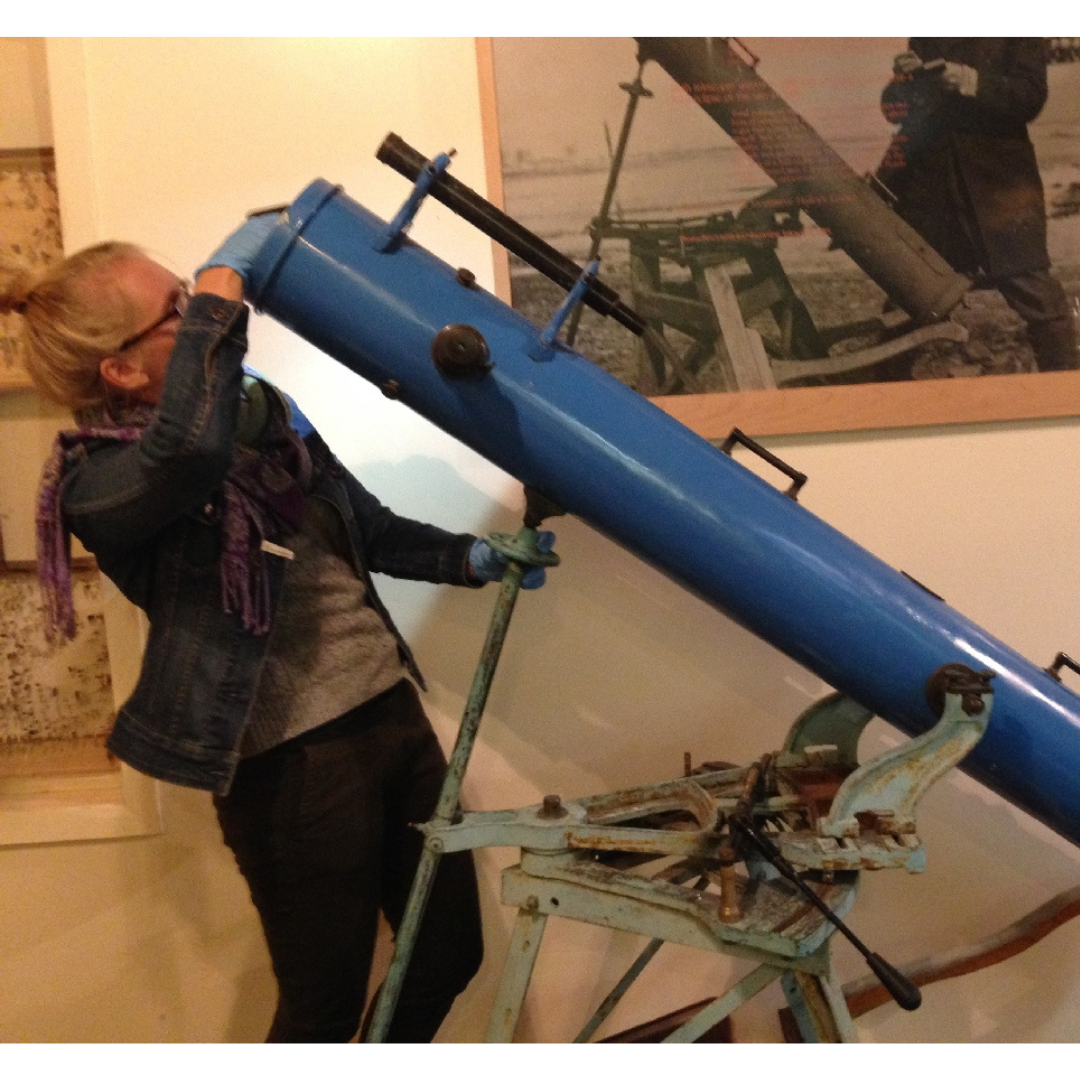
Carolyn standing at the front of a blue telescope, examining the front opening, while wearing blue gloves.

A blu-gloved hand holding up a copper-coloured lens cap with "Percy Criddle" engraved into it by hand.

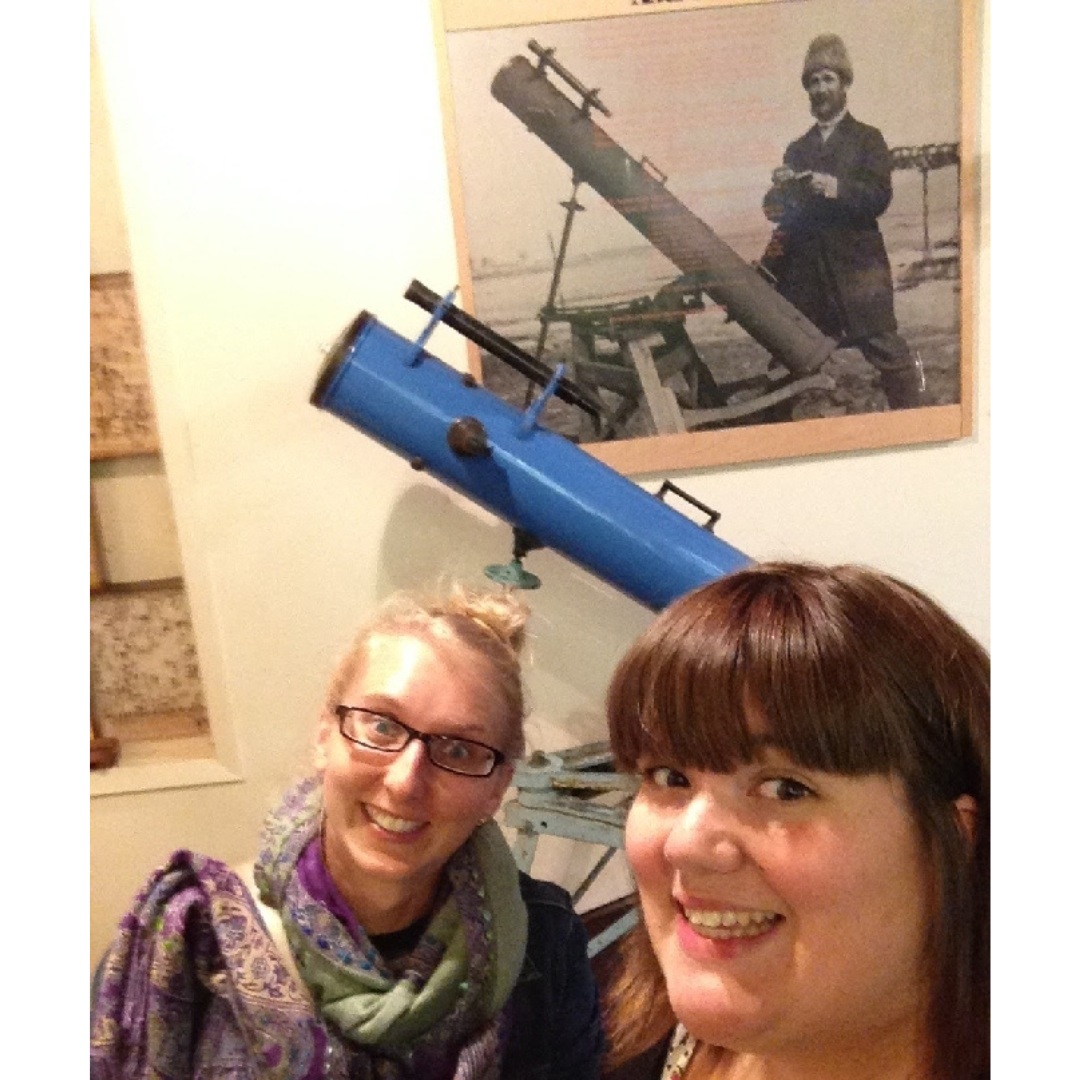
A smiling selfie taken by Cortney of herself and Carolyn standing in front of a blue telescope. On the wall behind the telescope is a black and white photo of Percy Criddle with the same telescope.

After all the disassembling, measuring, describing, photographing, and reassembling, we celebrated with a telescope selfie, as you do.

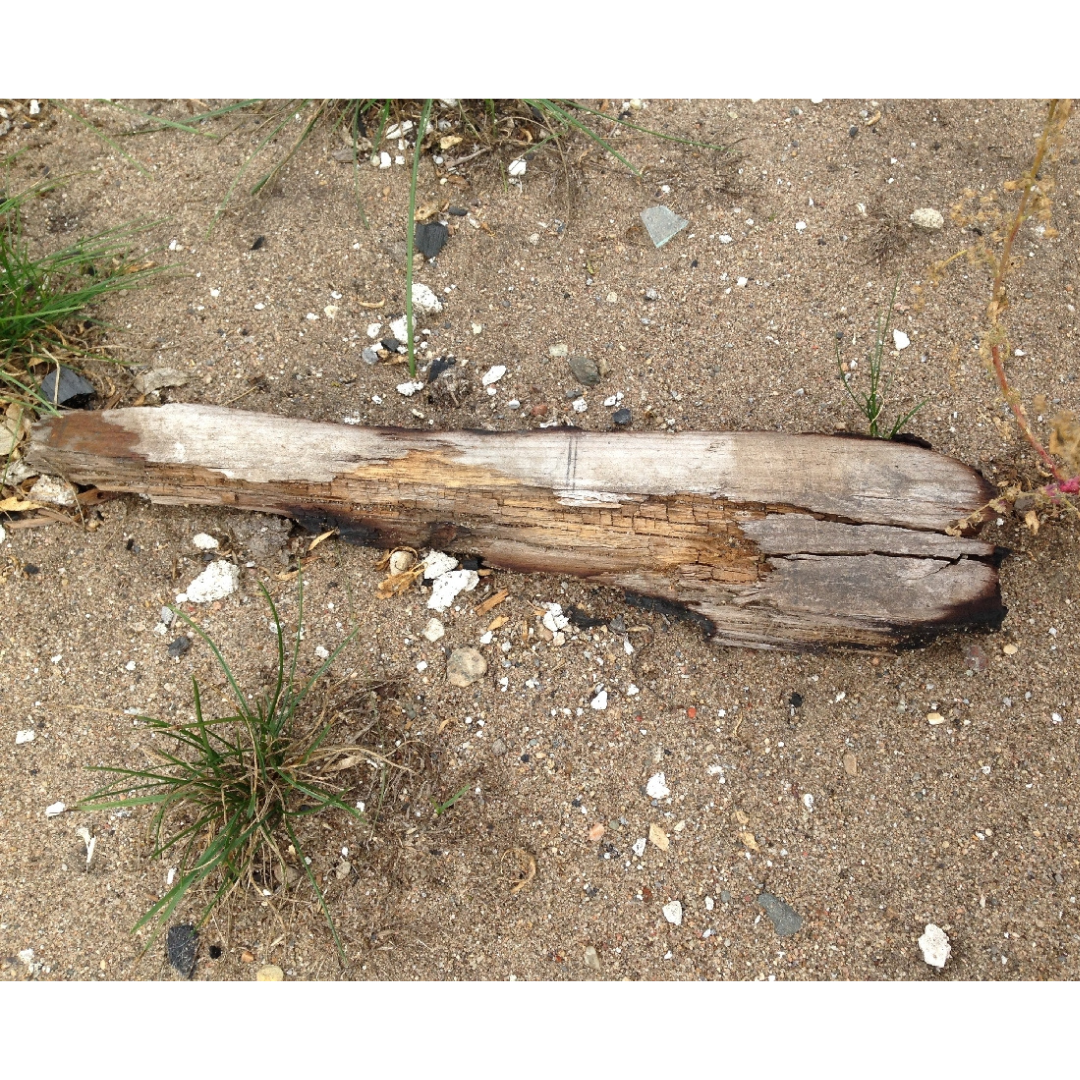
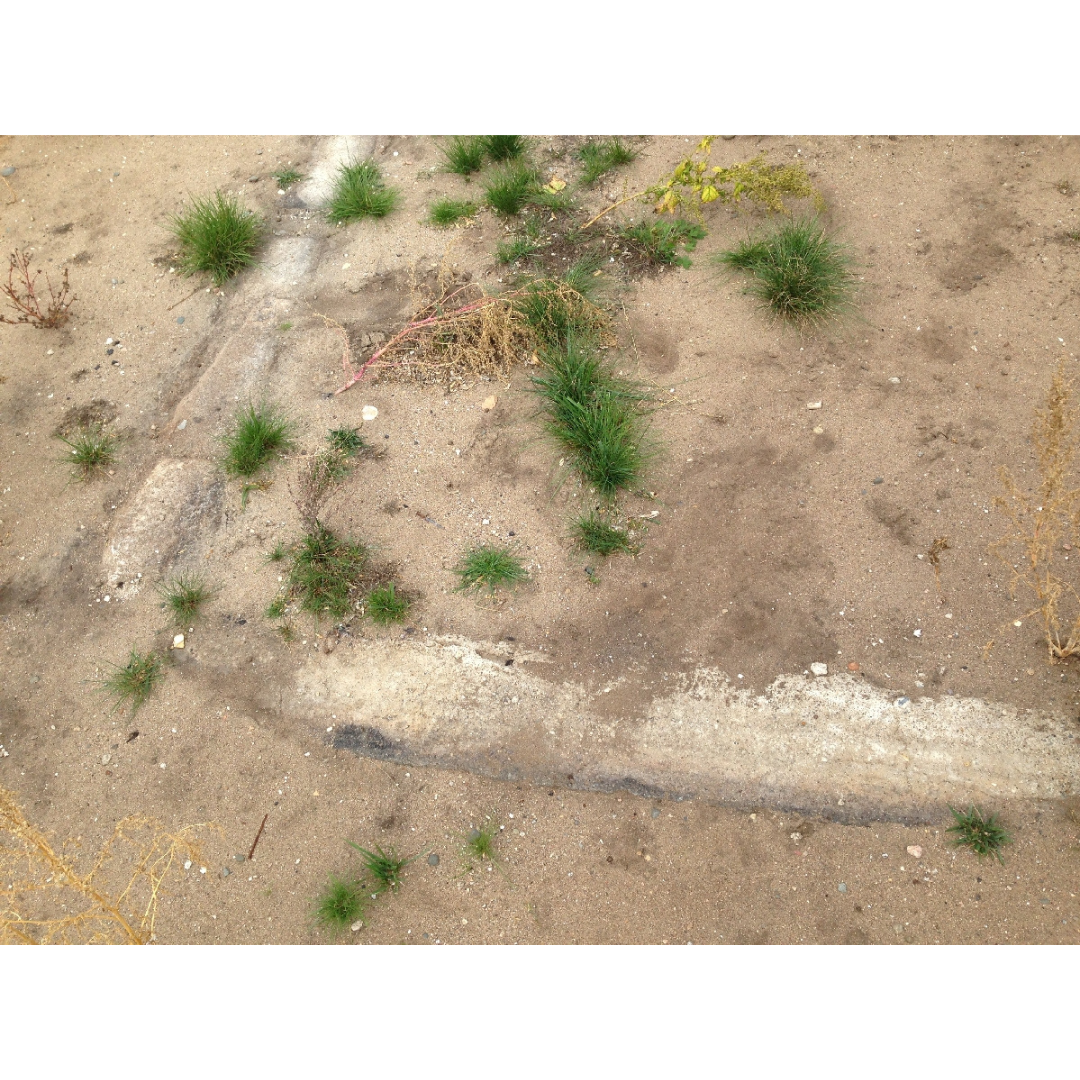
Before heading back to Winnipeg, Carolyn and I decided to visit Aweme (now the Criddle/Vane Homestead Provincial Heritage Park), the homestead of the Criddles from 1882 to 1960. Sadly, the big house, St. Albans, was destroyed by fire in June 2014. We poked around the sandy patch where the house once stood, trying to picture it.
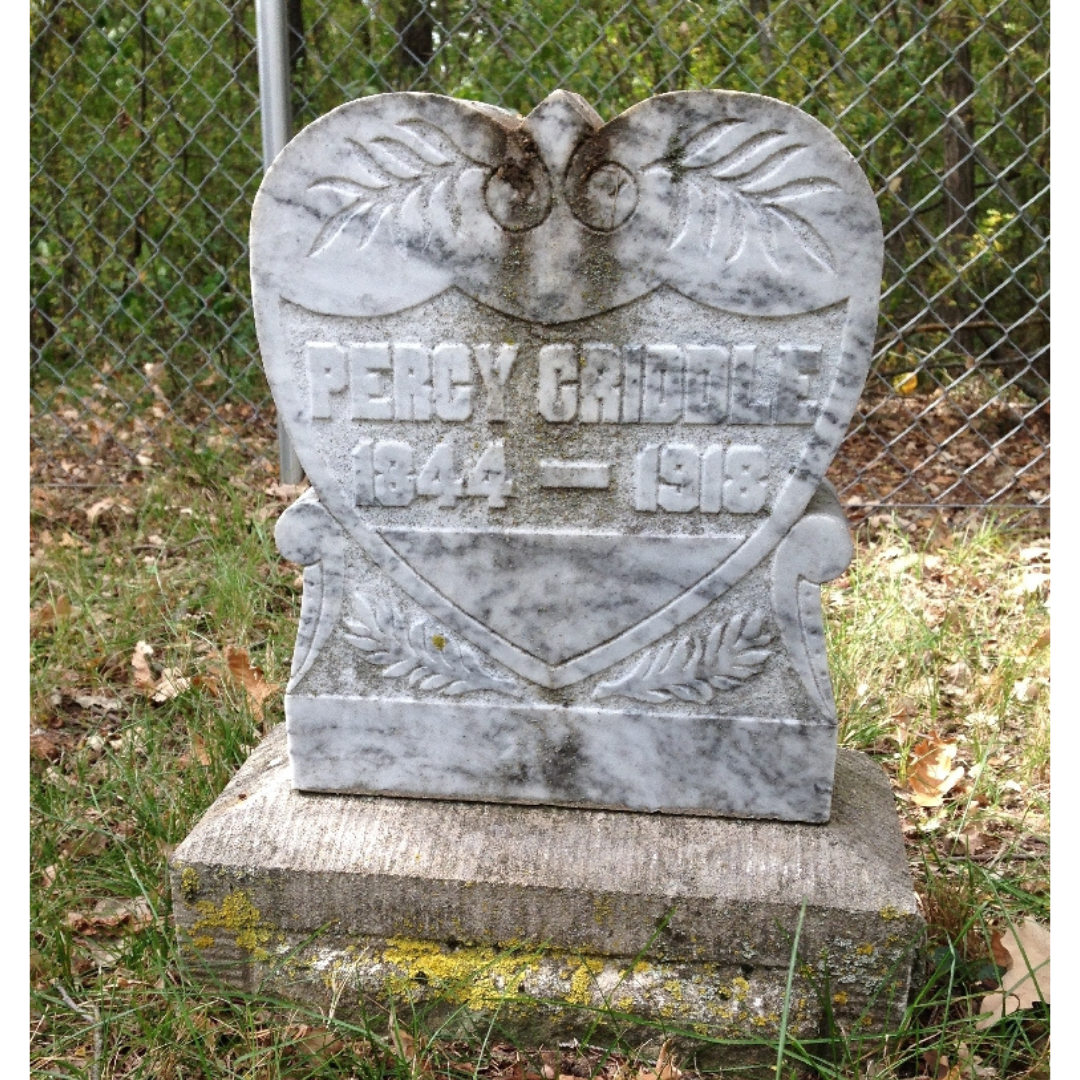
We hiked around the short trail, exploring Norman Criddle’s entomology lab and the crumbling foundation of Stuart Criddle’s former home, Gardenview, before stopping to pay our respects to Percy Criddle and his family at the graveyard.

A wooden beam embedded in the ground - part of the remnants of the big house known as St. Albans.

A right-angle corner made of wooden beams embedded in the ground - part of the remnants of the big house known as St. Albans.

A heart-shaped gravestone with two engraved leaves on the top of the heart. the stone reads, "Percy Criddle / 1844 - 1918".

Percy’s telescope has been catalogued, all its information and history entered into the collections database, the loan renewed for a five year term. Head out to Wawanesa and see it for yourself!

Cortney Pachet

Cortney Pachet

Collections Technician – Human History

Cortney Pachet started working at the Manitoba Museum in 2001 as a tour guide while earning her a BA (Honours) from the University of Winnipeg. She quickly realized that she wanted a career in museums…
Meet Cortney Pachet

Marvellous Mosses

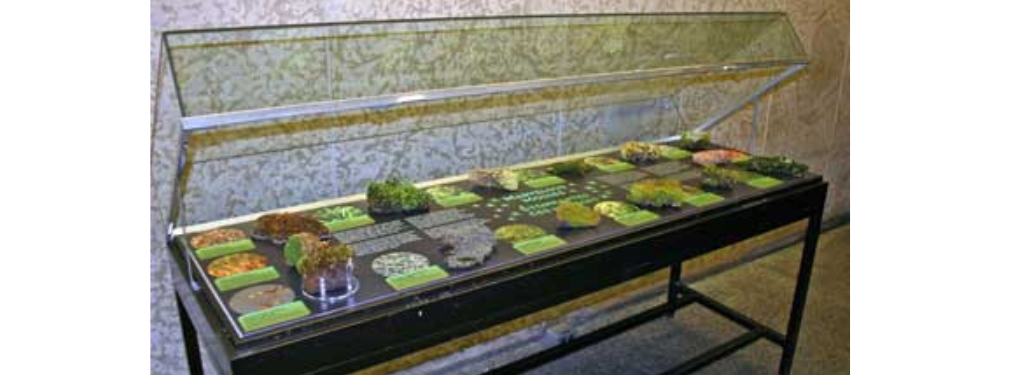
In a previous blog, Manitoba’s Miniature Forests, I described a field trip I took to obtain specimens of moss for the Museum’s collection. Today an exhibit featuring some of these moss specimens opened in the foyer of the Museum. I was grateful that Dr. Richard Caners with the Royal Alberta Museum was able to help identify these plants as mosses are not my main area of expertise.

Mosses are fascinating to look at with many varied forms. In fact, it’s amazing that such tiny plants can look so different. This exhibit will give visitors an opportunity to look at these organisms up close. Important features to look for are the stalked sporophytes, the reproductive parts of the mosses.

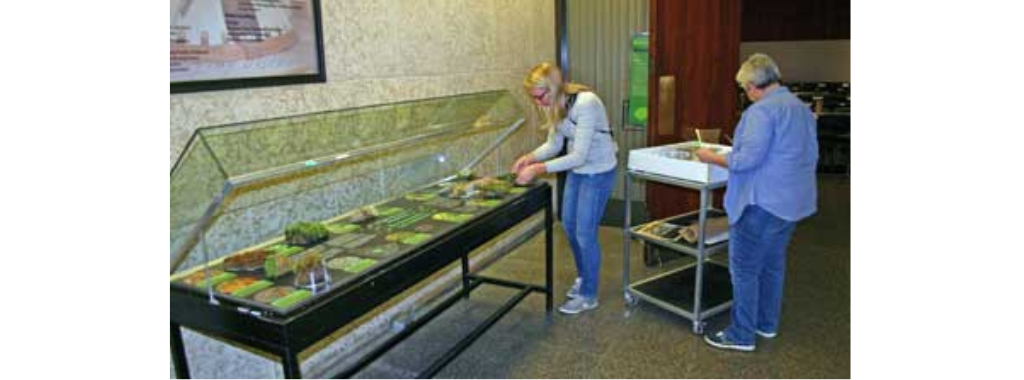
Two individuals arranging pieces in a ling, narrow exhibit case that has a raised glass lid.

Museum Conservators Carolyn and Ellen helped with the set up of the moss exhibit.

View into the open exhibit case with moss specimens in place, accompanied by information panels and photographs.

Set up completed!

The life cycle of mosses is quite different from that of flowering plants and people. If humans reproduced like mosses, our babies would grow out of our heads! Flowers and people normally have two sets of gene-containing chromosomes. Within our sex organs, cells with only half of these chromosomes are produced, namely eggs and sperm. This occurs so that when an egg and sperm unite, there will be just two sets of chromosomes (not four), one from each parent. But in mosses things work a little bit differently.

Mosses are like the amphibians of the plant world: they still need water to reproduce. The main part of the moss, the leafy green part, has only one set of chromosomes. During a wet time of the year, often spring, these plants produce eggs and sperm by straight cell division at the tips of their stems. The sperm are released and have to swim through water to reach the eggs. Once a sperm reaches an egg and fertilizes it, a tiny structure starts to grow from the tip of stem: a sporophyte with two sets of chromosomes. The sporophyte eventually produces spores with only one set of chromosomes. Once released, the tiny spores germinate and go on to produce the little plants we all know so well. Finished with its job of making babies and unable to photosynthesize, the sporophyte simply withers and falls off.


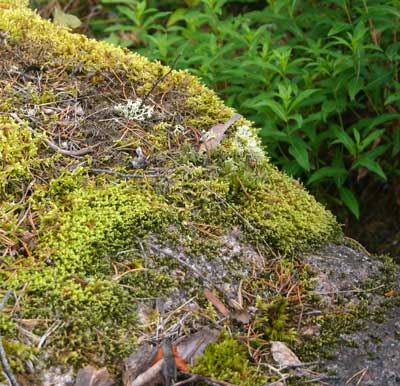
Image: It’s not dead! It’s just resting! Dried up mosses, like the ones on this rock, cease to be biologically active during hot, dry periods.

So come on down to the Museum to check out these marvellous little plants. They are available for the general public to view for free in the Museum’s foyer until April of 2016.

Dr. Diana Bizecki Robson

Dr. Diana Bizecki Robson

Curator of Botany

Dr. Bizecki Robson obtained a Master’s Degree in Plant Ecology at the University of Saskatchewan studying rare plants of the mixed grass prairies. After working as an environmental consultant and sessional lecturer…
Meet Dr. Bizecki Robson

Chief Piapot and the Qu’Appelle Treaty 

By Maureen Matthews, Past Curator of Cultural Anthropology 

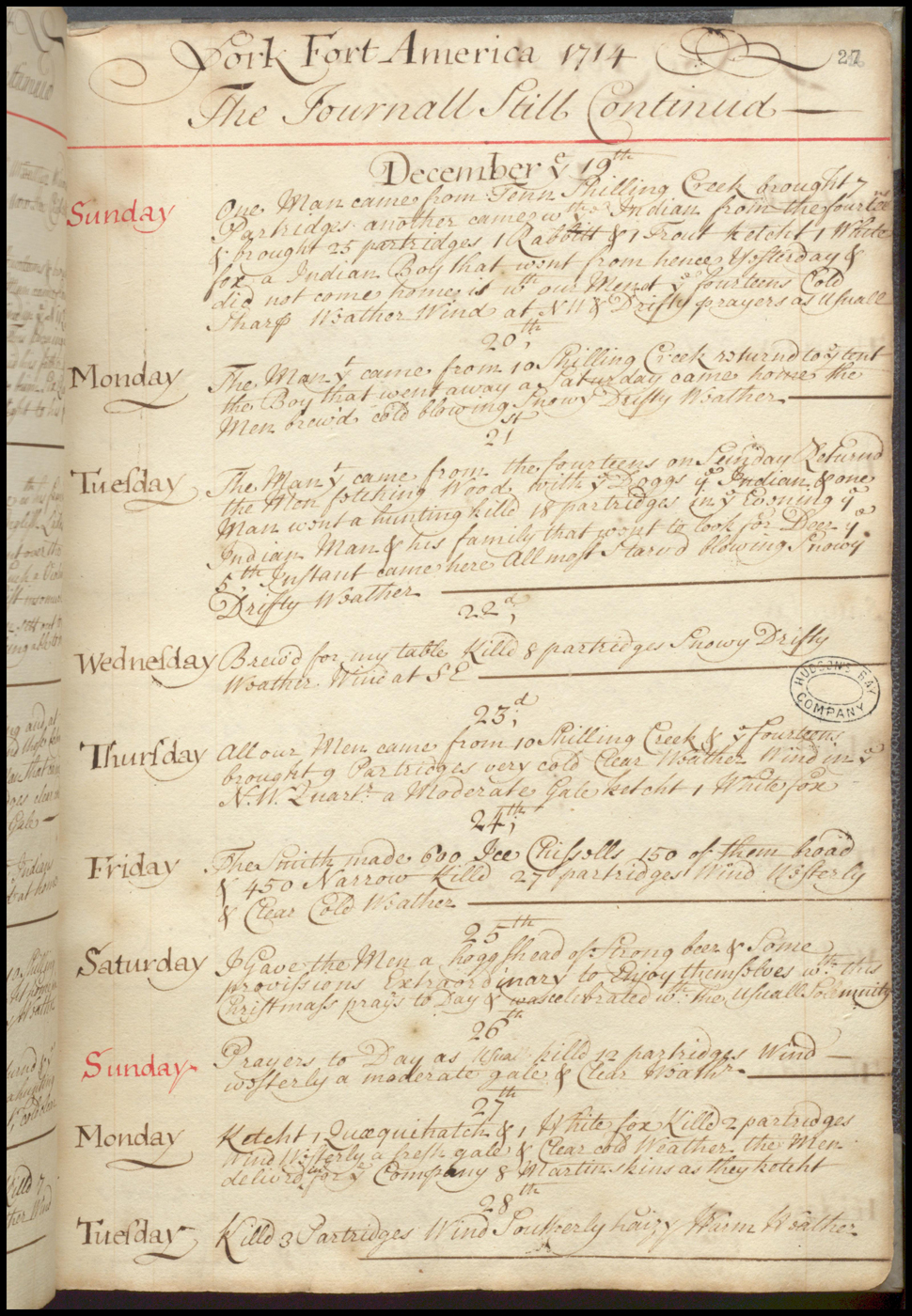
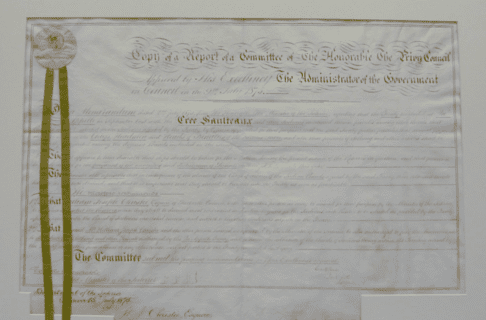
This is an image of an original 1875 handwritten parchment document related to the signing of Treaty No. 4., the “Qu’appelle Treaty”, temporarily on display at the museum as part the “We are All Treaty People Exhibit”. Treaty No. 4 was originally concluded at Fort Qu’Appelle in 1874 but many Anishinaabe and Cree Chiefs were absent at the time. This fragile document sets out instructions for Treaty Commissioner William Christie to return to Fort Qu’Appelle in the summer of 1875 and ” secure the adhesion” of the remaining Chiefs. 

Among those Chiefs was Piapot, one of the most famous and powerful leaders of the Plains Cree. He wanted a reserve for his people in the Cypress Hills region of what is now South-Western Saskatchewan. Christie misled Piapot about the terms of the Treaty, and Piapot’s band were forced to settle more than two hundred and eighty miles to the east. This document initiated a train of events which led to a decades long enmity between Canadian officials and the Plains Cree of Piapot’s band. 

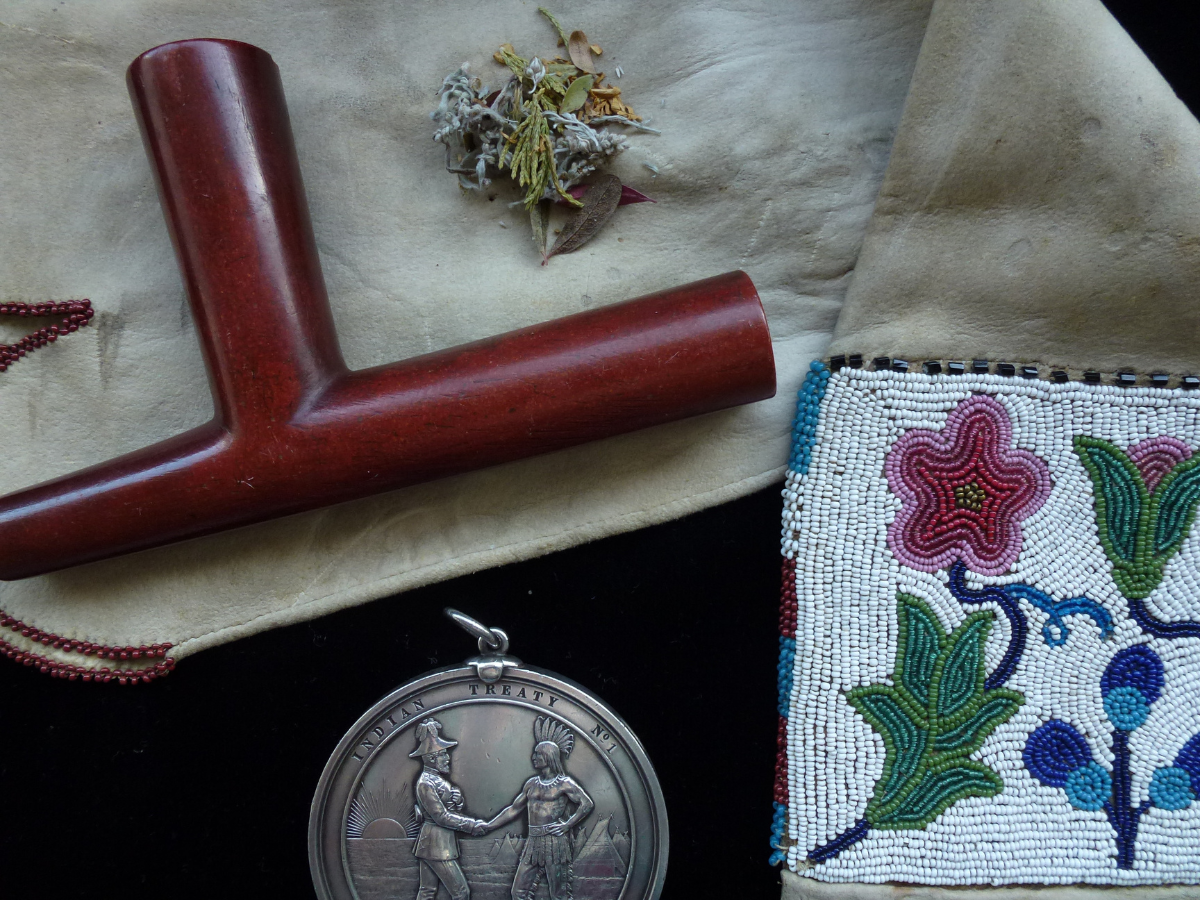
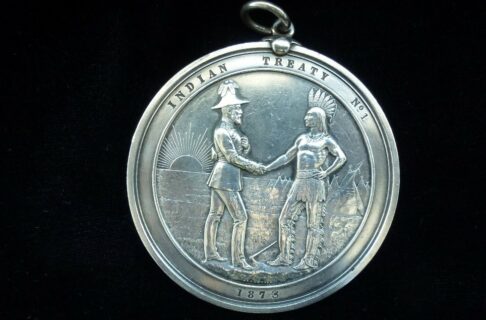
Close-up view of some of the artifacts featured in the “We Are All Treaty People” Exhibit: a wooden pipe and some tabacco laid on a pipe bag with beaded detailing. A Treaty No. 1 handshake medal.

Also featured in the “We are All Treaty People” exhibit is a peace pipe formerly owned by Piapot. The pipe was a gift of thanks to a minister who conducted the marriage of Piapot’s daughter.

The text of the document follows: 

Copy of a Report of a Committee of The Honourable The Privy Council 

Approved by His Excellency The Administrator of the Government in Council on the 9th of July 1875. 

A Memorandum dated 2nd of July, 1875, from, The Honourable the Minister of the Interior,  respecting the Treaty concluded at Qu’Appelle in September last with the Cree, Saulteaux and other Indians mentioned therein, provides among other things, that reserves be selected for the Indians affected by the Treaty by Officers appointed for that purpose; that the said Treaty further provides , that annual payments should be made to the Chiefs, Headmen and Heads of Families of the various Tribes , and also that presents of clothing and other articles shall be annually distributed among the different Bands included in the Treaty. 

That it appears to him desirable that steps should be taken for the selection during the present season, of the Reserves in question and that for provision to be made at once for the payment of the annuities and distribution of Presents  authorized to be distributed this year 

The Minister also represents that in consequence  of the absence of the Chiefs of certain of the Indian Bands affected by the said Treaty, their adhesion thereto has not as yet been obtained and thus it is important that they be brought into the Treaty as soon as practicable. 

He therefore recommends: 

 That William Joseph Christie, Esquire of Brockville, Ontario with the assistance of persons as may be named for the purpose by the Minister of the Interior be appointed to select the Reserves where they shall be determined most convenient and advantageous for the Indians , each reserve to be selected as provided by the Treaty after conference with the Band of Indians interested therein and subject to the conditions set forth in the Treaty.  

That the said, Mr. William Joseph Christie and the other person named as aforesaid by the Minister of the Interior to be authorized to pay the annuities and to distribute Clothing and other Presents authorized by the Qu’Appelle Treaty  and secure the adhesion of the Bands of Indians living within the territory covered by the Treaty and who either from absence or any other cause, were not parties to the Treaty concluded last year. 

The Committee submit the foregoing recommendation for your excellency’s approval. 

To The Honourable 

The Minister of the Interior Etc, etc, etc } 

Department of the Interior, Ottawa , 15 July 1875 

  1. J. Christie, Esquire                                      [signed] Minister of the Interior


Images: Parchment document HBC 1, Photo The Manitoba Museum 

Pipe, H4-42-6A, Pipe Bag, H 4-4-21-76, and Treaty Medal, HBC 57-53, Photo The Manitoba Museum. 

The Amazing Criddles – Part 1: The Family

Within the History Collection at the Manitoba Museum, we have sub-collections of artifacts, tied together by object type (like our collection of crocks) or social movement (like our fraternal orders material). One of our significant collections comes from a homesteading family whose breadth of material culture has caused my coworkers and I to ask on more than one occasion, “did the Criddles ever throw anything away?!”

In 1882, an Englishman and his family immigrated from Addlestone, Surrey, UK to a patch of sandy land east of Brandon, Manitoba to try his hand at farming. Unlike typical homesteaders of his day, Percy Criddle was the son of aristocrats, schooled in medicine and music at Heidelberg. He fancied himself a renaissance man, dabbling in sport, astronomy, law, medicine, and music, hosting weekend parties and maintaining a detailed meteorological record from 1884 until his death (and then perpetuated by his children until they abandoned the homestead in 1960). The most compelling peculiarity, however, is his family. Percy met Elise Harrer while he was studying in Germany; the two never married, but Elise moved to London after Percy returned to the UK and they proceeded to have six children –one of whom died in infancy. Shortly after Elise became pregnant with their last child, Percy married an Englishwoman named Alice Nicol. Alice gave birth to four children in the UK and another four at Aweme, their Manitoban homestead. After moving to Canada, both women (with Elise now using the surname “Vane”) lived under the same roof and the children were raised together, although their understanding or acknowledgement of their relationships has been the subject of debate.

From the meteorological record, visitors’ register and diaries to scientific catalogues and photographs, the Criddles were a well-documented family. The documentation pales in comparison to the material culture accumulated and preserved by the family from 1882 onward. Percy details purchases and acquisitions in his diary, noting their prices and sources and writes about his opinions on objects like his new telescope or organ. He also talks about items produced by the family; building blocks Percy made for the children or the house flag sewn by Alice. Percy and the family were regularly visited by an old friend, J.A. Tulk, who travelled from Surrey to Aweme on an annual basis, lugging all sorts of medicines, scientific instruments, books and other gifts for the Criddle-Vane family.

109 years after the Criddles arrived in Manitoba, a handful of Percy’s grandchildren donated the bulk of their grandparents’, aunts’, uncles’ and parents’ belongings to The Manitoba Museum –a whopping 3481 artefacts and 302 specimens! Over the past six months, the majority of my time has been dedicated to completing the cataloguing of this collection. Hundreds of Criddle artifacts have passed through my hands and I count myself lucky to have access to these amazing items. Here are a few of the most memorable artefacts I catalogued from the Criddle Collection:

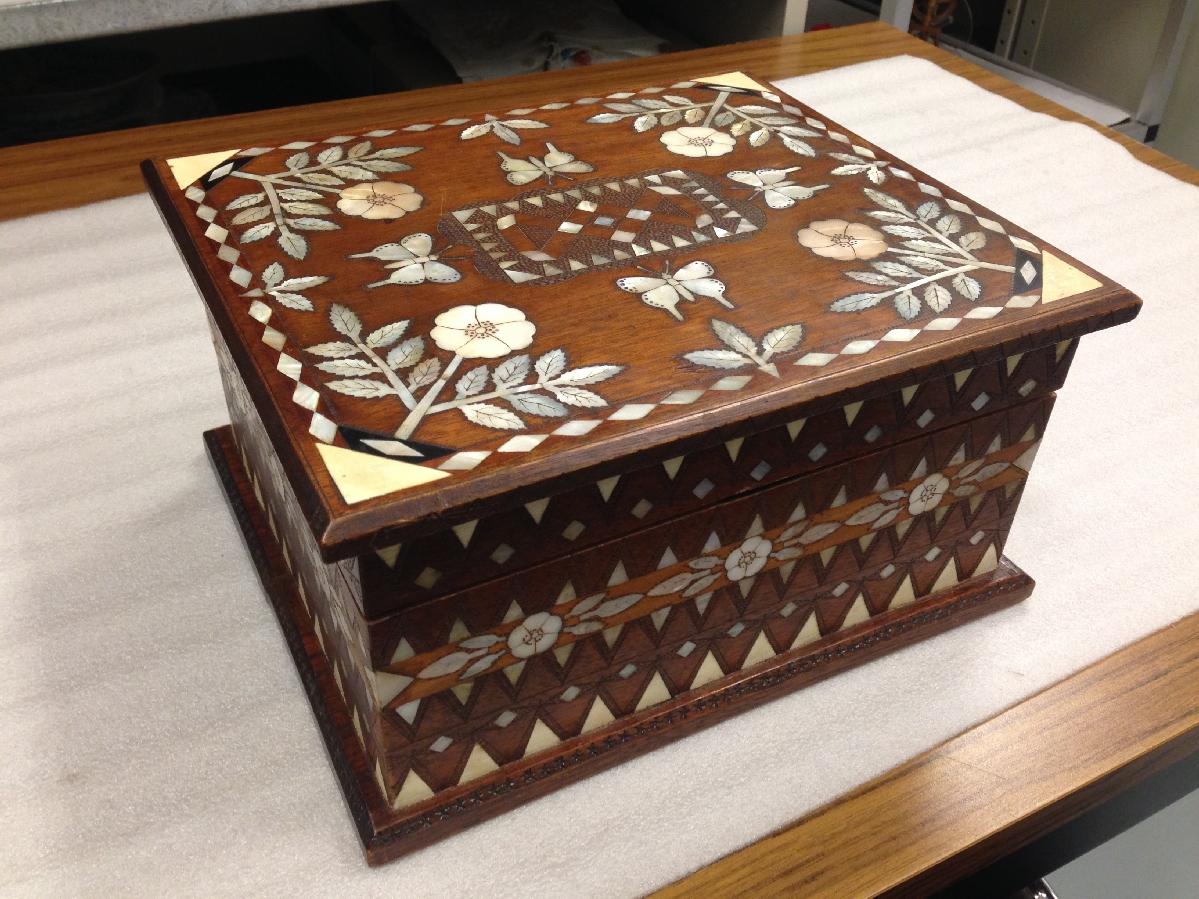
A wooden box inlaid with mother of pearl detailing in an intricate pattern.

1. Storage Box made by Stuart Criddle in 1903. This box, decorated with mother of pearl inlay, is one of many inlaid pieces created by the Criddle sons on winter evenings at Aweme. Lined with lush blue velvet, the box has an internal locking mechanism that is released by pressing a small piece of inlay located near one of the hinges. It took a lot of fiddling to discover exactly how it opened, so I noted the specifics in the catalogue record for future reference. The question remains…what was Stuart hiding in there?

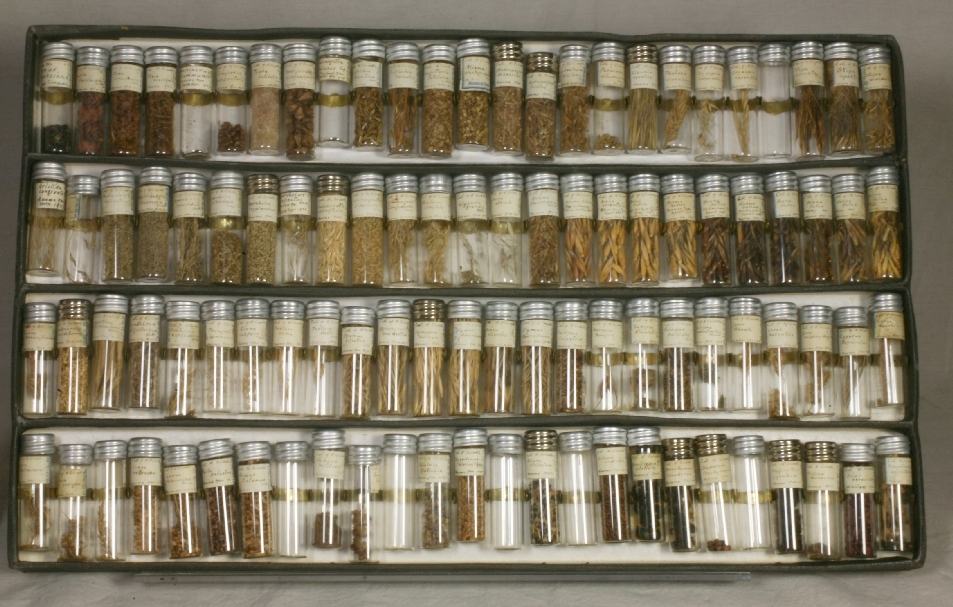
A shallow box containing four rows of small vials containing seeds.

2. Seed Samples collected by Norman Criddle between 1906-1933. Mainly known for his work in entomology, Norman Criddle was appointed the Manitoba provincial entomologist in 1919 and ran an entomology lab at Aweme. However, like his father, Norman had a range of interests, so it comes as no surprise that he was also a renowned watercolourist, his delicate illustrations of local flora gracing the pages of agricultural books like “Fodder and Pasture Plants” and “Farm Weeds of Canada”. During the second half of his life, Norman developed a collection of seeds totalling nearly 700 samples sourced primarily from Aweme and the surrounding area. Each sample was stored in a vial and all the relevant information was scrawled by Norman on tiny labels adhered to the vials. Deciphering what I refer to as “historical handwriting” is an arduous task and my colleagues started asking “Still working on the seeds?” I would shoot daggers from my eyes.

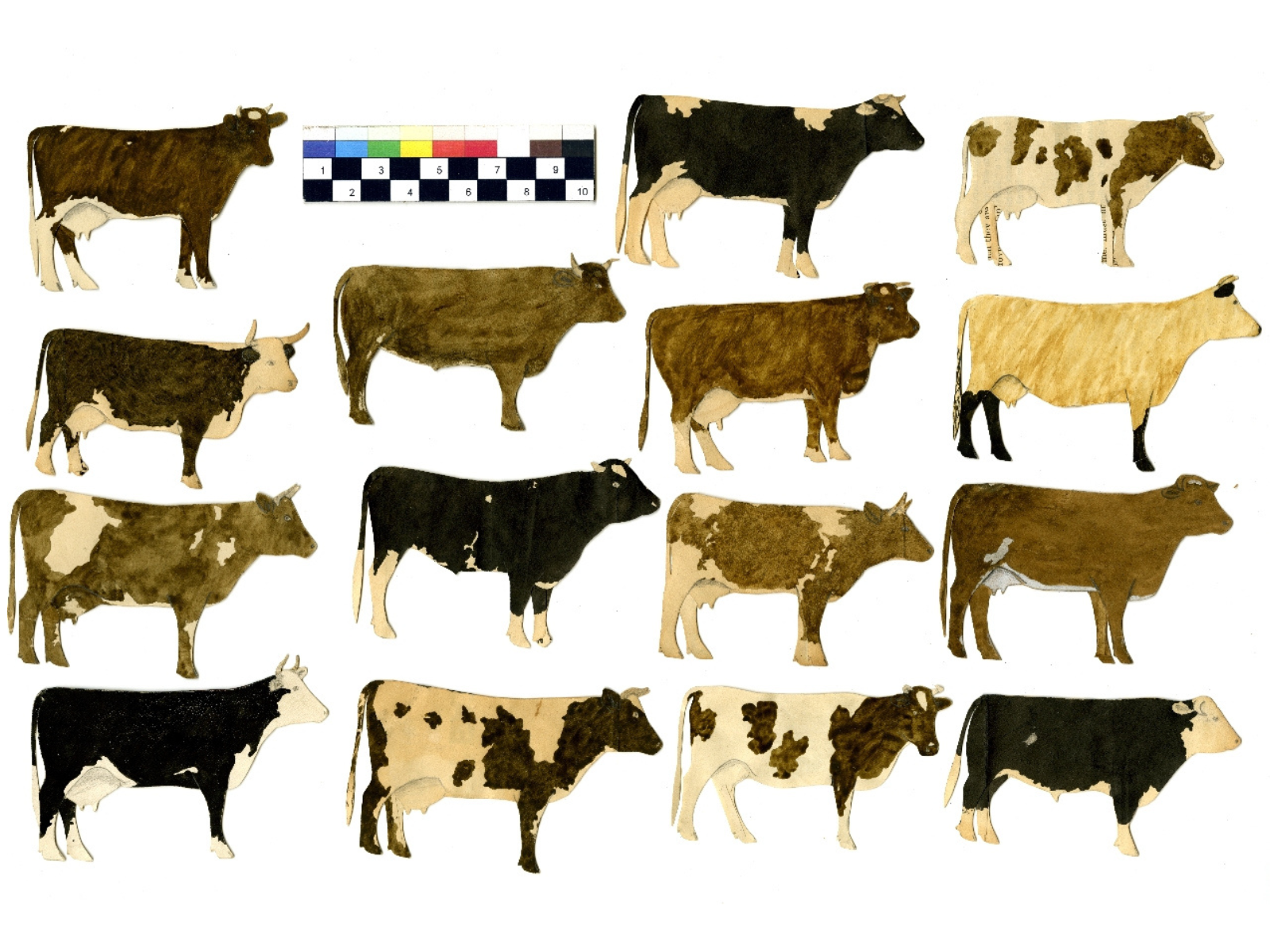
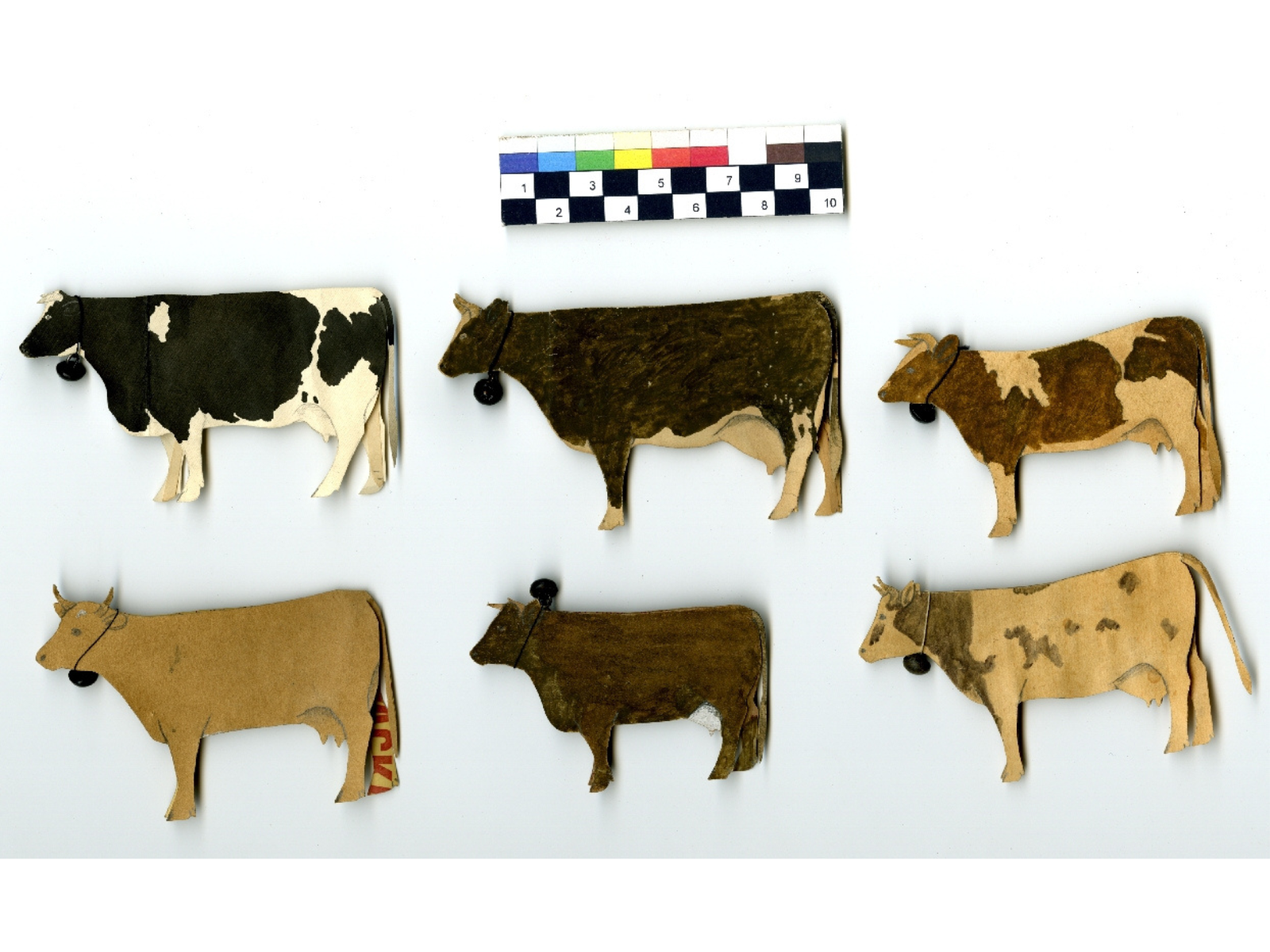
3. 129 Homemade cut-outs of Animals, including cows, bulls, horses, and dogs, made by Alma Criddle, circa 1909. According to Criddle-de-diddle-ensis: A biographical history of the Criddles of Aweme, “the cows were such favorites that [Alma] made paper replicas of them, instead of the usual “paper dolls” of childhood.” She cut out animal bodies from scraps of paper and used watercolours to tint the animals, replicating their unique looks. In the case of the cattle, Alma wrote the name of each animal near its belly, including bulls Carrot, Rhubarb and Radish and cows Rice, Nectar, Sylvia, Myrtle, White Rose and Pansy. I seriously had a huge smile on my face the entire time I worked on these paper animals.

Fifteen diligently hand-painted paper cut outs of cows.

Six diligently hand-painted paper cut outs of cows.

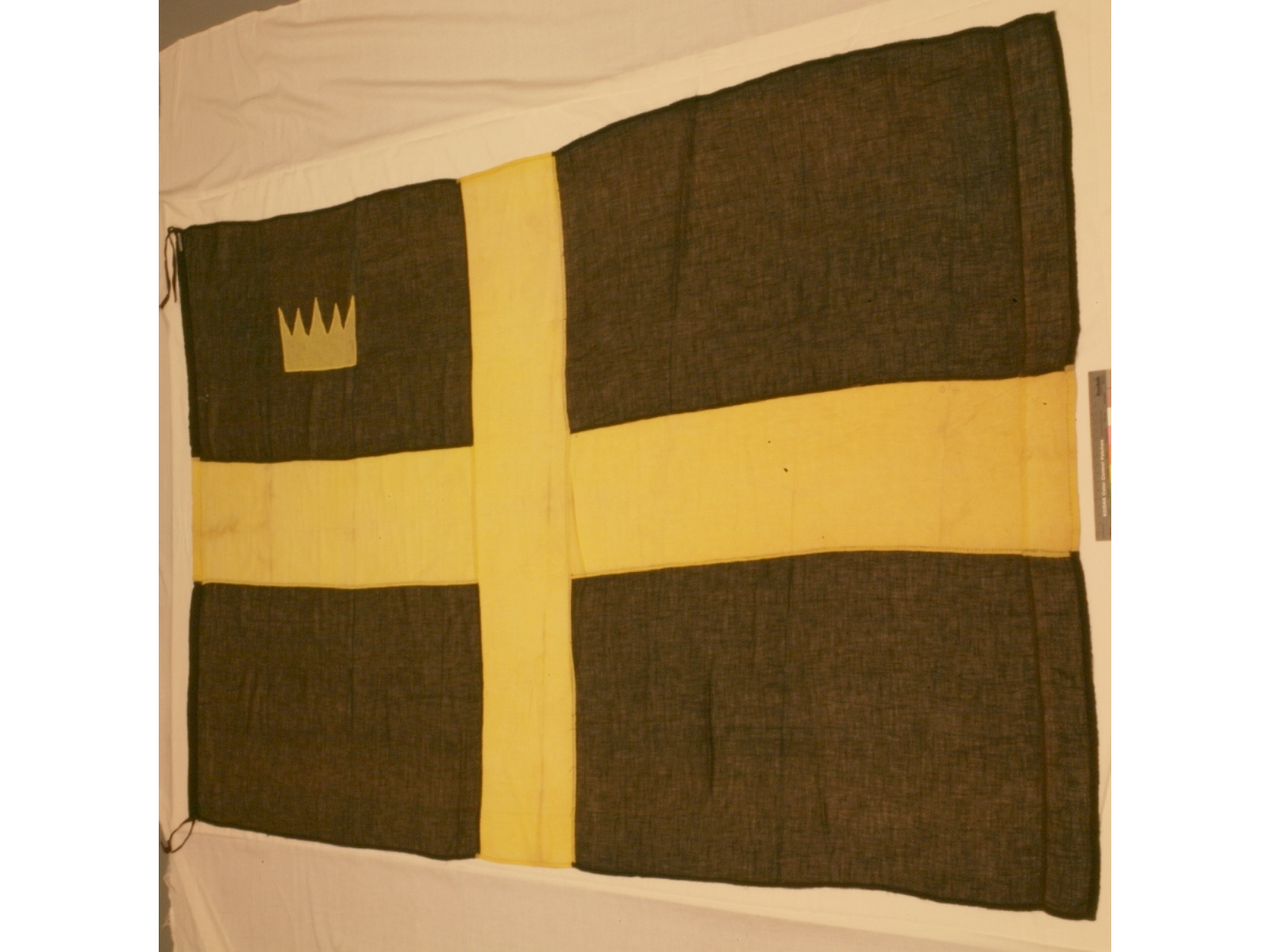
A large flag in brown material with a yellow cross through it. In the upper left quadrant is a yellow crown.

4. The St. Albans house flag was made by Alice Criddle in 1888. St. Albans was the title Percy assigned to the family home at Aweme, in the tradition of great English houses. Why he chose the name is never explained in his diaries, although his granddaughter speculates at length why he may have selected St. Albans in her book “Criddle-de-Diddle-Ensis”. The flag is well preserved and I love that it lends to Percy’s established reputation as an eccentric.

Now that the work is complete, I find myself feeling a mix of relief and longing – I’ll miss this peculiar homesteading family but other collections beckon. Stay tuned!

Cortney Pachet

Cortney Pachet

Collections Technician – Human History

Cortney Pachet started working at the Manitoba Museum in 2001 as a tour guide while earning her a BA (Honours) from the University of Winnipeg. She quickly realized that she wanted a career in museums…
Meet Cortney Pachet

Seven things you didn’t know about Cannabis

With the potential legalization of recreational marijuana in Canada in the news, it is useful to know a little bit about the history of this unusual plant. So here is my list of things you (probably) didn’t know about marijuana aka Cannabis.

An open drawer with samples of natural fibres accompanied by text and photographs.

1. Marijuana and hemp are the same species.

Technically both these plants belong to the same species: Cannabis sativa.  However, industrial hemp is a cultivar that has been bred to produce good fibre while marijuana has been bred to maximize its tetrahydrocannabinol (THC) content. Hemp has little to no THC in it.


2. Cannabis sativa  means “cultivated fragrant cane”.

Cannabis sativa  is the scientific name of the plant. All species have a genus (Cannabis ) and a species epithet (sativa ). The name is derived from the ancient Greek word for the plant (kannabis ) which means “fragrant cane”. The term “sativa” means “cultivated” in Latin.


Image: A display drawer in the Parklands/Mixedwoods Gallery shows rope made from natural fibers like wood nettle (Laportea canadensis) and hemp dogbane (Apocynum cannabinum).

Close up on the dense green leaves of a Wood nettle plant.

3. Cannabis  was once thought to grow in the wilds of Canada.

The explorer Jacques Cartier reported seeing “wilde hempe” in Canada. However, he was probably referring to hemp dogbane (Apocynum cannabinum) or wood nettle (Laportea canadensis), species traditionally used by First Nations peoples for rope making. Cannabis  is actually native to China, India, Pakistan, Afghanistan, Tagikistan and Kyrgyzstan.


4. Canadians were legally required to grow Cannabis at one time.

In the 1600-1700’s, Nova Scotian and Canadian (Quebec) farmers were required to grow hemp as Briton and France needed it for ship building; up to 80 tons of hemp were needed for every ship. However, many farmers did not want to grow hemp as they preferred growing food so they wouldn’t starve. King James I made the cultivation of hemp and flax mandatory in the English colonies of North America in 1611. In Quebec, King Louis XIV’s representative Jean Talon seized all of the thread that was for sale and distributed it only to farmers in exchange for hemp, so desperate were they to get their hands on some for their shipbuilding industry.


Image: Wood nettle, sometimes called hemp nettle (Laportea canadensis was traditionally used for rope making in Canada.

A pressed ,preserved specimen of Hops, with identification and specimen data in the lower right corner.

5. It was legal to grow Cannabis  during World War II.

In 1938 growing any Cannabis sativa (even hemp) in Canada was outlawed. During World War II the ban on hemp was lifted because the fibre was needed for the war effort as Japan controlled much of the land where hemp was being grown. The commercial growth of industrial hemp in Canada finally became legal again in 1998, although a licence is required for any farmer who wishes to do so. In 2015 the sale of hemp for its fibre, oil and seeds are projected to make Canadian farmers $45-$85 million.


6. Beer contains a close relative of Cannabis.

Hops or Humulus lupulus is in the same plant family as Cannabis : the Cannabaceae. Hops, which any beer aficionado knows, are the crucial ingredient to a good beer. The flowers of hop plants are covered with fragrant resin just as Cannabis flowers are. These flowers impart a bitter flavour to beers, as well as helping to preserve the brew.


Image: Hops (Humulus lupulus), a key ingredient in beer, grows wild in Manitoba. TMM B-4621.

7. Cannabis  is on display at The Manitoba Museum.

Cannabis can be seen in the Nonsuch Gallery; all of the ropes on the Nonsuch are made of hemp. Further, the ‘oakum’ used for caulking the joints between the boards was made from hemp fibres and Stockholm tar, which is what gives the ship that smoky smell. The Museum also has 15 hempen artifacts in the history collection (mainly textiles).

Coils of rope on hooks around the mast of a ship.

All of the ropes on the Nonsuch are made of hemp.

A storage unit containing textile artifacts rolled on beams to maximize storage space. One rug is partally unrolled to show the green, red, and gold pattern.

The Museum’s collection of textiles includes some hempen rugs. These artifacts are stored behind the scenes in the Museum’s vault.

Dr. Diana Bizecki Robson

Dr. Diana Bizecki Robson

Curator of Botany

Dr. Bizecki Robson obtained a Master’s Degree in Plant Ecology at the University of Saskatchewan studying rare plants of the mixed grass prairies. After working as an environmental consultant and sessional lecturer…
Meet Dr. Bizecki Robson

Flipping the Skull

By Dr. Graham Young, Curator Emeritus of Geology and Paleontology


It is exciting and interesting to work with the fossils of large vertebrate creatures, but this is a field with many complexities. During the fossilization of most vertebrates, the bone was replaced by other minerals, which makes the skeletal components both heavier and more brittle than they were during the animal’s life. For those of us working in the “back rooms” of museums, it can be very tricky to move these large, weighty, and fragile fossils as we prepare them, study them, or mount them for exhibit.

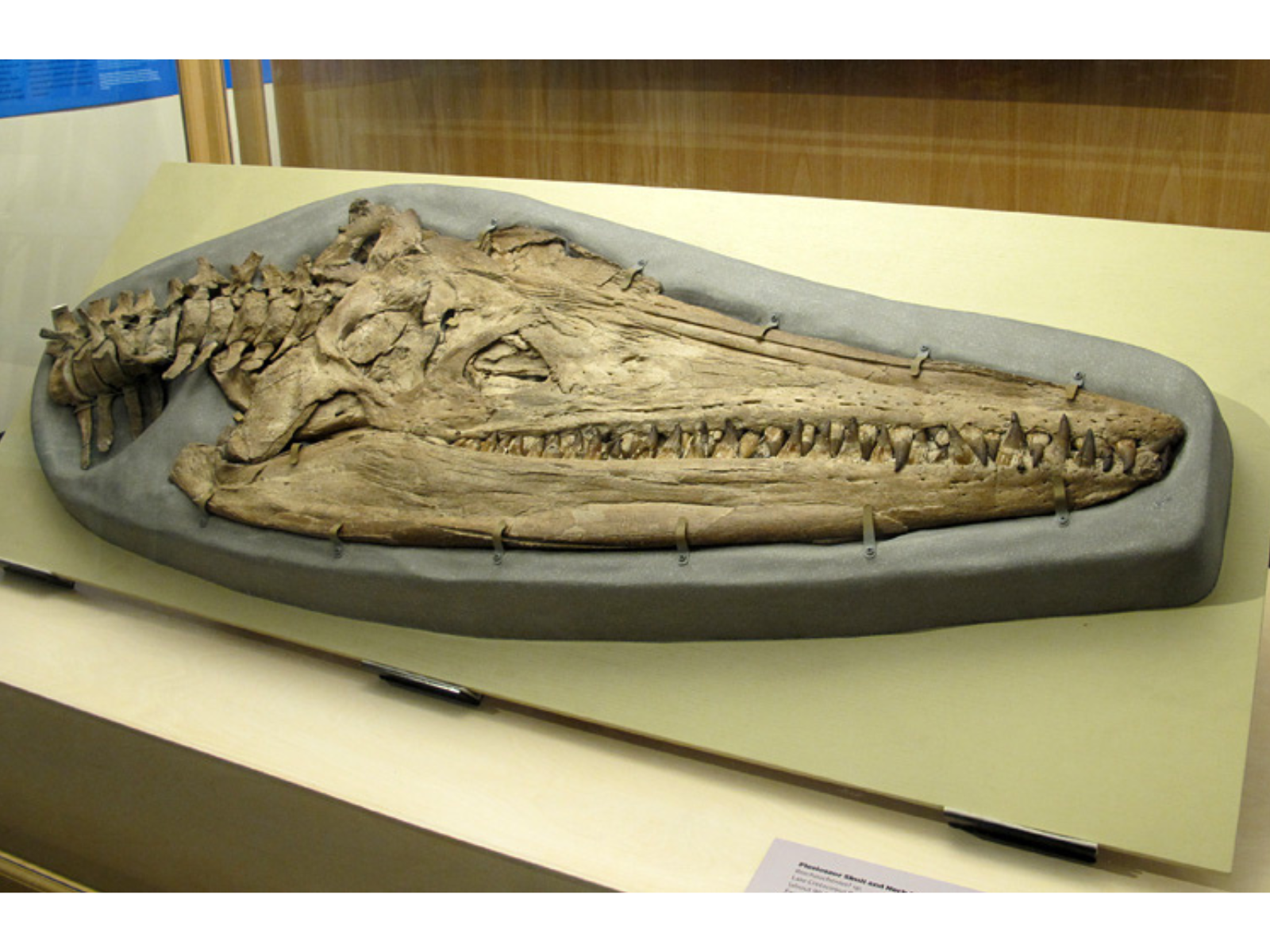
A few weeks ago, we had to perform one of the trickiest tasks associated with big vertebrates: flipping a skull. The large pliosaurid plesiosaur (read more in “Sea of Monsters”, here) that was donated to the Museum by Wayne Buckley (read more in “The Old Plesiosaur and the Sea”, here) had been fully prepared by Wayne, so that the bones are completely removed from bedrock; their weight is supported by mounts or cradles (structures similar to the plaster field jackets). This makes the fossil much easier to exhibit or study, but it means that we have to ensure that we are fully supporting the skull whenever we move it, so that it doesn’t collapse or break. Since this particular specimen is unique and scientifically important, and since it has survived the past 90 million years or so in remarkably good condition, it is imperative that we take extra care!

A plesiosaur skull fossil in a display mount. A large aquatic dinosaur with a long snout like mouth full of teeth.

The plesiosaur skull, as it appeared in our temporary exhibit last winter.

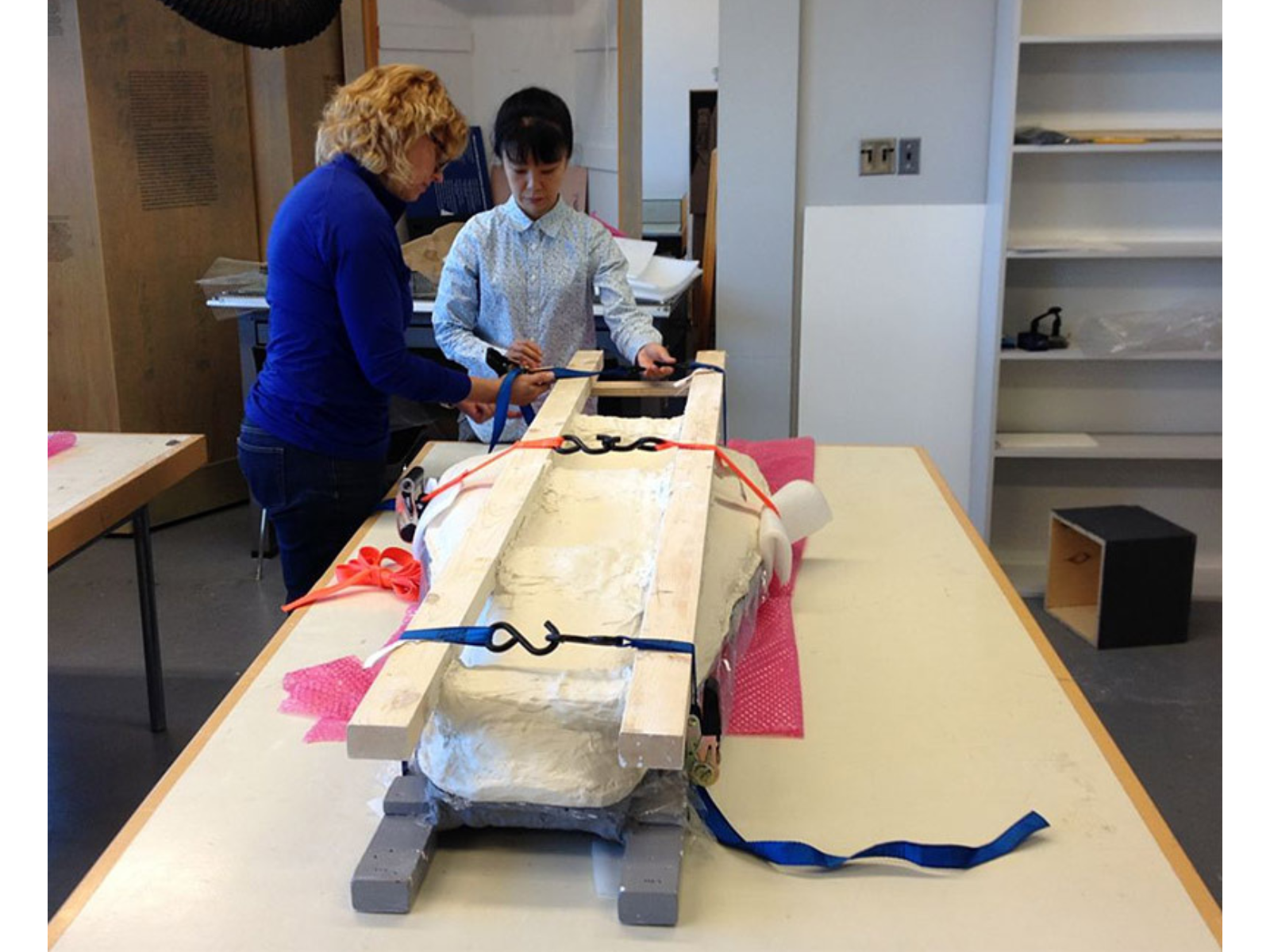
Two individuals standing at the far end of a table attaching cradles on either side of the skull fossil.

Janis Klapecki and Tamaki Sato, strapping the two cradles together.

In late September, we were visited by Dr. Tamaki Sato (Tokyo Gakugei University) and Dr. Xiao-Chun Wu (Canadian Museum of Nature), who spent several days here studying the skeleton for a scientific publication. Before they arrived, Debbie Thompson had been making the final exhibit mount for the plesiosaur; to allow her to do that work, the skull was resting in a temporary support cradle, with its “back” side (the side hidden during exhibit) facing up. We knew that Tamaki and Xiao-Chun would want to thoroughly examine both sides of the skull, and that at the midpoint of the week we would need to flip it so that they could study the “front” side.

Knowing this in advance, Debbie had prepared a second cradle that would fit onto the the side that was currently up, making this support out of wood, plaster, burlap, and other materials. Unfortunately for us, Debbie was on vacation when the visiting scientists were here, so it was left to the rest of us to ensure that the cradle was used as she had intended.

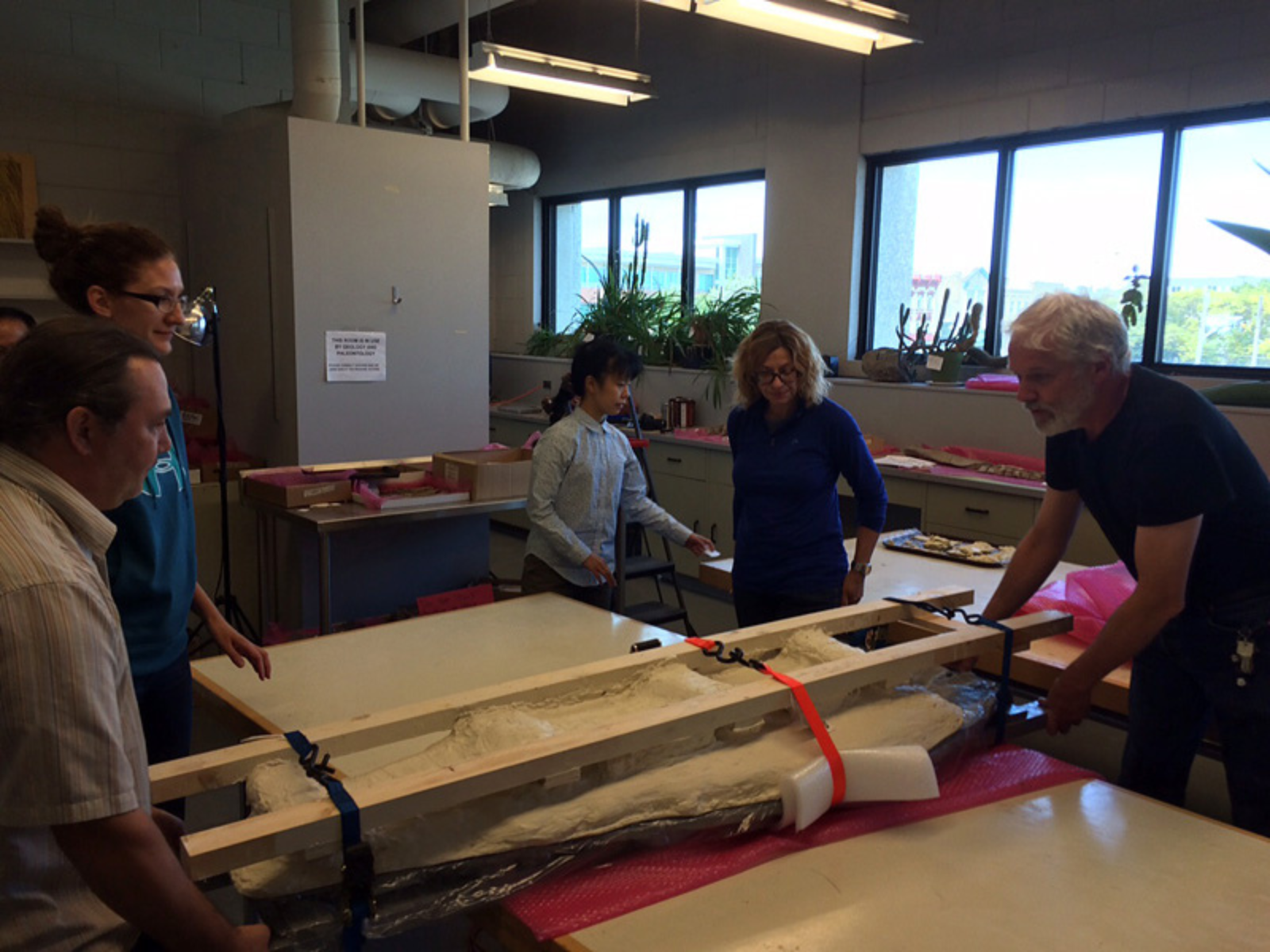
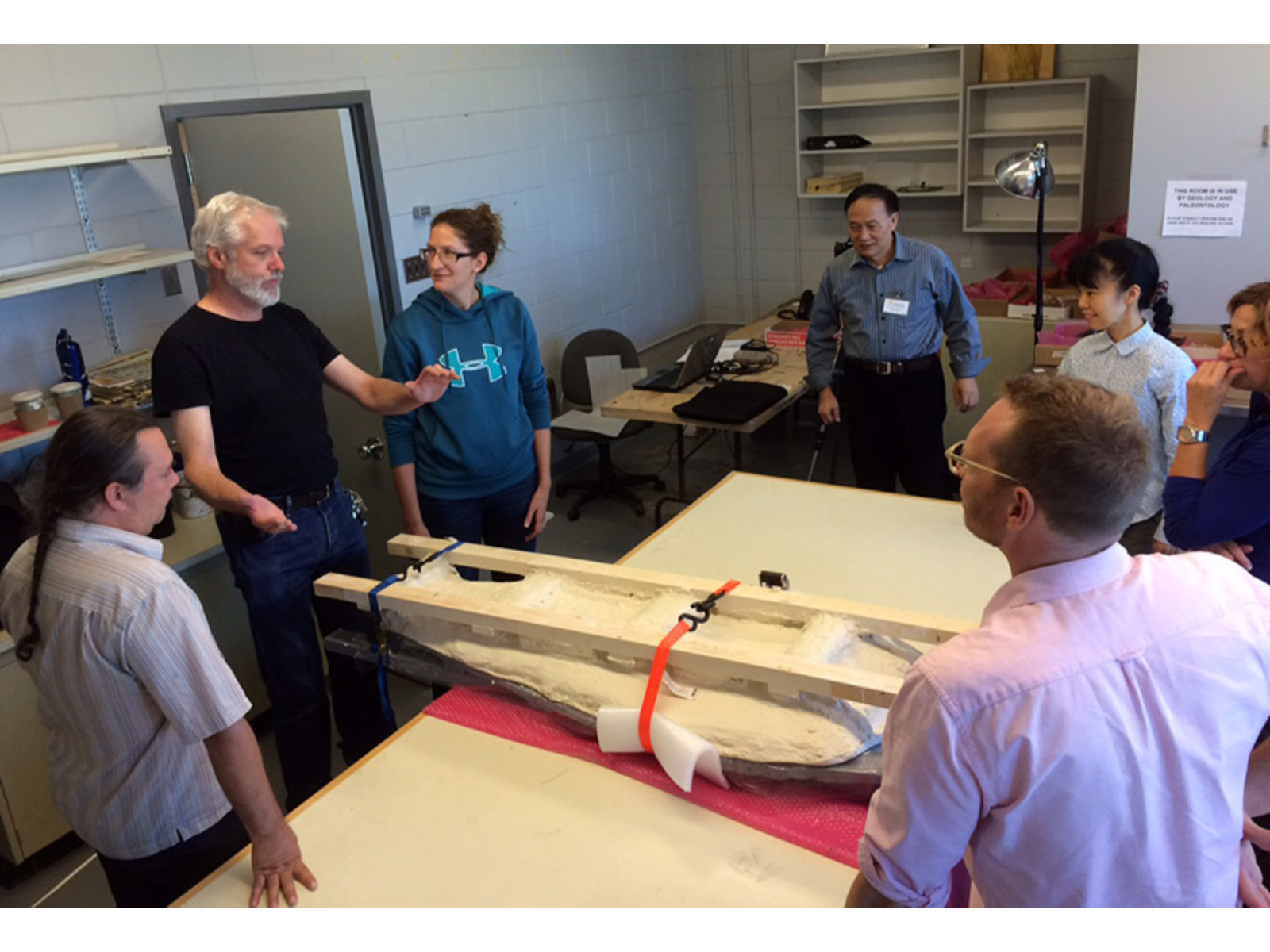
Five people standing around a table, with a cradled fossil on it. Long boards securaed either side of the fossil hang off each end of the table to facilitate a smooth flip.

Before we could begin the “flip”, we had to turn the cradles so that they ran across the table. L-R: Kevin Brownlee, Amelia Fay, Tamaki Sato, Janis Klapecki, and me (photo by Stephanie Whitehouse).

View from a raised angle, seven people standing around a table, with a cradled fossil on it. Long boards secured either side of the fossil hang off each end of the table to facilitate a smooth flip.

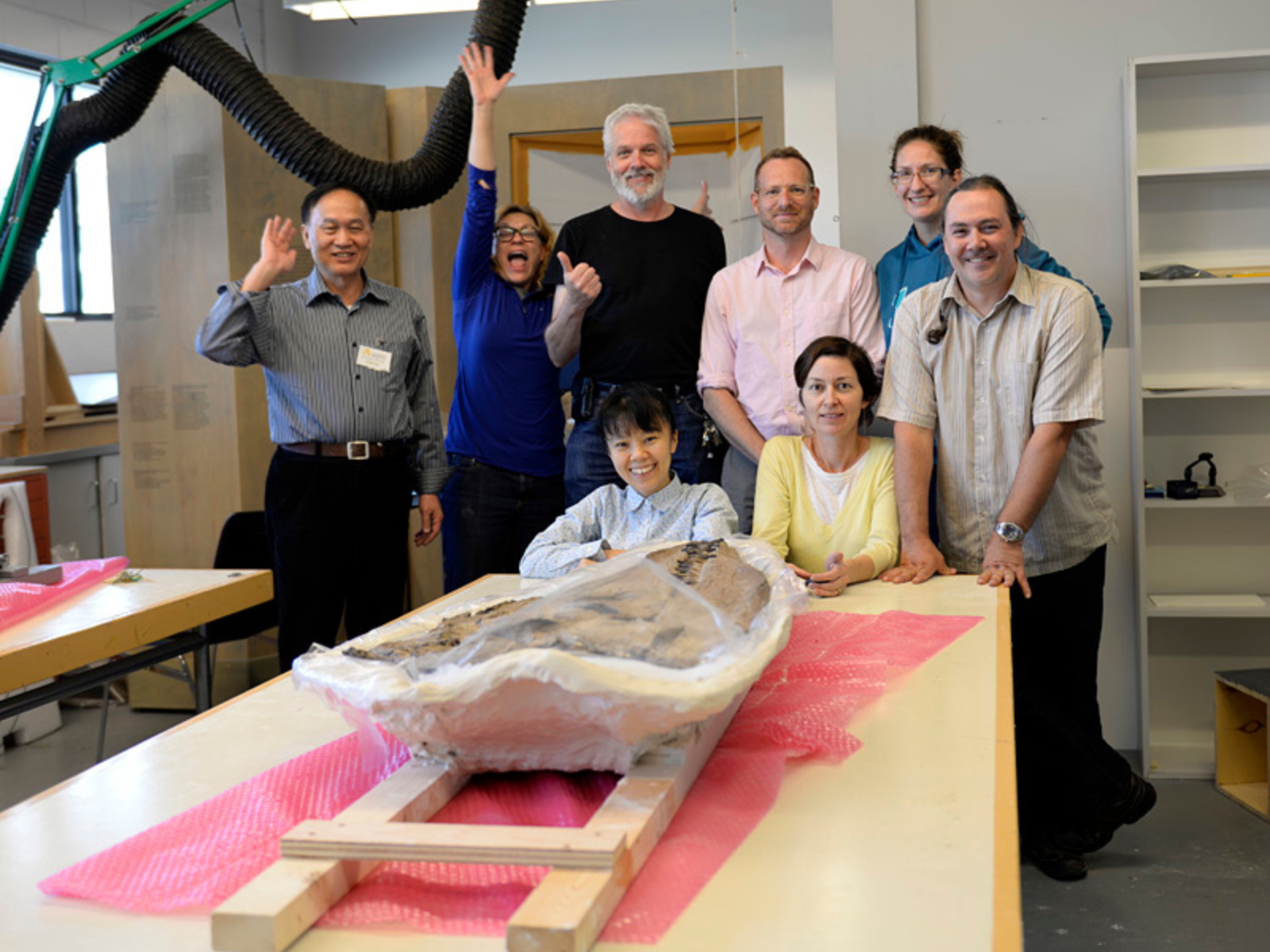
Making sure we are all in agreement before we begin! Clockwise from left: Kevin Brownlee, me, Amelia Fay, Xiao-Chun Wu, Tamaki Sato, Janis Klapecki, and Roland Sawatzky (photo by Stephanie Whitehouse).

On the Wednesday afternoon, Collections Specialist Janis Klapecki and I went to the room where the plesiosaur is laid out, and with Tamaki and Xiao-Chun we fitted Debbie’s second cradle over the skull. The fit was perfect, so we wrapped sturdy packing straps around the two cradles, then tightened them until there was no give and the wood supports were flexing a bit. This tightness would ensure that the bones would move as little as possible during the flip.

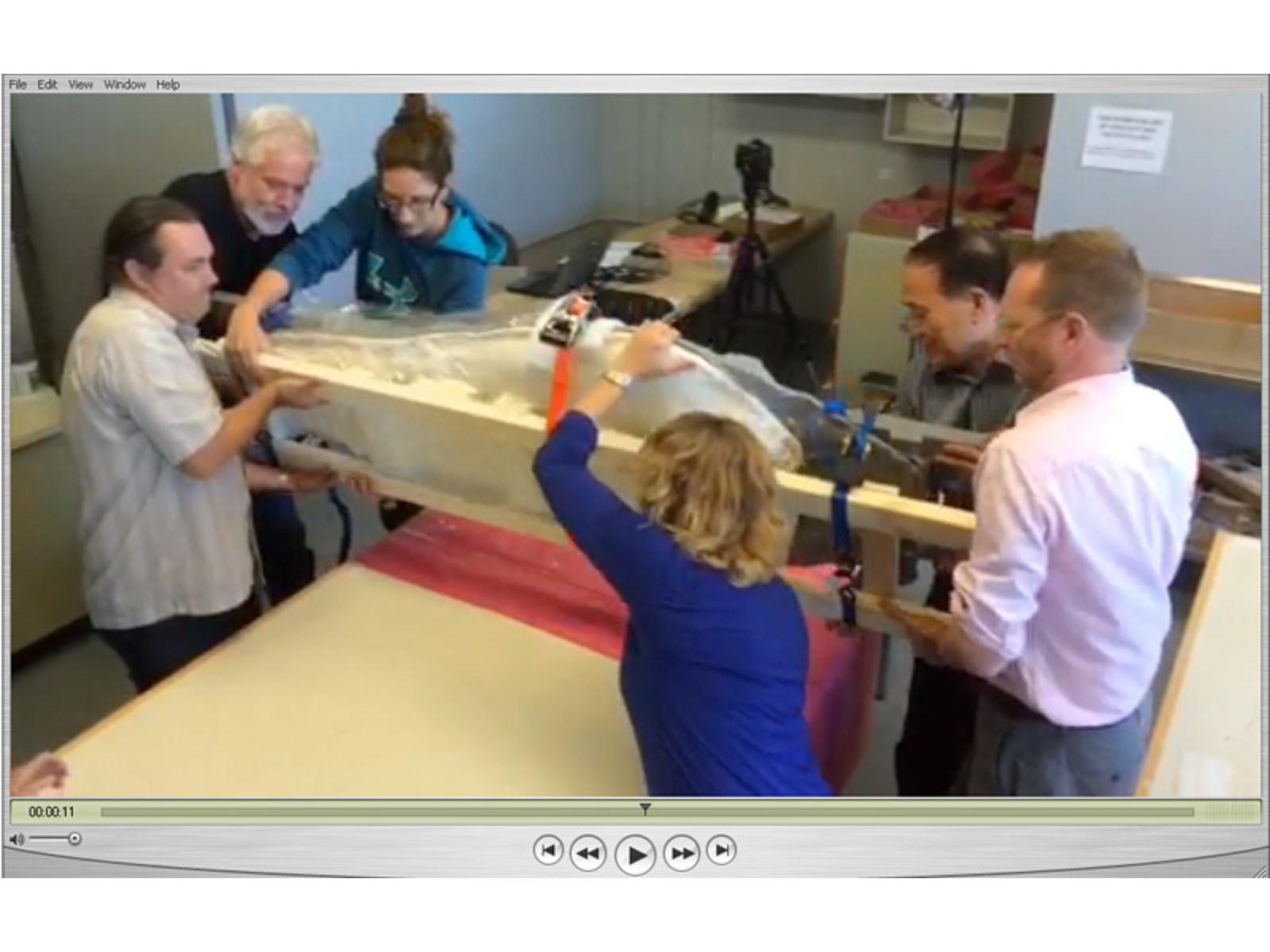
When we were ready, we were joined by several of our curatorial colleagues, who had kindly volunteered their assistance. The skull and cradles were not immensely heavy, but the operation had to be done very steadily and smoothly, so it was best to have two or three people on each end of it. Once we had everything in place, and once we had discussed how we would do it, it only took a couple of moments to actually flip the skull.

Six people, three at either end, in the process of flipping the cradled plesiosaur skull.

Click the image to watch a short video of the flip (2 MB; video by Stephanie Whitehouse).

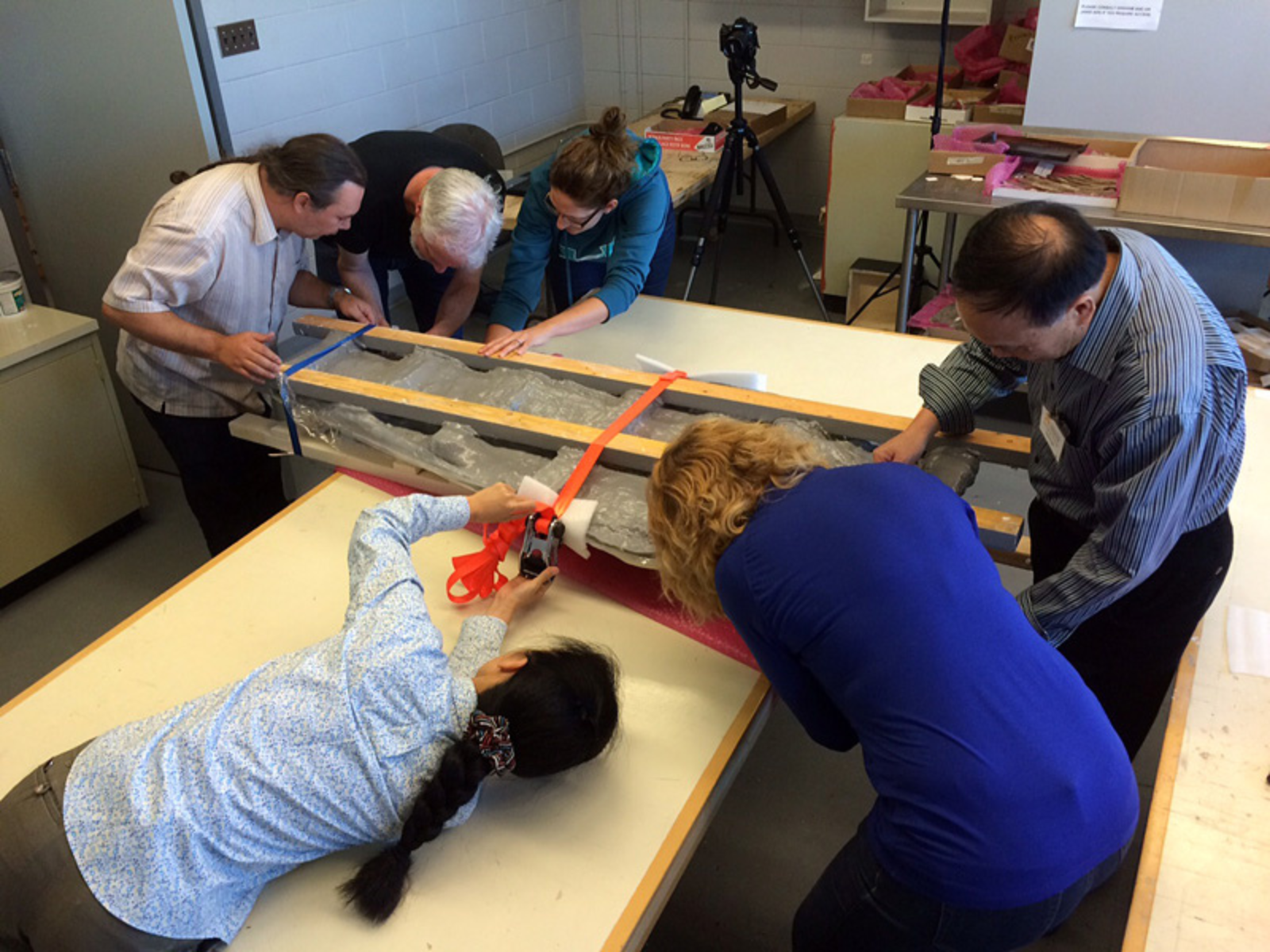
Six people, three at either end, bent over to check the condition of the cradled plesiosaur skull post-flip.

Before we could remove the “lid”, we had to check that the skull was not sticking to it anywhere (photo by Stephanie Whitehouse).

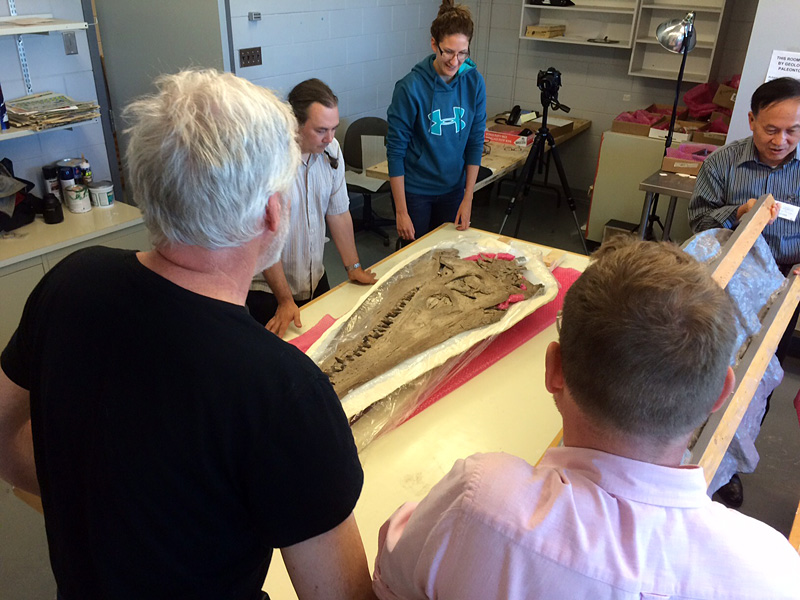
The flipped plesiosaur skull on the table with the cradle and "lid" removed, as five people stand around the table looking at it.

When we removed the straps and exposed the skull, it was clear that the planning had paid off: the fragile fossil had survived it perfectly. Tamaki and Xiao-Chun could continue their scientific study, and the rest of us could return to our many other tasks. But we aren’t quite done with this sort of work yet: we will have to flip the skull at least a couple more times before it goes into a new permanent gallery exhibit next year.


Image: The upper jacket is removed (photo by Stephanie Whitehouse).

A group of eight people pose, smiling together, for a photo at the end of a table which has the flipped plesiosaur skull laid across it.

Success! L-R, front: Tamaki Sato, Stephanie Whitehouse; back: Xiao-Chun Wu, Janis Klapecki, me, Roland Sawatzky, Amelia Fay, Kevin Brownlee (photo by Xiao-Chun Wu).


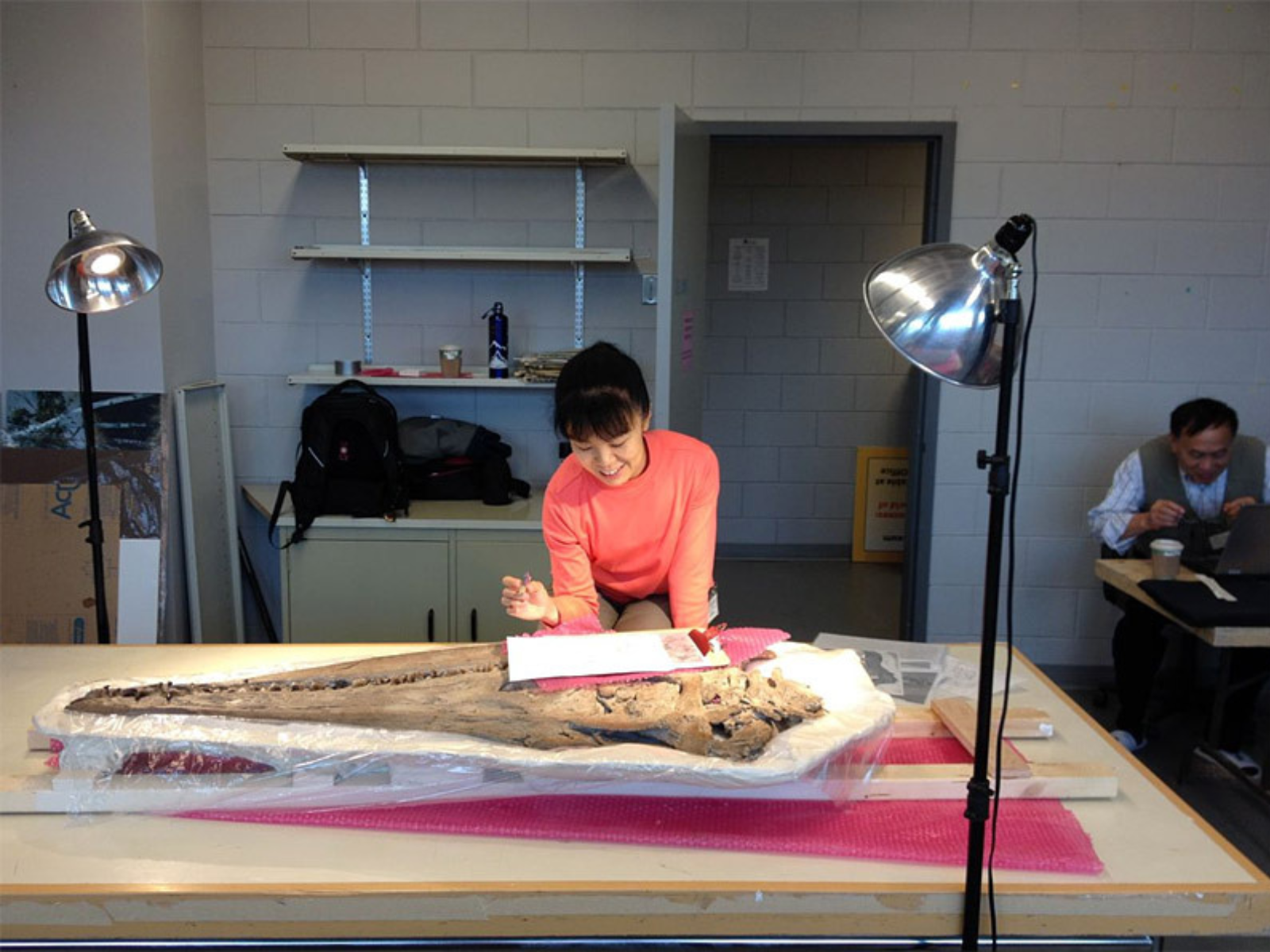
A smiling researcher with a clipboard bends over the plesiosaur skull laid out on the table, illuminated by two spot lights. In the background a second research sits at a desk working on a laptop.

Tamaki and Xiao-Chun return to their scientific studies.

The Smell of History

It’s fairly obvious based on my current job and previous work experience that I love all things old. I love the smell of old books, antique furniture, and apparently historic sites.

One of the goals for my recent trip to York Factory National Historic Site was to capture the site for our visitors with a videography team, but in the planning it seems I forgot about the other senses.

A lot of people have asked me about my trip and whether or not York Factory lived up to my expectations. I am happy to report that it exceeded my expectations, and in ways that I hadn’t really considered. Yes, the site is visually impressive and completely captivating but what really struck me was the smell of York Factory.

An empty room, lit only by the sunlight coming through four windows. Along the walls are empty build-in shelves, and to the left is a wide board laid across two saw horses like a table.

What does York Factory smell like? It smells like history! Each floor of the Depot had a different smell, and none of them bad (somewhat surprising considering that this particular structure has been standing for 177 years!). The main floor had an earthy smell, not musty but the cooler air at ground level made it feel like you were still outside.

The second floor was my favourite, the wood walls seemed to glow in the sunlight and it smelled warm and cozy. The rooms on the second floor were used for storing trade goods and it’s almost as if you can smell the goods themselves. Little maps show visitors what the rooms used to contain, and my absolute favourite room apparently used to store salt, sugar, and liquor (three things I enjoy!).

Image: The saleshop (converted from storage in the 1930s).

Close up view of a number of artifacts laid out on a table in a long room with wooden walls and a peaked wooden roof. Sunlight streams in at the far end of the room.

Looking out over the tables of artifacts you can see the warm glow of the walls and all the bright light from the windows. I wish you could smell it!

A paper map showing the second floor layout. A square building separated into seven rooms around a centre courtyard.

Parks Canada placed these neat maps on each floor so visitors can see each room’s purpose.

Looking directly up at a centre peak of a wooden ceiling, the wood planks have slight variations in colour from dark greys to light browns and reds.

Lying on the second floor and looking up at this beautiful ceiling.

The third floor felt a bit like a cabin, but it lacked the same warm and cozy smell of the second floor. From the third floor you can head up through a small attic area and step into the cupola (a look-out on top of the depot), which might be the only part of the whole Depot that had a slightly musty scent.

So how does one describe the smell of history? It smells like years of human interaction and activity I guess. The Depot at York Factory had people moving goods in and out, and even though I am certain it was hard work and not all happy-fun times like my visit, the place just feels good. From all senses.


Image: The third floor still has that lovely glow, but it didn’t smell as wonderful as the second floor!

Dr. Amelia Fay

Dr. Amelia Fay

Curator of Anthropology & the HBC Museum Collection

Amelia Fay is Curator of Anthropology and the HBC Museum Collection at the Manitoba Museum. She received her BA in Anthropology from the University of Manitoba (2004), an MA in Archaeology…
Meet Dr. Amelia Fay

Adventures of a Summer Student

As a child, the Manitoba Museum was my favourite field trip destination. I loved it all, but my favourite part was the Urban Gallery- particularly Madame Taro’s small apartment, which I thought was quite glamorous. Visits to the museum— either with classmates or family— activated my interest in history and museum work, and this summer I was given the opportunity to join the team through the Young Canada Works program as Collections and Conservation Assistant.

Summer student Jenna smiles towards the camera from her seat at a desk and computer.

One of the first projects I took on was identifying locations for human history artifacts whose locations are “unknown” in the database – 527 artefacts, to be exact. It could be summed up as a glorified treasure hunt. I spent a good few weeks going through the human history storage room— climbing up ladders, rifling through drawers, looking for catalogue numbers on hundreds of artifacts— and finally whittled the number down to 188! This was certainly one of my favourite projects of the summer. It was really fascinating to explore the variety of objects in the collection – everything from night caps to an Oh Henry bar package.

Throughout the summer I performed various forms of preventive conservation. At the end of each month I went through the galleries, labs, and storage vaults throughout the museum to take temperature and humidity measurements, as well as check the bug traps (yikes!). In August, a few of us went down into the hold of the Nonsuch to take taper gauge and trammel rod measurements to determine if the wood of the ship had expanded or contracted in the last six months. Even being on the ship for a couple hours felt a bit claustrophobic – I can’t imagine sailing for months at a time! In addition to these larger projects, I made boxes, altered mannequin forms, and recovered the bales in the Nonsuch gallery. The skills I had learned in 8th grade Home Economics finally paid off.

Elongated triangular flag. The background is yellow wiith a thick black stripe stitched on top reading “Votes for Women” along the centre.

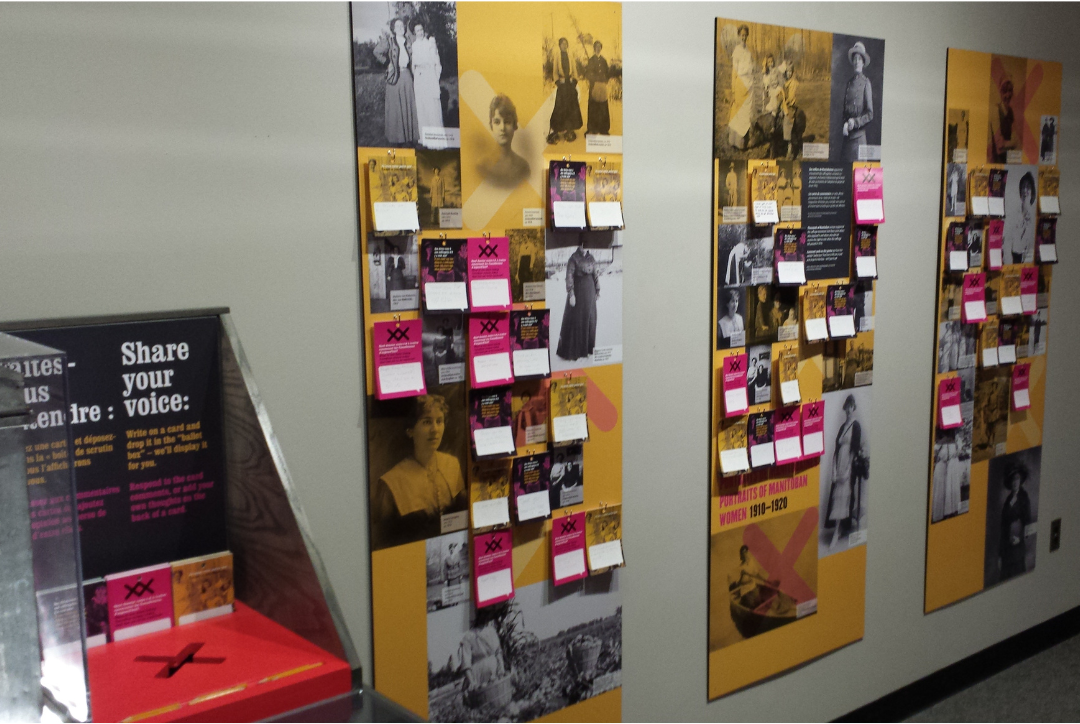
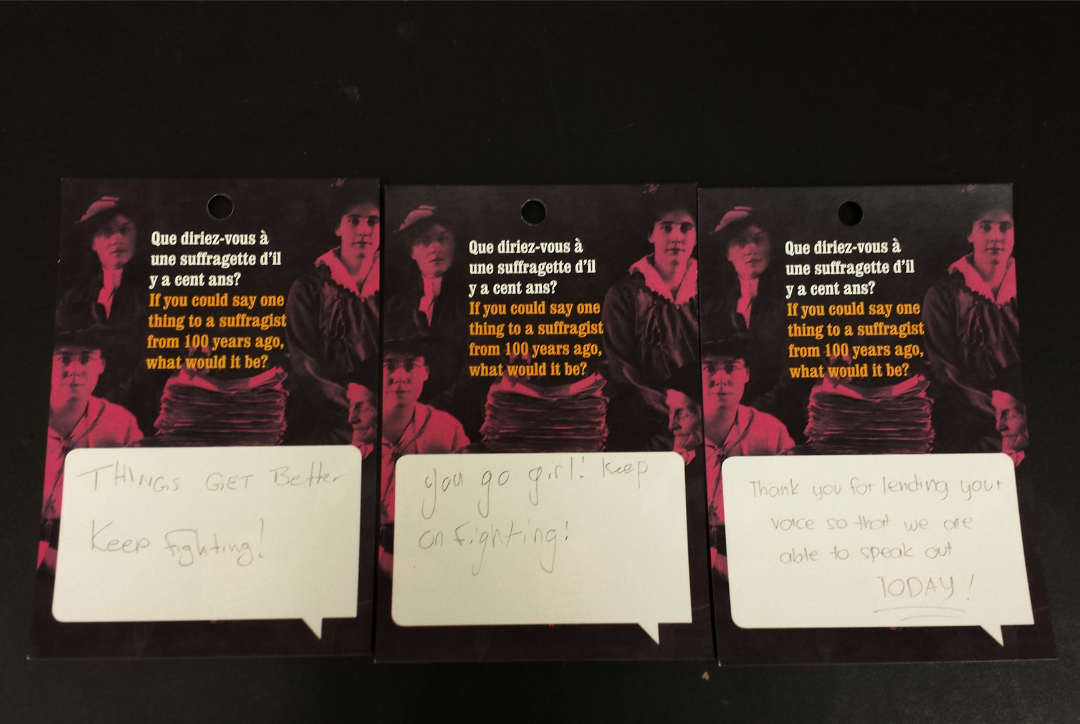
Perhaps one of the coolest things I did this summer was make a replica of a felt pennant for the upcoming “Nice Women Don’t Want the Vote” exhibit (which potentially thousands of people will see – no pressure!). Because the original artifact is quite worn and faded, a replica is more suitable to send along with the travelling exhibit to prevent further damage. Although I was a bit concerned about my lack of sewing and crafting skills, I am incredibly happy with and proud of the final product. The theme of the exhibit—women’s suffrage in the early 20th century—has been an interest of mine for quite a few years, and to be involved in the exhibit in any way was really incredible.

I had a great time at the museum this summer and was able to work on projects in many different areas of collections and conservation. The skills I built on and developed will no doubt open more opportunities for me in my (hopefully) museum-based future. The entire experience—the work and the people—was incredible, and I hope to be back here in the future!

Craziest Botanical Explorers in History

As the opening of the National Geographic Presents: Earth Explorers exhibit at the Museum draws near, I find myself remembering some of the botanical explorers I learned about when I was a student. Although these botanists lived at different points in time they shared one thing: an insane passion for plants that very nearly caused their demise!

Sir Joseph Banks, 1743-1820

A line engraving of a man in profile, with his long hair tied back with a ribbon. Engraved text under the photo reads, "Mr. Bankes".

After whetting his appetite for botanizing in Newfoundland and Labrador, Banks manipulated his way onto the Endeavour, a ship captained by none other than James Cook. During this voyage Banks collected plants from South America, Australia, and New Zealand, contracted malaria, nearly died from exposure and lost four companions. While planning a second journey to search for Antarctica, Banks insisted on bringing 15 companions with him including two horn players (cause everyone knows you just can’t botanize without horn players following you around). To accommodate them, he had a second deck built on the ship Resolution, which made it too top heavy to be seaworthy. Captain Cook was not amused and had it torn down. When Banks saw that his new deck was gone, he had an “epic” tantrum worthy of a spoiled two year old and refused to sail, going on a trip to Iceland instead!


Image: Image of Sir Joseph Banks. V0000331 Sir Joseph Banks. Line engraving. Credit: Wellcome Library, London. Wellcome Images images@wellcome.ac.uk http://wellcomeimages.org Sir Joseph Banks.

David Douglas, 1799-1834

Four cones from a Douglas-fir on a grey surface.

This irascible Scot was a true botanical nutcase. The son of a stonemason, Mr. Douglas became friends with renowned botanist William Hooker, who sent him on a plant collecting trip to the United States in 1823. Instead of bringing food, Douglas had his horse carry 100 pounds of paper to press plants in instead. This turned out to be a bad idea; he was reduced to eating all the berries, roots, and seeds he had collected on several occasions and was twice “obliged to eat up his horse” so that he wouldn’t starve to death. He nearly died from hypothermia, infections, falling into a gully, being attacked by grizzly bears, and the list goes on. The magnificent and enormous Douglas-fir trees (Pseudotsuga menziesii) of the west coast were named after him. He fell into a pit and was gored to death by the bull that was inside it at the age of 35.


Image: Cones of Douglas-fir (Pseudotsuga menziesii) from the Museum’s collection. a species named after David Douglas. TMM B-C-3.

Benedict Roezl, 1823-1885

A hand-drawn picture of a 'Miltoniopsis roezlii' orchid - white petals with a red and yellow interior, and long green leaves.

This hearty Czech botanist was obsessed with collecting orchids, discovering 8oo new species from the Americas. He was so obsessed with orchids that he once climbed a 5,000-m high mountain in Peru looking for new species, despite the fact that he had only one arm (the other was a prosthetic with an iron hook on the tip). To thwart competing orchid hunters, Roezl would either collect or destroy the rarest species he found, to the chagrin of conservationists everywhere. He was robbed by bandits 17 times but fortunately never lost much because the only things he carried were plants. Disappointed at the prospect of no money, one group of exasperated thieves was inclined to cut his throat. They spared him because he was clearly crazy (why would a one armed man wander around the countryside collecting weeds?), and believed that it was bad luck to kill a crazy person.


Image: Obsessed orchid hunter Benedict Roezl discovered this orchid, Miltoniopsis roezlii which was subsequently named after him. Image from plate 6085 in Curtis’s Bot. Magazine (Orchidaceae), vol. 100, (1874).

John Macoun, 1831-1920

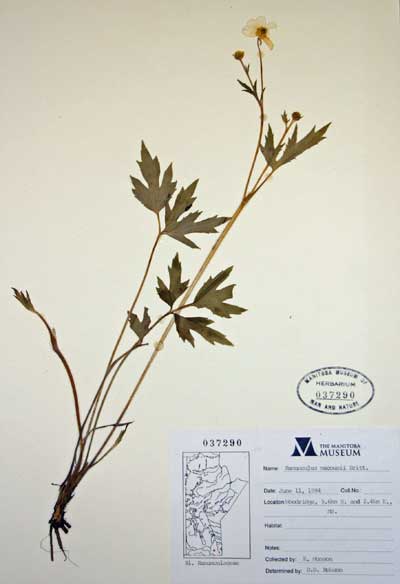
Three pressed preserved plants on a sheet of specimen paper. At the end of each of the long, thin stems is a small blue-purple flower. In the bottom right corner specimen data is noted.

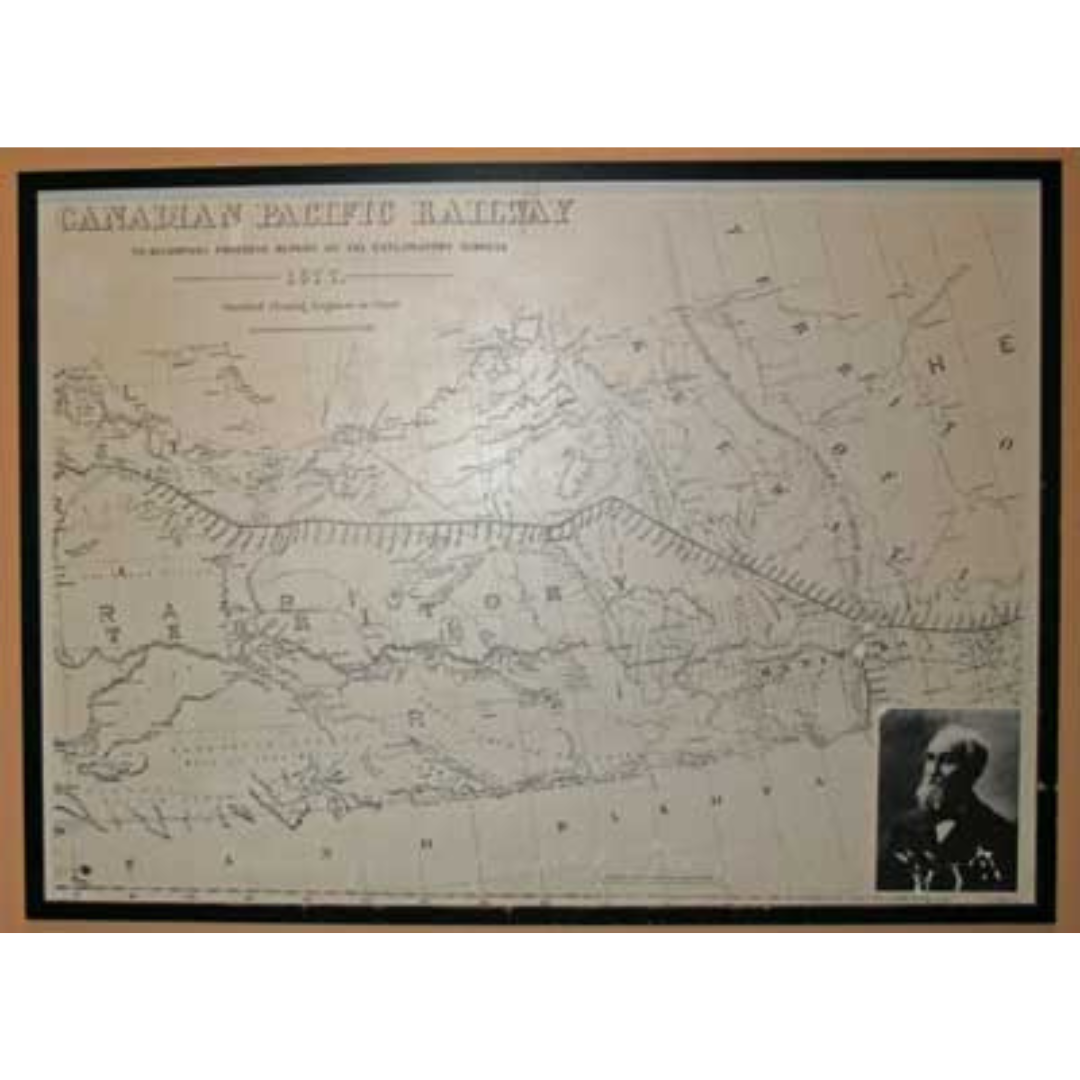
Offered the chance to explore the wild west of Canada during a railroad route reconnaissance, Mr. Macoun jumped at the chance, despite the fact that he didn’t know how to swim, canoe, snowshoe, drive a dog sleigh, or even ride a horse very well. He left a pregnant wife and four children behind during his first trip from Ottawa to Victoria in 1872. His journeys to collect the west’s flora occasionally met with disaster. He nearly drowned, was almost crushed by two falling trees, and accidentally shot off his thumb. During one journey, too weak from lack of food to row his canoe upstream, he tied a rope around his waist so he could pull it while stumbling along the shore instead. He collapsed from exhaustion close enough to his destination that he was rescued by local First Nations people. Despite these hardships Macoun collected an astounding 100,000 plant specimens in his lifetime.


Image: Macoun’s Gentian (Gentianopsis macounii) was named after the obsessive Irish-Canadian plant collector John Macoun. TMM B-38914.

Richard Evans Schultes, 1915-2001

A black and white photograph of Dr. Richard Evan Schultes with two Indigenous people in the Amazon. He is holding a selection of plants.

Schultes was obsessed with plants in a slightly different way than the others; he studied the medicinal and hallucinogenic ones. He wrote his undergraduate thesis on peyote and his Ph.D. on magic mushrooms. Not one to take someone’s word on the effects of hallucinogenic plants, he tried many himself, one time passing out for three days. He also took up the indigenous habit of chewing coca leaves to stay alert while travelling in the rainforests of South America. Once, he accidentally set fire to his collection while desperately trying to dry his plants in the jungle, nearly burning down his hosts’ house in the process. Schultes almost died from malaria, the nutritional disorder beriberi, and nearly drowned while doing field work. One night five vampire bats sat on his head and drank his blood. A grateful entomologist he once travelled with named a cockroach genus after him (Shultesia). He collected over 24,000 plants including 300 new to science and is considered the father of ethnobotany.


Image: Dr. Richard Evan Schultes in the Amazon. Public domain, via Wikimedia Commons.

Martin Dugard’s book “Farther Than Any Man”, Tyler Whittle’s “The Plant Hunters”, John Macoun’s autobiography “John Macoun: Canadian Explorer and Naturalist” and Wade Davis’ book “One River” were essential references for this blog and make excellent reading for those of you who wish to learn more about these extraordinary men.

Dr. Diana Bizecki Robson

Dr. Diana Bizecki Robson

Curator of Botany

Dr. Bizecki Robson obtained a Master’s Degree in Plant Ecology at the University of Saskatchewan studying rare plants of the mixed grass prairies. After working as an environmental consultant and sessional lecturer…
Meet Dr. Bizecki Robson

Cleaning Week: Filing Trilos

By Dr. Graham Young, Curator Emeritus of Geology and Paleontology


Last week was the Museum’s “cleaning week”, during which we were closed to the public so that we could focus on getting our house in order. There was much recycling of paper, moving of old furniture, and scrubbing of walls in many parts of the Museum. Here in the Geology and Paleontology lab, we decided that this was the ideal time to file some of the fossils that had been catalogued in the past few months. Most particularly, we put away several hundred Ordovician age trilobites from the Stony Mountain Formation at Stony Mountain, just north of Winnipeg.

Three drawer inserts full of catalogued trilobites, ready to be placed into their drawers.

How did the Museum end up with hundreds of trilobites that needed cataloguing? Stony Mountain is one of the really important sites in southern Manitoba dating from the Late Ordovician Period, about 445-450 million years ago. During this time central North America was covered by tropical seas, and at Stony Mountain the limestone deposits are tremendously rich in fossils of marine invertebrates: corals, brachiopods (lamp shells), trilobites, and many other kinds of creatures.


Image: Some of the catalogued trilobites, ready to be filed away.

Close up on a small box with six fossil pieces laid in cut-out foam beds, and a vial with cotton and smaller fossil pieces.

Staff and volunteers from this Museum and its predecessor (read more in “The Old Museum Lives On”, here) have collected fossils at Stony Mountain since the 1930s; over the years thousands of specimens have been catalogued to our collections, but very few of these were trilobites. A museum always collects more samples than can be catalogued quickly, and the Stony Mountain trilobites are somewhat complicated and consist mostly of small pieces*, so we had been holding onto them until there was time to consider which ones belonged in the permanent collection.


Image: Components of a trilobite that may belong to the genus Failleana (that’s a cranidium, the mid-part of a head, on the upper left).

We knew that the Stony Mountain trilobites had been gradually “stacking up”, and volunteer extraordinaire Ed Dobrzanski and I had decided that we would devote some serious time and space to this project when we could. A few months ago the lab was looking relatively clear, so we laid out the hundreds of trilobites in trays and decided which ones were good enough to go into the permanent collection. I identified quite a few of them, but it fell to Ed to carry out the laborious, repetitive work of cataloguing each specimen.

Volunteer Ed Dobrzanski standing with one hand on his hip in front of a tray of trilobite specimens.

The invaluable Ed Dobrzanski did most of the work on this project.

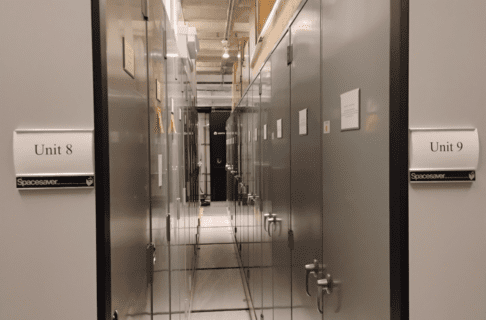
View down a storage room aisle, with metal cabinets lining either side.

The specimens were filed away in our collections room.

When he was done, there were some 150 catalogued batches, all neatly laid out and padded. Once I had reviewed his records (we always double-check everything for accuracy!), we still had to find space in the collections, shifting the drawers in several cabinets to free up a block so that the trilobites could all be together and organized.

Finally, last week, we put the trilobites away! This may seem like a very big job for some small old fossils, but it means that many potentially important specimens are now properly recorded and stored, with the trilobites and their data readily available for future research or exhibits.


Image: One of the drawers of Stony Mountain trilobites.

Close up on a fossilized cheirurid trilobite.

An enrolled and incomplete cheirurid trilobite, possibly belonging to Ceraurinus.

Two boxed trilobite specimen components in storage.

Trilobite components: the tail (pygidium) of a cheirurid on the left, and partial mouthparts (hypostome) of an asaphid on the right.

*These trilobites are almost all incomplete because most trilobite fossils are from pieces of exoskeleton left behind when the animals moulted in ancient tropical seas. For the fossils at Stony Mountain, wave and current action on the ancient seafloor caused further abrasion and breakage.