

A brown and white calf walking through knee-high grass.

I Always Feel Like Something is Watching Me

I Always Feel Like Something is Watching Me

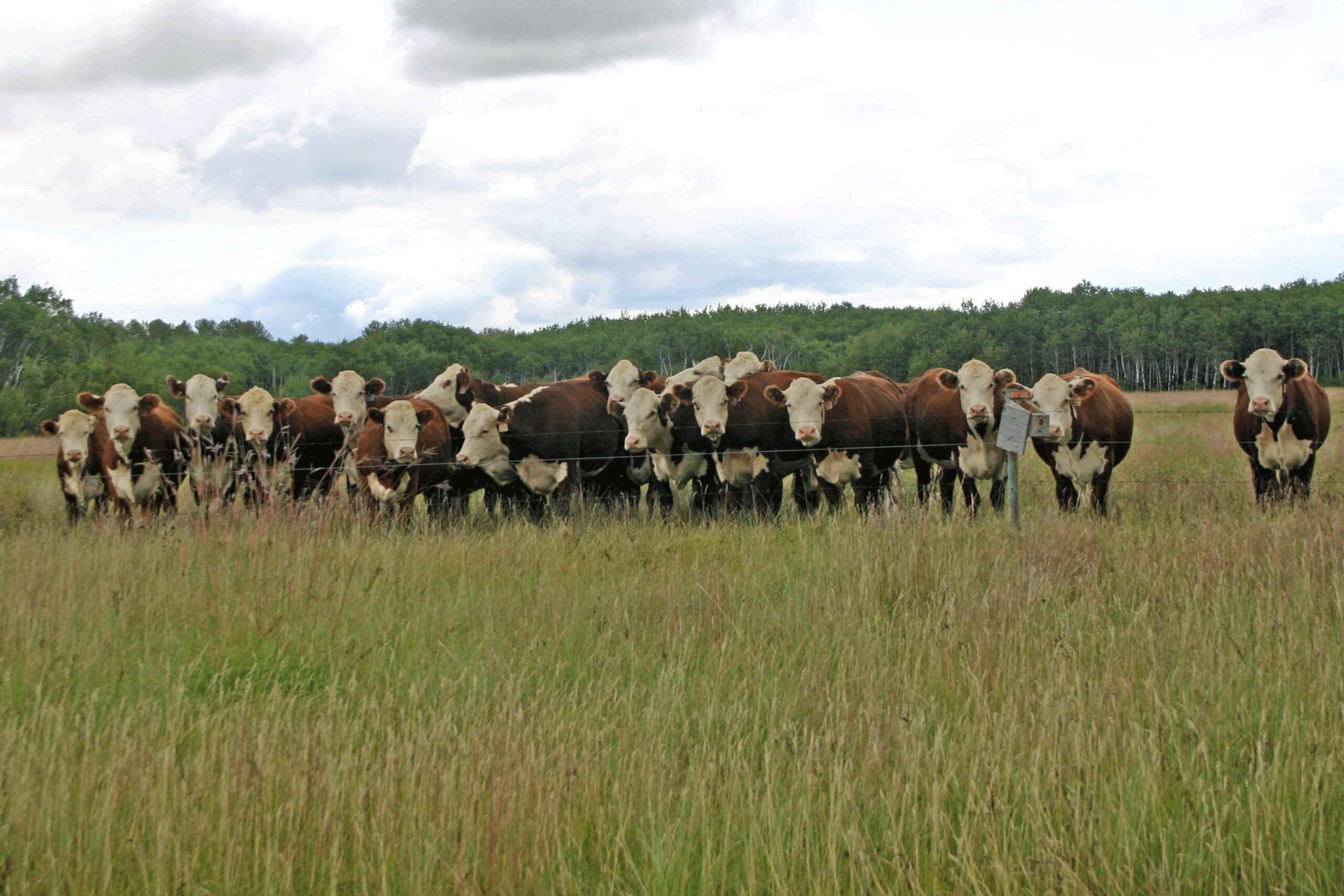
Usually when I do field work I’m by myself. But sometimes I get the feeling that I’m being watched. The main things that have been watching me this year are the cows. The Yellow Quill Prairie Preserve, owned by the Nature Conservancy of Canada, is sustainably grazed by a herd of cows. Aside from using some of my plot stakes as scratching posts and knocking them down, they generally leave me alone and I leave them alone. Sometimes, though, they get a little curious and stare at me with those slightly vacant eyes as if they are expecting me to do something spectacular, and that’s when I start to feel a bit self-conscious. I have no idea what sorts of entertainment a cow would enjoy. Sometimes I moo at them just to see what they’ll do, which is usually nothing. Sometimes they moo back though and then I wonder exactly what was it I said. Where’s Dr. Dolittle when you need him?

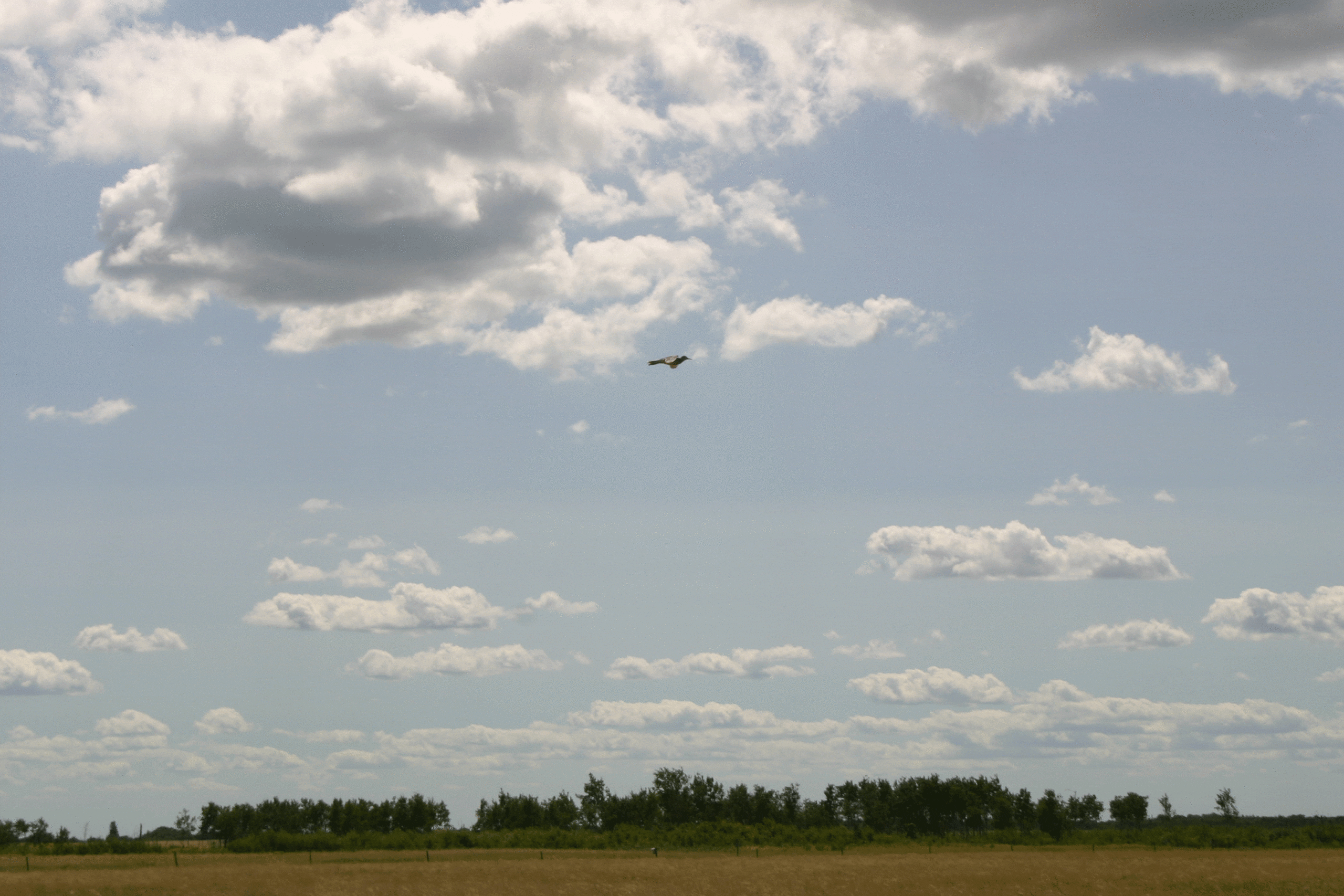
I’ve also been looked over quite thoroughly by the resident Upland Sandpiper. Usually it just chatters at me but last week it flew over a couple times and then landed in the grass and started walking in a circle around my plot for a couple of minutes. It kept peeking out from behind the grass like it thought I was up to no good. Although I would have loved to get a good picture of it, it was just too sneaky and all I got was photo of it as it flew away.

A herd of brown and white cows cluster together in a field, staring towards the camera.

The curious cows at the Yellow Quill Prairie Preserve like to stare at me.

A high-flying bird, soaring over a field against a blue sky with scattered white clouds.

This Upland Sandpiper kept stalking me!

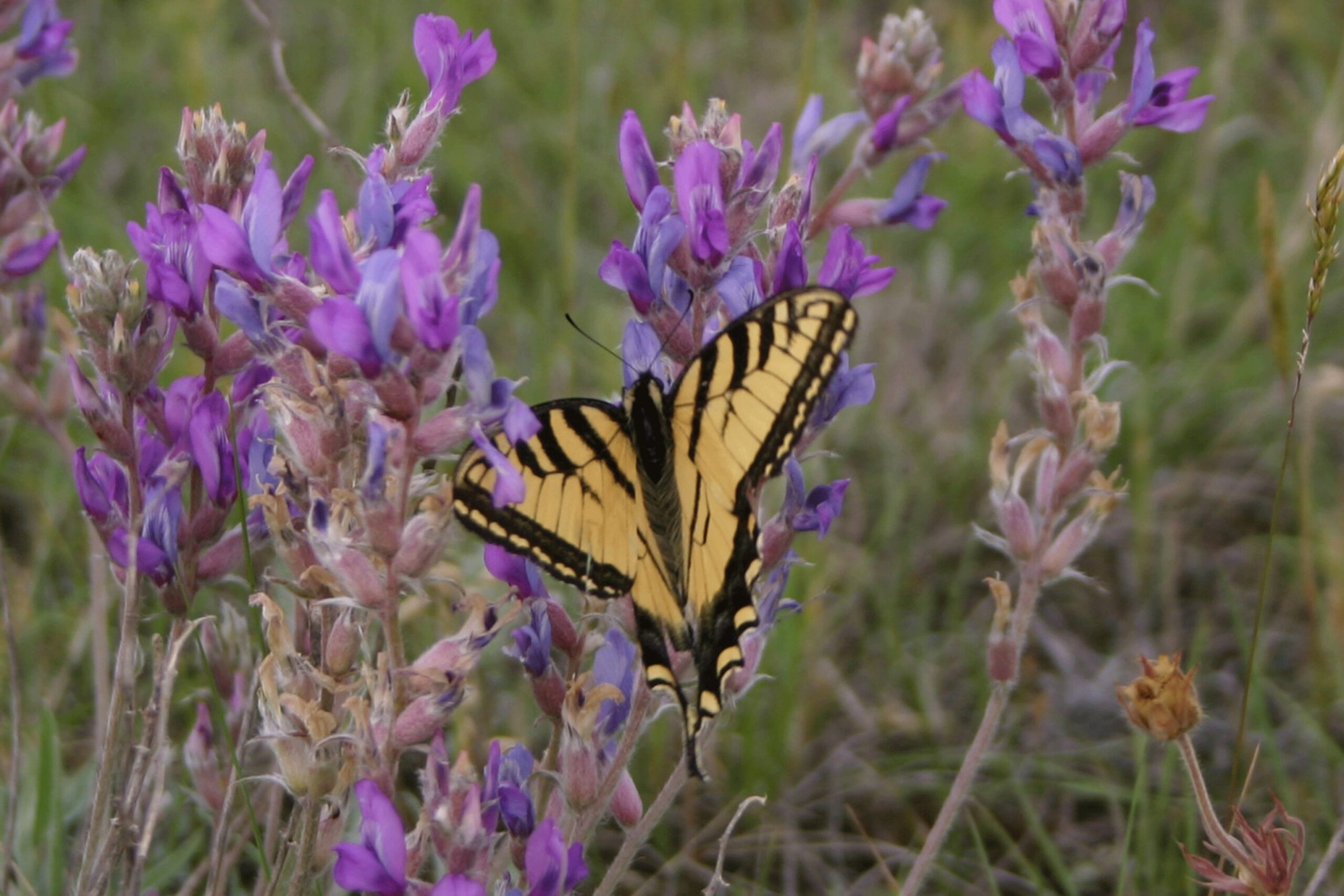
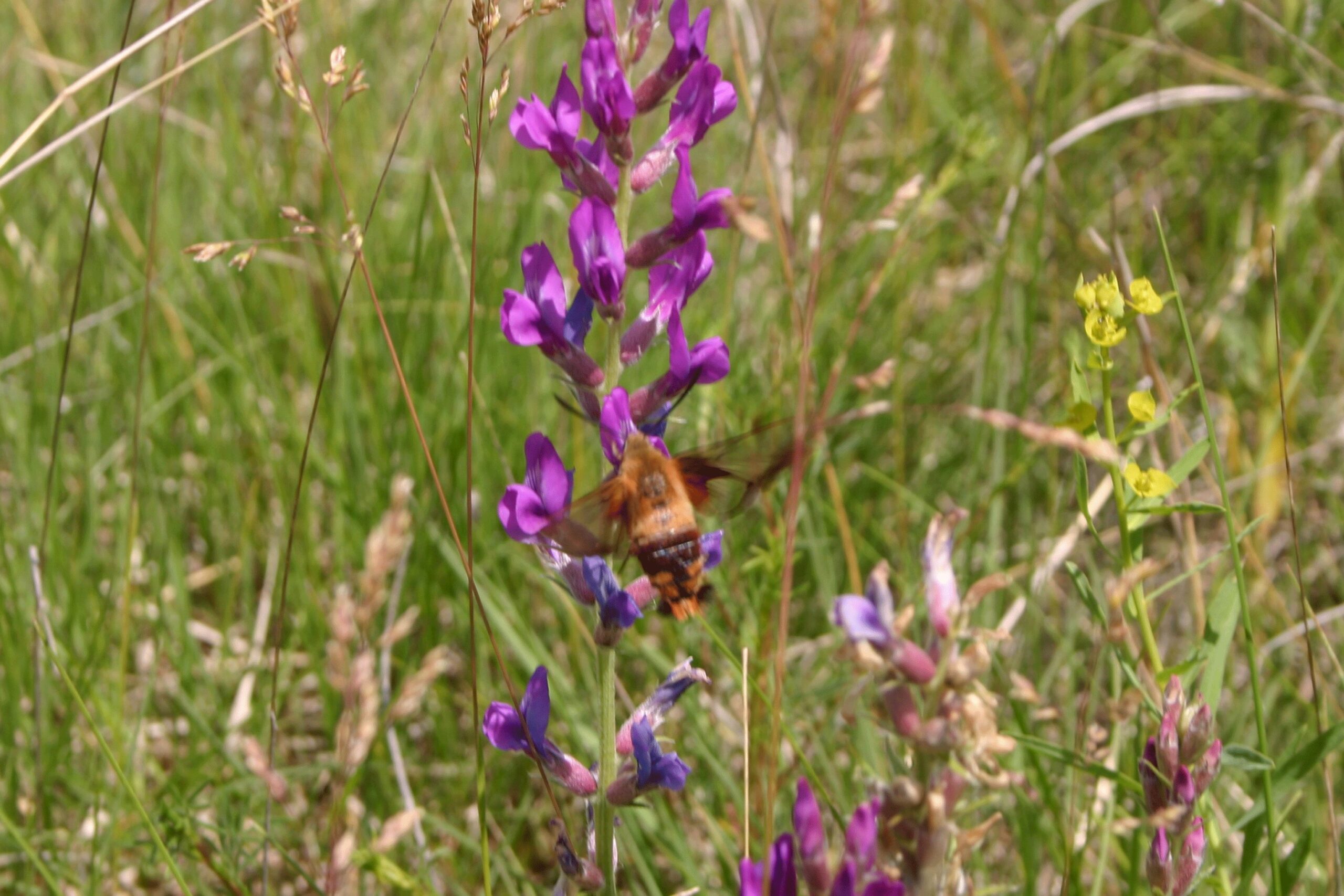
Mammals and birds aren’t the only wary creatures at the preserve. A beautiful Tiger Swallowtail (Papilio glaucus) was there, feeding on the Purple Locoweed (Oxytropis lambertii) but, like most butterflies, it did not want me to take its’ picture. Neither did a Hummingbird Clearwing Moth (Hemaris sp.). Those insects are so fast (like a hummingbird) that they are almost impossible to photograph. I did get one very blurry shot in before I could adjust my camera to “action mode” but by then it was gone. Maybe one day I’ll manage to take a decent photo of one.

In general, insects that have no form of self-defence, like butterflies and moths, are less apt to let you get anywhere near them. Or maybe they think they’re just too sexy for my camera. The jitteriness of butterflies has likely resulted in a flaw in my field data: I don’t know a lot about what they are feeding on, or how frequently they do so, due to their reluctance to approach me. I try to stay as still as possible, but I suspect that my butterfly and moth observations are low for this reason. Maybe I should start wearing camouflage.

A yellow and black Tiger Swallowtail butterfly perched among the purple flowers of a Purple Locoweed.

This jittery Tiger Swallowtail (Papilio glaucus), seen here feeding on a Purple Locoweed (Oxytropis lambertii), was not very photogenic.

A slightly blurry photo of a brown, chunky Hummingbird Clearwing Moth hovering beside the purple flowers of a Purple Locoweed.

I just managed to snap a blurry picture of this Hummingbird Clearwing Moth (Hemaris sp.) on Purple Locoweed (Oxytropis lambertii) before it zoomed away.

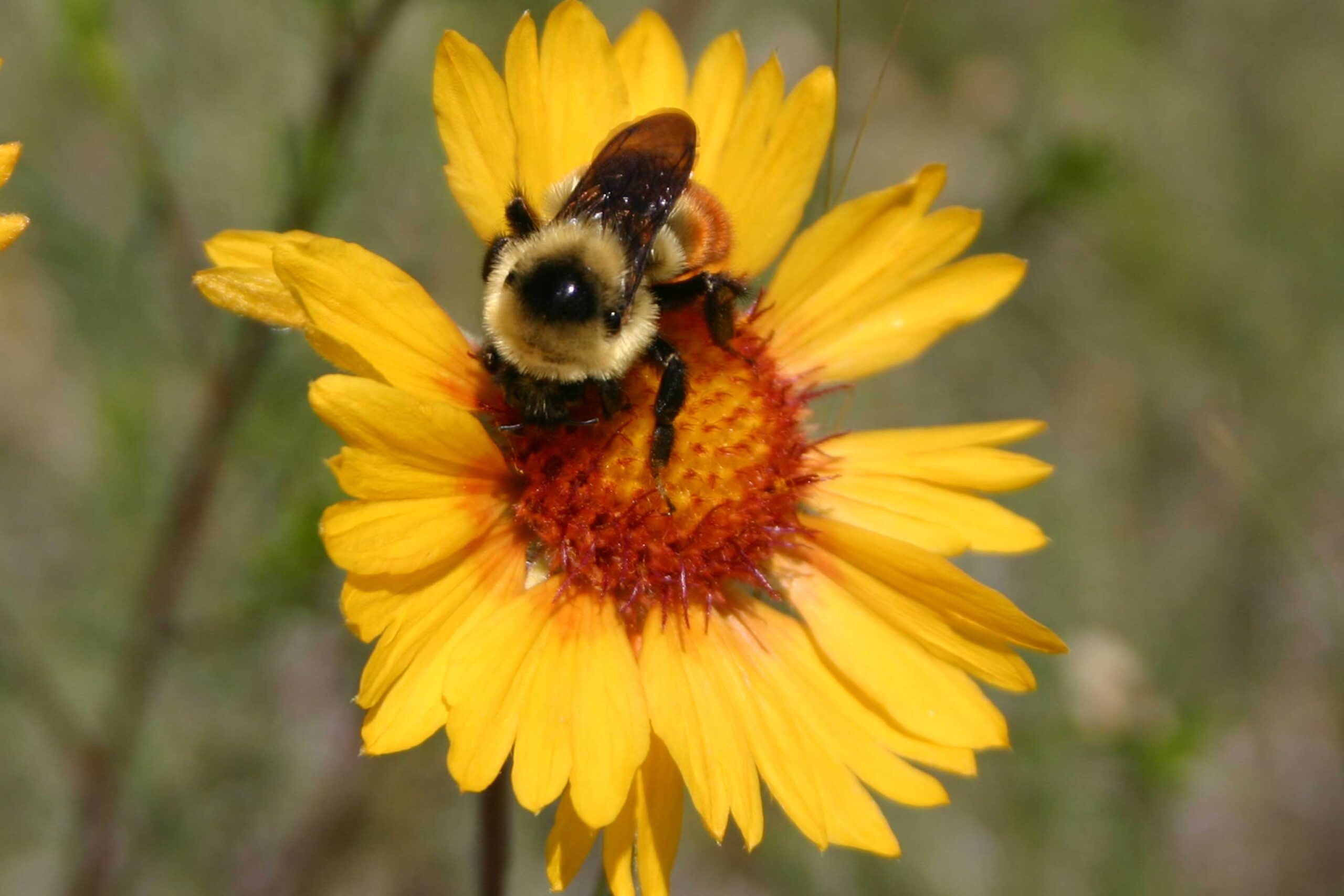
The presence of all these suspicious animals is why my favorite animals on the prairies are the bumblebees (Bombus spp.). Bumblebees are so confident that you are not going to hurt them (due to their stingers) that they’ll let you stick a camera right in their face! As a result I have a plethora of bumblebee images and some really great visitation data. Yeah bumblebees!


Image: A Bumblebee (Bombus sp.), seen feeding here on a Gaillardia (Gaillardia aristata) flower, is just too busy to care if you take its picture.

Dr. Diana Bizecki Robson

Dr. Diana Bizecki Robson

Curator of Botany

Dr. Bizecki Robson obtained a Master’s Degree in Plant Ecology at the University of Saskatchewan studying rare plants of the mixed grass prairies. After working as an environmental consultant and sessional lecturer…
Meet Dr. Bizecki Robson

Cataloguing Bird Skins

Post by Karen Sereda, past Collections Registration Associate (Natural History)


Where do all the dead animals come from?

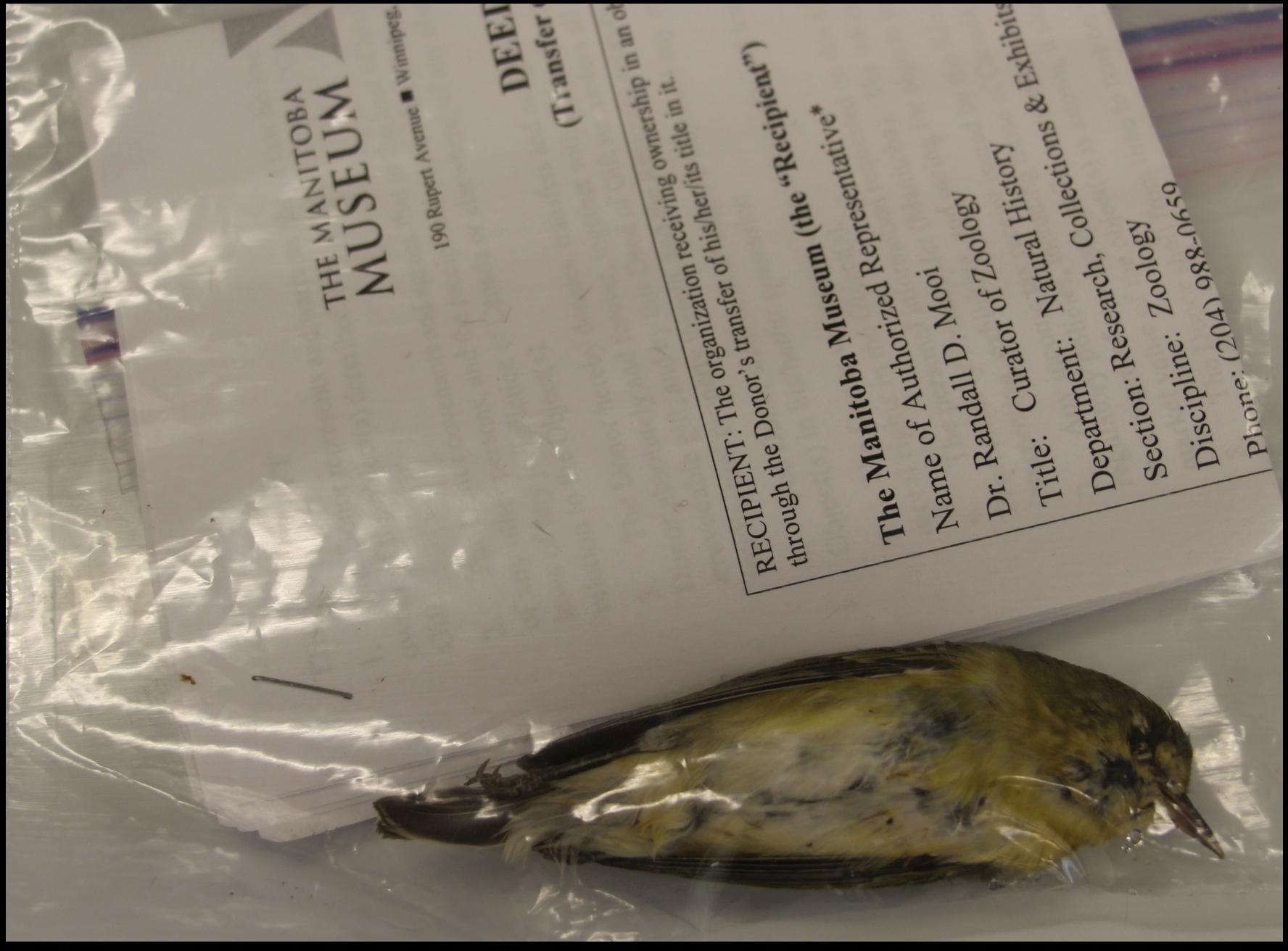
A small, dead bird with a white speckled breast with yellow in a plastic bag with donor form paperwork.

This is a common question we get at the Museum. People sometimes think that Museum staff regularly go out and kill birds and other animals for displays. This is not the case. Birds for example, sometimes accidentally fly into windows and die. We call these “window strikes”. If someone noticed at the time, they may go and pick the dead bird up, put it in a bag and freeze it. At a later date, that person might bring the bird to the Museum. If the Curator of Zoology, Dr. Randy Mooi, accepts the bird as a donation, then it is thawed and a bird skin is made.

The Museum’s Diorama and Collections Technician prepares bird skins from the donated “window strikes”.  You can read more about the preparation of bird skins in this blog by Debbie Thompson.


Image: Frozen bird in a bag, pre-acquisition 1018. © Manitoba Museum

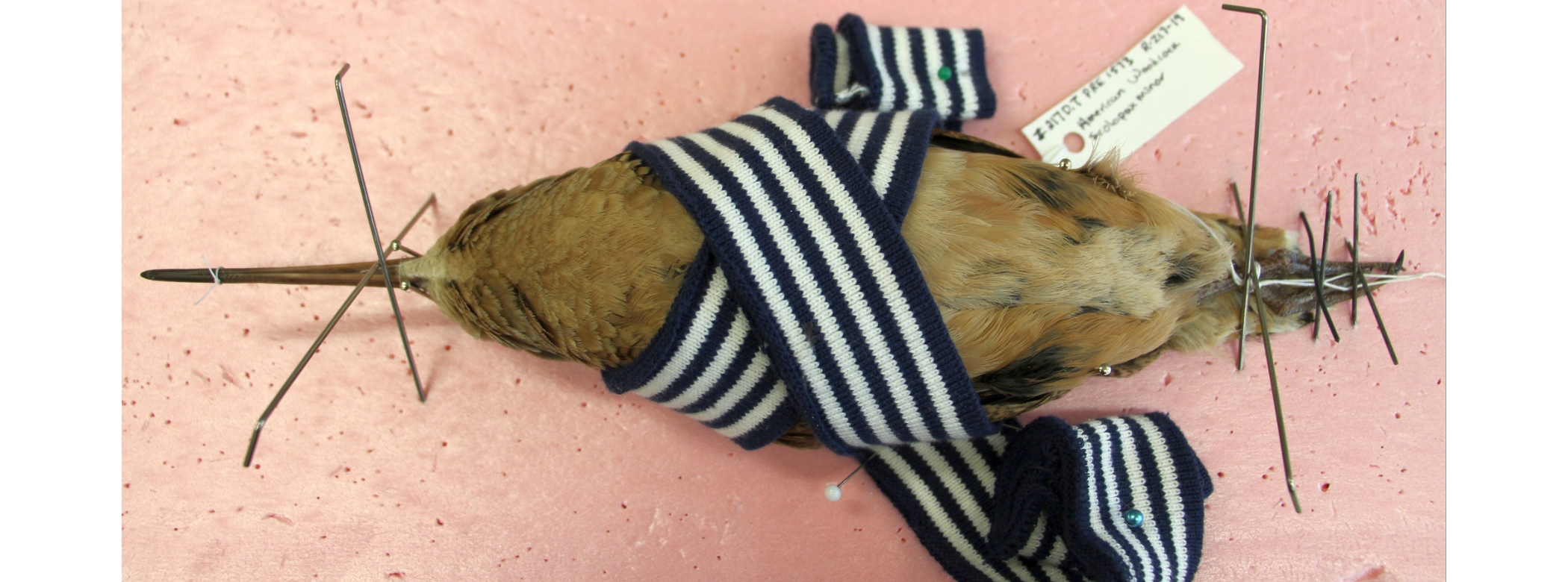
Once the bird skin is dry, the pins can be removed and the specimen is catalogued. The information or as we call it, “the data”, associated with a specimen is just as important to us as the bird itself. When I get a bird skin to catalogue the first thing I usually do is find the donor form, and then look up its name. Dr. Mooi would have already determined its scientific name. The bird is assigned a catalogue number, and its taxonomic classification is confirmed.

A bird specimen skin during the preparation process, pinned straight in position.

Pinned skin of a Scolopax minor (American Woodcock), pre-acquisition 1573. © Manitoba Museum

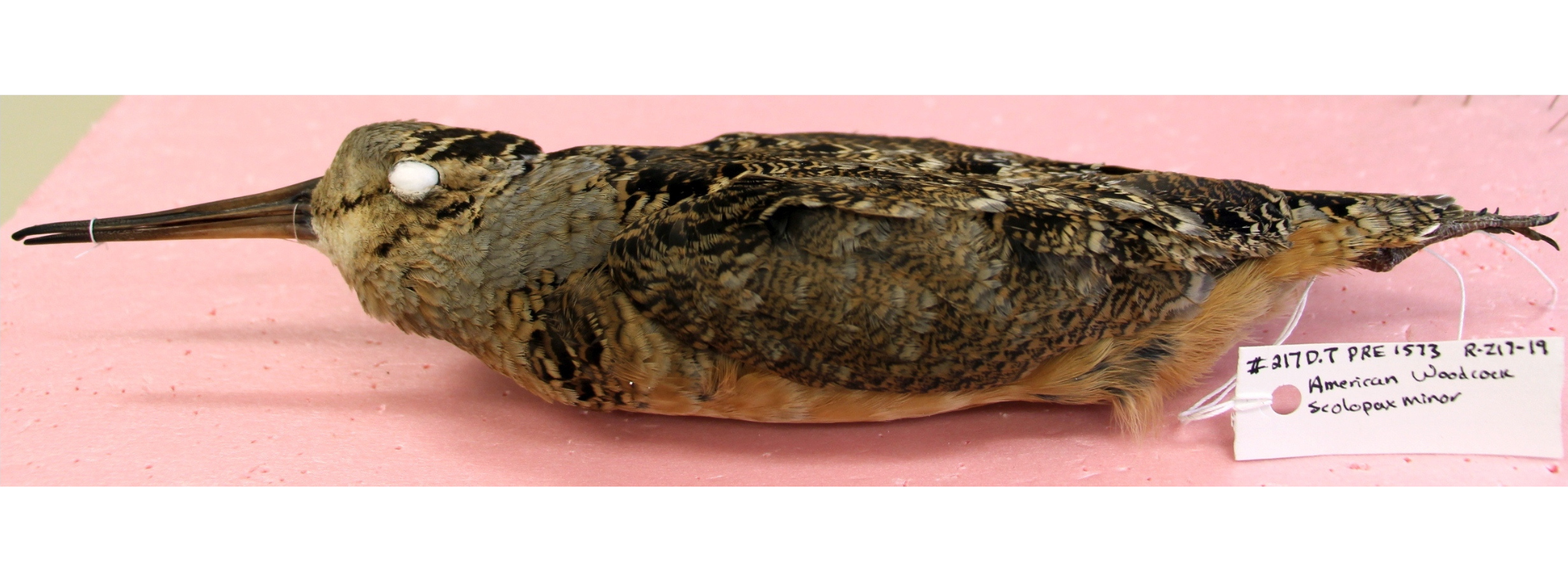
Prepared bird specimen with cotton batting in eye sockets and specimen label tied to its foot.

Skin of a Scolopax minor (American Woodcock) ready for cataloguing, pre-acquisition 1573. © Manitoba Museum

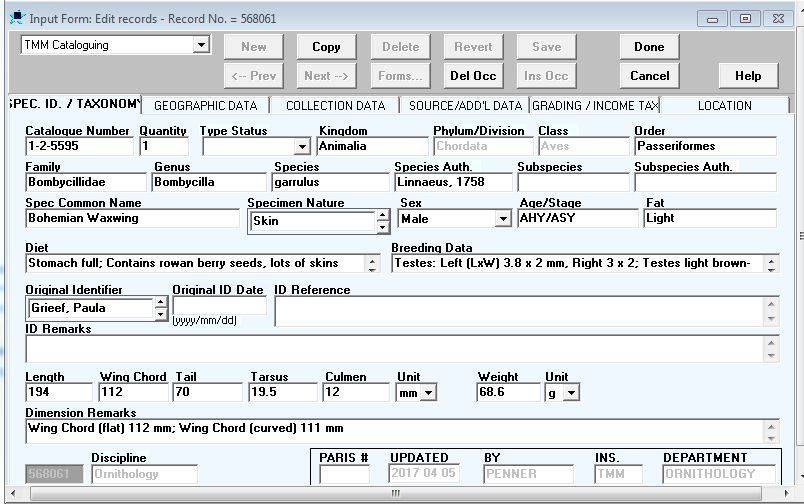
Where, when, and by whom the bird was collected is important information to know. Sometimes the person collecting the bird may have noted the time of day or what the bird was eating, or other interesting information about that particular bird. Donor information is also recorded. All this information makes up the data that is then entered into our digital database.


Image: Screenshot from database of catalogue number 1-2-5595. © Manitoba Museum

So why do we collect bird skins?

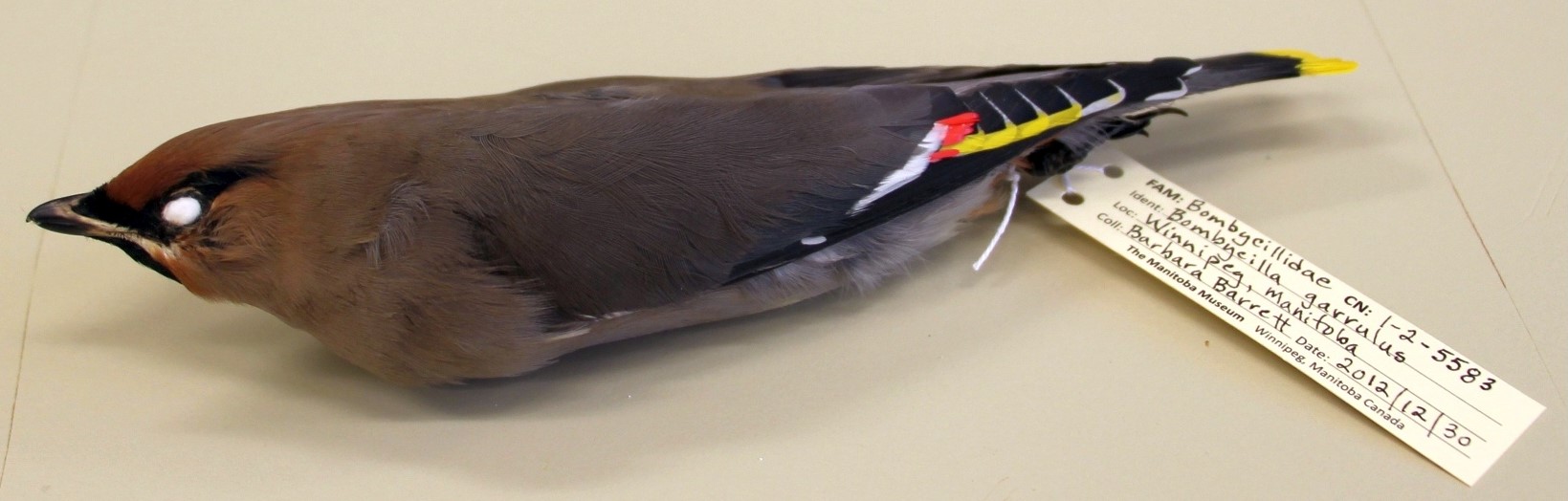
Prepared bird specimen with cotton batting in eye sockets and specimen label tied to its foot.

Collecting birds, or any other natural history specimen, is a record of where and when a particular organism lived. Bird distributions are known to change. Having a particular bird specimen is physical evidence of a bird living in a particular area. This is sometimes a record of how birds have expanded into new areas, or may have become less common in other areas.


Image: Catalogued Bombycilla garrulus (Bohemian Waxwing), catalogue number 1-2-5583. © Manitoba Museum

Also, not all birds of one species will look exactly the same. Even though they might be of a similar age and sex, birds can be different sizes, and exhibit different colour variations.

Sometimes samples are taken to test for DNA or other chemicals. This is how it was discovered that use of the pesticide DDT was causing the decline of certain species of predatory birds, such as eagles. The decline was because DDT accumulated in the parent birds, and caused thinning of bird egg shells. Then less baby birds would hatch successfully.

So, we never know, someday in the future those birds we collect might serve an unexpected purpose.

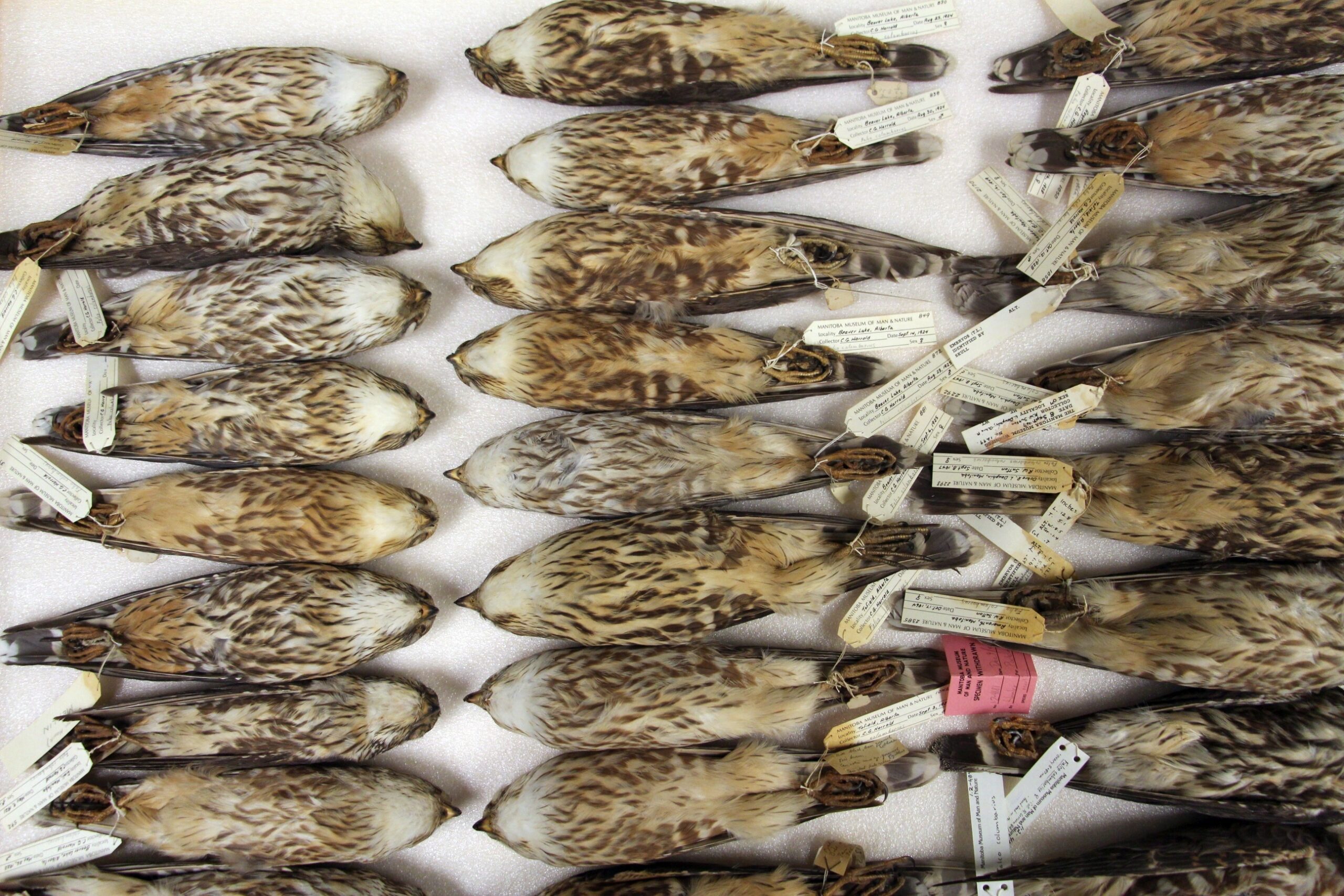
A specimen drawer containing about two dozen bird specimens of the same species.

Skins of Falco columbarius (Merlin) in the Museum’s collection. © Manitoba Museum

Spring has Sprung

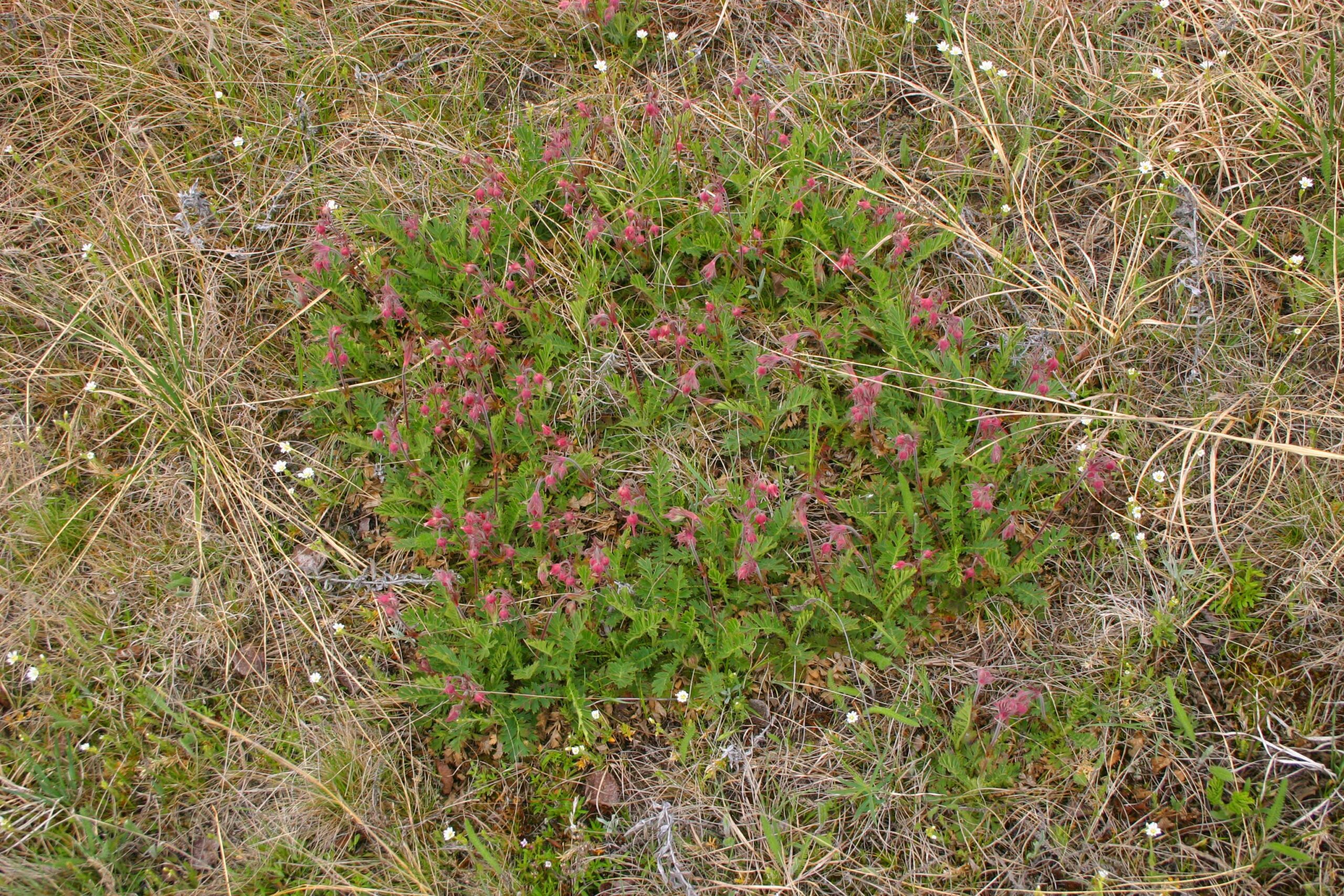
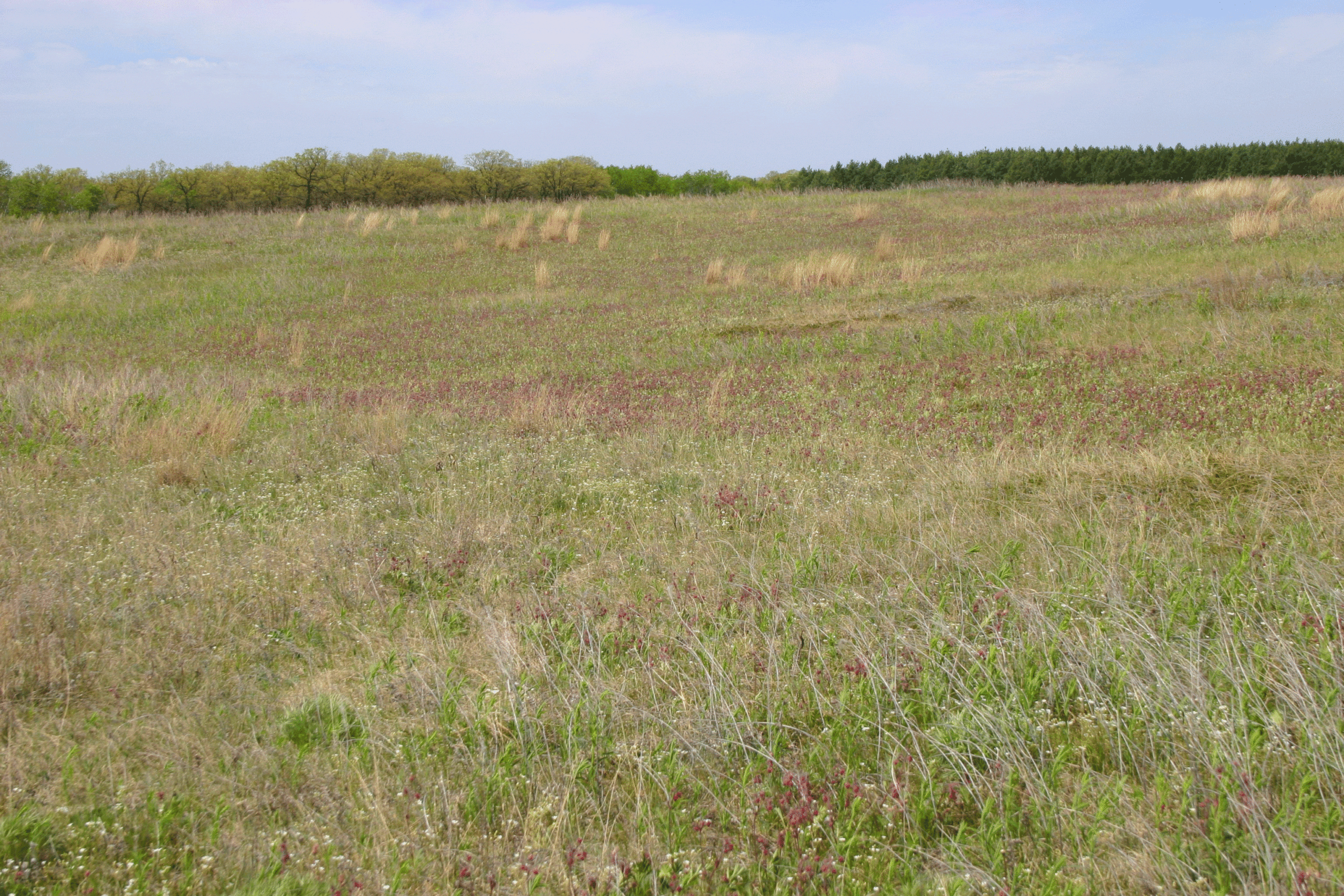
Once again I am studying pollinators at the Nature Conservancy’s Yellow Quill Prairie Preserve (find more details here) just south of Canadian Forces Base Shilo. Last year I made the mistake of starting my field surveys too late and missed the blooming of a number of early flowering plants like prairie crocus (Anemone patens), three-flowered avens (Geum triflorum), and chickweed (Cerastium arvense). This year I did my first survey on May 11, which was already almost too late for the crocuses but just in time for the others.

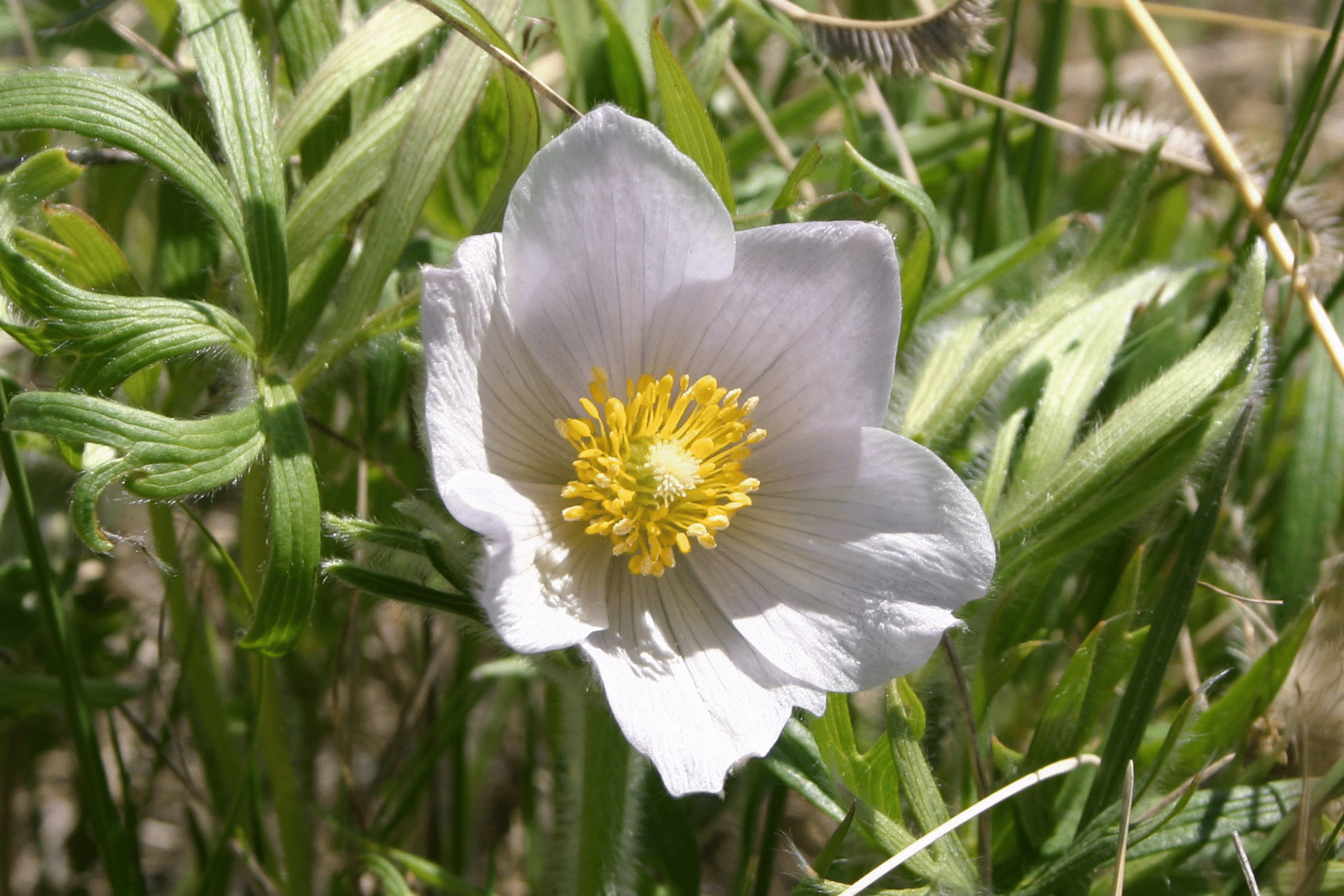
A small, low-growing white flower with a yellow centre.

Prairie crocus (Anemone patens) finished flowering in early May.

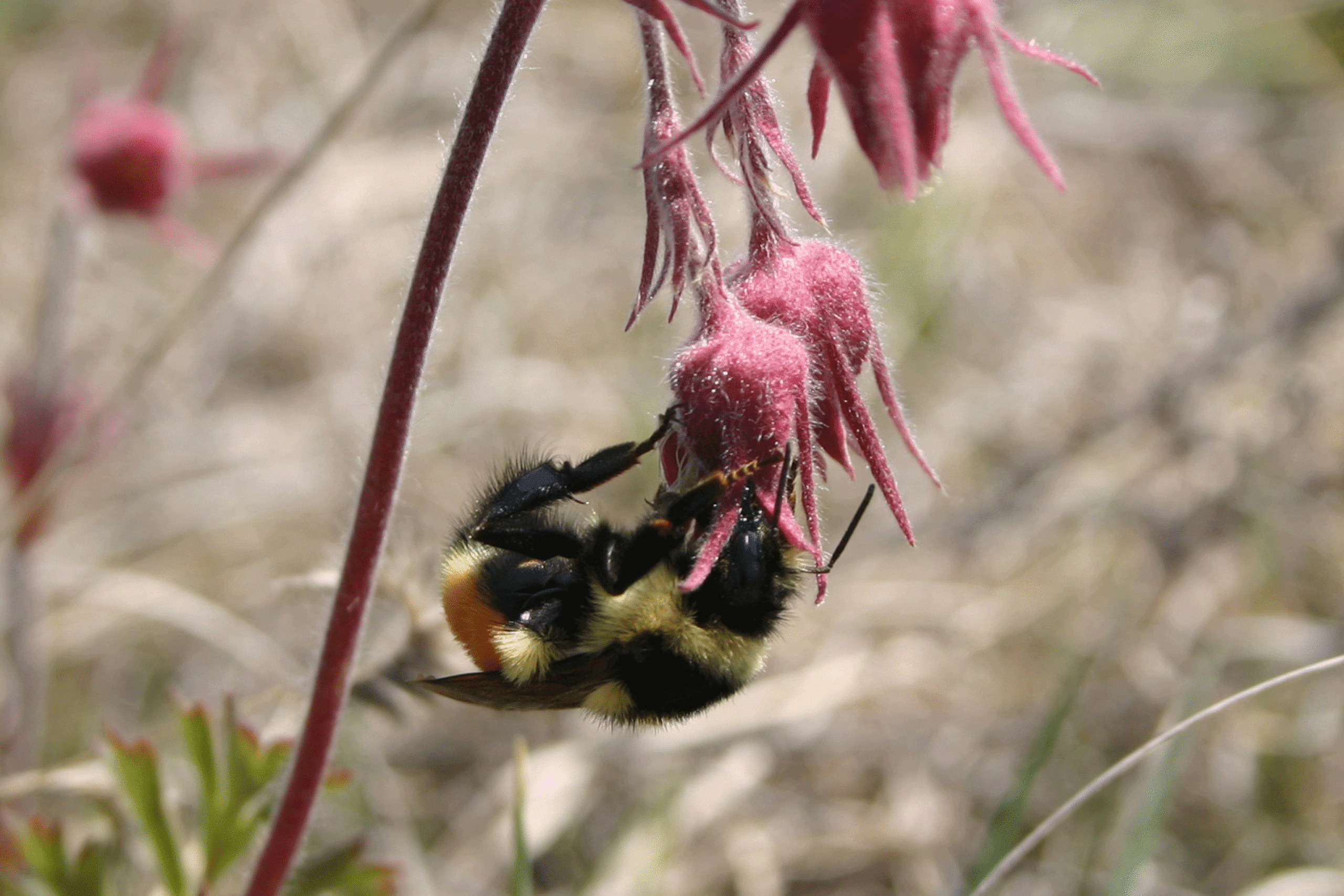
A yellow and black striped bumblebee with an orange band around its middle hangs upside-down from a pink flower on a low growing plant. Two other flowers grow from the same stalk.

Queen bumblebees often feed on three-flowered avens (Geum triflorum).

Spring is not the busiest time on the prairies as bee populations are not at their peak yet. However, it is a very important time because the queen bees start feeding. Bee queens are the only ones that survive the winter, going into hibernation in the soil. In spring, the hungry queens begin feeding on both pollen and nectar from the early blooming wildflowers. Once they have fattened up a bit, they select appropriate nesting sites and lay the eggs that will produce the first worker bees. Some queen bees brood their eggs, keeping them warm until they hatch. The workers typically start showing up in June.

My task this May was to find out what the queens were feeding on. Bumblebees (Bombus spp.) were most fond of three-flowered avens with 61% of all visits being to that species followed by chickweed (25%). Andrenid bees (Andrena spp.), on the other hand, preferred the chickweed visiting it 95% of the time. The little sweat bees (Lasioglossum spp.) weren’t terribly abundant yet but only visited the chickweed. In fact, one day it was so windy that I didn’t see any sweat bees at all. If they had ventured out, they would have been incapable of flying without getting completely blown off course as the wind speed was almost 50 km/hour. The few big insects that were out (e.g. bumblebees, clearwing moths) were zooming past me very quickly, if they were going in the direction of the wind that is.

Interestingly, I also saw domesticated honeybees (Apis mellifera), visiting three-flowered avens and chickweed in equal amounts. These honeybees are being kept by one of the nearby farmers and, since there are no crops in flower yet, they were out searching for something to eat. To me, this clearly demonstrates the value of prairie preserves. Although some consider wild prairies to be “waste land” because they aren’t being used to grow crops, they do provide us with benefits: they help pollinating insects survive and reproduce, are a safe place for nesting, and are a source of honey for us to eat.

Happily, except for the strong wind that one day, the weather was great during my surveys: sunny and warm. Hopefully my luck will hold out and I’ll have clear skies for my next field trip in early June.


Image: Streaks of pink and white at Yellow Quill Prairie represent three-flowered avens (Geum triflorum) and chickweed (Ceratium arvense) flowers in abundance.

Dr. Diana Bizecki Robson

Dr. Diana Bizecki Robson

Curator of Botany

Dr. Bizecki Robson obtained a Master’s Degree in Plant Ecology at the University of Saskatchewan studying rare plants of the mixed grass prairies. After working as an environmental consultant and sessional lecturer…
Meet Dr. Bizecki Robson

Make Goldenrods Great Again!

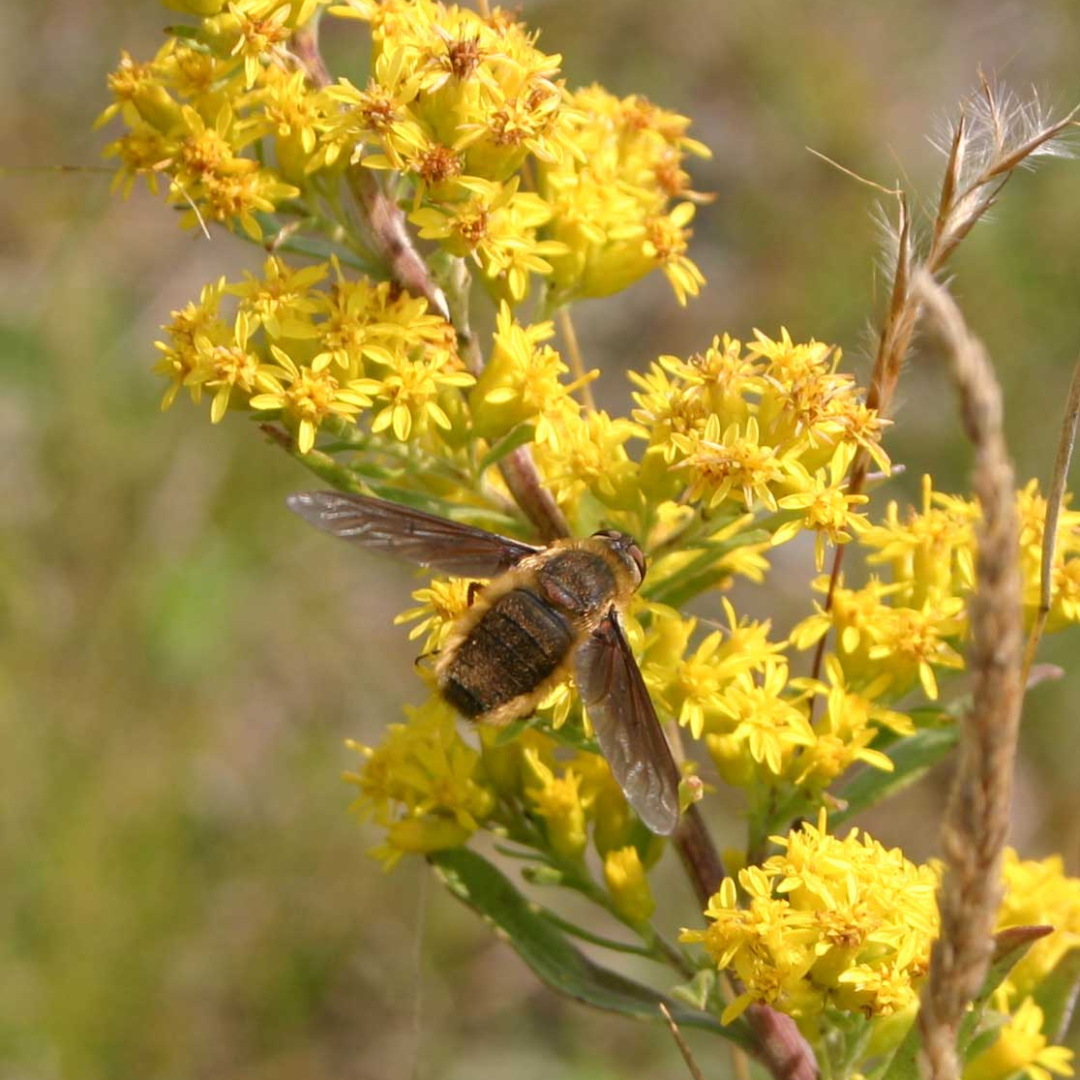
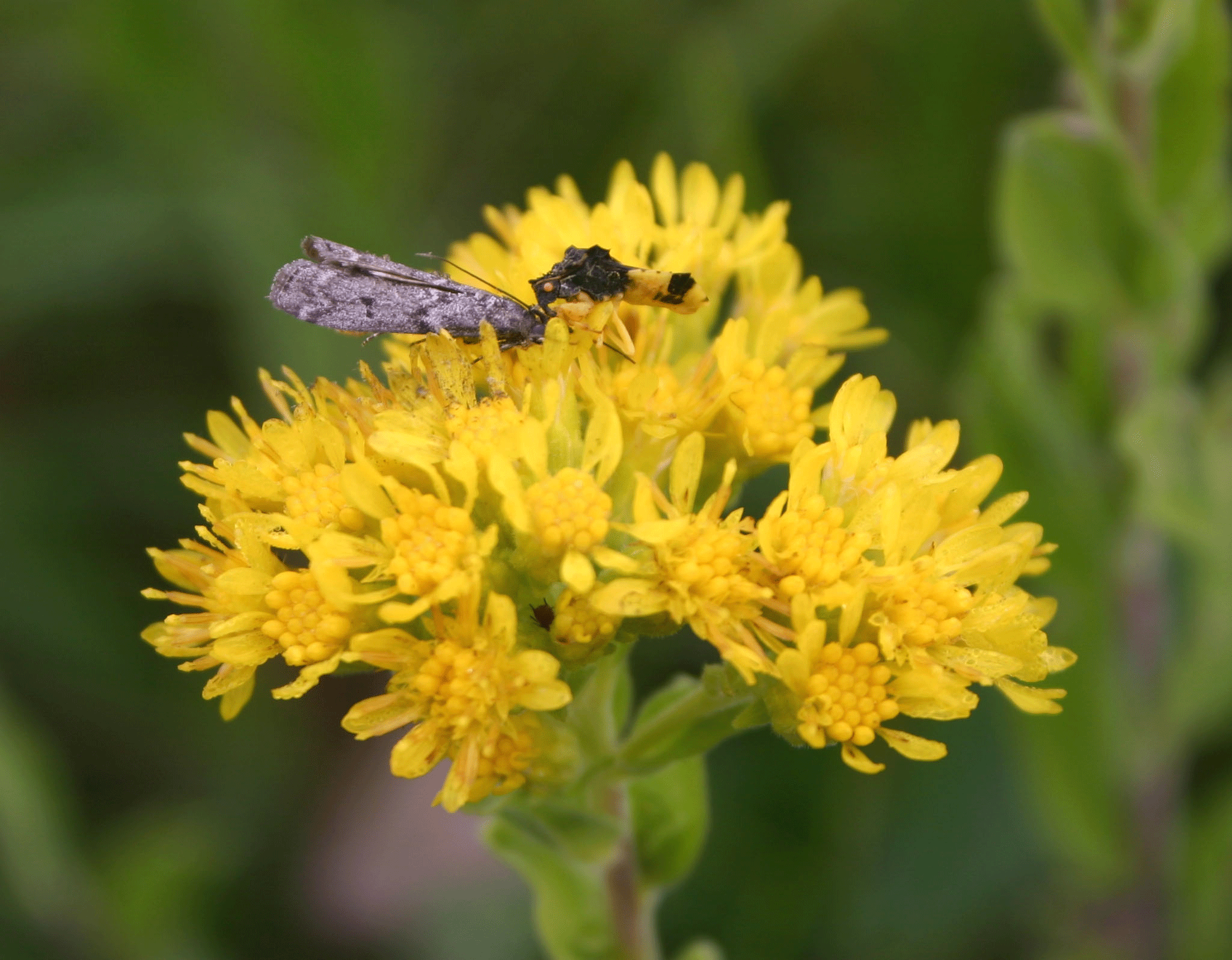
A close up on two insects on a cluster of yellow Goldenrod flowers. One of the insects is eating the other.

This is a blog about pollination. It’s gonna be great! You’ll love it. I write the best blogs. There’s this one plant—it’s a Goldenrod—it is THE best plant for pollinators. Manitoba has THE best plants for pollinators. Not like Ontario. All the pollinators love Goldenrod: bees, flies, butterflies, moths—even beetles. All the other plants in the prairie—losers. Can’t attract the pollinators! Can’t do it! But that Goldenrod! So many pollinators visit it that there’s this bug—it’s an ambush bug—that it sits on the Goldenrod and eats the pollinators that show up. It eats them! Totally devours them! Nothing left but a pathetic husk. Sad.
Goldenrods are the best. They used to be all over the place. Then immigrants came, cut down all the Goldenrods and started growing plants from Eurasia. Like wheat. Pollinators don’t like wheat! They hate it! There’s no nectar! None! Now the native pollinators, they don’t have anything to eat! Nothing! That’s why we should grow Goldenrods. A lot of them. So many that it will look like a wall. A big, golden wall. It’s gonna be beautiful! The pollinators will love it.


Image: Ambush bug eating a pollinator!

Dr. Diana Bizecki Robson

Dr. Diana Bizecki Robson

Curator of Botany

Dr. Bizecki Robson obtained a Master’s Degree in Plant Ecology at the University of Saskatchewan studying rare plants of the mixed grass prairies. After working as an environmental consultant and sessional lecturer…
Meet Dr. Bizecki Robson

More about Mycorrhizae

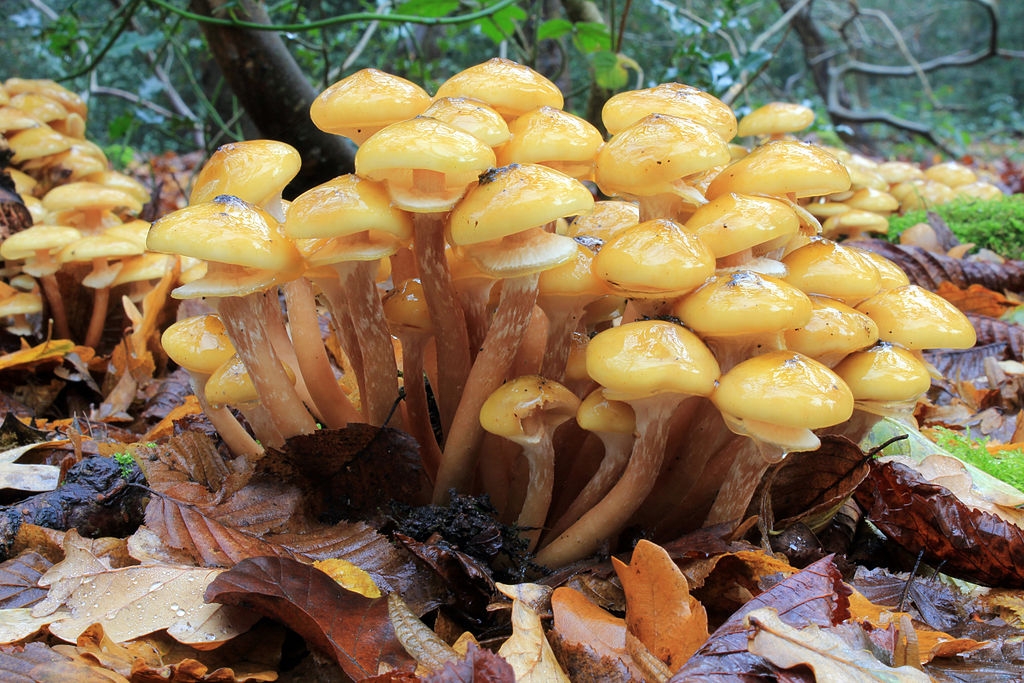
A dense closter of small mushrooms with shiny yellow caps that look as though they were dipped in honey.

Have you ever seen an uprooted tree while walking in a forest? If so, you might have noticed strands of white thread-like structures attached to the tree roots and running through the soil. What you were seeing were mycorrhizal fungi. These fungi surround and bind almost all of the plants growing in an ecosystem together. Some of them, like the honey fungus (Armillaria mellea; pictured) are even luminous, glowing in the dark. The honey fungus is also the world’s largest organism (that we know of, at least); one specimen stretches for an astounding 2.4 miles (3.8 km) (Ferguson et al. 2003)! This fungus is attached to hundreds of trees, which are also attached to countless other mycorrhizal fungi and forest plants. Sugars, water, and nutrients are exchanged between the plants and the fungi. Trillions of insects and microorganisms live on, and interact with these fungi-root systems. Unfortunately, our understanding of this massive system is horrible, because we can’t actually see what is going on.

Image: Wikimedia Commons


It’s important to remember that the parts of a forest or a prairie that we can see above ground are probably less than a half of the ecosystem’s total biomass; almost all of the fungal biomass is beneath the ground.

Some mycorrhizal fungi appear to only associate with certain plant species while others are less discriminating. About 80% of all plant species (including all trees) associate with mycorrhizae; the plants that don’t are the rushes, sedges, nettles, mustards, goosefoots, and pinks. Some plants are so dependent on mycorrhizae that they can’t live without them: the orchids are one such group. While most mycorrhizal relationships appear to be mutualistic, with both partners benefiting from the interaction, many orchids appear to be parasitic on the fungi!

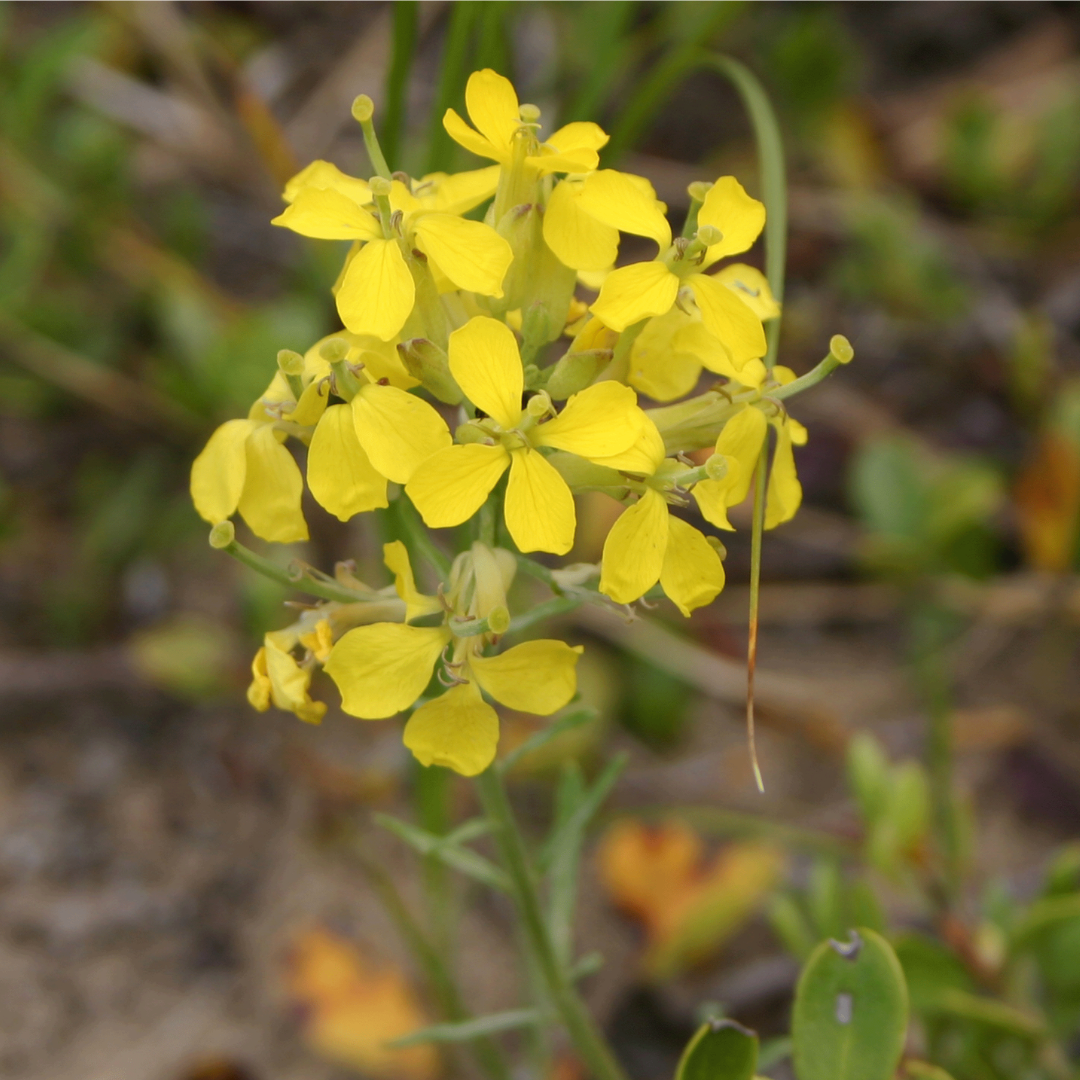
Close up on a cluster of four-petaled yellow flowers.

Plants in the mustard family like Western wallflower (Erysimum asperum) are some of the only species that do not associate with mycorrhiza. © MM

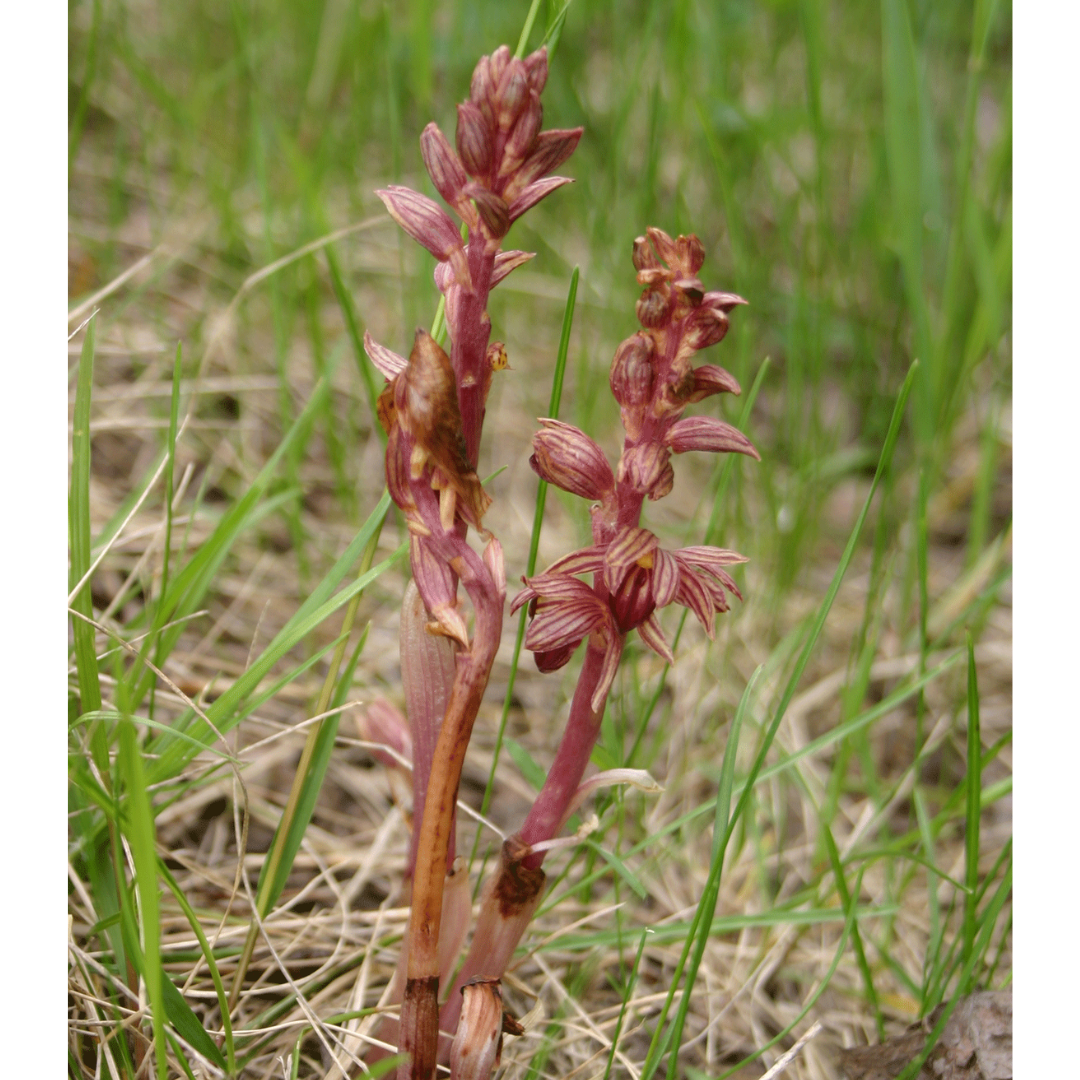
Two thick stalks growing up from the ground, with leaf-like petals on the top third.

Striped coralroot (Corallorrhiza striata) parasitize both trees and mycorrhizal fungi. © MM

The most parasitic orchids are the coralroots (Corallorrhiza spp.). These species are vascular plants that can no longer photosynthesize, as indicated by the fact that they are orange instead of green. Coralroot orchids parasitize mycorrhizal fungi, which form relationships with pine (Pinus spp.) trees. Thus all of the sugars the coralroot uses to fuel its growth come from the pine trees (via the mycorrhiza), and the water and minerals it needs come from the fungus (Zelmer and Smith 1995).

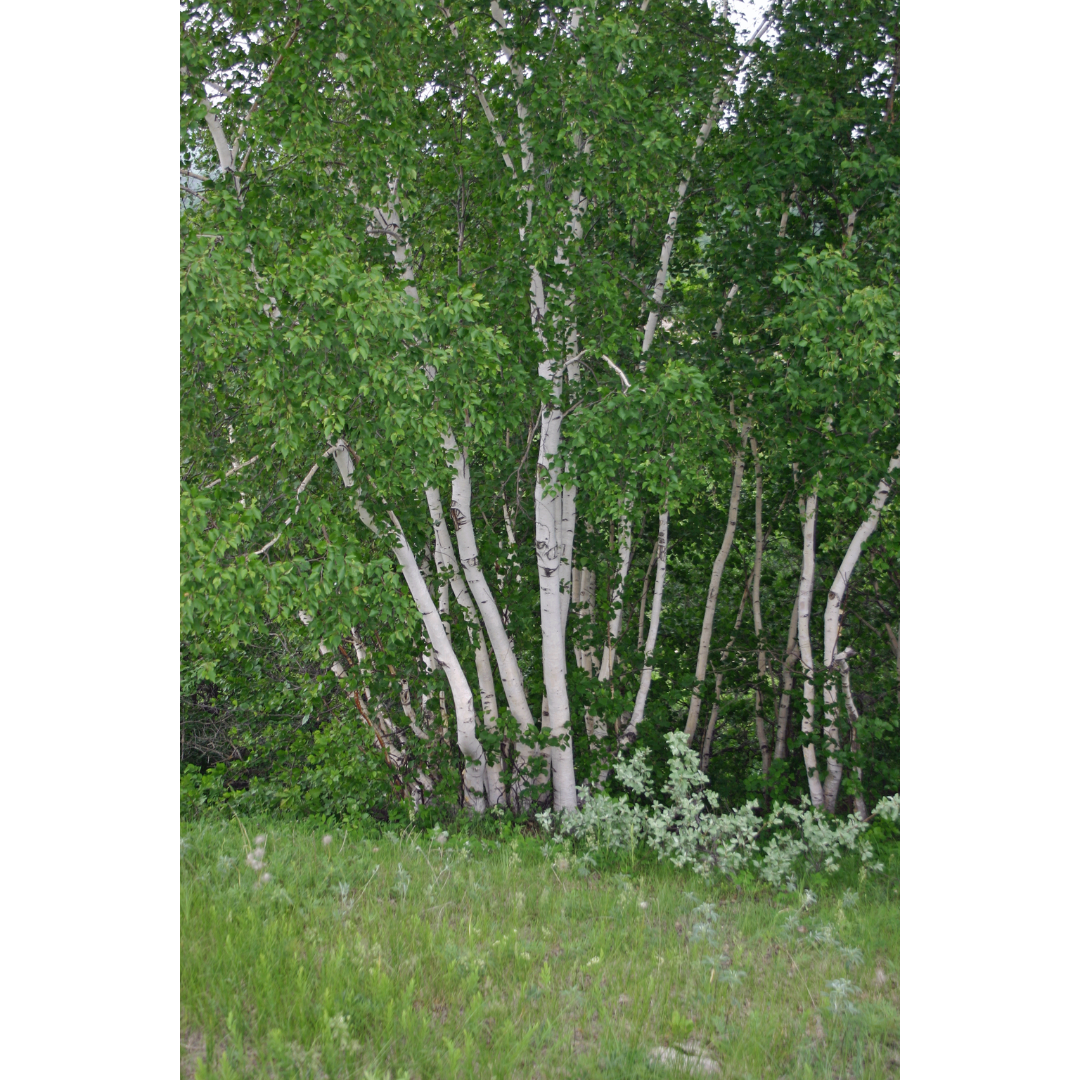
View over a clearing towards a group of Paper birch trees.

Mycorrhizae appear to help tree “parents” feed their offspring. In “The Hidden Life of Trees” the German forester Peter Wohlleben describes how sugars produced by large, adult trees in a forest are transferred through the mycorrhizae to the saplings, which are unable to access much light. In this way, young trees are provided with enough nourishment to stay alive until the adult tree dies and the young ones can obtain light for themselves. Resources are even transferred between trees of different species. Douglas firs (Pseudotsuga menziesii) were found to transfer nutrients to paper birch (Betula papyrifera) trees in the spring and fall when the birches had no leaves and the birches transferred nutrients to the firs in the summer when their leaves were shaded (Song et al. 2015). Wohllenben thinks that this happens because “a tree can be only as strong as the forest that surrounds it.”

This is just the tiniest shred of what scientists know about mycorrhizae and new studies are being conducted all the time using new tools and analytical techniques. Next time you’re out hiking in a forest remember this amazing invisible world under your feet!


Image: Paper birch (Betula papyrifera) trees exchange nutrients with other trees through mycorrhizal links. © MM

References

Ferguson, B.A., T.A. Dreisbach, C.G. Parks, G.M. Filip, and C.L. Schmitt. 2003. Coarse-scale population structure of pathogenic Armillaria species in a mixed-conifer forest in the Blue Mountains of northeast Oregon. Canadian Journal of Forest Research 33:612-623.

Song Y.Y., S.W. Simard, A. Carroll, W.W. Mohn and R.S. Zeng. 2015. Defoliation of interior Douglas-fir elicits carbon transfer and stress signalling to ponderosa pine neighbors through ectomycorrhizal networks. Scientific Reports, 5 8495. DOI: http://dx.doi.org/10.1038/srep08495

Wohlleben, P. 2016. The hidden life of trees: What they feel, how they communicate discoveries from a secret world. Greystone Books.

Zelmer, C.D. and R.S. Currah. 1995. Evidence for a fungal liaison between Corallorrhiza trifida (Orchidaceae) and Pinus contorta (Pinaceae). Canadian Journal of Botany 73:862-866.

Dr. Diana Bizecki Robson

Dr. Diana Bizecki Robson

Curator of Botany

Dr. Bizecki Robson obtained a Master’s Degree in Plant Ecology at the University of Saskatchewan studying rare plants of the mixed grass prairies. After working as an environmental consultant and sessional lecturer…
Meet Dr. Bizecki Robson

Red Cross Quilt Returns Home

When the weather turns cold many of us pull out handcrafted quilts and afghans. The comfort they bring often goes beyond the mere physical and can make us feel as if the people that created them are enveloping us in a warm and loving hug. Recently, a very special quilt was donated to the Manitoba Museum. One of thousands sent overseas by the Canadian Red Cross during the Second World War to provide warmth and comfort, it has now returned home to Manitoba nearly 75 years later.

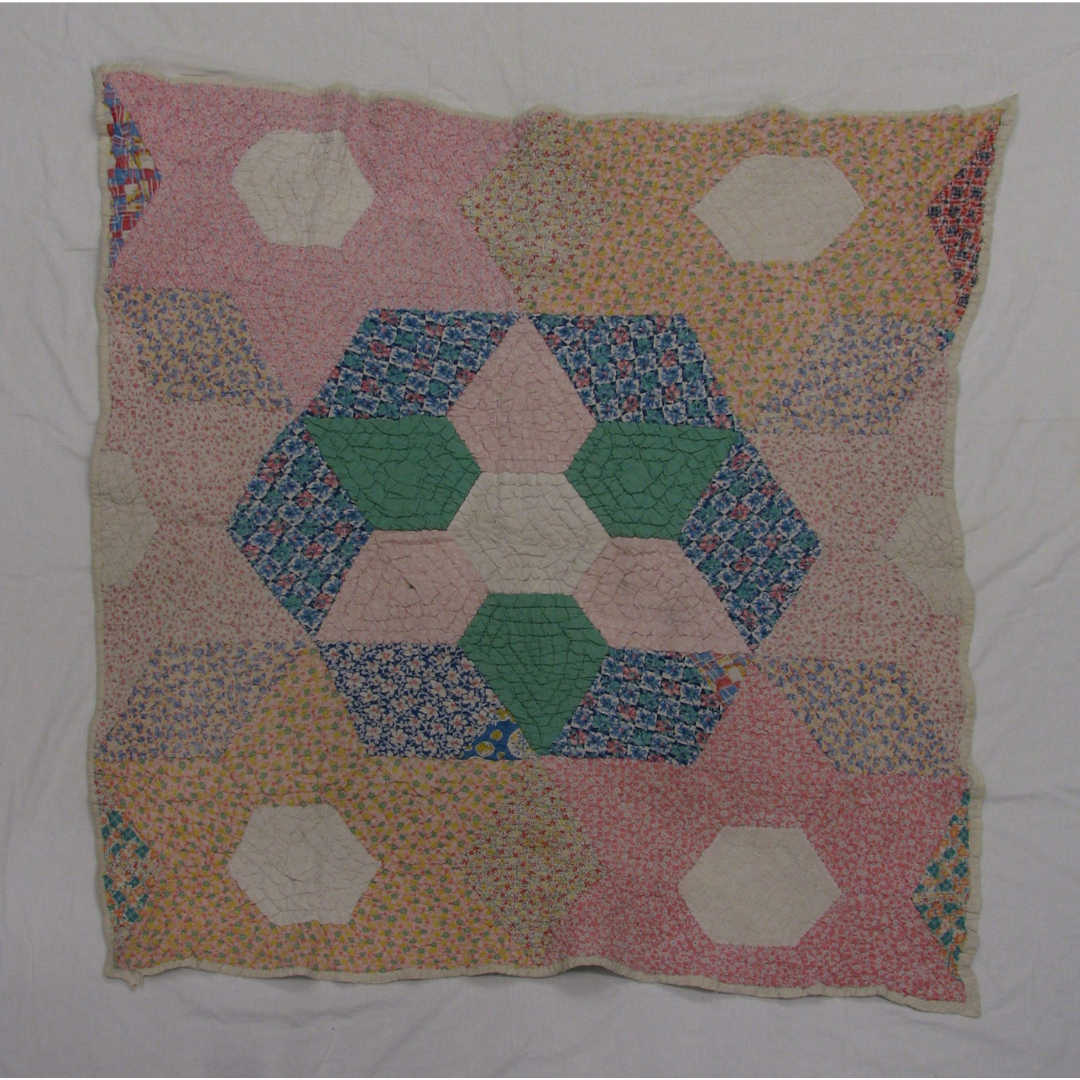
A quilt stitched of pastel pink, orange, and cream fabric with an accent portion in the middle in blues and greens.

Red Cross Quilt, H9-38-563. © The Manitoba Museum

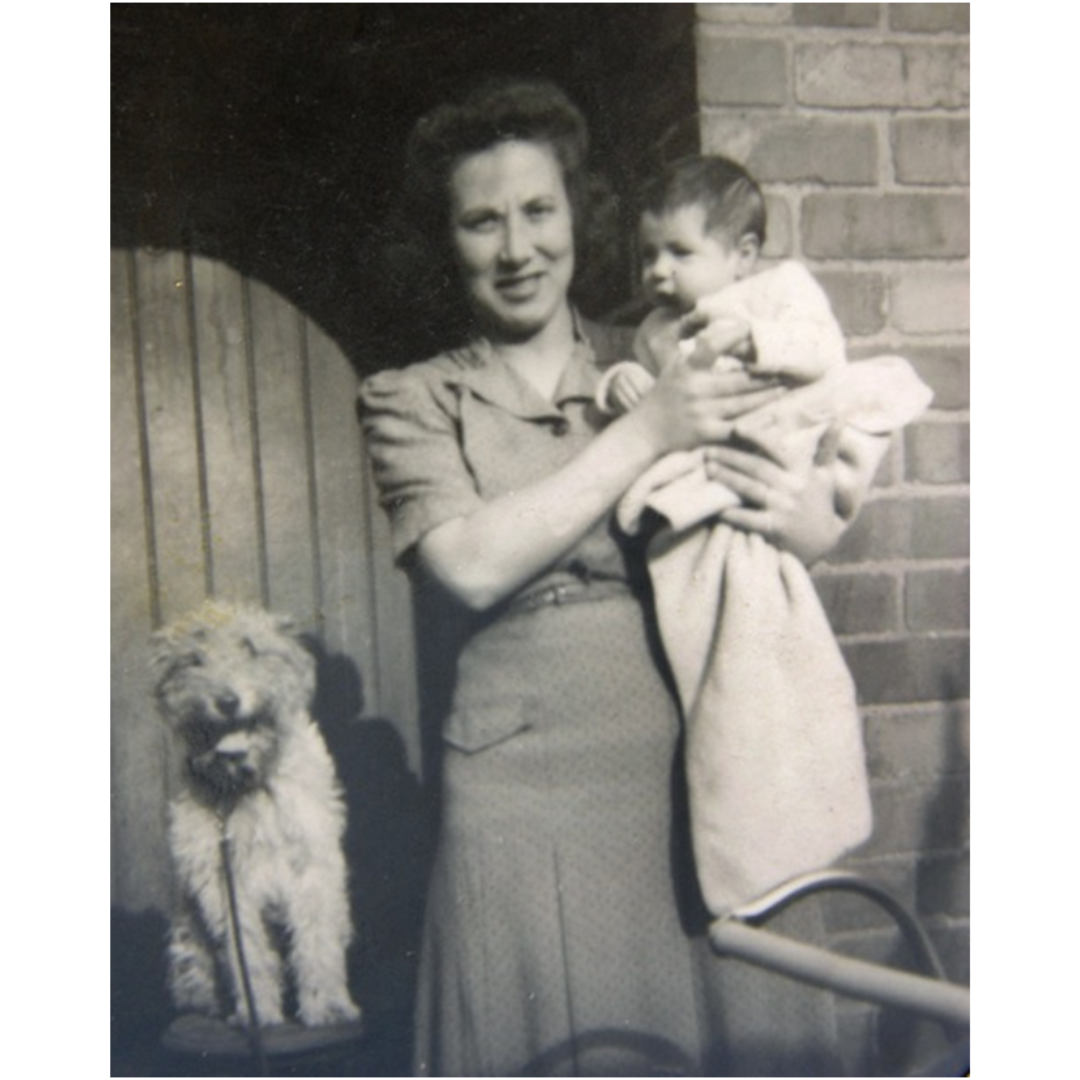
A black and white photograph of a woman standing outdoors holding a baby, with a dog seated beside them.

Betty Craddock with son Anthony. © Anthony Craddock

The story of the quilt begins in Steep Rock, Manitoba where local women would have been part of a network of participants in the Red Cross “Women’s War Work” sewing and knitting program. It was likely sorted and packed at a Red Cross facility before being shipped overseas and on to the Dudley Road Hospital in Birmingham. There, a Matron passed the quilt on to Cynthia (Betty) Craddock sometime towards the end of the war. Betty worked as a lathe operator making tank parts in a factory in Coventry. Her husband Joe had completed apprenticeship as a painter and decorator and then was called up for the army in 1940. He worked as a cook for the Army Intelligence Corp, serving in England and Wales. Joe reached the continent just after D-Day and was among the first troops in Belgium. They had married in 1943 and were together for over 70 years. Their only son Anthony was born in 1945.

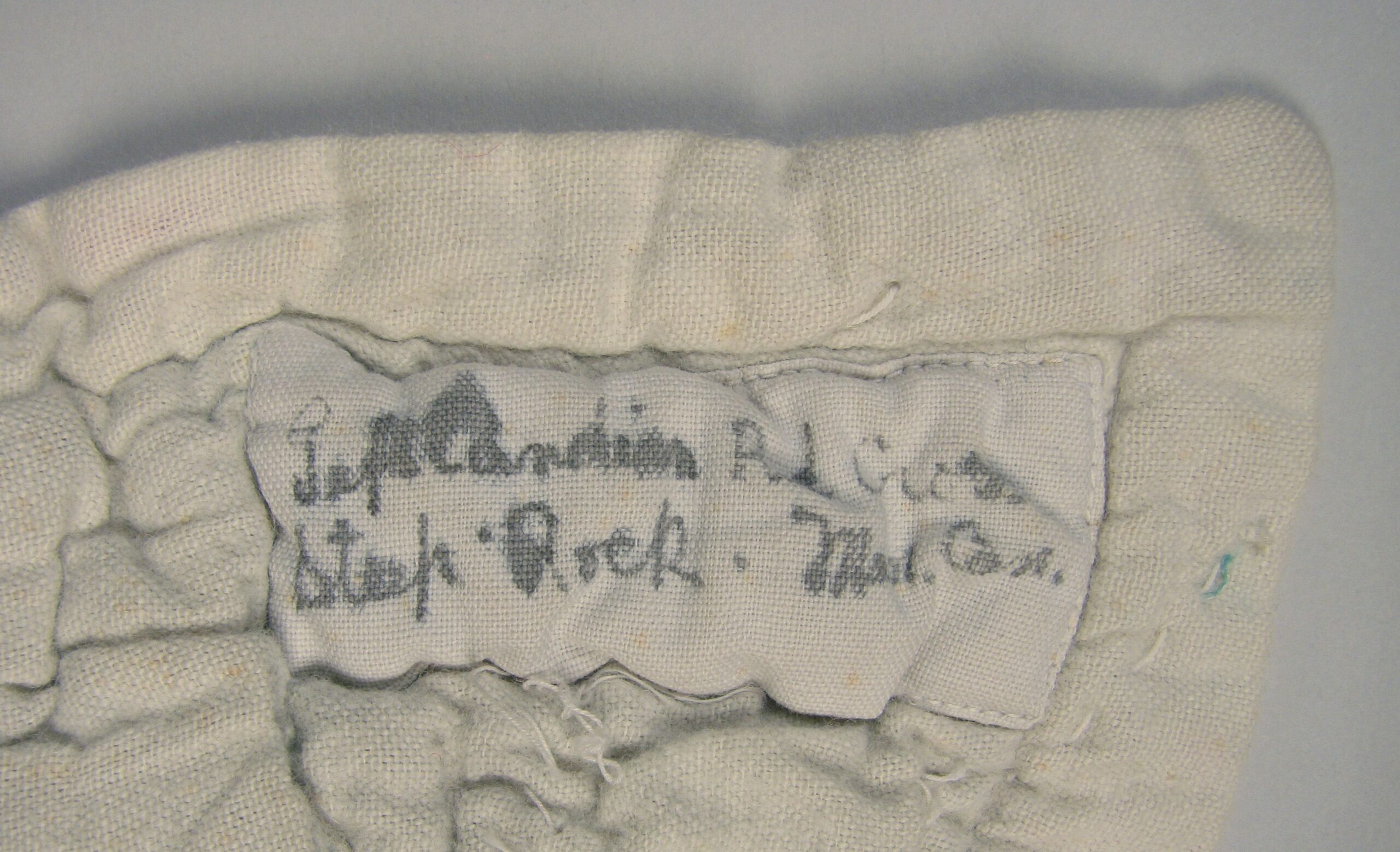
Following the war, the family moved to Kenilworth and the quilt went along with them. Britain was recovering from the war and rationing was still in place. Joe was working to start his own business. Anthony’s earliest memories are “of this quilt being on my bed and keeping me warm when times were hard.” He recalls that, “with no central heating, frost would often appear on the inside of the window.” The young Anthony was amazed by the colours and patterns and remembers reading the message on a tag on one corner of the quilt, “Gift Canadian Red Cross, Steep Rock Man. Can.”


Image: Close-up of label on quilt. © The Manitoba Museum

The Canadian Red Cross Society was founded in 1896. The purpose of the Society, as set out in its 1909 Act of Incorporation, was “to furnish volunteer aid to the sick and wounded of armies in time of war”. Following WWI, the Red Cross expanded its role into public health, especially in remote or newly settled areas of Canada. The two mandates merged in WWII as the Red Cross worked with military personnel and civilian victims of the war. On the home front, countless volunteers worked to high standards creating supplementary hospital and relief supplies.

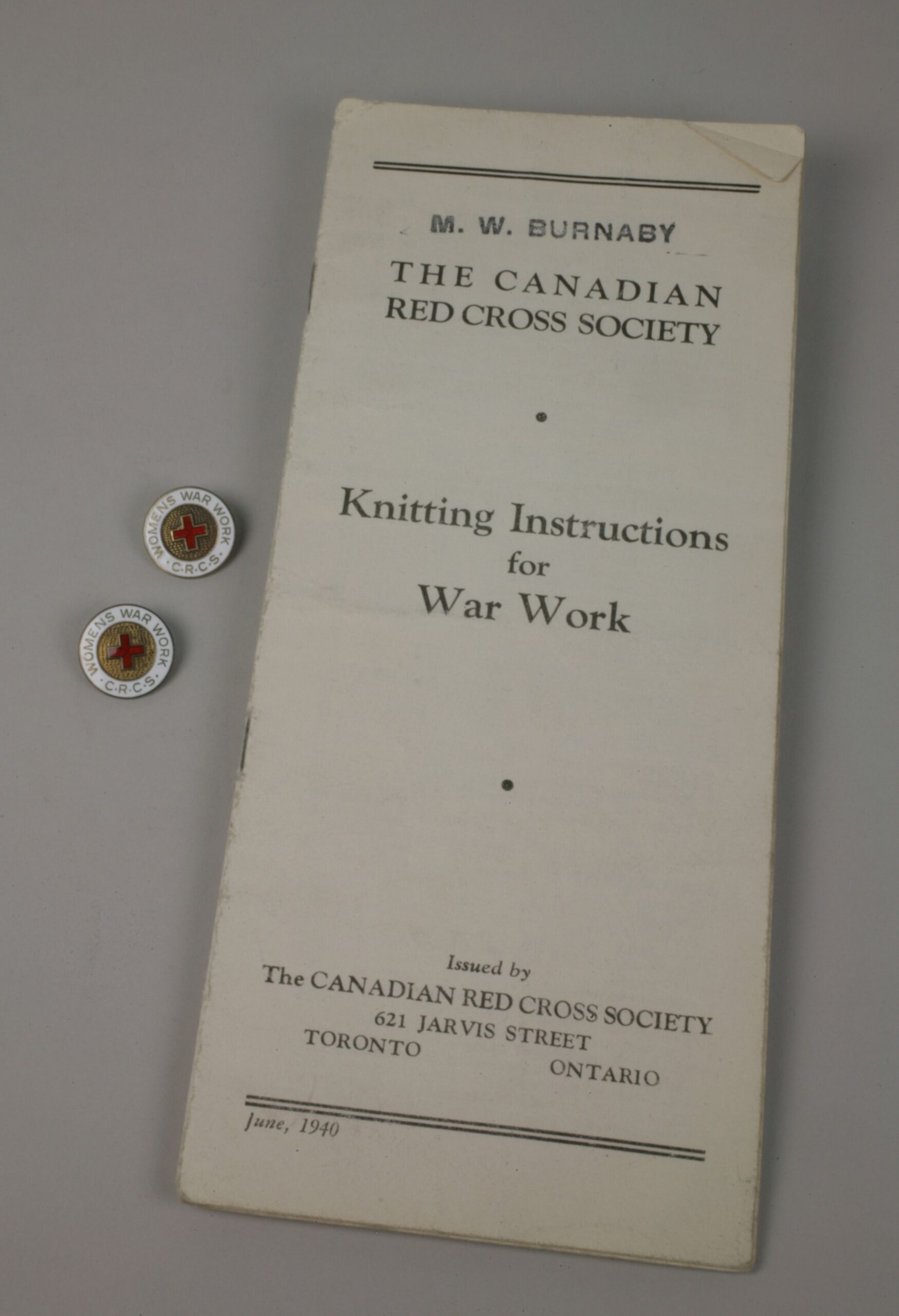
The Canadian Red Cross Society distributed patterns and lapel pins to volunteers in the “Women’s War Work” program.

A Canadian Red Cross Knitting Instructions for War Work booklet, with two lapel pins beside it.

Lapel pins, H9-22-407 and H9-31-994, Knitting Pattern, H9-29-545. © Manitoba Museum

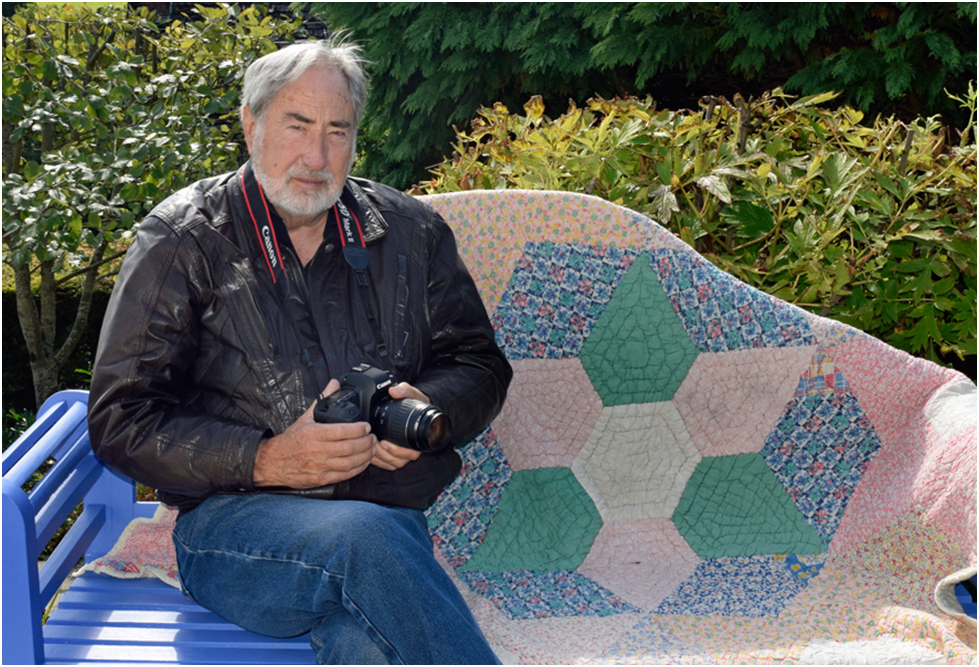
A grey-haired man holding a DSLR camera sitting on a blue bench with the quilt draped over the back of it.

Anthony Craddock has been a professional photographer since 1965 and is now a director of Images Etc Ltd”. Anthony Craddock with quilt, 2016. © Anthony Craddock

Now that the quilt has been received into the museum’s collection, Roland Sawatzky, Curator of History is looking forward to sharing it with the community and perhaps learning more about the “hands-on” humanitarians who sewed it. As the women of Steep Rock gathered to create this quilt, I’m sure they would not have imagined that it would be treasured by the receiving family into the next century.


Sources:

120 Years of the Canadian Red Cross at www.redcross.ca/history/home
Biographical and historical notes provided by Anthony Craddock

Nancy Anderson

Nancy Anderson

Collections Management Specialist – Human History

Nancy Anderson holds a B.A. (Hons) in History from the University of Winnipeg, and received her M.A. in Canadian Social History jointly from the University of Winnipeg and University of Manitoba. She has over 30 years experience…
Meet Nancy Anderson

Legacies of Confederation – Outlaw #5, Canada, and Bison Conservation 

Celebrating Canada’s first 150 years does not usually involve thinking about the environment or biodiversity, and certainly Confederation is a human history event. But human actions have an impact on our environment and the creation of Canada was no exception. Our latest exhibit, Legacies of Confederation: A New Look at Manitoba History, offers an opportunity to explore those impacts, those legacies, from a natural history perspective. Given the massive changes to Manitoba’s environment since 1867 (and 1870 when we became Canada’s fifth province), it is easy to focus on the negative effects; indeed, grasslands and many of their component parts have become rare or have even disappeared. But becoming a nation can also bring substantial resources to bear on mitigating those impacts through policy, funding, social conscience and national pride. 
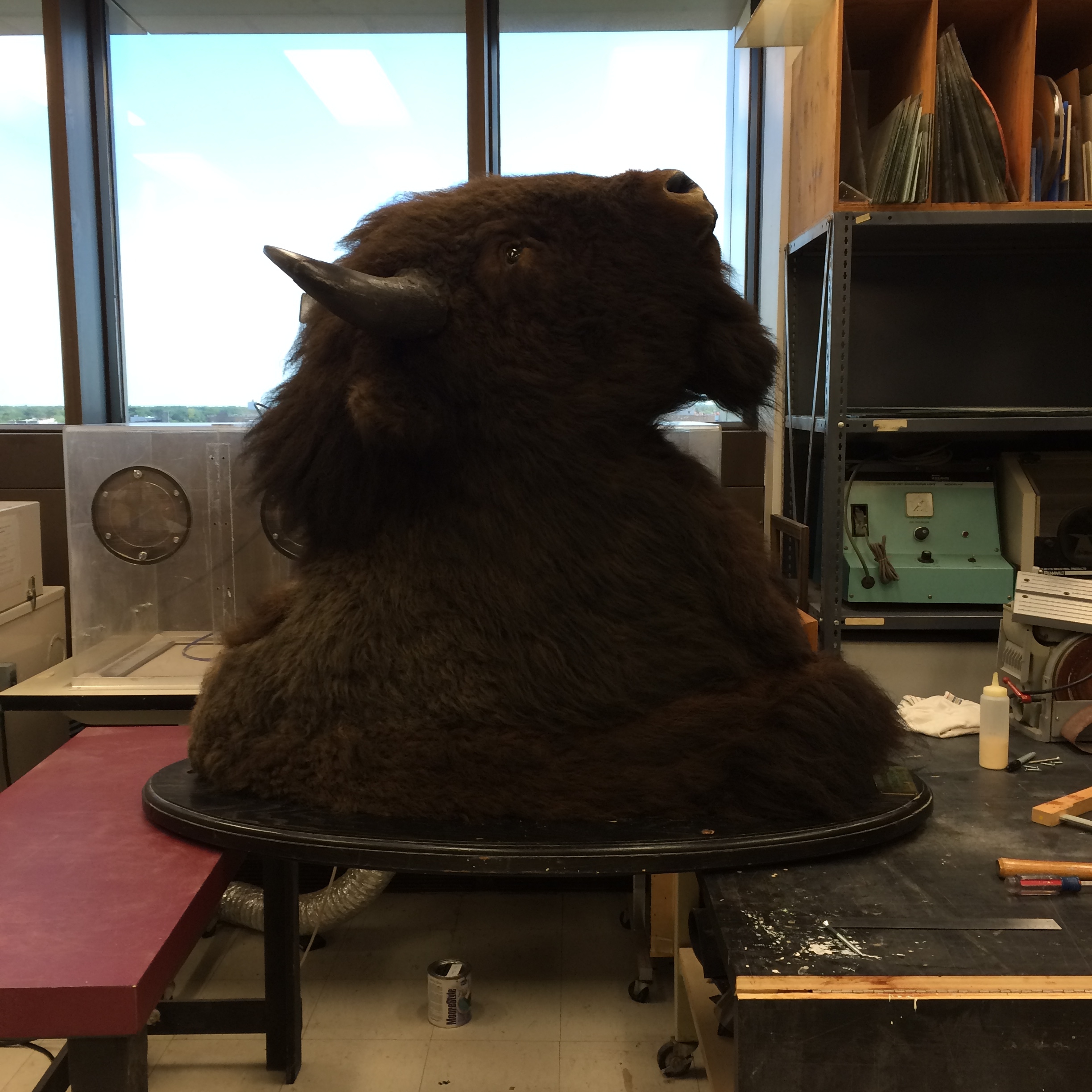
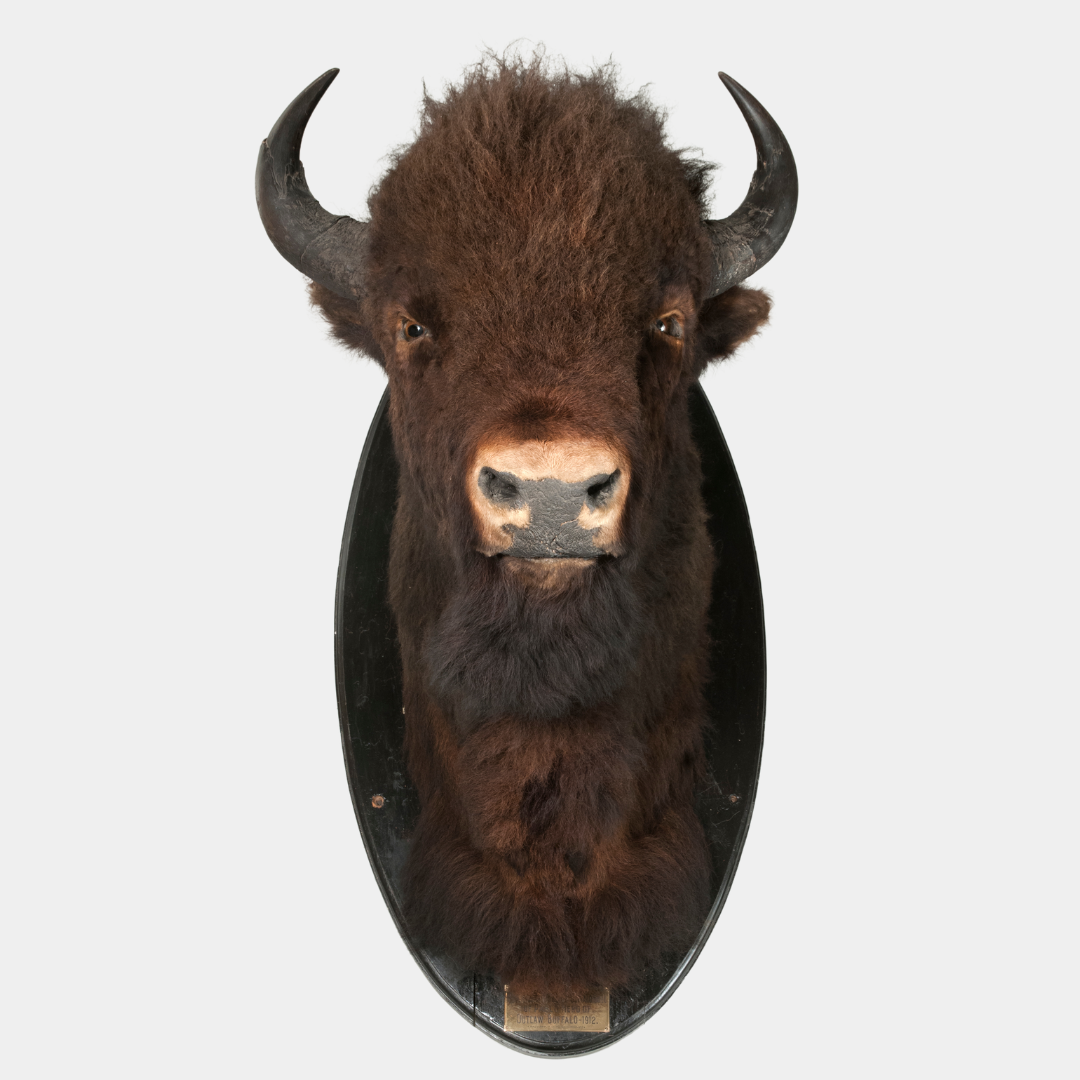
Outlaw #5 is a magnificent bison head that hung in the Winnipeg City Council Chambers in 1912 and is now hanging for all to see in the Legacies exhibit. This seems the beginning of a depressing story rather than a positive one, and in some ways it is; this bull bison is an unlucky representative of one of the last significant herds of plains bison (Bison bison bison) in North America at the turn of the 20th century. But it also represents the beginning of an incredibly successful conservation story – bringing bison back from the brink of extinction. I have introduced this specimen before, but this amazing mount has so many incredible stories to tell that I can’t resist an encore presentation. 
On the left, a caricature of a man riding a small bison with a large rising sun in the background. Text below reads “C.V. Alloway”. On the right, a oval photograph of a large bearded man in a fur coat and vest.

Caricature of Charles Alloway (Manitobans As We See ‘Em, 1909) and photo of James McKay (Archives of Manitoba), owners of a bison herd in Manitoba that, in part, found its way to the Pablo-Allard herd in Montana. 

The big bull once roamed the grassy hills of Montana as part of the Pablo-Allard herd. Much of this herd, perhaps all, was made up of what were originally Canadian bison (although nationalities are irrelevant to the animals!). The initial herd was the offspring of a few calves brought from near the Alberta/Montana border in the early 1870s. Others arrived through a rather circuitous route, likely from calves caught near Prince Albert, Saskatchewan by Charles Alloway (brother of William Alloway, founder of the Winnipeg Foundation) and James McKay (Manitoban politician, Treaty negotiator) also in the early 1870s and kept at Deer Lodge in Winnipeg. These went to Stony Mountain Penitentiary under the care of Samuel Bedson (warden), becoming a herd of perhaps 100 over about ten years. Most of these were sold to Charles “Buffalo” Jones in the late 1880s and brought to Kansas before eventually becoming part of the Pablo-Allard herd in Montana through sale. Here the herd grew to several hundred, but Pablo (Allard had passed away) was notified by the U.S. government that his lands could no longer be used for bison. He offered them for sale to Washington but negotiations bogged down. 
Canada came to the rescue. Alexander Ayotte, a Manitoban working for Canadian Immigration in Montana at that time, heard that the bison were up for sale and he notified Canadian officials. A deal was struck and Canada bought the herd in 1907. There is some suggestion that purchasing the Pablo-Allard herd was as much an opportunity for the government in Ottawa to poke a stick in the eye of the United States as it was to preserve a species, but there is little doubt that the individuals directly involved with the transfer, as well as the general public, were genuinely committed to conservation. Regardless, the end result was that over 700 bison were brought by train to Alberta, the nucleus of essentially all plains bison we see in Canada today and the basis of a conservation success story. 

Black and white photograph of thriteen mounted bison heads hanging on a light coloured exterior wall.

Finished bison heads on an outside wall in Winnipeg ready for auction in November 1911.

(Archives of Manitoba)

So where does Outlaw #5 fit in? As you might imagine, getting wild bison onto a train to Canada is no easy feat and some of them, the “outlaws”, refused to board. These remaining animals had no home and they were shot. At least thirteen outlaw bulls found their way to Winnipeg and into the skilled hands of Manitoba’s Official Taxidermist (yes, we had one of those), E. W. Darbey. He mounted these in his shop at 233 Main Street and they were auctioned in the fall of 1911. 

Sephia-toned photograph of eleven bison skulls placed along a pile of filled sacks in front of a store with a superimposed yellow arrow pointing to one of the skulls. The main store sign reads, “TAXIDERMIST” and smaller signs in front of the windows read, “E.W. Darbey / Taxidermist”.

E.W. Darbey’s shop on Main Street with bison skulls on the sidewalk in 1911. The yellow arrow points to skull #5, the Museum’s “outlaw” originally identified by the shape and patterns of the horn sheaths.  (Archives of Manitoba) 

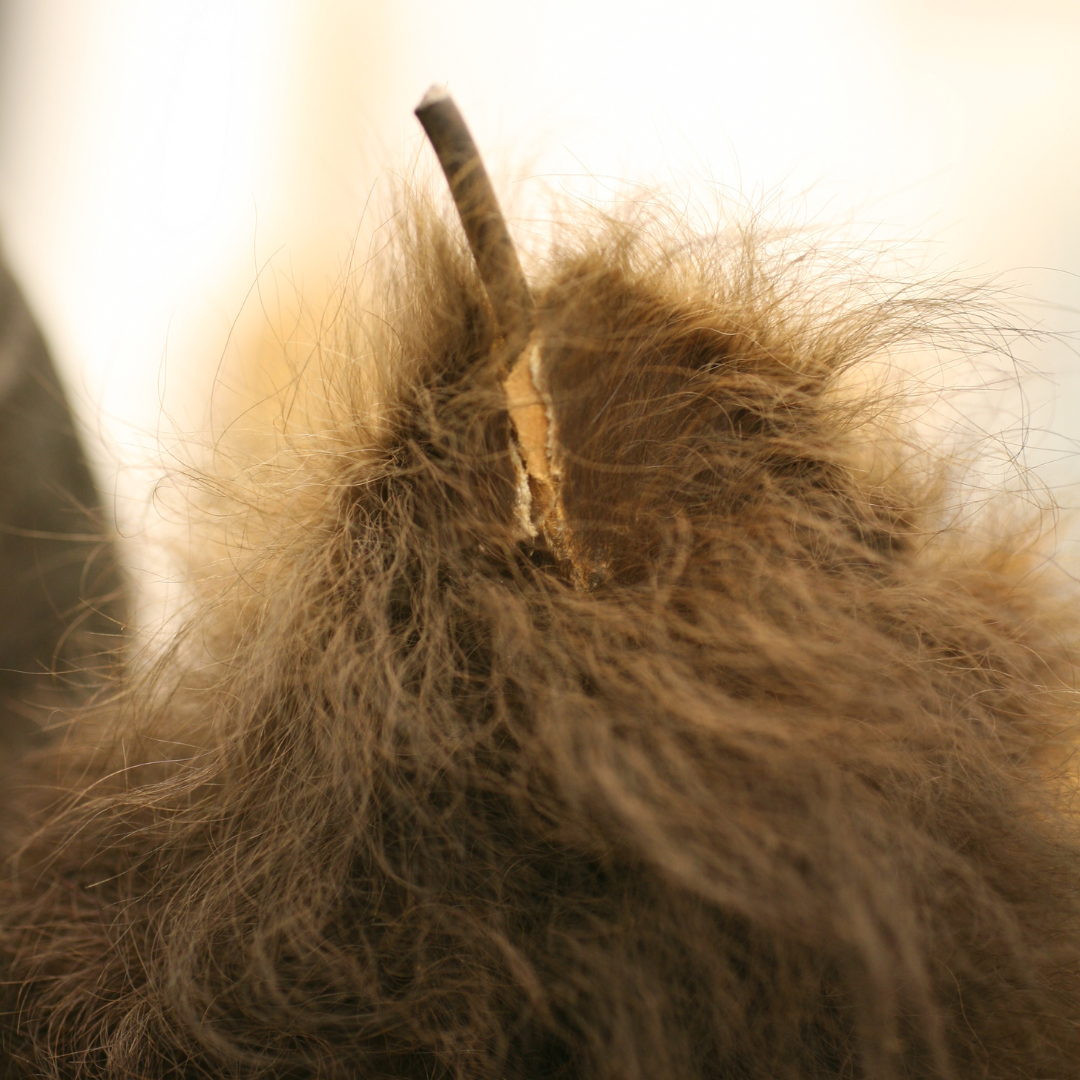
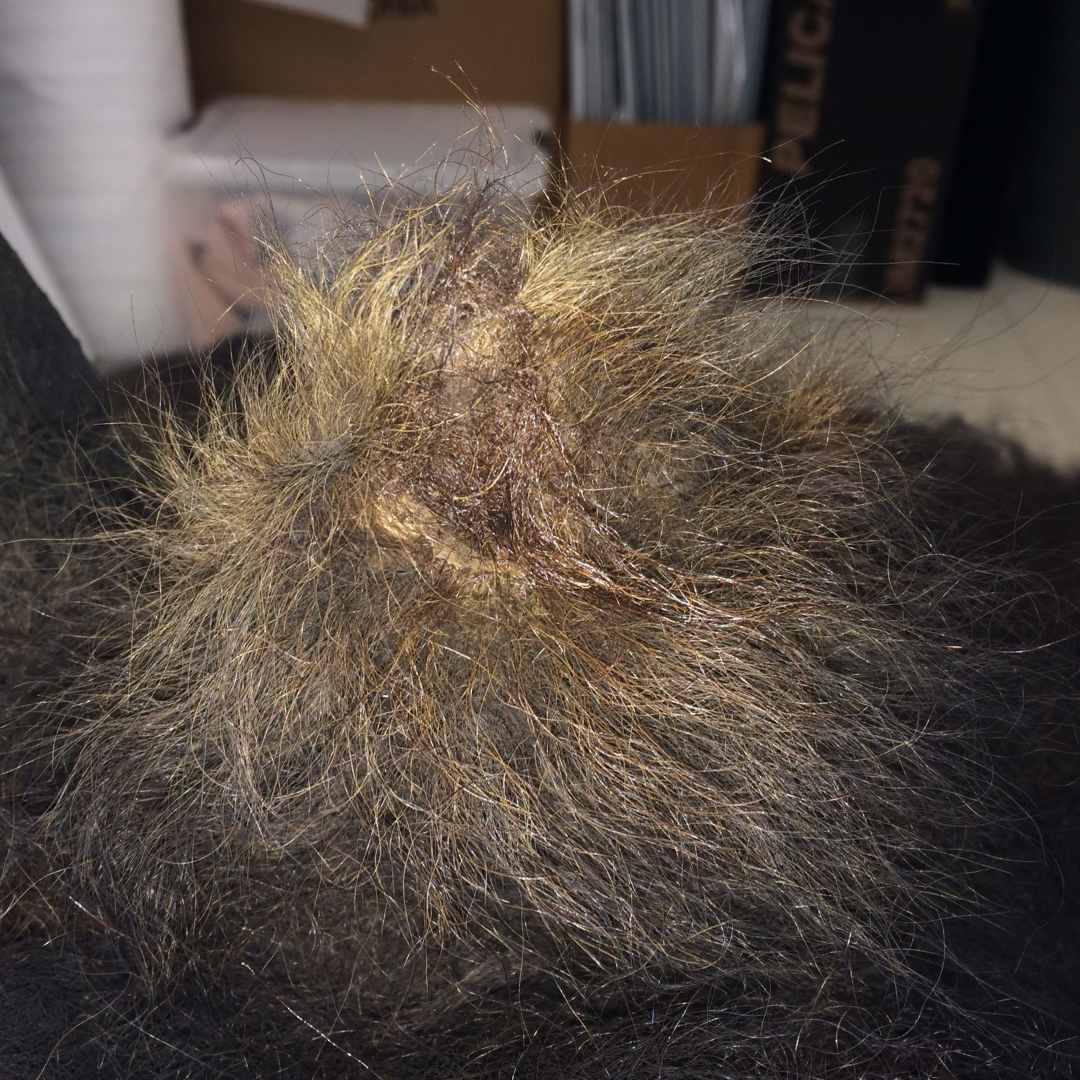
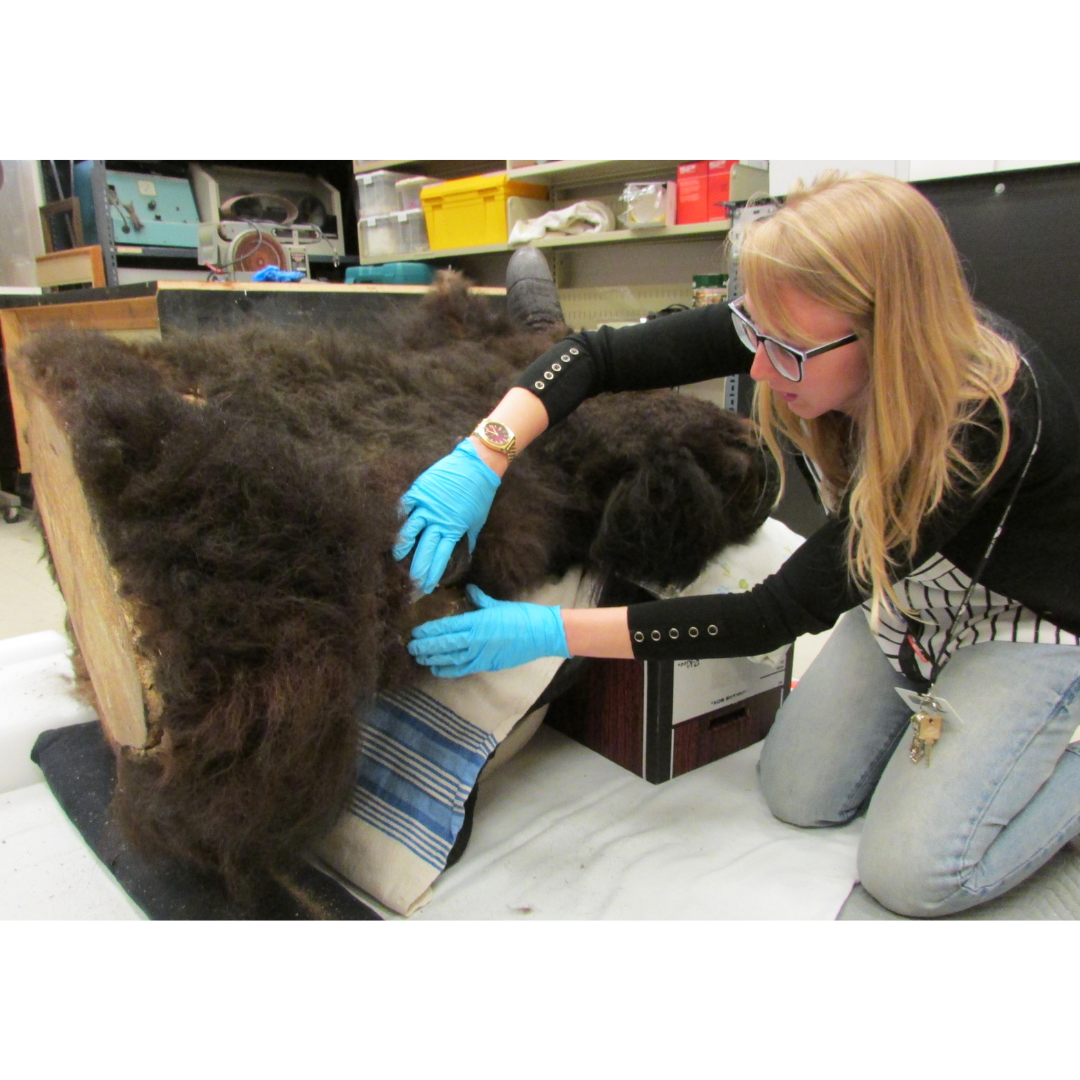
As I noted in my original blog, I used the horn patterns from the archival photographs and those on the Museum specimen to identify it as #5, marked by the yellow arrow in the image above, a task that was none-too-easy or even certain. To prepare the specimen for exhibit, it required careful conservation to repair damage on the skin, nose, and ears, as well as stabilization of the backboard before we could hang it. Carolyn Sirett, our conservator, had to remove the backboard from the mount and the first thing she saw was that the mount was numbered. She immediately called me to say I should come up to her lab. To my relief (and some satisfaction), in large black writing was “No. 5”! Carolyn  repaired the mount, and removed an incredible amount of dirt from the fur to make the specimen look much as it must have over 100 years ago. 

The backside of a mounted bison head with the backboard removed. On the baseboard of the head is written, “No. 5”. Conservator Carolyn Sirett sits to the side in the upper right corner.

Conservator Carolyn Sirett uncovered the “No. 5” beneath the backboard (at left) while repairing the mount for exhibit, confirming (thankfully!) my original identification from the Main Street photograph of skulls. 

Although I have not yet determined how Outlaw #5 came to be in the possession of The Hingston Smith Arms Co. Ltd. (they are not listed as purchasers at the auction), documents generously shared by the City of Winnipeg Archives show that in January of 1912 that company offered to hang the head in the City Council Chambers. This was in order for it to “be seen to advantage” and determine if Council would be willing to purchase it. After all, it was “the finest specimen of Buffalo Bull Head” and “the best one of the lot of out-law bulls of the Pablo herd.” It seems most of the Council agreed, as only one month later they voted 10 to 7 to buy the head for $750 – equivalent to over $18,000 today! And they engraved the description much as boasted by the company onto the plate that adorns the backboard: 

An engraved plaque plate reading, “Fine Specimen Head of Buffalo Bull of Pablo Herd of Outlaw Buffalo – 1912 / Property City of Winnipeg”.

So as Outlaw #5 stares haughtily down on visitors today, he is both a symbol of our capacity to destroy and an incredibly important symbol of our potential, as Manitobans and Canadians, to be better stewards of our nation’s spectacular natural world. 

Close-up of a mounted bison head.

Affectionately dubbed “Pablo” by Programs staff, the Museum’s outlaw bull of the Pablo-Allard herd is an impressive reminder of change since Confederation and ironic symbol of national conservation efforts. (MM 24175)

Confederation has fostered the diversity of perspectives that will help us through environmental challenges and that will work towards solutions over the next 150 years. Our exhibit might not provide the kind of birthday celebration we are likely to see on July 1st, but instead encourages a more sobering and reflective look at Confederation from a Manitoba viewpoint – how it happened, where we’ve been, and where we’d like to go. The incredible artifacts and specimens we have had the privilege to exhibit and interpret provide signposts to guide that thoughtful reflection. 

Legacies of Confederation: A New Look at Manitoba History is open until January 7, 2018 and is free with admission to the Museum Galleries. 

Dr. Randy Mooi

Dr. Randy Mooi

Curator of Zoology

Dr. Mooi received his Ph.D. in zoology from the University of Toronto working on the evolutionary history of coral reef fishes. Following a postdoctoral fellowship in the Division of Fishes of the Smithsonian Institution…
Meet Dr. Randy Mooi

Solar Eclipse This Summer, Part 1: Planning

Although summer may feel like it’s a long time from now, it’s not too early to start planning for at least one summer blockbuster event. On Monday, August 21, 2017, the moon will pass in front of the sun, causing a solar eclipse which will be seen all across North America. For a narrow line which runs across the central United States, the eclipse will be total: the moon will completely cover the bright part of the sun, providing a couple of minutes of the most amazing sight nature has to offer on this planet. For the rest of the continent, the eclipse is partial: the moon covers up only a part of the sun – still interesting and amazing, but not the show-stopper that a total eclipse is.

If you want to travel to the center line to see totality, you’d better plan on doing some driving. The path is about 10 hours south of Winnipeg at its nearest,  assuming you drive. Flying cuts this time somewhat, but you’ll still need a vehicle the day of the eclipse, because all of the hotels along the path of totality have been booked for several years. This is the first total solar eclipse that has crossed North America since 1991, so folks have been planning for quite a while for this event. At this point you’re looking at staying a few hours away and then driving to the center line the morning of the event. Although this might seem inconvenient, it does provide you with the flexibility to travel based on the weather. Clear skies = beautiful view of total eclipse; cloudy skies = nothing to see.

Over the coming months, we’ll provide more details on the eclipse event itself, including what local viewing options there are and how you can see the eclipse safely yourself. The Planetarium is not running a tour for this event, but we will be hosting programming and viewing of the eclipse from Winnipeg, where the sun will be 70% eclipsed. The Planetarium and Science Gallery will be running eclipse programming starting in July, so by eclipse day you’ll be well-prepared no matter where you choose to observe from.

The view of a total solar eclipse is well worth some travel. I saw the last one visible from Manitoba, on February 26th, 1979, and it was so inspiring that it set the course of my life in astronomy and science education. If you do decide to include the eclipse in this summer’s travel plans, check out eclipsophile.com’s great page on the event. Put together by veteran eclipse chaser and meteorologist Jay Anderson and astronomer (and former Winnipegger) Jennifer West, this site is full of the details you need to decide where to observe the Great North American Eclipse.

Scott Young

Scott Young

Planetarium Astronomer

Scott is the Planetarium Astronomer at the Manitoba Museum, developing astronomy and science programs. He has been an informal science educator for thirty years, working in the planetarium and science centre field both at The Manitoba Museum and also at the Alice G. Wallace Planetarium in Fitchburg, Massachusetts. Scott is an active amateur astronomer and a past-President of the Royal Astronomical Society of Canada.

Mycorrhizal Mushrooms

Have you ever wondered why the only fresh mushrooms you can get in stores are button, cremini, and portabello (all different varieties and stages of Agaricus bisporus)? Or why the fancy mushrooms, like morels (Morchella spp.) and chanterelles (Cantharellus spp.) are generally only available dried? And why are those dried mushrooms so expensive anyway? Can’t they just plant them in a field like wheat? To understand the answer to these questions, you need to know a few things about what mushrooms really are.

A long time ago scientists classified all organisms as either “plants” or “animals” largely based on whether they had a means of locomotion. For this reason, mushrooms (a.k.a. fungi), were classified as “plants”. Soon, however, scientists began to realize that fungi were not actually like plants at all: they produced spores instead of seeds, and most importantly, they weren’t green. Turns out fungi don’t produce their own food like plants do; they need to “eat” plants or animals-either living or deceased. In this way, they are actually more like animals.

A frilly-topped Morel on the ground.

Image: Morels (Morchella sp.) are much loved edible, wild mushrooms. ©MM

The base of a cob of corn with bulging purplish fungi growing near the stalk.

Corn smut (Ustilago sp.) is a fungal parasite on corn plants. From Wikimedia Commons.

Some fungi are parasites on plants, animals, protists or other fungi. You may be familiar with fungal crop parasites like corn smut (Ustilago maydis), rusts (e.g. Puccinia spp.), powdery mildew (e.g. Podosphaera spp.), ergot (Claviceps purpurea) or the infamous potato blight (Phytophthora infestans). In fact, some parasitic fungi even feed on people. Ever had jock itch (Tinea cruris), athlete’s foot (Tinea pedis) or a “yeast” (Candida albicans) infection? If so, a fungus was feeding on you. Gross!

A shelf-like mushroom with rounded edges growing off a tree trunk.

Other fungi are what scientists call “saprophytes”. These are fungi that eat dead plants and animals, not living ones. The fresh mushrooms that you get in grocery stores have this habit. Mushroom farmers collect various crop residues or composted manure to “feed” their fungal colonies. The main body of the fungus, called “mycelium”, consists of thin root-like structures called “hyphae”. These hyphae grow through the compost, feeding on the nutrients. When certain hyphae meet at the right time they begin to form a reproductive structure, which is the “mushroom”. The purpose of the mushroom is to produce and release spores (which are similar to seeds) to colonize new habitats.

Shiitake (Lentinula edodes) mushrooms are also commercially grown, albeit in a different way than button mushrooms: they grow on rotting hardwood trees, like oaks (Quercus spp.) instead of compost. This is why shiitatkes have a woody flavour to them. Oyster mushrooms (Pleurotus ostreatus) are similar to shiitakes, growing on various deciduous trees, often poplar (Populus spp.). You can actually buy special kits to help you grow your own shiitake and oyster mushrooms!

Image: Oyster mushrooms (Pleurotus ostreatus) taste a bit woody because they grow on wood! ©MM

However, some fungi are what botanists call “mycorrhizal”, literally Latin for “fungus root”. Mycorrhizal fungi form symbiotic associations with various wild plants, often trees. The hyphae wrap around plants’ roots and absorb some of the sugar that the plant produces via photosynthesis. In exchange, the fungus provides the tree with water and hard to get nutrients like phosphorus. So ultimately the relationship seems to be beneficial to both parties. Many of the wild mushrooms that we love are mycorrhizal and associated with conifers like pine (Pinus spp.): pine mushrooms (aka Matsutake) (Tricholoma matsutake), delicious milkcaps (Lactarius deliciosus) and porcinis (Boletus edulis). Chanterelles are associated with several species of conifers and deciduous trees. Truffles (Tuber spp.), on the other hand, prefer deciduous trees like oaks (Quercus spp.) and hazelnuts (Corylus spp.). Some morels (Morchella spp.) will grow on decaying organic matter like the button mushrooms but other species are mycorrhizal.

Four flat-capped mushrooms growing low to the ground next to fallen pinecones.

Image: Delicious milkcaps (Lactarius deliciosus) are mycorrhizal associates of pine trees. ©MM


So any attempt to cultivate these species would require growing a forest of appropriate tree hosts, inoculating the soil and hoping that they will eventually produce mushrooms. Although this sounds simple, there are many mysterious things going on in the soil that we barely understand and the factors that trigger mushroom production are one of them. In my next blog, I will be exploring some of the fascinating relationships between mycorrhizal fungi and Manitoba’s wild plants.

Dr. Diana Bizecki Robson

Dr. Diana Bizecki Robson

Curator of Botany

Dr. Bizecki Robson obtained a Master’s Degree in Plant Ecology at the University of Saskatchewan studying rare plants of the mixed grass prairies. After working as an environmental consultant and sessional lecturer…
Meet Dr. Bizecki Robson

Legacies of Confederation: Endangered Orchids

When Manitoba became part of Canada in 1870 the stage was set for one of the largest land transformations in history. In the last 150 years nearly all of Manitoba’s wild prairies fell to the plough. The little patches that remain as ranch land, private nature preserves, and federal and provincial crown lands are home to a suite of increasingly rare organisms, among them two spectacular prairie orchids: Western Prairie Fringed Orchid (Platanthera praeclara) and Small White Lady’s-slipper (Cypripedium candidum).  Models of these two species are on display in the Manitoba Museums’ Legacies of Confederation: A New Look at Manitoba History exhibit.

Close up on the top of a plant with fringed white flowers at the top of a tall stem.

Found only in moist, tall grass prairies with calcium-rich or alkaline soils, the Western Prairie Fringed Orchid is one of Canada’s legally protected endangered species. The only place where it is found in Canada is at the Tall Grass Prairie Preserve near Gardenton (click here for more details). Standing at almost a metre tall, this orchid produces an intoxicating fragrance to attract pollinating sphinx moths at night. The Canadian population is the largest in the world so its survival largely depends on our willingness to protect it.


Image: The endangered Western Prairie Fringed Orchid’s largest population is in Manitoba.

Close up on a plant with widely unfurling petals opening for a white ball-like centre mass.

Manitoba’s other endangered orchid, the Small White Lady’s-slipper, is a bit more widespread. It occurs at the Tall Grass Prairie Preserve but there are also populations further west, near Brandon, and further north, close to Lake Manitoba. It is a bit more common in the USA but still rare over most of its range. It prefers moist prairies with calcium-rich soils. The Small White Lady’s-slipper attracts small bees in the spring with its delicate scent but does not offer a nectar reward so pollination is infrequent.


Image: The Small White Lady’s-slipper is an endangered species in Manitoba and Canada.

In addition to their very specific habitat requirements these orchids produce seeds that are so tiny that there is virtually no nutrition available for young seedlings. In order to grow they need to form an association with a special fungus, called a mycorrhiza, which will help them get water and nutrients from the soil. The dependence of these two orchids on insect pollinators and soil fungus, along with the loss of habitat, has led to their endangerment.

It’s hard to believe that there was a time when people thought that species extinction was impossible. Humanity underestimated the power that our technology gave us over nature, and to some degree we still do. A conservation ethic did not really emerge until it was clear that there were no “lost worlds” left where rare species might still linger. The extinction of several Canadian bird species including the Labrador Duck (Camptorhynchus labradorius), Great Auk (Pinguinus impennis), Eskimo Curlew (Numenius borealis) and Passenger Pigeon (Ectopistes migratorius), largely due to overhunting, finally made Canadians understand our destructive capabilities and helped inspire the modern wildlife conservation movement. One of the benefits of confederation has been our collective will to ensure that some of Canada’s forests, tundra, prairies, lakes and ocean habitats are protected for all Canadians to benefit from–the 2-legged and the 4-legged and even the ones with no legs at all.

Dr. Diana Bizecki Robson

Dr. Diana Bizecki Robson

Curator of Botany

Dr. Bizecki Robson obtained a Master’s Degree in Plant Ecology at the University of Saskatchewan studying rare plants of the mixed grass prairies. After working as an environmental consultant and sessional lecturer…
Meet Dr. Bizecki Robson