
The End of World War One

The End of World War One

Part III in a three-part series.


As we enter the last weeks of our exhibit “Victoria Crosses of Valour Road”, which ends on Sunday, November 16, I want to give some attention to how the First World War ended and some of its implications. My blog entry is illustrated with WWI postcards from the Museum’s collections.

In the summer of 1918 the Germans and their allies had made their final push against the west, and they had failed. Their troops, finances, and population were exhausted and there was serious unrest at home. The counter attack by the Allied forces, strengthened by a major influx of Americans, stormed over western Germany in the fall of 1918. On the eastern front, Bulgaria had decided to leave the German alliance, opening a route for attack as well. Austria-Hungary, which had started the war, was being torn apart by military desertion based on multiple ethnic-nationalist movements. By the end of September, the highest levels of German command were recommending an armistice of some sort, but not “surrender”. They felt a treaty could be negotiated, but in fact they had no position of strength from which to negotiate. By the end of October, revolutions were breaking out around Germany, led initially by the German navy. Wilhelm’s authority was broken, and he was “informed” that he had abdicated on November 9.

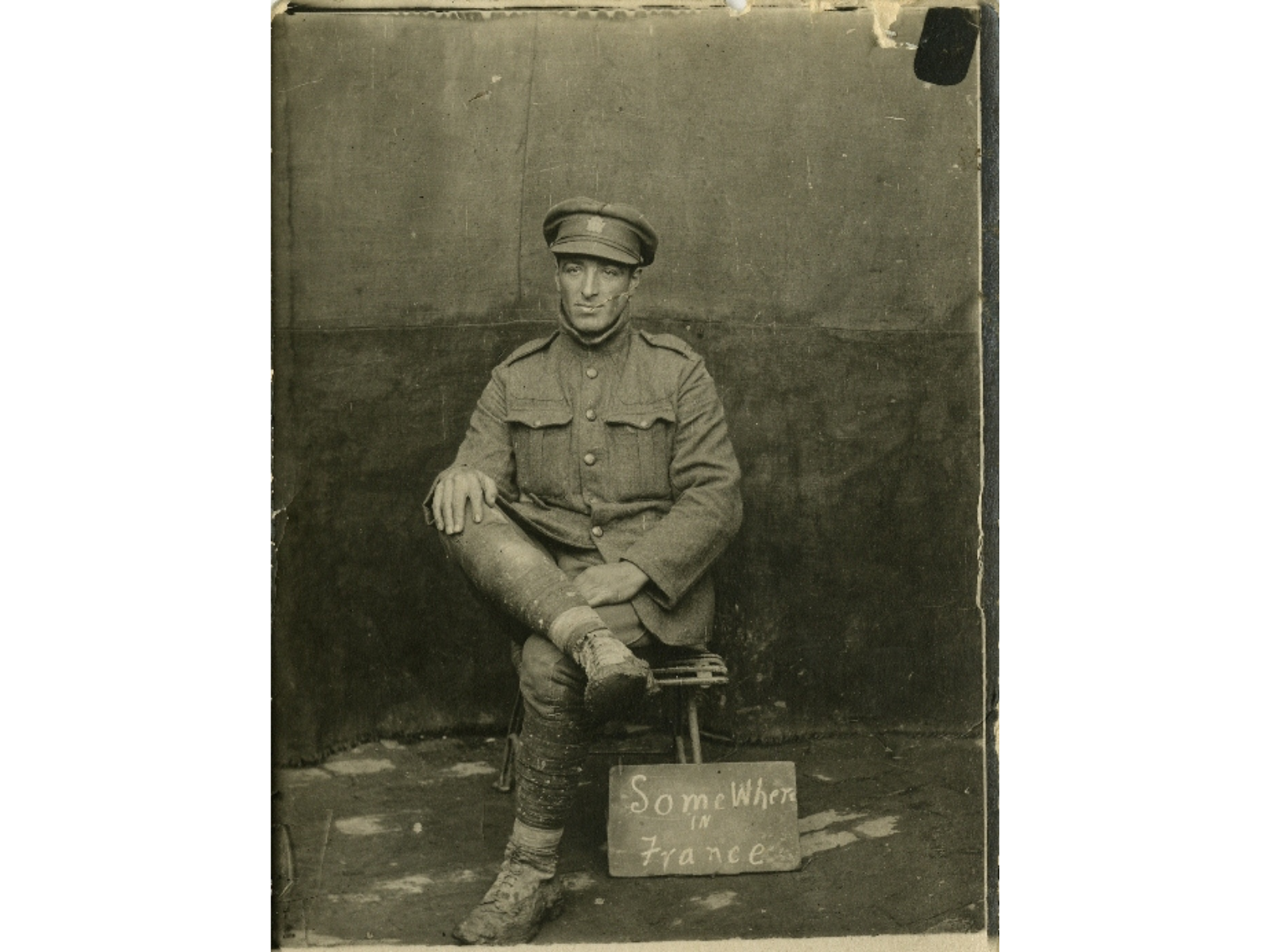
A sepia-toned photograph of a solider sitting on a stool with one leg up across the other. At the base of the stool and hand written sign reads, "Somewhere in France".

This postcard was sent to Mrs. Manchester, of 32 Lipton St., Winnipeg MB. The soldier is probably her son Stewart John B. Manchester, born in Souris, MB in 1888. He survived the war and went on to become a trainman for the CNR in Winnipeg.  H9-21-755. Copyright The Manitoba Museum.

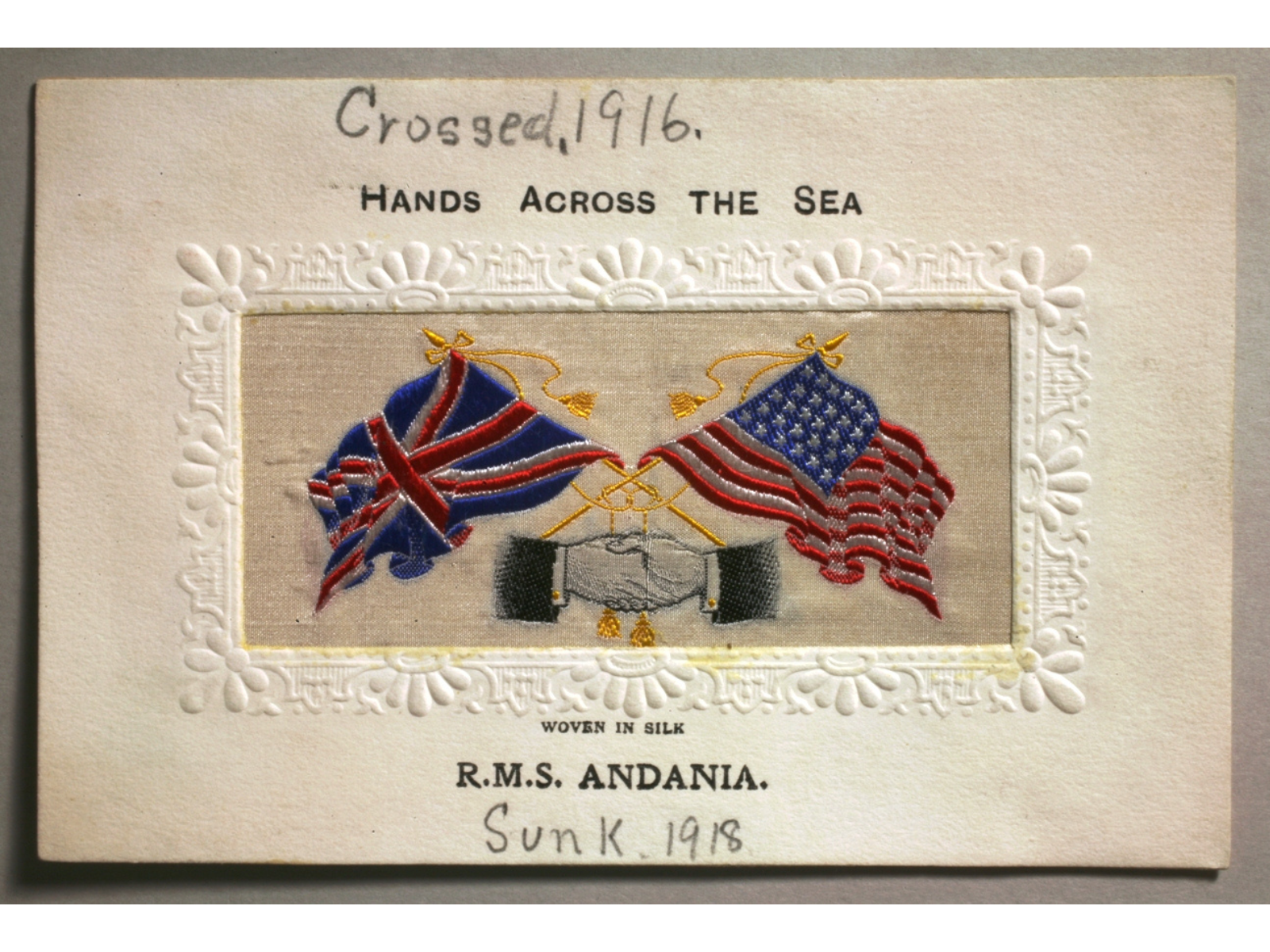
A postcard showing an embroidered image of two hands shaking under British and American flags. Printed text on the card frame reads, "Hands across the sea / R.M.S. Andania / Woven in silk". Handwritten text on the frame reads "Crossed, 1916 / Sunk 1918".

The RMS Andania was a passenger ship that was used to transport Canadian soldiers to Europe. In 1917 it returned to passenger service, but was torpedoed by a German submarine in 1918. The continued destruction of passenger ships by the Germans infuriated the Americans and the British and strengthened their resolve in the final days of the war. H9-15-697. Copyright The Manitoba Museum.

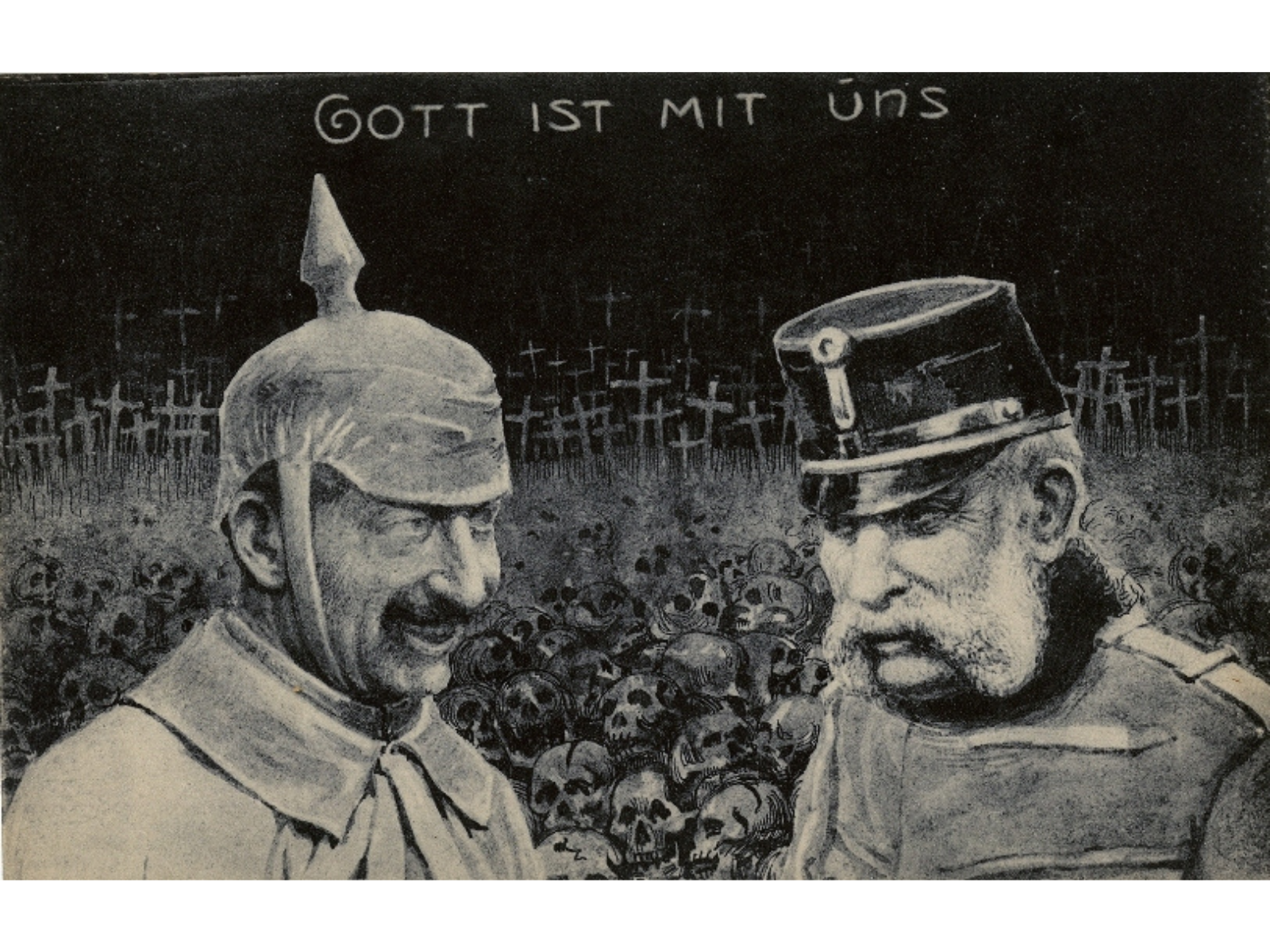
Postcard in dark hues showing two generals in the foreground, in front of piles of skulls lined by crosses. Text along the top reads, "Gott est mit uns".

The black humour in this Belgian postcard is unmistakable. Translated as “God is with us”, it makes fun of the German belief that God was on their side during the slaughter of WWI. H9-16-66. Copyright The Manitoba Museum.

At 11 am on November 11, the guns on the Western front were at long last silent. Unfortunately the greatest killer, the Influenza Pandemic of 1918, which would claim at least 20 million lives worldwide, was just getting underway…

What was accomplished by the Great War? On the surface, nothing. Germany retreated to its former borders, with a few small areas controlled by the allies, and their army and navy were decimated. But the allies suffered even more human losses.

To make it all “worth it”, the allies concocted the Treaty of Versailles, a punitive arrangement in which Germany and its allies, though not believing they had “lost”, were forced to pay massive amounts in reparations to the French and Belgians in particular. Regular Germans were furious, since it was their government, not they themselves, who were responsible for the war. These reparations, which Germany could never afford, led in part to a collapse of the German monetary system and widespread poverty, and helped to fuel the rise of the Nazis less than 20 years later. Remember that Hitler enlisted in the First World War, and used Germany’s treatment at the hands of the Allies as justification for many of his later actions.

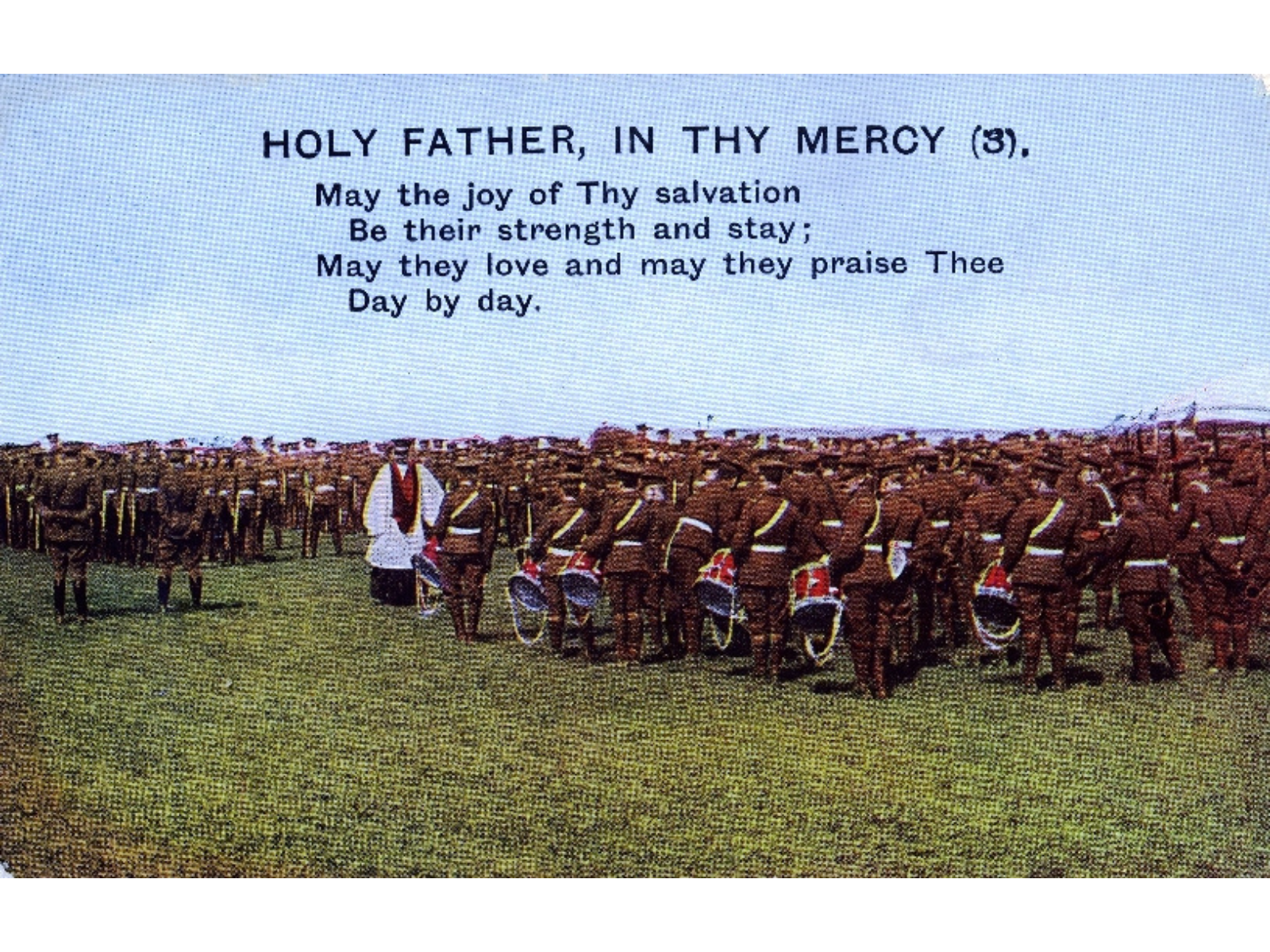
Troops amassed on a green field. Text over the blue sky reads, "Holy Father, in they Mercy (3) / May the joy of Thy salvation Be Their strength and stay; May they love and may they praise Thee Day by day."

Not surprisingly, many British and Canadian troops also believed God was on their side. H9-15-470. Copyright The Manitoba Museum.

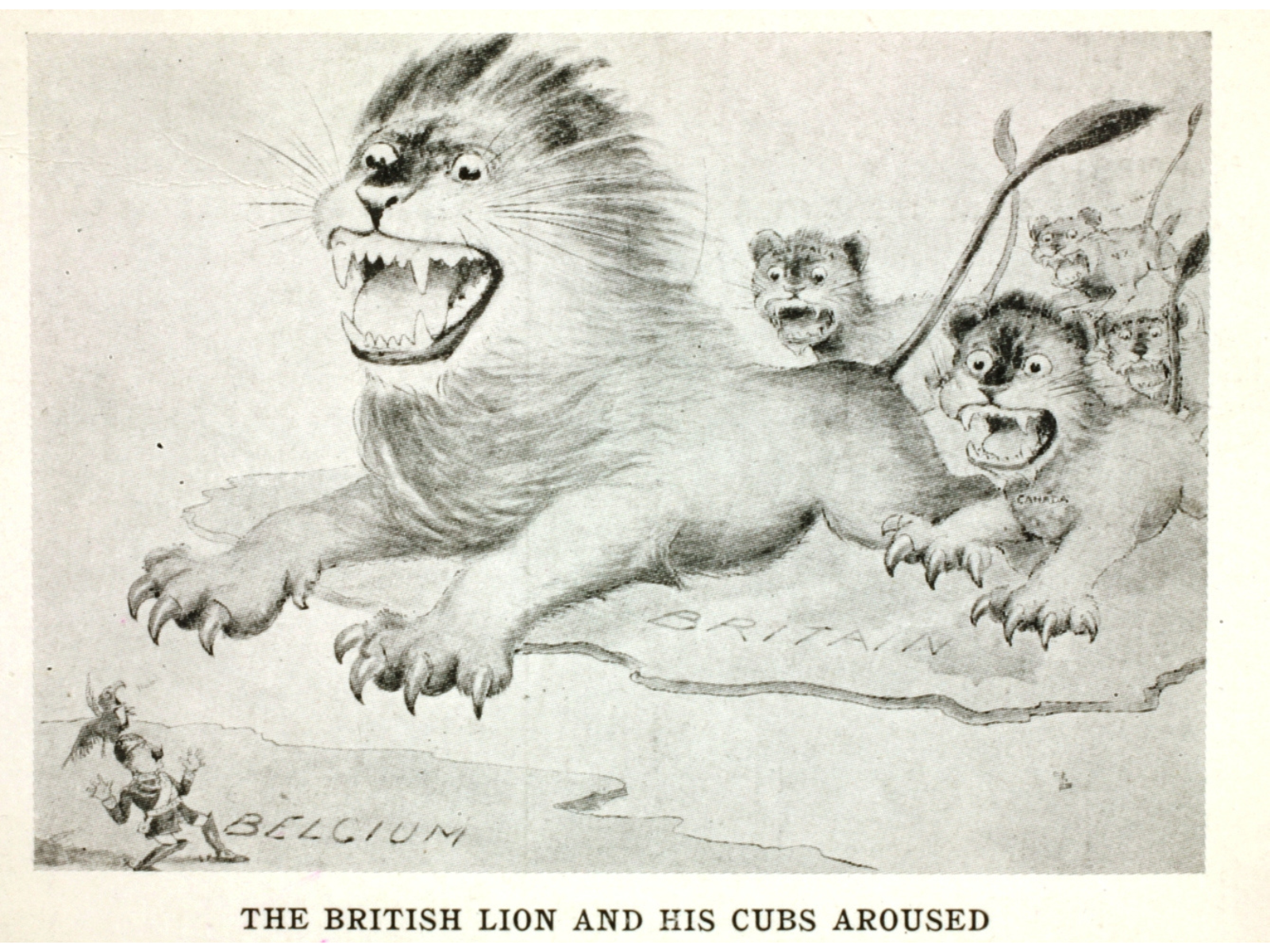
A postcard showing a leaping lion followed by four cubs pouncing from Britain to two generals depicted in Belguim.

This postcard depicts Great Britain as the lion, and the colonies and dominions as his “cubs”. Canada is the cub on the right. They are attacking a German general to help defend Belgium. H9-16-140C. Copyright The Manitoba Museum.

Back in Canada, tales of heroism and sacrifice, along with the thousands of dead and missing family members lost in the war, seem to have provided Canadians with a new sense of national identity that, while not divorced from the British Empire, was perhaps more robustly independent. On a more practical side, tens of thousands of soldiers returned home looking for work, to find that women had entered the workplace. In a bid for “fairness”, many women were laid off to make room for men. The Communist Revolution in Russia had also inspired workers worldwide to feel that labour could make social change. In Winnipeg, many of the strikers in the Winnipeg General Strike of 1919 were returned soldiers.

The political and social ramifications of the First World War seem endless, but certainly “old” Europe, with its aristocracy and its entrenched class systems, was severely tested and in some cases swept away.

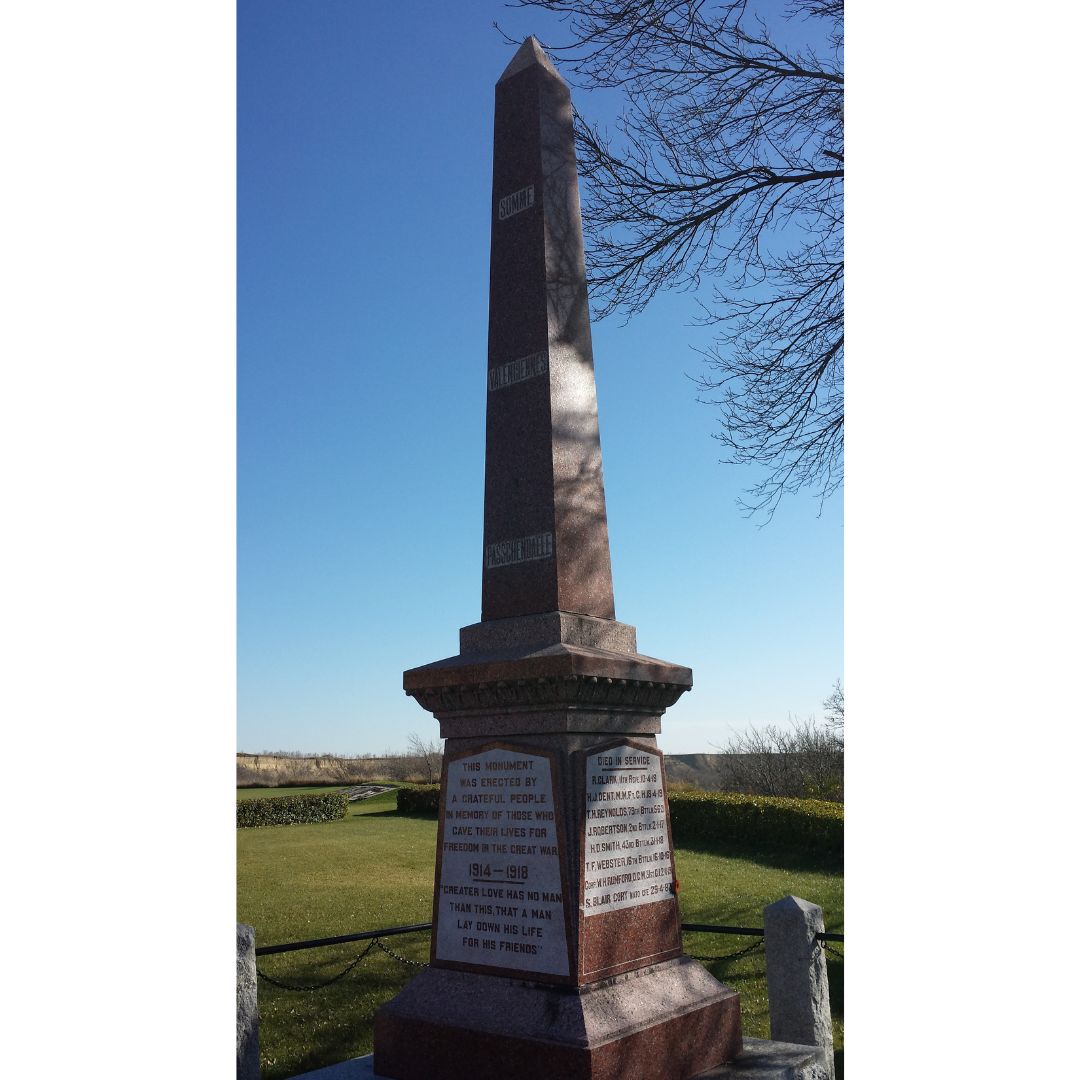
A pillar like war memorial in a green field.

War Memorial, Wawanesa, Manitoba. Photograph by Roland Sawatzky.

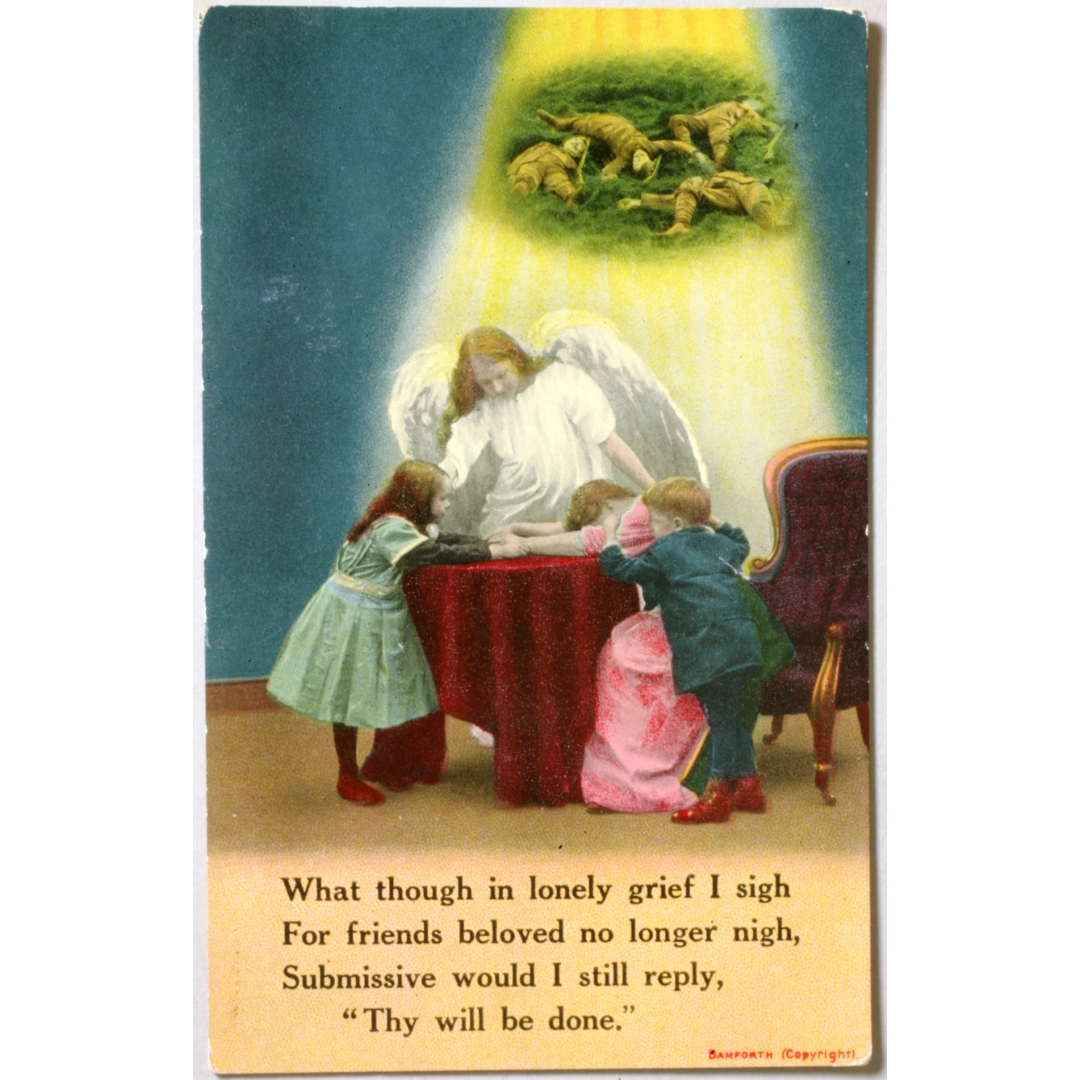
A postcard showing an angel standing over a grieving woman and two children at home. Above the scene, encircled in golden light a field with four dead soldiers. Text at the bottom reads, "What though in lovely grief I sigh / For friends beloved no longer nigh, / Submissive would I still reply, / 'Thy will be done.'"

This postcard depicts both dead soldiers and a heartbroken family. The postcard as a form of public mourning was a powerful acknowledgement of the real-life effects of the war. H9-15-469F. Copyright The Manitoba Museum.

Now the common man was seen as the suffering hero. Seventy-one Victoria Cross medals were awarded to Canadians for their service in WWI. Memorials were built by the thousands to commemorate the soldiers who lost their lives with an emphasis on names, dates of death, and ranks. To the best of its ability, society attempted to remember the individual. Governments around the world encouraged this trend, seeing it as conservative and socially integrative – and a far cry from the radical social movements they feared, like Communism (or the Winnipeg General Strike). These memorials can be seen all over Manitoba, from Memorial Boulevard in Winnipeg to many rural town parks (like Wawanesa). These memorials became the focal points of public mourning, such as Armistice Day, which was largely observed by families and friends of the deceased at Thanksgiving. It was not until 1931 that Remembrance Day as we know it was created by the federal government on the annual date of November 11.
Dr. Roland Sawatzky

Dr. Roland Sawatzky

Curator of History

Roland Sawatzky joined The Manitoba Museum in 2011. He received his B.A. in Anthropology from the University of Winnipeg, M.A. in Anthropology from the University of South Carolina, and Ph.D. in Archaeology…
Meet Dr. Roland Sawatzky

Tracking Down Canada’s Last Passenger Pigeon 

September 1st of 2014 marked the grim anniversary of the death of the last passenger pigeon on Earth. It’s extinction is probably the only one for which an exact hour of demise is recorded; the last individual was a captive bird, named Martha, that expired at 2pm local time at the Cincinatti Zoo. The disappearance of this species is almost impossible to comprehend, as it was once the commonest bird in North America, perhaps even the world, with population estimates of between 3 and 5 billion – yes, that’s billion – in the mid-1800s. 

But the capacity of humans to destroy knows no bounds. The awe-inspiring flocks that were described as darkening the sky from horizon to horizon, and the massive breeding colonies that numbered in the tens of millions were slaughtered by market hunters and shamefully wasted by hungry locals alike. Unfettered exploitation along with changes in environment due to deforestation resulted in the shocking disappearance of passenger pigeons from the wild by about 1900. 

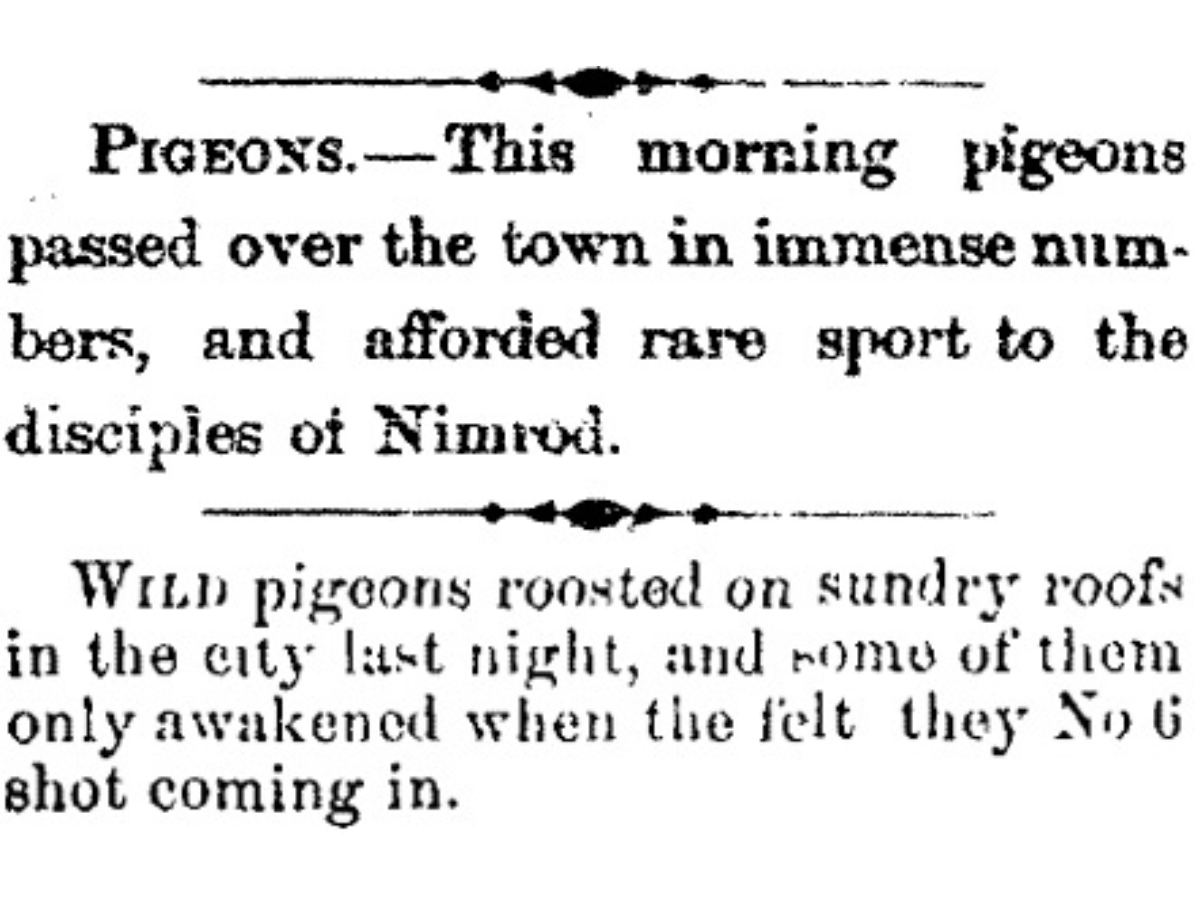
Old newspaper clipping reading, “Pigeons. – This morning pigeons passed over the town in immense numbers, and afforded rare sport to the disciples of Nimrod. / Wild pigeons roosted on sundry roofs in the city last night, and some of them only awakened when the felt they No 6 shot coming in.”

Local reports of passenger pigeons from Winnipeg newspapers, the upper from the Manitoba News-Letter of May 31, 1871 and the lower from the Manitoba Free Press of September 19, 1874. 

Although Manitoba never hosted massive colonies, large flocks provided food for First Nations peoples and hungry homesteaders, and were important enough to frontier life to merit frequent mention in local newspapers as “wild pigeon” or merely “pigeons.” Passenger pigeons bred in small groups in the south of the province and were seen as far north as Hudson Bay. 

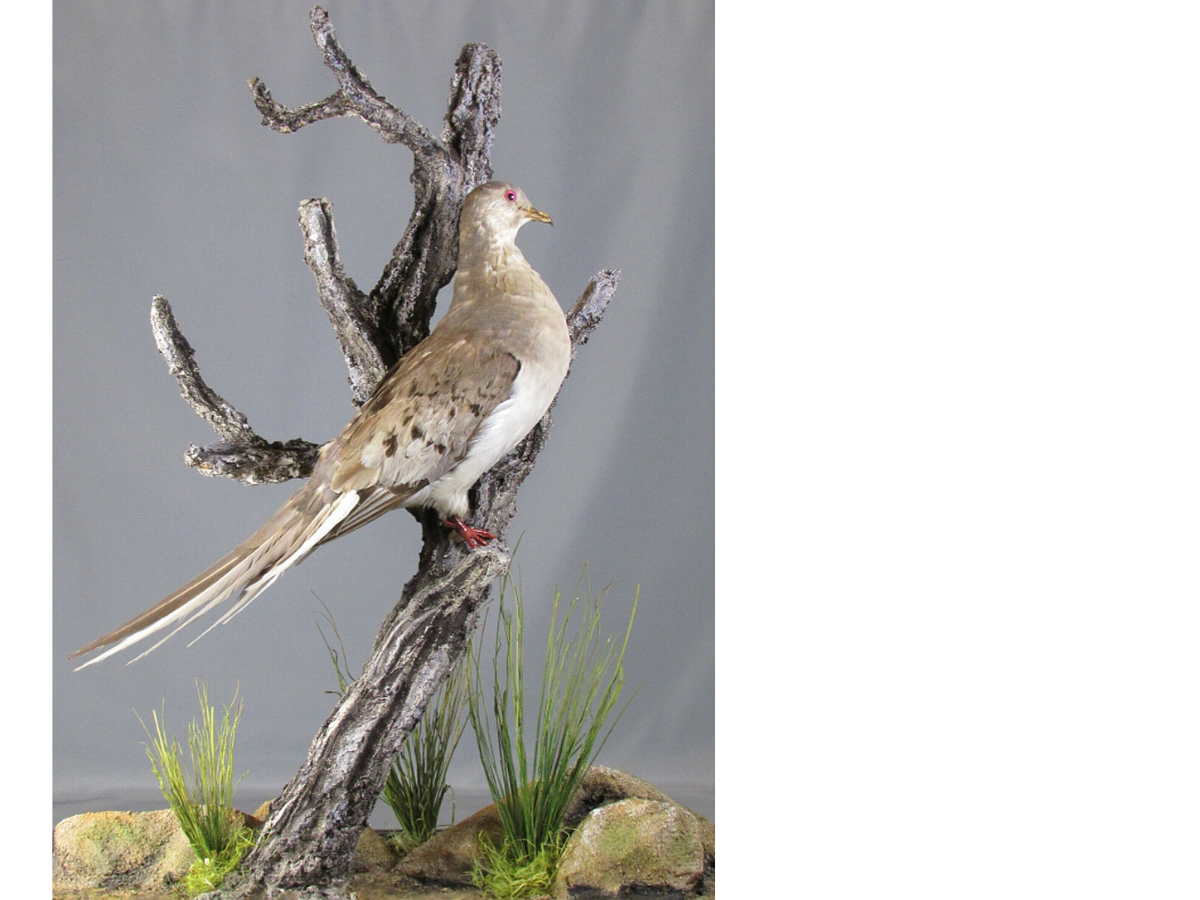
A passenger pigeon specimen posed on a low tree branch in a mini stand-alone diorama.

A relatively recent addition to the Museum’s passenger pigeon collection, a beautiful mount of a female generously donated by the Delta Waterfowl Foundation in 2013. Note the female lacks the orange breast and bluish back of the male, and is slightly smaller, about 37 cm. MM 1.2-5437 

In contrast to their abundance in the 19th century, there are relatively few specimens of passenger pigeons in natural history museums and even fewer of those that have information on when and where they were collected. This is in part because systematic museum and research collecting in North America was still relatively new, and because passenger pigeons were so common; who carefully collects crows or starlings today? The Manitoba Museum has five taxidermied specimens of passenger pigeon.  

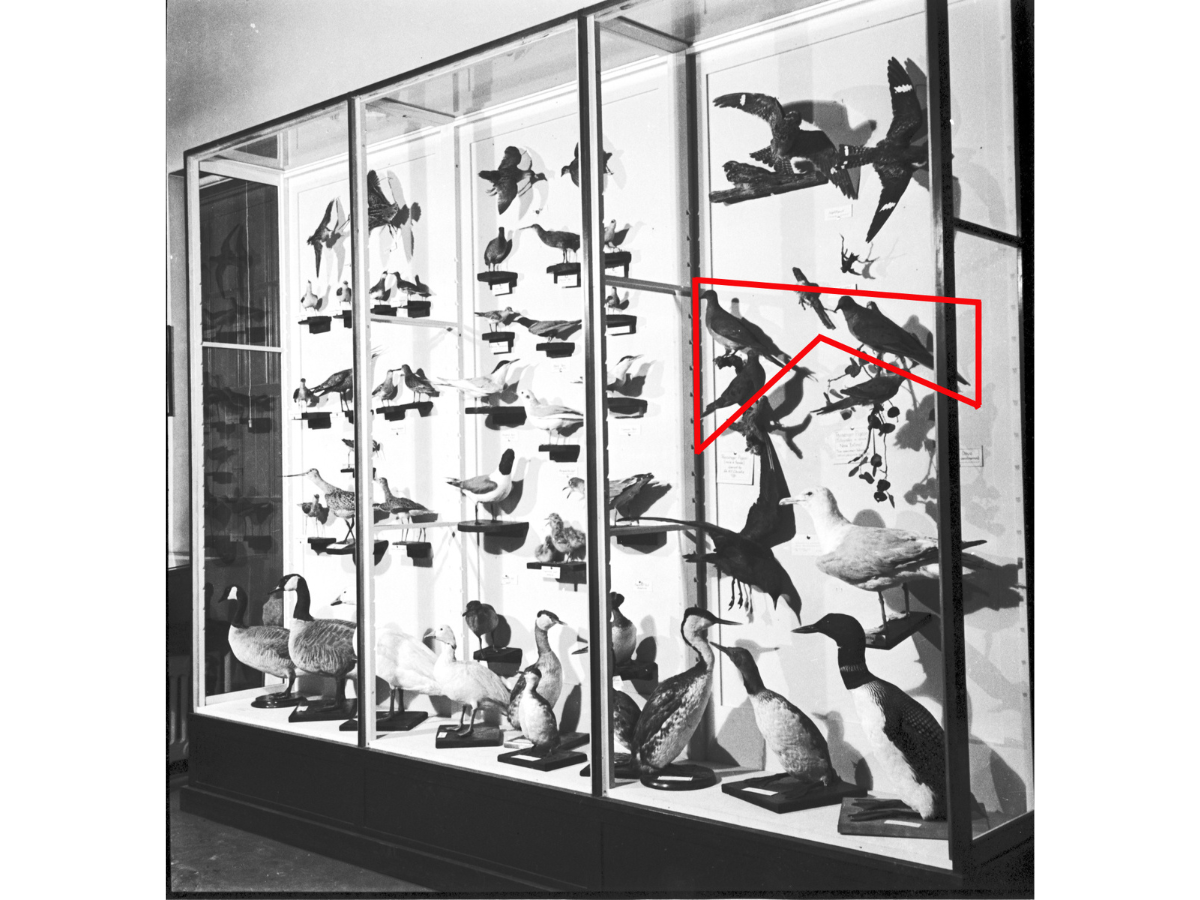
Black and white photograph of a glass display case containing many bird specimens. Three birds are digitally outline in red.

Some of the old bird cases as they were in the Civic Auditorium in the mid-1930s. The passenger pigeons are marked within the red lines. These three mounts are still in the Museum collection today. 

Until recently, all of the Museum’s passenger pigeons were of unknown locality – we weren’t even certain that our birds were actually from Manitoba! Record-keeping was not always thorough in the 1930s when some of them came into the possession of the original Manitoba Museum, and the others were in private collections where their exact histories have been lost. However, while examining some photographs of the exhibits in the old Civic Auditorium from the 1930s, I noticed that some were of the bird cases. One of these had three of our pigeon specimens on display! And another photo showed that one mount had very specific data on its label just below it tacked to the back of the case: 

Close-up of a museum label reading, “Passenger Pigeon. / (Ectopistes m. oris). / Now Extinct. / This specimen taken at Winnipegosis in 1898”.
Close-up of the old museum label from the mid-1930s as it appeared in the case.

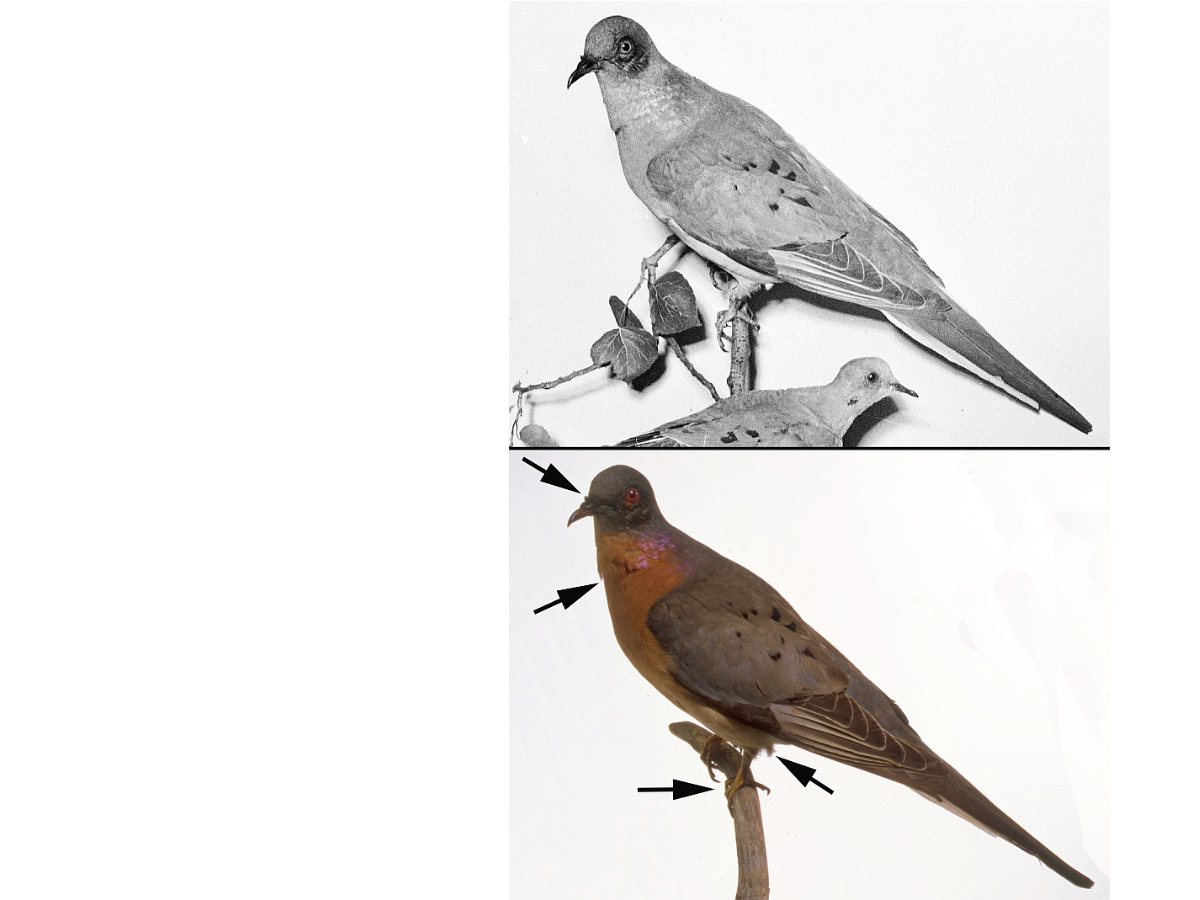
Did the Museum still have this particular specimen? Comparing our present collection with the photographs, I was able to determine that one of the five birds we have is an exact match for the Winnipegosis specimen that had been on display in the 1930s. This is especially important because detailed information on this bird was published by G.E. Atkinson in 1904, a taxidermist and naturalist from Portage la Prairie. He prepared this specimen and noted its date of collection as April 10th of 1898 – the last specimen ever collected in Canada! 

Two photographs side-by side. Top, a black and white photo of a passenger pigeon specimen on a small tree branch. Underneath is a colour phtoograph of the same specimen on a different small branch mount.

Comparison of the 1898 Winnipegosis specimen as it appeared in the Civic Auditorium in the mid-1930s (top) with a photo of one of our specimens (MM 1.2-2391) today (bottom). Arrows show the unmistakable features (tuft of feathers at base of bill, ‘ruff-like’ neck feathers, foot shape, leg feathering) that indicate that these are the same specimens. The pattern of black spots on the back are also distinctive. 

So the specimen has come full circle in its history with the Manitoba Museum. It was first on display in the mid-1930s in the Civic Auditorium, was in our collections storage for decades, and is now on exhibit again 90 years later at Rupert and Main. It remains, after all that time, still able to perform the unfortunate, but important function as a flag-bearer representing all extinct species and as a warning of where careless attitudes to our environment can lead us. 

Aldo Leopold, the famous Wisconsin environmentalist, said in memory of the passenger pigeon in 1947: 

“There will always be pigeons in books and in museums, but these are effigies and images, dead to all hardships and to all delights. Book-pigeons cannot dive out of a cloud to make the deer run for cover, nor clap their wings in thunderous applause of mast-laden woods. They know no urge of seasons; they feel no kiss of sun, no lash of wind and weather; they live forever by not living at all.”

And indeed, the Museum’s passenger pigeons will not, unfortunately, repopulate our skies. But they will always be here, for that is the value of museum collections – archives of natural history and silent witness to changes in our world. Our collections provide opportunity to study, marvel, contemplate, and learn. And although there are no more passenger pigeons in the wild, they can still be found in museums. I invite you to the Manitoba Museum and the new Prairies Gallery (2021) to see the last passenger pigeon ever collected in Canada, along with one other, and to reflect on their fate as well as our own place in the world. 

If you have any further information on these specimens or others, please contact the Museum. 


Dr. Randy Mooi

Dr. Randy Mooi

Curator of Zoology

Dr. Mooi received his Ph.D. in zoology from the University of Toronto working on the evolutionary history of coral reef fishes. Following a postdoctoral fellowship in the Division of Fishes of the Smithsonian Institution…
Meet Dr. Randy Mooi

Solar Eclipse visible from Manitoba

On Thursday afternoon this week, Manitobans will be treated to an uncommon celestial spectacle: a partial eclipse of the sun. Beginning just after 4 o’clock in the afternoon, the moon will move between the Sun and Earth, casting its shadow onto our planet and blocking out part of the sun as seen from earth. While uncommon and interesting to watch, solar eclipses have some particular issues which require some safety precautions.

Safety first: YOU SHOULD NEVER LOOK DIRECTLY AT THE SUN WITHOUT SPECIAL PROTECTION. The protection we’re talking about here is not sunglasses, but a special solar filter material which is the equivalent of the densest welder’s goggles that exist. The best way to observe the sun at any time (and especially during an eclipse) is to purchase special “eclipse glasses”. This silver-colored Mylar filters are designed to filter out all of the harmful light and other radiation from the sun, and provide you with a safe view. During an eclipse, the sun is no more or less dangerous than it is every other day – but then, no one usually stares at the sun for very long except when there is an eclipse to watch.

The following materials are NOT safe solar filters: sunglasses, CDs, Mylar balloon material, exposed photographic film, smoked glass, or any other material not specially-designed for solar viewing.

You should also never point a telescope or binoculars at the sun without a special filter that goes over the front of the instrument. Telescopes and binoculars focus so much sunlight that they will instantly set fire to anything put at the eyepiece – this includes paper, pencils, eclipse glasses, your head… you get the idea.

Having said all of that, a solar eclipse is a great event to watch: you can actually see the clockwork of the heavens ticking forward as you watch. The motion you see if the orbital motion of our moon, a rock hurtling around our planet at about 3,600 km/h. It really is worth watching, you just need to do so properly.

To help, the Museum has brought in safe solar eclipse glasses which are available for $3 a pair at the Museum Shop and Museum Box Offices. You can also head to the public observing session being hosted by the Royal Astronomical Society of Canada at Assiniboine Park’s picnic area, where safely-filtered telescopes will give you an up-close view of the action. Finally, in case it is cloudy here in Manitoba, there will be online feeds from across North America to watch on the web.

Now, to the details…

For Manitobans, the eclipse begins about 4:08 pm, when the moon begins to move in front of the sun starting on the upper left side. At this point, the sun is over in the southwest and fairly low, so you will want o have a good view in that direction. Over the next hour or so, the moon will block out progressively more of the sun’s visible face. At 5:24 pm, we are near the peak of the partial eclipse. From Winnipeg, 60% of the sun will be covered, while in northern Manitoba the eclipse is close to 70%.

Unfortunately, that is about as good as it gets – there will be no “total” phase of this eclipse, where the sun is totally blocked by the moon (as it was in 1979 for Winnipeggers). The alignment between sun, moon and earth is not exact, and so the total phase misses earth completely this time. After 5:24 pm, the moon will start to move off the sun’s disk. The sun will actually set before the eclipse is over, however, so you should have a chance to capture a very unusual picture: a partially-eclipsed sun setting. Sunset in Winnipeg is about 6:22 pm, while around Thompson, Manitoba it sets about 6:12 pm.

SAFETY AGAIN: I can’t stress how important it is to observe this event safely. Use eclipse glasses. If you have older ones from a previous event, discard them if they have *any* scratches or pinholes in them. Your eyesight is worth more than $3. If you want a close-up view, go to the RASC’s observing event – that’s where I will be.

Scott Young

Scott Young

Planetarium Astronomer

Scott is the Planetarium Astronomer at the Manitoba Museum, developing astronomy and science programs. He has been an informal science educator for thirty years, working in the planetarium and science centre field both at The Manitoba Museum and also at the Alice G. Wallace Planetarium in Fitchburg, Massachusetts. Scott is an active amateur astronomer and a past-President of the Royal Astronomical Society of Canada.

Mural, Mural, On the Wall

On September 30th we participated in a lovely anniversary celebration with our friends at the Hudson’s Bay Company Archives and Canada’s National History Society to acknowledge two important events: 40 years since the transfer of the archival records to the Manitoba Archives; and 20 years since the HBC officially donated the archives to the Province of Manitoba, and the artifacts to the Manitoba Museum.

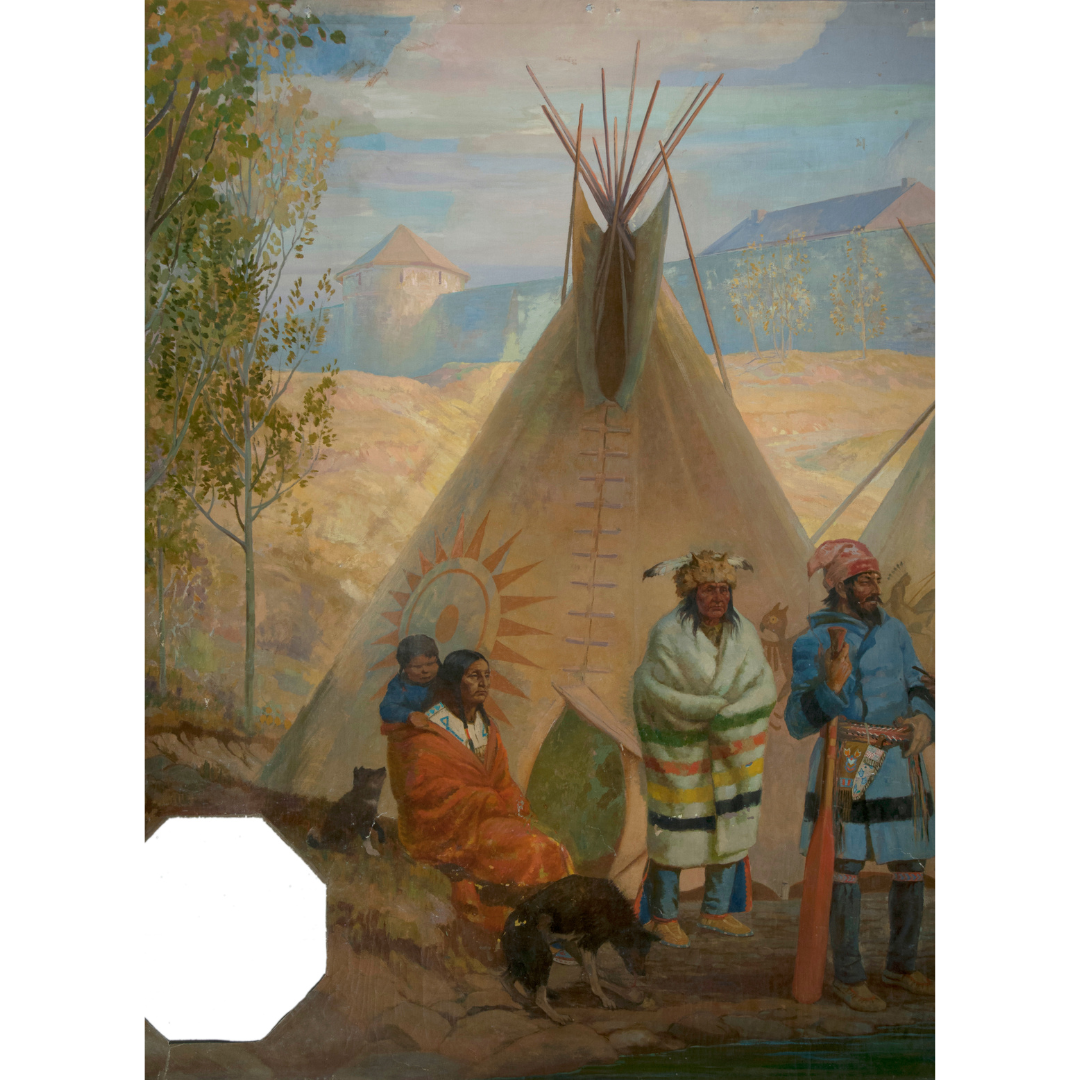
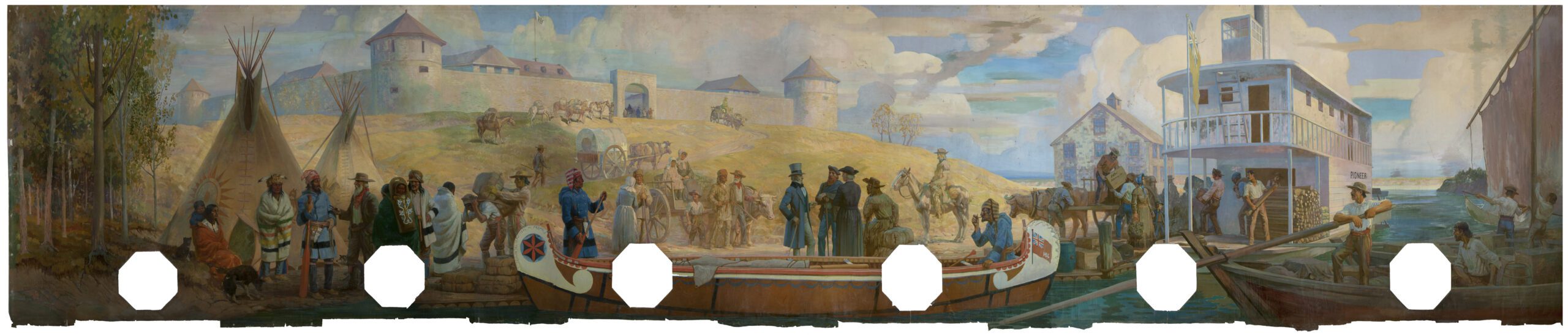
Painted mural showing three Indigenous individuals, one of whom has a child on their back, another wears a blanket with the iconic HBC stripes in green, red, yellow, and blue. Another holds a paddle. All three are in front of a tipi. In the background a stone fort can be seen in part.

For me the highlight of the event, aside from the delicious crustless sandwiches from Ray & Jerry’s, was the official donation of two murals to the HBC Museum Collection. These murals are not just an important part of HBC history, but also the City of Winnipeg’s, as they were prominently displayed in our downtown Hudson’s Bay store.

When the Hudson’s Bay Company was designing their Winnipeg store, set to open in 1926, they thought not only of the retail space, but also of the image they wanted to project.  As such, they hired one of Canada’s most prolific artists of the early 20th century, Adam Sherriff Scott, to produce two large murals for the main floor of their new store.

Sherriff Scott worked closely with fellow artist and amateur ethnologist Edwin Tappan Adney to design historically accurate scenes from the Company’s history as the subject matter. One mural was to depict a scene from Upper Fort Garry, very fitting considering the store’s proximity to the old fort, and the other was to focus on the Nonsuch.


Image: Close up of one of the panels in The Pioneer at Fort Garry, 1861.

The final product was two large murals, approximately 52′ long by 10′ wide, that were placed above the banks of elevators on the main floor.  Many Winnipeggers will probably recognize The Pioneer at Fort Garry, 1861 as it remained on display until January 2014, but the Nonsuch at Fort Charles had a much shorter display period (to be discussed in my next blog post!).

A long, narrow mural showing a scene at a riverside. On the left is a wooded area and two tipis, with individuals grouped nearby in discussion. Along the river, several boats and canoes bring goods. In the distance is a large stone fort. Six white hexagons line the bottom of the mural.

Image: The Pioneer at Fort Garry, 1861 (Note the cut-outs for the medallions above the elevators!).

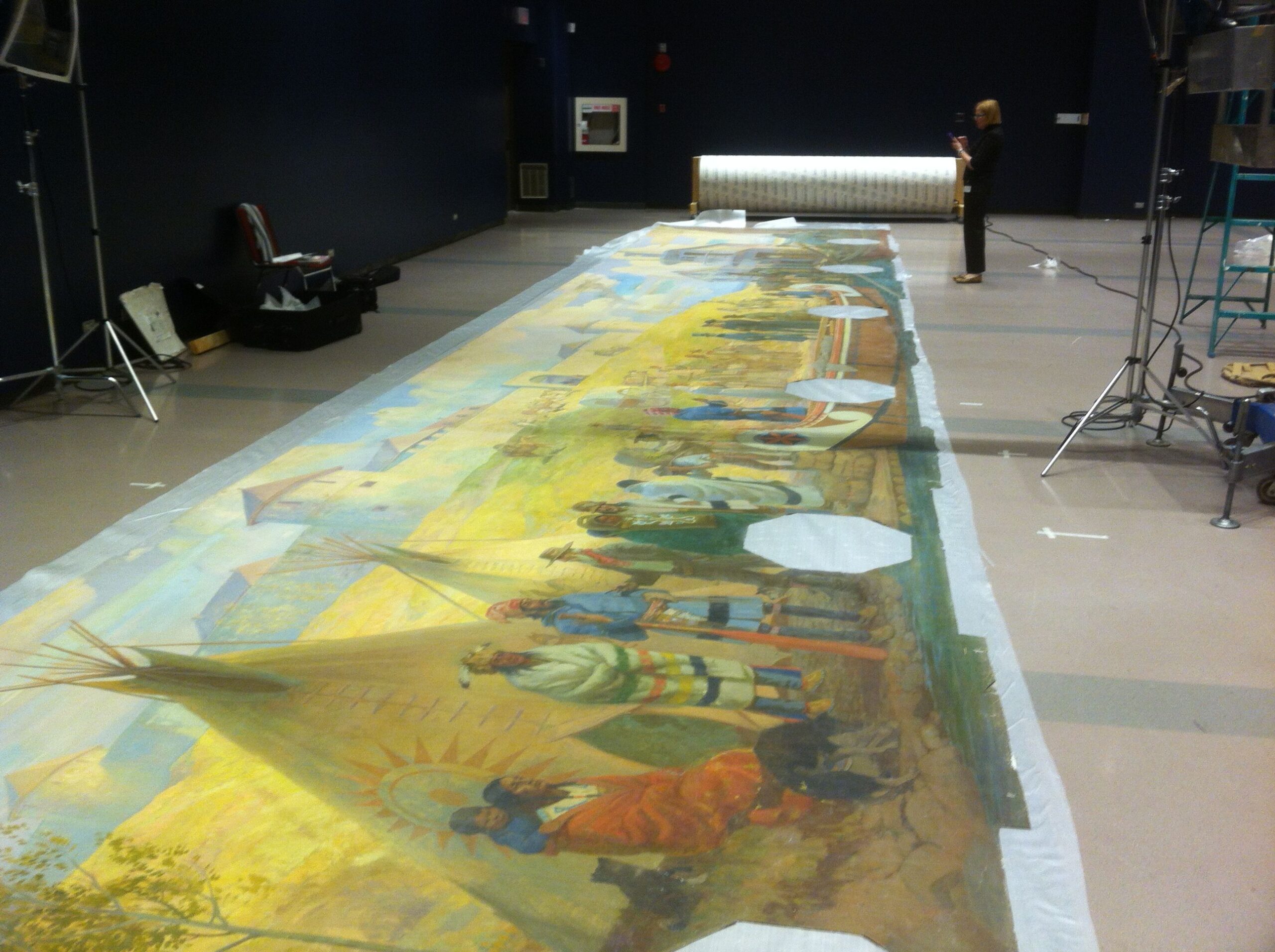
An oversized mural rolled out on the floor of a large space.

I had The Pioneer appraised and photographed during our big clean-up week in September.  It was great to see it unrolled again, although I’ll admit it was a giant pain to roll it back up!

In my next post I’ll talk about the content of both murals, include some close-up sections of The Pioneer, and provide some more information on the mysterious Nonsuch at Fort Charles mural.


Image: The mural unrolled and ready for photos and appraisal.

Dr. Amelia Fay

Dr. Amelia Fay

Curator of Anthropology & the HBC Museum Collection

Amelia Fay is Curator of Anthropology and the HBC Museum Collection at the Manitoba Museum. She received her BA in Anthropology from the University of Manitoba (2004), an MA in Archaeology…
Meet Dr. Amelia Fay

Are we Still in Manitoba?

By Dr. Graham Young, past Curator of Palaeontology & Geology


Travels in the Hudson Bay Lowlands, August, 2014

Manitoba is an immense place, very slightly larger than France. If you look at the map, you will see that roads here are concentrated in the southernmost part of the province. The farther north you go, the fewer areas you will find that are easy to visit. Those of us who work in field-based sciences occasionally get to some of the more out-of-the way places, but most of us have still seen only a small fraction of what this province has to offer. The Manitoba landscapes that are familiar to us are either the parts that we have seen (such as the prairies and the big lakes), or those that are regularly depicted in photographs and tourist brochures (such as a few places in the boreal forest and the rocky shoreline around Churchill).

This fact was really brought home to me during the last week of August, as I was invited to participate in some northern fieldwork organized by my colleagues at the Manitoba Geological Survey. I have seen a good few parts of southern and central Manitoba, but in the northern third of the province I really only know the Churchill area. Nevertheless, I thought I had a good feel for what the areas away from Churchill might be like. Our plan for this trip was to visit some of the geological sites in the Churchill area, but also to take advantage of funding support for helicopter time, which would allow us to visit a few places far up the Churchill River, 100 kilometres from any road and far from the Hudson Bay Railway.

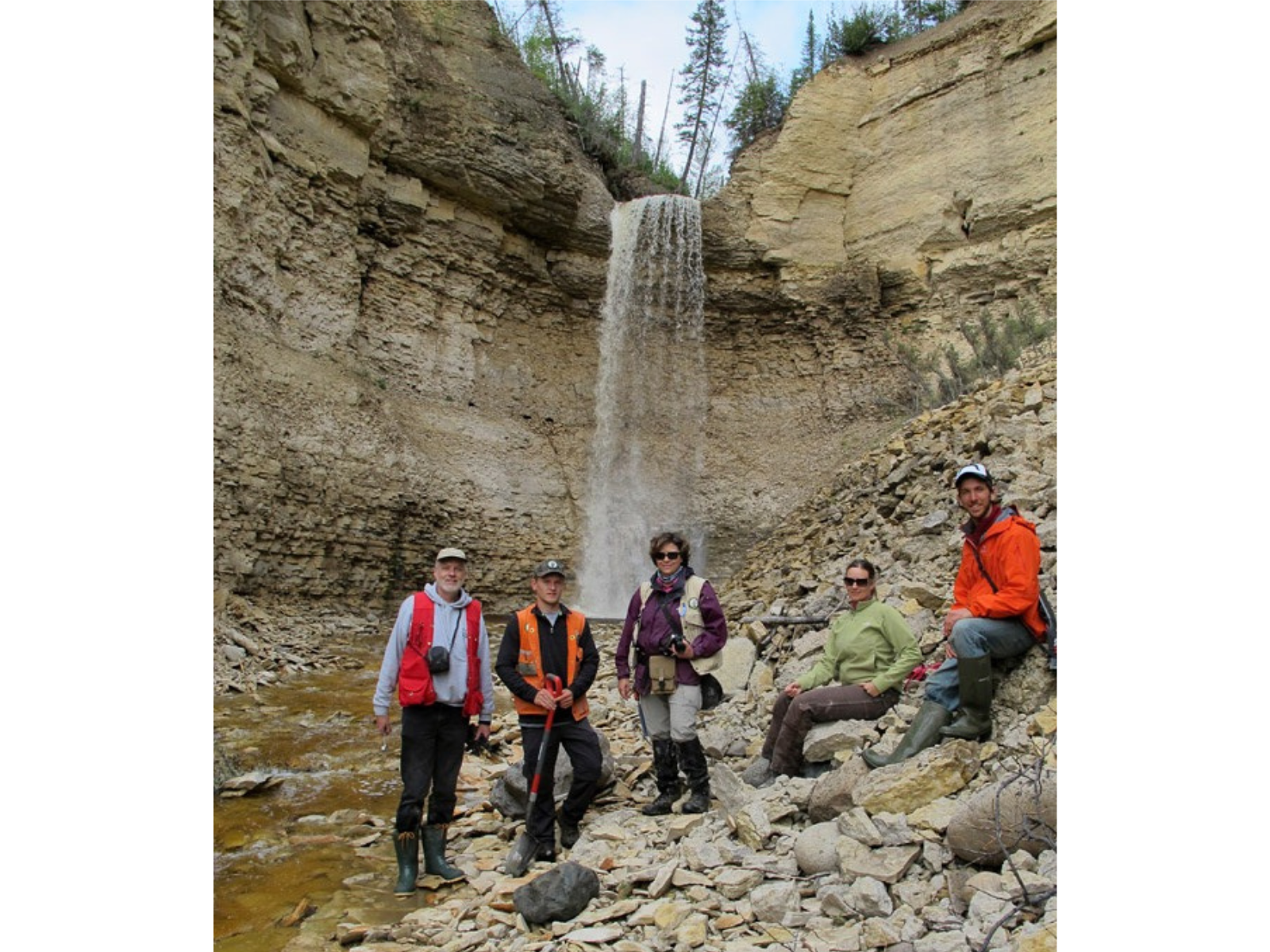
Five people posing together in front of a waterfall on the rocky shore of a creek.

Visiting the waterfall at Surprise Creek, near the Churchill River. L-R: Me, Daniel Shaw (Manitoba Geological Survey), Michelle Boulet Nicolas (MGS), Michelle Trommelen (MGS), and Daniel Gibson (Churchill Northern Studies Centre). Photo by our helicopter pilot, Frank Roberts

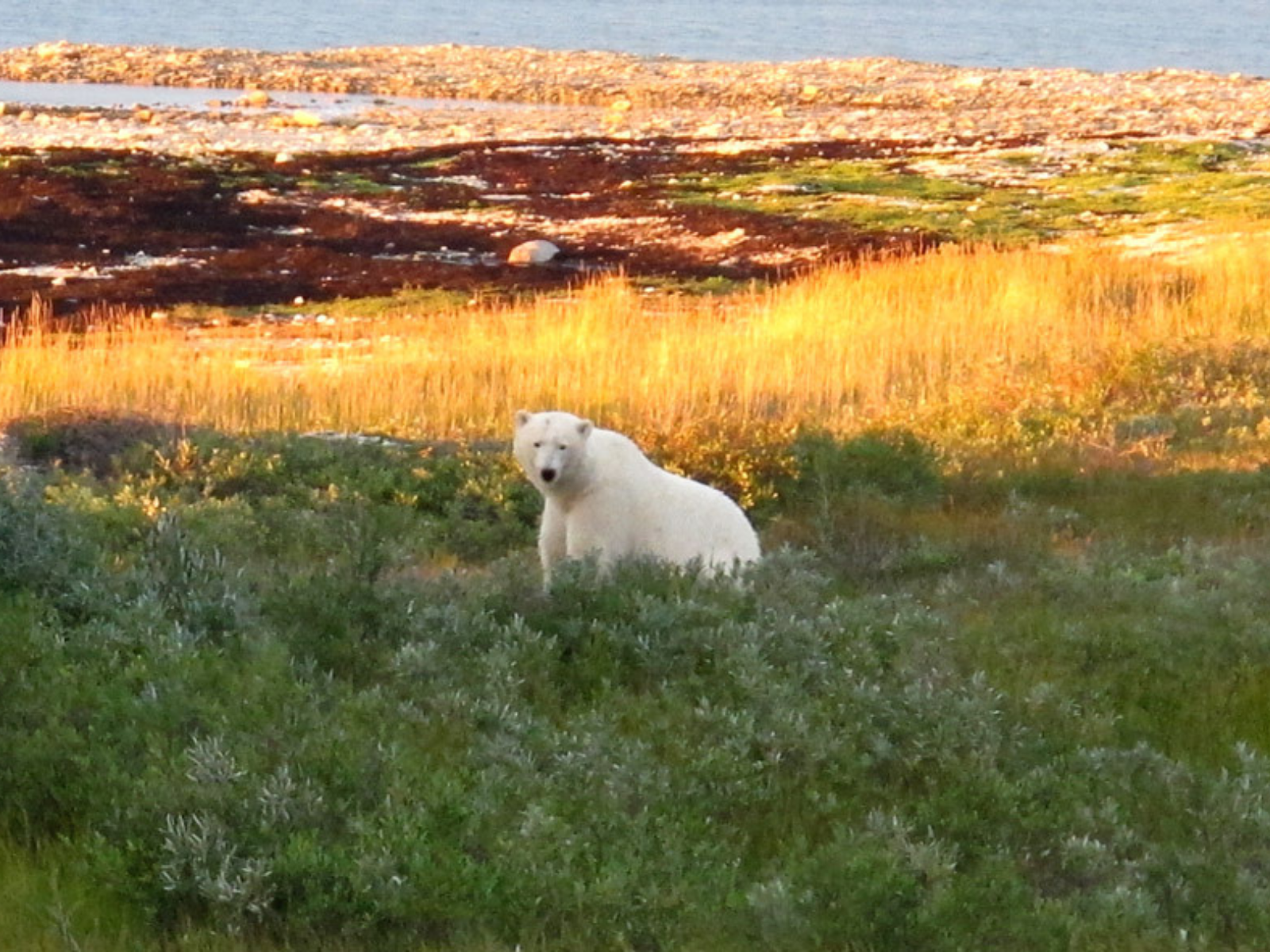
A polar bear sitting in vegetation varying from green to yellow to red before it reaches the water.

The “standard” image of Churchill: a polar bear in coastal vegetation.

The helicopter travel turned out to be an eye-opening experience. The up-river sites had received some study from scientists working with the Geological Survey of Canada, who visited this area 50 to 60 years ago, so I knew something of what I would see in terms of the rocks and fossils: the bedrock exposures are very good, and many of the fossils are superb (though they are not generally as abundant as I had anticipated).

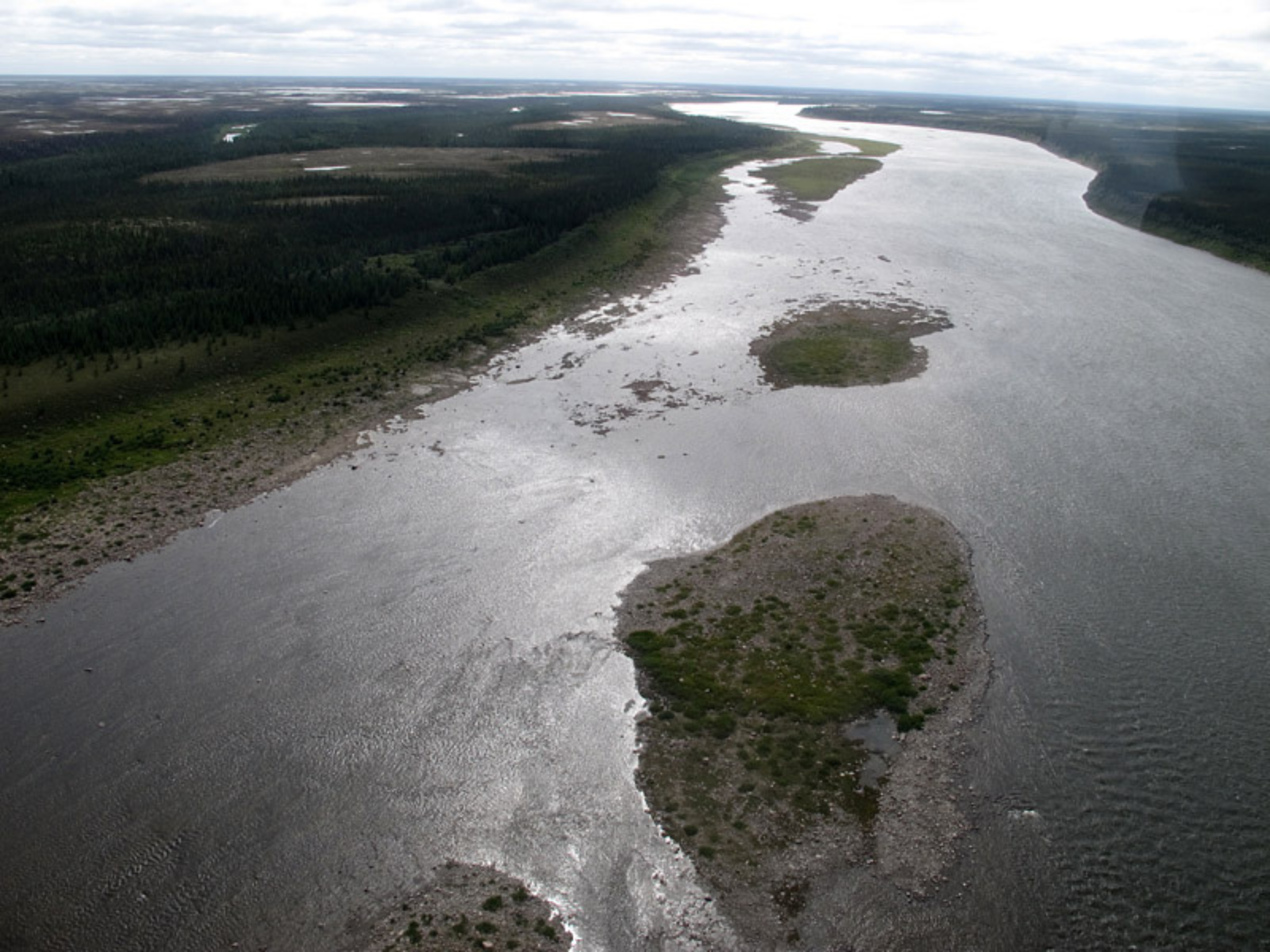
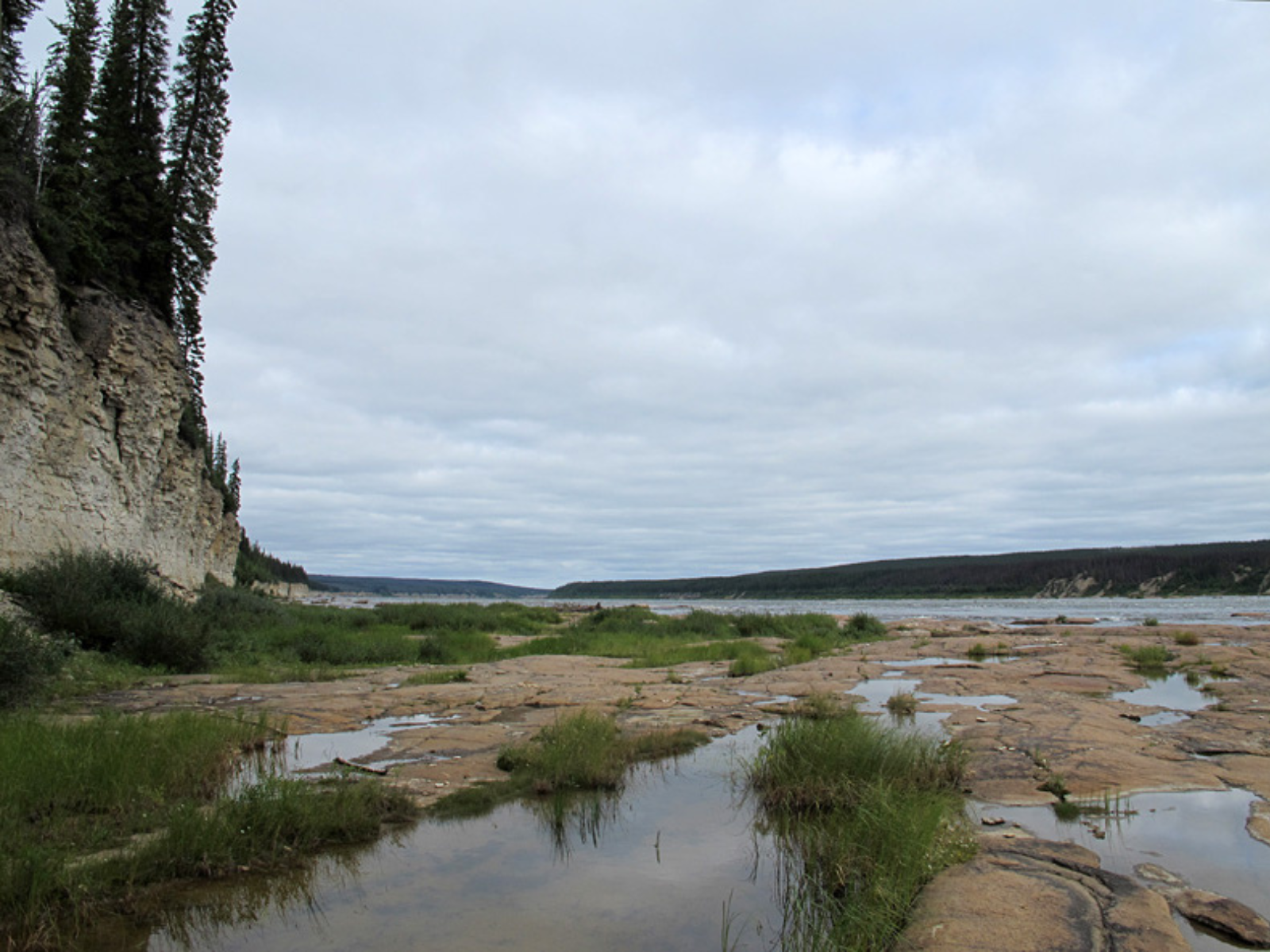
More than a decade ago we had overflown a few of these up-river sites when we had a bit of helicopter time in Churchill, so I should have really known what it would be like there, but seeing them from the ground was quite different. The Churchill River landscape has a tremendous sweep and grandeur. The river is very wide and flows swiftly, sometimes in an almost straight line, more often with gentle bends. Some downstream areas have bars of gravel and cobbles, but farther upstream there are several sets of treacherous-looking rapids. The valley walls steepen as you travel upstream, from the flat lowlands south of Churchill to a substantial height of land 100 kilometres upstream where the valley walls are cliffs of Ordovician bedrock, resting on the Precambrian granitic rock that makes up the river bed.

Aerial view of a river.

The lower Churchill River is huge!

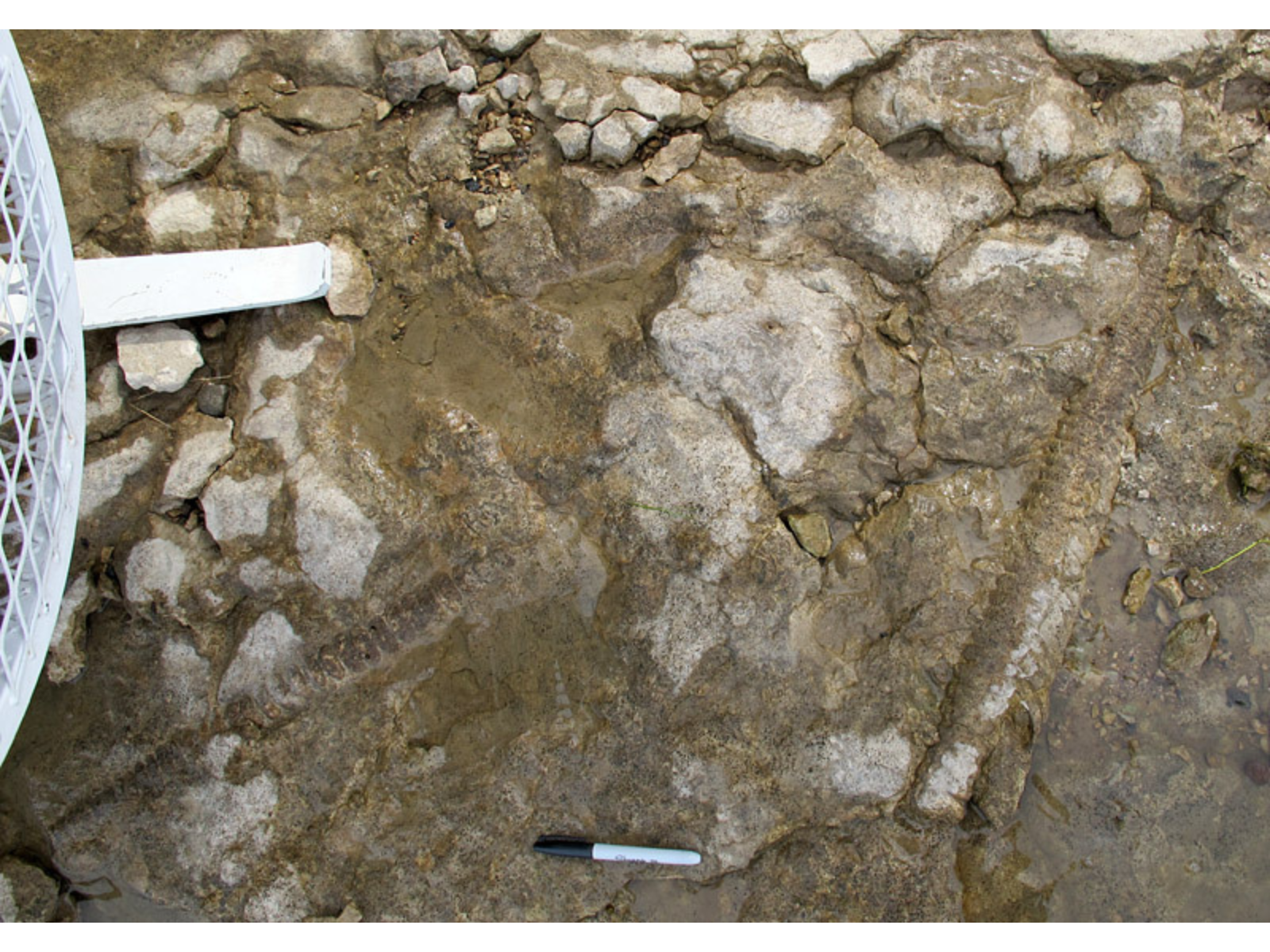
View looking down at the ground where several long, thin cephalopods embedded in the rocky ground with a Sharpie marker lying on the ground for scale.

A few of the fossils we found: these Ordovician age cephalopods were in the Chasm Creek Formation below Red Head Rapids on the Churchill River (one of these is now in the collections of the Museum). That’s the helicopter skid on the left; we had landed directly on the outcrop.

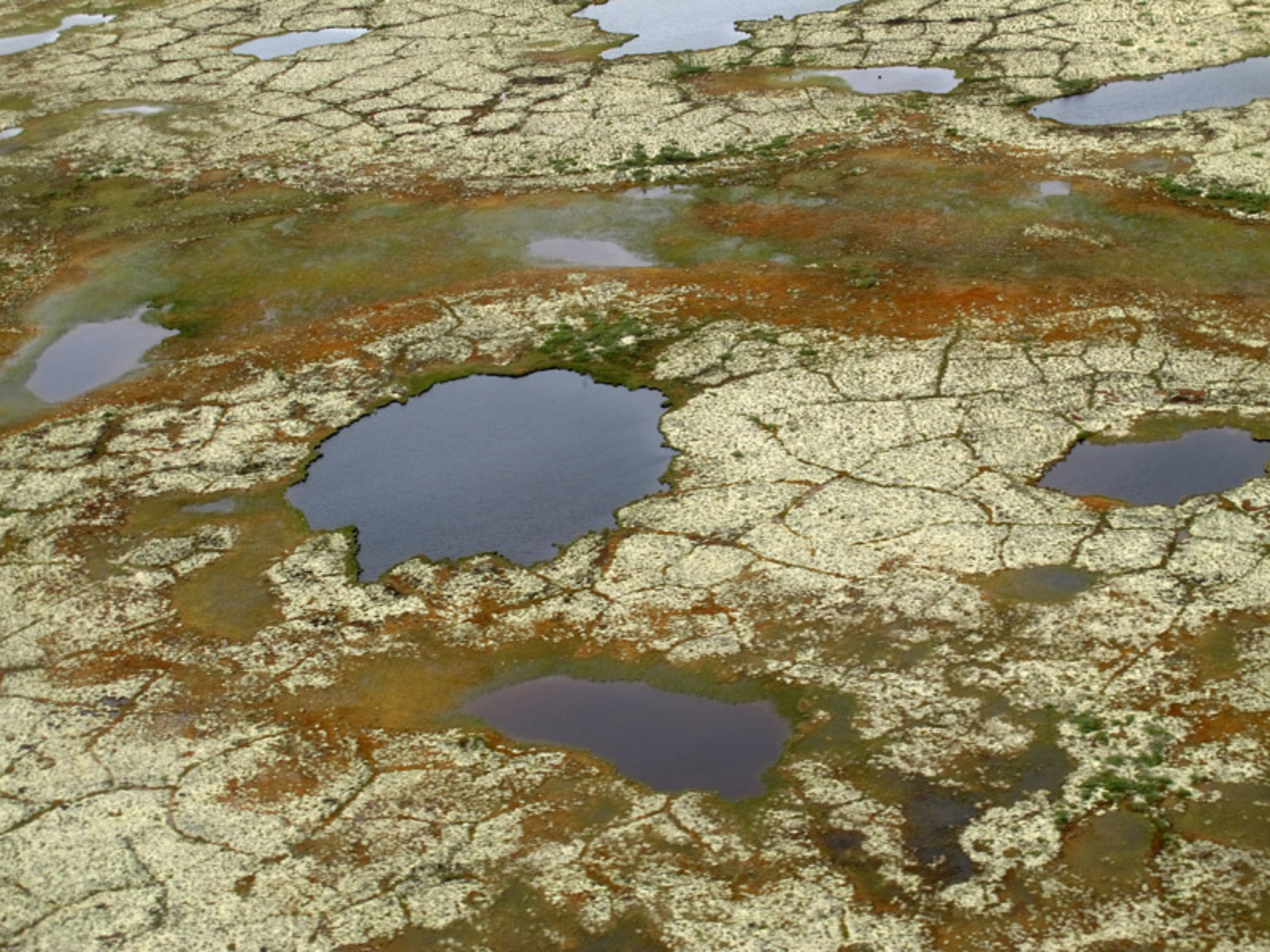
An aerial view of mossy ground punctuated by ponds.

Up over the tundra the landscape is dramatically different: this is an aerial view of moss and ponds, from a height of a few hundred feet.

Portage Chute, Bad Cache Rapids, Surprise Creek, Caution Creek, Chasm Creek . . . the place names alone should be enough to tell you that you aren’t on the prairies any more. Honestly, if I had been somehow sedated and delivered into the ravine of Chasm Creek without any awareness of how I arrived there, I would have thought that it had to be somewhere in the Yukon or perhaps the Northwest Territories.

A rocky, cliff side river bed.

A river-level view just below Portage Chute.

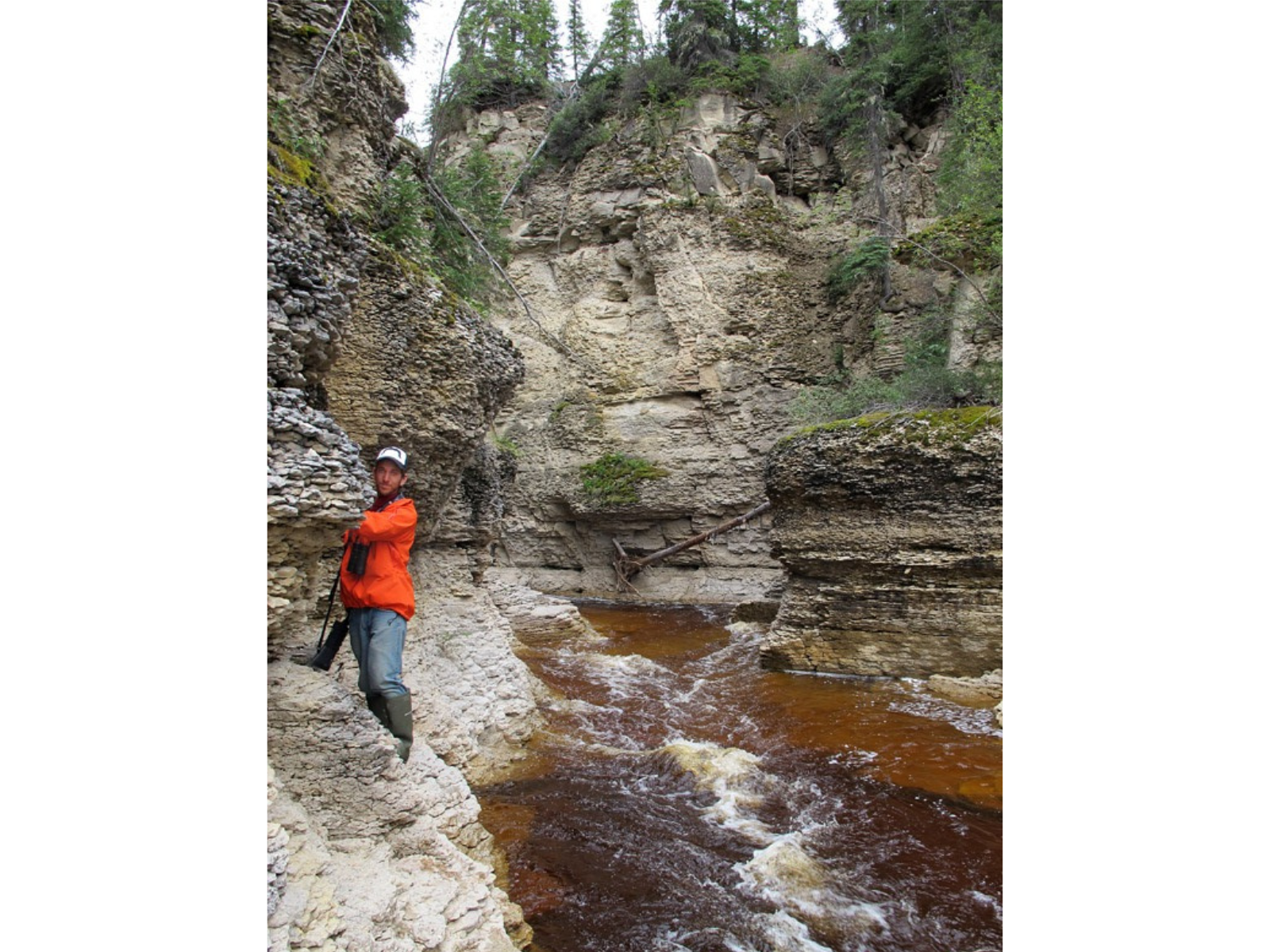
A person wearing an orange jacket standing on a narrow ridge of the cliffside of a steep-sided river.

Daniel Gibson at Chasm Creek.

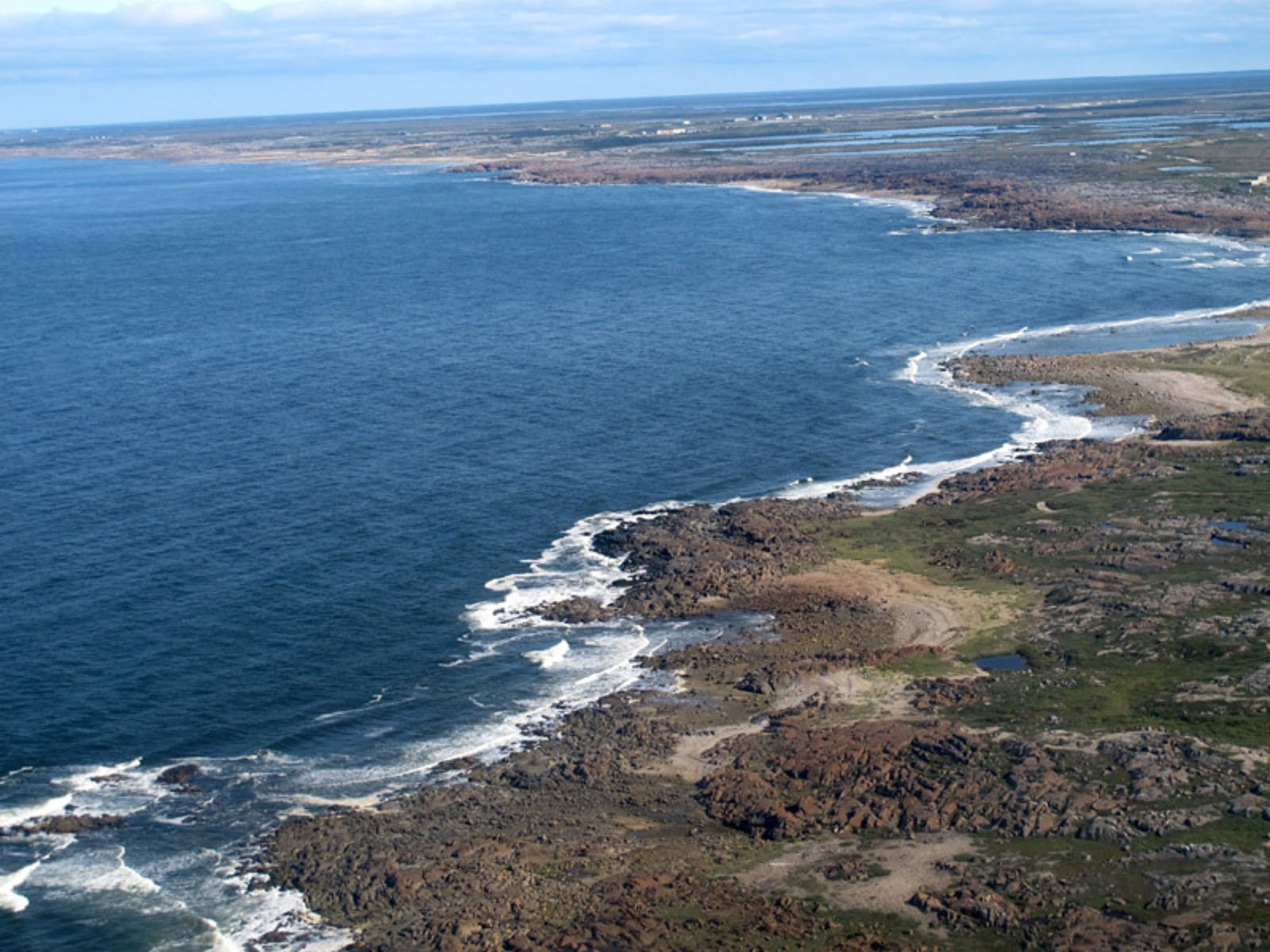
Aerial view along the rugged coast of the Hudson Bay.

A more familiar place as we flew “homeward” near the end of the day: a  view back along the coast of Hudson Bay toward the Churchill Northern Studies Centre.

The valley of the Churchill River is a literally awesome place, breathtaking in its grandeur, its scale, and in the variety of landforms and organisms. It is absolutely a northern place, a place that Manitobans should be aware of, a place to celebrate!

UPDATE: Lunar Eclipse TONIGHT!

The total lunar eclipse I wrote about on Monday will occur tonight, after midnight and into the pre-dawn hours of Wednesday morning – you can find the original article here, with times and observing suggestions. The weather for the city of Winnipeg does not look great, but there looks to be clearer skies to the west. Visit Winnipeg’s Clear-Sky Clock for hour-by-hour cloud forecasts for astronomy. Good luck!

UPDATED: Harvest Moon Eclipse for Manitoba

UPDATE – 7 October 2014: Remember, the eclipse occurs after midnight TONIGHT! Weather forecast is not looking great for Winnipeg, but viewers farther west may have a clear view.


Original article: The full moon in October is referred to as the Harvest Moon, since it rises as the sun sets and so would provide farmers an extra hour or so of light to finish bringing in their harvest. Full Moon is also the only time we can have a lunar eclipse, and this month we get both events occurring together.

A lunar eclipse occurs whenever the moon moves into the earth’s shadow. Many people don’t think about it, but the moon is just a big rock in space – it doesn’t give off any light of its own. The only reason we see the moon at all is that the sun is shining on it, and that light is reflected to us here on Earth. If you look at the moon when it is near First Quarter phase, this is easiest to see: the half of the moon facing the sun is lit up, and the half of the moon facing away from the sun is dark. (Of course, this is true for the earth as well – the side of Earth facing the sun is lit up and experiencing daylight, while the side of the earth facing away from the sun is dark and experiencing night.)

So, what can prevent sunlight from lighting up the moon? It turns out that there is only one thing big enough and close enough to do that – our planet, the Earth. If things line up just right, the moon will move into the shadow of the earth, and so sunlight will be blocked from lighting up the moon. This creates what we call a lunar eclipse. Lunar eclipses aren’t particularly rare; there is usually one or two a year visible somewhere in the world.

A Word about Safety

The word “eclipse” can conjure images of special safety glasses and people staying inside to avoid going blind, but those warnings refer to eclipses of the sun (which we will have in a couple of weeks, but that is the subject of another blog!) Viewing a lunar eclipse has absolutely NO risk of eye damage and does not require any special equipment (although a pair of binoculars or a telescope can enhance the view).

This week’s lunar eclipse early on Wednesday morning, between about 3 am and 7 am (details below). This means, of course, that for many folks it’s really a Tuesday night event, since once you wake up on Wednesday the event will be over. Make sure you set your alarm or stay up late on the correct date! On the plus side, the eclipse is a slow, stately event, and so you can peek out every few minutes or so and then warm up inside without missing too much.

Eclipse Timeline

All events are given in Central Daylight Time, the local time for Manitoba.

Tuesday, Oct 7 – evening – the eclipse starts in just a few hours, so make sure you have set your alarm and have all of your gear ready to go. A clear morning sky in October can be cold, so make sure you are dressed for winter, not fall. You will want a clear view of the southwest and west horizon, with as few trees or buildings in the way. Unlike most events, you don’t need to get away from city lights, although it helps.

Wednesday, Oct 8, 3:15 a.m. – the beginning of the eclipse is a very subtle thing. The Earth’s shadow is not hard-edged, but fuzzy, so the eclipse sort of “fades in” very slowly. Sharp-eyed viewers will start to notice that the left edge of the moon is getting dusky sometime before 4 a.m., but exactly when depends both on the observer and the atmospheric conditions around the world. It’s something not predictable in advance, so you just have to go out and see. Over the next hour, the moon will grow darker on the left edge, and probably start to take on an orange or red hue. As the eclipse begins, the moon is over in the southwestern sky, about a third of the way from the horizon to the point straight overhead. Over the next few hours, the moon will move down and to the right, so make sure you can see clear to the western horizon.

Wednesday, Oct 8, 4:14 a.m. – the moon begins to enter the darker central part of the Earth’s shadow (called the umbra). The moon is definitely getting darker from the left, and over the next while it will look as if the Earth’s curved shadow is creeping across the moon’s face. Actually, it is the moon which is moving towards the left into the shadow – if you are watching with binoculars, check the moon’s position against the background stars and you’ll see this slow motion. Over the next hour or so, the moon will get very dark as it moves completely into Earth’s Shadow. (Incidentally, observing this phase of the eclipse provides proof that the Earth is round – you can see that the Earth’s shadow is curved, not straight.)

Wednesday, Oct 8, 5:25 a.m. – the moon is totally eclipsed, completely within the shadow of the Earth. Despite this, the moon likely won’t disappear completely. The Earth blocks direct sunlight from striking the moon, but the Earth’s atmosphere acts like a lense and bends light from around the edges of the Earth. Because of the geometry, the only light that can hit the moon is the light from all of the sunrises and sunsets all around the world at that particular moment – those glorious reds, oranges, and pinks that we can see as the curtain goes up on a clear night. During the total phase, the moon can take on a red or orange colour, depending on the conditions around the world at that time. Because of this, every lunar eclipse is different – some are very bright, others almost black. The forecast for this year is for a brighter-than-average eclipse, based on the amount of volcanic dust and so on in the atmosphere, but this isn’t definitive.

Wednesday, Oct 8, 5:54 a.m. – Mid-eclipse, with the moon at its darkest. By this point, the moon is low on the western horizon, making for a dramatic photo-opportunity for those who have a building or other landmark to your west on eclipse night.

Wednesday, Oct 8, 6:24 a.m. – the total phase of the eclipse ends, as the moon starts to move out of the Earth’s umbral shadow. At this point, the moon is low in the west and the sky is already beginning to brighten in the east. Depending on how dark the eclipse is, it may be tough to spot the moon without looking carefully.

Wednesday, Oct 8, 7:30 a.m. – the moon has exited the earth’s umbral shadow, ending the partial phase of the eclipse. While there is still some eclipse shadow going on with the fainter outer shadow of the Earth (the penumbra), it likely will be lost in the growing twilight and the moon’s proximity to the horizon.

Wednesday, Oct 8, 7:40 a.m. – the sun rises, and the moon sets 11 minutes later, with the penumbral eclipse still in progress.

Enjoy the view – because of the late hour, there is no public viewing planned for this eclipse, but you can enjoy it with the unaided eye, or a pair of ordinary household binoculars or a small telescope if you have one.

Scott Young

Scott Young

Planetarium Astronomer

Scott is the Planetarium Astronomer at the Manitoba Museum, developing astronomy and science programs. He has been an informal science educator for thirty years, working in the planetarium and science centre field both at The Manitoba Museum and also at the Alice G. Wallace Planetarium in Fitchburg, Massachusetts. Scott is an active amateur astronomer and a past-President of the Royal Astronomical Society of Canada.

William Dampier: Pirate Botanist

Piracy and botany are two words that do not usually occur together in a sentence. But in the golden days of exploration, seafaring men were not always vicious rogues intent on thievery. Well alright, a lot of them probably were. But one man among them combined piracy with a love of plants and that man was Captain William Dampier (1651-1715).

Formal painted portrait of a man with waving, shoulder-length dark brown hair, wearing a red-brown jacket, open to show a ruffled cravat.

Captain Dampier was an orphan who left home at an early age to pursue a naval career. After working on various ships, and on land in a sugar plantation and as a forester, he eventually took up with a band of pirates. Not one to let his work get in the way of his hobbies, he kept meticulous notes and made drawings of the fascinating plants and animals he encountered in a journal. A pirate carrying both a cutlass and botanical collecting kit must have made an unusual sight!


Image: Portrait of William Dampier “Pirate and Hydrographer”. Photograph by T. Murray [Public domain], via Wikimedia Commons

Although Charles Darwin is the naturalist usually associated with the Galapagos Islands, Dampier was actually the first Englishman to describe their flora and fauna. Unlike Darwin though, Dampier came to the islands as a deckhand on a stolen frigate! Dampier’s descriptions were often practical in nature, noting which trees could used to make fires (buttonwood!), and which plants and animals were edible. Sadly on the Galapagos, the edible animals turned out to be the extremely rare “land turtles” which sailors often brought on board their ships for fresh meat.

Later on Dampier’s voyages took him to the Indian Ocean where he was marooned by his crew near Sumatra. He eventually made it back to England where he published his memoirs in the 1697 book entitled “A New Voyage Round the World” which became an instant hit!

Bristley pods growing in clusters on a plant with elongated, waxy green leaves.

Dampier noted that Buttonwood (Conocarpus erectus) made good firewood. Photo by Ulf Mehlig (Own work) [CC-BY-SA-2.5 (http://creativecommons.org/licenses/by-sa/2.5)], via Wikimedia Commons.

A page featuring drawings of four plants titled "Plants found in New Holland".

Drawings of plants found in New Holland, from Dampier’s “A Voyage to New Holland”. Drawing by William Dampier (Princeton University Library, Rare Books Division) [Public domain], via Wikimedia Commons

Dampier’s book was so popular that the British Admiralty gave him command of a ship, H.M.S. Roebuck. His mission was to sail to Western Australia to determine if it could be colonized, and collect some botanical specimens while there. Unfortunately Dampier’s ship was a bit of a lemon; it sank near the island of Ascension taking most of his precious dried plants and notes down with it. The 24 plant specimens he rescued were eventually donated to the Oxford University Herbarium where they still remain in a collections facility not unlike the one we have here at the Manitoba  Museum.

A oblong coconut beside a halved coconut, showing the hollow cavity in the centre.

Dampier is linked to one of history’s most famous mutinies: the Bounty. Dampier’s book described the nutritional value of both coconut (Cocos nucifera) and breadfruit (Artocarpus altilis). Dampier described the coconut as having a cavity “full of sweet, delicate, wholesome and refreshing water” and a kernel that “is soft like cream”. Baked breadfruit on the other hand “must be eaten new, for if it is kept above twenty-four hours, it becomes dry, and eats harsh and choky.” The mission of Captain Bligh of the Bounty was to bring breadfruit plants to Jamaica to feed slaves but it was unpopular, likely because, as Dampier warned, it simply was not served fresh enough.

Oddly enough, despite Mr. Dampier’s colourful career, he has never been depicted in any films. I guess Hollywood doesn’t consider a pirate that stops to collect the roses worthy of any attention!


Image: Dampier described the taste of coconut in his book. TMM F-164  & F-165.

Dr. Diana Bizecki Robson

Dr. Diana Bizecki Robson

Curator of Botany

Dr. Bizecki Robson obtained a Master’s Degree in Plant Ecology at the University of Saskatchewan studying rare plants of the mixed grass prairies. After working as an environmental consultant and sessional lecturer…
Meet Dr. Bizecki Robson

A New Old Look for the Urban Gallery

What’s old is new again! The Urban Gallery at The Manitoba Museum has just received a bit of a face lift. Many of our visitors enjoy the immersive experience of this gallery, where they can explore the nooks and crannies of different buildings, stroll along the streets or watch a silent film in the theatre. As curators, we’re always looking for ways to improve that experience.

The Urban Gallery represents Winnipeg in the early 1920s. It was a bustling, modern city with hundreds of thousands of citizens – it was in no way a little town. To get this across, we wanted to populate the gallery with pictures of real people of the period. Three large spaces allowed us to introduce historical photographs of people of different backgrounds and occupations. Hours of research at the Archives of Manitoba sifting through hundreds of photographs led me to choose three, two of which relate to the railway tracks, with the third placed beside the movie theatre. All three photographic reproductions are courtesy of the Archives of Manitoba.

A historical photograph blown up on a stone wall next to a set of wooden doors. The photo shows a group of well dressed individuals from the 1920s standing at a rail station.

Lord and Lady Byng with entourage, June 18, 1922, at the CPR station in Winnipeg. Part of the elite society of Great Britain, Lord Byng led Canadian forces at Vimy Ridge and was, at the time of this photograph, the Governor General of Canada.

A historical photograph blown up on the wall showing a railway worked gang standing around a railway line. The photograph lines up with a railway line built our in the Winnipeg 1920 Cityscape.

On the opposite end of the track we have this railway worker gang in Manitoba, circa 1920. It was tough and dangerous work. Unfortunately we don’t know the workers’ names.

Historical photograph blown up between two stone walls. Photo shows a horse drawn wagon with a worker on the wagon with the reins. In front of the photo is a water trough.

A Central Dray Company employee with horse and wagon, circa 1915, 61 Princess St. This was the handy mover of the period, ready to haul anything, including pianos. The building in the background is still standing today (see right).

A seven-storey stone building with many windows.

The building in the background of the Central Dray photomural, as it looks today. This is the back of 70 Arthur St. as seen from Princess St. from roughly the same perspective.

Come to The Manitoba Museum and experience the “all new, all old” Urban Gallery photomurals, and get a feel for Winnipeg in the 1920s, a city of contrasts.

Dr. Roland Sawatzky

Dr. Roland Sawatzky

Curator of History

Roland Sawatzky joined The Manitoba Museum in 2011. He received his B.A. in Anthropology from the University of Winnipeg, M.A. in Anthropology from the University of South Carolina, and Ph.D. in Archaeology…
Meet Dr. Roland Sawatzky

Where Have All the Pollinators Gone?

After a summer filled with ticks, mosquitoes and biting flies, I was ready for a pest-free pollinator survey at the Nature Conservancy preserves near Riding Mountain National Park this September. Autumn field work can be quite lovely with the beautiful fall colours, comfortable temperatures and migratory birds moving through. But you can’t always get what you want. The vicious thunderstorm that pelted my car with hazelnut-sized hail and forced me to pull over onto the side of the road just as I was leaving town forebode what was to come: crappy weather. I suppose that it was simply too much to ask for four weeks of rain-free field work this year though. I consider myself lucky to have had such nice weather in June, July and August.

Looking out over a field towards a tree line on a cloudy, grey day.

Part of the reason I like studying pollinators is that they don’t like bad weather. When it is cold and rainy they just curl up in their little dens, or hide under a flower or some vegetation till it warms up. That makes total sense when you’re not much bigger than a raindrop yourself. Getting hit by hazelnut-sized hail would mean an early grave for you! Better to lay low for a while. Since I dislike doing field work when the weather is bad, the arrangement works out just fine.

When I started my first survey it was cool, cloudy, windy, and threatening to rain. Aside from a few bumblebees clinging to the undersides of Lindley’s asters (Symphyotrichum laeve) and sipping a bit of nectar to stay warm, there were no pollinators about. The next morning was worse: it was cold and rainy but as it cleared up by noon I was still able to complete all my surveys. Wednesday and Thursday were slightly better as it did not rain; however, it was still too cold for much pollinator activity.

Image: Cold, cloudy weather at the preserves in September meant that most of the pollinators just stayed home.

A bumblebee with wet and matted fuzz clinging to the petals  of a small purple flower.

This rain-soaked bumblebee clung to the underside of a Lindley’s aster (Symphyotrichum laeve) to stay dry.

A small bee crawling along the top of a many-petaled yellow flower.

A poor, cold little sweat bee feeding on false dandelion (Agoseris glauca) flower.

Close up on a cluster of white flowers with yellow centres.

Despite the poor weather conditions and paltry number of pollinator visits (only 16 per day), I still learned something valuable on this trip. The point of my research was to identify which flowers should be grown to provide pollinators with enough forage over the entire season. In September the main plant species in bloom are Lindley’s and many-flowered aster (Symphyotrichum ericoides) so these two species should probably be included in any prairie restoration seed mix. These flowers provide overwintering queen bees with nectar and pollen till they are ready to hibernate.

And so my summer of field work is at an end. This is pollinator biologist, Diana Robson, signing out and wishing all those bees, flies and butterflies (but not the mosquitoes) a safe sleep until spring!

Image: Many-flowered asters (Symphyotrichum ericoides) are the most abundant flowers in autumn on fescue prairies.

Dr. Diana Bizecki Robson

Dr. Diana Bizecki Robson

Curator of Botany

Dr. Bizecki Robson obtained a Master’s Degree in Plant Ecology at the University of Saskatchewan studying rare plants of the mixed grass prairies. After working as an environmental consultant and sessional lecturer…
Meet Dr. Bizecki Robson