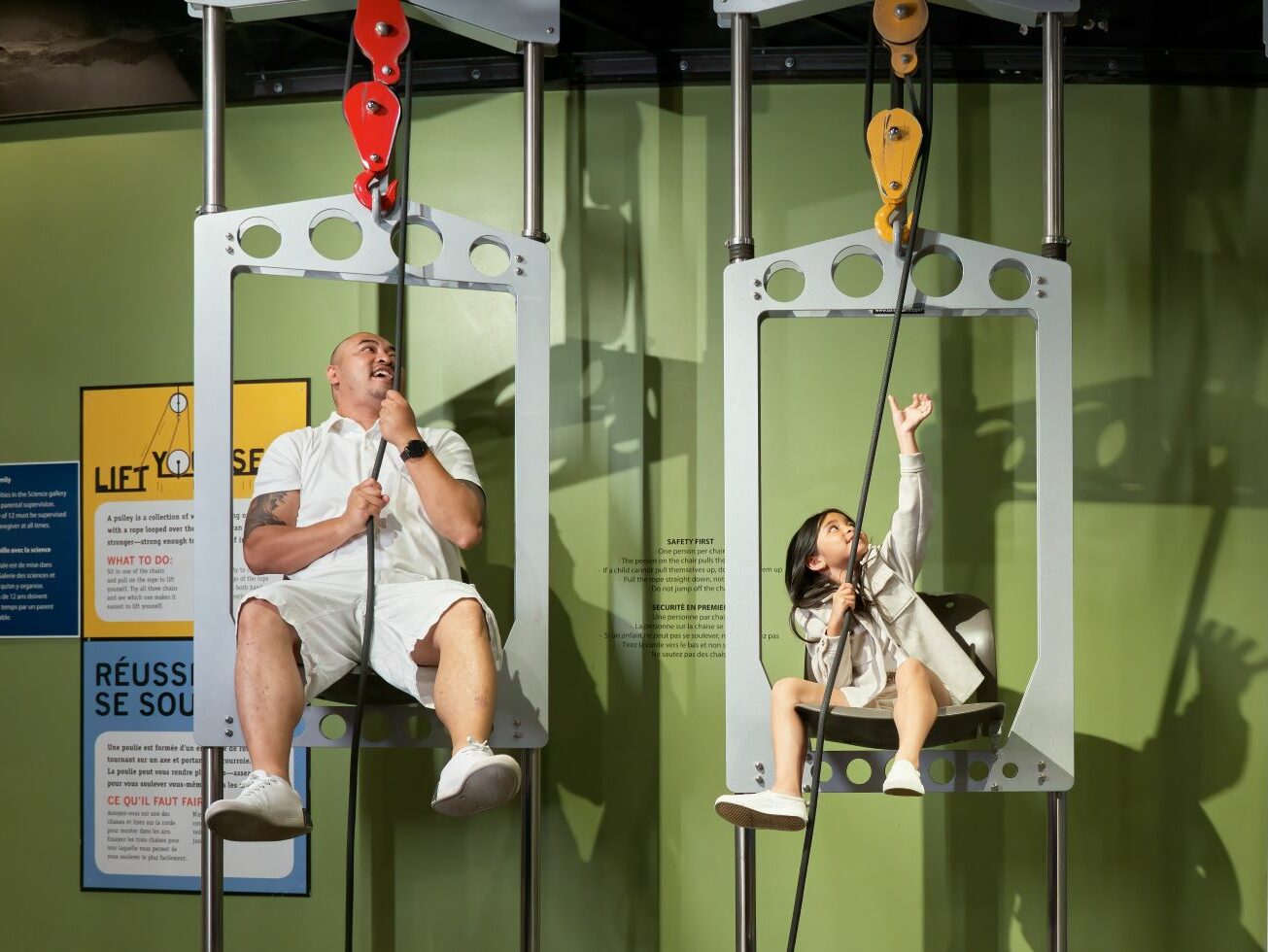

Raise the Sails!

Raise the Sails!

The Nonsuch at the Manitoba Museum is the largest artifact (in size) in the collection. It is unique in that it is an artifact that visitors get to walk aboard, touch and literally step into a piece of history. Another interesting part is that the Nonsuch is a real life ship that was once sailed by a crew and it is because of this that the Conservators at TMM care for it a little differently than other objects in the collection.

One aspect of caring for such a large artifact is following a routine maintenance plan in order to keep the ship in first-class shape. This includes regular cleaning of the decks, captain’s quarters, sails and hold, as well as taking twice-yearly measurements to see if there are any changes or movements to the wooden components. Another part of the maintenance plan is moving and adjusting the rigging. When we talk about the rigging of the Nonsuch we are talking about a lot of different components including the masts, ropes, yards, and sails. One of the reasons why we undo and move the lines as part of the conservation maintenance plan is to allow the ropes to not stiffen overtime. Movement of the rigging also allows the sails to be unrolled so that they do not become stretched from sitting in the same position.
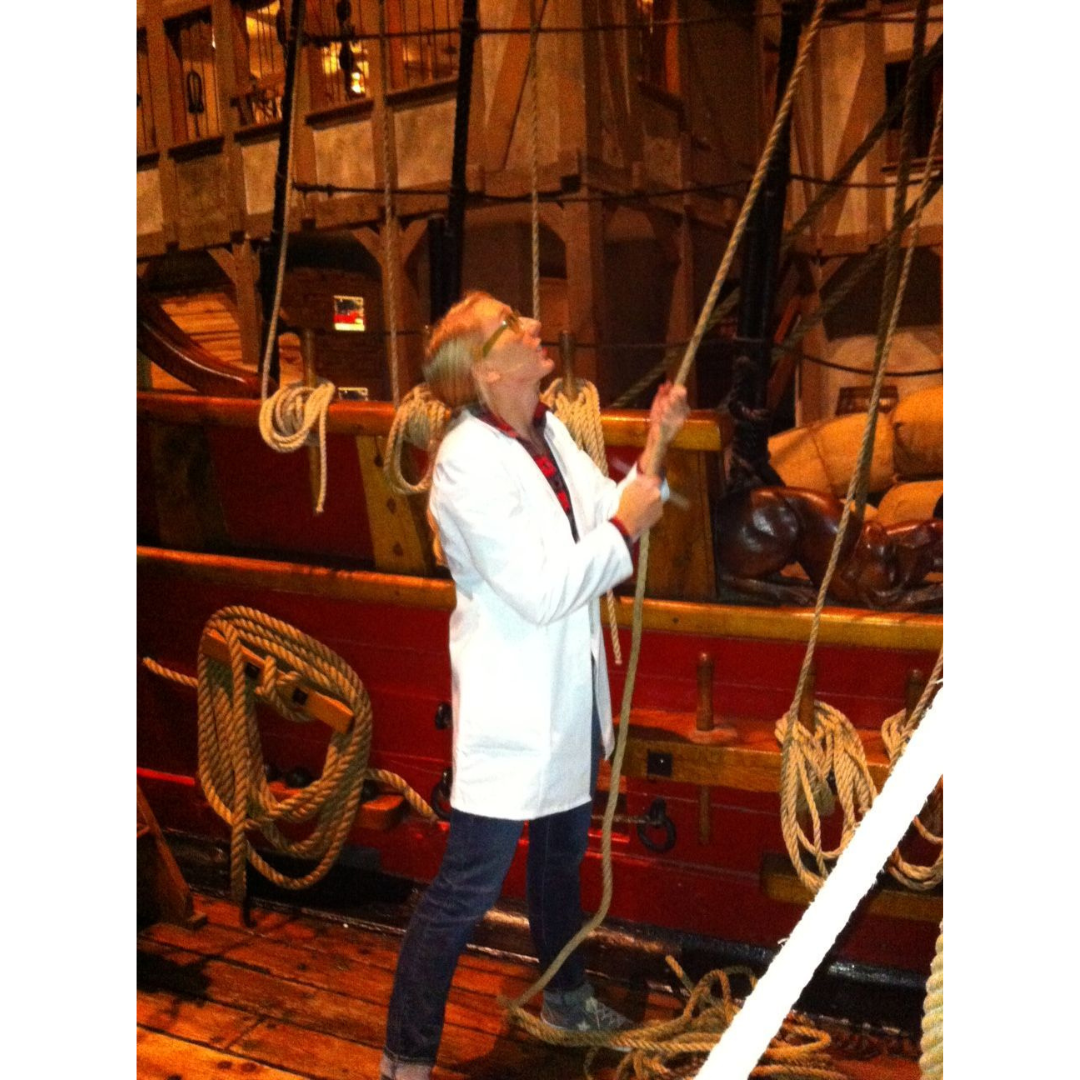
A woman wearing a white lab coat stands on the deck of a wooden sailing vessel, holding a rope taught as she looks up.

Carolyn working on deck.

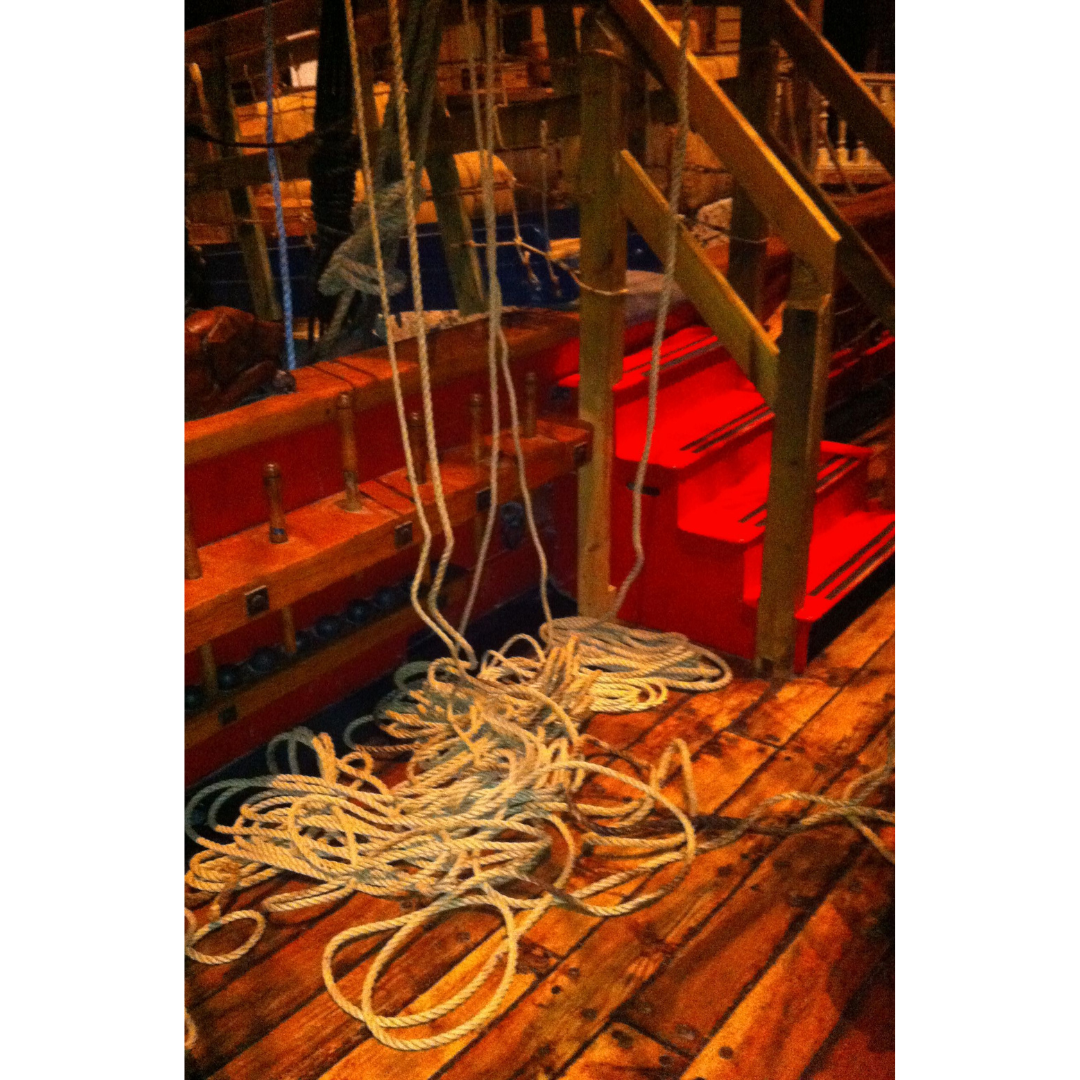
A pile of loose rope on the wooden deck of a ship.

We’ve thrown the lines off the belaying pins and they’re lying loose on deck.
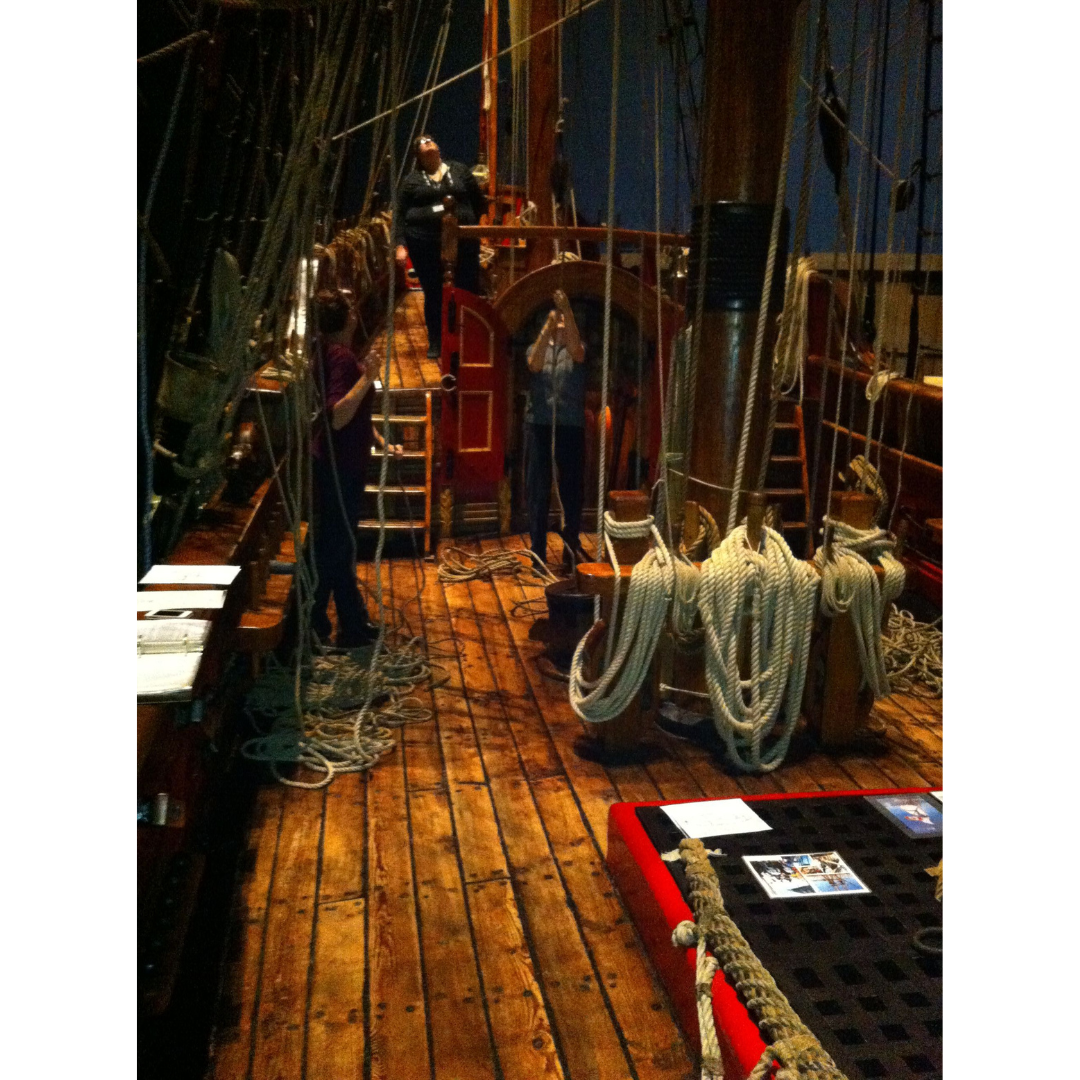
Three individuals standing on the deck of a wooden sailing vessel. All are looking up, as one pulled on a rope threaded through a pulley.

Museum staff moving lines on the ship.

Some other unique things that are done by the Conservation team to keep the Nonsuch as close to working order include tarring the deck seams, repainting the stern carvings, and splicing rope works when needed.

The next step in our maintenance plan, which will hopefully be completed in the upcoming months, includes climbing the ratlines (rope ladders leading up the mast) with our special vacuums and giving the ship a good dusting. This probably wouldn’t have been done in the high seas due to the abundance of wind available but since the ship is permanently stored indoors it does get quite dusty. Part of our training for this task includes taking fall protection training so that we are as safe as possible when geared up in harnesses and climbing the rigging. Stay tuned for a future blog on what it’s like to vacuum a ship 60 ft. in the air!

As mentioned earlier, the Nonsuch is treated differently from other artifacts and needs to be preserved in a way that maintains it in working order to prevent further damage. This is in comparison to our regular collections which mostly stay static in their positions tucked away in storage vaults. Having the opportunity to be a part of the preservation of the Nonsuch is a rare opportunity and also a chance for Conservators to trade in our lab coats for a sailor’s cap every once in a while.
Carolyn Sirett

Carolyn Sirett

Senior Conservator

Carolyn Sirett received her B.A. in Anthropology from the University of Manitoba, Diploma in Cultural Resource Management from the University of Victoria, and Diploma in Collections Conservation and Management…
Meet Carolyn Sirett

The Value of Professional Conferences

By Kathy Nanowin, past Manager of Conservation


I went to the annual conference of the Canadian Association for Conservation (CAC) this year, as I try to do every year. It is held in late spring in a different location in Canada, alternating between different regions of the country. It is not a large conference, with attendance ranging from 70 or so in the smaller cities, to about 150 or even 200 in larger cities such as Toronto. This is because there are not a huge number of conservators in Canada; we are quite a small profession.

Why do professional associations, or any group for that matter, hold conferences? Aren’t they just an excuse to travel somewhere exotic on the corporate or government dime, and drink wine?

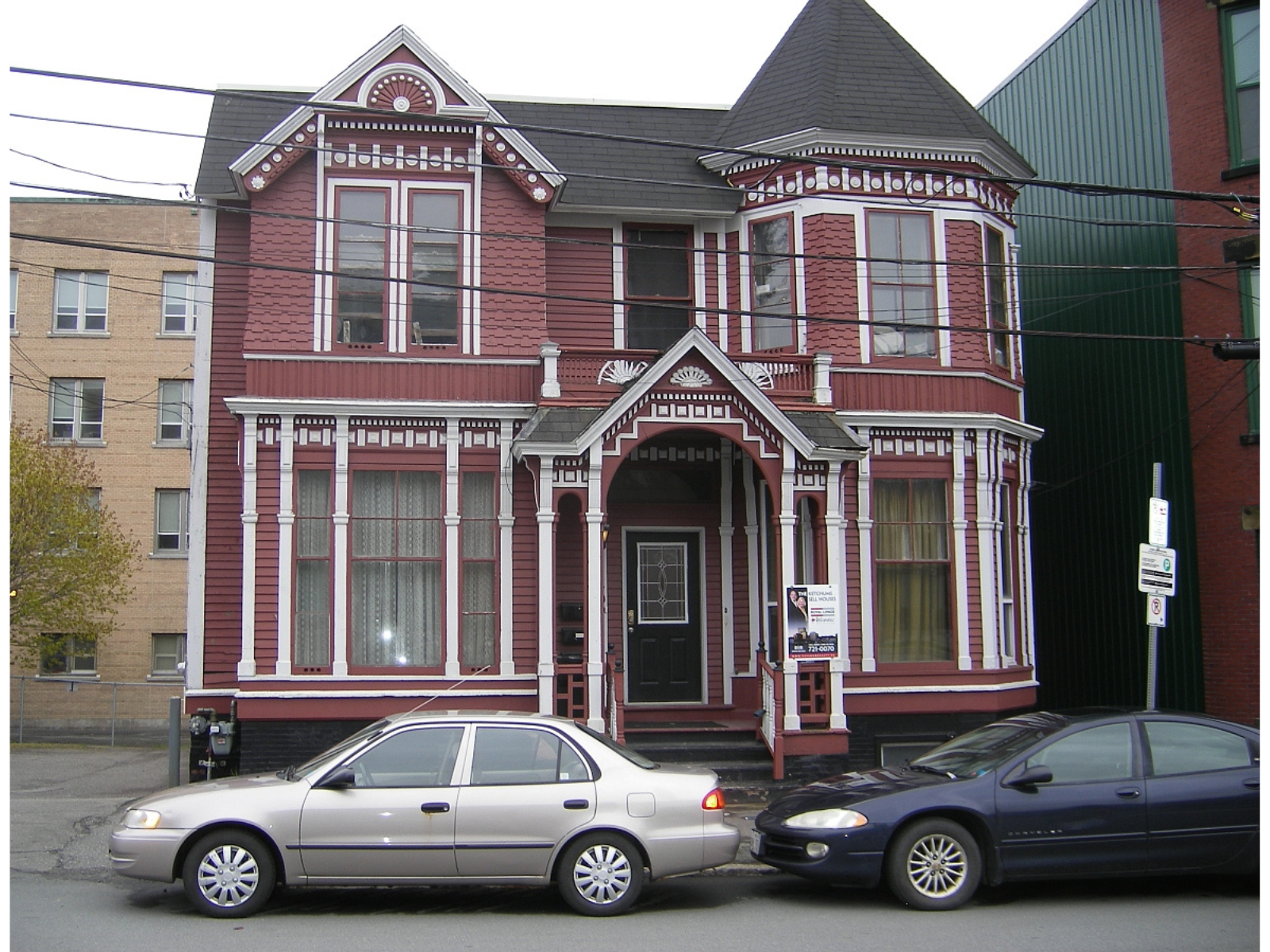
The exterior of a large red historic house with white trim.

Historic house in Saint John, New Brunswick, where I attended a conference.

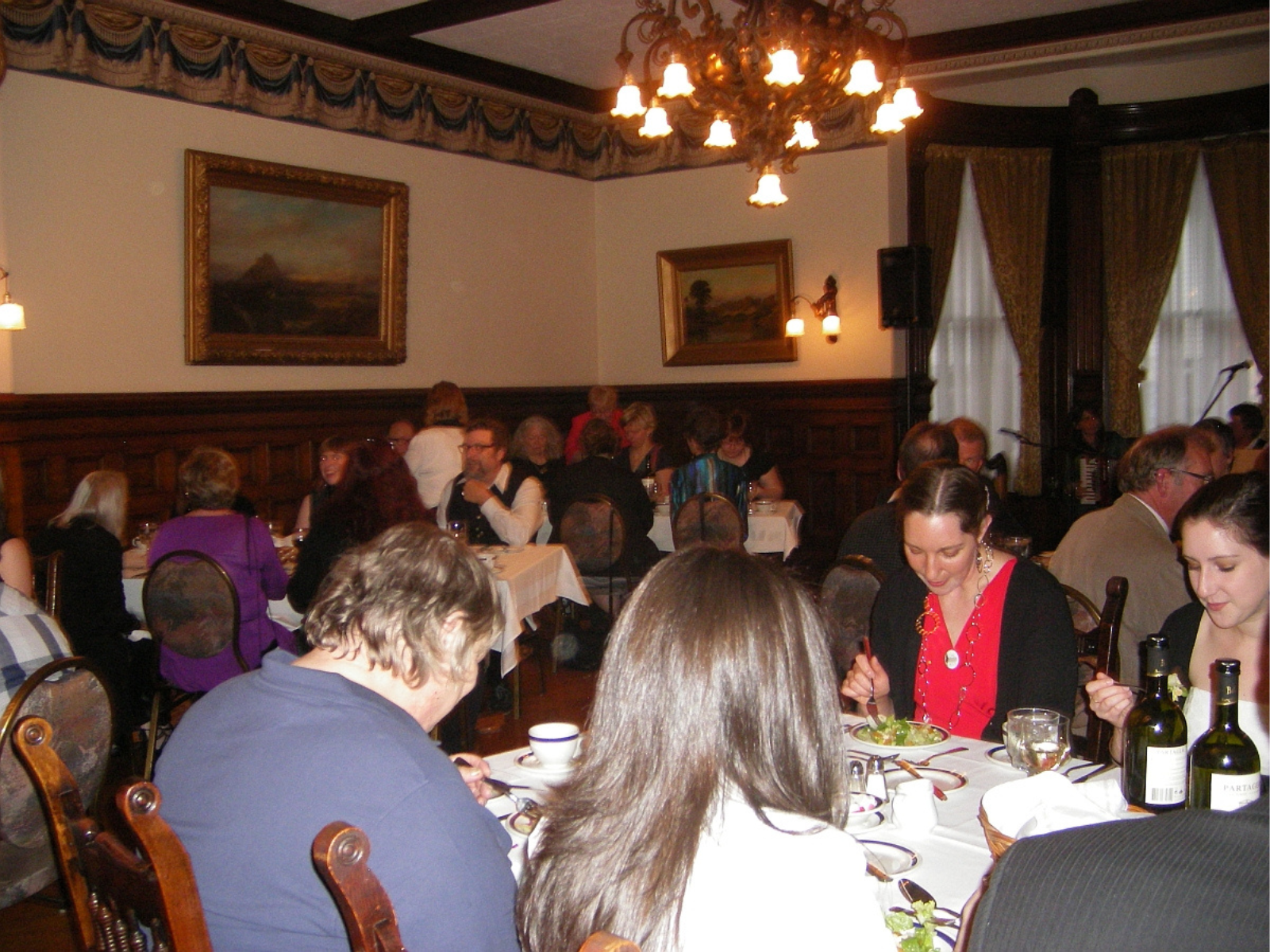
Interior room in a historic house with people seated around tables laid around the room.

The conference banquet was also in a historic building, the Union Club.

Well, no. Conservators have been compared to doctors; the way we care for objects has many similarities to the way doctors care for people. We “operate” (perform treatments) on objects to repair damage that has been done. We also spend a lot of time advising on preventive measures that will keep objects “healthy”; as in human health, prevention is the most important consideration, to prevent or mitigate damage or deterioration. There are also, as in medicine, many scientists working with practitioners (the conservators) to identify needed areas of research, to add to the body of knowledge in our areas of work. New information is always being discovered, as in medicine. That is why we have professional journals, and why we hold conferences.

I’ve been to many conferences over the years I’ve been a conservator. I find that I always learn something, and I always come back to work rejuvenated, with my enthusiasm for my job renewed. Working in cultural heritage in Canada can make one feel fairly isolated. I don’t have that much contact with the general public; I work in a medium-size museum, so I have a lot of museum colleagues, but not that many fellow conservators to talk to. There just aren’t that many of us.

Going to a different Canadian city every year, getting to see different museums, with their great collections, but also challenging situations, is wonderful. However, the best thing about going to professional conferences, for me, is the face to face contact with people. I can read someone’s article in a journal, but to talk to them in person just can’t be replaced. I learn about new conservation treatments, the latest research, shared problems, and the overall mood of the profession. I catch the giant enthusiasm of new graduates.

I personally am able to pay to attend CAC conferences out of my pocket, but I also try to support the attendance of another conservator from the Museum out of departmental budgets, with grant assistance, whenever possible. This is because I firmly believe in the value of professional development, and especially the value of professional conferences.

A Once Sticky Situation

By Lisa May, past Conservator


When performing inventory and maintenance in the museum galleries, the collections and conservation staff sometimes discover things which are questionable museum practices.

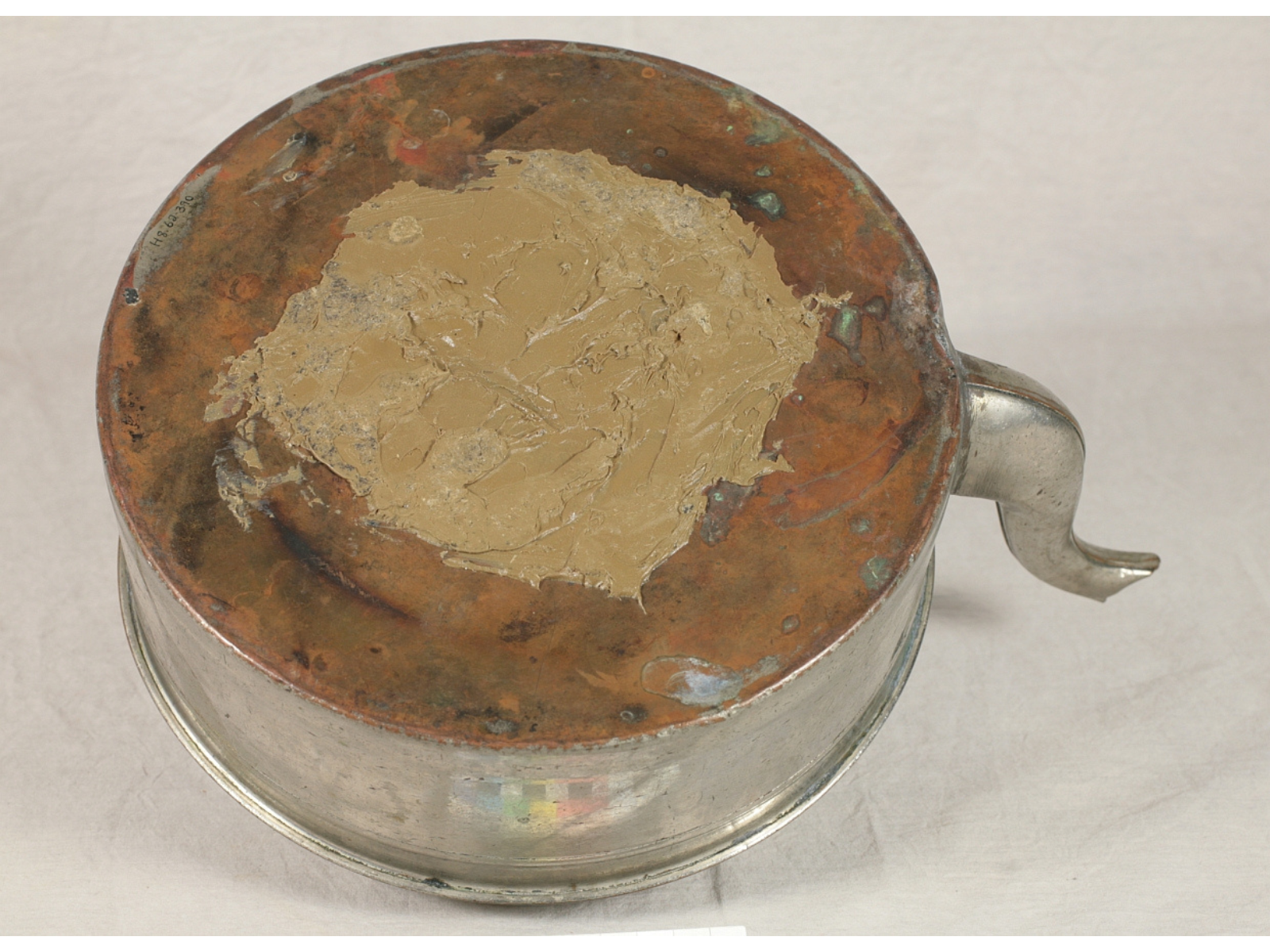
This month while working in The Sod House exhibit, we discovered some artifacts had a substance resembling adhesive on the bottom of them. After discussions with senior staff it was found that in the 1970s when the exhibit had originally been an open exhibit, not enclosed behind a Plexiglas door, artifacts were glued to surfaces to prevent them from being stolen. Obviously, this was an act executed long ago, possibly by a non-collections staff member, as we are all now aware this is not an appropriate method for securing or mounting artifacts in an exhibit. Conservation knowledge and theory have advanced and changed significantly since this exhibit was installed in the 1970s; we would not glue things down this way today.

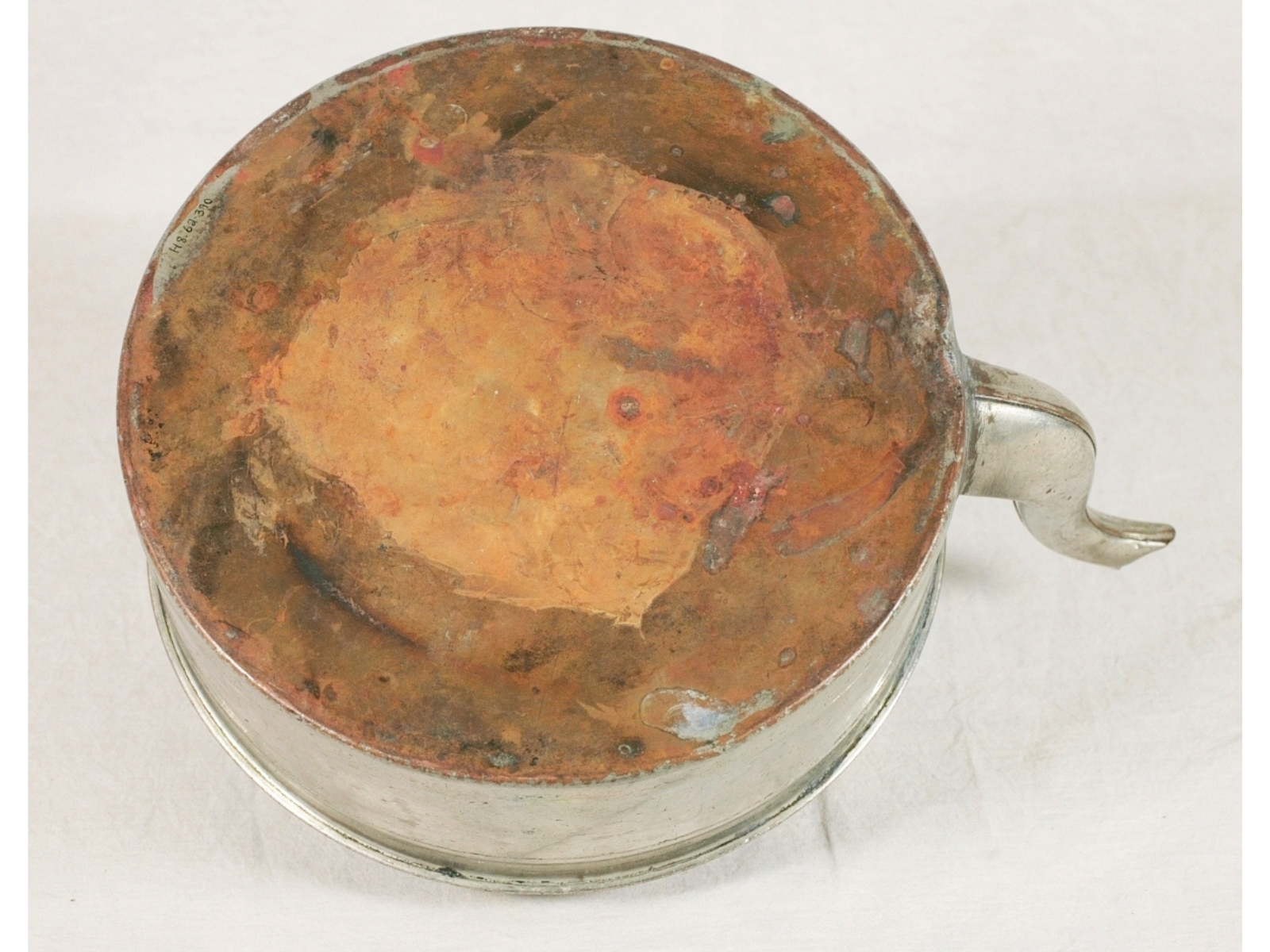
Next steps included removing the artifacts from the exhibit and taking them to the conservation lab and, after condition reporting and taking photographs, trying to remove the adhesive without damaging the artifacts. Luckily, as a significant amount of time had passed, the adhesive had dried out and lost its “sticky” properties and with a hammer and chisel (not what we usually consider cleaning tools in conservation), we were able to chip the adhesive off with no damage to the artifacts.

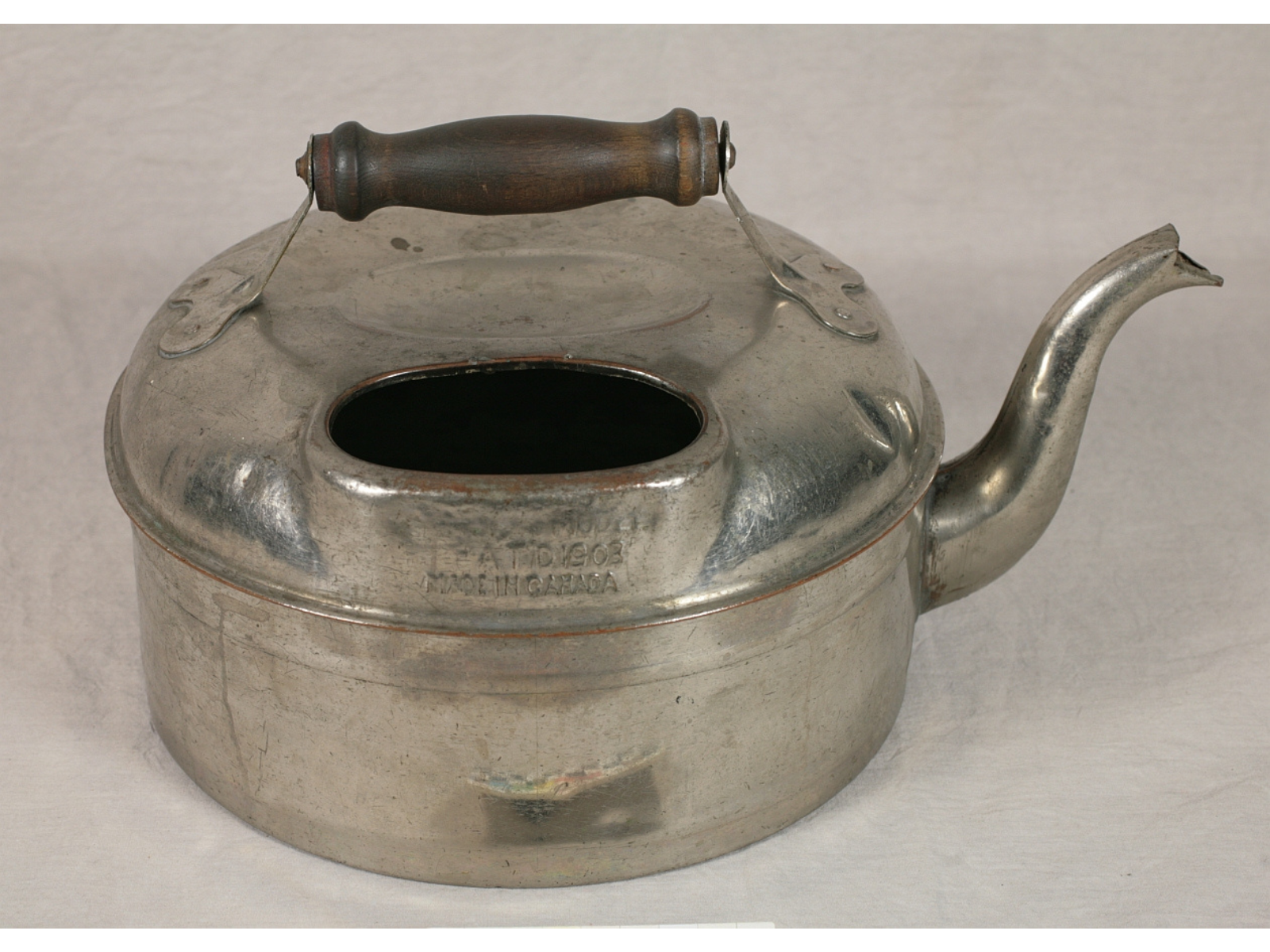
A large shiny silver kettle.

This kettle is one of the artifacts in the Sod Hut.

The bottom of a large silver kettle with the remains of a crusty brown adhesive around the bottom.

Bottom view shows the old adhesive.

The bottom of a large silver kettle with a stain on the bottom, but the remnants of the adhesives removed.

The old, hardened adhesive was removed successfully; the brighter area shows where it was.

The artifacts were then returned to exhibit and collections and conservation staff continue to perform inventory and maintenance in the galleries, hoping not to find too many other unwanted surprises!

From Acquisition to Exhibit – One Artifact’s Journey

By Kathy Nanowin, past Manager of Conservation


When the Museum receives an artifact or specimen, very often the donor asks or expects that the new acquisition will be put immediately on display. This, more than 90% of the time, is NOT the case. The reasons are various, but mostly it comes down to scarce resources – of staff, time, and money. It takes resources to process the new donation; it takes resources to prepare it for exhibit; it takes resources to plan and develop the exhibit. Having said all that, here is the tale of one object which went from initial acquisition to permanent display in less than a year.

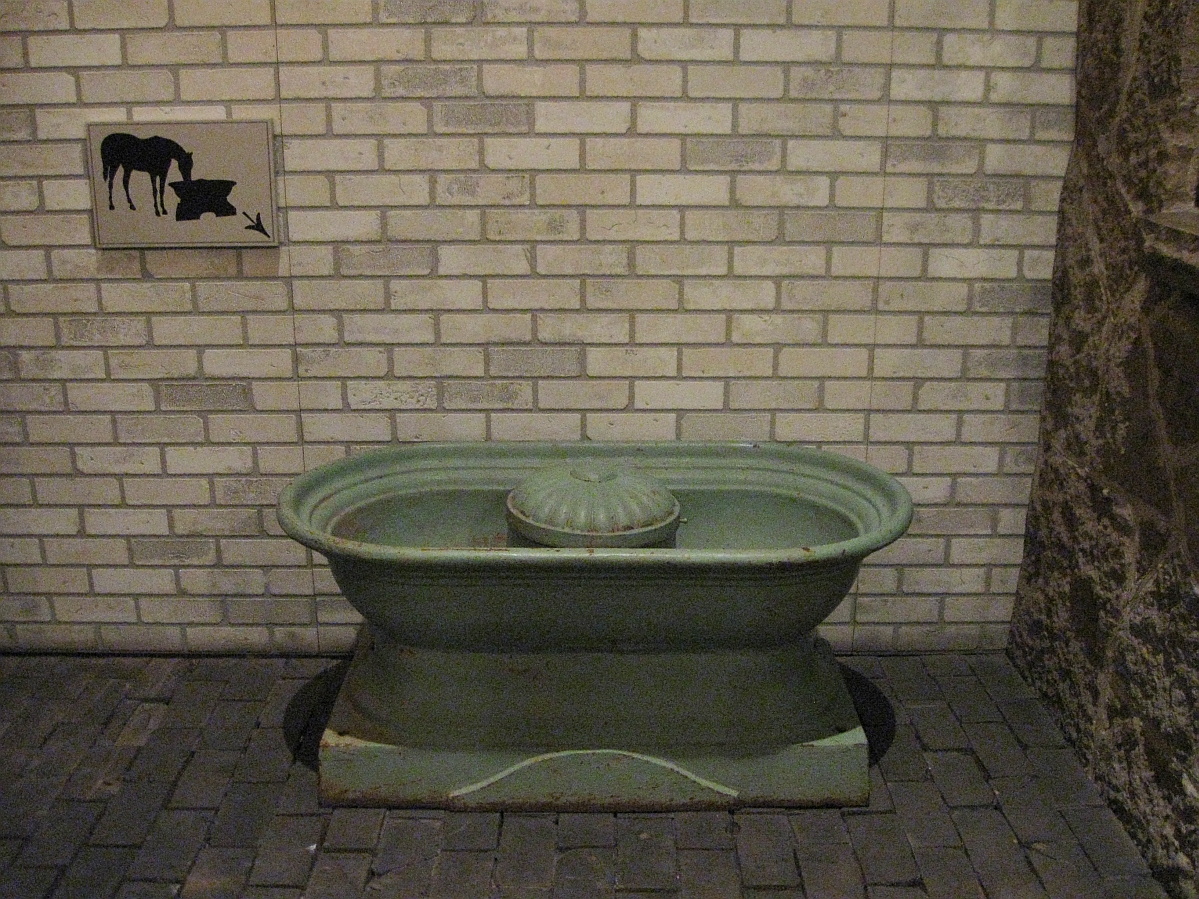
The artifact is a horse watering trough, which would have been a common sight in public spaces up until just over a century ago. TMM did not have anything like this in its collection, so it was approved for acquisition. Normally, once the collections management process is followed, it ends with the artifact or specimen being found a home in one of our storage areas; however, in this case, Curator of History Roland Sawatzky thought that there was an empty area in the Urban Gallery where the horse trough would naturally fit.

We have a formal Exhibit Procedure at the museum, so Roland followed this while the artifact was proceeding to be accessioned, catalogued, photographed, and condition reported. Ultimately, the idea was approved for this unique object to take its place in TMM’s permanent galleries.

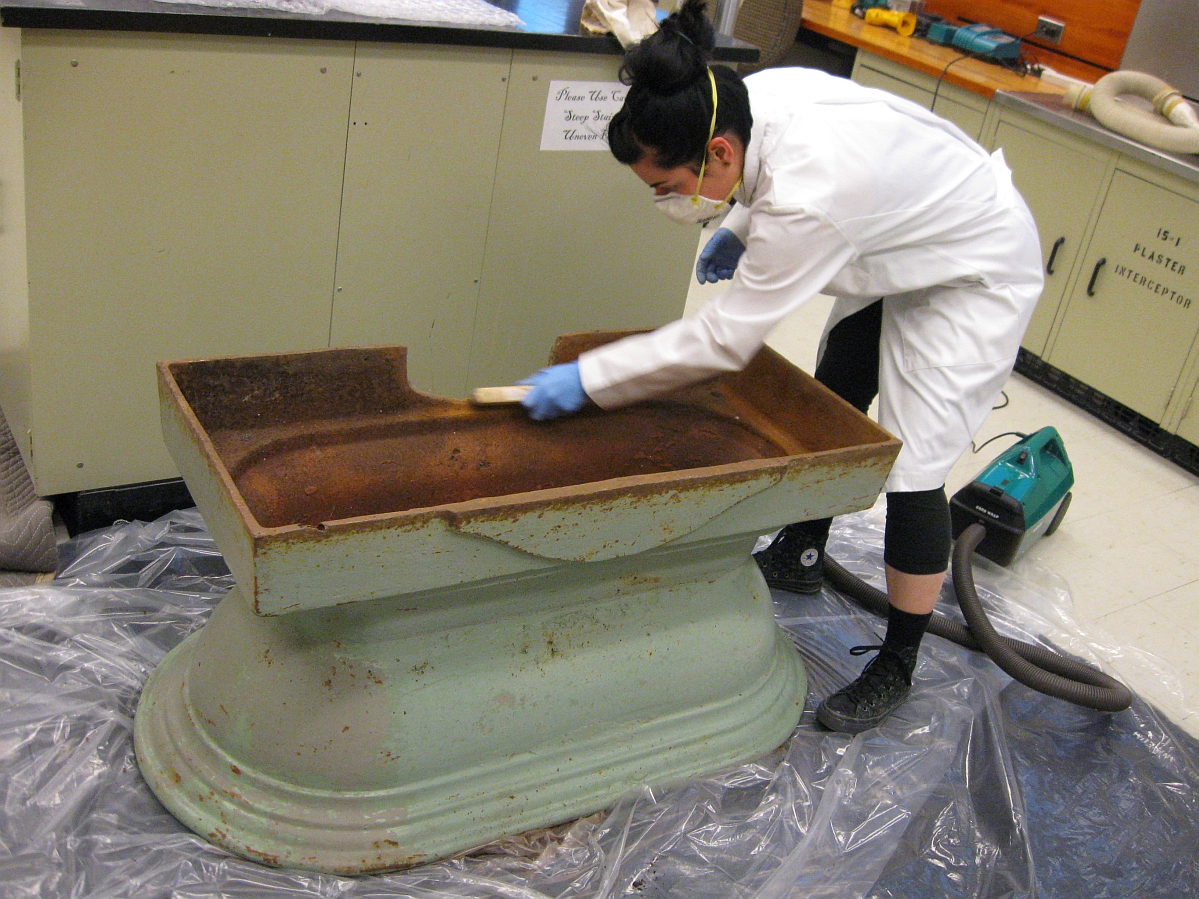
The horse watering trough is made of painted steel. It is quite stable, but did need some conservation treatment – a good cleaning – before it was at its best to be displayed.

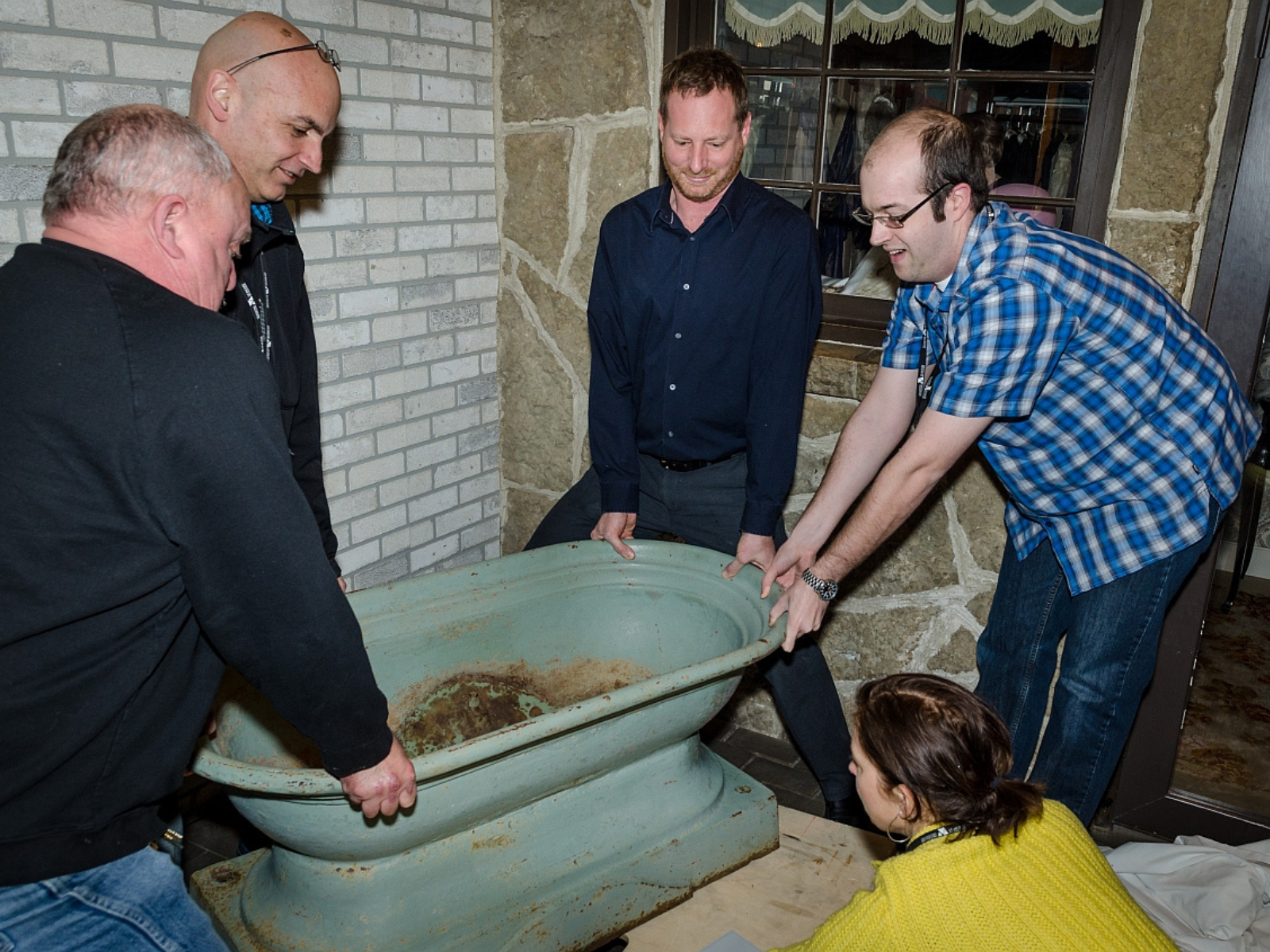
After the conservation treatment and documentation, the watering trough was brought down to the Urban Gallery on a Monday when we’re closed to the public, and placed in position against the wall between the Proscenium Theatre and Amy Galbraith’s Dress Shop. It took several sets of strong arms and legs to lift and lower it into position.

An individual wearing a white lab coat, face mask, and blue gloves uses a stiff brush to clean an upside-down water trough upturned on clear plastic.

Conservator Lisa May cleans trough with a wire brush.

Five individuals work together to move a large solid water trough in a museum gallery.

The heavy trough was lifted off a dolly and lowered into place

A water trough with a fountain-like piece in the centre, placed against a brick wall near a sign showing a horse drinking from a similar shaped trough, and an arrow pointing towards this one.

The horse watering trough in the gallery.

Again, I have to emphasize that this is a rare case, when a newly acquired object goes on long-term display shortly after it arrives at The Manitoba Museum (yes, eleven months is relatively short in the museum world). In this instance, the artifact fills a gap in the gallery space, and helps tell a story we weren’t telling before – a reminder that horses used to be ubiquitous in the city, before motorized vehicles became common. The next time you visit the Museum, be sure to check it out!

Artifacts in Strange Places

By Kathy Nanowin, past Manager of Conservation


Recently, Collections and Conservation staff spent some time in two of our more unusual storage locations, in order to improve the conditions of artifacts there.

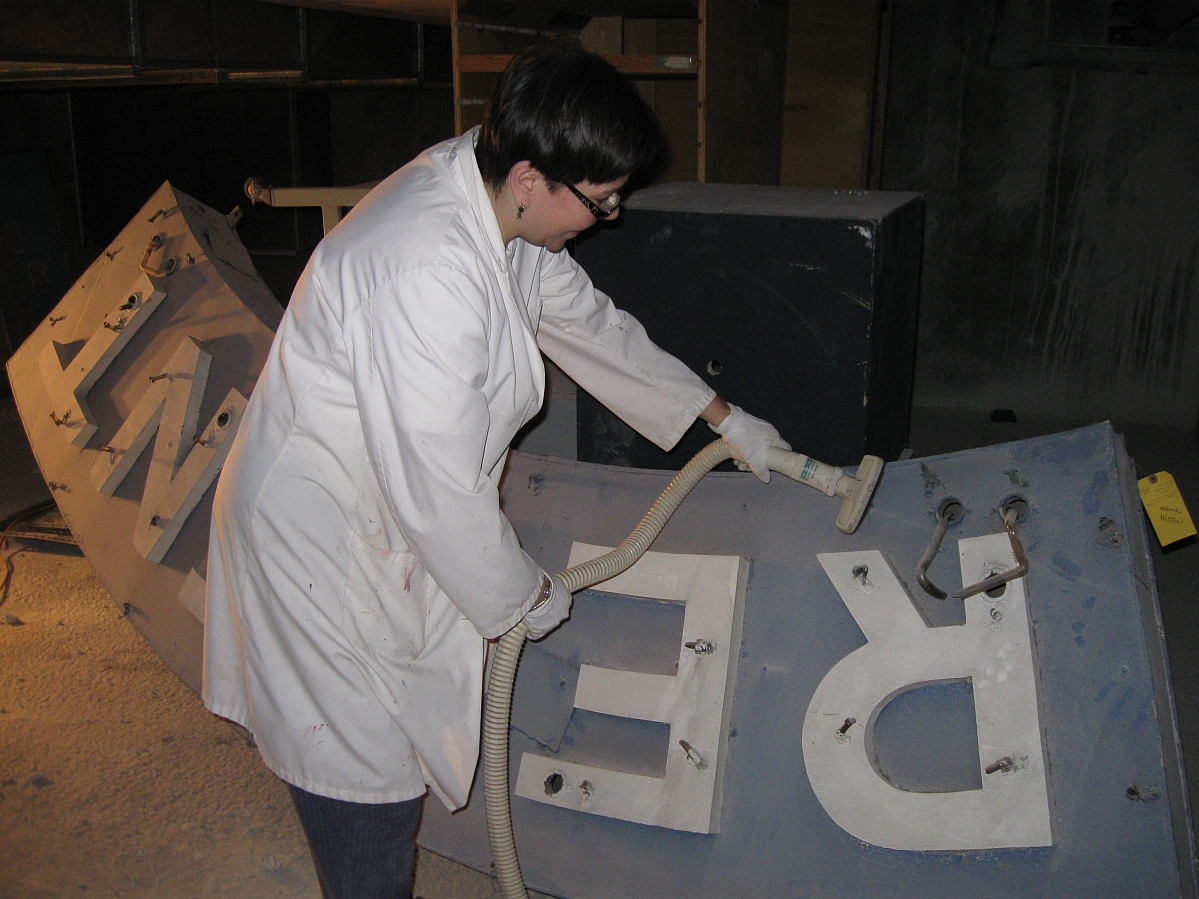
Due to overcrowding in TMM’s climate-controlled collection storage areas, there are artifacts located in less than ideal conditions. Staff worked on several artifacts in these areas, cataloguing, condition reporting, photographing, and finally covering them up with polyethylene after a good vacuuming.

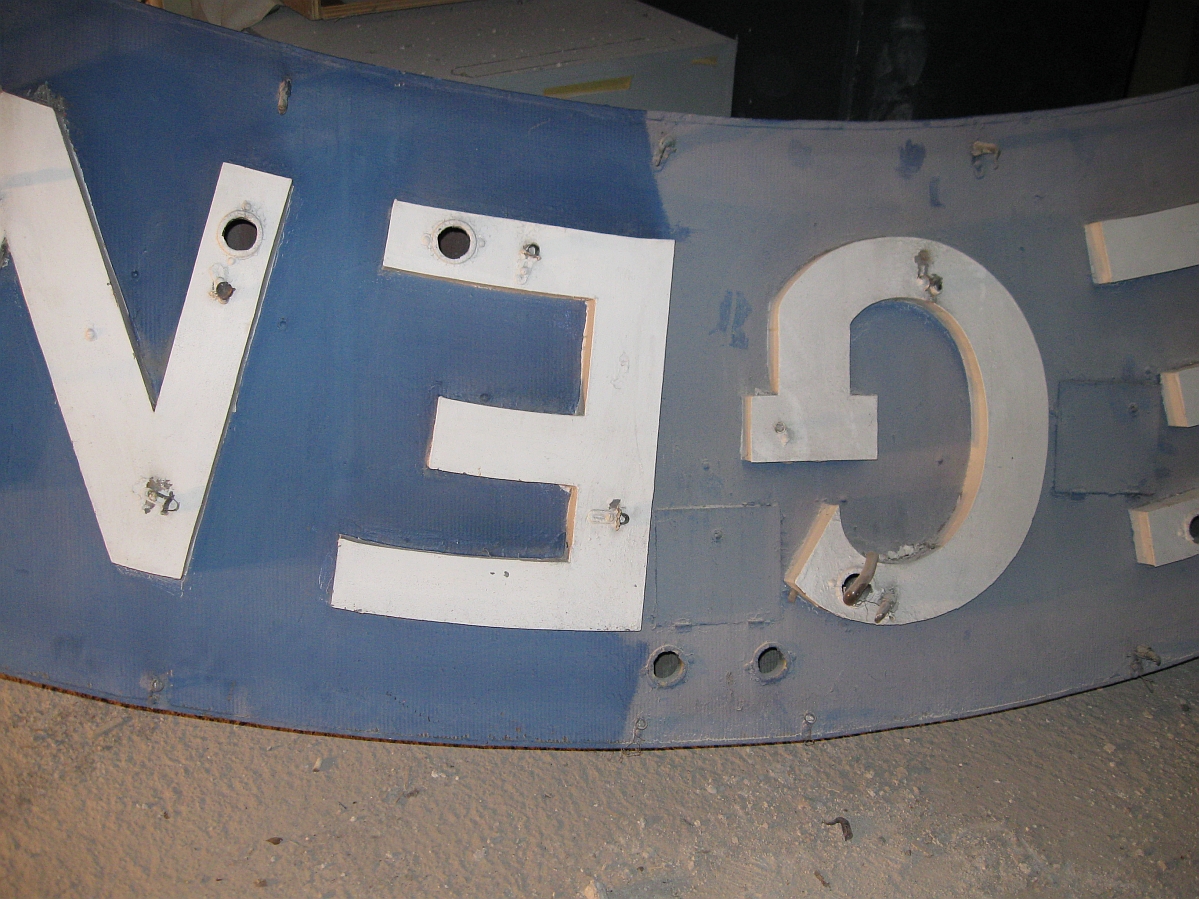
An individual wearing a white lab coat holding the hose and nozzle of a vacuum cleaner to a large dusty sign.

This large neon sign was vacuumed before being covered with polyethylene.

A portion of a large sign, half vacuumed. One half is very dimmed with dust, the other is clean and blue with white lettering.

There was a lot of dust to be removed.

The most important factors in deciding to place these objects here are the materials of which they are made (least sensitive to environmental changes or extremes), robustness of the artifacts, and their size – sometimes there just isn’t room in the other storage areas.

The Manitoba Museum is not unique in having to store collection objects in areas where there is little climate control. It is, of course, incumbent upon us to do the best we can in these kinds of spaces. Although covering the objects with plastic does reduce visibility, and hence the ability to spot detrimental changes in condition such as corrosion, that is offset by the protection against dust, which can be damaging in some cases, as well as disfiguring. Having observed the conditions in these spaces, we know the risk of dust falling on the objects is certain, whereas we’ve not encountered the high humidity that would initiate rust.

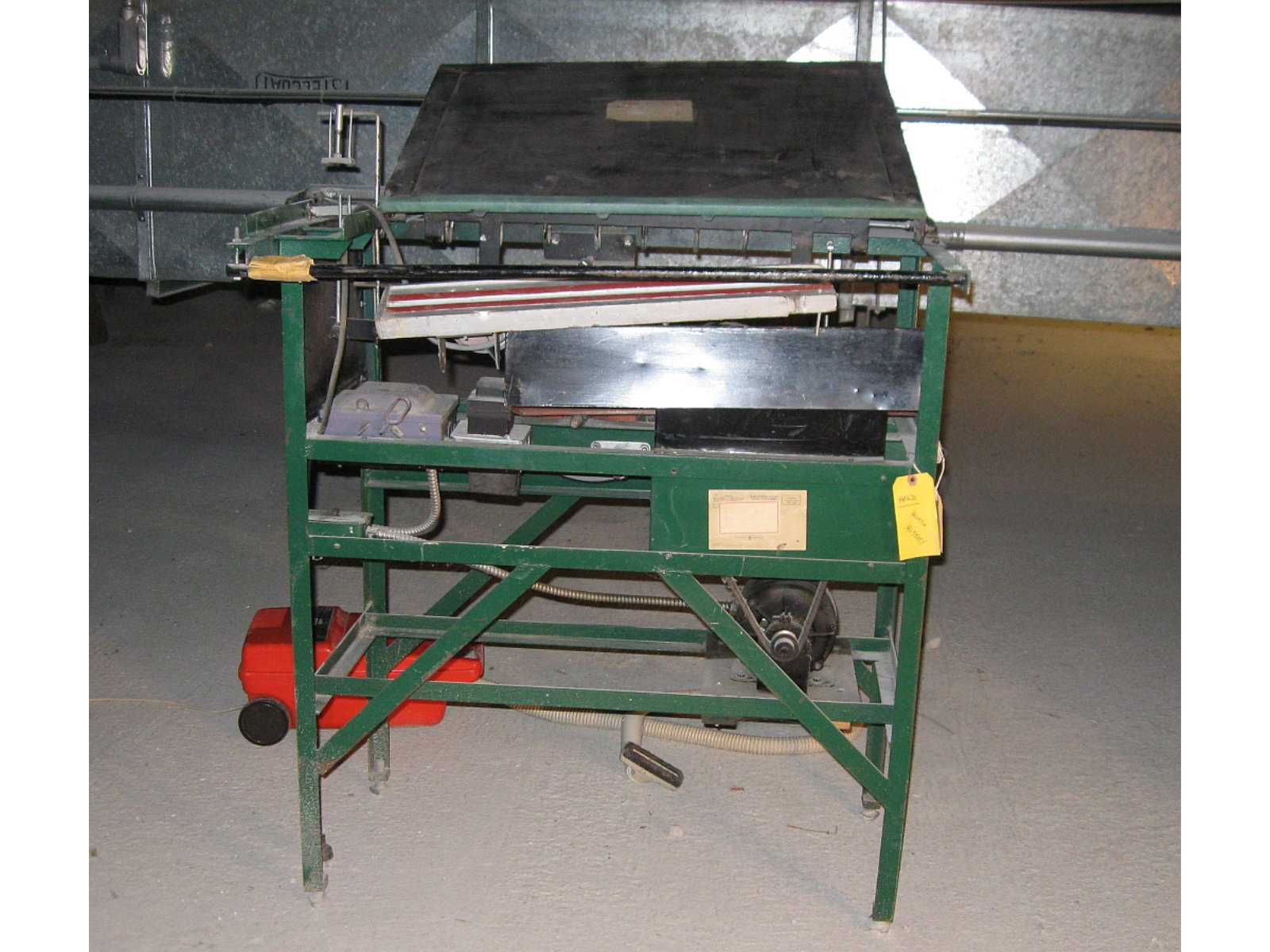
A large metal egg grader next to an orange vacuum cleaner.

This egg grader is large and robust, suitable for storage in less stringent conditions.

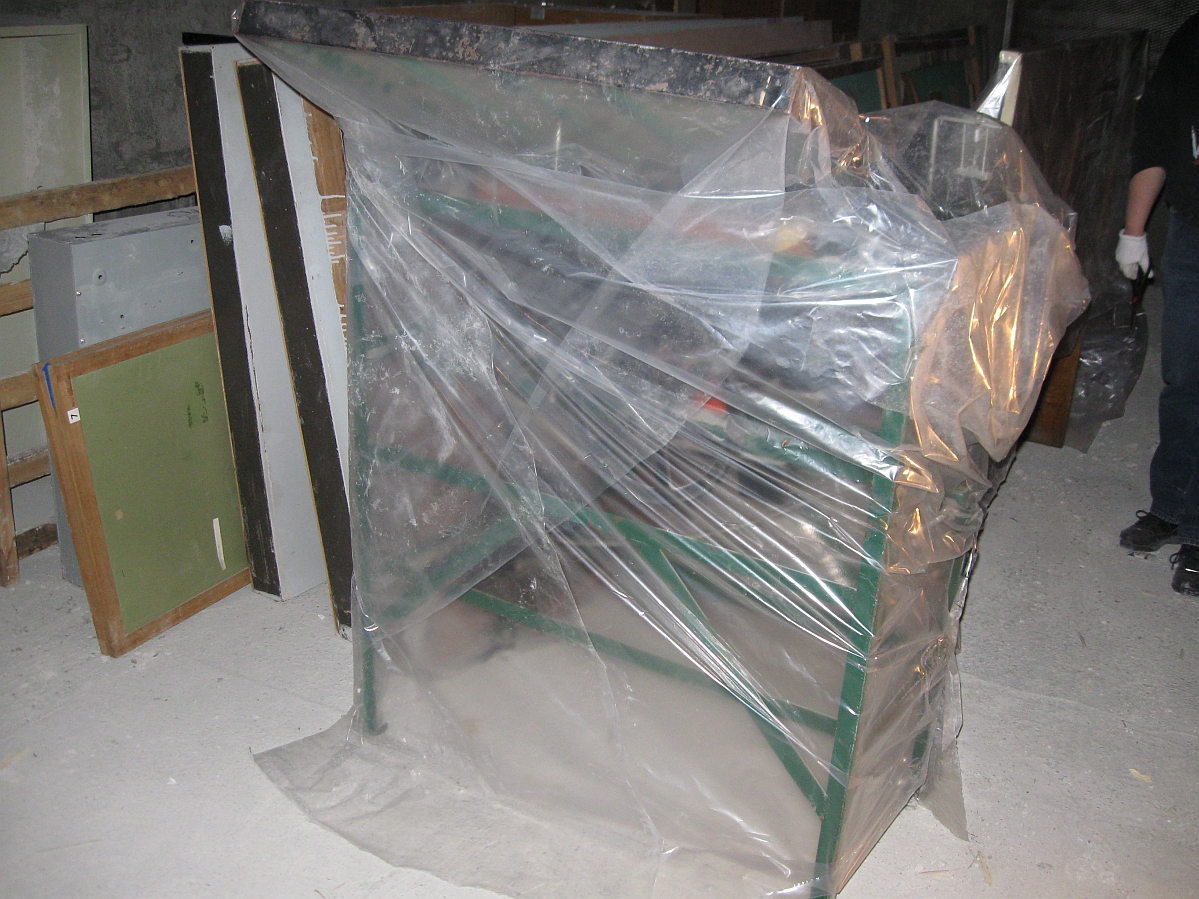
The metal egg grader now tightly wrapped in clear polysthylene.

The egg grader was vacuumed then wrapped in polyethylene.

We always strive to improve the care of our collections wherever we can. All in all, although these storage spaces are not great, the artifacts are now better protected, as well as better documented.

Adventures of a Conservator in Training

By Jessica VanOostwaard, Conservation Intern

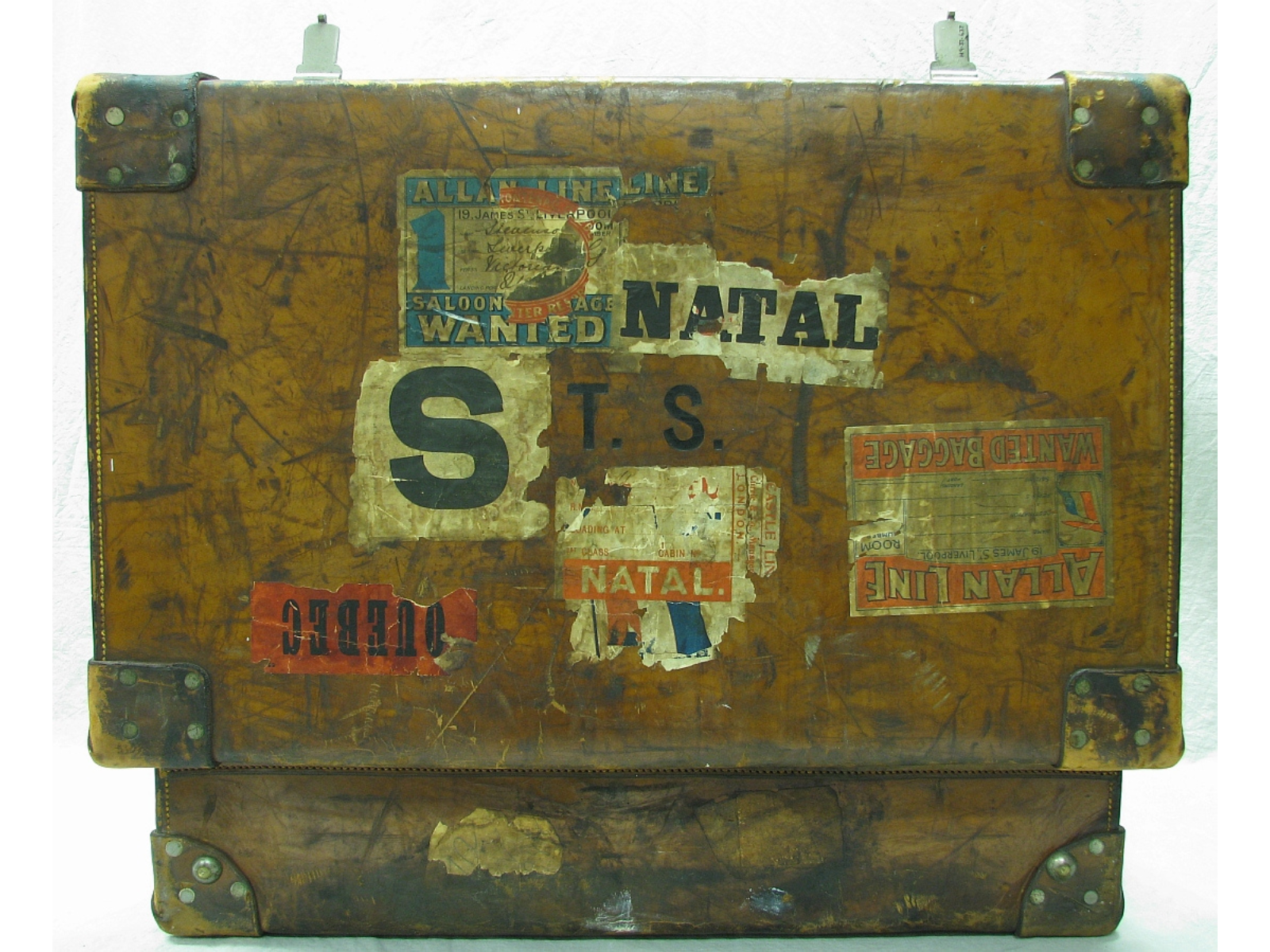
An aged open trunk or large suitcase with the open lid facing the camera. Various worn stickers and labels are peeling around the lid.

As a requirement for the Collections Conservation and Management program at Fleming College in Peterborough Ontario, all students are required to participate in a 15 week internship at an institution of their choice. I was elated to learn that my request to carry out my internship at The Manitoba Museum was accepted. In September I arrived in Winnipeg eager to learn, and The Manitoba Museum did not disappoint.

During my time at the Museum I was able to put my knowledge to work and carried out a number of treatments on some very interesting artifacts in addition to helping collections personnel with gallery maintenance.


Image: The labels on this travelling case were falling off; now, they are secure

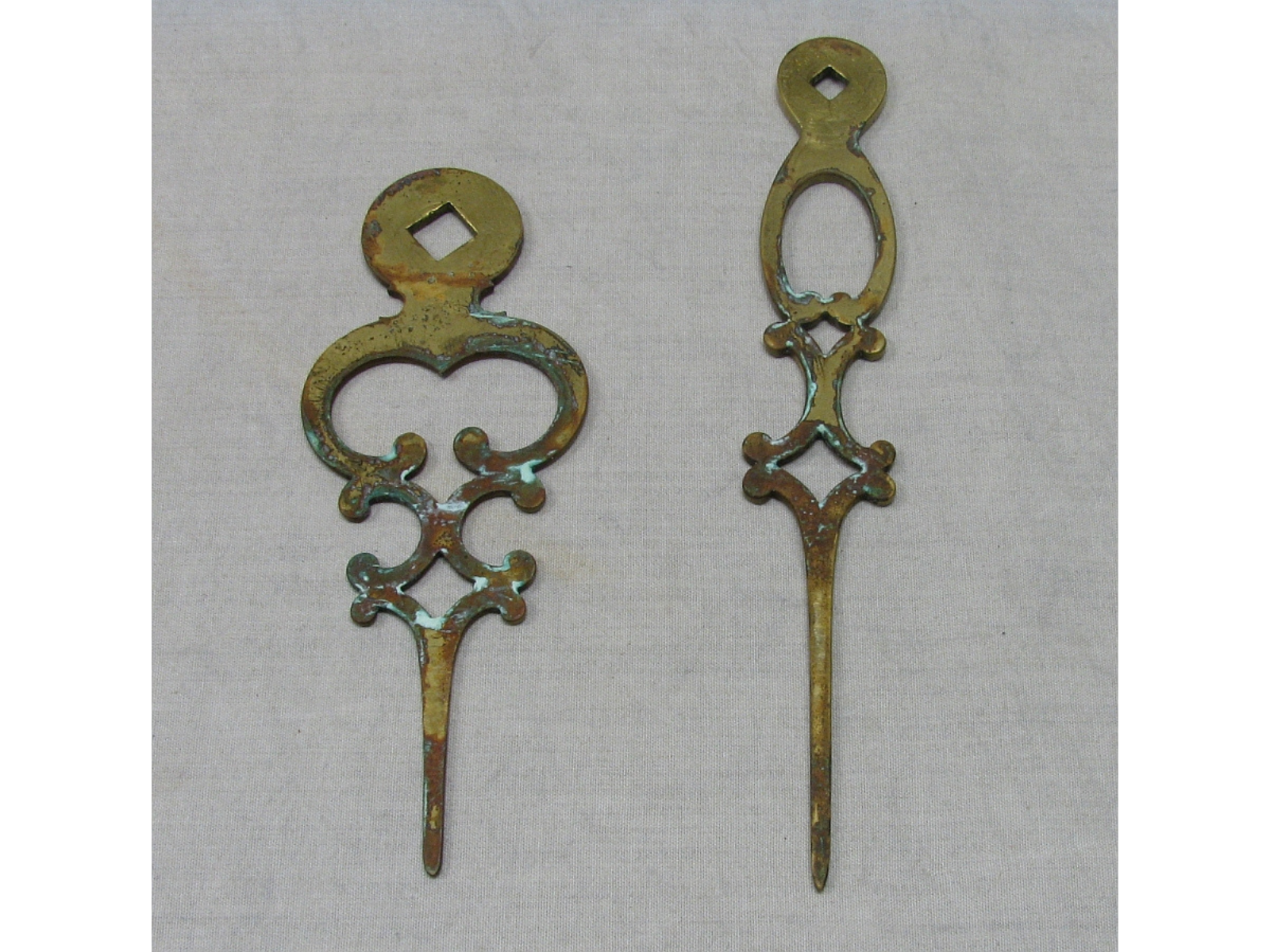
Two corroding brass clock hands (removed from the clock).

Corrosion plagued these brass clock hands.

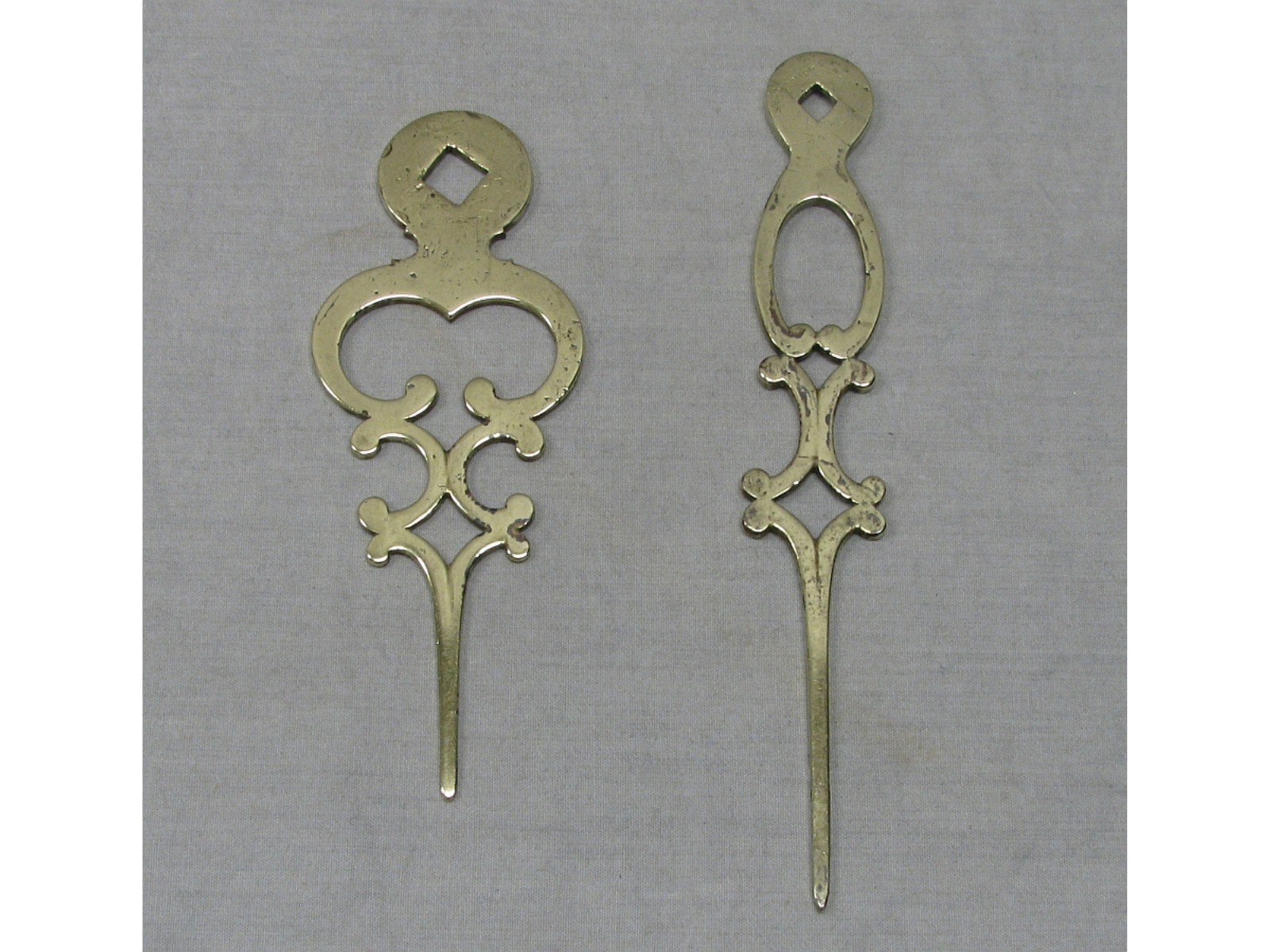
Two shiney brass clock hands (removed from the clock).

With some care, they are as good as new.

My time at the museum was not only spent treating the artifacts in the museum’s collection but also helping out with other collection work that needed to be done. Whether it was making mounts for “The World is their Oyster: Marvelous Molluscs” exhibit, venturing down into the secluded sub-basement to help organize Archaeology storage boxes or protecting the artifacts by making boxes and monitoring for pesky insects, The Manitoba Museum provided me with useful experience that will be invaluable in my future career, and for that I would like to thank everyone at the Museum for a wonderful opportunity.

Department Staff Ramp up Gallery Work

By Kathy Nanowin, past Manager of Conservation


The Collections and Conservation Department conducts ongoing maintenance and inventory activities in the Museum Galleries. Most of this work is done during our winter season, when the Museum is closed on Mondays. Recently, we changed our procedures, amalgamating tasks that formerly were done separately.

Now, when working on an exhibit area, all collections management and conservation tasks are completed at the same time: condition checks, cleaning, photography, cataloguing, and inventory checks. This involves preparatory work: searching the collections database to determine whether any new cataloguing or condition reports are needed; assigning catalogue numbers to objects which previously had none; ensuring that any loan objects have up to date paperwork.

Once in the galleries, the actual cleaning, photographing, and application of catalogue numbers takes place.

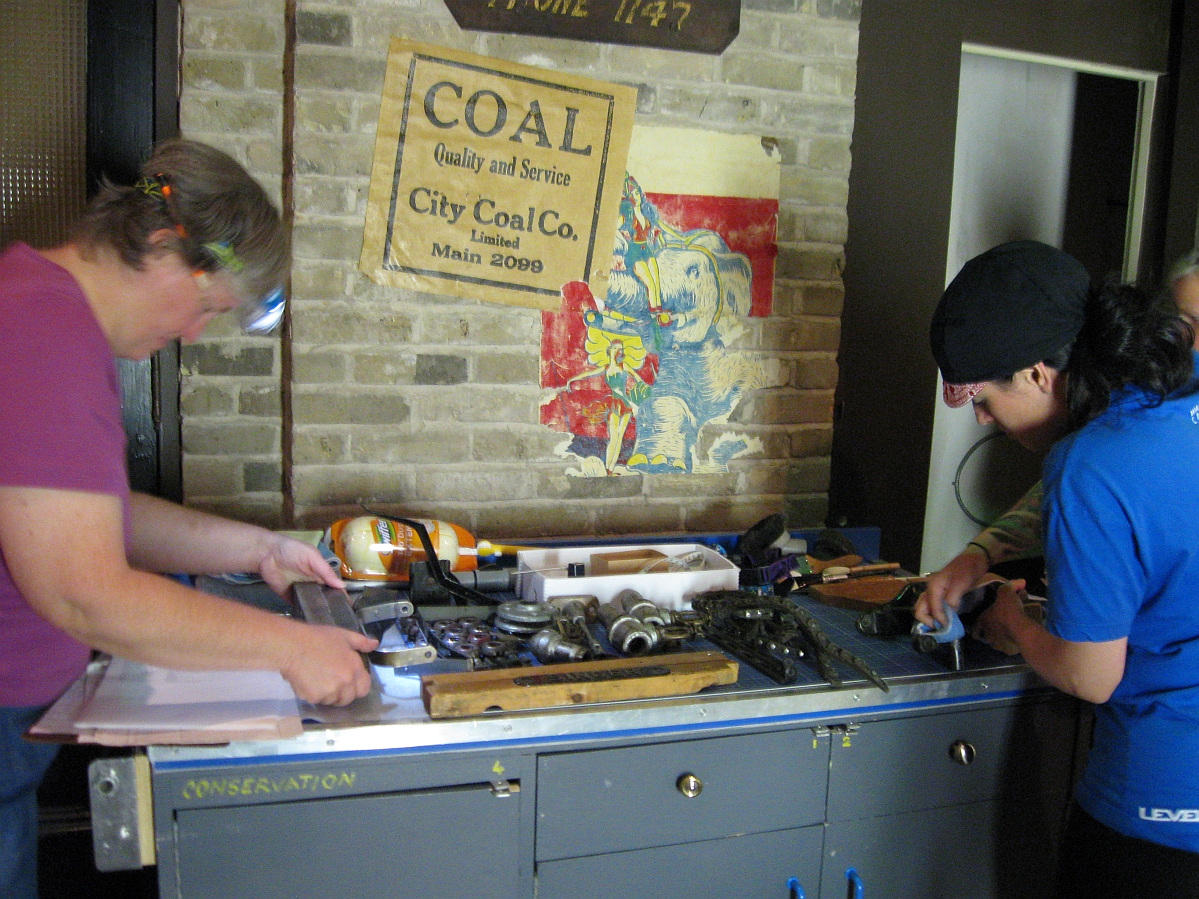
Three staff members standing around a work bench on wheels, checking on artifacts.

Department staff checking and cleaning objects in Urban Gallery.

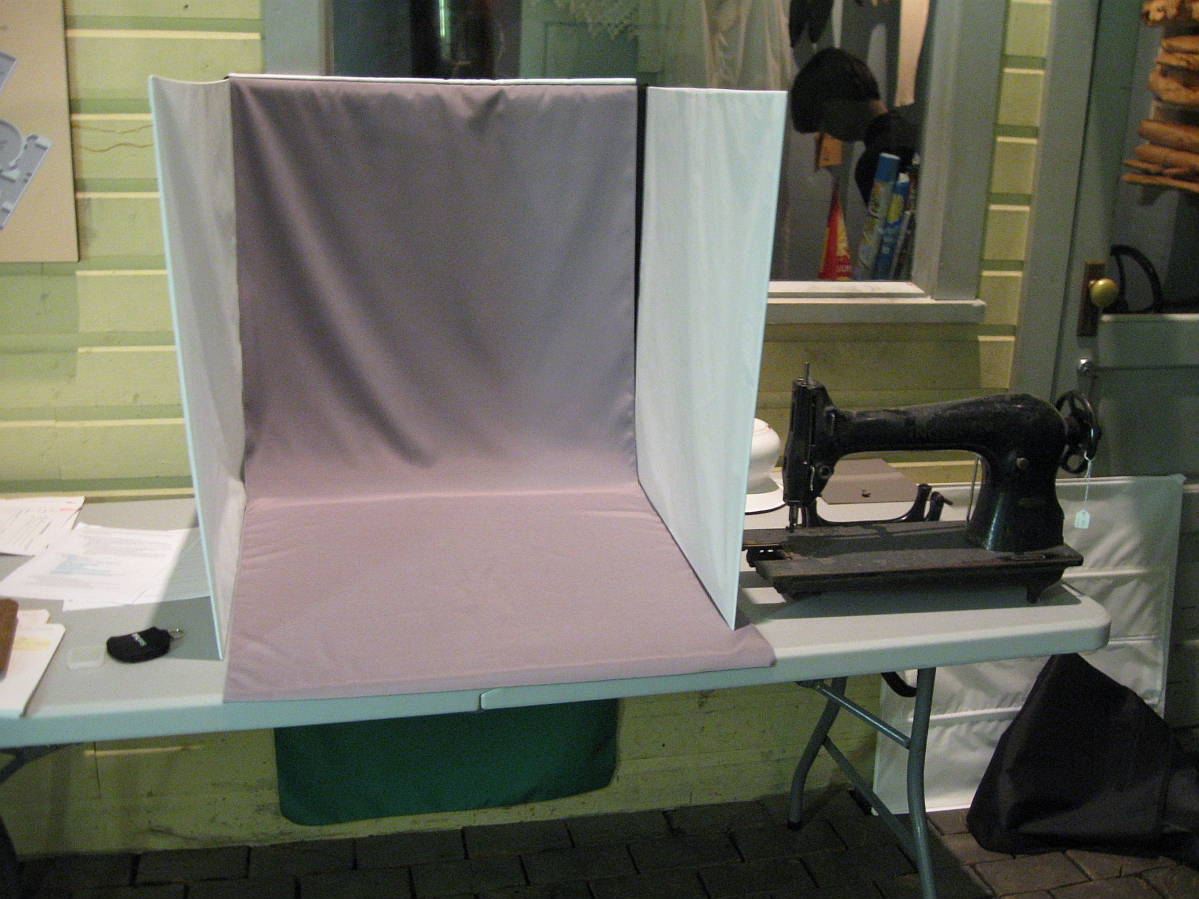
A shadow box set up on a table with a strip of light purple-grey cloth draped along the base and backside. Beside it on the table sits an old fashioned sewing machine.

A box is set up on a work table to photograph artifacts.

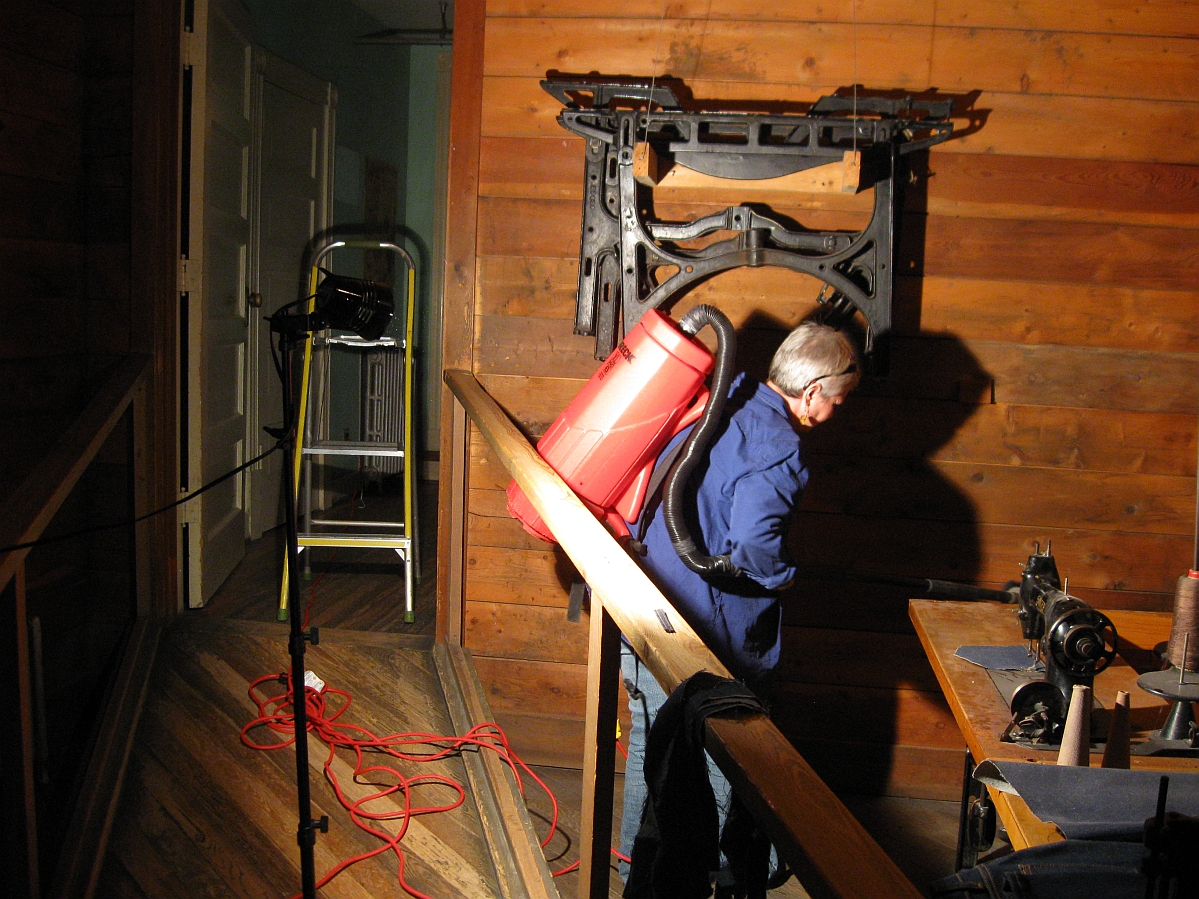
An individual wearing a red backpack vacuum cleaning artifacts and the space in the Winnipeg 1920 Cityscape.

Vacuuming in the Garment Factory Sewing Room, Urban Gallery

As with other aspects of collections management (see blog entry “Door to Door: a collecting trip” here), sometimes the bulk of the work happens after what you see us do. In the case of gallery work, more time is often spent in the entry of new catalogue records, entry or update of condition reports, review and saving of digital images, edits or updates of location records.

Our department is focusing on ensuring we have accurate up to date database records for artifacts and specimens in the galleries. It is becoming more urgent as The Manitoba Museum plans for significant gallery changes in the next few years. Any object moves should go smoothly if our records are all perfect. But it is daunting, as we have nine permanent galleries with over 4000 artifacts and specimens on exhibit. We have just begun implementing our new process, and will continue to work at adding to, updating, and perfecting our collection records, concentrating on objects in the galleries.

How to Disassemble an Artifact

Recently, conservator Lisa May worked with the Museum’s Operational Services staff to smoothly disassemble an artifact so it could be moved out of a basement storage area. The artifact is a display case that came from a prominent Winnipeg business, Winnipeg Music Supply, which closed in 1984, at which time the display case was donated to the Manitoba Museum.

It was stored for many years at the Museum’s storage building on Lily St., in a basement room. In 2010, a pipe break and subsequent water infiltration led to the decision to remove all artifacts stored at basement level, due to concerns of a major mould outbreak (See blog post “Lily St. Storage Move”, Sept. 3, 2010). Every other artifact was removed from the basement, but this display case was too big and heavy to take out as it was. Finally, last month it was taken apart; and last week, it was hoisted up onto the main floor of the storage building.

Taking the case apart was no simple operation. Lisa and carpenter Marc Hébert spent considerable time examining the case to see how it was put together. Lisa drew a diagram indicating which areas should be worked on first, noting things to check as they went along.

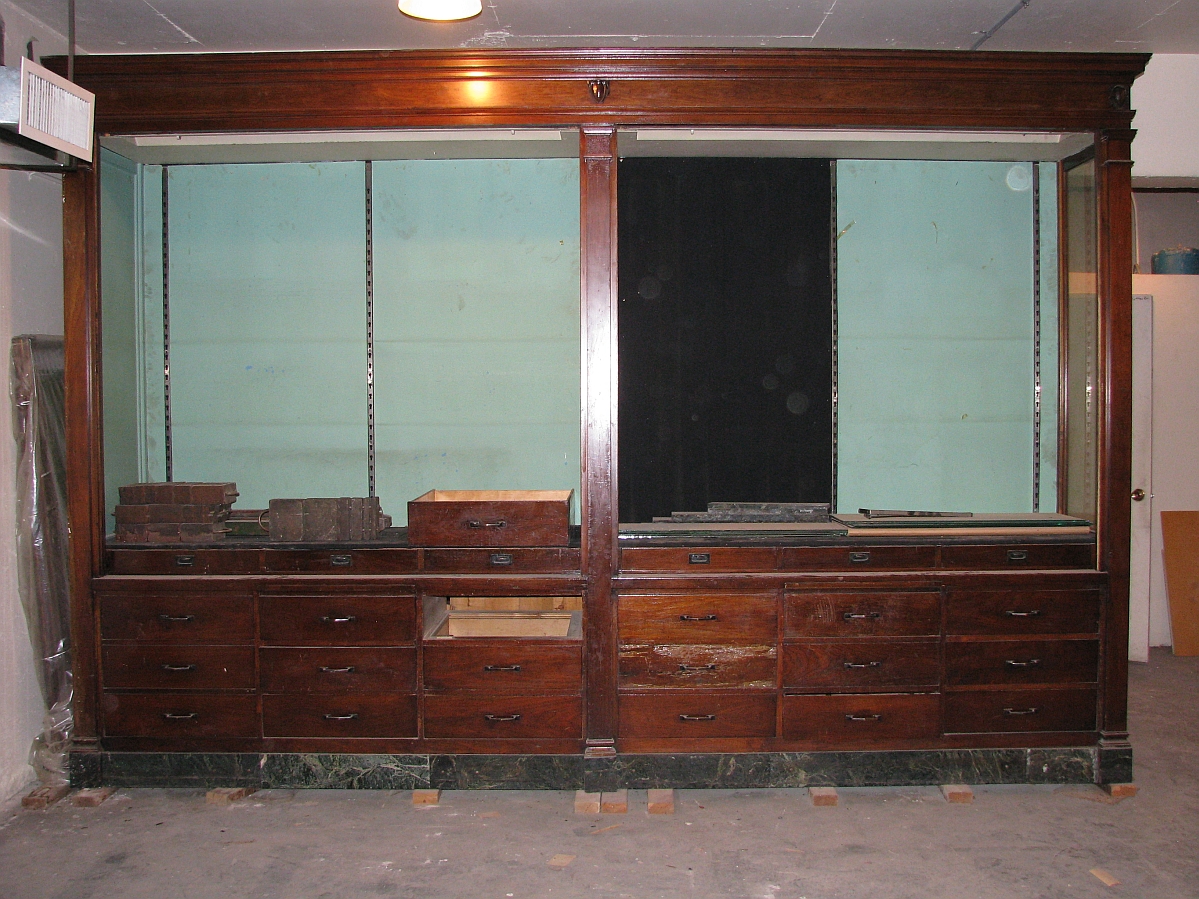
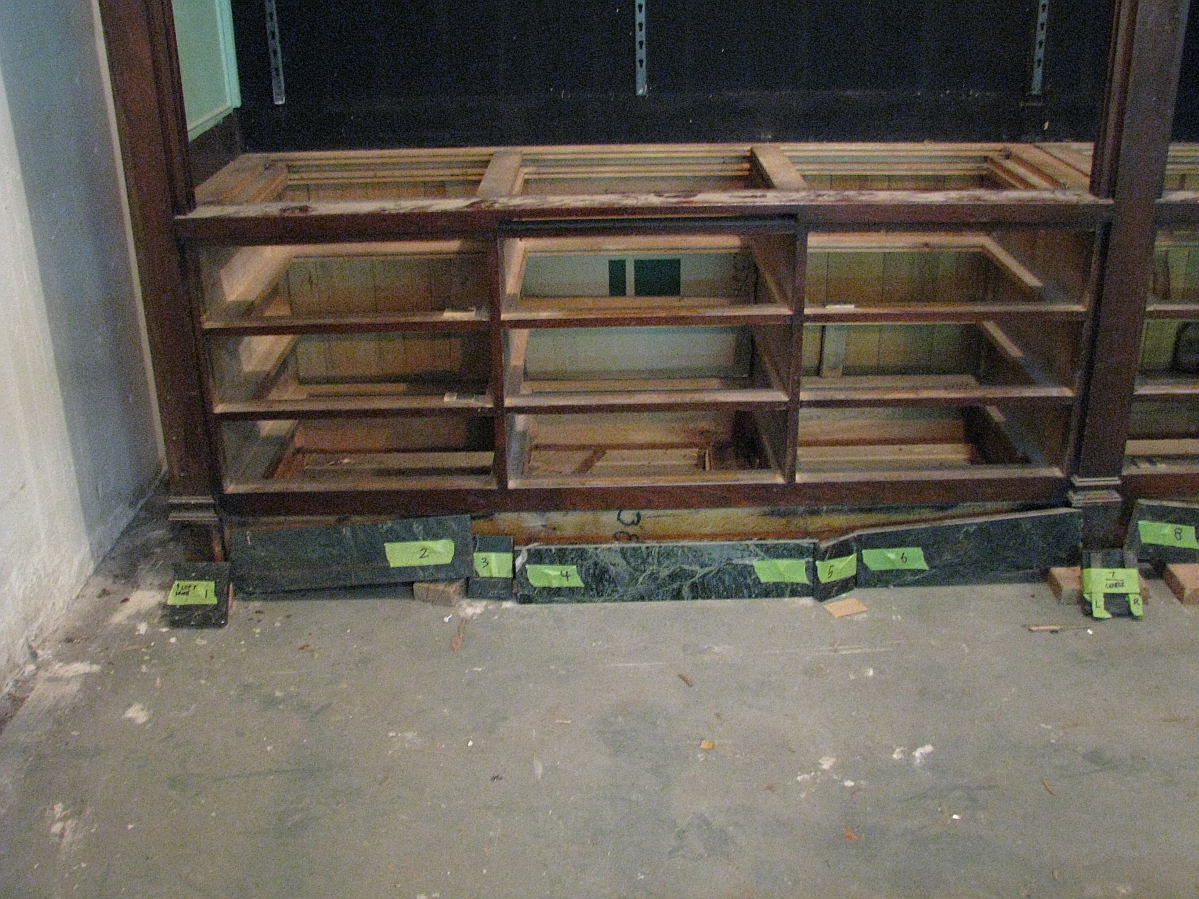
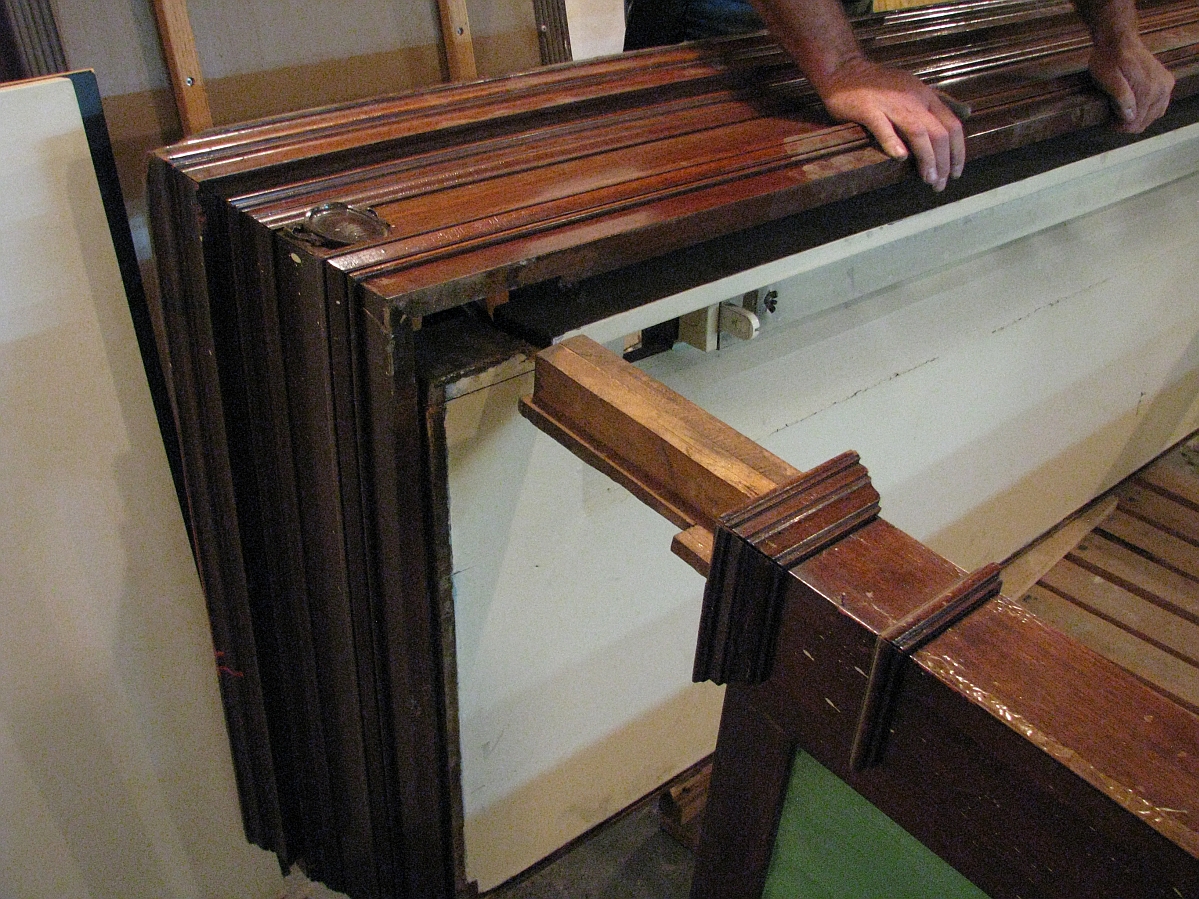
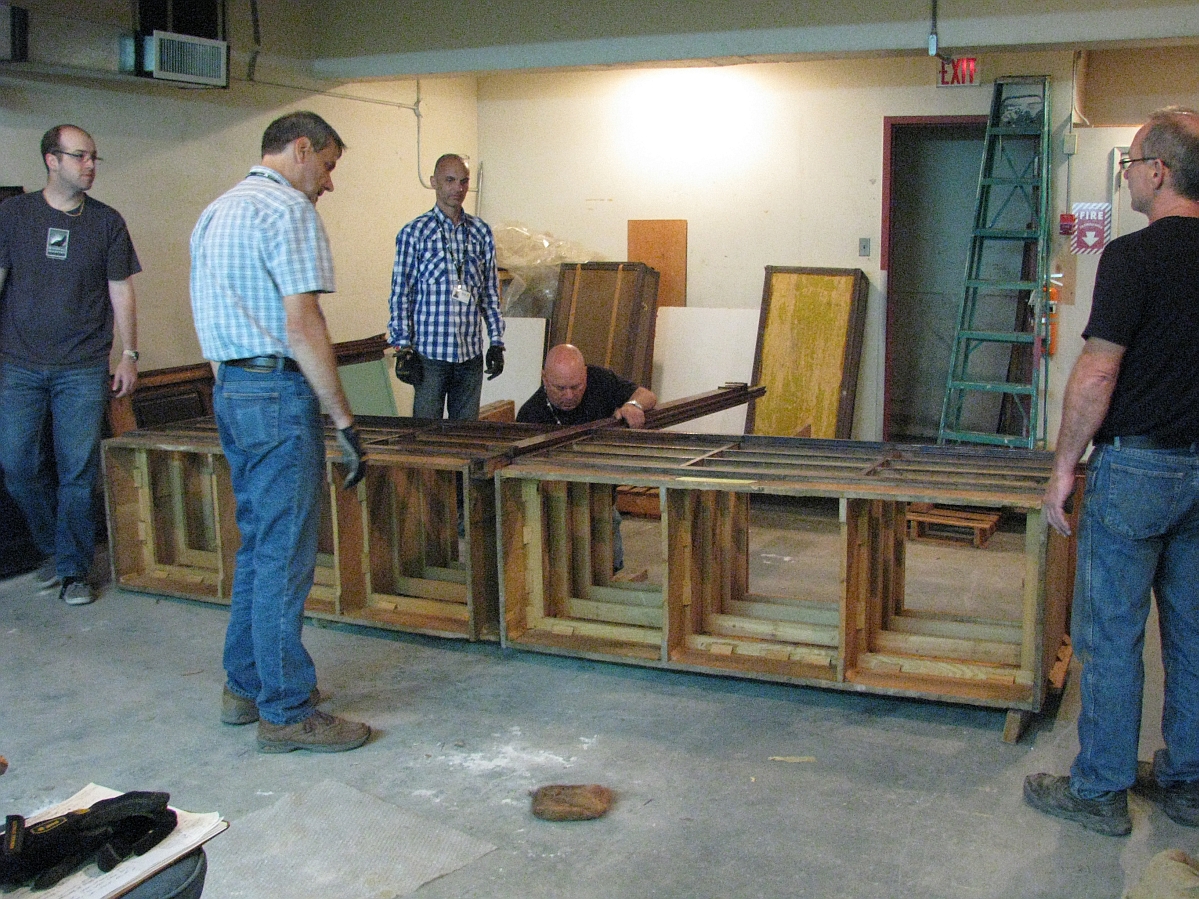
First of all, the drawers and all separate pieces were removed. Then the interior display surface was removed, and next the marble trim from the bottom. The pieces were all numbered for ease of reassembly. Then the back was taken off, and the case lowered onto its back side. The top was carefully pulled off. After that, the sides came apart quite easily, and finally the two halves were separated from the centre column.

A large display case with drawers along the bottom portion and two large openings on the top.

Display case before beginning disassembly.

The drawer cavities of a large display case with the drawers removed..

The marble trim was labeled for identification.

A large display case with its top being removed from the side posts.

The top, all one piece, was carefully pulled off.

Five individuals standing around the frame of a large display case laying on its side on the ground.

Removing the centre column.

The pieces were lifted to the main level of the building using a hoist, and now sit waiting, with all the other artifacts, for the time when they will be moved into a different storage facility – for this building will be demolished to make way for a much-needed multilevel parkade.

Although a relatively small project, it required careful planning and many hands (and backs!) to accomplish without damaging the artifact. Our Operational Services staff are professional and experienced, but not conservators, so Lisa’s input and guidance was required. Everything went well, and we look forward to the day (coming soon, we think) when this case will be moved into an improved storage environment.

Door to Door – A Collecting Trip

By Kathy Nanowin, past Manager of Conservation

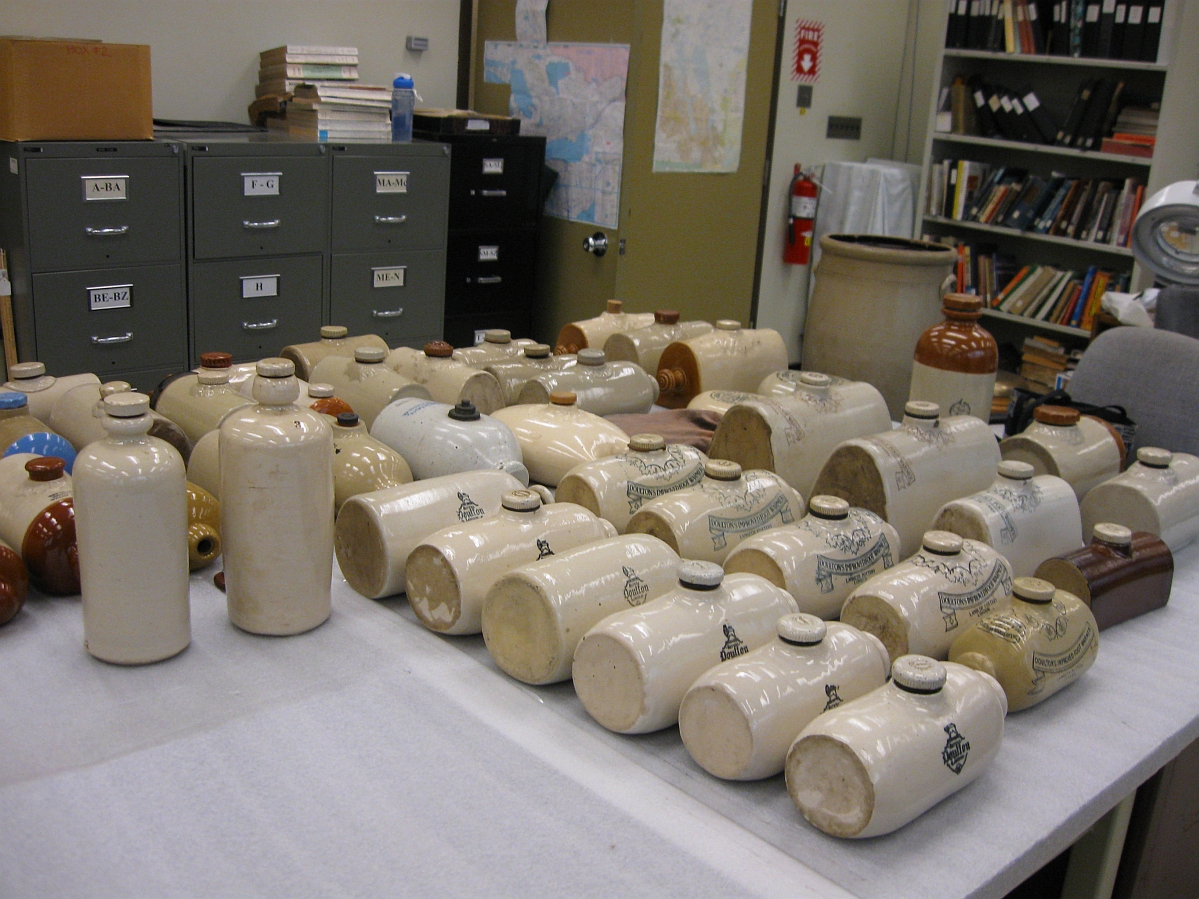
The Manitoba Museum recently acquired a number of objects that add to an existing collection. The Wilson family collection of bottles and crocks is an extensive one, with over 1600 artifacts. The Wilsons contacted the Museum with an offer to donate a related collection of ceramic footwarmers and various Medalta ware. Curator Roland Sawatzky recommended we accept the offered items; the subject went to our Collection Committee, which approved it on the curator’s recommendation. Follow us now through the process of preparing for and completing the acquisition.

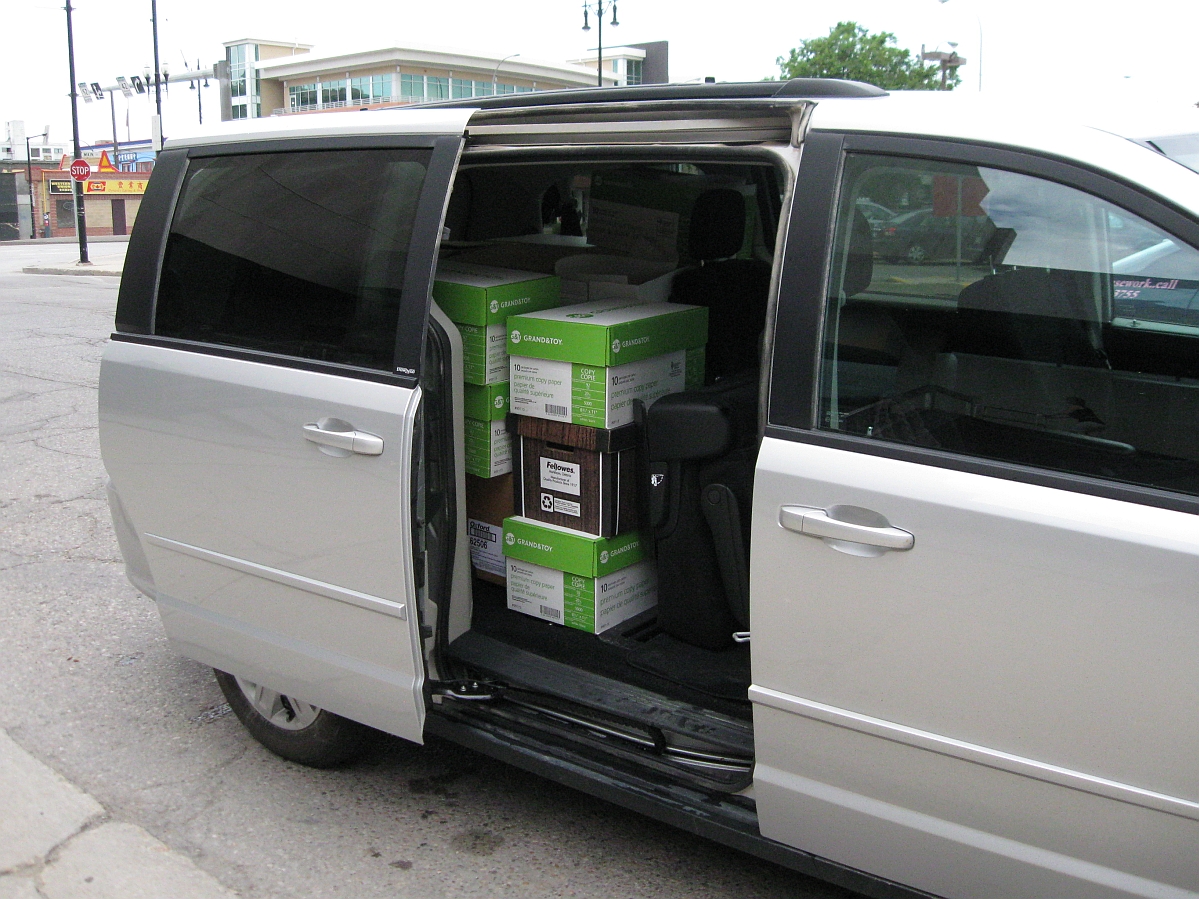
Photo of a mini van with the side door open, and file storage boxes stacked in the back of the van.

Preparation


We had been provided a list of items. Knowing the number was roughly 150, with 49 of those being ceramic footwarmers, I collected 35 “Banker’s box” size boxes. An intern, Megan Narvey, cut pieces of foam for packing and placed them in every box. She also cut up some extra bubble wrap for packing.

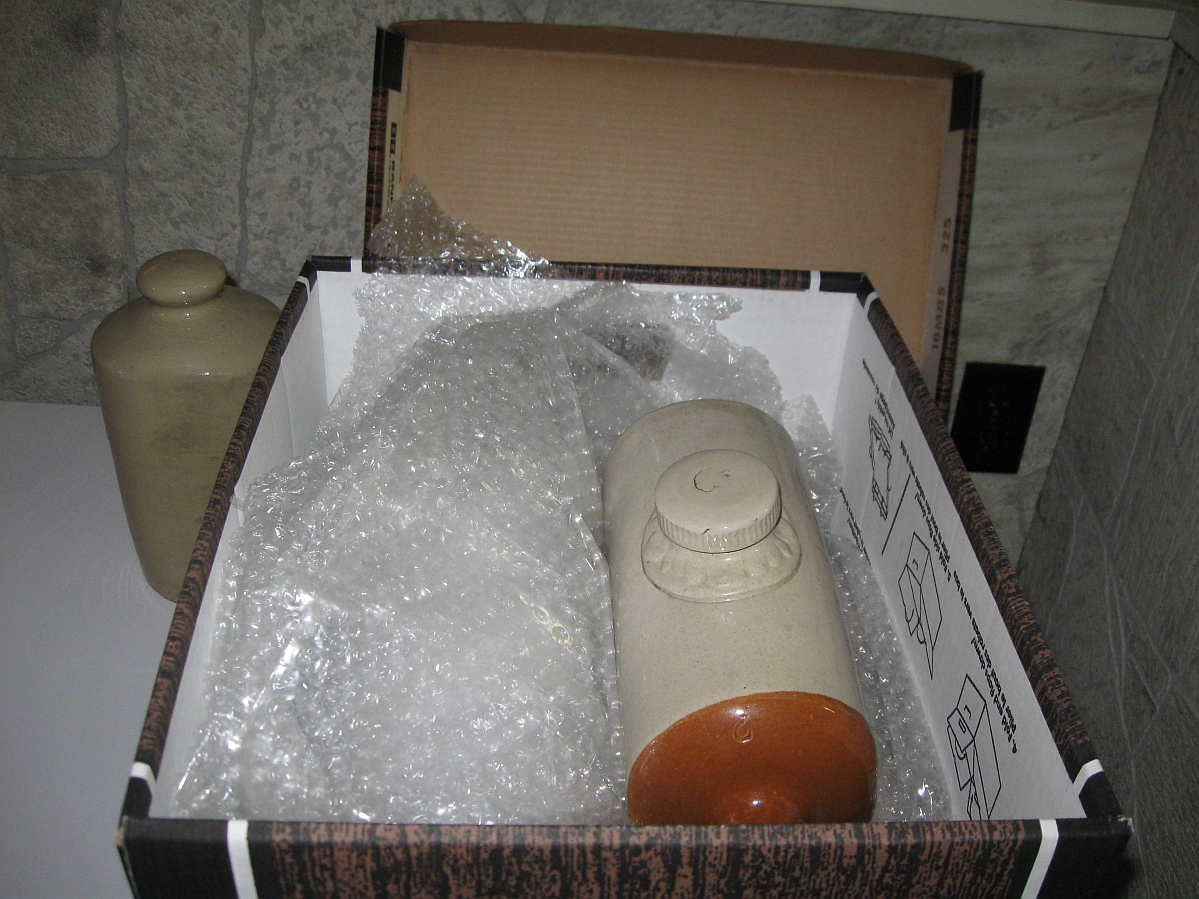
Two ceramic footwarmers wrapped in bubble wraps in a box.

Pickup

Three people were involved in the pickup: Curator Andrea Dyck (Contemporary Cultures and Immigration), acting for Roland, who was undertaking fieldwork; Nancy Anderson, Collections Assistant, Human History; and Megan Narvey, Collections and Conservation intern. We rented a minivan, and all the boxes fit into the back. Arriving at the donor’s house, the empty boxes were brought in, and packing proceeded. Luckily, all the objects were stored on shelves in one area in the basement, which made packing faster. The boxes were then loaded into the van, and staff returned to the Museum. The Deed of Gift forms had been signed at the house, so the objects were legally ours to take.


Image: Footwarmers packed in box.

Unloading and Unpacking

The boxes were put onto carts and brought into the Museum, into the elevator and up to the sixth floor History Lab.

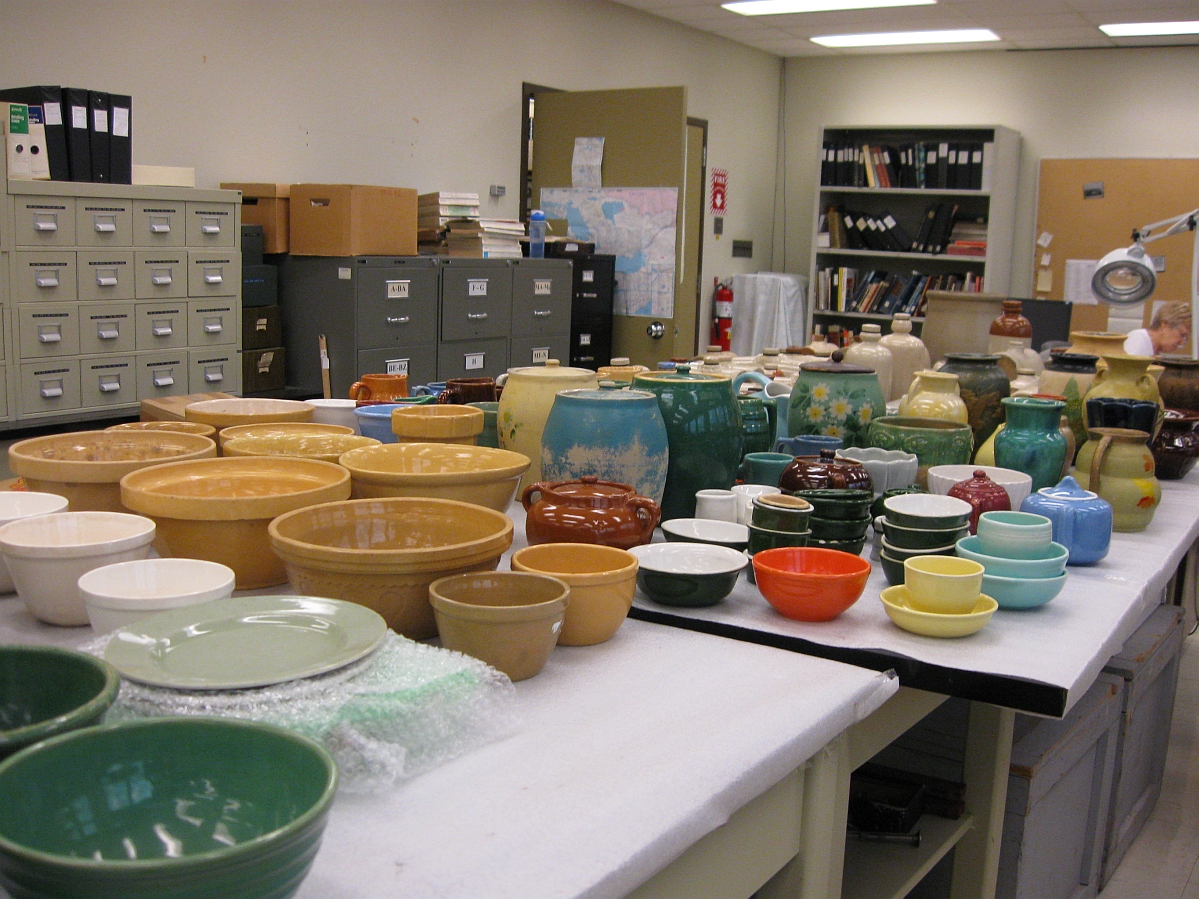
A variety of Medalta pottery items including jars, bowls, and pitchers, arranged across two tables in a museum storage room.

Here is the Medalta ware unpacked in the History lab.

A few dozen Medalta pottery footwarmers - tube-shaped containers with blunt ends and a cork like stopper in the middle.

The footwarmers in the lab.

Next Steps

With all items removed from boxes, the next step is to process them. Each must be assigned a catalogue number and entered into the collection database. They also must be physically numbered, catalogued, photographed, and condition reported, before being put into their permanent storage location.

More than meets the eye

The actual collection trip took approximately a half day. However, the preparation took about the same amount of time, and the next steps will be far more time-consuming. With cataloguing and condition reporting, many entries can be cut and pasted, and the conservators can use a checklist to speed the process; however, I still anticipate that the processing of these 150 or so objects will take person-hours adding up to weeks of work!

Unless you work in a museum, most likely you have no idea of the details involved in collections work. The steps I’ve described are required for all new acquisitions. This is a glimpse into the day to day tasks the Collections and Conservation department staff tackle, although it’s just one part of what we do.

Harry Finnigan

Harry Finnigan, founder and principal of McKay Finnigan and Associates in Winnipeg, is recognized internationally as a leader in downtown revitalization.

Born and raised in Winnipeg’s inner city, he has extensive experience in community economic development, policy development, urban and regional planning, and project management.

Harry overcame initial adversities in Winnipeg’s inner city with his steadfast educational development, culminating in a Masters of City planning from the University of Manitoba. Harry used his knowledge to unlock the potential in the Winnipeg downtown core area for the enrichment of all its residents.

Harry’s continued legacy of community development can be seen in the oil capital of Edmonton, America’s most livable city Pittsburg PA, and even the Republic of Botswana. In the early 90’s he was instrumental in developing the Downtown Winnipeg Business Improvement Zone which we now know as the Downtown Winnipeg Biz. During his tenure as Director of the City of Winnipeg, Planning, Property and Development Department he played a pivotal role in the development of downtown’s new residential neighborhood “Waterfront Drive”.  

Harry is currently channeling his drive and experience into his own highly successful consulting firm, providing community enrichment where it’s needed most. Being a donor to The Manitoba Museum since 2004 and a Museum Tribute supporter, Harry also officially adopted the first artifact from the Museum’s Adopt an Artefact program.

Harry is continuing in the altruism that has governed his professional life by sharing a very unique and personal artifact and Heirloom from the famous Sitting Bull. This unique treasure was presented to Harry’s Grandmother Ellen Inkster as a gift by Sitting Bull himself in thanks for her kindness to him.

As seen in the June issue of Features Online:

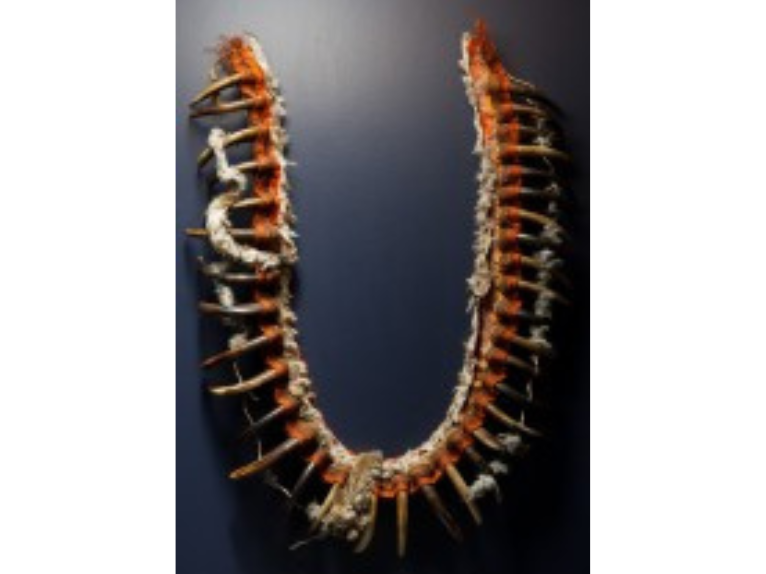
An open mounted necklace with numerous bear claws lining it.

Sitting Bull’s Bear Claw Necklace  –  An interesting memoire of a local man’s family history and their connection to Sitting Bull and a precious artefact on permanent display within The Manitoba Museum.

Following the battle of Little Big Horn in 1876, Sitting Bull led many of his people to safety within the Hudson Bay Company’s territory to the north, Rupertsland. Protected under the authority of Queen Victoria, and specifically the Northwest Mounted Police, he spent quite some time around FortQu’Appelle, in what is now part of Saskatchewan. That’s where he met my grandmother, Ellen Arabella Inkster, and my grandfather, Henry McKay.

Yes, I did say “grandmother” and “grandfather”! In some ways I’ve jumped a few generations as my grandfather was 47 years old when my father, Reginald Harold Stanley McKay, was born in 1903, and my father was 47 years old when I was born in 1950. It seems odd to be able to note that when my grandparents got married at Ft.Ellicein August, 1881, Sir Sam Steele, an historic figure in our country’s history, and then head of the North West Mounted Police, served as best man at their wedding.

In the 1960’s, my father wrote a short paper about the McKay family and their deep roots to the history of Western Canada. In it he mentioned that his father “soon learned to converse in the Sioux tongue and Sitting Bull told him much of his life story in the Northwestern States during those turbulent days. He presented my mother with his necklace of Grizzly Bear Claws, a symbol of authority only reserved for chiefs of high rank. In turn, my mother gave this relic to her uncle Sheriff Colin Inkster and at present I believe this is seen periodically in a glass case in the Winnipeg Civic Auditorium Museum”.

There are a few stories within the McKay family which have been passed down over the years about Sitting Bull’s necklace. They all affirm that it was given as a gift by Sitting Bull himself. One story has our grandmother sitting in the general store at Ft. Ellice when Sitting Bull walked in. She noticed the poor shape that his shoes were in so she offered him a pair of moccasins which she had made. He then gave her the necklace in appreciation of her gift. Another story suggests that the necklace was given by Sitting Bull as a gift for my grandparent’s wedding.

As chance would have it, in the early 1990’s I was invited to a small luncheon the purpose of which was to brainstorm ideas on how funds could be raised in support of The Manitoba Museum (then known as The Manitoba Museum of Man and Nature). Following the luncheon I mentioned to the then Director, that while through my family I was aware of a grizzly bear claw necklace in the Museum’s collection, I never had the opportunity to actually see it. I was encouraged to make arrangements to view the necklace through the Curator of the Native Ethnology Department at the Museum.

The viewing was organized for later that summer. I was joined by my sister Roberta McGillivary, her son Clifford, my wife Elvira, our son Shaun, and our friend (and photographer) Bill Eakin. We all followed up to the 3rd floor where the necklace was being kept in storage.

The white box containing the necklace was opened and voila – there it was! Roberta exclaimed: “That’s it, that’s it. I’ve heard so much about it! Can I try it on?” I turned to her and said: “Roberta, it’s a precious artifact, and this is a museum!” However, to my surprise the curator lifted the necklace from the box and gently placed it around Roberta’s neck. I immediately had this vision, or strange sense of a special moment from long ago – of Sitting Bull placing his necklace on my grandmother, Ellen Inkster. It was a powerful feeling and hard to explain.

Displayed below is the photograph of my sister Roberta wearing the bear claw necklace. After the meeting, I provided the curator with my father’s paper on the McKay family, as well as a few old newspaper clippings and other documents connecting Henry McKay with Sitting Bull reinforcing our interesting family history and connection of Western Canada.

“Every time I visit the Manitoba Museum, I make a point of going to the Parklands/Mixed Woods exhibit, where Sitting Bull’s Bear Claw Necklace is on permanent display. I am reminded of my grandmother and her connection to the iconic Aboriginal leader, Sitting Bull; and I think fondly of my sister Roberta who passed away on January 2, 2011. I am pleased to have been able to adopt this priceless artefact in her memory.”

Harry H. McKay Finnigan