
So, once something is named, isn't that it?

So, once something is named, isn’t that it?

By Kathy Nanowin, past Manager of Conservation

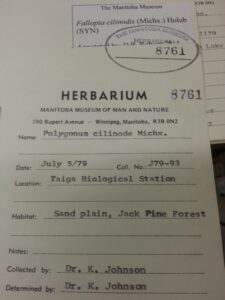
Close up on the identification data of a herbarium specimen in the Museum Collection. It is for a Polygonus elenode Michx collected in July 1979.Recently, my husband asked me what I was working on, and when I told him I was updating the nomenclature for specimens in the Family Polygonaceae, he looked at me funny. I realized that as a non-biology person, my response was not that informative to him. It did not tell him that I was working on updating the official names of plant specimens, or even which plants they were, and it also did not make sense as to why their names would even change.
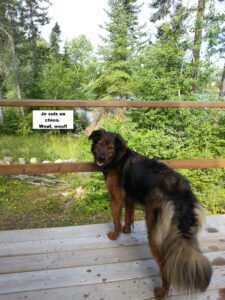
A black and borwn dog with a bushy tail stands on a wooden platforms in front of a railing before a wooden area. The dog is looking back towards the camera an a small text box near its head reads, "Je suis un chein. Wouf, wouf!"When a living organism is recognized as being unique and different from other organisms, it is assigned a scientific name. This is the name that is used in the Museum’s database. A common name may be also included, but common names are not as useful or informative. This is because common names are different in each language. For example, the domestic dog is “perro” in Spanish, “chien” in French, “sobaka” in Russian, “gŏu” in Mandarin, “hund” in Danish, and “cane” in Italian. However, the scientific name for dog is Canis familiaris, and this is the same everywhere in the world.
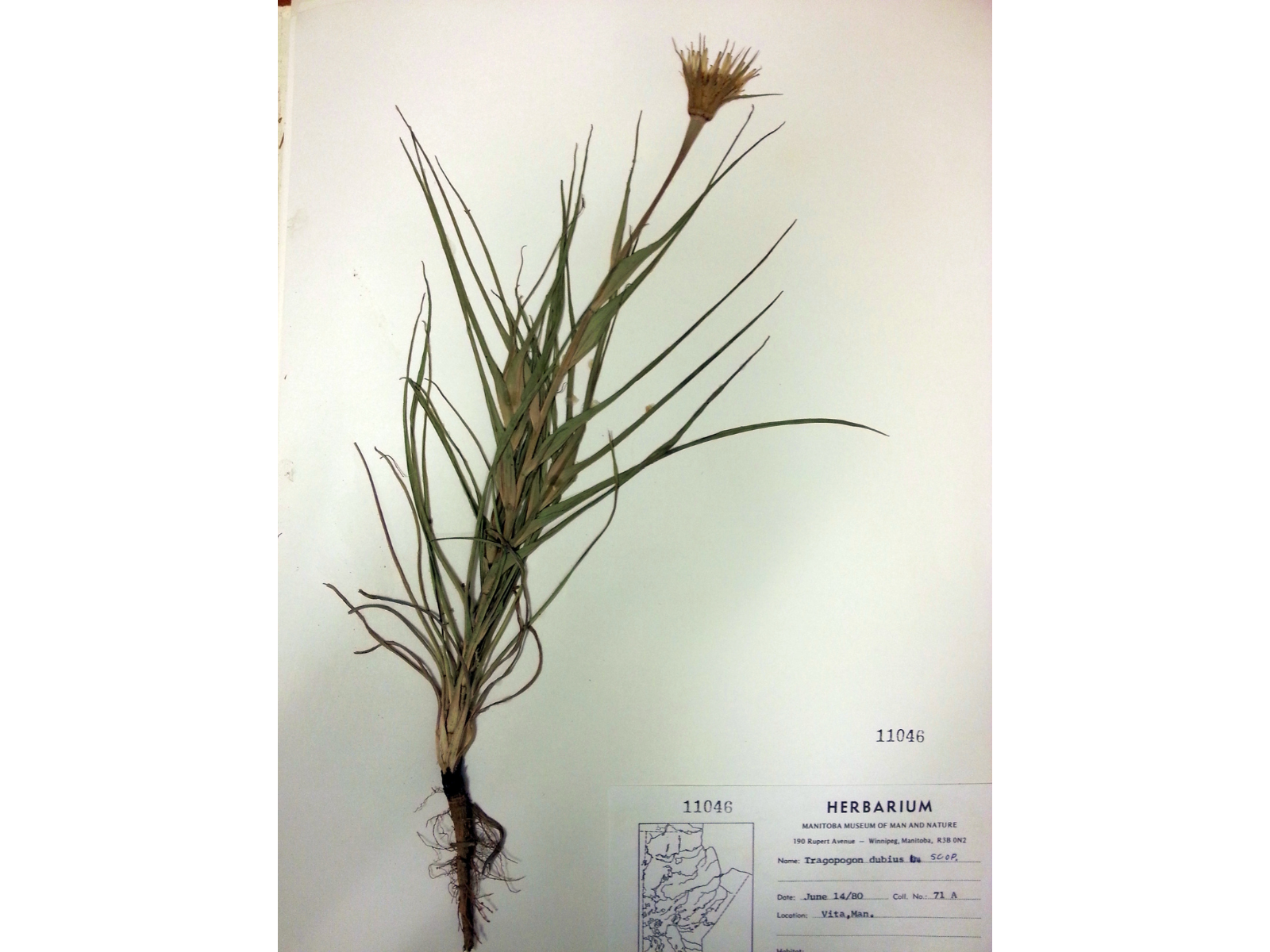
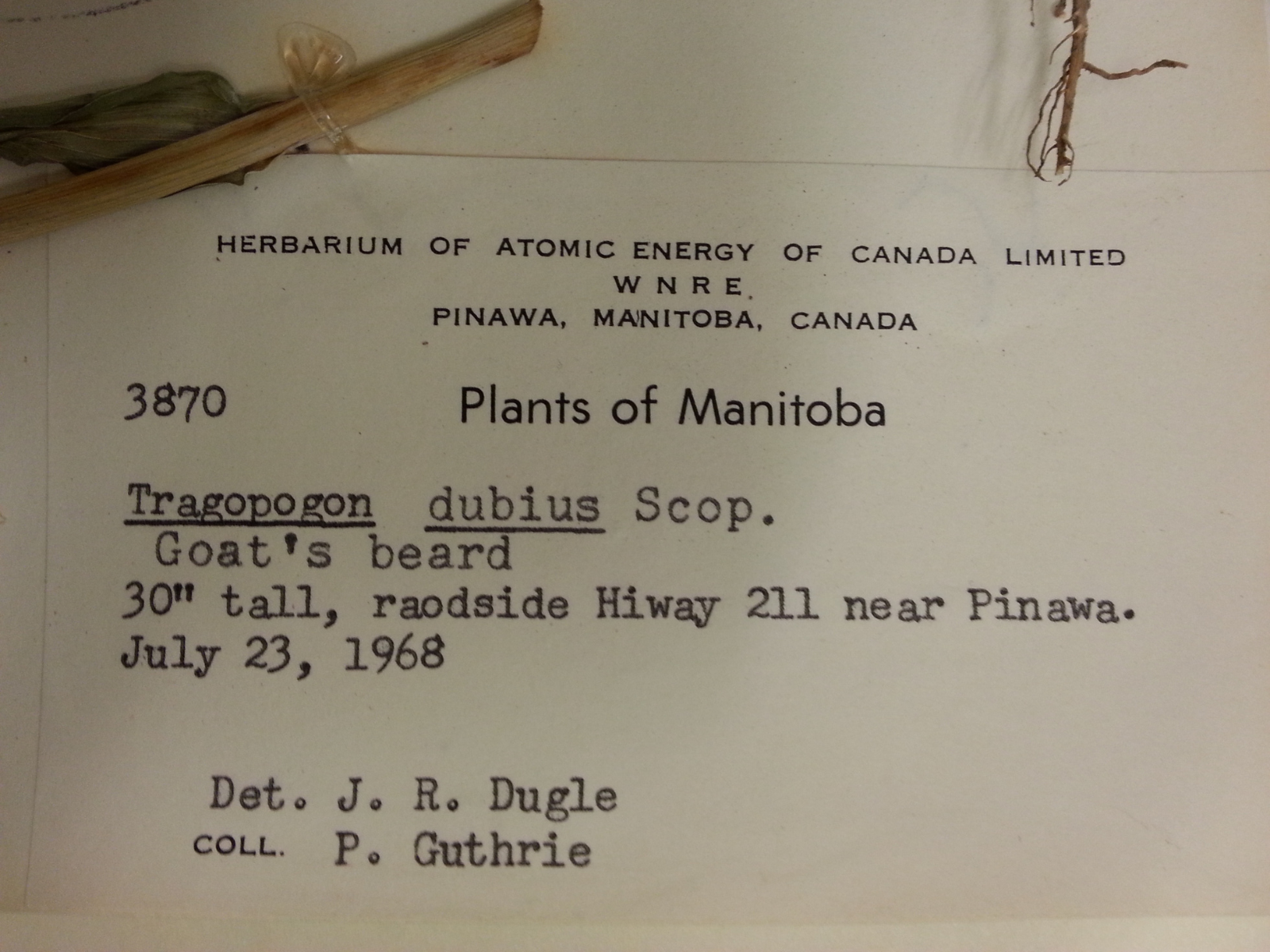
Even in the same language, it is not unusual for a common name to vary from country to country or region to region. A common ditch plant in Manitoba is seen below. Its scientific name is Tragopogon dubius. In Manitoba, this plant’s common name is most often Goat’s Beard, but in Europe it is known as Salsify, and in the southern United States it is called the Wild Oyster Plant.

So, each different type of organism is assigned a scientific name to be sure scientists know what organism they are talking about. Scientific names have two parts to them, the genus (Tragopogon) and the specific epithet (dubius), and these are latinized words. The scientific name is therefore a binomial, that is, it has two parts to the name. The genus is always capitalized, and the specific epithet is not. To show that this is the official scientific name of an organism, the two words are either underlined (usually done when handwritten) or italicized (usually used when typed).

A pressed Goat's Beard, or Tragopogon dubius, specimen with Museum Herbarium Collection indentification information in the lower right corner of the page.

CLose up on a Tragopogon dubius herbarium specimen identification note. The name Tragopogon dubius is underlined.

There are strict rules for naming organisms. In biology, the sub-discipline of naming organisms is called taxonomy. There are international conferences and conventions where scientists meet to discuss and agree upon the rules for taxonomy, and this may mean that names changes.

There are various reasons for names to change:

1. Sometimes a specimen is reclassified, and the name has to change to reflect this.

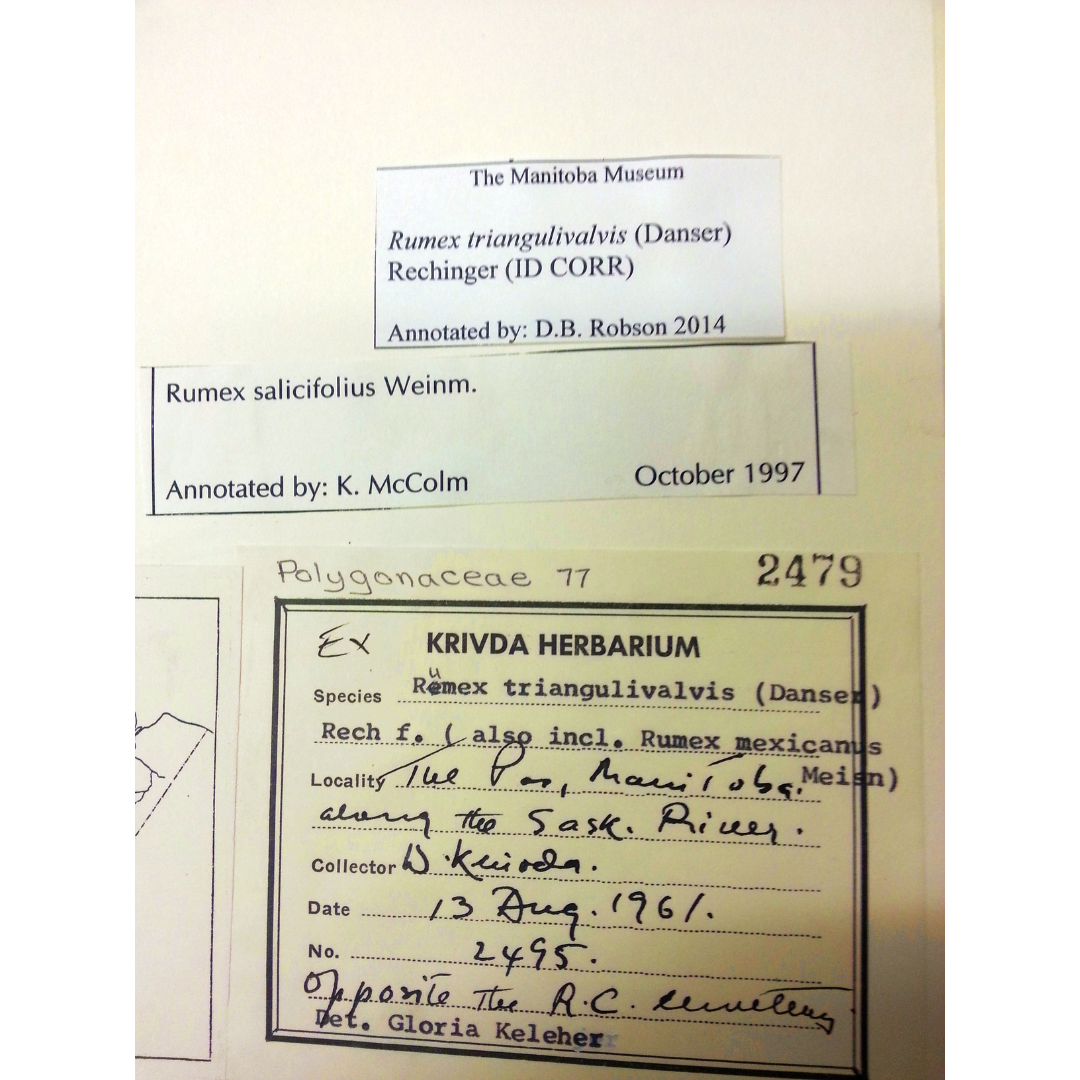
2. Sometimes a specimen was incorrectly identified. In the lower left photograph, the original name was actually correct. Someone changed it in 1997, and then in 2014 it was changed back to its original, correct name.

3. Sometimes it is discovered that specimens with different names are actually the same thing, and so one name is adopted over the other.

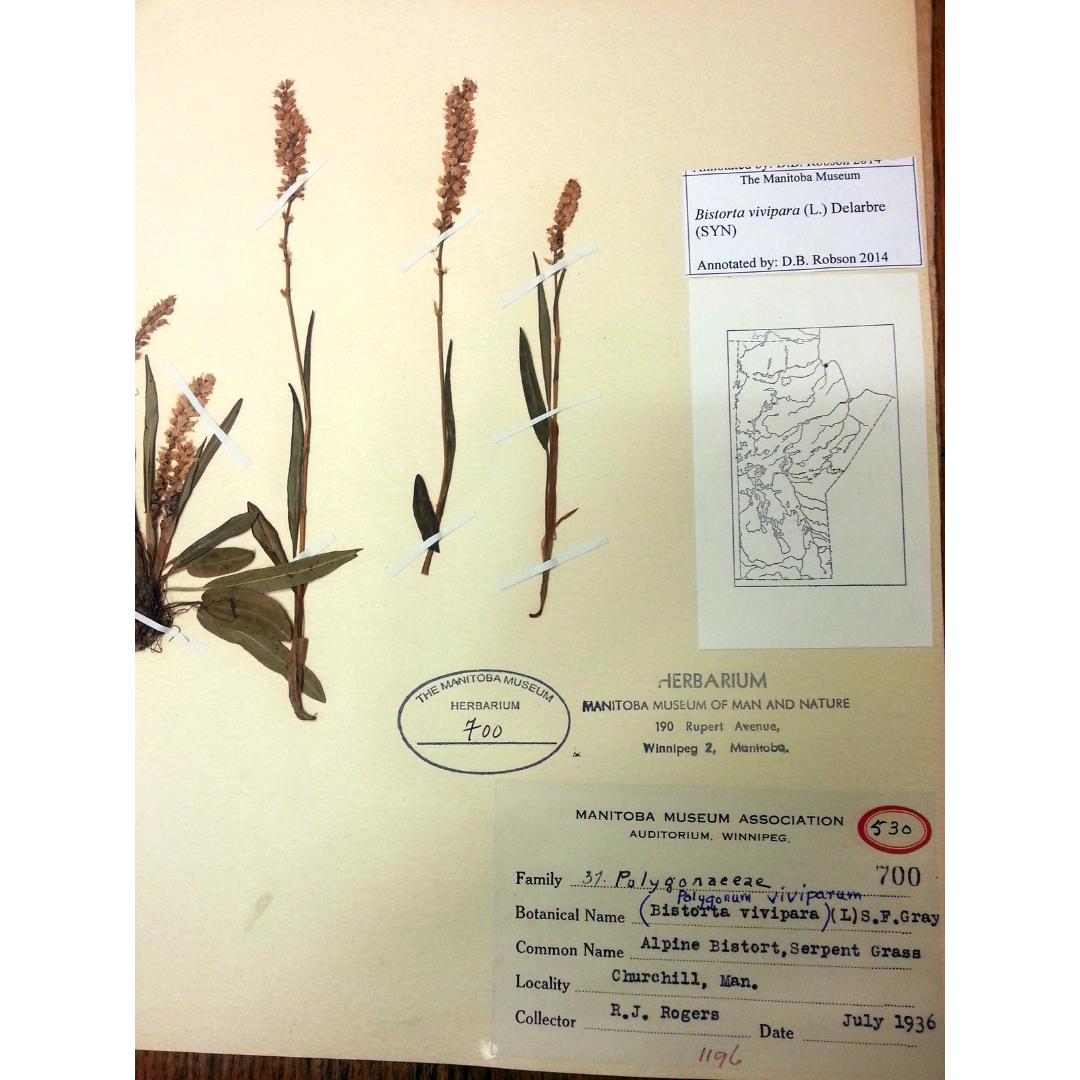
4. And sometimes, if you wait long enough, an older name resurfaces (as in the lower right photograph).This is usually because of a reorganization of the naming system.

Herbarium identification label for a 'Rumex triangulivalis' specimen showing that as the originally identified name, which was then incorrectly corrected in 1997, and recorrected in 2014.

Pressed plant herbarium specimen accompanied by an identification data panel labeling it as 'Bistorta vivpara'.

So the next time you wonder what is that tree, insect or bird, try to find out its scientific name!

The Amazing Criddles, Pt. 2 – Wawanesa Site Visit

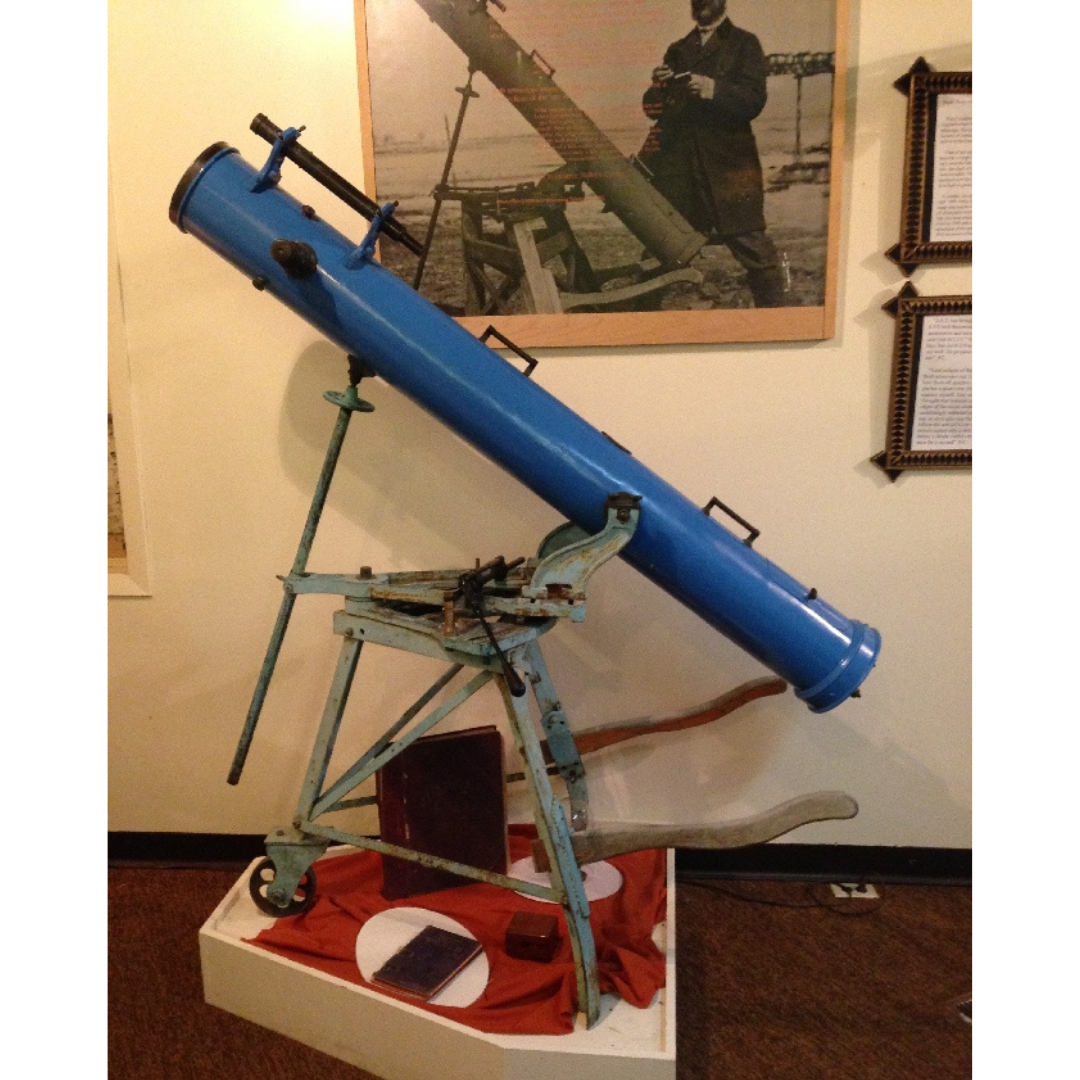
One of the lesser known aspects of museum work involves the lending and borrowing of artifacts and specimens. This isn’t to say you can borrow the Nonsuch for a lovely family sailing holiday, but other museums and heritage sites often work with us to make the most of our collections. Lower Fort Garry has several pieces of our HBC Museum Collection onsite to illustrate the rich history of the fur trade, for instance. Loans can be short little stints for special events or drag on for decades as the original paperwork yellows in its file folder. As I wrapped up cataloguing all of the Criddle collection, I realized that one remaining artifact had been on loan to the Sipiweske Museum since 1991. Other than a black and white photograph, we had no data on this object – a telescope used by Percy Criddle to observe Halley’s Comet in 1910– which meant…a ROAD TRIP!!!

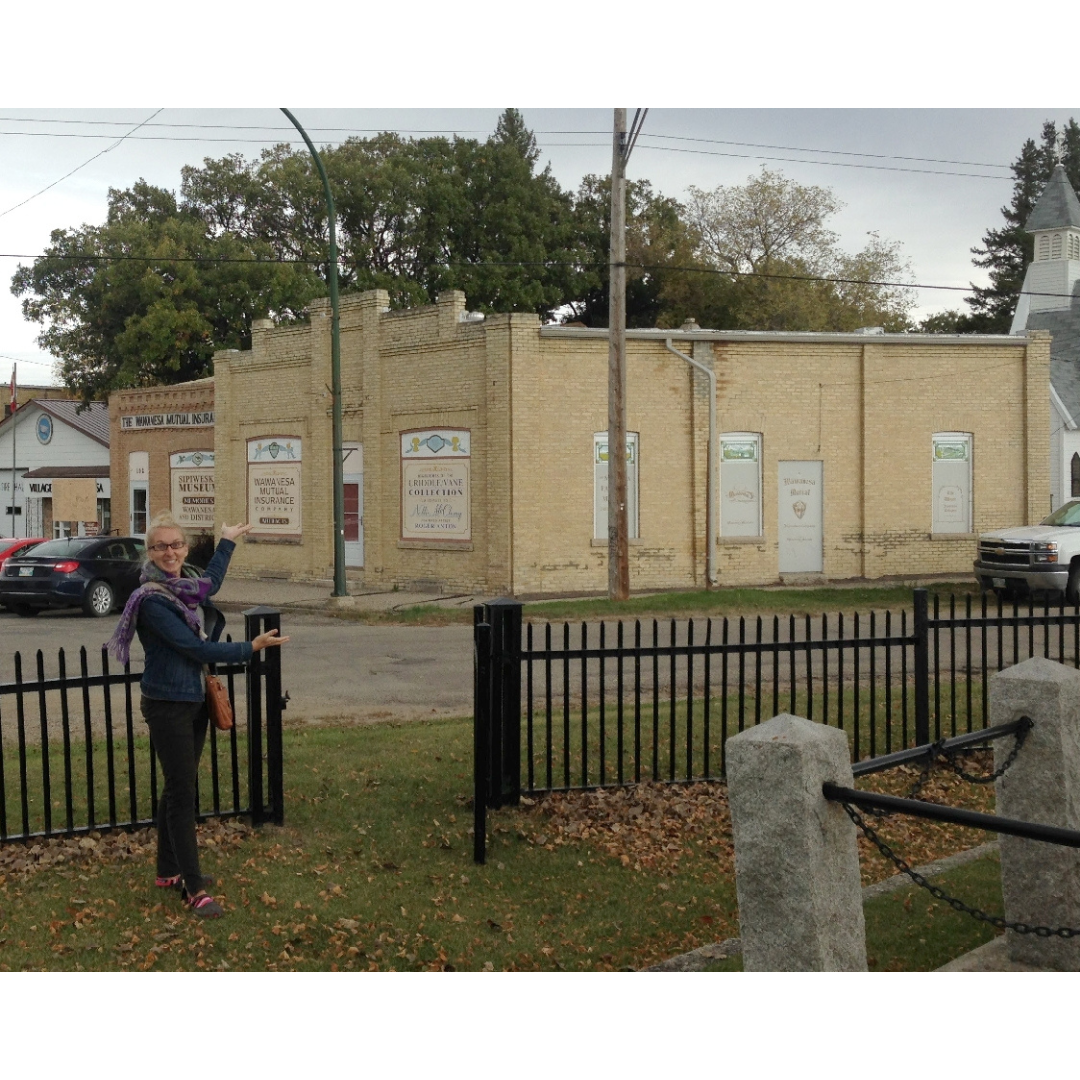
All objects in our collection need to be catalogued and undergo a condition report, so your friendly neighbourhood cataloguer (me) and our conservator extraordinaire (Carolyn) headed off on an adventure towards the quiet, picturesque town of Wawanesa, 202 kilometres west of Winnipeg, to visit the elusive Criddle telescope.

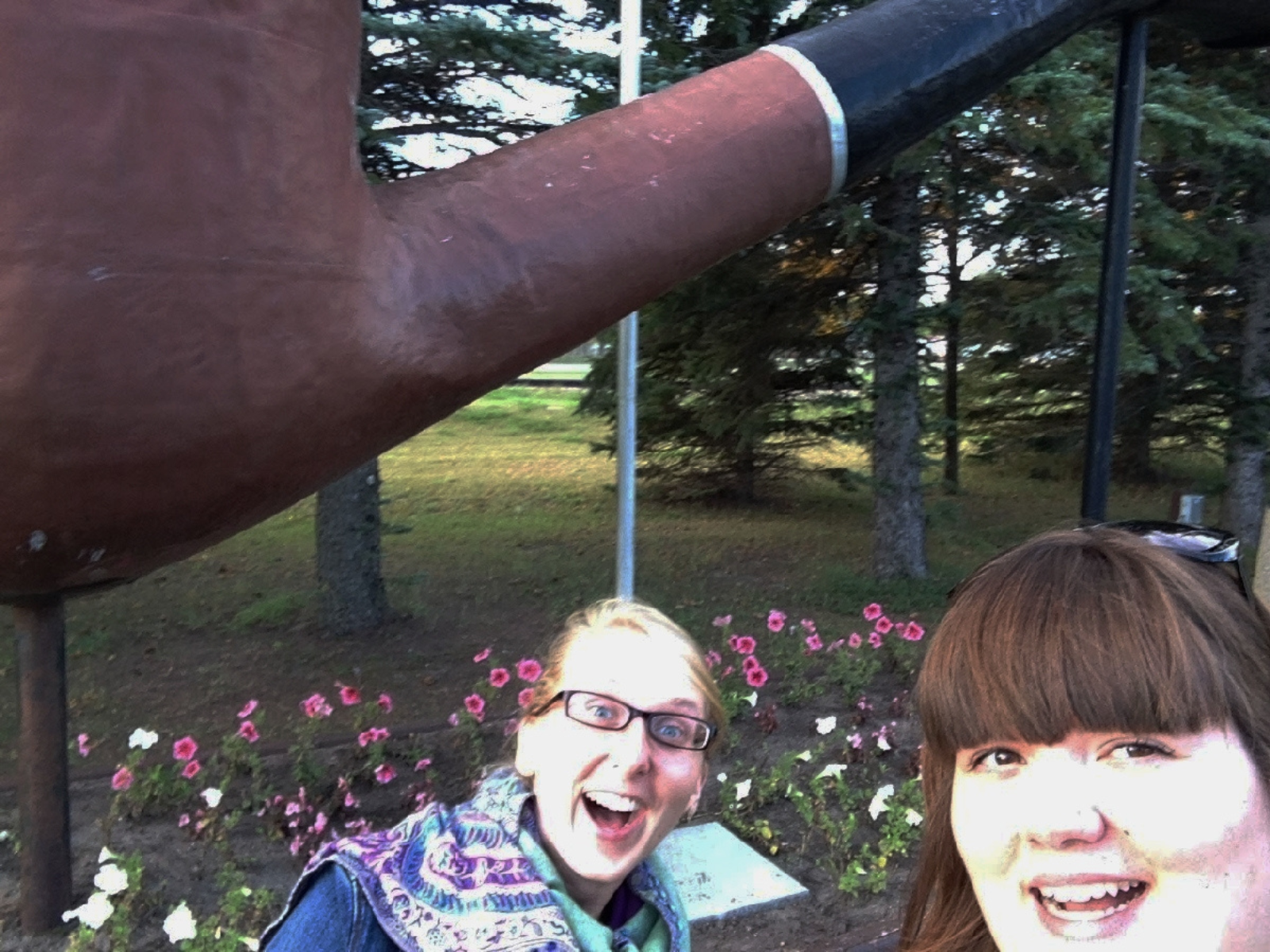
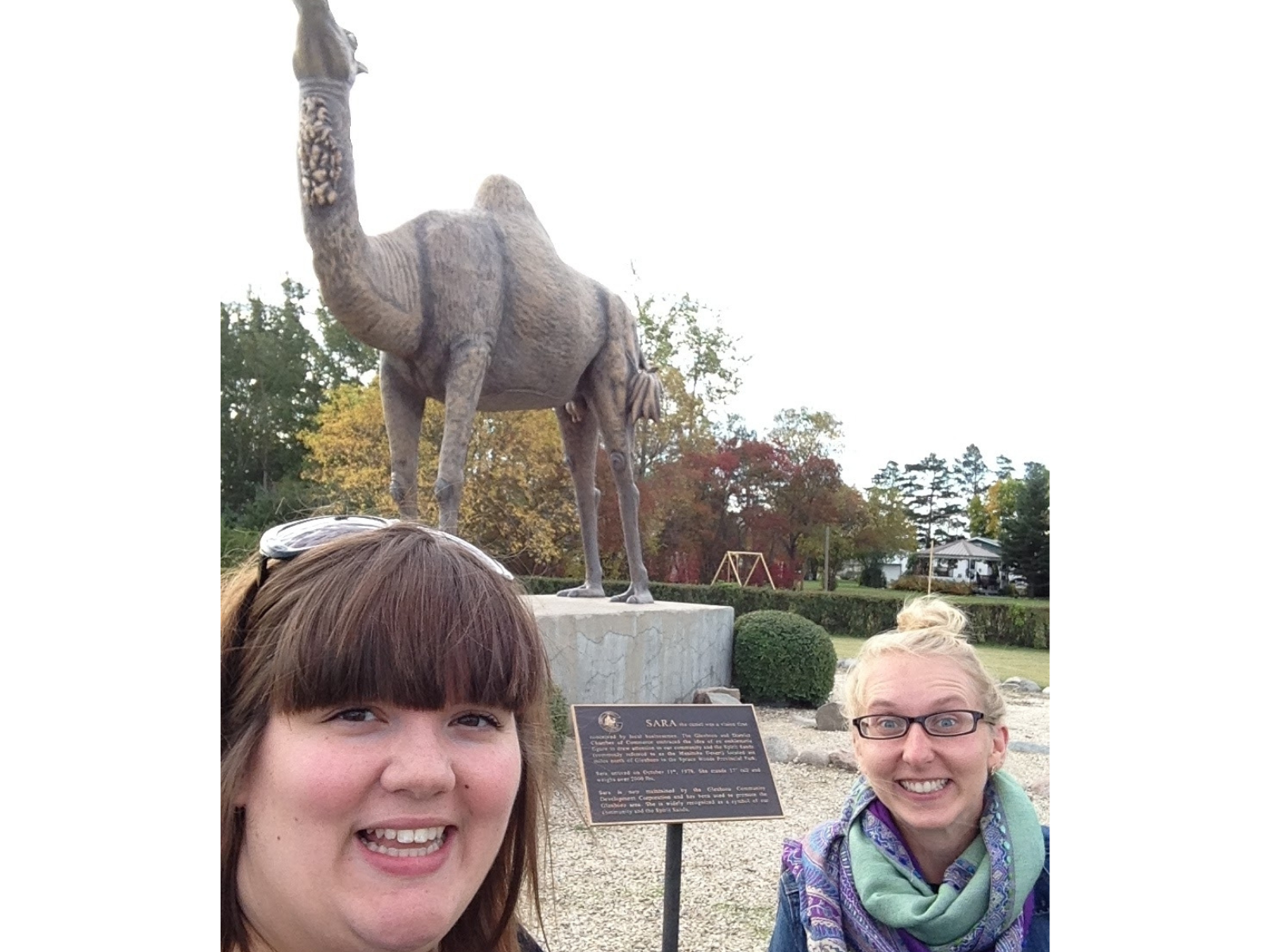
We were making good time, so I decided to show Carolyn some of my favourite stops along Highway 2, including the World’s Largest Smoking Pipe in St. Claude (my grandpa’s hometown!) and Sara the 17 foot tall Camel in Glenboro.

A smiling selfie taken by Cortney of herself and Carolyn in front of a giant brown and black smoking pipe statue.

A smiling selfie taken by Cortney of herself and Carolyn in front of a statue of a giant single-humped camel.

Arriving in Wawanesa, we headed to the Sipiweske Museum and made our way through the winding galleries until we arrived at the telescope. We wasted no time getting to work, examining the 130 year old telescope from every angle. This Browning telescope was made in London and brought over to Percy Criddle in 1885 by his friend and benefactor, J.A. Tulk.

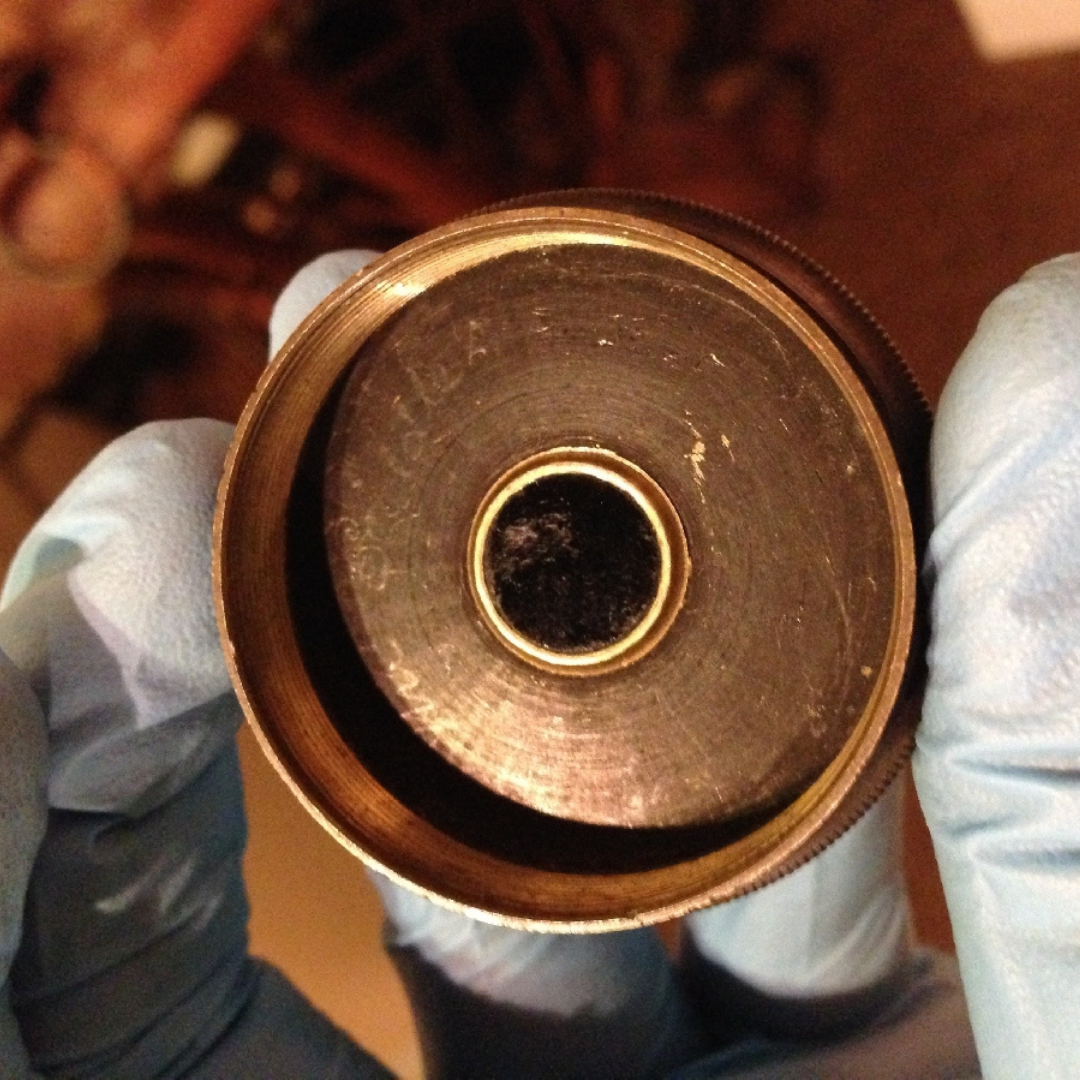
Pulling apart the eyepieces, I found a lovely surprise – Percy Criddle’s name, written in his own hand inside a lens piece, preserved for all this time. He treasured this telescope and observed many celestial events with it, including the passing of Halley’s Comet and a lunar eclipse.

Carolyn stand in a fenced yard gesturing towards a stone building across the street - the museum.

A blue telescope on display on a small pedestal in a museum.

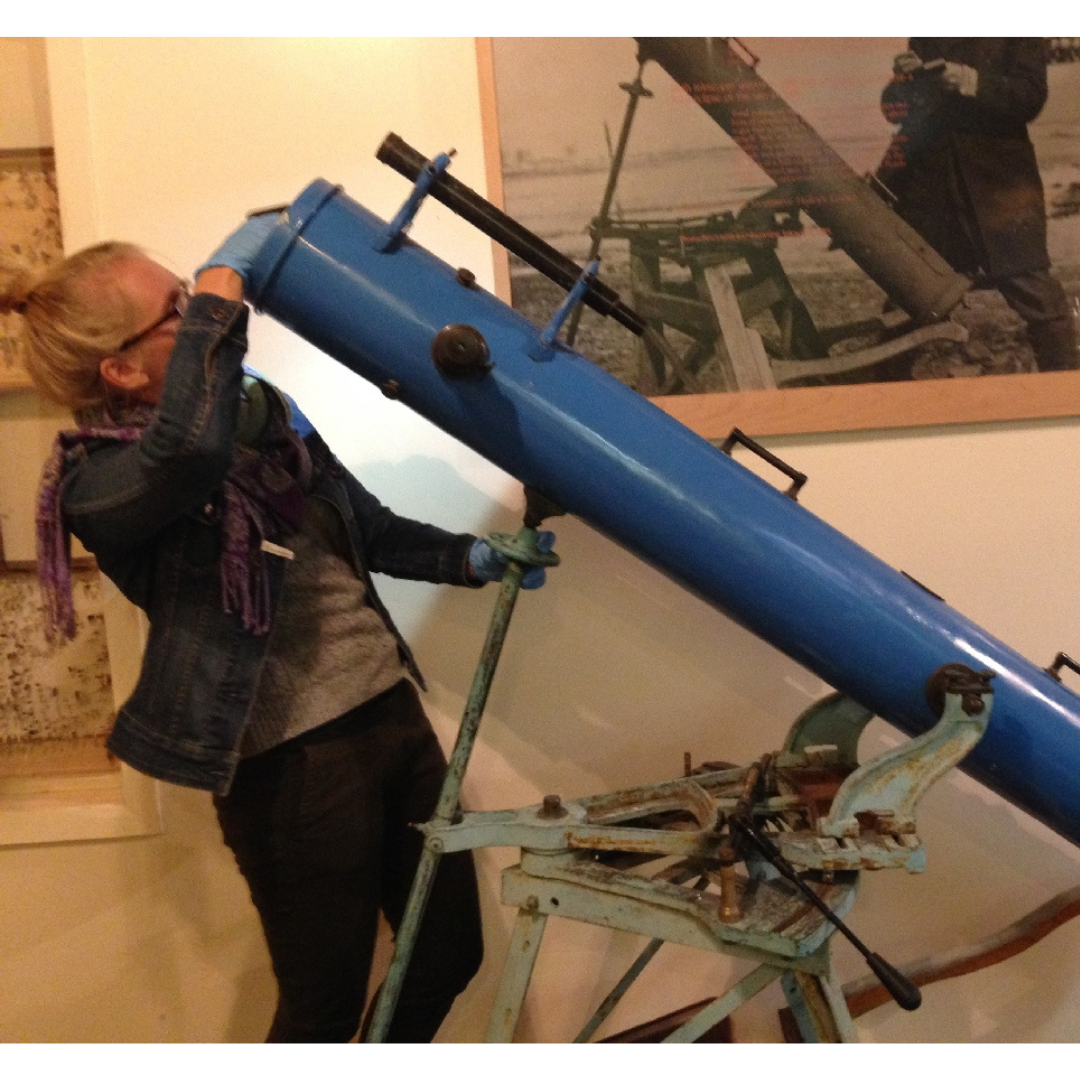
Carolyn standing at the front of a blue telescope, examining the front opening, while wearing blue gloves.

A blu-gloved hand holding up a copper-coloured lens cap with "Percy Criddle" engraved into it by hand.

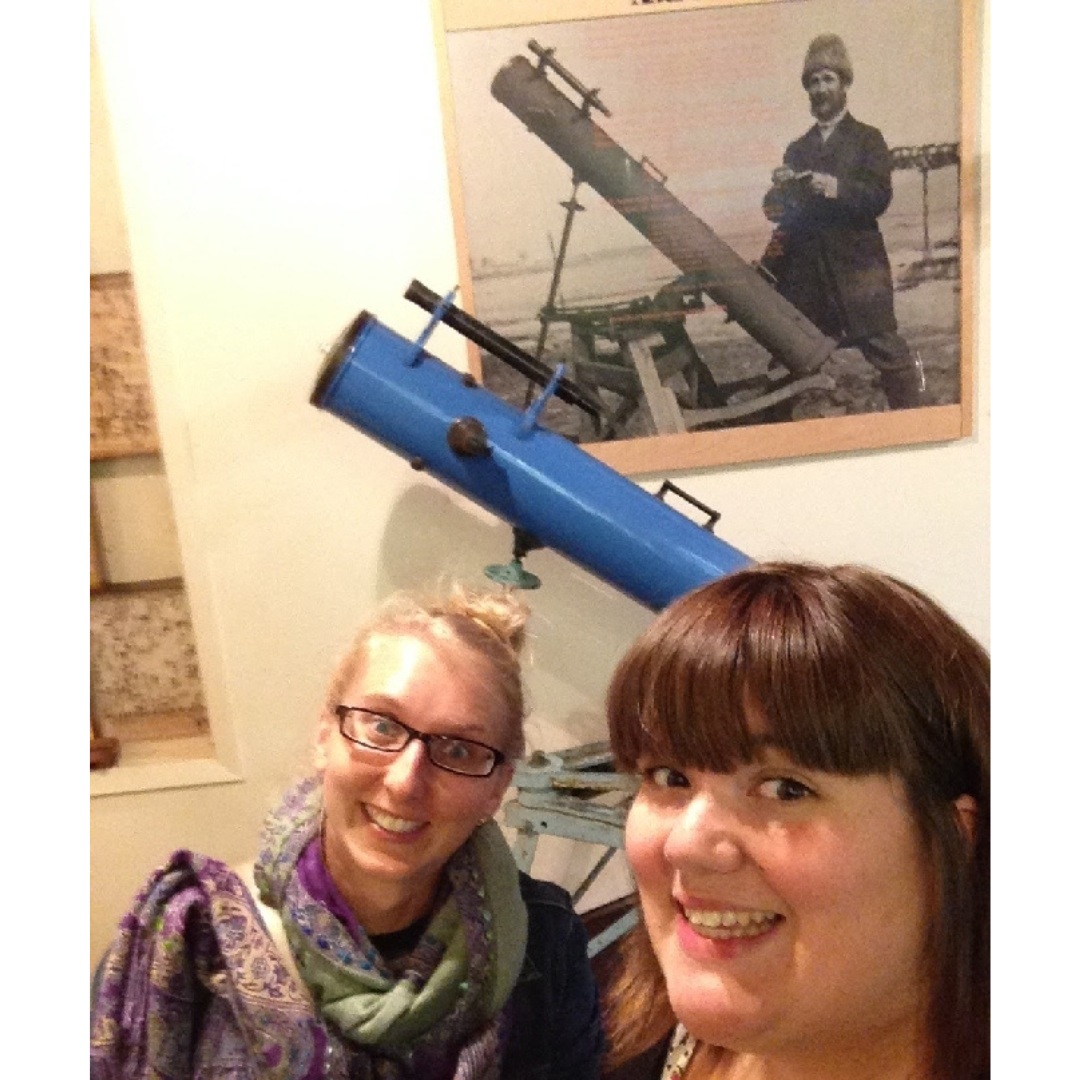
A smiling selfie taken by Cortney of herself and Carolyn standing in front of a blue telescope. On the wall behind the telescope is a black and white photo of Percy Criddle with the same telescope.

After all the disassembling, measuring, describing, photographing, and reassembling, we celebrated with a telescope selfie, as you do.

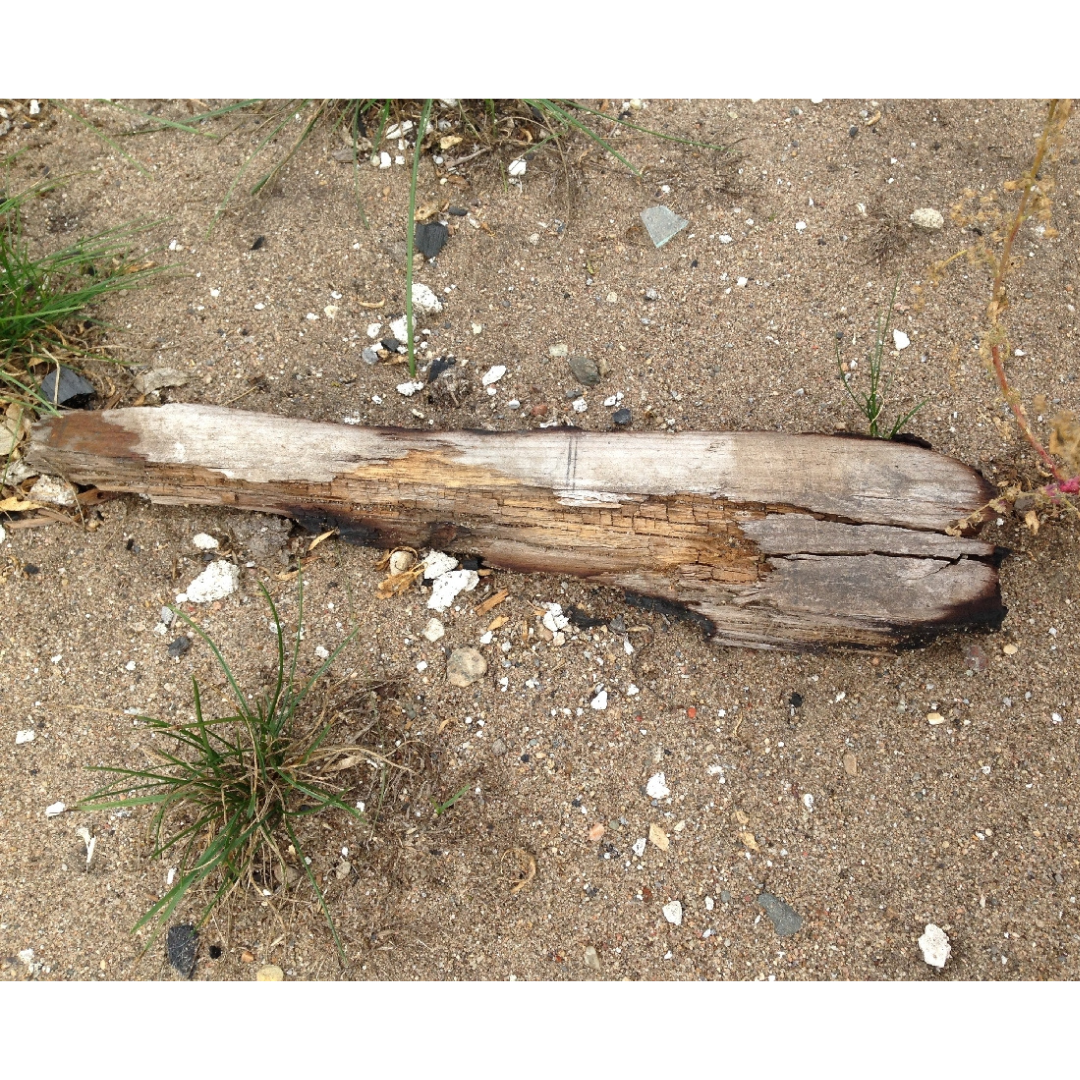
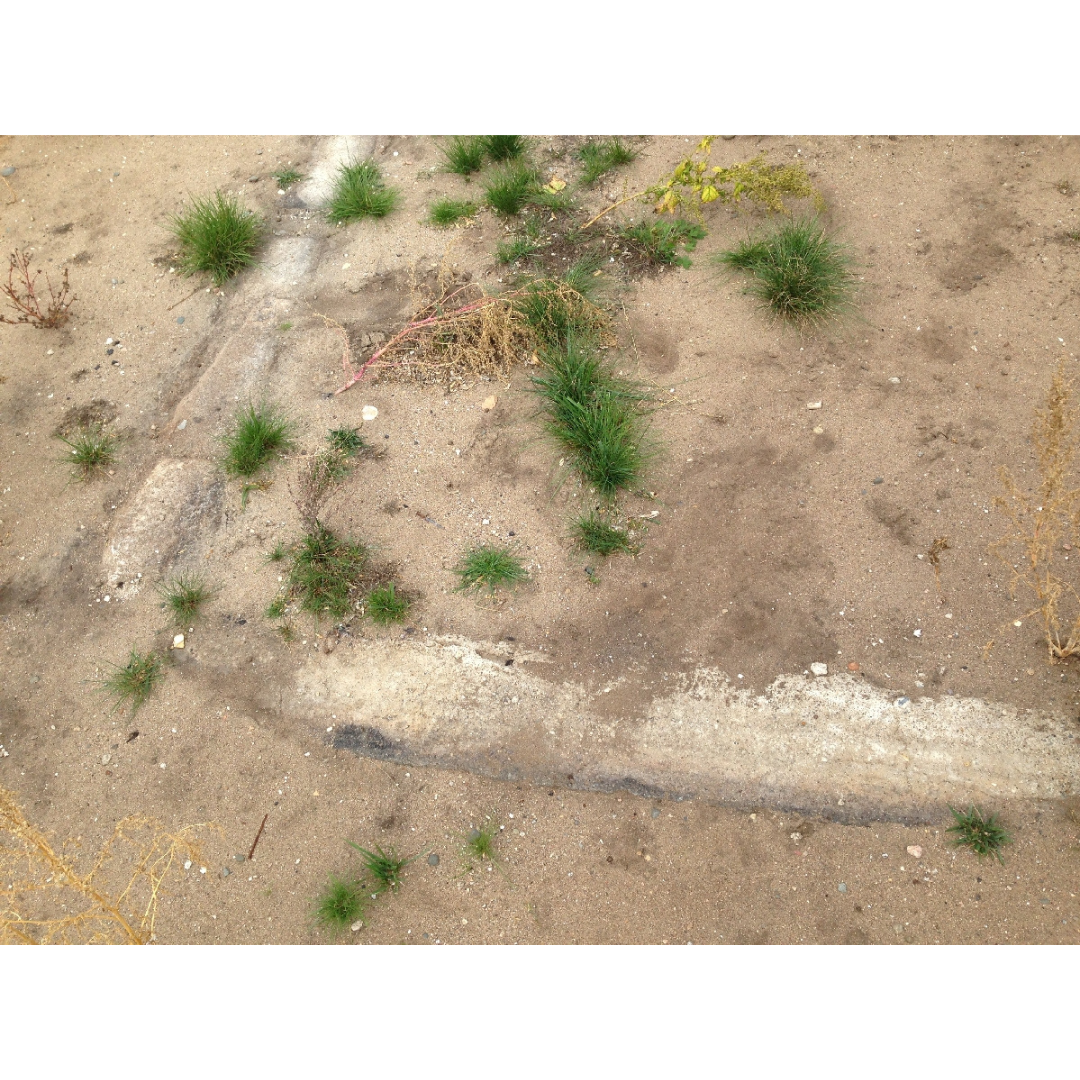
Before heading back to Winnipeg, Carolyn and I decided to visit Aweme (now the Criddle/Vane Homestead Provincial Heritage Park), the homestead of the Criddles from 1882 to 1960. Sadly, the big house, St. Albans, was destroyed by fire in June 2014. We poked around the sandy patch where the house once stood, trying to picture it.

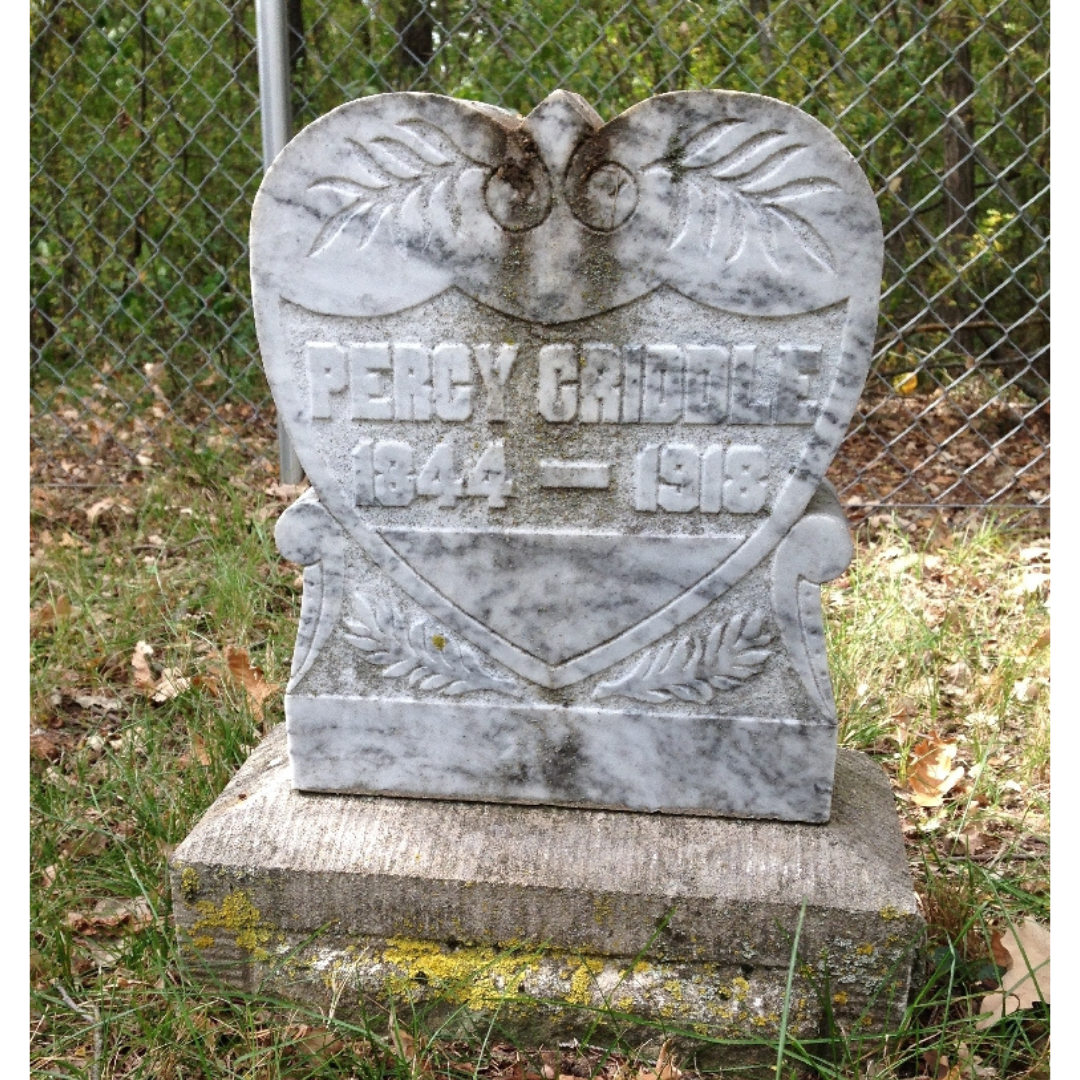
We hiked around the short trail, exploring Norman Criddle’s entomology lab and the crumbling foundation of Stuart Criddle’s former home, Gardenview, before stopping to pay our respects to Percy Criddle and his family at the graveyard.

A wooden beam embedded in the ground - part of the remnants of the big house known as St. Albans.

A right-angle corner made of wooden beams embedded in the ground - part of the remnants of the big house known as St. Albans.

A heart-shaped gravestone with two engraved leaves on the top of the heart. the stone reads, "Percy Criddle / 1844 - 1918".

Percy’s telescope has been catalogued, all its information and history entered into the collections database, the loan renewed for a five year term. Head out to Wawanesa and see it for yourself!

Cortney Pachet

Cortney Pachet

Collections Technician – Human History

Cortney Pachet started working at the Manitoba Museum in 2001 as a tour guide while earning her a BA (Honours) from the University of Winnipeg. She quickly realized that she wanted a career in museums…
Meet Cortney Pachet

The Amazing Criddles – Part 1: The Family

Within the History Collection at the Manitoba Museum, we have sub-collections of artifacts, tied together by object type (like our collection of crocks) or social movement (like our fraternal orders material). One of our significant collections comes from a homesteading family whose breadth of material culture has caused my coworkers and I to ask on more than one occasion, “did the Criddles ever throw anything away?!”

In 1882, an Englishman and his family immigrated from Addlestone, Surrey, UK to a patch of sandy land east of Brandon, Manitoba to try his hand at farming. Unlike typical homesteaders of his day, Percy Criddle was the son of aristocrats, schooled in medicine and music at Heidelberg. He fancied himself a renaissance man, dabbling in sport, astronomy, law, medicine, and music, hosting weekend parties and maintaining a detailed meteorological record from 1884 until his death (and then perpetuated by his children until they abandoned the homestead in 1960). The most compelling peculiarity, however, is his family. Percy met Elise Harrer while he was studying in Germany; the two never married, but Elise moved to London after Percy returned to the UK and they proceeded to have six children –one of whom died in infancy. Shortly after Elise became pregnant with their last child, Percy married an Englishwoman named Alice Nicol. Alice gave birth to four children in the UK and another four at Aweme, their Manitoban homestead. After moving to Canada, both women (with Elise now using the surname “Vane”) lived under the same roof and the children were raised together, although their understanding or acknowledgement of their relationships has been the subject of debate.

From the meteorological record, visitors’ register and diaries to scientific catalogues and photographs, the Criddles were a well-documented family. The documentation pales in comparison to the material culture accumulated and preserved by the family from 1882 onward. Percy details purchases and acquisitions in his diary, noting their prices and sources and writes about his opinions on objects like his new telescope or organ. He also talks about items produced by the family; building blocks Percy made for the children or the house flag sewn by Alice. Percy and the family were regularly visited by an old friend, J.A. Tulk, who travelled from Surrey to Aweme on an annual basis, lugging all sorts of medicines, scientific instruments, books and other gifts for the Criddle-Vane family.

109 years after the Criddles arrived in Manitoba, a handful of Percy’s grandchildren donated the bulk of their grandparents’, aunts’, uncles’ and parents’ belongings to The Manitoba Museum –a whopping 3481 artefacts and 302 specimens! Over the past six months, the majority of my time has been dedicated to completing the cataloguing of this collection. Hundreds of Criddle artifacts have passed through my hands and I count myself lucky to have access to these amazing items. Here are a few of the most memorable artefacts I catalogued from the Criddle Collection:

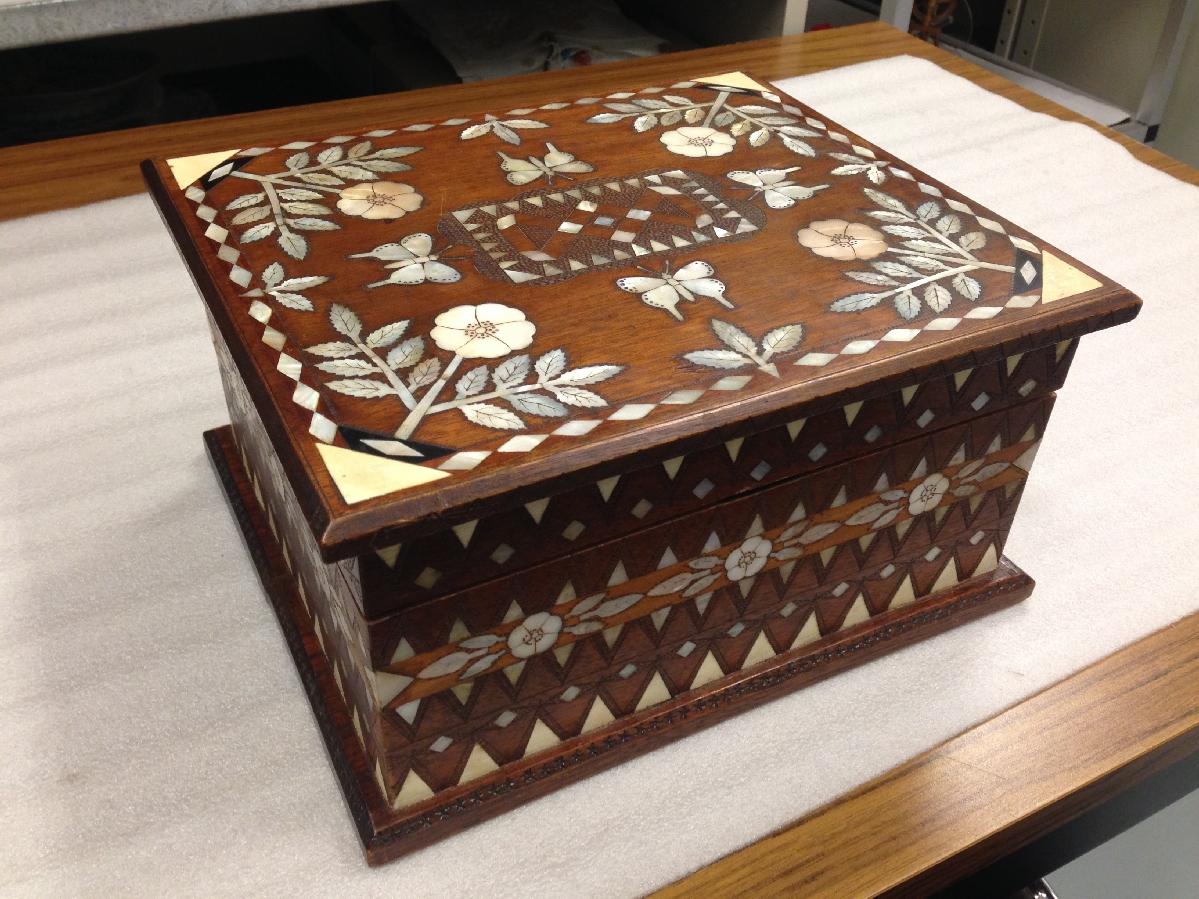
A wooden box inlaid with mother of pearl detailing in an intricate pattern.

1. Storage Box made by Stuart Criddle in 1903. This box, decorated with mother of pearl inlay, is one of many inlaid pieces created by the Criddle sons on winter evenings at Aweme. Lined with lush blue velvet, the box has an internal locking mechanism that is released by pressing a small piece of inlay located near one of the hinges. It took a lot of fiddling to discover exactly how it opened, so I noted the specifics in the catalogue record for future reference. The question remains…what was Stuart hiding in there?

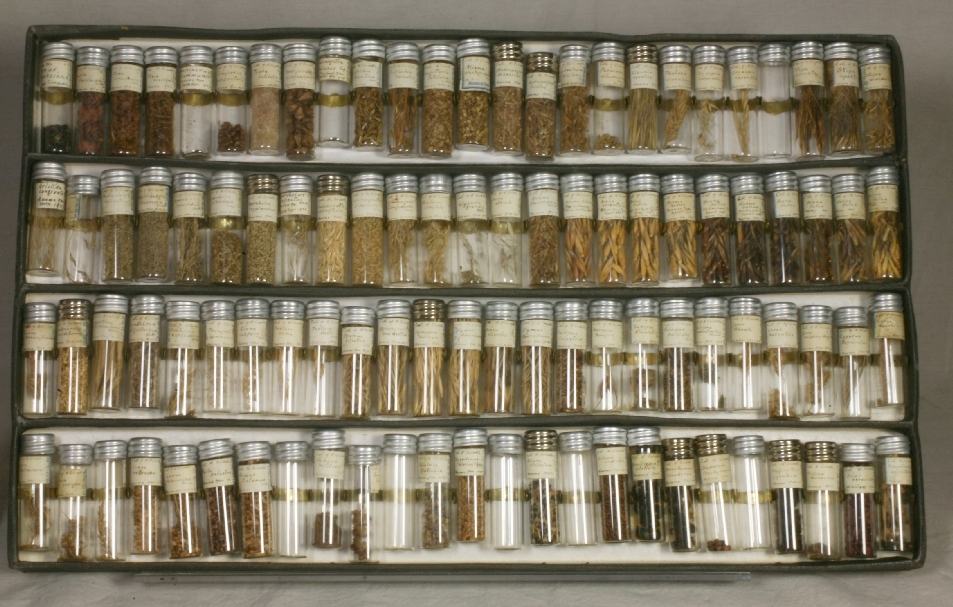
A shallow box containing four rows of small vials containing seeds.

2. Seed Samples collected by Norman Criddle between 1906-1933. Mainly known for his work in entomology, Norman Criddle was appointed the Manitoba provincial entomologist in 1919 and ran an entomology lab at Aweme. However, like his father, Norman had a range of interests, so it comes as no surprise that he was also a renowned watercolourist, his delicate illustrations of local flora gracing the pages of agricultural books like “Fodder and Pasture Plants” and “Farm Weeds of Canada”. During the second half of his life, Norman developed a collection of seeds totalling nearly 700 samples sourced primarily from Aweme and the surrounding area. Each sample was stored in a vial and all the relevant information was scrawled by Norman on tiny labels adhered to the vials. Deciphering what I refer to as “historical handwriting” is an arduous task and my colleagues started asking “Still working on the seeds?” I would shoot daggers from my eyes.

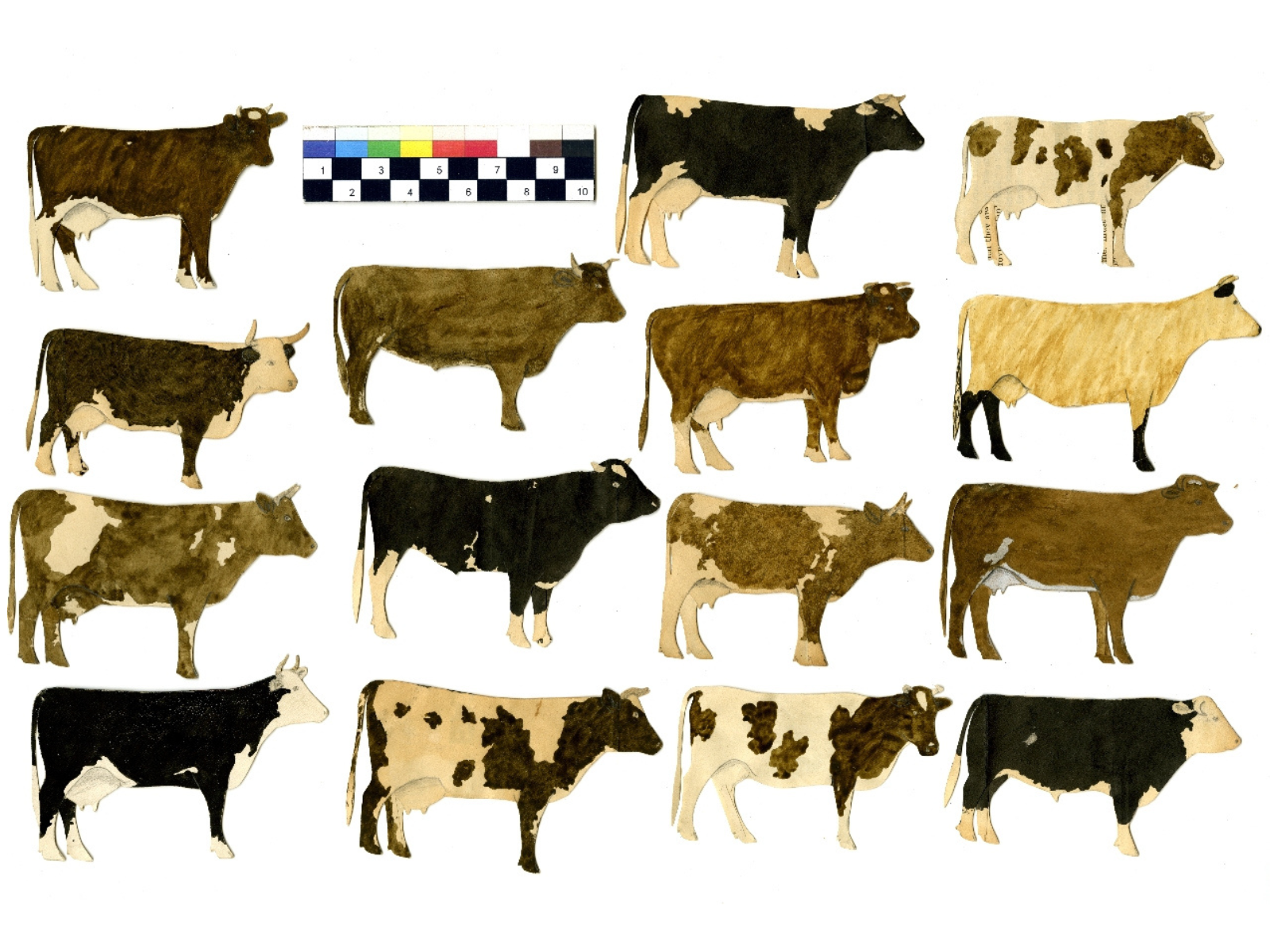
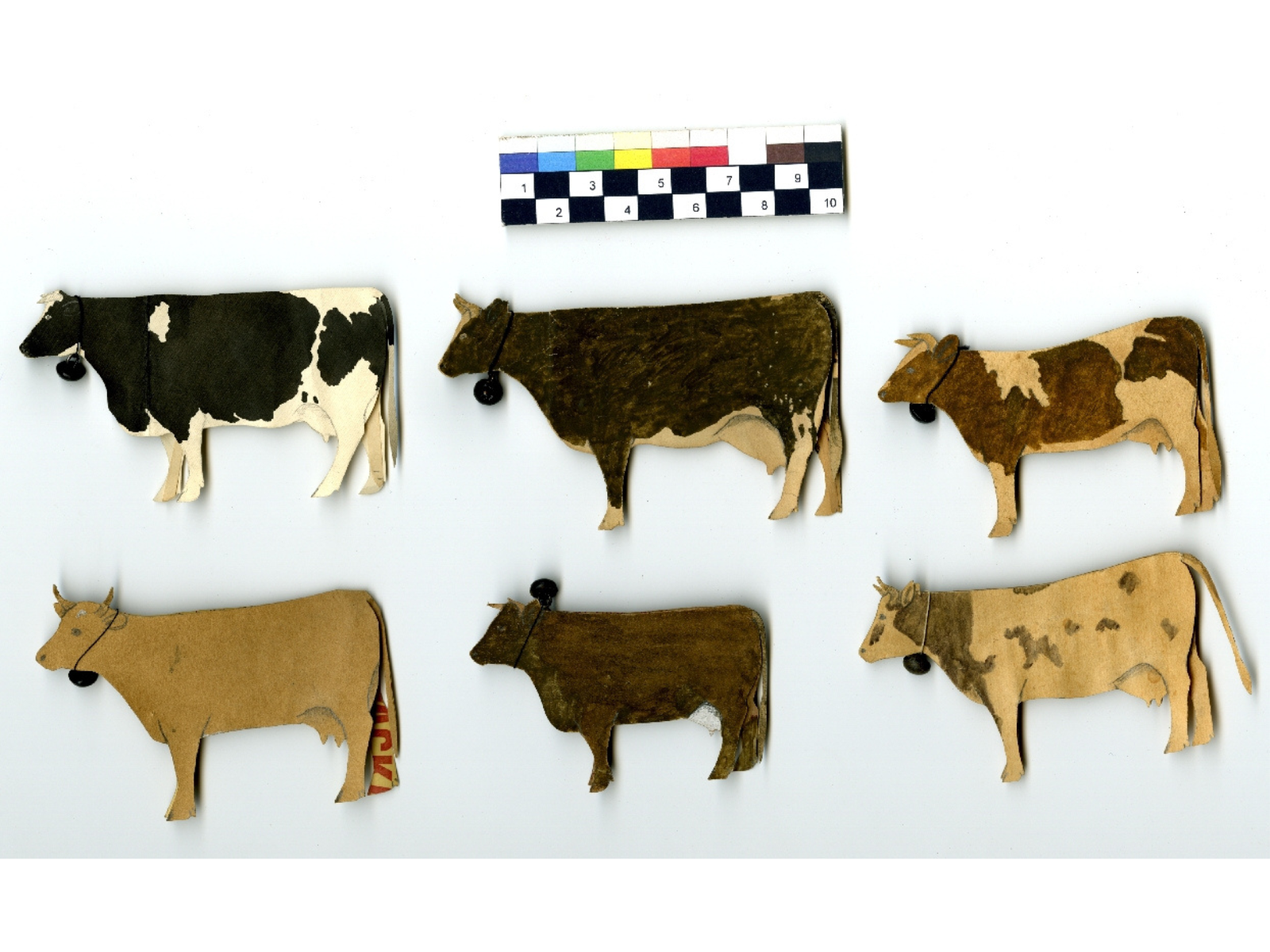
3. 129 Homemade cut-outs of Animals, including cows, bulls, horses, and dogs, made by Alma Criddle, circa 1909. According to Criddle-de-diddle-ensis: A biographical history of the Criddles of Aweme, “the cows were such favorites that [Alma] made paper replicas of them, instead of the usual “paper dolls” of childhood.” She cut out animal bodies from scraps of paper and used watercolours to tint the animals, replicating their unique looks. In the case of the cattle, Alma wrote the name of each animal near its belly, including bulls Carrot, Rhubarb and Radish and cows Rice, Nectar, Sylvia, Myrtle, White Rose and Pansy. I seriously had a huge smile on my face the entire time I worked on these paper animals.

Fifteen diligently hand-painted paper cut outs of cows.

Six diligently hand-painted paper cut outs of cows.

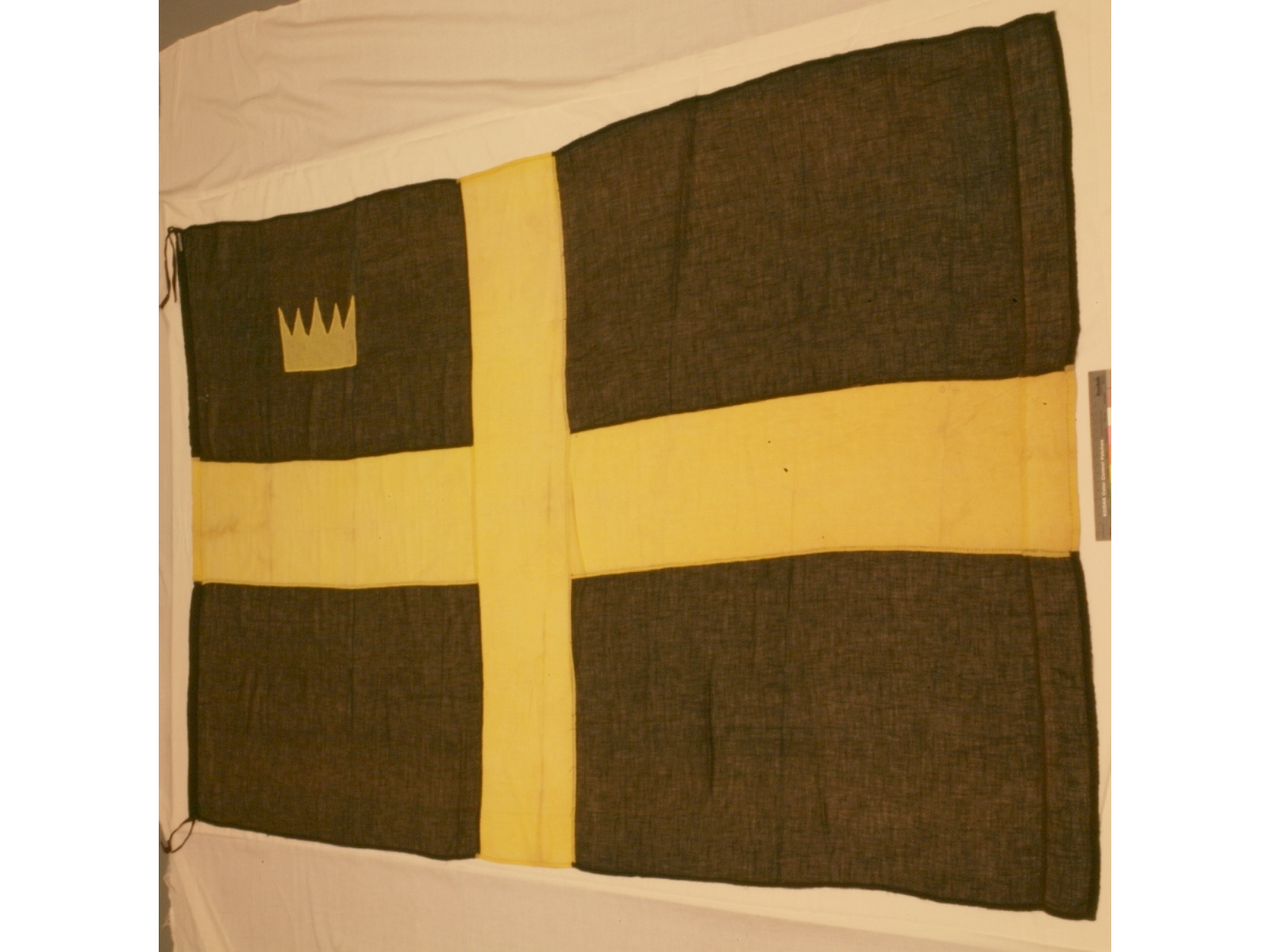
A large flag in brown material with a yellow cross through it. In the upper left quadrant is a yellow crown.

4. The St. Albans house flag was made by Alice Criddle in 1888. St. Albans was the title Percy assigned to the family home at Aweme, in the tradition of great English houses. Why he chose the name is never explained in his diaries, although his granddaughter speculates at length why he may have selected St. Albans in her book “Criddle-de-Diddle-Ensis”. The flag is well preserved and I love that it lends to Percy’s established reputation as an eccentric.

Now that the work is complete, I find myself feeling a mix of relief and longing – I’ll miss this peculiar homesteading family but other collections beckon. Stay tuned!

Cortney Pachet

Cortney Pachet

Collections Technician – Human History

Cortney Pachet started working at the Manitoba Museum in 2001 as a tour guide while earning her a BA (Honours) from the University of Winnipeg. She quickly realized that she wanted a career in museums…
Meet Cortney Pachet

Adventures of a Summer Student

As a child, the Manitoba Museum was my favourite field trip destination. I loved it all, but my favourite part was the Urban Gallery- particularly Madame Taro’s small apartment, which I thought was quite glamorous. Visits to the museum— either with classmates or family— activated my interest in history and museum work, and this summer I was given the opportunity to join the team through the Young Canada Works program as Collections and Conservation Assistant.

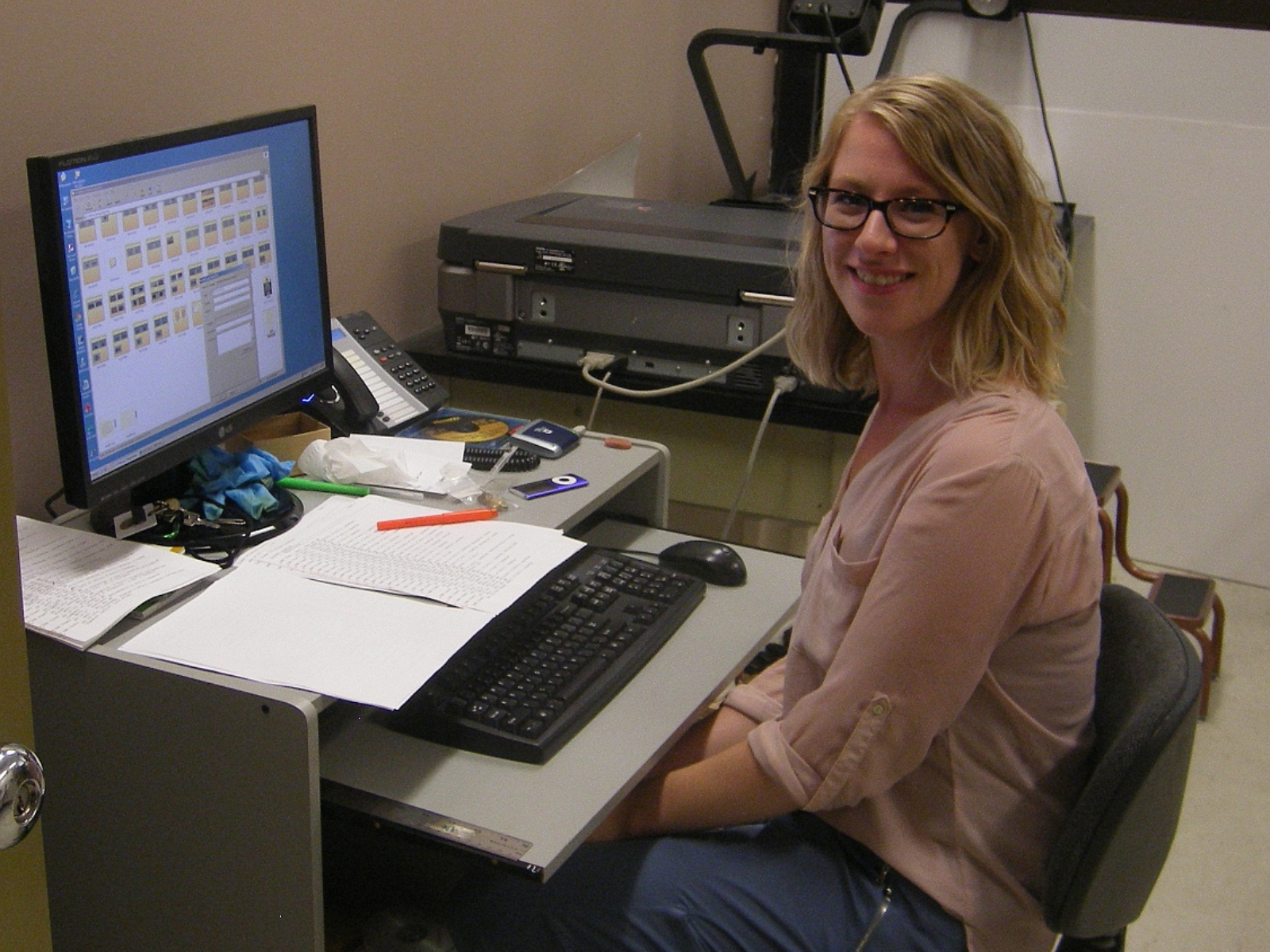
Summer student Jenna smiles towards the camera from her seat at a desk and computer.

One of the first projects I took on was identifying locations for human history artifacts whose locations are “unknown” in the database – 527 artefacts, to be exact. It could be summed up as a glorified treasure hunt. I spent a good few weeks going through the human history storage room— climbing up ladders, rifling through drawers, looking for catalogue numbers on hundreds of artifacts— and finally whittled the number down to 188! This was certainly one of my favourite projects of the summer. It was really fascinating to explore the variety of objects in the collection – everything from night caps to an Oh Henry bar package.

Throughout the summer I performed various forms of preventive conservation. At the end of each month I went through the galleries, labs, and storage vaults throughout the museum to take temperature and humidity measurements, as well as check the bug traps (yikes!). In August, a few of us went down into the hold of the Nonsuch to take taper gauge and trammel rod measurements to determine if the wood of the ship had expanded or contracted in the last six months. Even being on the ship for a couple hours felt a bit claustrophobic – I can’t imagine sailing for months at a time! In addition to these larger projects, I made boxes, altered mannequin forms, and recovered the bales in the Nonsuch gallery. The skills I had learned in 8th grade Home Economics finally paid off.

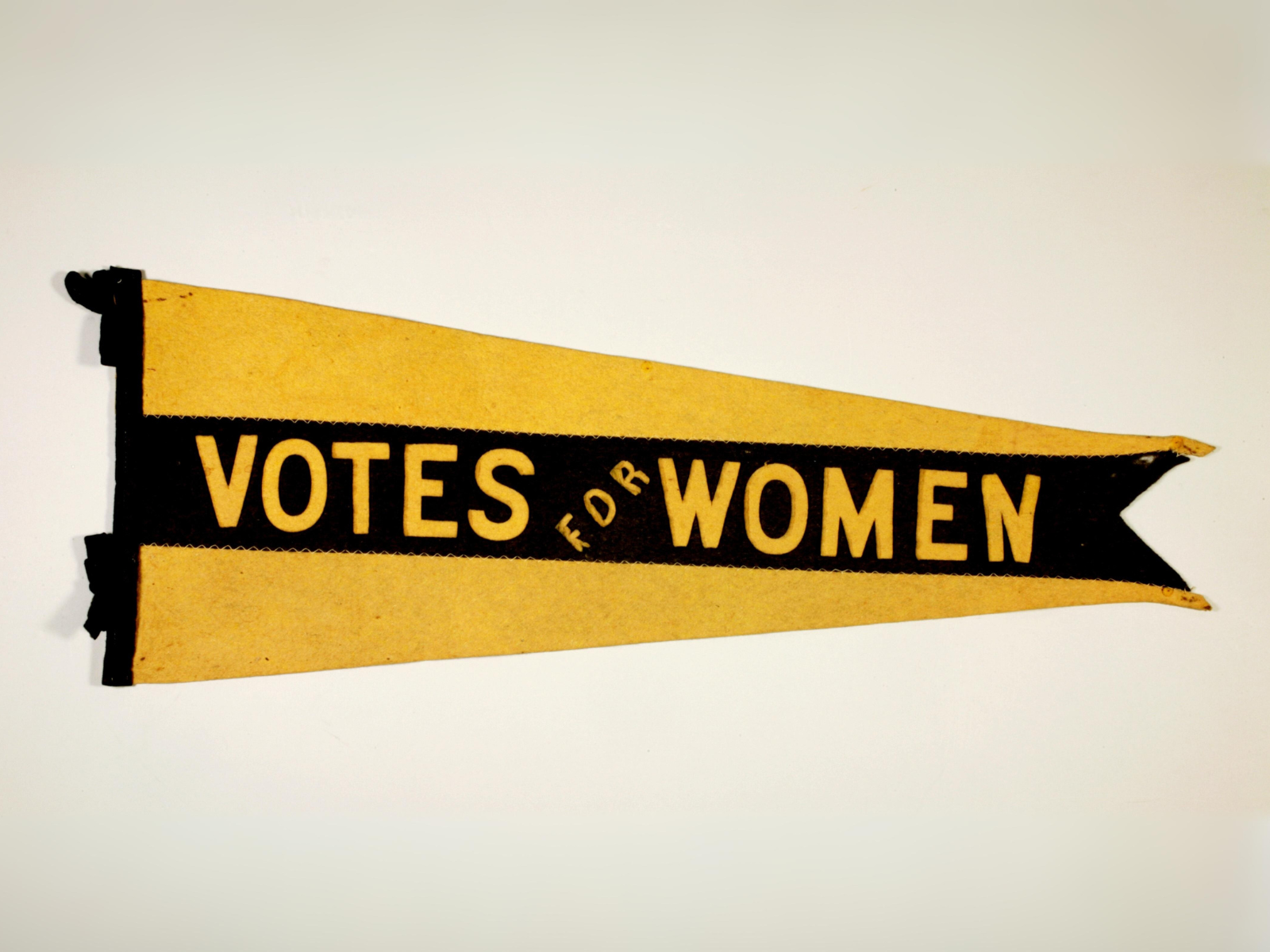
Elongated triangular flag. The background is yellow wiith a thick black stripe stitched on top reading “Votes for Women” along the centre.

Perhaps one of the coolest things I did this summer was make a replica of a felt pennant for the upcoming “Nice Women Don’t Want the Vote” exhibit (which potentially thousands of people will see – no pressure!). Because the original artifact is quite worn and faded, a replica is more suitable to send along with the travelling exhibit to prevent further damage. Although I was a bit concerned about my lack of sewing and crafting skills, I am incredibly happy with and proud of the final product. The theme of the exhibit—women’s suffrage in the early 20th century—has been an interest of mine for quite a few years, and to be involved in the exhibit in any way was really incredible.

I had a great time at the museum this summer and was able to work on projects in many different areas of collections and conservation. The skills I built on and developed will no doubt open more opportunities for me in my (hopefully) museum-based future. The entire experience—the work and the people—was incredible, and I hope to be back here in the future!

Hey – Who’s that Mann?

There are two new exhibits opening this summer in our Parklands/Mixed Woods Gallery here at the Manitoba Museum and we couldn’t be more excited to soon be able to share our work! The Conservation lab has been working hard these past few months to get everything documented, cleaned, and mounted for its grand debut, including a very important Mann. Yes, this Mann was in fact a man, more fully known as William Mann, William Pennefather or Chief Kakekapenais, who signed Treaty No. 1 at Lower Fort Gary on behalf of the Fort Alexander Band (now Sagkeeng First Nation).

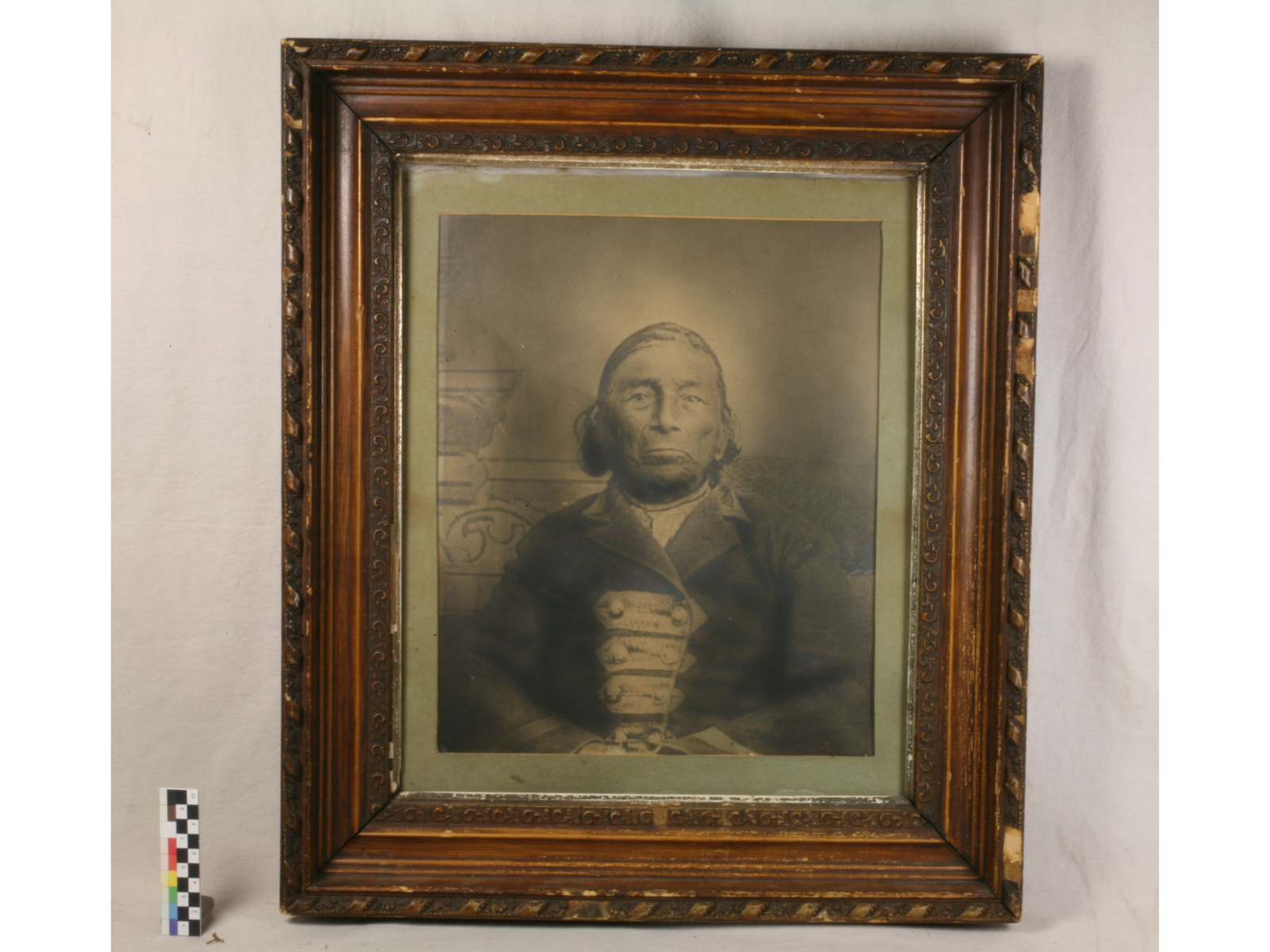
An original photographic silver-gelatin print of William Mann taken around the same time as the signing of Treaty No. 1 in 1871 was recently acquired by the Museum; however, the condition of the photograph was quite poor. As the Manitoba Museum is on Treaty No. 1 land, it is important for us to display such a prominent figure and significant artifact in our galleries; but to ensure its long term preservation, it first required a careful touch from our conservators before it could be hung on the wall.

Smoke, water, and mould damage, as well as acidic backing materials and pollutants in the air causing the photograph to have a mirrored finish, were all contributors to the poor condition of the Mann photograph. The frame was also very dirty and had numerous areas of broken plaster molding. So we said – hey, let’s fix it all!

But with many artifacts there are challenges a conservator faces and this artefact proved to be one of them. As much as we want to be able to clean and revive artifacts to their former glory, sometimes certain conditions do not make it possible. After several spot tests on the front of the photograph it was found that we wouldn’t be able to clean it without risking more damage to the emulsion (the photo-sensitive side of a photograph). In this case the best thing to do was nothing!

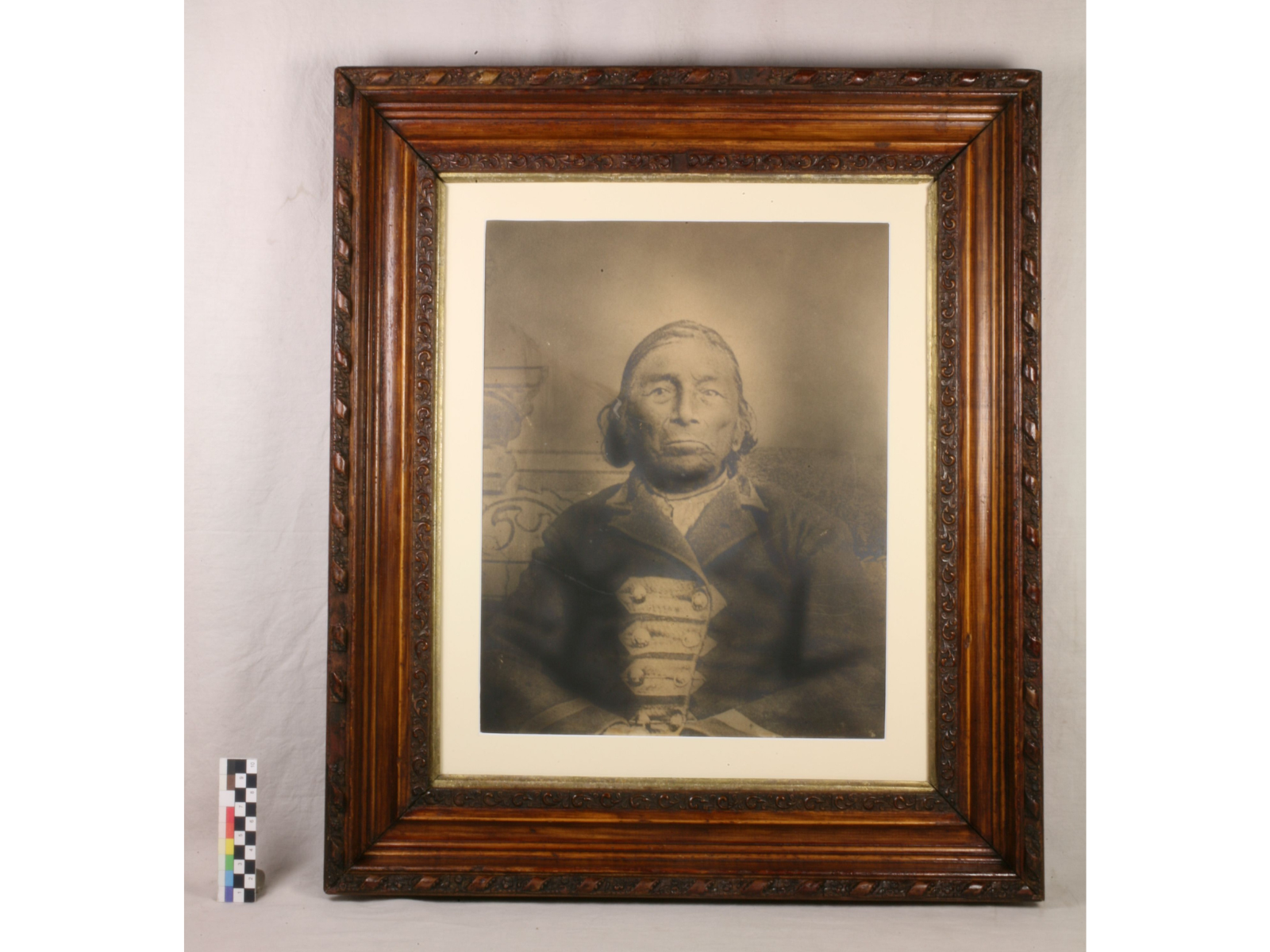
The cleaning and repair of its original frame proved to be much more successful. After swabs and swabs of grime were removed and the gaps filled, the frame looks like a million bucks. We re-matted the photograph with acid free materials for its long term care and at the end – to our complete surprise – the features and contrasts in the photograph actually became more visible, even though we hadn’t intervened at all. Sometimes prevention is the best form of conservation.

With a few more weeks to go before this new exhibit opens, I have provided a few before and after images of the Mann photograph as a sneak peak of what changes are coming to our galleries.

A sepia toned formal photograph of a serious-faced man, seated against a faint backdrop and where a military-style coat. The photograph is in a ornate wooden frame. Both frame and photograph look aged, and a little worn and torn. The matte around the photograph has aged to a greenish colour.

The Mann photo before treatment.

A sepia toned formal photograph of a serious-faced man, seated against a faint backdrop and where a military-style coat. The photograph is in a ornate wooden frame. The frame and glass have been cleaned, and the matte replaced with a fresh white one, making the features and contrasts of the image clearer.

The photo after treatment.

Carolyn Sirett

Carolyn Sirett

Senior Conservator

Carolyn Sirett received her B.A. in Anthropology from the University of Manitoba, Diploma in Cultural Resource Management from the University of Victoria, and Diploma in Collections Conservation and Management…
Meet Carolyn Sirett

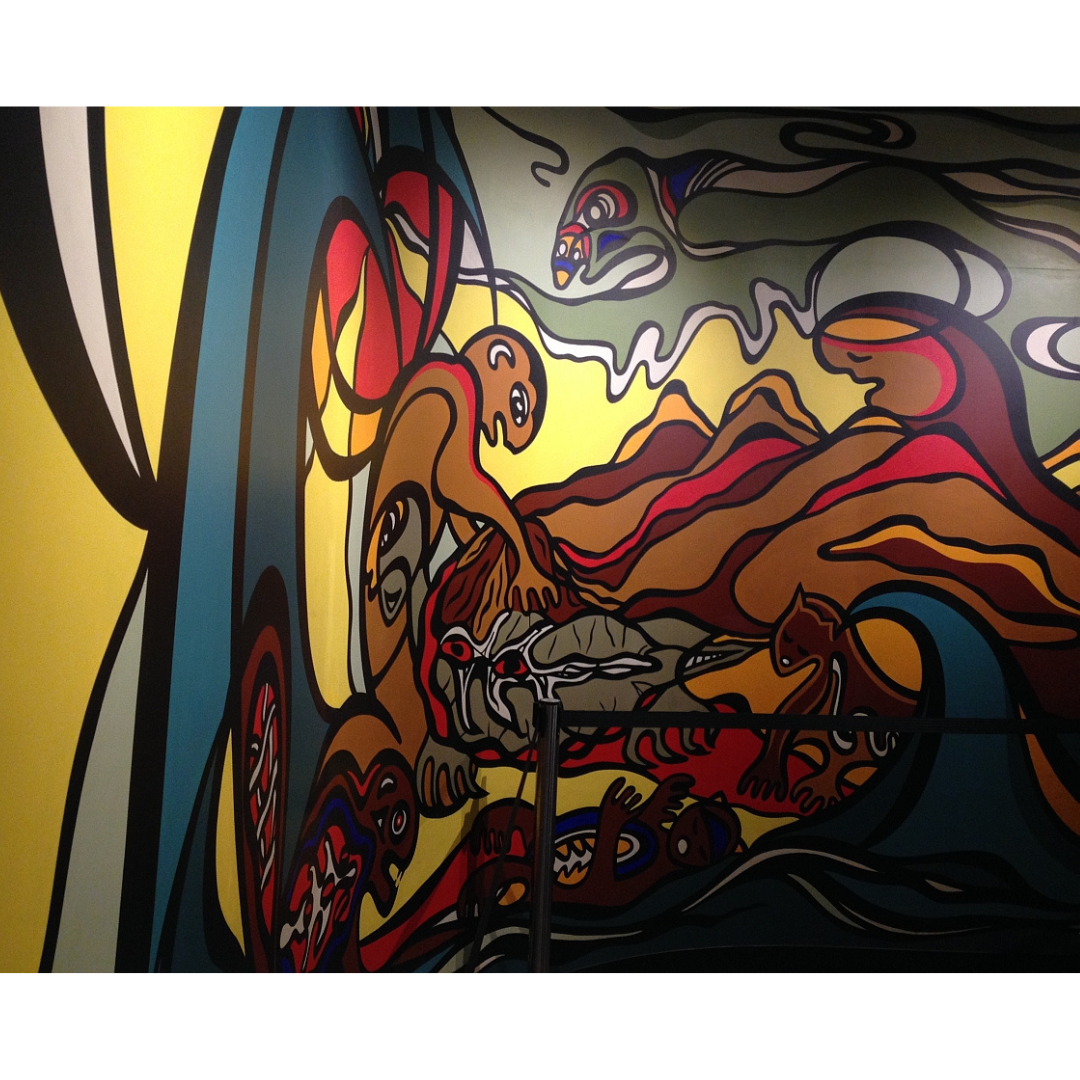
Inspiring Daphne Odjig mural back to its original glory

When people ask me what inspired me to work in the museum field, I can pinpoint my answer to a single visit to The Manitoba Museum when I was twelve years old. That summer we spent our vacation touring around Manitoba on day trips, packed into our Pontiac 6000 station wagon, visiting small local museums and landmarks that set one little town apart from the next (here’s looking at you, Sara the Camel!). On the roster of things to see was The Manitoba Museum of Man and Nature (as it was called back then). Thanks to my babysitting job, I was armed with a newly purchased camera and ready to capture every moment of our visit. Rounding the corner away from the bison that greeted us in the first gallery, I stopped. There it was, colourful and bold, larger than life. The mural. Snapping a photo, I decided at that moment, I needed to work at a museum. I still can’t say for certain what it was about that mural that led me to this epiphany, but twenty years later, here I am, working at the museum, blogging about it.
Daphne Odjig, a Potawatomi artist from Ontario, was commissioned to paint the mural, “The Creation of the World”, in 1972 as part of the Earth History gallery. Odjig was living in Manitoba at the time and later went on to cofound the Professional Native Indian Artists Incorporated with artists such as Jackson Beardy, whose works also appear at The Manitoba Museum. As I studied Odjig’s larger oeuvre in university, I came to appreciate the uniqueness of “The Creation of the World”, both in its subject matter and execution. Odjig’s paintings often depict human relationships, focusing on mothering, with images composed of darker, more muted colours bordered by softer lines while still harkening to the Woodlands School style “Creation” celebrates.

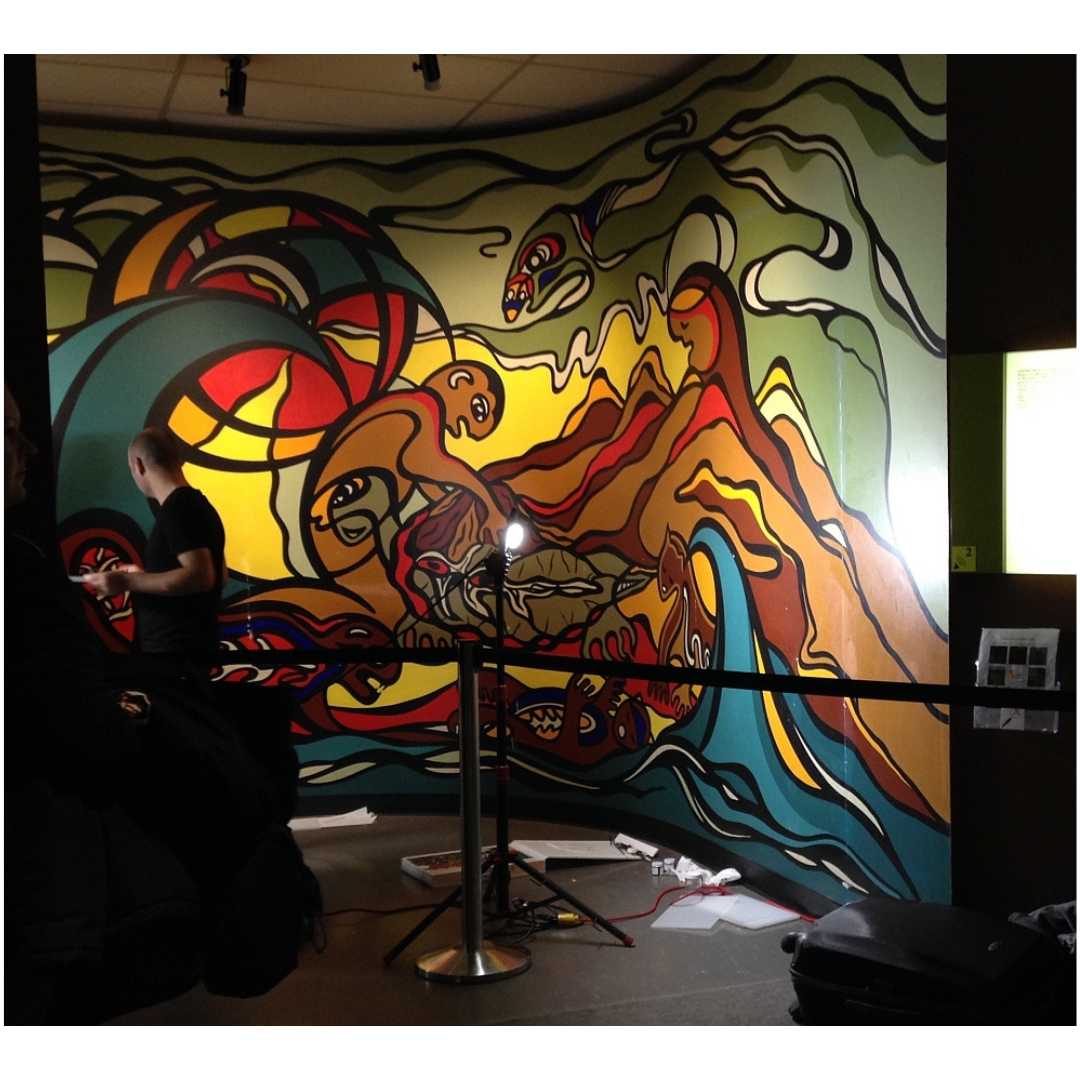
Forty-two years on display had begun to show on the face “The Creation of the World”…pencil marks, gouges from countless strollers crashing into the curved wall, cracks from the shifting plywood have marred the surface of Odjig’s beautiful contribution to the museum. On Valentine’s Day, art conservator Radovan Radulovic and his assistant Vitaliy Yatsewych began a three day restoration of the mural, a process of cleaning, filling in holes, and painting. Radulovic describes the work as trial and error; creating a colour by mixing acrylic paints, painting a spot, letting it dry, deciding if the colour matches the original and starting again, if necessary. The aforementioned cracks, however, are impossible to repair without going in behind the mural or removing it altogether. For the time being, Radulovic and Yatsewych, by all accounts, have brought “Creation” back to its former glory. The addition of a rail guard will prevent errant strollers and carts from damaging the mural and new exhibit panels will put further emphasis on this cherished piece.

A brightly coloured wall mural on a concave wall. Stantions are set up in front of it with lights on tripods, so facilitate the conservators' work.

Work begins on the mural.

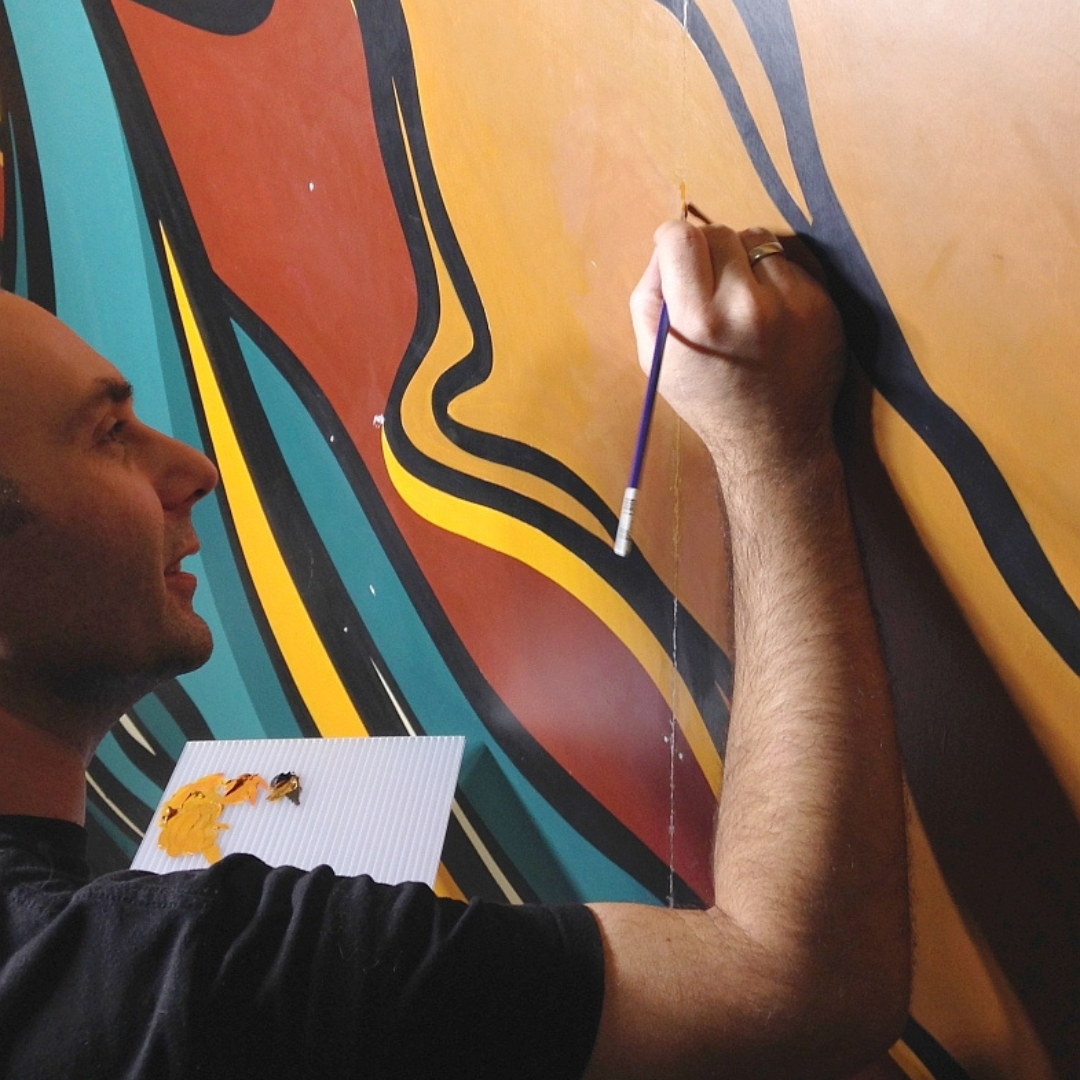
Close-up from behind and to the side on a person holding a paint palette and a paintbrush, touching up a orange portion of the mural.

Conservator Radovan Radulovic works on large crack in mural.

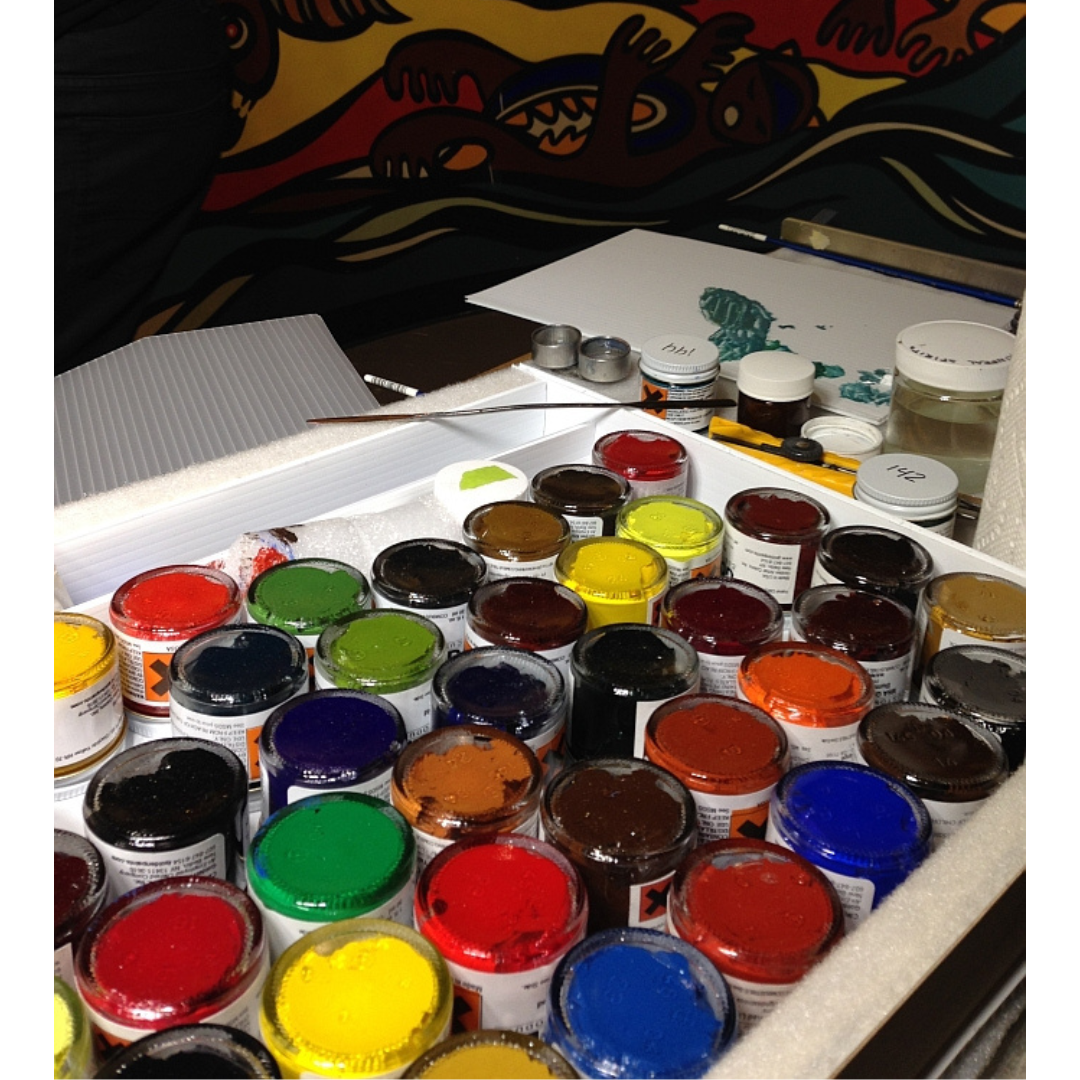
A tray of paint pots in a range of bright colours, with greens, reds, blues, browns, yellows, and more.

A paintings conservator’s tool kit.

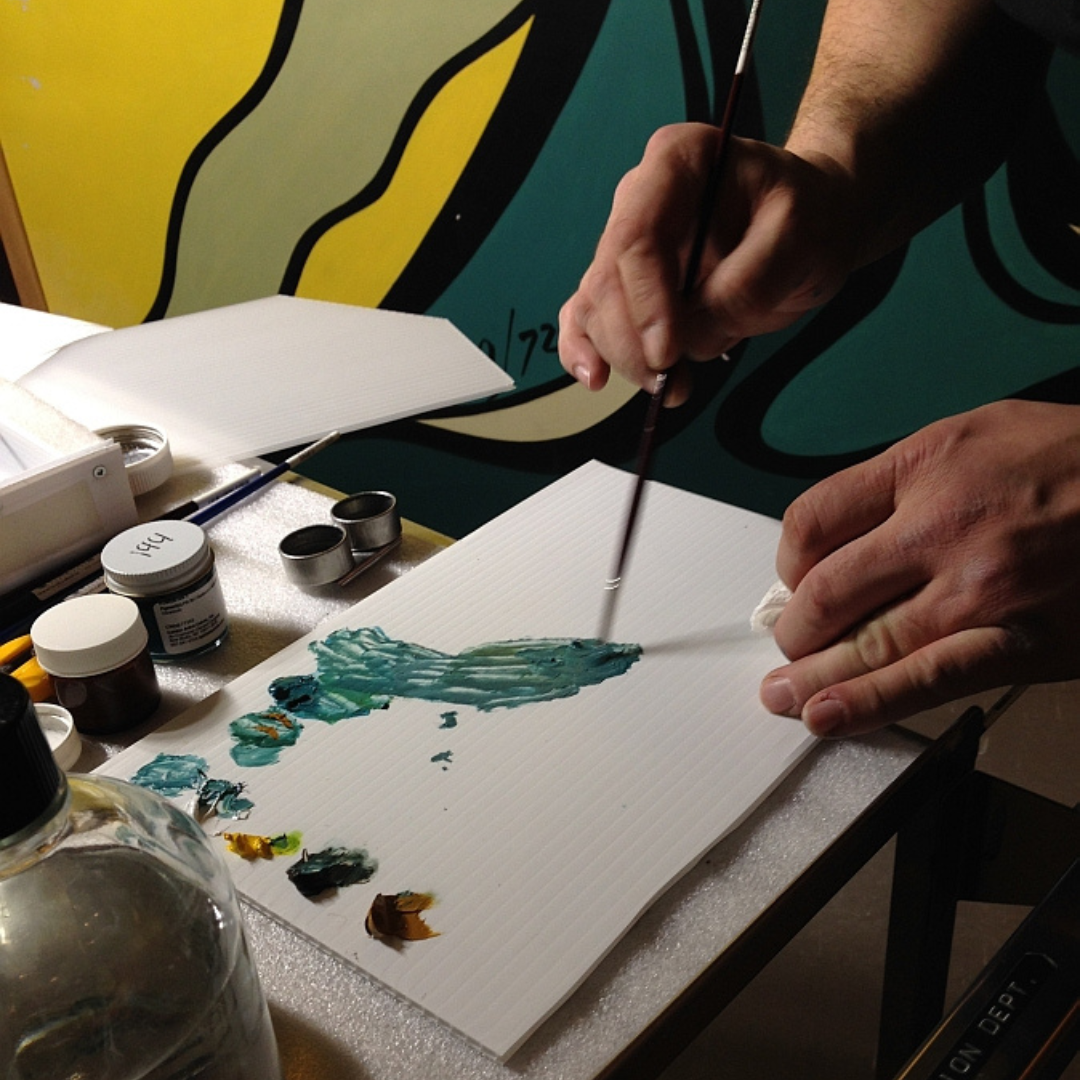
Close up on a person's hands as they mix a custom teal blue-green colour of paint on a board.

Vitaliy Yatsewych mixes colours to create the perfect match.

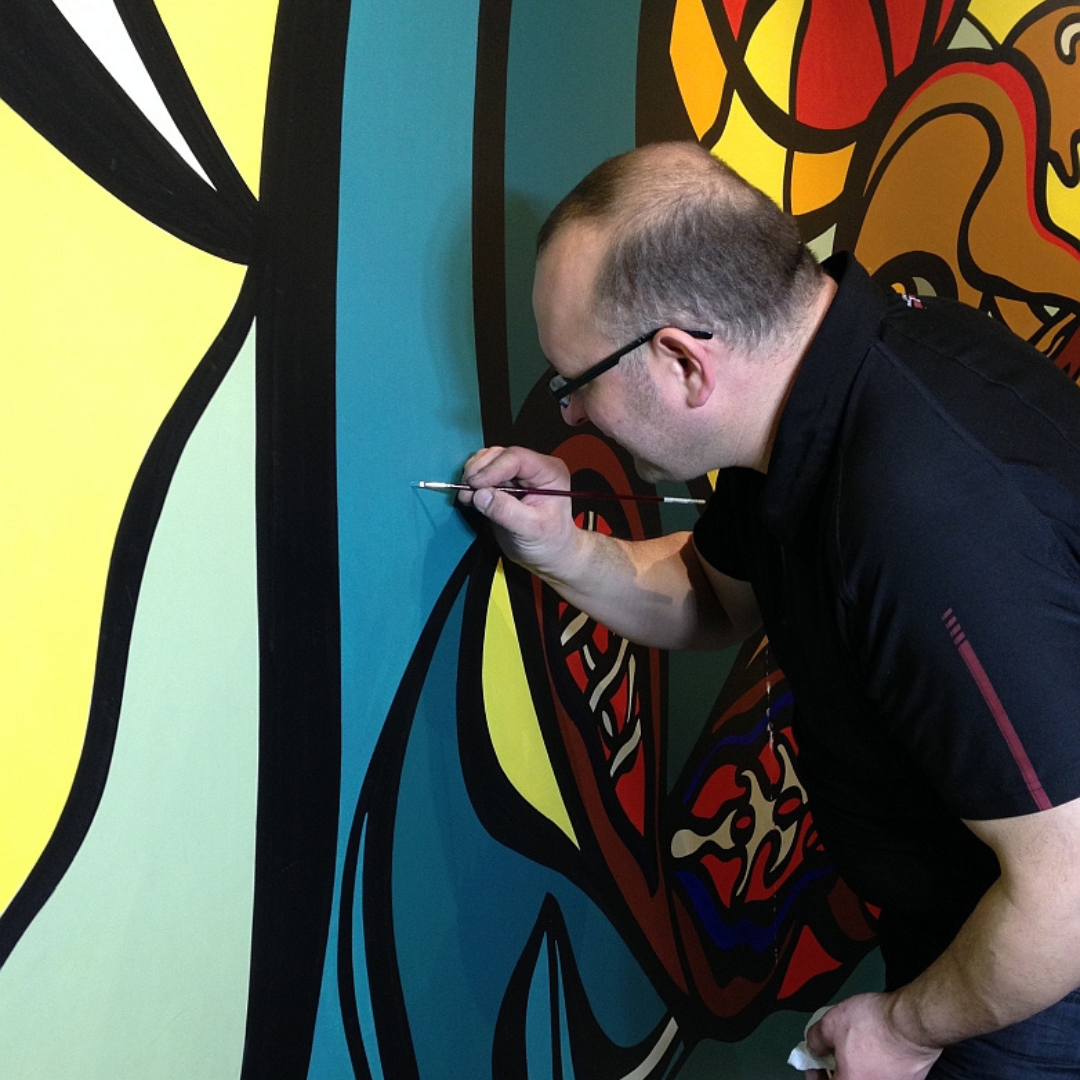
A person painting a very small test spot on a portion of medium blue on the mural.

Yatsewych tests out the colour he created on the mural.

The retouched "Creation of the World" mural, in bright colours on a concave curved wall.

The finished product.

Have a good look at “The Creation of the World” the next time you visit The Manitoba Museum. Marvel at its scale. Absorb the colours. Take a photo. Appreciate its creator and those who continue to preserve it for future museum-goers (so, don’t touch it, ok?).

Cortney Pachet

Cortney Pachet

Collections Technician – Human History

Cortney Pachet started working at the Manitoba Museum in 2001 as a tour guide while earning her a BA (Honours) from the University of Winnipeg. She quickly realized that she wanted a career in museums…
Meet Cortney Pachet

We’re Back in the Rigging Again!

By Kathy Nanowin, past Manager of Conservation


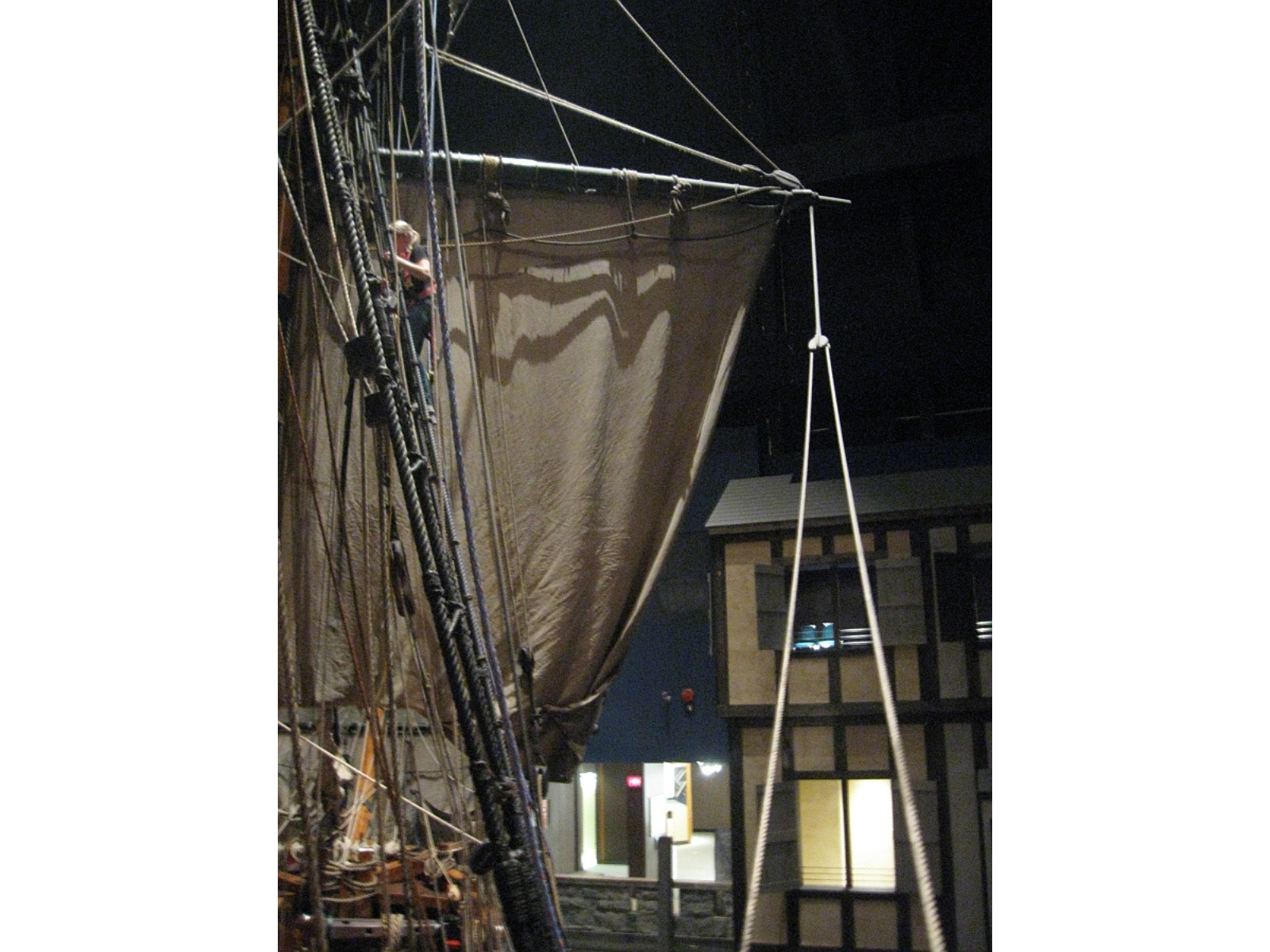
Well, after thirteen years or so, the Museum’s conservators are back climbing in the Nonsuch rigging, in order to check and clean the lines, sails and masts. This is a very exciting development for Collections and Conservation.

A bit of background information – amendments to Manitoba’s Workplace Safety and Health regulations in 2002 resulted in stricter requirements for workers climbing at heights. The Nonsuch therefore had to be provided with fall arrest lines, in order that workers could safely climb up in the rigging. The Manitoba Museum worked for the next several years to design, cost and install appropriate safety lines from the gallery ceiling. Additionally, the staff who would be doing the climbing had to take Fall Arrest training; and the Museum had to have a written Safe Work Procedure detailing how the climbing will be done.

Finally, everything has been put in place, including the purchase of safety harnesses designed specifically for women, as the two conservators who will be climbing are both female.

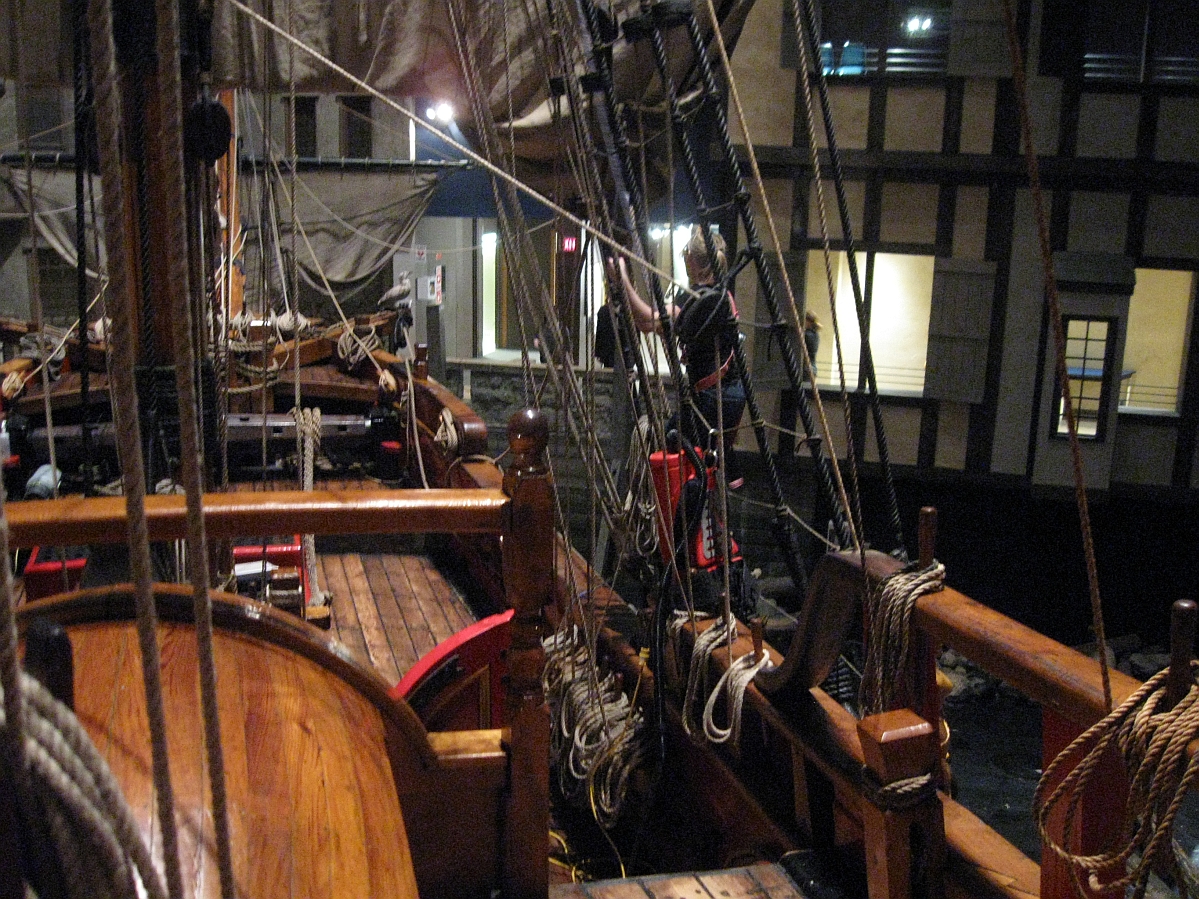
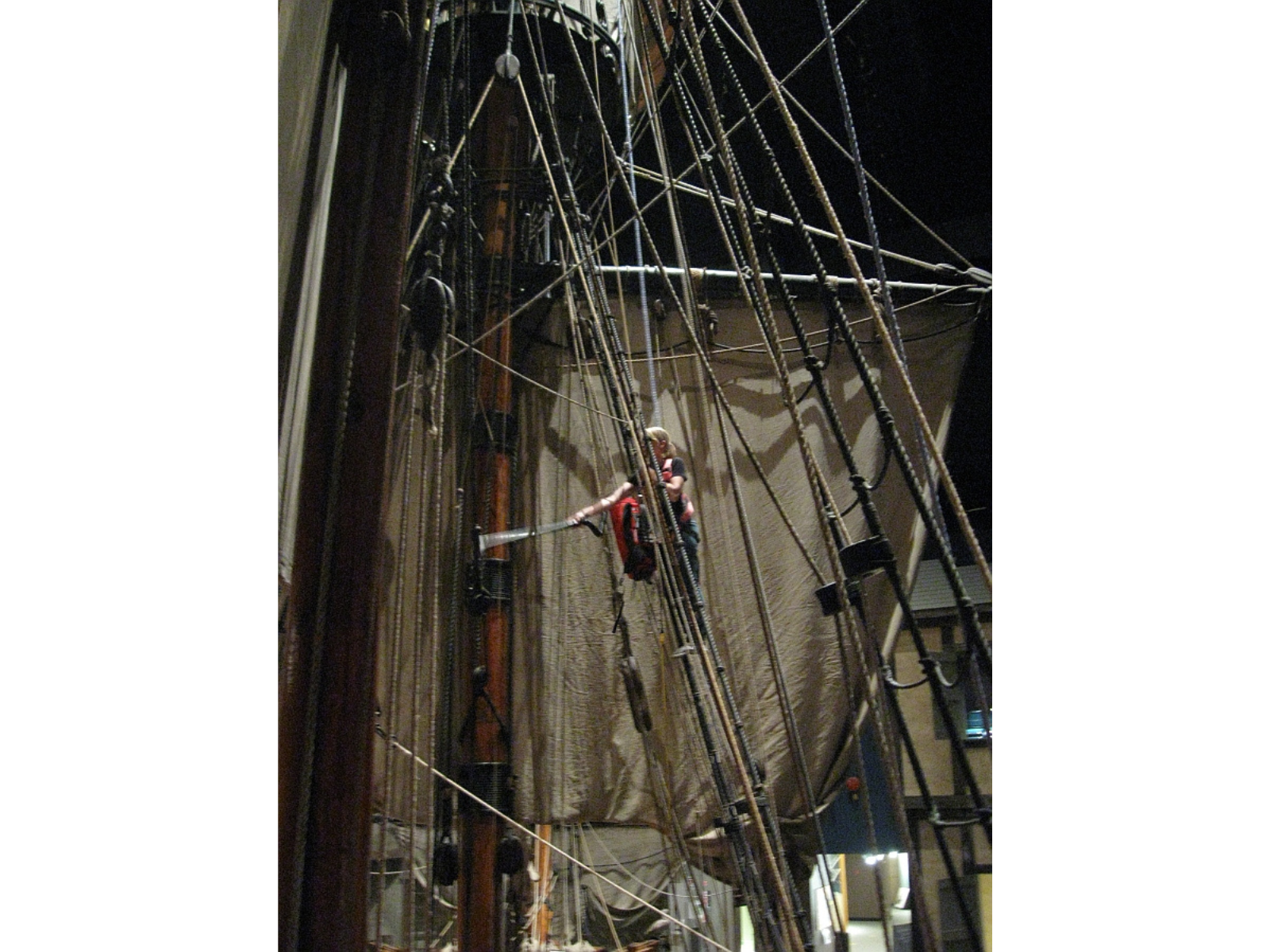
Conservator Carolyn Sirett was the first to go up and look at how dusty the main yard and mainsail were (very dusty!). She then came back down and we decided that she could carry up the backpack vacuum that is normally used to clean on board the ship.

An individual in safety harness climbing the ratlines of a wooden sailing vessel (the Nonsuch) in full sail.

Carolyn on her first climb.

An individual in safety harness on one of the side rails of a wooden sailing vessel (the Nonsuch), preparing to climb up the ratlines with a backpack style vacuum cleaner.

Carolyn starts to climb with the vacuum.

An individual in safety harness part way up the ratlines of a wooden sailing vessel (the Nonsuch) with a backpack style vacuum cleaner held in front of them through the ratlines.

Here she is partway up the ratlines.

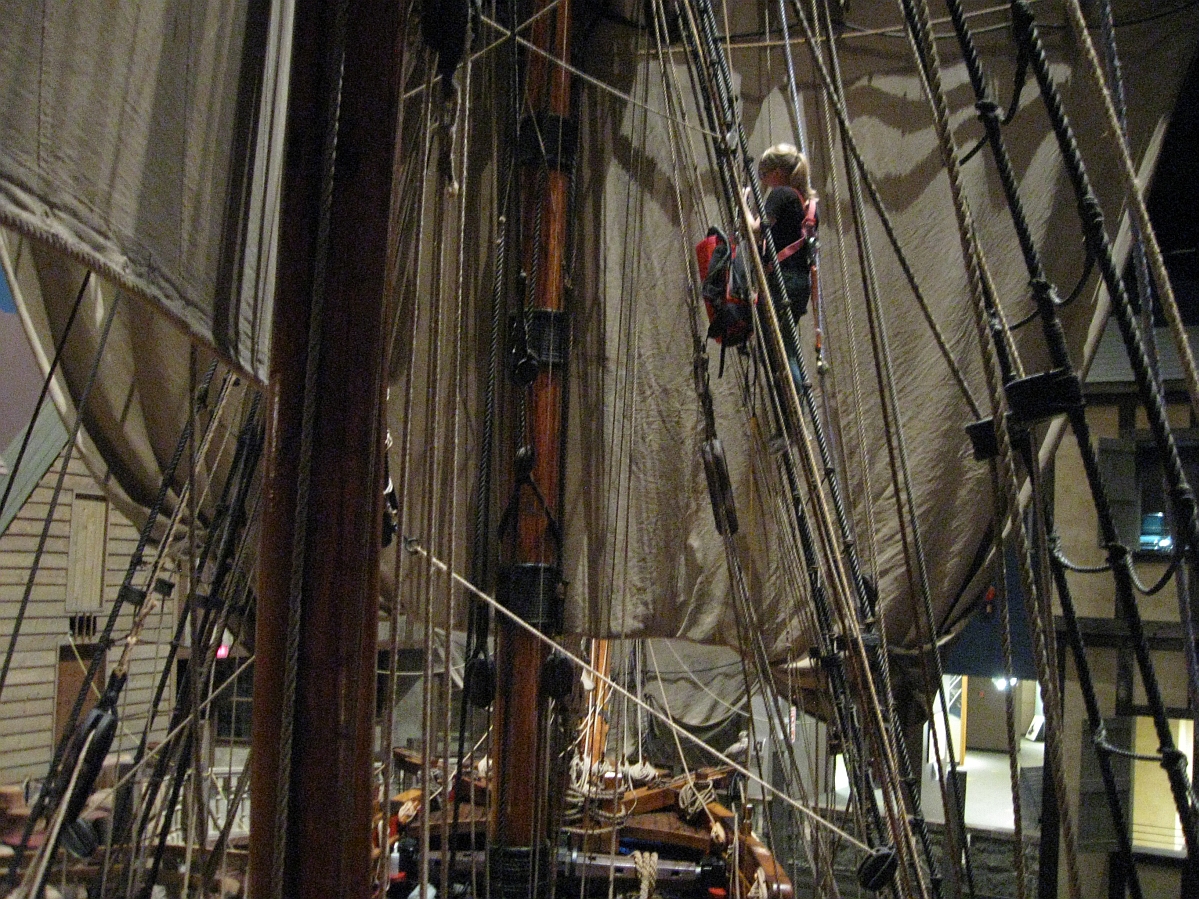
An individual in safety harness part way up the ratlines of a wooden sailing vessel (the Nonsuch) with a backpack style vacuum cleaner. They are reaching through the ratlines towards the mast with the vacuum hose.

Carolyn was able to vacuum most of the dust off the starboard side of the mainsail, main yard and the footropes on the main yard.

We will continue to climb up in the rigging as time allows. Mondays during winter hours are best, as it takes time to prepare – check harnesses, get supplies – and we can’t let any visitors on board while someone is working aloft. The Museum will soon be moving to summer hours, so after next week, the work will most likely stop until the fall.

In future, instead of hauling a vacuum up into the rigging, we will be using a converted central vacuum that belongs to the Planetarium/Science Centre. It has a 50-foot long hose, so only that will have to be carried up; it will be much easier.


Image: Vacuuming the main mast.

We will continue to clean off the Nonsuch rigging over the next fall/winter season. Dust can be damaging as well as unsightly, so it should be removed whenever possible. I hope to post some before and after images that will really demonstrate how much dust we’ll be dealing with!

Where the Dead Things Are

Recently, Melissa Pearn, our Cataloguer of Natural History collections went on maternity leave. She wrote this blog entry before she left.


As a Natural History cataloguer, I have the opportunity to work with some very interesting specimens. I love that my job involves all three areas of natural history – botany, zoology (mostly entomology), and palaeontology/geology. Having studied pollination and reproduction of Lady’s Slipper orchids for my Master’s thesis, I especially enjoy working with the botanical and entomological specimens. It’s fascinating to get to see some of the plants and insects that I have heard or read about, but have never had the opportunity to see in nature.

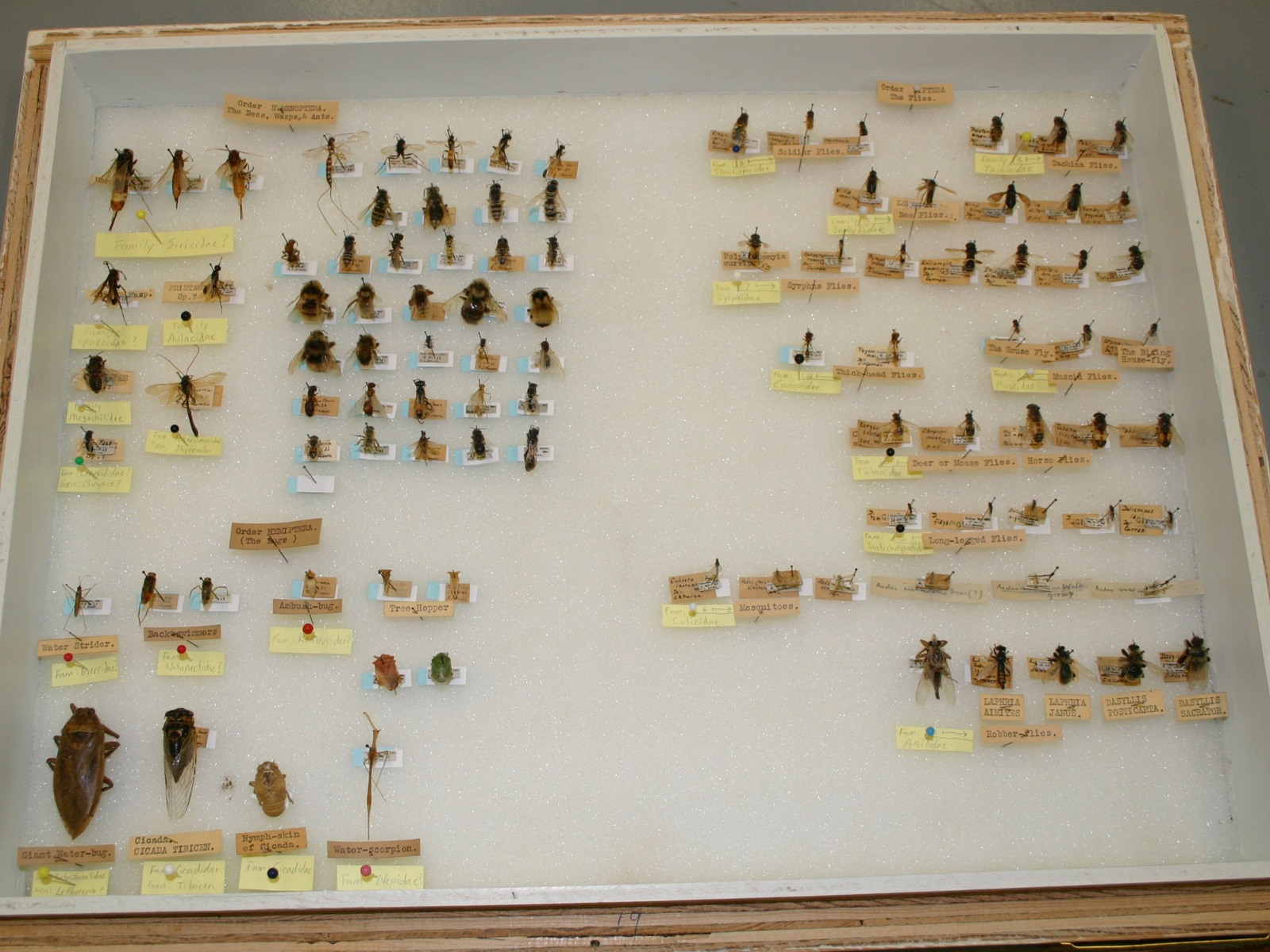
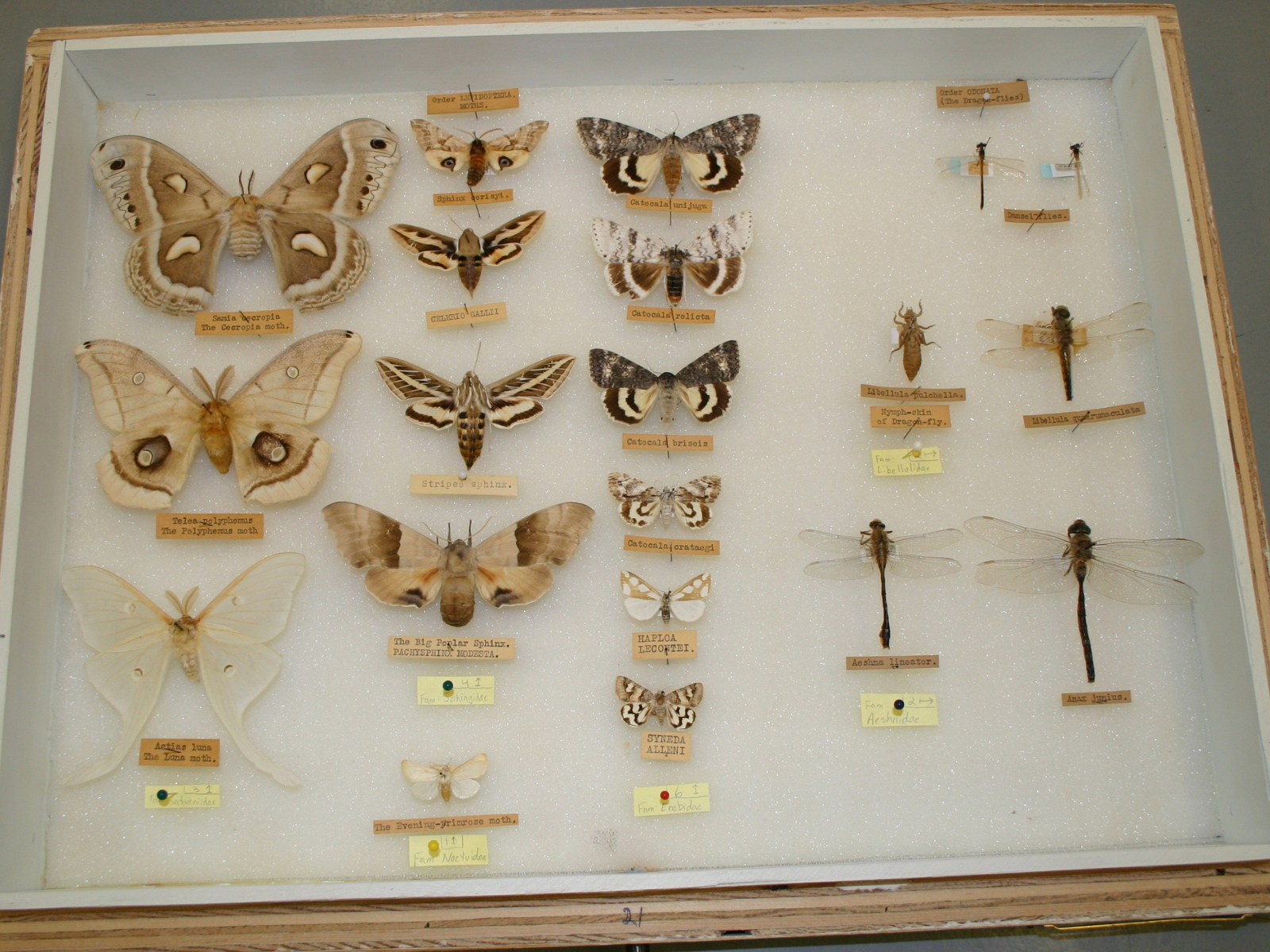
I’ve recently been cataloguing an interesting collection of Manitoba insects. The specimens were collected in the 1920’s and 1930’s, in places such as Victoria Beach and Winnipeg (especially Transcona). Not only is the collection fascinating because of its age and local origins, but also because of its diversity. Many of the specimens belong to the Lepidoptera (moths and butterflies), but the collection also includes insects from 11 other groups such as Hymenoptera (ants, bees, and wasps), Coleoptera (beetles), Diptera (flies), Hemiptera (the true bugs), and Odonata (dragonflies), among others.

The collection was assembled by Manitoban naturalist and entomologist George Shirley Brooks. He was born in Wrentham, Surrey, England in 1872 and came to Manitoba around 1913. He was not only a founding member and president (1932-1934) of the Natural History Society of Manitoba, but also co-founder of The Manitoba Museum and author of “Checklist of the Butterflies of Manitoba”. He died in Winnipeg on October 20, 1947 and is buried at Brookside Cemetery.

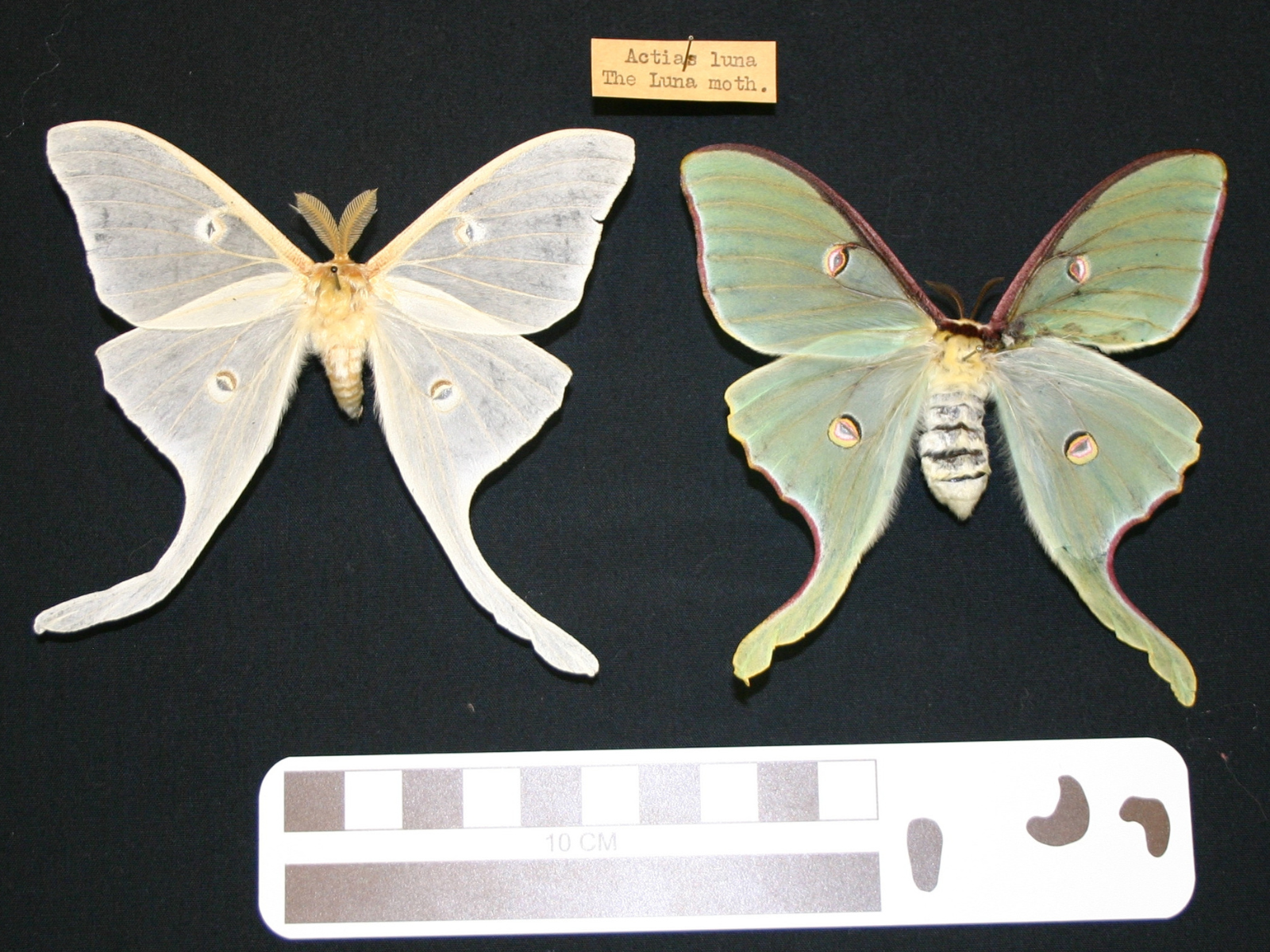
Older collections such as this one are very valuable for the information that they contain. Because many specimens have a collection date and location, they can help researchers to evaluate and determine population trends over time, or to determine the status of rare species for example. In order to maintain the integrity of these types of collections, proper storage and handling are very important. In Natural History, specimens are stored in a collections room that is controlled to create just the right temperature, light, and humidity conditions. Under less than ideal conditions, or when on display for long periods of time, specimens can become altered, as can be seen with the faded coloring of some of the moths and butterflies in the Brooks collection.

An open storage drawer containing a variety of pinned insect specimens.

Insect case with Hymenopterans (bees, wasps), Dipterans (flies) and Hemipterans (true bugs).

An open storage drawer containing a variety of pinned insects including moths and dragonflies.

Storage case with insect groups Lepidoptera (moths) and Odonata (dragonflies and damselflies).

Two pinned Luna Moths with distinct colouration differences. the wings of the moth on the left is faded nearly to white, whereas the one on the right has green wings.

Two Luna Moth specimens. Though approximately the same age, the one on the left has become severely faded.

NOTE: Melissa had a healthy baby girl on Feb. 3. She is named Ivy. The Museum staff wish her family all the best.

Joe Maruca’s “Secret” Notebook

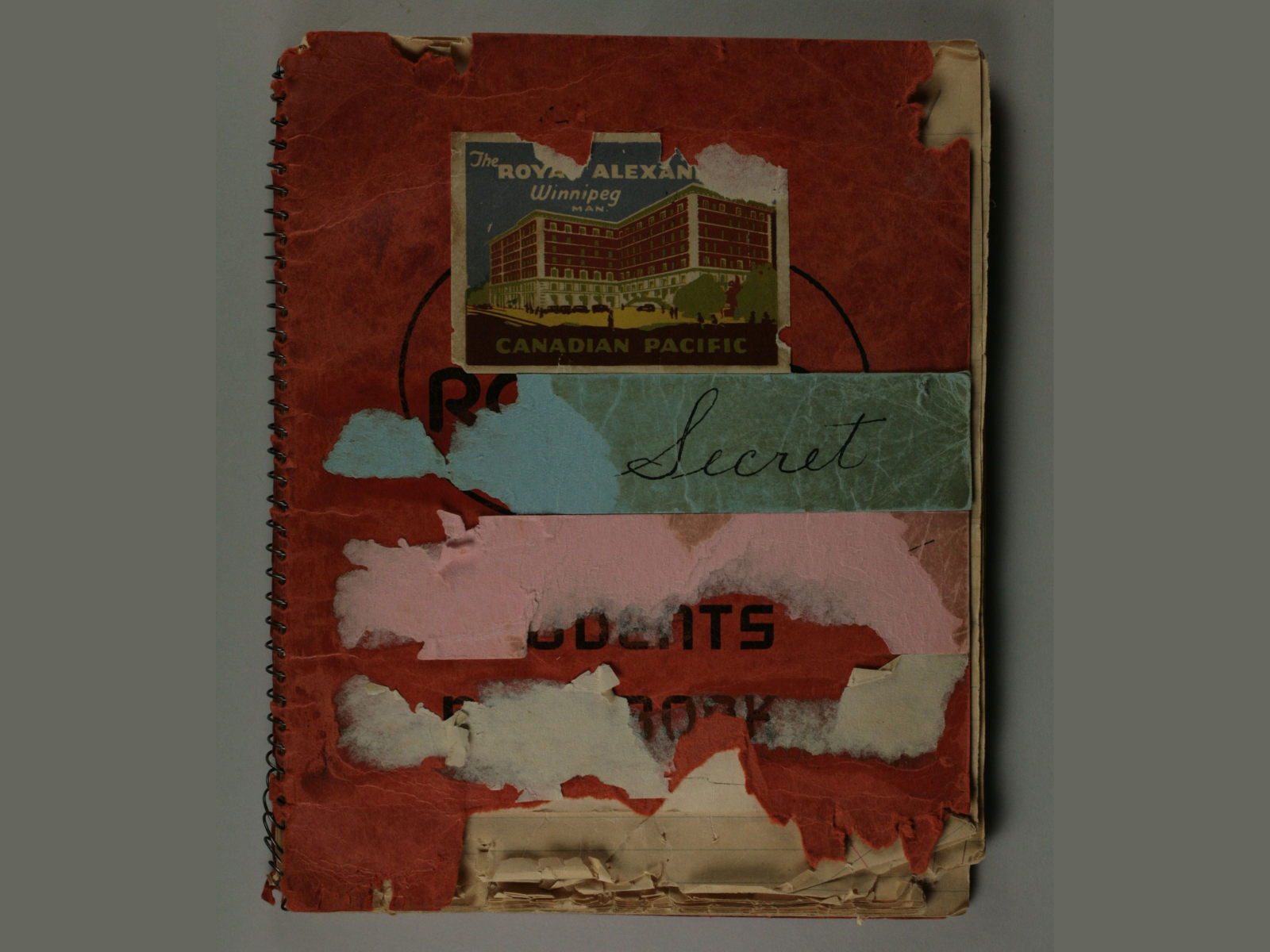
At some time or another, we have all experienced a really satisfying day at work, or perhaps more often, a day that left us wanting to vent our frustrations. Today we might use social media to voice these emotions. In the days before Facebook or Twitter, Joe Maruca documented his working life in a ‘Secret’ notebook filled with amusing cartoon sketches. 

Recently, I processed a fascinating collection of family items donated by the children of Joseph and Alice Maruca. These include a porter’s uniform, photographs, documents and the notebook. Joe’s father, Vincenzo had immigrated from Italy in 1920 and worked as a freight carpenter at the CNR shops in Transcona. In the 1950s Joe Maruca was employed as a Porter Captain at the Royal Alexandra Hotel in Winnipeg. The “Royal Alex” was part of the Canadian Pacific chain and was considered one of the finest hotels in western Canada. It opened its doors on Higgins and Main in 1906 and served as a social centre of Winnipeg until 1967. The hotel was demolished in 1971. 

A worn sketchbook, it’s red cover torn and with the remains of torn off tape or stickers. A reminding piece of blue tape reads, “Secret” below a slightly torn sticker showing an image of a large red and white multi-story building and text reading, “The Royal Alexander / Winnipeg Man. / Canadian Pacific”.

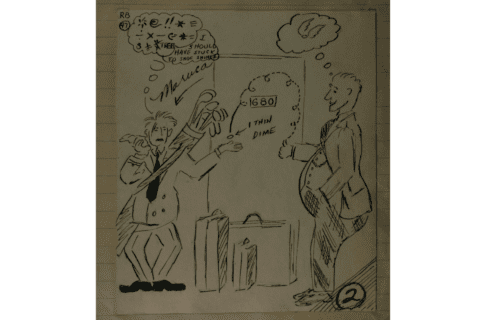
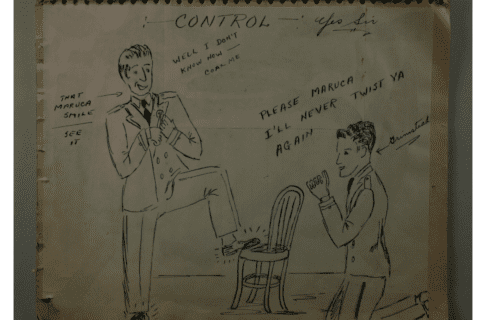
Through Joe’s sketches we can see a humorous account of the inner workings of the Royal Alexandra as viewed through the eyes of the front line staff. There is the frustration of being under tipped by a wealthy client or being “twisted” by a co-worker. The word twist can be as slang expression meaning to cheat or have something wrench from your grasp – when a fellow porter takes your next client and tip! We also see Joe as the hero of the story and a bit of a lady’s man. 

Cartoon sketch showing a round man flicking “1 thin dime” to a struggling porter holding a bag of golf clubs and standing beside three suitcases. A bubble above the porter’s head reads, “I should have stuck to shoe shines”.
“One Thin Dime” sketch by Joe Maruca
Cartoon sketch showing a man on his knees in front of another man who stands filing his nails, with one foot up on a chair. The standing man saying, “Well I don’t know – coax me”, while the kneeling man says, “Please Maruca I’ll never twist ya again”. Sketch title at the top reads, “CONTROL / Yes Sir”.
“Control”
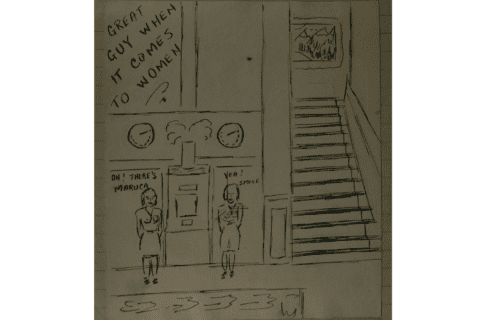
Cartoon sketch showing two women standing near the foot of a large flight of stairs with a framed mountain landscape hanign above the landing. One woman says, “Oh! There’s Maruca” and the other says, “Yea! Smile”. In the upper left corner is written, “Great guy when it comes to women”.
“A great guy when it comes to women”

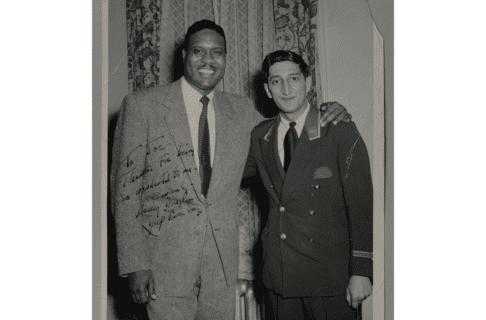
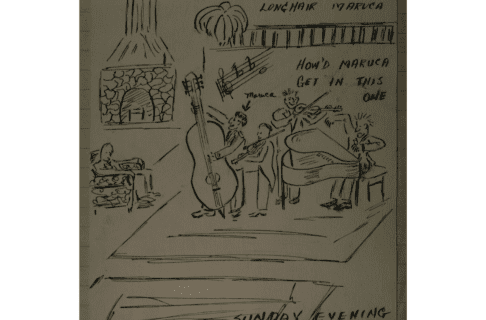
The Royal Alex was home-on-the-road to musicians who came to play at the hotel or local hotspots such as the Don Carlos night club. Included in the donation is a collection of signed photographs of notable African-American musicians of the era – The Mills Brothers, The Charioteers, Nellie Lutcher and The Deep River Boys. Joe enjoyed a positive reputation among these performers and the service he provided would have been in marked contrast to the discrimination they faced at segregated American hotels in the 1950s. “When you’re in Winnipeg ask for Joe, he’ll take good care of you” was the message passed among the performers. A couple of his sketches suggest that Joe may have had musical dreams of his own.

Signed black and white photograph with slightly weathered edges of Joe Maruca in his porter’s uniform posing with Harry Douglas.
Harry Douglas with Joe Maruca “To Joe, Thanks for being so wonderful to me. Sincerely, Harry Douglas, Deep River Boys”
Cartoon sketch showing a four-man band on a stage. In the corner is a large firepace and a person sitting in an armchair watching the band. The cellist is labelled “Maruca” and writing near the pianist reads, “How’d Maruca get in this one”. Wriitng along the bottom reads, “Sunday Evening (Irving Plumb.)”.
“Long hair Maruca”

As new artifacts are added to the Manitoba Museum’s collection, our understanding of the past expands. Donations from families like the Marucas help to give us a glimpse the life of a talented ‘average working Joe’. 

Nancy Anderson

Nancy Anderson

Collections Management Specialist – Human History

Nancy Anderson holds a B.A. (Hons) in History from the University of Winnipeg, and received her M.A. in Canadian Social History jointly from the University of Winnipeg and University of Manitoba. She has over 30 years experience…
Meet Nancy Anderson

Christmas in the Collections

A few weeks ago, as my family was setting up our Christmas tree, I hesitated putting up a small number of glass balls, passed down to me from my grandma many years ago, remnants of my dad’s childhood in Winnipeg’s North End. These ornaments have been a staple on my tree for a decade since striking out on my own –the delicate painted glass balancing out my beloved childhood favourite, an A&W Bear on a green felt sled. This year, however, I am The Mother Of A Toddler. Little, excited hands grasping and pulling at the ornaments I have lovingly toted move after move! Finally, after some encouragement from my spouse, the glass balls were cautiously placed at the top of the tree, where Toddler Hands McStickyfingers can’t reach them, despite her efforts to stand on her toes, arms outstretched, saying “Reach! Reach!” (Nice try, kid.)

Thankfully, safely in the storage room at The Manitoba Museum, our History collection’s complement of Christmas ornaments remains out of the grasp of toddlers. Whenever handled, these ornaments receive the “White Glove Treatment”, meaning we don cotton gloves to protect the artifacts from oil present on our skin. In instances where an object is particularly delicate or small, I prefer to wear blue nitrile gloves, so I can best hold artifacts as I examine them for cataloguing or photographing.

Delving into the collection to photograph Christmas artifacts, a few pieces stood out to me, reminiscent of ornaments –both old and new– decorating my tree at home. Carefully preserved by generations of family members, many of these artifacts were collected to decorate the Urban Gallery each year, featured on the Christmas tree in the dentist’s parlour as part of an exhibit called In Winnipeg at Christmas.

This delicate toadstool and its pair date to the mid-1920s, donated to The Museum along with a few dozen other ornaments of the period, including a hot air balloon, birds and fruit, like these bunches of grapes. Originally, these ornaments decorated the tree of a young Winnipeg couple, married in 1925.

A delicate glass ornament shaped like a mushroom with a hollow red cap and white stem.

Two small red and gold raspberry Christmas tree ornaments.

The skiing snowman, made of cotton and pipe cleaners, was donated to the collection after his original owners loaned him to the Manitoba Museum for In Winnipeg at Christmas.

Our Christmas holdings, however, are not limited to the 1920s. For those who prefer the A&W sledding bear over the filigreed glass ball, the collection has plenty to offer. One former curator had an eye for objects that reflected the contemporary popular culture of the 1980s, picking up pieces like a Snoopy squeeze doll –yes, that’s its official name in our collections database– and a staple for most people born in the late 1970s or early 1980s, a Cabbage Patch Kid tree ornament.

A vintage Frosty the Snowman decoration showing a snowman with legs and arms riding a set of skis while wearing a black top hat and green pipe cleaner scarf.

Toy in profile of Snoopy the dog wearing a red and white Santa coat and hat and green mittens, and holding a gift behind his back.

A small Cabbage Patch Doll wearing a red onsie pyjama set, red shoes with white bobbles, and a red bonnet. The ornament is still in the original packaging.

As I put these ornaments back in their boxes and return them to their shelves in the storage space, I can’t help but wonder whether one day my ornaments will meet a similar fate, becoming part of an exhibit like In Winnipeg at Christmas in the 1980s, but with a snappier title. Provided I can keep them safe from the toddler ‘til then.

Cortney Pachet

Cortney Pachet

Collections Technician – Human History

Cortney Pachet started working at the Manitoba Museum in 2001 as a tour guide while earning her a BA (Honours) from the University of Winnipeg. She quickly realized that she wanted a career in museums…
Meet Cortney Pachet