


Posted on: Thursday February 26, 2026
March skies begin the very short spring season, astronomically speaking. Between the sun setting later and the daylight savings time change, it seems like we only see the spring constellations briefly before the summer ones rise up to supplant them. This March, Manitobans can also look forward to a total lunar eclipse as well as the hopefully warmer temperatures that should accompany the Vernal Equinox.
Although this article focuses on events visible in Manitoba, most events will also be visible across Canada and most places in the mid-northern hemisphere.

Update: A Bright Comet (or Two?)
A comet is a chunk of rock and ice a few kilometers across that orbits the Sun in a long, oval path. When the comet is close to the Sun, some of the comet’s ice melts and forms a tail which can stretch for a million kilometers or more. After looping around the Sun, the comet heads back into the outer solar system and refreezes, becoming invisible again until its next trip around. While there are always a few dozen comets in the sky, most are very faint and invisible without a telescope.
Occasionally, a comet will become bright enough to see in binoculars or (on rare occasions) with the unaided eye. We have had a few bright comets in the past few years, most recently Comet Tsuchinshen-ATLAS which was a beautiful sight in the fall of 2024 (see image at right).
For 2026, there are two comets which *might* become bright. The trouble is, both were just discovered in the last year, so we don’t have past behaviour as a guide. Both will reach their peak in April of 2026, and if they pan out there will be a special update of the Astronomy Blog here to provide details.
First is comet C/2026 A1 (MAPS). This is a rare type of comet called a sungrazer, which means it gets very close to the Sun in its orbit. During closest approach, the comet can become very bright; the other side of the coin is that the comet is very close to the Sun and thus in the daytime sky. If the comet gets bright enough, it may be visible in broad daylight for a few days in early April; if it doesn’t, then you won’t see it at all. Recent observations with the James Webb Space Telescope suggest that the comet is on the small side, which means it might just melt away before it even gets a chance to brighten. Comet MAPS will be one of those late-breaking news stories, so stay tuned for our April edition!
Second is comet C/2025 R3 (PANSTARRS). This comet will likely become a binocular object in the early morning sky in mid-April, but there is some thought that it might become brighter. We’ll follow this one as well and provide updates as more details become known.
(By the way, MAPS and PANSTARRS are both acronyms for robotic telescope surveys which discovered the comets while scanning the sky looking for new objects. They each discover lots of comets, so it’s usually important to mention the numeric designation as well as the name. There are several comet MAPS and more than a dozen comet PANSTARRS already!)
The Solar System for March 2026
Mercury drops back into the evening twilight after a good run in late February; you might still catch it very low and to the right of much brighter Venus very early in the month, right after sunset.
Venus is very low in the west after sunset, getting slightly higher and moving slightly farther north over the course of the month. Head out after sunset when the sky is still fairly bright; Venus is the brightest “star” you can see above the western horizon.
Mars is still too close to the Sun to be visible this month. It will appear very low in the east-southeast just before sunrise sometime next month.
Jupiter is high in the south as darkness falls, and sets about 3 a.m. local time in the west-northwest. It’s a great time to look at the planet in binoculars (to see the four largest moons) or a telescope. See our feature article on Jupiter in last month’s blog.
Saturn is fading into the evening twilight, low in the southwest and above much brighter Venus, setting about 90 minutes after the Sun. It passes Venus on March 7th and 8th, although you’ll have to catch it soon before it sets. Head out about 30 minutes after sunset to start looking for it near much brighter Venus. Saturn will return to the morning sky in mid-2026 for its next apparition.
Uranus is in the evening sky a few degrees below the famous Pleaides star cluster (also known as the Seven Sisters). This month it approaches and passes a pair of stars of similar brightness, which should help in identifying which “dot” in your binoculars is the ice giant planet. It is too faint to easily see without binoculars, and even a telescope shows it as a faint dot that looks just like the other faint stars. A detailed star-charting app like Stellarium or the charts in the Observer’s Handbook is required to track it down.
Neptune is invisible this month in the bright sky of evening twilight. It requires good binoculars or a small telescope to even spot, and a large telescope to make it out as anything more than a faint dot. As with Uranus, a detailed star chart like those in the Observer’s Handbook or produced software by Stellarium is required to tell which tiny “dot” is Neptune.
Of the five known dwarf planets, only (1) Ceres is close enough to be seen in binoculars or a small telescope. Ceres has faded below easy visibility in binoculars for the year, but will brighten again beginning in late 2026.
Sky Calendar for March 2026
All times are given in Central Standard Time, the local time for Manitoba. However, most of these events are visible across Canada at the same local time without adjusting for time zones.
If there’s a little box to the left of the date, you can click on it to see a star map of that event! All images are created using Stellarium, the free planetarium software.
Tuesday, Mar. 3, 2026 (morning sky): Full Moon / Total Lunar Eclipse. Read our detailed article on this lunar eclipse.

Wednesday, Mar. 4, 2026 (evening sky): Venus and Saturn are close in the evening sky. Watch their changing positions over the next few days.
 Thursday, Mar. 5, 2026 (evening sky): Venus and Saturn are close in the evening sky.
 Friday, Mar. 6, 2026 (evening sky): Venus and Saturn are close in the evening sky.
 Saturday, Mar. 7, 2026 (evening sky): Venus and Saturn are close in the evening sky.
 Sunday, Mar. 8, 2026 (evening sky): Venus and Saturn are close in the evening sky.
 Monday, Mar. 9, 2026 (evening sky): Venus and Saturn are close in the evening sky.
 Tuesday, Mar. 10, 2026 (evening sky): Venus and Saturn are close in the evening sky.
Wednesday, Mar. 11, 2026: Last Quarter Moon
Wednesday, Mar. 18, 2026: New Moon
 Thursday, Mar. 19, 2026 (evening sky): A very young Moon is near Venus in the evening sky. Catching the 1%-illuminated crescent will require clear skies and probably binoculars. For Manitoba, the Moon is only about 24 hours “old” when it sets, which is a very challenging observation.
 Friday, Mar. 20, 2026 (evening sky): Tonight, the much-easier-to-spot crescent Moon is directly above Venus and twice as high above the horizon after sunset.
Sunday, Mar. 22, 2026 (evening sky): The waxing crescent Moon is below and to the right of the Pleiades star cluster. Watch the Moon approach the cluster as the pair slowly sink into the west as they set.
Wednesday, Mar. 25, 2026 (evening sky): The First Quarter Moon is beside Jupiter tonight.
Thursday, Mar. 26, 2026 (evening sky): The Moon is near the bright stars Castor and Pollux in Gemini, and actually eclipses the star Kappa Geminorum as seen from Manitoba at about 10:30 p.m.
Other Celestial Sights
Outside of the events listed above, there are other things we see in the sky that can’t always be predicted in advance.
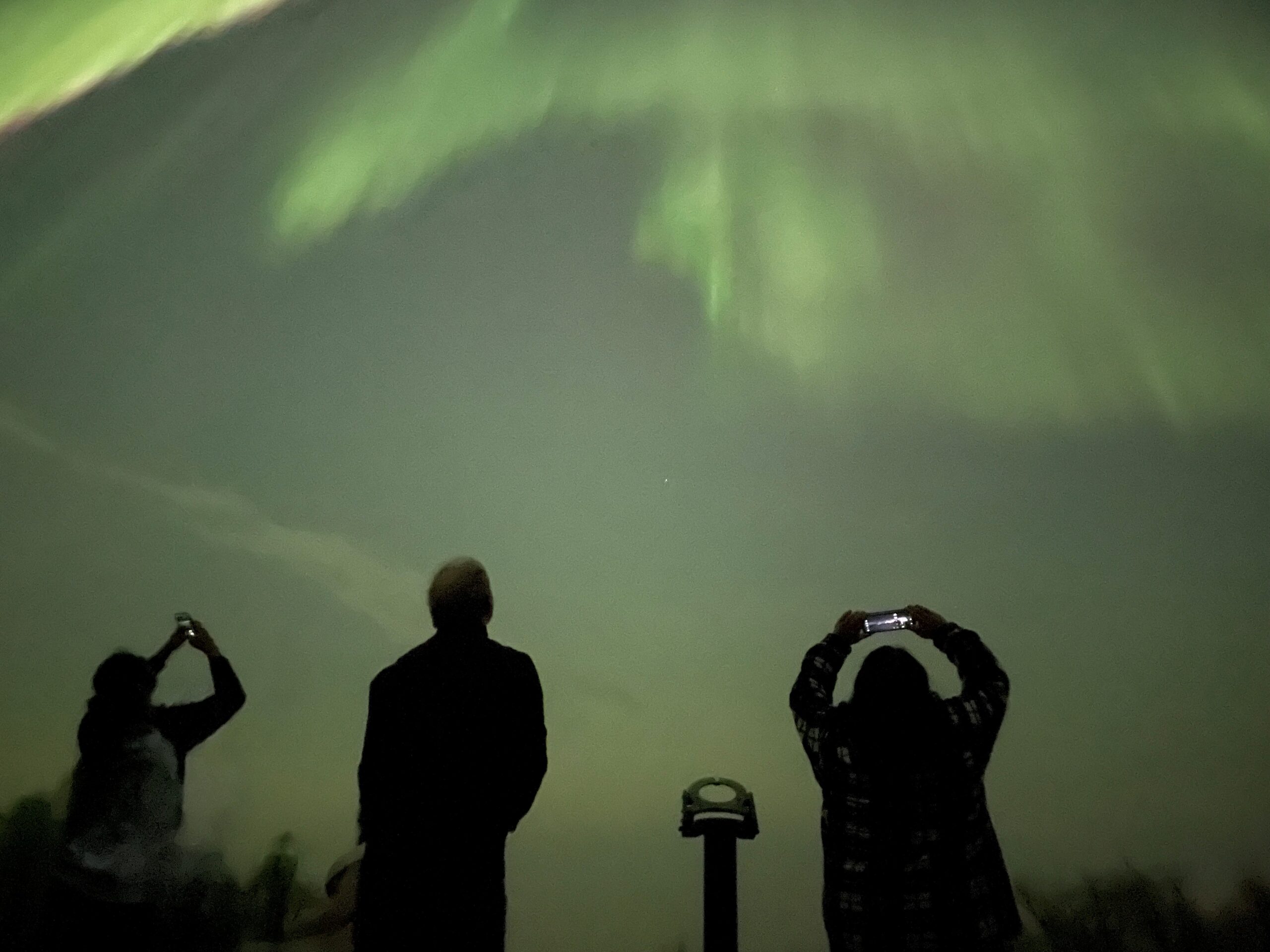
Aurora borealis, the northern lights, are becoming a more common sight again as the Sun goes through the maximum of its 11-year cycle of activity. Particles from the Sun interact with the Earth’s magnetic field and the high upper atmosphere to create glowing curtains of light around the north (and south) magnetic poles of the planet. Manitoba is well-positioned relative to the north magnetic pole to see these displays often, but they still can’t be forecast very far in advance. A site like Space Weather can provide updates on solar activity and aurora forecasts for the next 48 hours. The best way to see the aurora is to spend a lot of time out under the stars, so that you are there when they occur.
Random meteors (also known as falling or shooting stars) occur every clear night at the rate of about 5-10 per hour. Most people don’t see them because of light pollution from cities, or because they don’t watch the sky uninterrupted for an hour straight. They happen so quickly that a single glance down at your phone or exposure to light can make you miss one.
Satellites are becoming extremely common sights in the hours after sunset and before dawn. Appearing as a moving star that takes a few minutes to cross the sky, they appear seemingly out of nowhere. These range from the International Space Station and Chinese space station Tianhe, which have people living on them full-time, to remote sensing and spy satellites, to burnt-out rocket parts and dead satellites. The most common sightings are Starlink satellites, which are being launched dozens at a time to bring internet to remote regions, but which cause trouble with astronomy and pollution. These can be predicted in advance (or identified after the fact) using a site like Heavens Above by selecting your location.