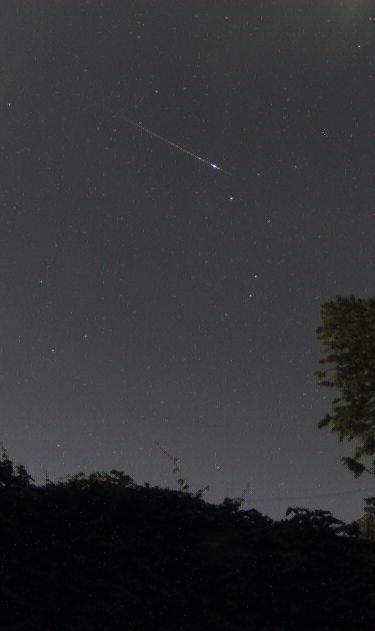


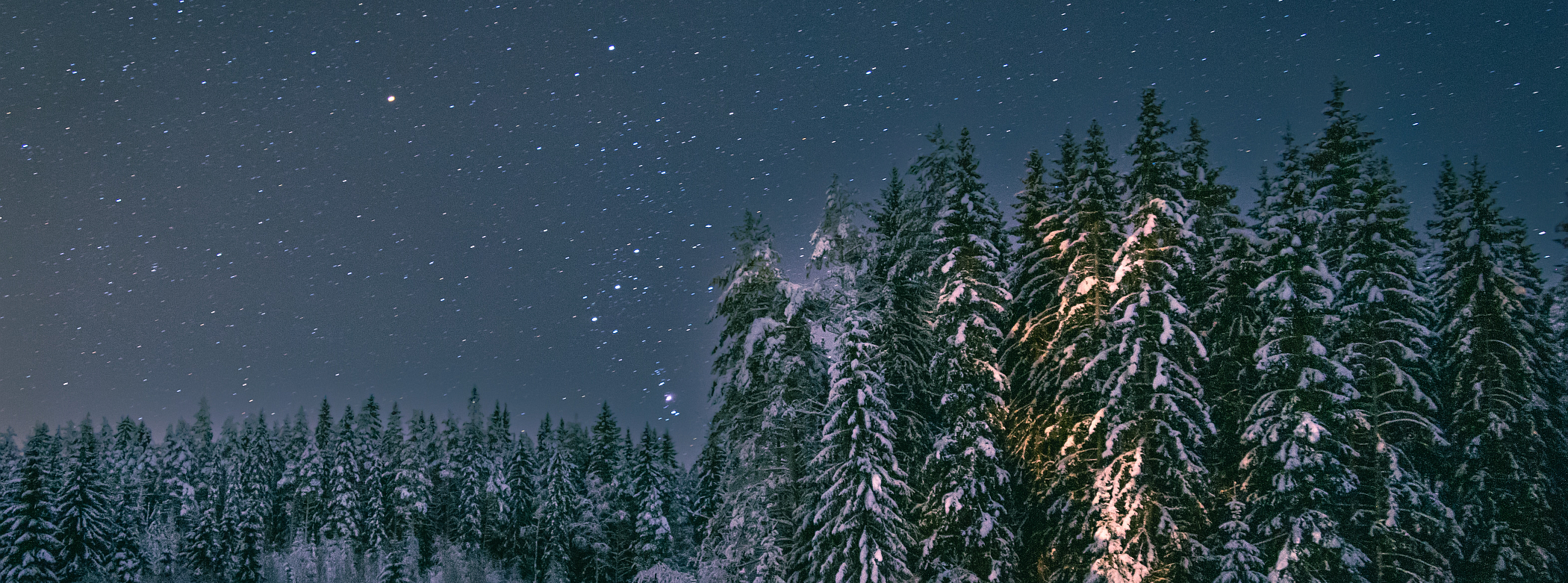
A starry sky over a winter forest scene. The constellation Orion is rising,
Manitoba Skies

The Sky for January 2026

What’s up in the sky for January 2026.

The Sky for January 2026

Manitoba’s January skies are usually cold if they are clear, and the long winter nights make stargazing easier. You don’t need to stay up late to spot Orion and his retinue of winter constellations rising in the east after dark, and the crisp winter air can provide remarkably clear views for users of telescopes and binoculars.

Although this article focuses on events visible in Manitoba, most events will also be visible across Canada and most places in the mid-northern hemisphere.


The Solar System for January 2026

Mercury is too close to the Sun to be easily seen from Manitoba this month, although more southerly viewers might catch it very low in the southeast just before sunrise during the first few days of the month. It reaches superior conjunction (in line with and just below the Sun) on January 21st, 2026.

Venus has disappeared into the sun’s glare as well, passing its superior conjunction on January 6th, 2026. It will reappear in the evening sky early in the spring of 2026.

Mars is still too close to the Sun to be visible this month. It passes behind the sun and reaches superior conjunction on January 9th, 2026.

Jupiter is the planetary highlight of the month. The giant planet is low in the east at sunset and is visible all night, rising high into the south and then lower into the northwest by sunrise. Jupiter reaches opposition on January 10th, the date when it is opposite the Sun in the sky. This is also when Jupiter appears near its brightest and largest as seen from Earth, so it’s a great time to break out the binoculars or telescope and take a look.

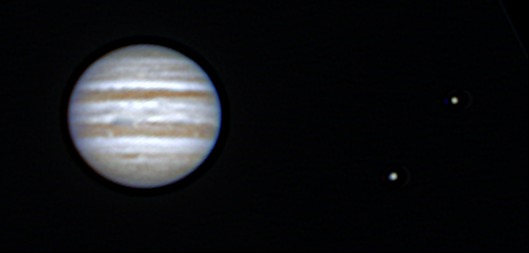
Even a small telescope will show Jupiter as a tiny planet with several tinier “stars” in a line near it – these are Jupiter’s largest moons. Up to four of them can be seen, depending on where they are in their orbit around the giant planet. Often these moons can be glimpsed in binoculars as well.

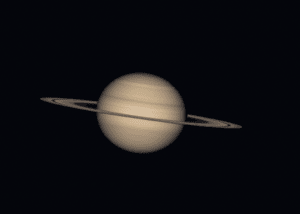
Saturn is in the south, a third of the way up the sky, as darkness falls. It sets before midnight in the southwest, so catch it early if you want to spot it. Saturn’s rings are nearly edge-on to our line of sight, making them nearly invisible in a telescope. The Moon is nearby on January 22nd and 23rd, 2026.

Uranus is in the evening sky a few degrees below the famous Pleaides star cluster (also known as the Seven Sisters). It is too faint to easily see without binoculars, and even a telescope shows it as a faint dot that looks just like the other faint stars. A detailed star-charting app like Stellarium or the charts in the Observer’s Handbook is required to track it down.

Neptune requires good binoculars or a small telescope to even spot, and a large telescope to make it out as anything more than a faint dot. It spends the month near Saturn, though, which makes it easier to track down than usual. As with Uranus, a detailed star chart like those in the Observer’s Handbook or produced software by Stellarium is required to tell which tiny “dot” is Neptune.

Of the five known dwarf planets, only (1) Ceres is close enough to be seen in binoculars or a small telescope. Ceres has faded below easy visibility in binoculars for the year, but will brighten again beginning in late 2026.
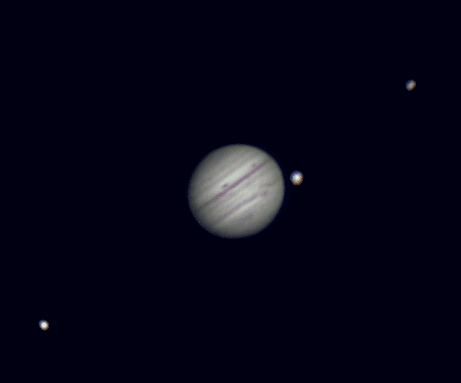
Jupiter and its moons as seen through a backyard telescope. (Image credit: Planetarium Astronomer Scott Young)

Planetary Spotlight: Jupiter

Jupiter is probably the best planet for amateur astronomers. Being the largest planet, we can see details in the cloud tops (Jupiter is a gas giant planet, and so the “surface” we see is actually the top of the  atmosphere). Its four brightest moons are visible in any telescope, and even in binoculars if you can hold them steady enough (try bracing your arms against your body or the arms of a reclining lawn chair, or mount the binoculars on a tripod).

Seeing detail on Jupiter does require some practice, though. The first time you look at Jupiter up close, you’ll probably see a bright white “star” with a few fainter “stars” lined up with it. Don’t just take a quick peek and give up, though. Your eyes will see more if you keep looking. Eventually you’ll see that the bright “star” isn’t a point of light, but a tiny globe. You’ll start to notice some dark lines running across it – those are the big equatorial cloud bands that circle the planet.

The more often you look at Jupiter through a telescope, the more you will see. Our eyes aren’t very good at looking at tiny images through a small tube. It takes practice to train your eye and brain. The tenth night you look at Jupiter, you will see much more than you did on the first night. You can also put your camera at the eyepiece to snap a picture. It takes practice to make it work, but you can get great images through a telescope with just a cell phone or point-and-shoot camera.

Sky Calendar for January 2026

All times are given in Central Standard Time, the local time for Manitoba. However, most of these events are visible across Canada at the same local time without adjusting for time zones.

If there’s a little box to the left of the date, you can click on it to see a star map of that event! All images are created using Stellarium, the free planetarium software.

Friday, January 2nd, 2026: First Friday at the Manitoba Museum includes free telescope viewing this month (weather permitting). Telescopes will be set up outside the Planetarium dome from 6:30 p.m. to 9:00 p.m. for views of the Full Moon and the planets Jupiter and Saturn. Dress warmly!

The Full Moon and Jupiter rise side by side among the stars of Gemini the Twins on January 3rd, 2026.

Saturday, January 3rd, 2026: Full Moon, appearing near Jupiter in the sky. Since Jupiter is near opposition, and the Full Moon is basically what happens when the Moon reaches its own “opposition” (the point opposite the Sun in the sky), this make sense!

Saturday evening is also the peak of the annual Quadrantid meteor shower, but with the full moon and the timing this isn’t a great year for it. You might see a handful of meteors after sunset tonight, but the Moon will overwhelm most of them.

Tuesday, January 6th, 2026: Venus reaches superior conjunction, passing around the far side of the Sun as seen from Earth.

Friday, January 9th, 2026: Mars reaches superior conjunction, passing around the far side of the Sun as seen from Earth.

Saturday, January 10th, 2026: Jupiter reaches opposition, about 634 million kilometers away from Earth. Today is also the Last Quarter Moon.

Sunday, January 18th, 2026: New Moon

Wednesday, January 21st, 2026: The planet Mercury reaches superior conjunction, passing around the far side of the Sun. If this text sounds familiar, it’s because it is the third planet to pass superior conjunction this month – nothing more than a coincidence of cycles that have been going on for billions of years.

The crescent Moon is to the right of Saturn in the southwest on the evening of January 22nd, 2026.Thursday, January 22nd, 2026: The Moon is to the right of Saturn tonight in the early evening sky.

The crescent Moon is above Saturn in the southwest on the evening of January 23rd, 2026.Friday, January 23rd, 2026: The Moon is to the left of Saturn tonight in the early evening sky.

A binocular view of the Moon beside the Pleiades star cluster on the evening of January 27th, 2026. The view shown is at 6 p.m. Central Time.Tuesday, January 27th, 2026: The Moon is beside the Pleaides star cluster this evening. It is closest at dusk, but the Moon’s orbital motion moves it farther away from the star cluster even as the Earth’s rotation carries them both higher into the sky. (The accompanying chart shows the view at 6 p.m., Central time; the Moon will move farther to the left about its own diameter every hour relative to the background stars.)

Wednesday, January 28th, 2026: Mercury and Venus pass close to each other, but this occurs far too close to the Sun to be visible.

Saturday, December 27th, 2025: First Quarter Moon
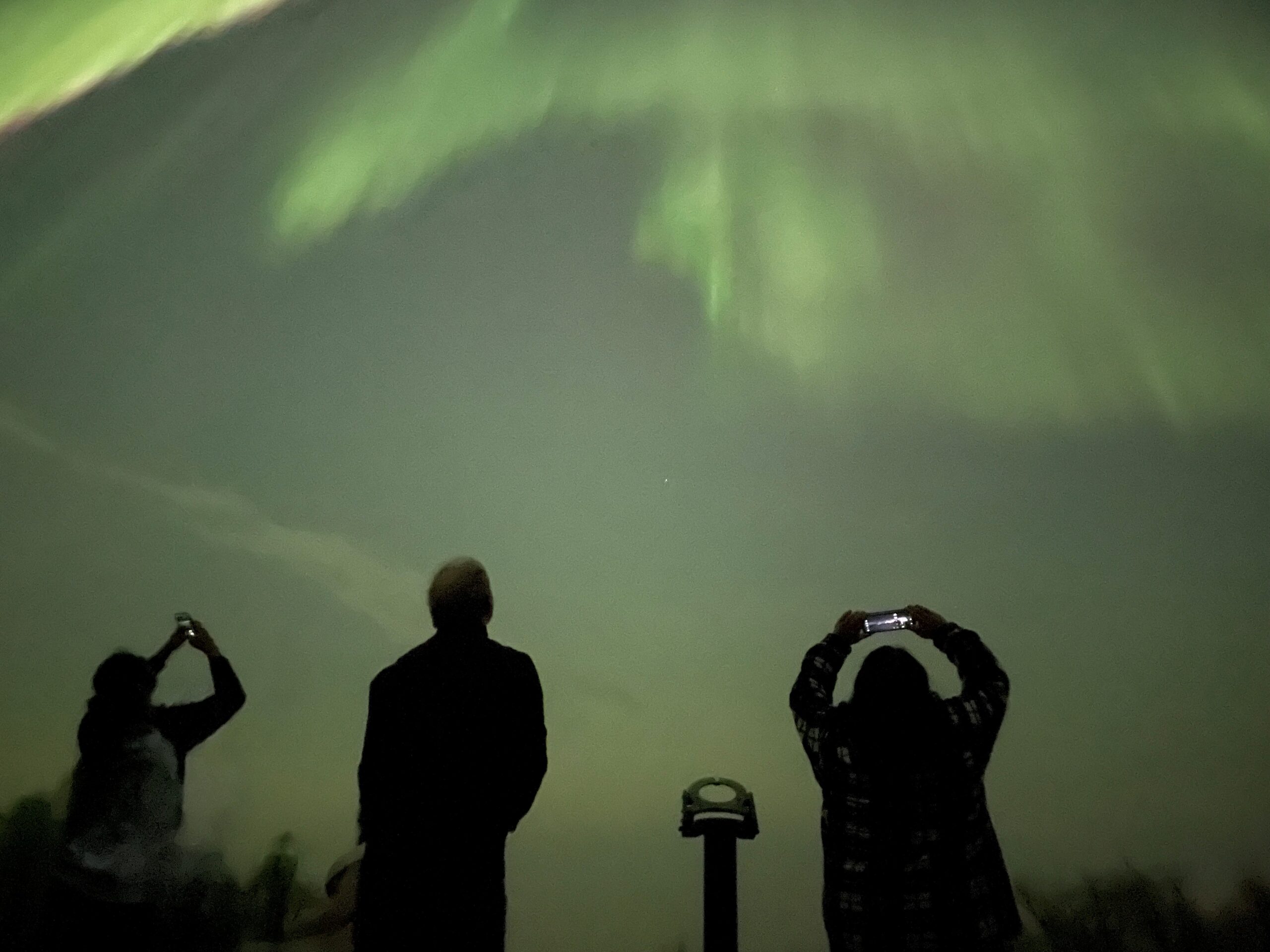
People stare up at the northern lights above them.

Other Celestial Sights

Outside of the events listed above, there are other things we see in the sky that can’t always be predicted in advance.

Aurora borealis, the northern lights, are becoming a more common sight again as the Sun goes through the maximum of its 11-year cycle of activity. Particles from the Sun interact with the Earth’s magnetic field and the high upper atmosphere to create glowing curtains of light around the north (and south) magnetic poles of the planet. Manitoba is well-positioned relative to the north magnetic pole to see these displays often, but they still can’t be forecast very far in advance. A site like Space Weather can provide updates on solar activity and aurora forecasts for the next 48 hours. The best way to see the aurora is to spend a lot of time out under the stars, so that you are there when they occur.

Random meteors (also known as falling or shooting stars) occur every clear night at the rate of about 5-10 per hour. Most people don’t see them because of light pollution from cities, or because they don’t watch the sky uninterrupted for an hour straight. They happen so quickly that a single glance down at your phone or exposure to light can make you miss one.

Satellites are becoming extremely common sights in the hours after sunset and before dawn. Appearing as a moving star that takes a few minutes to cross the sky, they appear seemingly out of nowhere. These range from the International Space Station and Chinese space station Tianhe, which have people living on them full-time, to remote sensing and spy satellites, to burnt-out rocket parts and dead satellites. The most common sightings are Starlink satellites, which are being launched dozens at a time to bring internet to remote regions, but which cause trouble with astronomy and pollution. These can be predicted in advance (or identified after the fact) using a site like Heavens Above by selecting your location.

Scott Young

Scott Young

Planetarium Astronomer

Scott is the Planetarium Astronomer at the Manitoba Museum, developing astronomy and science programs. He has been an informal science educator for more than thirty years, working in the planetarium and science centre field. Scott is an active amateur astronomer and a past-President of the Royal Astronomical Society of Canada. He hosts Dome@Home, the Manitoba Museum’s award-winning online astronomy show.

Geminid Meteor Shower 2025

What is a meteor shower?

Well, first, a meteor is a flash of light we see in the sky, often called a “shooting star” or “falling star”. They’re not stars at all, though – they are tiny pieces of space dust crashing into the Earth as it orbits the Sun. When the dust (called a “meteoroid” when it’s still out in space) hits the Earth’s atmosphere, friction causes the dust to burn up and create a tunnel of glowing air as it travels.

There’s dust scattered throughout space, left over from the formation of the solar system, and so on any given night you might see a meteor or three. If you were in perfectly dark skies and watched the entire sky for an entire hour, you might see a half-dozen meteors an hour on any given night.

But just like dust in your house, there are places in space where there is more dust than average. One of those places is in the orbit of a comet. A comet is a small body made of dust and ice that orbits the Sun. If a comet’s orbit brings it close enough to the Sun, it starts to melt and the dust forms a long tail behind it. This dust fades away fairly quickly, but it’s still out there in the comet’s orbital path. If that orbital path comes close to the Earth’s orbit, we can run through a big clump of comet dust on the same night each year. That’s a meteor shower.


What are the Geminids?

The Geminid meteor shower is an annual event that peaks around December 13-14 each year. It’s an unusual meteor shower, in that it’s not in the orbit of a comet, but of an asteroid: asteroid (3200) Phaethon. (Maybe Phaethon used to be a comet but the ice has all melted, so it’s just dust. We’re not sure.)

Phaethon has an unusual orbit that takes it very close to the Sun, closer then Mercury, before looping out to the main asteroid belt between Mars and Jupiter. Phaethon’s orbit also comes in at a steep angle compared to the rest of the planets, which is one of the reasons the Geminids are a great meteor shower (more on this later).

On an average year, you can expect to see a meteor a minute or so in the couple of hours between 11 pm and 1 am local time. That’s pretty good – most “meteor showers” are really more of a trickle, with only a dozen or so meteors per *hour*. So, one a minute is a “shower”, relatively speaking. And, almost alone among meteor showers, the peak of activity occurs in the middle of the night, around local midnight, when the constellation Gemini is high in the sky. This is because of the high angle that the meteor orbits make with the plane of the Earth’s orbit. Most meteor showers don’t peak until just before dawn, so they are much less convenient to watch.


How do I see the Geminids in 2025?

Meteor observing involves a lot of laying around and just looking at the sky. You don’t need (or want!) a telescope for this – meteors can happen anywhere in the sky, so you need the wide field of view that your unaided eyes provide. Your most useful piece of equipment is a reclining lawn chair so you can lay back and not be on the cold ground. A blanket or three and a thermos of a warm beverage is also a good addition.

The most important thing is to travel to a location where there are no competing lights, and to keep your eyes dark-adapted. Pick a spot in advance: a park, a parking lot, or some other place where you’re not on private property. (DO NOT just pull over to the side of the highway – not only will passing headlights ruin your night vision, but wandering around in the dark near the road is dangerous.)

Once you find a dark spot, you need to keep it dark. That means to turn off your car. This is especially important in a place where other observers have gathered, since your headlights will ruin everyone else’s  view if you leave them on. And, put your phone away. Our eyes take a good five or more minutes to get fully dark-adapted, but as soon as you see a bright-ish light, they immediately flip to “day” mode and you need to re-adapt all over again. Every time a phone turns on in your field of view, even just for a second, you will miss about 10%-15% of the meteors that hour. Don’t drive out of town in the cold and then waste your time doomscrolling instead of watching the sky!


When is the best time to look?

The Geminids slowly ramp up through December to their peak on the 13th-14th, and then decline over the next week or so. Best views will be between about 11pm and 2am on the night of Saturday, December 13th, 2025 and into the morning of Sunday, December 14th, 2025. During peak times, the rate from a really dark sky could be as high as 120 or more an hour – that’s an average of two every minute! Earlier in the evening and after the peak, rates will be about half that number. The night before and the night after will still have reasonable activity, perhaps 1/3 to 1/2 the numbers seen at the peak (so, 40-60 per hour). Before and after that, the rates decline sharply. So, we really want clear skies from December 12-15 this year!

(I guess that should be made clear: if it’s cloudy, you won’t see any, since meteors all burn up much higher in the atmosphere than the clouds.)

Remember, any lights you can see will turn off your eyes’ night mode. So, turn off your car headlights or cover them with a blanket. Keep your phone hidden so you don’t lose your darkvision every time a notification comes in. Dress warmly – a clear December night in Manitoba is going to be frigid! Make sure you are in a place where you are secure. Make sure your vehicle is up to winter driving, and that someone knows where you are if your car doesn’t start. (Don’t depend on a cell phone to call for help – cell service tends to fade in remote areas, and batteries die quickly in the cold.)

The Geminids are a great skywatching event – a relaxed event, no specialized equipment required, and you get to sit and watch the stars while waiting for the next meteor. You can even count meteors for science to help astronomers understand the swarm of particles from this unusual asteroid.

If the weather is clear, we will be attempting a live-stream of the Geminid meteor shower on Saturday night. Follow the Manitoba Museum on Facebook or YouTube to watch – if you “like” or “subscribe” you’ll get a notification when the stream goes live.

Clear Skies!

Scott Young

Scott Young

Planetarium Astronomer

Scott is the Planetarium Astronomer at the Manitoba Museum, developing astronomy and science programs. He has been an informal science educator for more than thirty years, working in the planetarium and science centre field both at The Manitoba Museum and also at the Alice G. Wallace Planetarium in Fitchburg, Massachusetts. Scott is an active amateur astronomer and a past-President of the Royal Astronomical Society of Canada.

The Sky for December 2025

December brings us to the arbitrary “end” of our calendar cycle, one of the few calendar events that aren’t astronomically based. While the number of days in a year comes from the amount of time it takes Earth to revolve around the Sun, there is nothing special about December 31st to mark the “end” of anything.

Because it does mark the last month of the year, though, it’s a good time to look ahead at what’s coming for the next orbit. It’s also the first month this year to be fully back on Standard Time after the Daylight Savings Time excursion of the summer. Finally, December hosts the best meteor shower of the year, the Geminids, which peaks on the evening of the 13th and morning of the 14th in a mostly moonless sky.


The Solar System for December 2025

Mercury begins its best morning appearance of the year, but it still isn’t great for those living in northerly latitudes. It’s at its brightest at the beginning of the month, about 10 degrees above the south-eastern horizon just before dawn, but fades and sinks lower into the twilight over the next few weeks. A clear sky, unobstructed horizon, and perhaps binoculars will be needed to pick it out of the brightening dawn.

Venus sinks into the morning twilight during the first few days of December and is invisible for the rest of this month. It passes between us and the Sun early in 2026, thereafter appearing in the evening sky.

Mars is too close to the Sun to be visible this month.

Jupiter rises soon after sunset in the east-northeast and is visible all night, rising high into the south and then lower into the northwest by sunrise. It is near the two bright stars Castor and Pollux in Gemini, Even a small telescope will show Jupiter as a tiny planet with several tinier “stars” in a line near it – these are Jupiter’s largest moons. Up to four of them can be seen, depending on where they are in their orbit around the giant planet. Often these moons can be glimpsed in binoculars as well.

Saturn is in the southeast as darkness falls, the brightest “star” in that area of the sky and well-placed for telescope viewing. Saturn’s rings are nearly edge-on to our line of sight, making them nearly invisible in a telescope.

Uranus is in the evening sky a few degrees below the famous Pleaides star cluster (also known as the Seven Sisters). It is too faint to easily see without binoculars, and even a telescope shows it as a faint dot that looks just like the other faint stars. A detailed star-charting app like Stellarium or the charts in the Observer’s Handbook is required to track it down.

Neptune requires good binoculars or a small telescope to even spot, and a large telescope to make it out as anything more than a faint dot. As with Uranus, a detailed star chart like those in the Observer’s Handbook or produced software by Stellarium is required to tell which tiny “dot” is Neptune.

Of the five known dwarf planets, only (1) Ceres is close enough to be seen in binoculars or a small telescope. Ceres has faded below easy visibility in binoculars for the year, but will brighten again beginning in late 2026.

The Geminid Meteor Shower

The annual Geminid meteor shower is the best meteor shower of the year, and this year is a perfect year for it. The peak of the event occurs with the Moon mostly out of the sky, so if you drive away from any more local light pollution (like city lights), you can have a dark sky full of stars, and see the best that this shower has to offer.

For details on how to observe this event, check out Scott’s latest blog here.


Sky Calendar for December 2025

All times are given in Central Standard Time, the local time for Manitoba. However, most of these events are visible across Canada at the same local time without adjusting for time zones.

If there’s a little box to the left of the date, you can click on it to see a star map of that event! All images are created using Stellarium, the free planetarium software.

Thursday, December 4th, 2025: Full Moon, occurring just 12 hours after the Moon’s closest point to the Earth in its orbit, a so-called “supermoon”. The difference in size between a “super” moon and a “mini” moon (when the moon is farthest from Earth) is not really noticeable, but the brightness increase may be detectable by careful observers.

Sunday, December 7th, 2025: The waning gibbous Moon forms a nice grouping with Jupiter and the bright stars Castor and Pollux.

Monday, December 8th, 2025: The waning gibbous Moon has passed Jupiter but still is close enough to draw the eye.

Tuesday, December 9th-Wednesday, December 10th, 2026: The Moon occults (eclipses) the bright star Regulus in Leo for much of Canada except the south. In Winnipeg, the Moon skims just north of the bright star, but observers in the northern Interlake and northern Manitoba will see the Moon cover up the star briefly just after midnight. Details for various cities across Canada can be found at the International Occultation Timing Association. (“ZC1487” is a catalogue number referring to Regulus.)

Thursday, December 11th, 2025: Last Quarter Moon

Saturday, December 13th-Sunday, December 14th, 2025 (morning sky): The annual Geminid meteor shower peaks. Decent views are available the night before and after. The Moon is a waning crescent and doesn’t rise until nearly 2 a.m. so it won’t interfere with viewing.

Wednesday, Dec. 17th (morning sky): The thin crescent Moon is about level with Mercury, low in the southeast just before sunrise.

Friday, December 19th, 2025 (morning sky): New Moon

Sunday, December 21st, 2025: Winter Solstice occurs at 9:03 a.m. CST. This marks the first day of winter in the northern hemisphere, astronomically speaking. (The weather tends not to pay attention to the astronomical definitions, of course – it’s just a point in time that can be predicted accurately.)

Monday, December 22nd, 2025 (morning sky): Ursid meteor shower peaks. Usually a minor shower, this shower can still produce 5-10 meteors per hour in the few hours before dawn. It has produced occasional outburst of activity, though, up to 25 meteors per hour for short periods, in a way we can’t yet predict.

Friday, December 26th, 2025: the nearly-first-quarter Moon is near Saturn in the evening sky.

Saturday, December 27th, 2025: First Quarter Moon.

People stare up at the northern lights above them.

Outside of the regular events listed above, there are other things we see in the sky that can’t always be predicted in advance.

Aurora borealis, the northern lights, are becoming a more common sight again as the Sun goes through the maximum of its 11-year cycle of activity. Particles from the Sun interact with the Earth’s magnetic field and the high upper atmosphere to create glowing curtains of light around the north (and south) magnetic poles of the planet. Manitoba is well-positioned relative to the north magnetic pole to see these displays often, but they still can’t be forecast very far in advance. A site like Space Weather can provide updates on solar activity and aurora forecasts for the next 48 hours. The best way to see the aurora is to spend a lot of time out under the stars, so that you are there when they occur.

Random meteors (also known as falling or shooting stars) occur every clear night at the rate of about 5-10 per hour. Most people don’t see them because of light pollution from cities, or because they don’t watch the sky uninterrupted for an hour straight. They happen so quickly that a single glance down at your phone or exposure to light can make you miss one.

Satellites are becoming extremely common sights in the hours after sunset and before dawn. Appearing as a moving star that takes a few minutes to cross the sky, they appear seemingly out of nowhere. These range from the International Space Station and Chinese space station Tianhe, which have people living on them full-time, to remote sensing and spy satellites, to burnt-out rocket parts and dead satellites. These can be predicted in advance (or identified after the fact) using a site like Heavens Above by selecting your location.

Scott Young

Scott Young

Planetarium Astronomer

Scott is the Planetarium Astronomer at the Manitoba Museum, developing astronomy and science programs. He has been an informal science educator for more than thirty years, working in the planetarium and science centre field both at The Manitoba Museum and also at the Alice G. Wallace Planetarium in Fitchburg, Massachusetts. Scott is an active amateur astronomer and a past-President of the Royal Astronomical Society of Canada.

The Sky for October 2025

October this year features a couple of unusual visitors to the autumn sky: a pair of comets which may become bright enough to see in small telescopes. As usual, the online hype over these comets far outstrips reality. See below for the real deal, including how you can track down these tiny snowballs for the edge of the solar system.

A comet shines above the twilight sky.

Comets in October 2025

Comets are chunks of ice and dust a few kilometers across that originate from the edge of the solar system. If one moves through the inner solar system closer to the Sun, the ice melts and the dust streams away, blown buy the solar wind into a tail which can sometimes become bright enough to see from Earth. They can be visible for days or weeks as they zoom around the Sun and head back out into deep space.

At any given time there are five or ten comets in the sky that are visible in large telescopes. A comet that reaches binocular visibility is uncommon, maybe one every couple of years. A comet that becomes bright enough to be seen without optical aid is even more rare.

In October, there are actually two comets that are becoming visible in binoculars and small telescopes. Unfortunately, only one is easy to spot from the northern hemisphere. There’s also a rare interstellar comet passing through our solar system, and while it won’t be visible without a telescope it’s generating a lot of media attention. Let’s dive in.


Comet Lemmon (C/2025 A6) is visible in binoculars near the Big Dipper now, although that part of the sky is best seen in the pre-dawn hours. As the comet brightens it will pass into the evening sky and be more conveniently placed for viewing.

Finder chart for Comet Lemmon 2025 A6.


Comet SWAN (C/2025 R2) was very bright in the southern hemisphere, but has faded after rounding the sun. It is visible low in the evening sky after sunset. It rises higher into the sky as it moves away, becoming visible in a darker sky but also fading. How these two factors balance out will determine wether this is a good comet or a “meh” comet.

Finder chart for Comet SWAM 2025 R2.


Comet 3I/ATLAS is a different kind of comet – it comes from beyond our solar system. (So, REALLY REALLY REALLY far away instead of just REALLY  REALLY far away!) It passes near the planet Mars in early October, where a fleet of Mars probes will turn their cameras towards this target of opportunity. After passing around the Sun this object will head off into deep space, never to return. While never getting bright enough to see even in a good backyard telescope, it’s still an interesting object that is sharing some of the scientific  spotlight with the other two comets above.

Update – 6 October 2025: Several images of Comet 3I/ATLAS have been released from the various Mars spacecraft, and frankly they’re disappointing. While the cameras are closer than we are to the comet, and the Sun isn’t in the way, they’re not cameras designed for taking pictures of the sky. So, they look like the pictures of the sky most people get with their cell phones – a short trail that moves during the long exposure required. The various space agencies really overhyped what they’d be able to image in these circumstances.


The Solar System for September 2025

Mercury is too close to the horizon to be seen from Canadian latitudes this month. It reaches greatest elongation from the Sun on October 29, but it sets at sunset and so we won’t catch it this time around. Mercury is in the same area of the sky as Mars, and viewers in the southern hemisphere will be able to catch them just after sunset.

Venus rises in the east as morning twilight begins, and is low in the east-southeast as the sun rises. Venus is bright enough to be seen well into twilight and even after sunrise, if you can keep your eyes focused on it – but as soon as you look away, you’ll lose it because your eyes will defocus and it will be lost in the bright sky. On the morning of the 19th the thin crescent moon passes nearby, a nice morning phot op.

Mars is still too close to the Sun (as seen from Canadian latitudes) to be visible this month. In the same area of the sky as Mercury, and viewers farther south will be able to catch them just after sunset.

Jupiter rises about midnight at the beginning of October, the brightest “star” in the sky until Venus rises. Jupiter stands high in the south by dawn. Jupiter is below the bright stars Castor and Pollux in Gemini, with Pollux being the one closer to Jupiter.

Saturn is low in the southeast as darkness falls and is visible all night, rising to its highest point in the south around midnight.  Saturn’s rings are only tilted by a couple of degrees relative to our line of sight, which means they appear very thin and edge-on. The situation gets worse throughout the year, as the rings will nearly disappear from our point of view. They’re still there, but they are so thin that it’s like looking at the edge of a piece of paper. On the plus side, for those with large telescopes, we will be able to see some of Saturn’s moons cast their shadow on the planet as they orbit. Saturn’s largest moon, Titan, casts its shadow on the planet on the nights of October 5-6th, the last such event visible for the next 15 years (although Titan itself will still transit the planet several more times in 2025).

Uranus is in the morning sky a few degrees below the famous Pleaides star cluster (also known as the Seven Sisters). It is too faint to easily see without binoculars, and even a telescope shows it as a faint dot that looks just like the other faint stars. A detailed star-charting app like Stellarium is required to track it down.

Neptune is in the same binocular field of view as Saturn for the entire month, but since it is even farther than Uranus it is invisible without optical aid. Neptune requires good binoculars or a small telescope to even spot, and a large telescope to make it out as anything more than a faint dot. Again, a detailed star chart like those produced by Stellarium is required to tell which tiny “dot” is Neptune.

Of the five known dwarf planets, only (1) Ceres is close enough to be seen in binoculars or a small telescope. Ceres reaches opposition (the point opposite the Sun in the sky) on October 2, below and to the left of Saturn and Neptune, and remains bright enough to spot in binoculars and small telescopes all month. You should be able to spot it  as a faint “star” that slowly changes its position each night. Use the attached chart, excerpted from the RASC Observer’s Handbook, to tell which “dot” is the dwarf planet.

Star chart showing the position of dwarf planet Ceres in 2025.


Sky Calendar for August 2025

All times are given in the local time for Manitoba: Central Daylight Time (UTC-5). However, most of these events are visible across Canada at the same local time without adjusting for time zones.

If there’s a little box to the left of the date, you can click on it to see a star map of that event! All images are created using Stellarium, the free planetarium software.

Sunday, October 5, 2025: Saturn’s largest moon, Titan, casts its shadow along the north pole of Saturn, while the moon itself transits across Saturn’s mid-northern latitude. (Visible with large telescopes only.) The nearly-Full Moon is nearby tonight as well.

Tuesday, October 6th, 2025: Full Moon occurs at 10:48 p.m. CDT.

Monday, October 13th, 2025: Last Quarter Moon occurs at 1:13 p.m. CDT.

Sunday, October 19th, 2025 (morning sky): The crescent Moon is near Venus just before dawn.

Tuesday, October 21st, 2025 (morning sky): The Orionid meteor shower peaks in the pre-dawn hours this morning, but it produces less than a dozen meteors per hour on average. You’ll need to drive away from bright lights into darker country skies to get a good view. This year, the Orionids peak on the night of New Moon, so no moonlight will interfere.

Wednesday, October 29th, 2025: First Quarter Moon occurs at 11:21 a.m. CDT. Also this morning, the Moon occults (passes in front of) the dwarf planet Pluto, but this event is totally unobservable because of Pluto’s great distance makes it impossible to see without a telescope at the best of times.

Friday, October 31st, 2025: Hallowe’en night is a great night to share sky views with any trick-or-treaters that visit your house. Binoculars on a tripod will show the Moon well, and a telescope can show Saturn’s rings!


People stare up at the northern lights above them.

Summer Meteor Showers

Outside of the regular events listed above, there are other things we see in the sky that can’t always be predicted in advance.

Aurora borealis, the northern lights, are becoming a more common sight again as the Sun goes through the maximum of its 11-year cycle of activity. Particles from the Sun interact with the Earth’s magnetic field and the high upper atmosphere to create glowing curtains of light around the north (and south) magnetic poles of the planet. Manitoba is well-positioned relative to the north magnetic pole to see these displays often, but they still can’t be forecast very far in advance. A site like Space Weather can provide updates on solar activity and aurora forecasts for the next 48 hours. The best way to see the aurora is to spend a lot of time out under the stars, so that you are there when they occur.,

Random meteors (also known as falling or shooting stars) occur every clear night at the rate of about 5-10 per hour. Most people don’t see them because of light pollution from cities, or because they don’t watch the sky uninterrupted for an hour straight. They happen so quickly that a single glance down at your phone or exposure to light can make you miss one.

Satellites are becoming extremely common sights in the hours after sunset and before dawn. Appearing as a moving star that takes a few minutes to cross the sky, they appear seemingly out of nowhere. These range from the International Space Station and Chinese space station Tianhe, which have people living on them full-time, to remote sensing and spy satellites, to burnt-out rocket parts and dead satellites. These can be predicted in advance (or identified after the fact) using a site like Heavens Above by selecting your location.

Scott Young

Scott Young

Planetarium Astronomer

Scott is the Planetarium Astronomer at the Manitoba Museum, developing astronomy and science programs. He has been an informal science educator for more than thirty years, working in the planetarium and science centre field both at The Manitoba Museum and also at the Alice G. Wallace Planetarium in Fitchburg, Massachusetts. Scott is an active amateur astronomer and a past-President of the Royal Astronomical Society of Canada.

The Sky for August 2025

August is a great month for stargazing. Besides the annual Perseid meteor shower, we have some planets gathering in the pre-dawn sky which will make a nice series of photo-ops for early risers. August is also a time when many people vacation to places farther from city lights, giving them the chance to see a really dark sky. Travel during the time near new moon will maximize your dak-sky experience, but even the Full Moon rising over the city skyline can remind us of our connection to the wider universe around us.

The Solar System for August 2025

Mercury is invisible early in the month as it passes near the Sun, but reappears in the morning sky just before sunrise for the second half of August this year. The closest planet to the Sun never rises very high above the horizon before the Sun does, so you will need a clear horizon and good timing to catch it. See calendar entries below.

Venus begins the month rising about 3 a.m. local time, but slowly slips sunward over the course of the month. It passes less than 1 degree from Jupiter on August 12 and is near the Beehive star cluster in Cancer the Crab at the end of the month. See various calendar entries below for details.

Mars is in the constellation Virgo, so low in the west-southwest that you probably won’t see it. It doesn’t slip behind the Sun until January 2026, but right now the angle of its orbit keeps it very low from northern latitudes like Manitoba. (Despite all the hype of supposed “big events” you might have heard about online.)

Jupiter rises in the northeast before 4 a.m. local time at the beginning of the month, and about 2 a.m. by the end of August. It begins to brighter Venus’ lower left, drawing closer and closer each morning until their closest approach on the morning of August 12, 2025. After this, Jupiter rises higher each morning as it moves slowly among the stars of Gemini.

Saturn rises about 11 p.m. at the beginning of August, and by 9 p.m. at month’s end, finally becoming high enough for reasonably-timed observations. Saturn’s rings are tilted almost edge-on to our line of sight, making them difficult to see in a telescope. Neptune is nearby for most of the summer (see below). The waxing gibbous Moon is nearby on the morning of August 12 (see below).

Uranus is in the morning sky a few degrees below the famous Pleaides star cluster (also known as the Seven Sisters). It is too faint to easily see without binoculars, and even a telescope shows it as a faint dot that looks just like the other faint stars. A detailed star-charting app like Stellarium is required to track it down.

Neptune is in the same binocular field of view as Saturn for the entire month, but since it is even farther than Uranus it is invisible without optical aid. Neptune requires good binoculars or a small telescope to even spot, and a large telescope to make it out as anything more than a faint dot. Again, a detailed star chart like those produced by Stellarium is required to tell which tiny “dot” is Neptune.

Of the five known dwarf planets, only (1) Ceres is close enough to be seen in binoculars or a small telescope. In August, Ceres is below and to the left of Saturn and Neptune, wandering among the stars of the constellation Cetus the Whale. You’ll need a chart like the one in the RASC Observer’s Handbook or an app like Stellarium to track it down. Ceres will be easier to spot in the fall as it gets closer and brighter.

Sky Calendar for August 2025

All times are given in the local time for Manitoba: Central Daylight Time (UTC-5). However, most of these events are visible across Canada at the same local time without adjusting for time zones.

If there’s a little box to the left of the date, you can click on it to see a star map of that event! All images are created using Stellarium, the free planetarium software.

Friday, August 1, 2025: First Quarter Moon

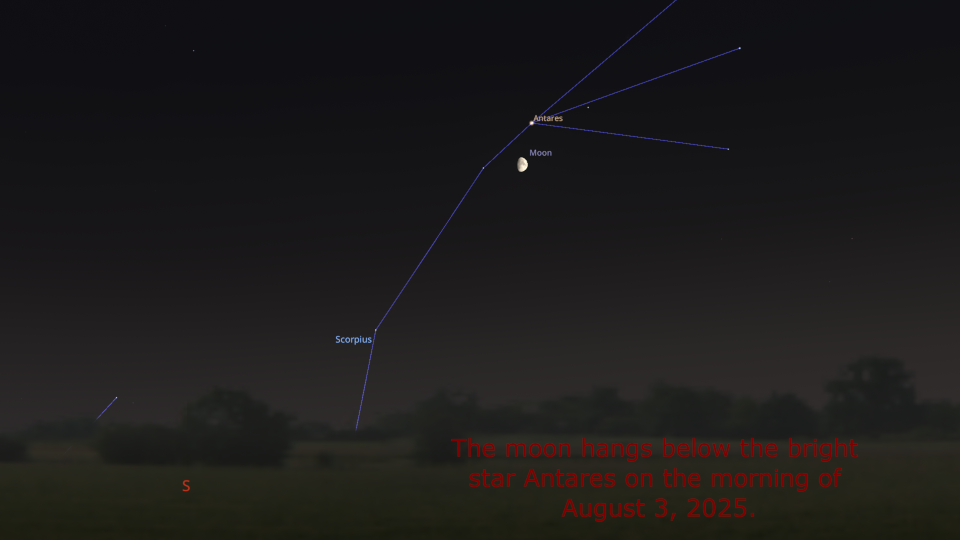
The Moon and Antares, 3 Aug 2025Sunday, August 3, 2025: The waxing gibbous Moon is just below the bright red star Antares, very low in the south this evening and into Monday morning.

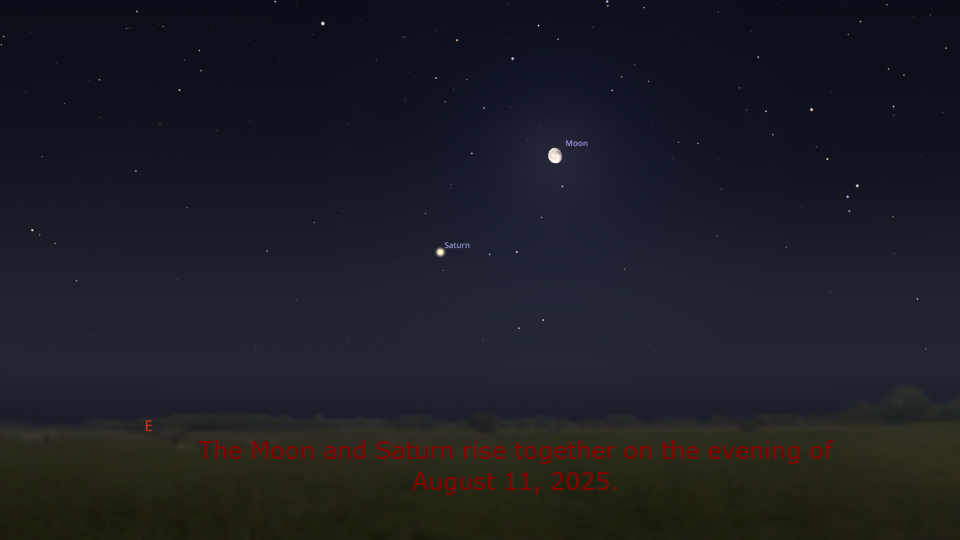
The Moon and Saturn rise together on the evening of August 11, 2025.Monday, August 11, 2025: A busy night for observers. The waxing gibbous Moon is above and to the right of Saturn as they rise about 10 p.m. CDT. Over the course of the night, the Moon will move closer to Saturn as the pair rise higher and move across the sky. This showcases two of the most important sky cycles: the rising of Saturn and the Moon is caused by the Earth’s rotation every day, while the Moon gets closer to Saturn due to the Moon’s orbital motion around the Earth every month.

Also tonight and into tomorrow, the annual Perseid meteor shower reaches its peak intensity – but this isn’t a great year for it. The nearly-full Moon’s light will overwhelm most of the faint meteors. Best time will be to in the early morning hours of the 12th, in the period from about 2am until dawn. During this period you might see a dozen or two meteors per hour, if you are in a dark sky and watch the sky continuously with no breaks. If you are up this late/early, watch for Venus and Jupiter’s conjunction just before dawn (see below).

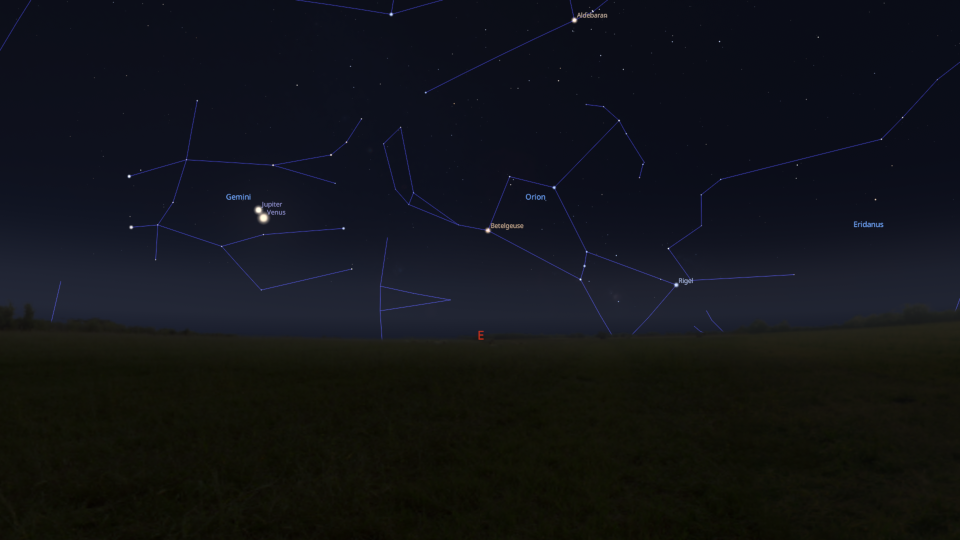
Jupiter and Venus conjunction 12 July 2025Tuesday, August 12, 2025 (morning):  The peak of the Perseid meteor shower is offset by the bright Moon, but you can still expect a meteor every minute or two if you’re patient. Jupiter and Venus rises in the north-northeast about 3:20 a.m. local time, less than 1 degree apart and probably tinted orange by any smoke on the atmosphere.

Jupiter and Venus conjunction 12 July 2025They will rise higher and be due east by dawn.

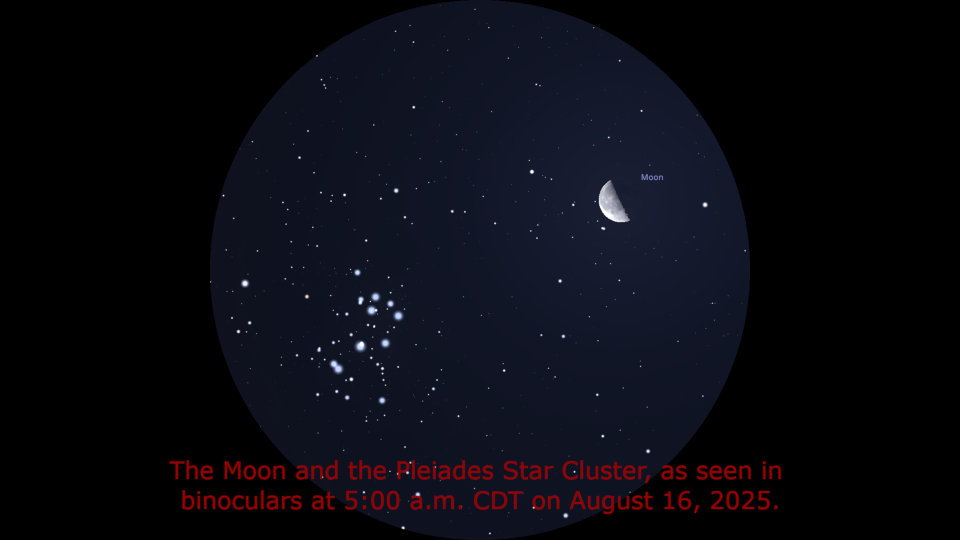
The Moon and the Pleiades star cluster.Saturday, August 16, 2025 (morning): The Last Quarter Moon is approaching the Pleaides star cluster, growing closer each hour until the sun rises.

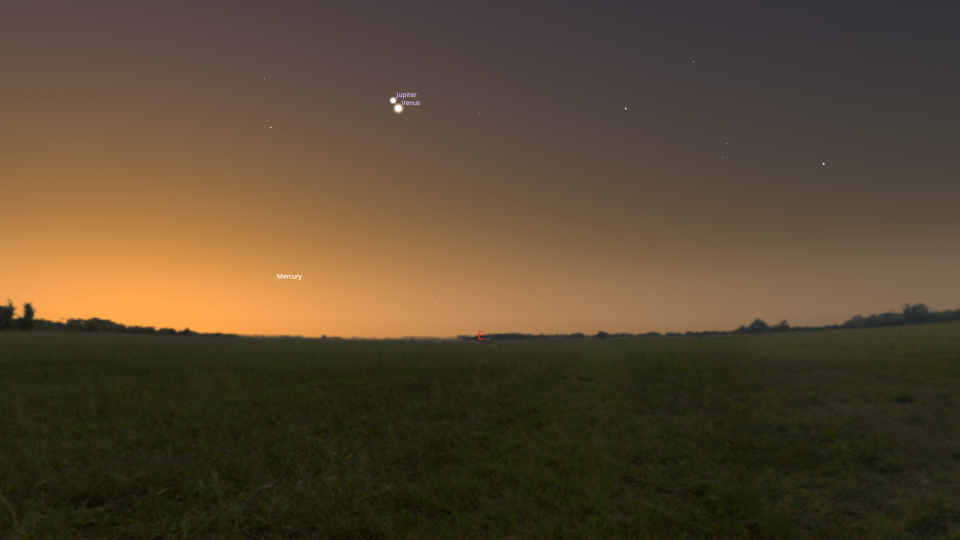
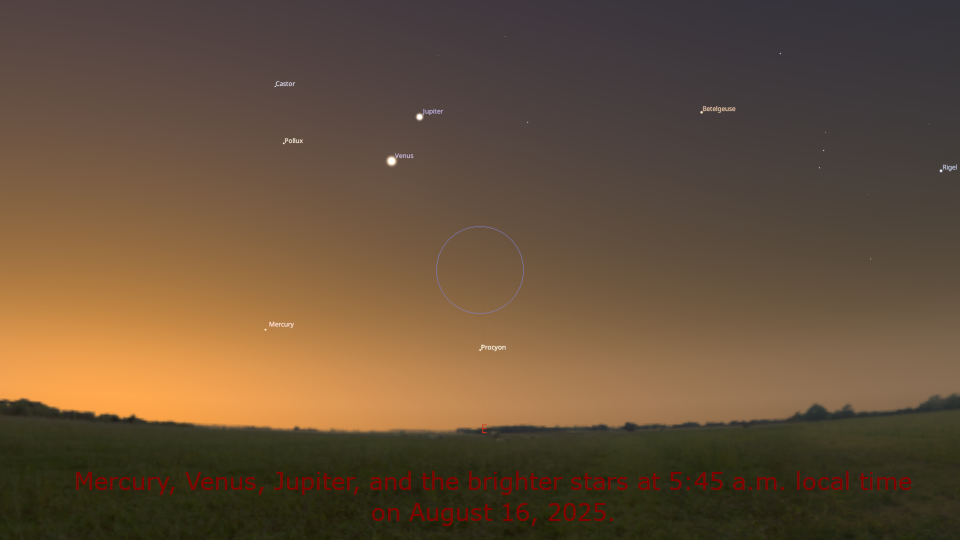
Mercury, Venus, Jupiter, and the brighter stars as seen at 5:45 a.m. CDT on August 16, 2025.The morning of the 16th is probably your first chance to spot Mercury this season, early in the morning in the east, below and left of much brighter Venus and Jupiter. The chart shows the view at 5:45 a.m. local time; the blue circle represents the field of view shown in typical household binoculars, which will definitely help in tracking down the elusive inner planet. Over the next several days Mercury will rise higher and get brighter and easier to see.

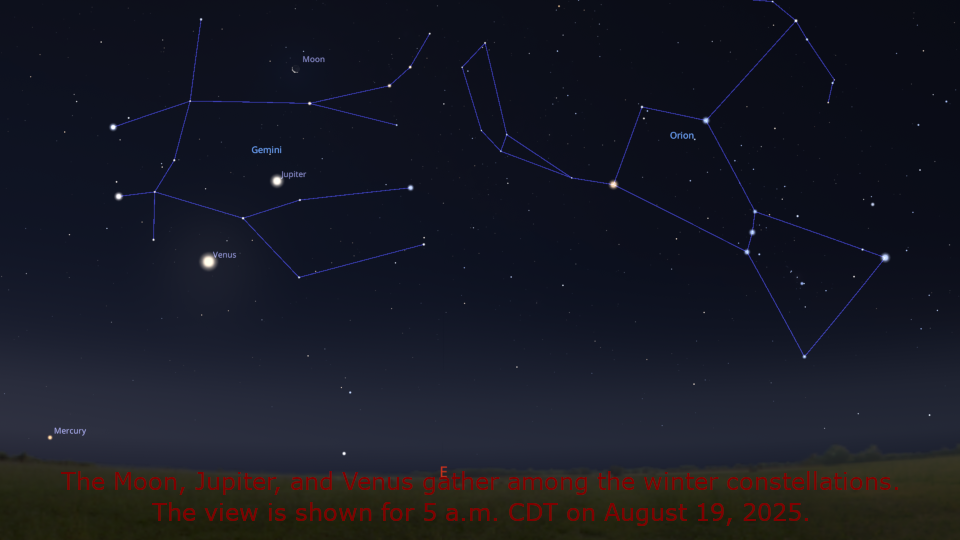
The Moon, Jupiter, and Venus gather. 5am CDT 19 Aug 2025.

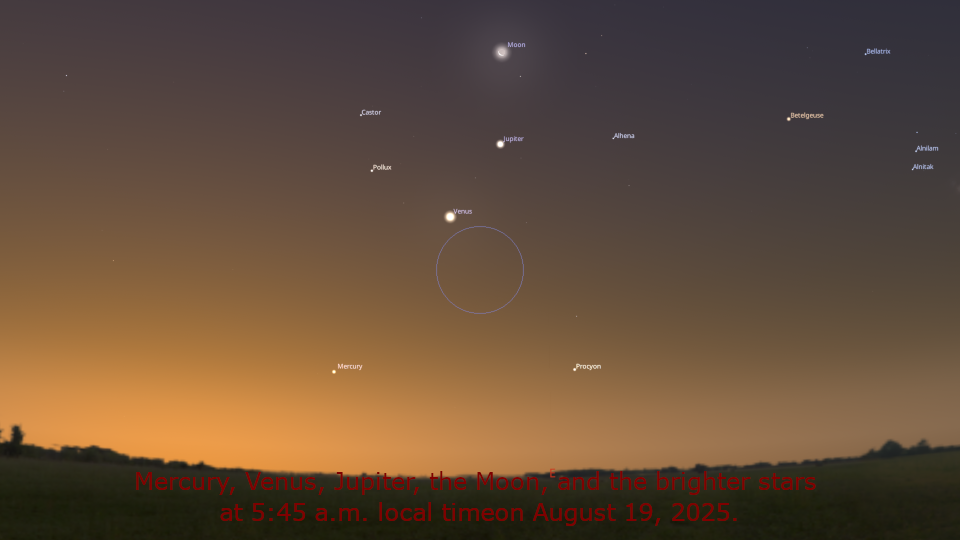
Tuesday, August 19, 2025 (morning): The waning crescent moon forms a ragged line with Venus and Jupiter in the pre-dawn sky.

Mercury, Venus, Jupiter, and the Moon at 5:45 am CDT on August 19, 2025.Also look for Mercury very low to the horizon just before dawn.

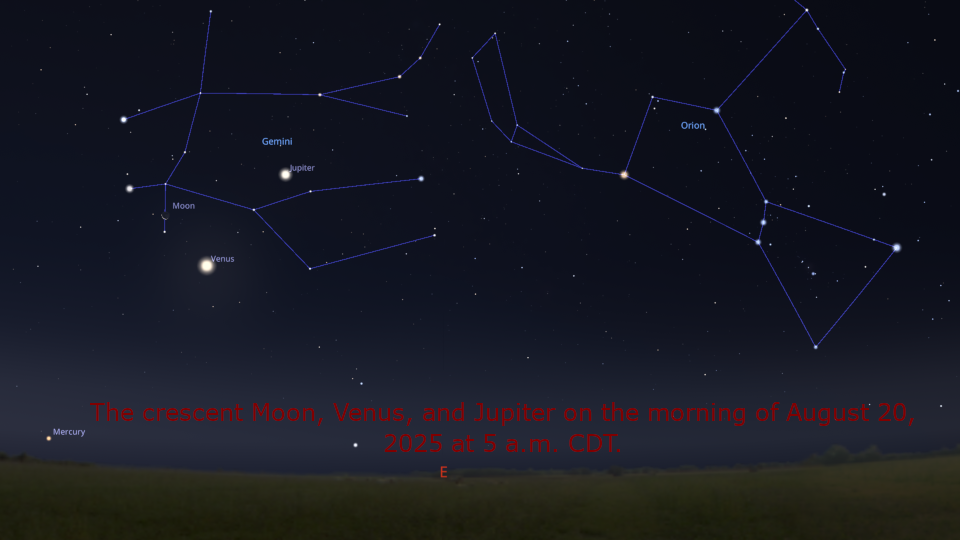
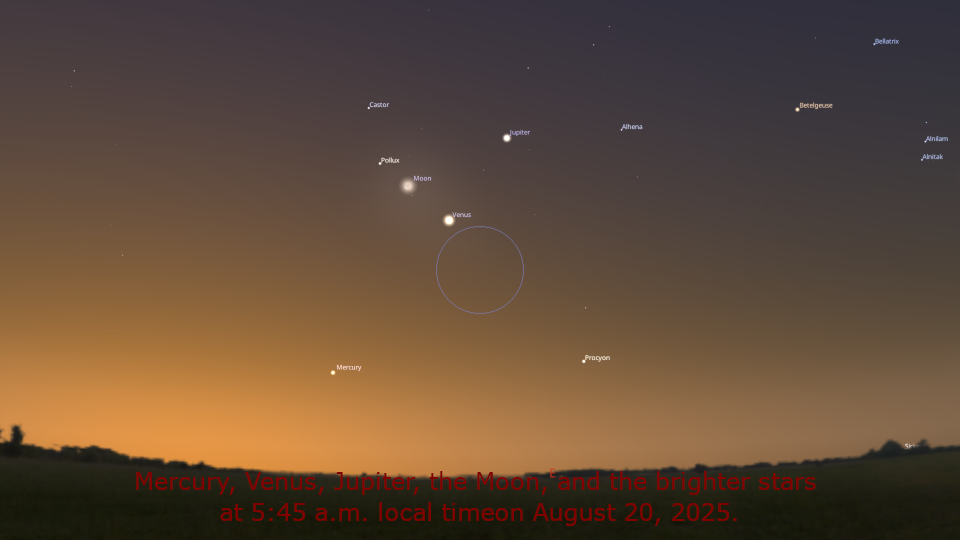
The moon, Jupiter, and Venus on the morning of August 20, 2025.Wednesday, August 20, 2025 (morning): The waning crescent has passed Jupiter and Venus, now forming a right triangle with the two bright planets in the morning sky. Above and to the left at much fainter Castor and Pollux, the brightest stars in the constellation of Geminin the Twins.

Mercury, Venus, Jupiter, and the Moon at 5:45 am CDT on August 20, 2025.Also look for Mercury very low to the horizon just before dawn.

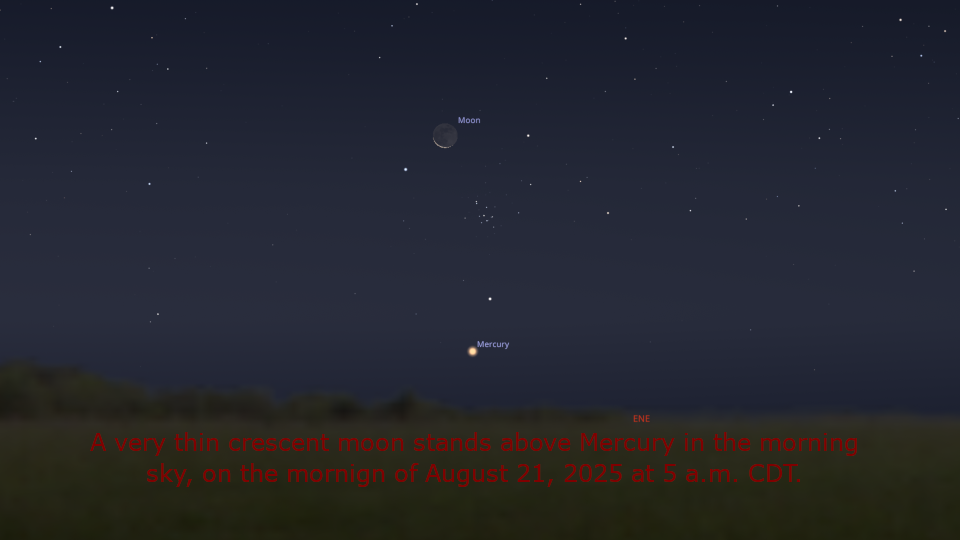
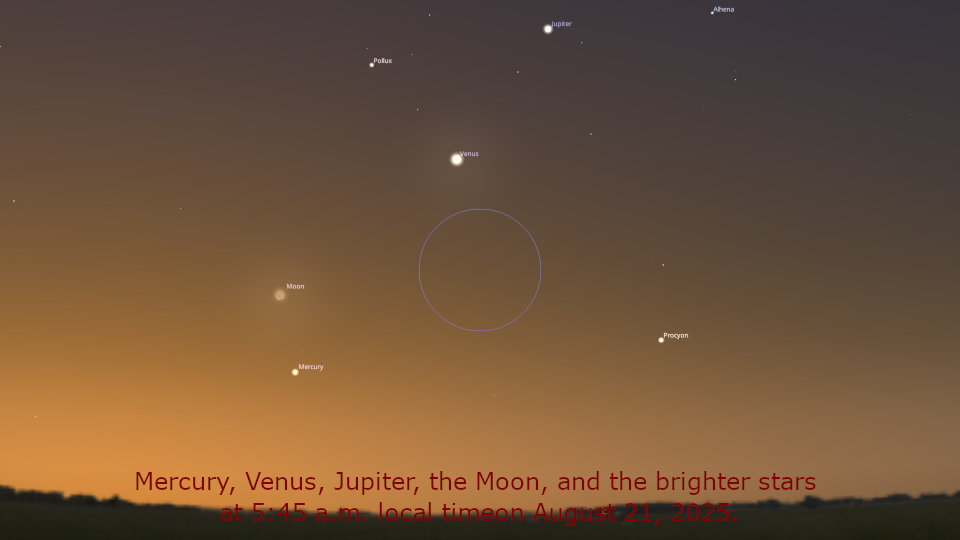
A thin crescent Moon joins Mercury on the morning of August 21, 2025 at 5 a.m. CDT.Mercury and the Moon at 5:45 am CDT on August 21, 2025.Thursday, August 21, 2025 (morning): A razor-thin crescent Moon stands above Mercury as the dawn sky brightens. Look low in the east-northeast as the sky brightens. The chart to the right shows the view at 5:45 a.m. CDT; the blue circle indicates the field of view of typical household binoculars.

Saturday, August 23, 2025: New Moon

Sunday, August 31, 2025: First Quarter Moon


People stare up at the northern lights above them.

Summer Meteor Showers

Outside of the regular events listed above, there are other things we see in the sky that can’t always be predicted in advance.

Aurora borealis, the northern lights, are becoming a more common sight again as the Sun goes through the maximum of its 11-year cycle of activity. Particles from the Sun interact with the Earth’s magnetic field and the high upper atmosphere to create glowing curtains of light around the north (and south) magnetic poles of the planet. Manitoba is well-positioned relative to the north magnetic pole to see these displays often, but they still can’t be forecast very far in advance. A site like Space Weather can provide updates on solar activity and aurora forecasts for the next 48 hours. The best way to see the aurora is to spend a lot of time out under the stars, so that you are there when they occur.,

Random meteors (also known as falling or shooting stars) occur every clear night at the rate of about 5-10 per hour. Most people don’t see them because of light pollution from cities, or because they don’t watch the sky uninterrupted for an hour straight. They happen so quickly that a single glance down at your phone or exposure to light can make you miss one.

Satellites are becoming extremely common sights in the hours after sunset and before dawn. Appearing as a moving star that takes a few minutes to cross the sky, they appear seemingly out of nowhere. These range from the International Space Station and Chinese space station Tianhe, which have people living on them full-time, to remote sensing and spy satellites, to burnt-out rocket parts and dead satellites. These can be predicted in advance (or identified after the fact) using a site like Heavens Above by selecting your location.

Scott Young

Scott Young

Planetarium Astronomer

Scott is the Planetarium Astronomer at the Manitoba Museum, developing astronomy and science programs. He has been an informal science educator for more than thirty years, working in the planetarium and science centre field both at The Manitoba Museum and also at the Alice G. Wallace Planetarium in Fitchburg, Massachusetts. Scott is an active amateur astronomer and a past-President of the Royal Astronomical Society of Canada.

Summer Meteor Showers

August is known for the annual Perseid meteor shower, which can often (but not always) produce a nice show for skywatchers. There are also about a dozen minor meteor showers that aren’t worth watching, that AI-driven social media pages are now picking up on and promoting as if they are something to see. Unfortunately, even the best meteor showers barely qualify for the name “shower”, so managing expectations is important.

Even a single meteor arcing across the sky can be a memorable sight, which is probably why many people “wish on a star” when they see one. Meteor observing requires no special equipment and is a casual way to enjoy the sky with the occasional “wow!” moments of a meteor. Don’t hype over numbers, and enjoy your time under the stars, and you will enjoy observing meteor showers.


What’s Going On

Meteor showers are basically caused when the Earth passes through a cloud of dust as it orbits the Sun. These interplanetary dust bunnies are left behind by comets or asteroids as they orbit the Sun. When our planet moves through one at high speed, the dust all burns up in our atmosphere, with each grain of sand or tiny rock becoming visible as a meteor (a.k.a. “shooting star”, “falling star”, etc.). Because we can predict their dates in advance, meteor showers are usually one of the first things put onto astronomy calendar websites.

But are meteor showers actually something worth watching? The answer depends on which meteor shower you’re looking at, and how much effort you’re willing to put in to seeing it.


The Effects of Light and Time

Most meteors are faint, and so if you have bright lights nearby then you won’t see the faint ones, which cuts your rates down significantly. Observing inside the city means you will see only a quarter or less of the predicted rates. To see a meteor shower well, you need to drive as far from city lights as you can.

If the Moon is in the sky, that’s like city lights you can’t drive away from. When the Moon is in the sky you can also lose about 75% of the meteors predicted.

And if that isn’t enough: meteor rates start very low in the evening, get stronger after midnight, and peak in the few hours before dawn. I have observed the Perseid meteor shower from inside the city before midnight and literally seen not a single meteor per hour. I ahve also observed the Perseids from a rural location with no moon, and seen 2 meteors per minute in the pre-dawn hours (120 per hour). So, these factors make a big difference in what you will see.

A meteor flashes overhead.
Meteor Observing

First, an important point: a typical meteor is only visible for a second or two. Any glance away from the sky during that hour and you might miss one. (Especially if you are glancing at an electronic device, which also ruins your night vision and makes it hard to see anything at night for up to five minutes!) So, to see the maximum number of meteors, you need to watch the sky, uninterrupted, for the whole hour. If you spend 25% of your time looking away from the sky, you will miss 25% of the meteors. To really appreciate the meteor shower, you need to commit to watching the sky without distraction.

Second point: on any given night throughout the year, if you are away from city lights on a dark, moonless night, you can expect to see between 1 and 10 meteors per hour. That’s the background rate in between meteor showers, the random dust in between the dust bunnies that is spread out across the solar system.

So, any meteor “shower” that lists a rate of less than 10 meteors per hour basically is no different than any other night. (OK, it *is* different scientifically, but for the average skywatcher you won’t even notice it.) This is why I’ve never promoted the dates of the Alpgha Capricornid meteor shower, which peaks on July 31 with a maximum theoretical rate of 3 meteors per hour. But I’m seeing social media posts announcing that it is on now and combining with the Perseids in a “rare” “double” “shower” “event” – and every one of those words is misused in this case. It happens every year, there are actually about 8 meteor showers active right now, and if you didn’t notice it last year it won’t be a big deal this year either. Complete hype, no substance.

So What Is Worth Watching?

In the summer, the answer is easy: the Perseids. That’s it. All the other minor meteor showers are underwhelming for the average skywatcher. The South Delta Aquariids, which peak on July 31, have a rate of between 5 and 10 meteors per hour, so if you are a hardcore meteor observer that’s one to try as well when (like this year) it lines up with the dark of the Moon.

In 2025, the Perseids peak when the Moon is nearly full, so even if you go out in the pre-dawn hours of August 11-12 (the peak night) you will likely only see 10-30 meteors per hour this year. For numbers, it’s not a great year because of the Moon. But, that means there’s no real need to drive far from the city; any reasonably dark space where you can see the sky will do this year.


It’s Not All About Numbers

Remember, though: the sheer number of meteors isn’t the only metric to use. I have seen single meteors that were so bright and beautiful they have stuck in my memory for decades. Often, evening meteors tend to be long and bright – so even if there aren’t a lot, the ones you see can be well worth it.

The bottom line is: meteor showers are a good time to see shooting stars, but don’t expect a laser light show. Each streak of light you see is a piece of dust left over from the formation of the solar system, a reminder of the era when planetary collisions were common as they shaped our planet. Keep expectations low, and appreciate whatever meteors you do manage to catch. A night under the stars is always time well spent.

Scott Young

Scott Young

Planetarium Astronomer

Scott is the Planetarium Astronomer at the Manitoba Museum, developing astronomy and science programs. He has been an informal science educator for thirty years, working in the planetarium and science centre field both at The Manitoba Museum and also at the Alice G. Wallace Planetarium in Fitchburg, Massachusetts. Scott is an active amateur astronomer and a past-President of the Royal Astronomical Society of Canada.

The Sky for April 2025

“April showers bring May flowers”, goes the saying, and it’s true that April does often have a lot of rain (or at least clouds) for Manitoba. On clear nights, though, we get a unique view away from our Milky Way galaxy and out into the darkness of intergalactic space. With fewer bright stars to guide you, contemplate the darkness between the stars: that’s what most of the universe is like.

The Solar System

Mercury is technically in the morning sky in April, but the angles dictate that it stays very low to the horizon (and probably invisible) from Manitoba. Southern hemisphere viewers get their best morning views this year of the elusive innermost planet.

Venus has moved between us and the Sun (well, just above the Sun) and is now low in the east before dawn.

Mars is still bright in the evening sky, forming an ever-changing triangle with the bright stars Castor and Pollux in Gemini.

Jupiter still shines brightly in the evening sky, high in the southwest after sunset in the constellations of Taurus.

Saturn has moved into the morning sky, but like Mercury it is very low to the horizon and probably invisible from Manitoba until near the end of the month. Saturn will be a summer feature this year, so wait a few months and you’ll get a great view.

Uranus sets very soon after the sun and is not easily observable this month. You’d need at least binoculars, and probably a small telescope, to be able to spot it, and even then it’s so far from Earth that it appears as just a faint “star” in a field of other stars.

Neptune is invisible without a telescope at the best of times, and this month is not the best of times. Neptune is near Venus in the bright twilight sky before sunrise and is unobservable this month.

Of the five known dwarf planets, none are visible with typical backyard telescopes this month.

Sky Calendar for April 2025

All times are given in the local time for Manitoba: Central Daylight Time (UTC-5). However, most of these events are visible across Canada at the same local time without adjusting for time zones.

Tuesday, Apr. 1, 2025 (evening): The thin crescent Moon is above the Pleiades star cluster in the evening sky. Both with fit comfortably into the field of view of typical household binoculars.

Wednesday, Apr. 2, 2025 (evening): The thin crescent Moon stands above and to the right of Jupiter in the west after sunset. in the evening sky. You should be able to see both in binoculars at the same time. Look for some tiny dots in a line very close to Jupiter – those are some of its largest moons! Callisto is the one farthest to the right and likely the one most easily seen in binoculars. Good eyesight or higher magnification may show a second dot closer to the bright planet – that’s Ganymede and Europa, which appear right beside each other tonight, merged into a single point.

Thursday, Apr. 3, 2025 (evening): The waxing crescent Moon is about halfway between bright white Jupiter (to its lower right) and reddish Mars (higher and to its left) in the west and southwest after sunset.

Friday, Apr. 4, 2025 (evening): The first-quarter Moon forms an almost-triangle with Mars and the stars Castor and Pollux. From bottom left, we have Mars, Pollux, and Castor.

Saturday, Apr. 5, 2025 (evening): The waxing gibbous Moon is to the left of Mars tonight. Both fit into the field of view of typical binoculars. This is a good chance to compare the reddish colour of Mars with the grey-white tones of the Moon.

Thursday, Apr. 10, 2025 (evening): After weeks of flirting as a triangle, Mars forms an almost-straight line with Castor and Pollux this evening. Nothing significant about this, other than it looks cool from our point of view here on Earth. (Mars is only 185 million kilometers away, while Pollux is 324 billion km and the six stars of the Castor system are 25 trillion km distant. Their apparent alignment is in in two dimensions as seen from this particular corner of the universe.)

Saturday, Apr. 12, 2025: Full Moon

Sunday, Apr. 20, 2025: Last Quarter Moon

Monday, Apr. 21, 2025 (evening): Tonight is the peak of the annual Lyrids meteor shower. Beginning around 11 p.m. local time you can expect to see a dozen or so meteors per hour from a dark sky location. The show intensifies after midnight and into the pre-dawn hours of the 22nd. As meteor showers go, this one isn’t at the same level as the Geminids of December or even the Perseids of August, but it’s a nice evening under the stars in cool spring skies before the mosquitoes hatch.

Thursday, Apr. 24, 2025 (morning): The thin crescent moon is visible off to the right of bright Venus in the eastern sky about a half-hour before sunrise.

Friday, Apr. 25, 2025 (morning): The thin crescent Moon has moved to the lower left of Venus. Both are visible in the eastern sky just before dawn.

Sunday, Apr. 27, 2025: New Moon

Tuesday, Apr. 29, 2025 (evening): The crescent Moon reprises its appearance with Jupiter, although this time they are too far apart to fit into the view through binoculars at the same time. The Moon is slightly below and to Jupiter’s right this evening after sunset.

Also tonight, Mars begins its approach to the Beehive star cluster (also known as Messier 44 or M44) in the constellation of Cancer the Crab. While the cluster is just a faint smudge in binoculars, a small telescope shows a few dozen stars. Mars will skirt the northern edge of the cluster during the first week or May, making for interesting pictures for small telescope users.

Wednesday, Apr. 30, 2025 (morning): You might be able to glimpse Saturn through binoculars starting today if you’re up early. Start looking about 5:30 am local time. First, find Venus, which is the brightest (and probably only) “star” you will see in the bright twilight glow in the east. Put Venus near the “10 o’clock” position in your binoculars, and then look for a really faint object near the “4 o’clock” position. That’s Saturn. It will likely only be visible for a short window between when it rises and when the sky is too bright to see it/

Wednesday, Apr. 30, 2025 (evening): The crescent Moon stands above Jupiter in the western sky after sunset.

People stare up at the northern lights above them.

Outside of the regular events listed above, there are other things we see in the sky that can’t always be predicted in advance.

Aurora borealis, the northern lights, are becoming a more common sight again as the Sun goes through the maximum of its 11-year cycle of activity. Particles from the Sun interact with the Earth’s magnetic field and the high upper atmosphere to create glowing curtains of light around the north (and south) magnetic poles of the planet. Manitoba is well-positioned relative to the north magnetic pole to see these displays often, but they still can’t be forecast very far in advance. A site like Space Weather can provide updates on solar activity and aurora forecasts for the next 48 hours. The best way to see the aurora is to spend a lot of time out under the stars, so that you are there when they occur.,

Random meteors (also known as falling or shooting stars) occur every clear night at the rate of about 5-10 per hour. Most people don’t see them because of light pollution from cities, or because they don’t watch the sky uninterrupted for an hour straight. They happen so quickly that a single glance down at your phone or exposure to light can make you miss one.

Satellites are becoming extremely common sights in the hours after sunset and before dawn. Appearing as a moving star that takes a few minutes to cross the sky, they appear seemingly out of nowhere. These range from the International Space Station and Chinese space station Tianhe, which have people living on them full-time, to remote sensing and spy satellites, to burnt-out rocket parts and dead satellites. These can be predicted in advance (or identified after the fact) using a site like Heavens Above by selecting your location.

Scott Young

Scott Young

Planetarium Astronomer

Scott is the Planetarium Astronomer at the Manitoba Museum, developing astronomy and science programs. He has been an informal science educator for more than thirty years, working in the planetarium and science centre field both at The Manitoba Museum and also at the Alice G. Wallace Planetarium in Fitchburg, Massachusetts. Scott is an active amateur astronomer and a past-President of the Royal Astronomical Society of Canada.

The Sky for December 2024

Winter nights start early and last long, making them perfect for star watching. Except for the temperature… and the clouds… Catch a clear December night, though, and you’ll be treated to the brightest stars and planets in the sky.

Comet Updates

The great fall comet, 2023 A3 (Tsuchinshen-ATLAS) has come and (mostly) gone, providing some beautiful views in October and November. It’s still in the evening sky, but only visible with telescopes as it rockets away from the inner solar system.

Another comet, Comet 2024 G3 (ATLAS), was discovered by the same program that helped find 2023A3 – the Asteroid Terrestrial-impact Last Alert System, or ATLAS. This comet, a so-called “sun-grazer” will likely get quite bright, but only be visible in the daytime sky and from the southern hemisphere, so that means most Manitobans won’t be able to see it.

The Solar System

Mercury passes between Earth and Sun (and slightly above the Sun as viewed from Earth), so it remains invisible until the second half of December, when it appears low in the southeastern sky just before sunrise. On the morning of December 28, the thin crescent Moon is nearby, next to the reddish star Antares.

Venus spends the month in the evening sky, low in the southwest after sunset. The thin crescent Moon approaches on the 3rd, is nearby on the 4th, and is still close on the 5th, making a nice photo op. It stands a little higher at sunset each night, and sets about three hours after sunset. In a telescope, Venus displays phases like the Moon, and in December it is about 50% illuminated, a tiny half-moon shape at high power.

Mars rises in the northeast about 9pm in early December, and a bit after 7pm by month’s end. By midnight it is high in the south, providing the clearest telescope views. Mars reaches its best next month, its closest point to Earth on this orbit, but it’s worth looking at now.

The planet Jupiter and two of its moons.
The planet Jupiter’s intricate clouds bands and visible through a telescope. Two of its largest moons are seen at right. [Image: S. Young]
December 2024 belongs to Jupiter, The giant planet reaches opposition on December 7, 2024, rising at sunset, hitting its highest altitude in the south around local midnight, and not setting until sunrise. Jupiter dominates the evening sky, outshining everything else except Venus and the Moon. A small telescope will reveal some of Jupiter’s banded clouds, while its four largest moons are visible in binoculars as tiny “stars” in a line on either side of the planet.

Saturn is low in the south at sunset, and sets before midnight. The rings are nearly edge-on as seen from Earth, but visible in a telescope with more than about 30x magnification. Saturn edges closer to Venus and the setting sun each night, making it lower and harder to get clear telescopic views.

Sky Calendar for December 2024

Dec. 1 : New Moon

Dec. 4: The thin crescent Moon is below Venus, just after sunset, low in the southwestern sky.

Dec. 5: The thin crescent Moon is to the left of Venus in the southwestern sky, just after sunset.

Dec. 7:  Jupiter at opposition, visible all night.

Dec. 7: The crescent Moon is below and to the right of Saturn in the evening sky.

Dec. 8: The First Quarter Moon is to the left of Saturn in the evening sky.

Dec. 13-14: Peak of the Geminid meteor shower. The nearyl-full Moon will reduce the number of meteors seen, but you can still expect 20-40 meteors per hour in late evening and early morning.

Dec. 14: The nearly-full Moon forms a line with Jupiter and the bright star Aldebaran in the eastern sky.

Dec. 15: Full Moon

Dec. 17: The waning gibbous Moon is just above Mars as the pair rises in the East about 7:15 p.m. local time.

Dec. 21: The winter solstice occurs at 4:20 a.m. Central Time, marking the beginning of astronomical winter in the northern hemisphere (and the beginning of summer in the southern hemisphere).

Dec. 22: Last Quarter Moon

Dec. 22-23: The peak of the Ursids meteor shower, which radiate from near the North Star. They only produce a few meteors per hour, though.

Scott Young

Scott Young

Planetarium Astronomer

Scott is the Planetarium Astronomer at the Manitoba Museum, developing astronomy and science programs. He has been an informal science educator for thirty years, working in the planetarium and science centre field both at The Manitoba Museum and also at the Alice G. Wallace Planetarium in Fitchburg, Massachusetts. Scott is an active amateur astronomer and a past-President of the Royal Astronomical Society of Canada.

The Sky for August 2024

August brings the return of some planets to the evening sky, the most famous meteor shower of the year, and longer nights than we’ve seen for a couple of months. The Milky Way is on full display, offering an unforgettable view from a dark, moonless sky. Unfortunately all of these benefits will likely be offset by smoke in the air from forest fires across Canada, which has become a fixture of summertime observing for the last several years.

The Perseid Meteor Shower

The annual Perseid meteor shower is the most famous meteor shower of the year, although it is not the best one of the year. Its occurrence in August during summer vacation likely makes it more accessible than the much better Geminids, which occur in mid-December. For a complete rundown on the Perseid meteor shower, check out this blog post.

2024 is a good year for the Perseids, since the peak time occurs with the Moon out of the sky. The thing about meteor showers is, they peak in the few hours before dawn for any given location. So to see the Perseids at their best, you want to observe from about 1:30 a.m. to dawn. There will be almost no meteors before midnight – you might see one or two, and the ones you do see will likely be bright ones, but it won’t be much of a “shower” unless you stay up all night.

To observe the Perseids, get away from city lights. Light pollution will wash out the fainter meteors, and there are a lot more faint meteors than bright ones. Bring a reclining lawn chair and blanket to ward off the early-morning chill, and set up facing the darkest part of the sky (or straight up, if you’re in a nice dark spot). Turn off your electronic devices and your car’s lights – any stray light will make it hard to see the meteors for you and anyone near you. The meteors only last a second or two, so you need to watch the sky continuously – literally, don’t blink or you’ll miss it.

You can also try and take pictures of meteors – set up your camera on a tripod and take a bunch of time exposures of the sky. If you’re lucky, a meteor will happen while you’re taking a picture.

We’d love to show your Perseid pics on Dome@Home, our online astronomy show. Send them to space@manitobamuseum.ca and then tune in to our August 28th show at 7 p.m. Central on the Museum’s Facebook and YouTube channels.

The Solar System

Finally, some planets are visible in the evening sky! Barely…

Mercury is still on the evening side of the sky, but in August it sets just after the Sun and so isn’t visible for Canadian viewers. Folks farther south still have have a chance to catch it early in the month, low in the west just after sunset.

Venus has appeared in the evening sky, although like Mercury it is still low in the sky; only its great brightness allows it to be spotted very low soon after sunset. The thin crescent moon is nearby on August 5th.

Mars rises about 2 a.m. local time in the northeast, inconspicuous compared to nearby Jupiter and both the Pleaides and Hyades star clusters. Mars and Jupiter pass less than half a degree apart on the morning of August 14th; see the Sky Calendar entry below for details.

A simulated view of Saturn and its rings.

Jupiter is the brightest “star” in the eastern sky after midnight, outshining all the visible stars as it cruises through the stars of Taurus. The waning crescent Moon is nearby on the morning of August 27.

Saturn rises about 11 p.m. local time early in the month, and moves into the south by dawn. The ringed planet reaches opposition on September 8, so it’s coming into its best viewing position for the year. The rings are only tilted about 4 degrees to our line of sight, making them appear very thin from our point of view. The nearly-full Moon is to Saturn’s left on the evening of the 21st.

Sky Calendar for August 2024

Click on highlighted dates for a star chart showing the view!

Aug 4: New Moon

Aug 11 – Aug 12 (morning sky): Best viewing for the annual Perseids meteor shower; see featured article above. Decent rates should occur the morning before and after as well.

Aug 12 (evening sky): First Quarter Moon

Aug 14 (morning sky): Jupiter and Mars are close together in the morning sky, separated by less than the size of the Full Moon. They’re still pretty close the morning before and after this date.

Aug 19: Full Moon

Aug 20-21 (after midnight into morning sky): The waxing gibbous Moon is to the left of and slightly above Saturn. The two are only about 3 degrees (6 Full Moon diameters) apart, fitting easily into the same binocular field-of-view.

Aug 26: Last Quarter Moon

Aug 27 (morning sky): The waning crescent Moon is above Jupiter, rising together in the morning sky about 1 a.m. local time in the morning sky. Mars is below and to the left, forming a not-quite-right triangle. The red supergiant star Aldebaran is to Jupiter’s right along with the Hyades star cluster, with the Pleaides above them all. The morning rising of these star clusters remind us that winter is coming.

Aug 28 (morning sky): The Moon, Mars, and Jupiter form a very squashed triangle pointing downwards in the eastern sky before dawn.

Aug: 29 (morning sky): By this morning the Moon has moved farther on, still forming a rough line with Mars and Jupiter in the early morning sky.

Scott Young

Scott Young

Planetarium Astronomer

Scott is the Planetarium Astronomer at the Manitoba Museum, developing astronomy and science programs. He has been an informal science educator for thirty years, working in the planetarium and science centre field both at The Manitoba Museum and also at the Alice G. Wallace Planetarium in Fitchburg, Massachusetts. Scott is an active amateur astronomer and a past-President of the Royal Astronomical Society of Canada.

Meteor Showers in Summer (2024 Edition)

Meteors

A meteor (a.k.a. falling star, shooting star) looks like a bright streak across the starry sky that lasts for a second or two before fading away. Most people believe they are rare enough that you should make a wish when you see one, but they are surprisingly common if you watch the sky a lot. On any given night with no Moon, if you get away from city lights and watch the sky continuously, you’ll see up to a half-dozen meteors per hour. Any light sources – the Moon, city lights, you phone – will reduce that number to near zero.

Each meteor you see is actually a tiny piece of dust about the size of a grain of sand which is burning up in the Earth’s atmosphere. Space isn’t empty, you see – it’s dusty, with all the dust leftover from the big construction job that was the formation of the solar system. As the Earth orbit the Sun, it plows through the dust at over 100,000 kilometers per hour. It’s a one-sided collision, and the poor speck of dust disintegrates in a flash of light that we can see from the ground as a meteor.

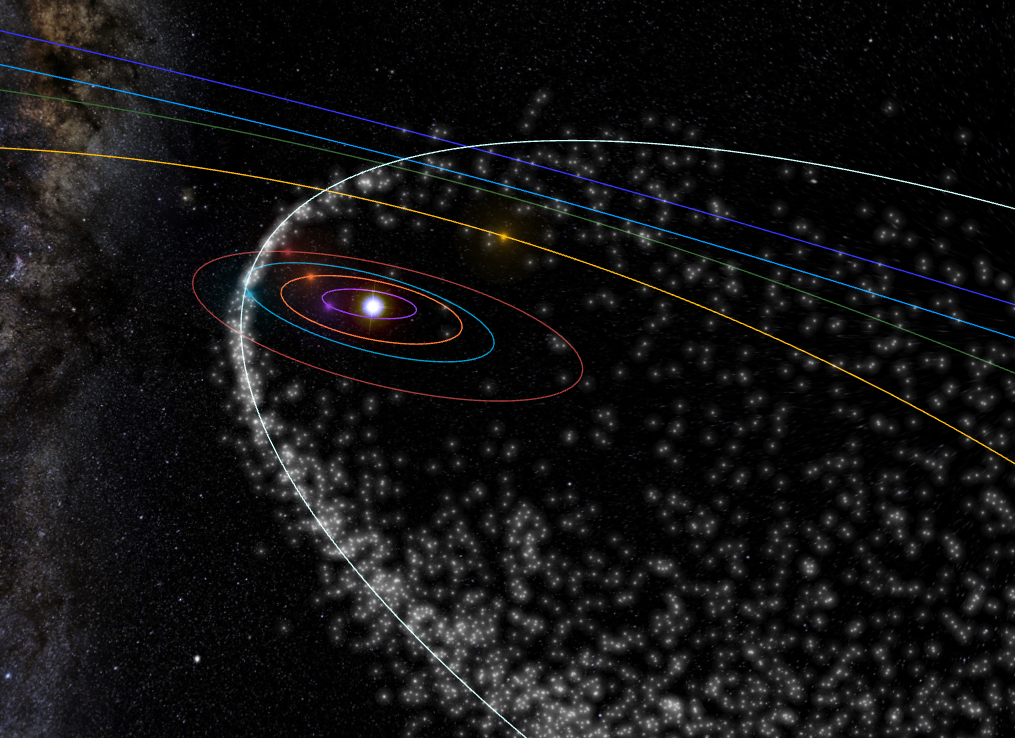
A diagram of the solar system showing the Perseid meteor stream.

Meteor Showers

So far, so good – you can see these little specks of dust as they vaporize, and they pretty much occur randomly all the time, we just don’t usually notice. But, it turns out that space isn’t evenly dusty. There are spots, just like in your house, that have more dust than others. In my house, these dust bunnies congregate under the furniture and anyplace the air vents push them; in the solar system these dust bunnies remain where they were shed, in the orbital paths of comets. The solar system is crisscrossed by trails of dust left behind by various comets (and a few asteroids). If the Earth’s orbit intersects one of those trails, we will fly through an interplanetary dust bunny every year around the same time. That’s a meteor shower.

The name “meteor shower” makes you think you can see a lot more meteors than on other nights. But here’s the thing: “a lot” can mean different things. Forty times the normal rate sounds like a lot, until you remember it’s forty times about one meteor per hour. There are over a hundred meteor showers catalogued, but there are only a couple of meteor showers a year that produce more than forty meteors an hour. Even during an official meteor “shower”, you can probably only expect to see a half-dozen meteors per hour, and that’s under perfect skies with your eyes watching the sky 100% of the time.

The Perseids for 2024

So, most meteor showers don’t produce many meteors; that’s the bad news. The good news is, the Perseids in August is one of them, which makes them probably the most famous meteor shower of all. And, in 2024 the Moon will be out of the sky during the crucial morning hours. If you can get away from city lights under a clear, dark sky, you might see up to 60 meteors an hour – one a minute – in the early morning hours of August 12.

That’s pretty specific timing, but luckily the Perseids “dust bunny” is more than one day wide. The Earth actually enters the outer edge of it in late July, and each morning the rates will increase until the peak on the 11th-12th. So, we have several chances to see a decent Perseids display this year.

The key point to remember is that all meteor showers are best between about 1:30 a.m. and 5 a.m. local time. Pre-midnight observing might be 1/10 or less of the morning rates. Really, you have to stay up all night to see this.

To get the best view, get as far away from city lights as practical, and set up a reclining lawn chair or blanket so you can lean back and see as much of the sky as possible. Keep all the lights around you off, especially if you are in a park of other spot with other observers. One peek at your phone will shut off the natural night vision of your eyes for up to ten minutes, so you really need to avoid looking at any lights. (If you need to keep your car running, cover the headlights with a blanket or something so you don’t blast the whole park with your lights!) If you have any lights nearby, put them behind you out of your view, and just watch the sky. You don’t need a telescope or binoculars – in fact, those instruments restrict your field of view so much that you probably won’t see any meteors through them at all. The meteors can appear anywhere in the sky, and they only last a second or two – literally, don’t blink or you can miss them.

Meteors and Cameras

You can take pictures of meteors, but it involves a little luck, and some understanding of your camera. If you have a DSLR or mirrorless camera, you can put it on a tripod and set your exposure manually for something like 5 or 10 seconds – you’ll get a lot of pictures of stars, but if you’re lucky a meteor will happen while you’re shooting, and it will show up in one picture.

If you’re using your phone camera, you might need to download a better camera app than the one your phone came with – check out the app store for one that is designed for night or sky photography. The same tactic applies – take lots of pictures, and hope you catch one. Make sure the light from your camera doesn’t interfere with your vision, though – just take the pictures now, and look at them later.

One thing to watch for: satellites. There are piles of satellites that will show up in your images as streaks of light. You can tell satellites by the trail being the same brightness and thickness throughout; meteors tend to start faint and narrow, get brighter and wider, and then trail out again.

Other Summer Meteor Showers

While technically there are other meteor showers in July and August, in practice these are not noticeable to the average observer and are scientific designations only. They’re named after the constellation or star that the meteors appear to radiate from, but most of them produce a meteor every couple of hours or so – not even a spritzing, let alone a shower. Even the bigger South Delta Aquariid meteor shower, which peaks in late July, only produces about 5 meteors an hour at best. If you are interested in these minor meteor showers, there is backyard science that can be done by tracking them with a camera, though; visit the International Meteor Organization for some great information on getting deeper into the science of meteor observing.

tl;dr: The morning of August 12th between 1:30 a.m. and 4:30 a.m. you will probably see quite a few meteors. The morning before and after, you’ll still see a good number. The rest of the summer, you’ll hardly see any, but you might see one anytime you are looking at the stars.