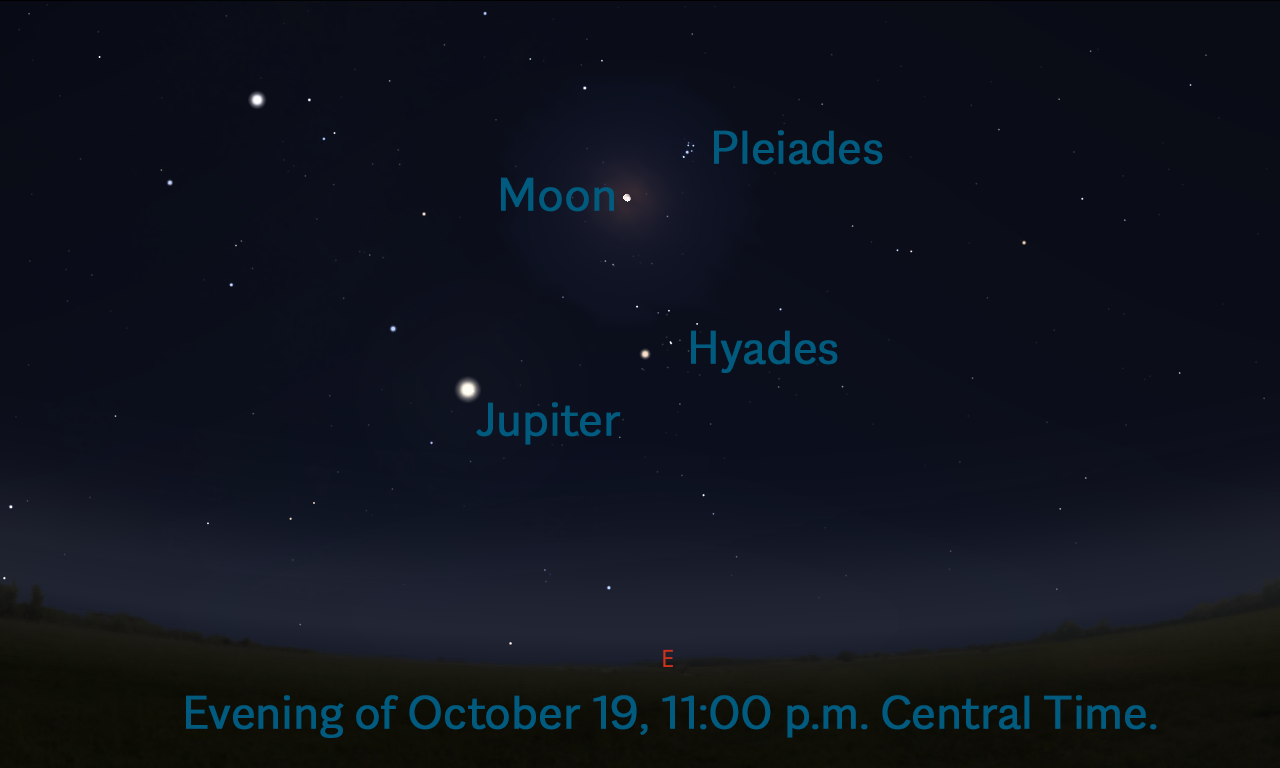



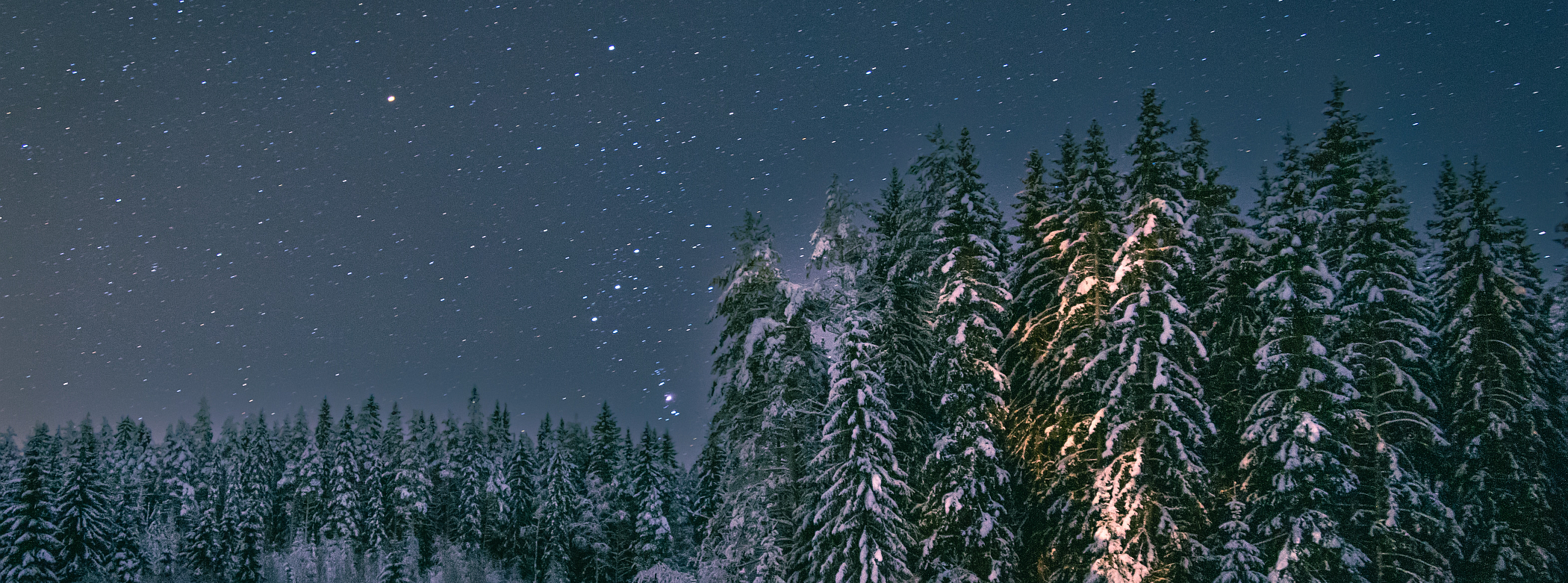
A starry sky over a winter forest scene. The constellation Orion is rising,
Manitoba Skies

The Sky for January 2026

What’s up in the sky for January 2026.

The Sky for January 2026

Manitoba’s January skies are usually cold if they are clear, and the long winter nights make stargazing easier. You don’t need to stay up late to spot Orion and his retinue of winter constellations rising in the east after dark, and the crisp winter air can provide remarkably clear views for users of telescopes and binoculars.

Although this article focuses on events visible in Manitoba, most events will also be visible across Canada and most places in the mid-northern hemisphere.


The Solar System for January 2026

Mercury is too close to the Sun to be easily seen from Manitoba this month, although more southerly viewers might catch it very low in the southeast just before sunrise during the first few days of the month. It reaches superior conjunction (in line with and just below the Sun) on January 21st, 2026.

Venus has disappeared into the sun’s glare as well, passing its superior conjunction on January 6th, 2026. It will reappear in the evening sky early in the spring of 2026.

Mars is still too close to the Sun to be visible this month. It passes behind the sun and reaches superior conjunction on January 9th, 2026.

Jupiter is the planetary highlight of the month. The giant planet is low in the east at sunset and is visible all night, rising high into the south and then lower into the northwest by sunrise. Jupiter reaches opposition on January 10th, the date when it is opposite the Sun in the sky. This is also when Jupiter appears near its brightest and largest as seen from Earth, so it’s a great time to break out the binoculars or telescope and take a look.

Even a small telescope will show Jupiter as a tiny planet with several tinier “stars” in a line near it – these are Jupiter’s largest moons. Up to four of them can be seen, depending on where they are in their orbit around the giant planet. Often these moons can be glimpsed in binoculars as well.

Saturn is in the south, a third of the way up the sky, as darkness falls. It sets before midnight in the southwest, so catch it early if you want to spot it. Saturn’s rings are nearly edge-on to our line of sight, making them nearly invisible in a telescope. The Moon is nearby on January 22nd and 23rd, 2026.

Uranus is in the evening sky a few degrees below the famous Pleaides star cluster (also known as the Seven Sisters). It is too faint to easily see without binoculars, and even a telescope shows it as a faint dot that looks just like the other faint stars. A detailed star-charting app like Stellarium or the charts in the Observer’s Handbook is required to track it down.

Neptune requires good binoculars or a small telescope to even spot, and a large telescope to make it out as anything more than a faint dot. It spends the month near Saturn, though, which makes it easier to track down than usual. As with Uranus, a detailed star chart like those in the Observer’s Handbook or produced software by Stellarium is required to tell which tiny “dot” is Neptune.

Of the five known dwarf planets, only (1) Ceres is close enough to be seen in binoculars or a small telescope. Ceres has faded below easy visibility in binoculars for the year, but will brighten again beginning in late 2026.
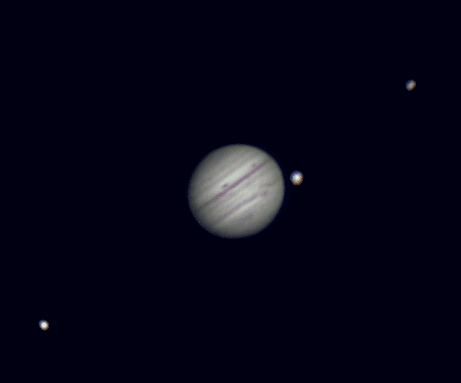
Jupiter and its moons as seen through a backyard telescope. (Image credit: Planetarium Astronomer Scott Young)

Planetary Spotlight: Jupiter

Jupiter is probably the best planet for amateur astronomers. Being the largest planet, we can see details in the cloud tops (Jupiter is a gas giant planet, and so the “surface” we see is actually the top of the  atmosphere). Its four brightest moons are visible in any telescope, and even in binoculars if you can hold them steady enough (try bracing your arms against your body or the arms of a reclining lawn chair, or mount the binoculars on a tripod).

Seeing detail on Jupiter does require some practice, though. The first time you look at Jupiter up close, you’ll probably see a bright white “star” with a few fainter “stars” lined up with it. Don’t just take a quick peek and give up, though. Your eyes will see more if you keep looking. Eventually you’ll see that the bright “star” isn’t a point of light, but a tiny globe. You’ll start to notice some dark lines running across it – those are the big equatorial cloud bands that circle the planet.

The more often you look at Jupiter through a telescope, the more you will see. Our eyes aren’t very good at looking at tiny images through a small tube. It takes practice to train your eye and brain. The tenth night you look at Jupiter, you will see much more than you did on the first night. You can also put your camera at the eyepiece to snap a picture. It takes practice to make it work, but you can get great images through a telescope with just a cell phone or point-and-shoot camera.

Sky Calendar for January 2026

All times are given in Central Standard Time, the local time for Manitoba. However, most of these events are visible across Canada at the same local time without adjusting for time zones.

If there’s a little box to the left of the date, you can click on it to see a star map of that event! All images are created using Stellarium, the free planetarium software.

Friday, January 2nd, 2026: First Friday at the Manitoba Museum includes free telescope viewing this month (weather permitting). Telescopes will be set up outside the Planetarium dome from 6:30 p.m. to 9:00 p.m. for views of the Full Moon and the planets Jupiter and Saturn. Dress warmly!

The Full Moon and Jupiter rise side by side among the stars of Gemini the Twins on January 3rd, 2026.

Saturday, January 3rd, 2026: Full Moon, appearing near Jupiter in the sky. Since Jupiter is near opposition, and the Full Moon is basically what happens when the Moon reaches its own “opposition” (the point opposite the Sun in the sky), this make sense!

Saturday evening is also the peak of the annual Quadrantid meteor shower, but with the full moon and the timing this isn’t a great year for it. You might see a handful of meteors after sunset tonight, but the Moon will overwhelm most of them.

Tuesday, January 6th, 2026: Venus reaches superior conjunction, passing around the far side of the Sun as seen from Earth.

Friday, January 9th, 2026: Mars reaches superior conjunction, passing around the far side of the Sun as seen from Earth.

Saturday, January 10th, 2026: Jupiter reaches opposition, about 634 million kilometers away from Earth. Today is also the Last Quarter Moon.

Sunday, January 18th, 2026: New Moon

Wednesday, January 21st, 2026: The planet Mercury reaches superior conjunction, passing around the far side of the Sun. If this text sounds familiar, it’s because it is the third planet to pass superior conjunction this month – nothing more than a coincidence of cycles that have been going on for billions of years.

The crescent Moon is to the right of Saturn in the southwest on the evening of January 22nd, 2026.Thursday, January 22nd, 2026: The Moon is to the right of Saturn tonight in the early evening sky.

The crescent Moon is above Saturn in the southwest on the evening of January 23rd, 2026.Friday, January 23rd, 2026: The Moon is to the left of Saturn tonight in the early evening sky.

A binocular view of the Moon beside the Pleiades star cluster on the evening of January 27th, 2026. The view shown is at 6 p.m. Central Time.Tuesday, January 27th, 2026: The Moon is beside the Pleaides star cluster this evening. It is closest at dusk, but the Moon’s orbital motion moves it farther away from the star cluster even as the Earth’s rotation carries them both higher into the sky. (The accompanying chart shows the view at 6 p.m., Central time; the Moon will move farther to the left about its own diameter every hour relative to the background stars.)

Wednesday, January 28th, 2026: Mercury and Venus pass close to each other, but this occurs far too close to the Sun to be visible.

Saturday, December 27th, 2025: First Quarter Moon
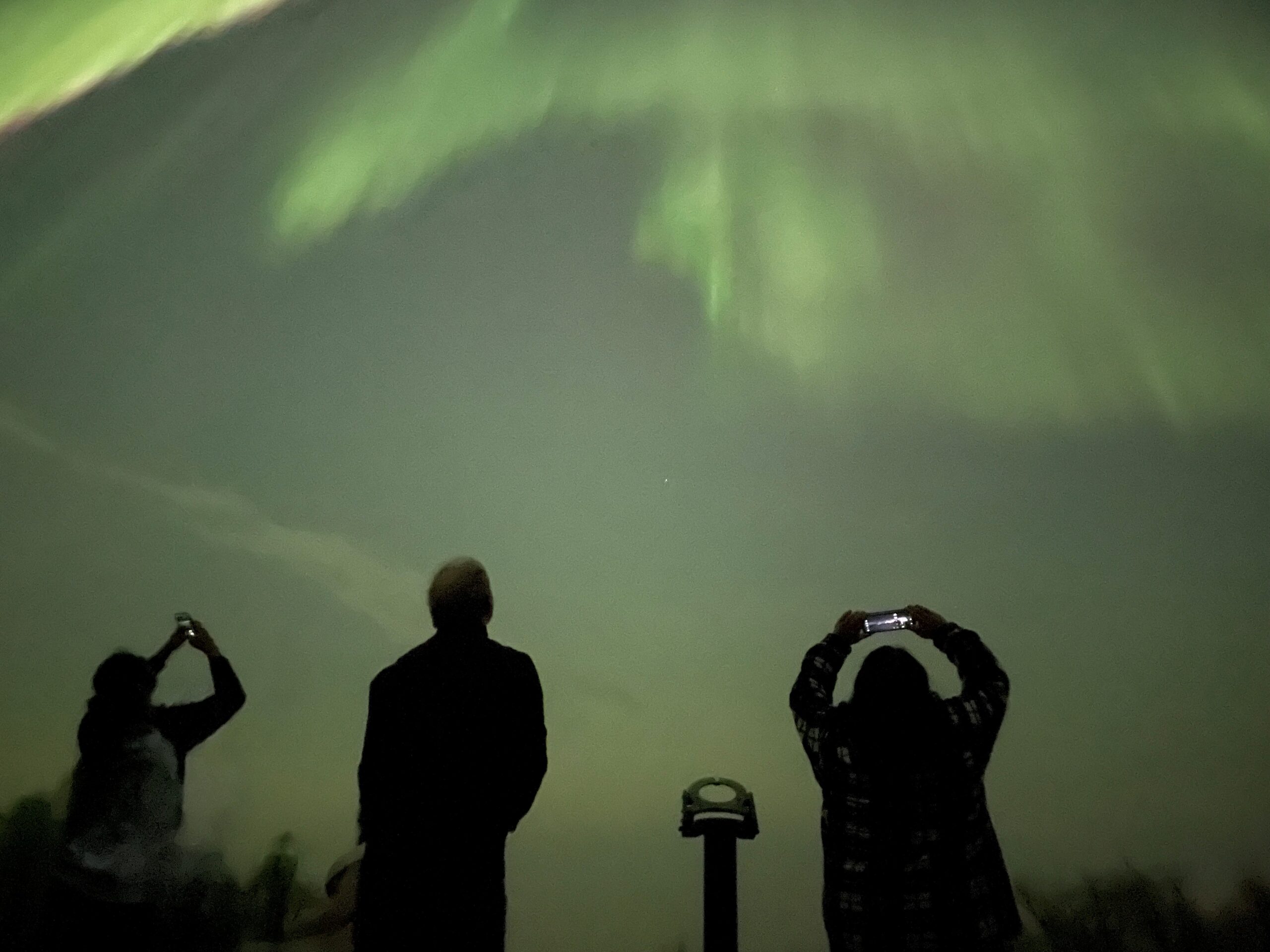
People stare up at the northern lights above them.

Other Celestial Sights

Outside of the events listed above, there are other things we see in the sky that can’t always be predicted in advance.

Aurora borealis, the northern lights, are becoming a more common sight again as the Sun goes through the maximum of its 11-year cycle of activity. Particles from the Sun interact with the Earth’s magnetic field and the high upper atmosphere to create glowing curtains of light around the north (and south) magnetic poles of the planet. Manitoba is well-positioned relative to the north magnetic pole to see these displays often, but they still can’t be forecast very far in advance. A site like Space Weather can provide updates on solar activity and aurora forecasts for the next 48 hours. The best way to see the aurora is to spend a lot of time out under the stars, so that you are there when they occur.

Random meteors (also known as falling or shooting stars) occur every clear night at the rate of about 5-10 per hour. Most people don’t see them because of light pollution from cities, or because they don’t watch the sky uninterrupted for an hour straight. They happen so quickly that a single glance down at your phone or exposure to light can make you miss one.

Satellites are becoming extremely common sights in the hours after sunset and before dawn. Appearing as a moving star that takes a few minutes to cross the sky, they appear seemingly out of nowhere. These range from the International Space Station and Chinese space station Tianhe, which have people living on them full-time, to remote sensing and spy satellites, to burnt-out rocket parts and dead satellites. The most common sightings are Starlink satellites, which are being launched dozens at a time to bring internet to remote regions, but which cause trouble with astronomy and pollution. These can be predicted in advance (or identified after the fact) using a site like Heavens Above by selecting your location.

Scott Young

Scott Young

Planetarium Astronomer

Scott is the Planetarium Astronomer at the Manitoba Museum, developing astronomy and science programs. He has been an informal science educator for more than thirty years, working in the planetarium and science centre field. Scott is an active amateur astronomer and a past-President of the Royal Astronomical Society of Canada. He hosts Dome@Home, the Manitoba Museum’s award-winning online astronomy show.

The Sky for November 2025

November is a good month for planet watchers, as both Saturn and Jupiter are well-placed in the evening. Comet Lemmon is still visible, although it fades over the course of the month. Although several meteor showers are active or even peak in November, none of them produce a rate of meteors that most people would consider a “shower”.

The fall sky still gives us a view of the summer sky just after dark – as those stars slip into the west, the sunset occurs earlier each night, which gives us an extra bit of summer (at least astronomically). Pegasus and Andromeda are high in the south, and Cassiopeia takes her place near the zenith. Meanwhile, the winter constellations – Orion, Taurus, Gemini – are waiting in the east to usher in the cold weather.

And of course, in November we alter the clocks as part of the misnamed “daylight savings” scheme, which probably made sense when you literally blew out the lights at night, but makes no difference in the era of 24/7 office lights, refrigerators, and device charging.

Comets in November 2025

Comet Lemmon among the stars.

Comets are chunks of ice and dust a few kilometers across that originate from the edge of the solar system. If one moves through the inner solar system closer to the Sun, the ice melts and the dust streams away, blown buy the solar wind into a tail which can sometimes become bright enough to see from Earth. They can be visible for days or weeks as they zoom around the Sun and head back out into deep space.

At any given time there are five or ten comets in the sky that are visible in large telescopes. A comet that reaches binocular visibility is uncommon, maybe one every couple of years. A comet that becomes bright enough to be seen without optical aid is even more rare.

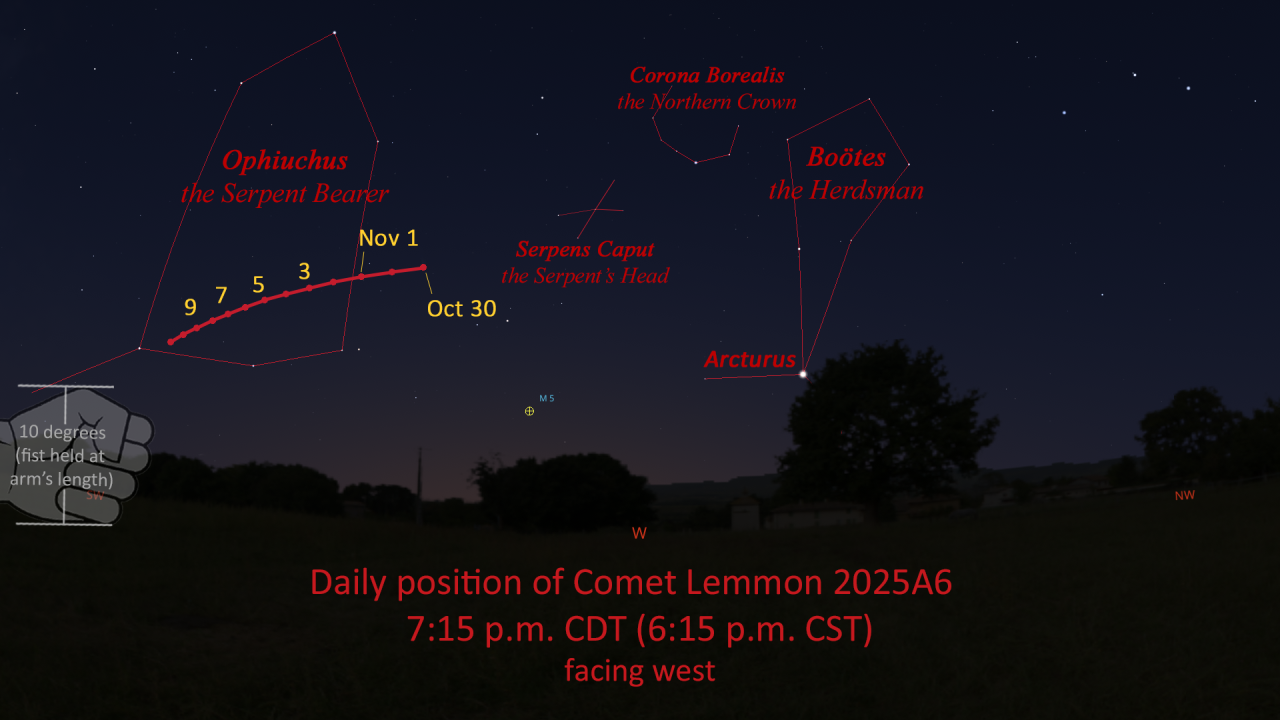
In November 2025, Comet Lemmon (C/2025 A6) is still visible in binoculars (and maybe to the unaided eye, from a dark sky) in the early evening. Last month, this comet was a nice photographic target, but it looked just like a fuzzy blob to most visual observers (perhaps with a bit of a tail pointing upwards). If you want to see this comet before it fades too much, head out 30 minutes after sunset in the first week of November. The Moon gets brighter each night, though, and won’t leave the sky until November 7th, when the comet has already started to sink lower into the horizon haze. Use the chart below to see where the comet it relative to the bright star Arcturus and the fainter stars of the little-known constellation Ophiuchus.

Comet 2025 R2 SWAN has pretty much faded from view for most observers unless you have a telescope. It was nice over the last few weeks, but was quickly overshadowed by Comet Lemmon which turned out to be brighter and have a much longer and more visible tail. With a small telescope or large binoculars you can still spot Comet SWAN in the evening sky, slowly moving between the Great Square of Pegasus and the planet Saturn.

Meanwhile, Comet 3I/ATLAS is passing through perihelion on the far side of the Sun, and will re-emerge into the morning sky this month. Despite what you may have heard, various satellites have been watching this interstellar comet even as it passes behind and slightly above the Sun as seen from Earth, and it is still behaving exactly like a comet. However, one can apparently gain lots of social media clicks by suggesting that this object is not natural. There is absolutely no evidence that 3I/ATLAS is anything other than a comet, but that has never stopped spotlight hogs from making stuff up in the past.


Star chart depicting the daily position of Comet Lemmon (C/2025 A6) at 7:15 pm CDT (6:15 CST) facing west.

Comet Lemmon (C/2025 A6) is visible in binoculars in the evening sky after sunset. Get away from city lights and look for a fuzzy “star” in the location on the chart.

The Solar System for November 2025

Mercury passes just above the Sun on November 19th, making it invisible for observation for most of the month. By the end of the month it appears low in the southeast just before sunrise.

Venus rises in the east as morning twilight begins, but sinks lower each morning until finally disappearing into the glow of dawn. What is the last morning you can see it?

Mars is too close to the Sun to be visible this month.

Jupiter rises about 11 p.m. at the beginning of the month, and mid-evening by month’s end. It shines as the brightest “star” in the sky (other than Venus just before dawn) near the bright stars Castor and Pollux in Gemini. Even a small telescope will show Jupiter as a tiny planet with several tinier “stars” in a line near it – these are Jupiter’s largest moons. Up to four of them can be seen, depending on where they are in their orbit around the giant planet. Often these moons can be glimpsed in binoculars as well.

Saturn is in the southeast as darkness falls, the brightest “star” in that area of the sky.  It sets about 4 a.m. at the beginning of the month and about 1 a.m. by month’s end. Telescope users should catch it when it is highest in the south to avoid the turbulent air near the horizon. Saturn’s rings are only tilted by a couple of degrees relative to our line of sight, which means they appear very thin and edge-on. The waxing gibbous moon is to the right of Saturn on November 1st, 2025 and to its left on November 2nd, 2025.

For those with large telescopes or astroimaging equipment, Saturn’s largest moon, Titan, crosses in front of Saturn’s disk as seen from Earth on the evening of November 6th and 22nd.

Uranus is in the morning sky a few degrees below the famous Pleaides star cluster (also known as the Seven Sisters). It is too faint to easily see without binoculars, and even a telescope shows it as a faint dot that looks just like the other faint stars. A detailed star-charting app like Stellarium is required to track it down.

Neptune is in the same binocular field of view as Saturn for the entire month, about 4º to Saturn’s left (that’s a bit more than half of the field of view of typical binoculars).  Neptune requires good binoculars or a small telescope to even spot, and a large telescope to make it out as anything more than a faint dot. Again, a detailed star chart like those produced by Stellarium is required to tell which tiny “dot” is Neptune.

Of the five known dwarf planets, only (1) Ceres is close enough to be seen in binoculars or a small telescope. Ceres is still visible this month after its opposition in early October, below and to the left of Saturn and Neptune, and remains bright enough to spot in binoculars and small telescopes all month. You should be able to spot it  as a faint “star” that slowly changes its position each night. Use the attached chart, excerpted from the RASC Observer’s Handbook, to tell which “dot” is the dwarf planet.

Star chart showing the position of dwarf planet Ceres in 2025.


Sky Calendar for November 2025

All times are given in the local time for Manitoba, which changes this month from Daylight “Savings” Time (CDT) to Standard Time (CST). However, most of these events are visible across Canada at the same local time without adjusting for time zones.

If there’s a little box to the left of the date, you can click on it to see a star map of that event! All images are created using Stellarium, the free planetarium software.

Saturday, November 1st, 2025 (evening sky): The Moon is to the right of Saturn this evening. Also, turn your clock one hour earlier before you go to bed on November 1st, as Daylight Savings Time ends at 2 a.m. on Sunday, November 2 this year.

Sunday, November 2nd, 2025 (evening sky): The Moon is to the left of Saturn this evening.

Tuesday, November 4th-Wednesday, November 5th, 2025 (morning sky): The annual South Taurid meteor shower peaks this morning, but it produces so few meteors that it is only monitored for scientific purposes. This year, the full Moon means we won’t see even the one or two meteors per hour predicted. Not worth getting out of bed for.

Wednesday, November 5th, 2025: Full Moon

Sunday, November 9th, 2025 (evening sky): The waning gibbous Moon is near Jupiter all night.

Tuesday, November 11th-Wednesday, November 12th, 2025 (morning sky):The annual North Taurid meteor shower peaks this morning, but like its southerly cousin it produces so few meteors that it is only monitored for scientific purposes. Not worth getting out of bed for. Last Quarter Moon occurs just before midnight on the 11th in our time zone.

Wednesday, November 12th, 2025 (not visible): The just-past-last-quarter Moon occults (passes in front of, or eclipses) the bright star Regulus in Leo early this evening, but this event is not visible from North America. Mentioned only because it will probably be all over social media.

Sunday, November 16th-Monday, 17th, 2025 (morning sky): The annual Leonid meteor shower peaks just before morning twilight on November 17th, with an expected rate of 5 to 15 meteors per hour. The Leonids are famous for producing occasional and quasi-periodic “storms” of hundreds or thousands of meteors per hour, but this is not expected this year.

Tuesday, November 18th, 2025 (morning sky): The very thin crescent Moon and Venus are beside each other, very low in the east just before dawn. You will need a very clear sky and maybe also binoculars to spot them against the bright twilight sky.

Thursday, November 20th, 2025: New Moon

Sunday, November 23th, 2025: Saturn’s rings are as close to edge-on as we get this year, with the rings tilted less than a quarter of a degree away from edge-on. After this, our view of the rings improves as the angle of our view increases year after year.

Friday, November 28th, 2025 (evening sky): The First Quarter Moon is to the right of Saturn this evening.

Saturday, November 29th, 2025 (evening sky): The waxing gibbous Moon is to the left of Saturn this evening.

Summer Meteor Showers

People stare up at the northern lights above them.

Outside of the regular events listed above, there are other things we see in the sky that can’t always be predicted in advance.

Aurora borealis, the northern lights, are becoming a more common sight again as the Sun goes through the maximum of its 11-year cycle of activity. Particles from the Sun interact with the Earth’s magnetic field and the high upper atmosphere to create glowing curtains of light around the north (and south) magnetic poles of the planet. Manitoba is well-positioned relative to the north magnetic pole to see these displays often, but they still can’t be forecast very far in advance. A site like Space Weather can provide updates on solar activity and aurora forecasts for the next 48 hours. The best way to see the aurora is to spend a lot of time out under the stars, so that you are there when they occur.

Random meteors (also known as falling or shooting stars) occur every clear night at the rate of about 5-10 per hour. Most people don’t see them because of light pollution from cities, or because they don’t watch the sky uninterrupted for an hour straight. They happen so quickly that a single glance down at your phone or exposure to light can make you miss one.

Satellites are becoming extremely common sights in the hours after sunset and before dawn. Appearing as a moving star that takes a few minutes to cross the sky, they appear seemingly out of nowhere. These range from the International Space Station and Chinese space station Tianhe, which have people living on them full-time, to remote sensing and spy satellites, to burnt-out rocket parts and dead satellites. These can be predicted in advance (or identified after the fact) using a site like Heavens Above by selecting your location.

Scott Young

Scott Young

Planetarium Astronomer

Scott is the Planetarium Astronomer at the Manitoba Museum, developing astronomy and science programs. He has been an informal science educator for more than thirty years, working in the planetarium and science centre field both at The Manitoba Museum and also at the Alice G. Wallace Planetarium in Fitchburg, Massachusetts. Scott is an active amateur astronomer and a past-President of the Royal Astronomical Society of Canada.

The Sky for October 2025

October this year features a couple of unusual visitors to the autumn sky: a pair of comets which may become bright enough to see in small telescopes. As usual, the online hype over these comets far outstrips reality. See below for the real deal, including how you can track down these tiny snowballs for the edge of the solar system.

A comet shines above the twilight sky.

Comets in October 2025

Comets are chunks of ice and dust a few kilometers across that originate from the edge of the solar system. If one moves through the inner solar system closer to the Sun, the ice melts and the dust streams away, blown buy the solar wind into a tail which can sometimes become bright enough to see from Earth. They can be visible for days or weeks as they zoom around the Sun and head back out into deep space.

At any given time there are five or ten comets in the sky that are visible in large telescopes. A comet that reaches binocular visibility is uncommon, maybe one every couple of years. A comet that becomes bright enough to be seen without optical aid is even more rare.

In October, there are actually two comets that are becoming visible in binoculars and small telescopes. Unfortunately, only one is easy to spot from the northern hemisphere. There’s also a rare interstellar comet passing through our solar system, and while it won’t be visible without a telescope it’s generating a lot of media attention. Let’s dive in.


Comet Lemmon (C/2025 A6) is visible in binoculars near the Big Dipper now, although that part of the sky is best seen in the pre-dawn hours. As the comet brightens it will pass into the evening sky and be more conveniently placed for viewing.

Finder chart for Comet Lemmon 2025 A6.


Comet SWAN (C/2025 R2) was very bright in the southern hemisphere, but has faded after rounding the sun. It is visible low in the evening sky after sunset. It rises higher into the sky as it moves away, becoming visible in a darker sky but also fading. How these two factors balance out will determine wether this is a good comet or a “meh” comet.

Finder chart for Comet SWAM 2025 R2.


Comet 3I/ATLAS is a different kind of comet – it comes from beyond our solar system. (So, REALLY REALLY REALLY far away instead of just REALLY  REALLY far away!) It passes near the planet Mars in early October, where a fleet of Mars probes will turn their cameras towards this target of opportunity. After passing around the Sun this object will head off into deep space, never to return. While never getting bright enough to see even in a good backyard telescope, it’s still an interesting object that is sharing some of the scientific  spotlight with the other two comets above.

Update – 6 October 2025: Several images of Comet 3I/ATLAS have been released from the various Mars spacecraft, and frankly they’re disappointing. While the cameras are closer than we are to the comet, and the Sun isn’t in the way, they’re not cameras designed for taking pictures of the sky. So, they look like the pictures of the sky most people get with their cell phones – a short trail that moves during the long exposure required. The various space agencies really overhyped what they’d be able to image in these circumstances.


The Solar System for September 2025

Mercury is too close to the horizon to be seen from Canadian latitudes this month. It reaches greatest elongation from the Sun on October 29, but it sets at sunset and so we won’t catch it this time around. Mercury is in the same area of the sky as Mars, and viewers in the southern hemisphere will be able to catch them just after sunset.

Venus rises in the east as morning twilight begins, and is low in the east-southeast as the sun rises. Venus is bright enough to be seen well into twilight and even after sunrise, if you can keep your eyes focused on it – but as soon as you look away, you’ll lose it because your eyes will defocus and it will be lost in the bright sky. On the morning of the 19th the thin crescent moon passes nearby, a nice morning phot op.

Mars is still too close to the Sun (as seen from Canadian latitudes) to be visible this month. In the same area of the sky as Mercury, and viewers farther south will be able to catch them just after sunset.

Jupiter rises about midnight at the beginning of October, the brightest “star” in the sky until Venus rises. Jupiter stands high in the south by dawn. Jupiter is below the bright stars Castor and Pollux in Gemini, with Pollux being the one closer to Jupiter.

Saturn is low in the southeast as darkness falls and is visible all night, rising to its highest point in the south around midnight.  Saturn’s rings are only tilted by a couple of degrees relative to our line of sight, which means they appear very thin and edge-on. The situation gets worse throughout the year, as the rings will nearly disappear from our point of view. They’re still there, but they are so thin that it’s like looking at the edge of a piece of paper. On the plus side, for those with large telescopes, we will be able to see some of Saturn’s moons cast their shadow on the planet as they orbit. Saturn’s largest moon, Titan, casts its shadow on the planet on the nights of October 5-6th, the last such event visible for the next 15 years (although Titan itself will still transit the planet several more times in 2025).

Uranus is in the morning sky a few degrees below the famous Pleaides star cluster (also known as the Seven Sisters). It is too faint to easily see without binoculars, and even a telescope shows it as a faint dot that looks just like the other faint stars. A detailed star-charting app like Stellarium is required to track it down.

Neptune is in the same binocular field of view as Saturn for the entire month, but since it is even farther than Uranus it is invisible without optical aid. Neptune requires good binoculars or a small telescope to even spot, and a large telescope to make it out as anything more than a faint dot. Again, a detailed star chart like those produced by Stellarium is required to tell which tiny “dot” is Neptune.

Of the five known dwarf planets, only (1) Ceres is close enough to be seen in binoculars or a small telescope. Ceres reaches opposition (the point opposite the Sun in the sky) on October 2, below and to the left of Saturn and Neptune, and remains bright enough to spot in binoculars and small telescopes all month. You should be able to spot it  as a faint “star” that slowly changes its position each night. Use the attached chart, excerpted from the RASC Observer’s Handbook, to tell which “dot” is the dwarf planet.

Star chart showing the position of dwarf planet Ceres in 2025.


Sky Calendar for August 2025

All times are given in the local time for Manitoba: Central Daylight Time (UTC-5). However, most of these events are visible across Canada at the same local time without adjusting for time zones.

If there’s a little box to the left of the date, you can click on it to see a star map of that event! All images are created using Stellarium, the free planetarium software.

Sunday, October 5, 2025: Saturn’s largest moon, Titan, casts its shadow along the north pole of Saturn, while the moon itself transits across Saturn’s mid-northern latitude. (Visible with large telescopes only.) The nearly-Full Moon is nearby tonight as well.

Tuesday, October 6th, 2025: Full Moon occurs at 10:48 p.m. CDT.

Monday, October 13th, 2025: Last Quarter Moon occurs at 1:13 p.m. CDT.

Sunday, October 19th, 2025 (morning sky): The crescent Moon is near Venus just before dawn.

Tuesday, October 21st, 2025 (morning sky): The Orionid meteor shower peaks in the pre-dawn hours this morning, but it produces less than a dozen meteors per hour on average. You’ll need to drive away from bright lights into darker country skies to get a good view. This year, the Orionids peak on the night of New Moon, so no moonlight will interfere.

Wednesday, October 29th, 2025: First Quarter Moon occurs at 11:21 a.m. CDT. Also this morning, the Moon occults (passes in front of) the dwarf planet Pluto, but this event is totally unobservable because of Pluto’s great distance makes it impossible to see without a telescope at the best of times.

Friday, October 31st, 2025: Hallowe’en night is a great night to share sky views with any trick-or-treaters that visit your house. Binoculars on a tripod will show the Moon well, and a telescope can show Saturn’s rings!


People stare up at the northern lights above them.

Summer Meteor Showers

Outside of the regular events listed above, there are other things we see in the sky that can’t always be predicted in advance.

Aurora borealis, the northern lights, are becoming a more common sight again as the Sun goes through the maximum of its 11-year cycle of activity. Particles from the Sun interact with the Earth’s magnetic field and the high upper atmosphere to create glowing curtains of light around the north (and south) magnetic poles of the planet. Manitoba is well-positioned relative to the north magnetic pole to see these displays often, but they still can’t be forecast very far in advance. A site like Space Weather can provide updates on solar activity and aurora forecasts for the next 48 hours. The best way to see the aurora is to spend a lot of time out under the stars, so that you are there when they occur.,

Random meteors (also known as falling or shooting stars) occur every clear night at the rate of about 5-10 per hour. Most people don’t see them because of light pollution from cities, or because they don’t watch the sky uninterrupted for an hour straight. They happen so quickly that a single glance down at your phone or exposure to light can make you miss one.

Satellites are becoming extremely common sights in the hours after sunset and before dawn. Appearing as a moving star that takes a few minutes to cross the sky, they appear seemingly out of nowhere. These range from the International Space Station and Chinese space station Tianhe, which have people living on them full-time, to remote sensing and spy satellites, to burnt-out rocket parts and dead satellites. These can be predicted in advance (or identified after the fact) using a site like Heavens Above by selecting your location.
Scott Young

Scott Young

Planetarium Astronomer

Scott is the Planetarium Astronomer at the Manitoba Museum, developing astronomy and science programs. He has been an informal science educator for more than thirty years, working in the planetarium and science centre field both at The Manitoba Museum and also at the Alice G. Wallace Planetarium in Fitchburg, Massachusetts. Scott is an active amateur astronomer and a past-President of the Royal Astronomical Society of Canada.

Bright Comet This October?

UPDATED 2024 Oct 10 0915 CDT

Manitobans will have a chance to catch a comet this October (2024). Comet C/2023 A3, a.k.a. Comet Tsuchinshen-ATLAS, will be visible in our evening sky beginning about October 11. This article will describe how to see the comet yourself and provide a day-by-day description of its period of best visibility.

Based on its behaviour up until October 10, I am tempering my expectations for this comet a bit. It’s still going to be a great sight, but it won’t be as bright as some have been predicting. The comet will likely need binoculars or a camera to spot it while it’s in the bright twilight over the week of Oct 11-16.

However, the comet’s tail is longer than expected, stretching nearly 45 degrees across the sky – that is about the distance from the horizon to halfway overhead. So even though the comet’s head sets soon after the sun, its tail might be visible sticking up above the horizon much later, when the sky has gotten darker. You’ll still want dark skies free of city lights, and binoculars or a camera, to get the best view.

(Note: While written for Manitoba, this article works for anyone in southern Canada, or at roughly the same latitude of 40-50 degrees North anywhere in the world. So, much of Europe and Asia will have similar views.)

(Second note: Comets are notoriously unpredictable. They can undergo outbursts that make them brighten 100x in an hour; they can also fragment or fizzle out without any obvious explanation. This article presents the best predictions available at the time of writing, and will be updated as conditions change.)

(Third note: While another potentially bright comet, Comet C/2024 S1 (ATLAS), was discovered recently, this comet will likely not be visible from Manitoba.)

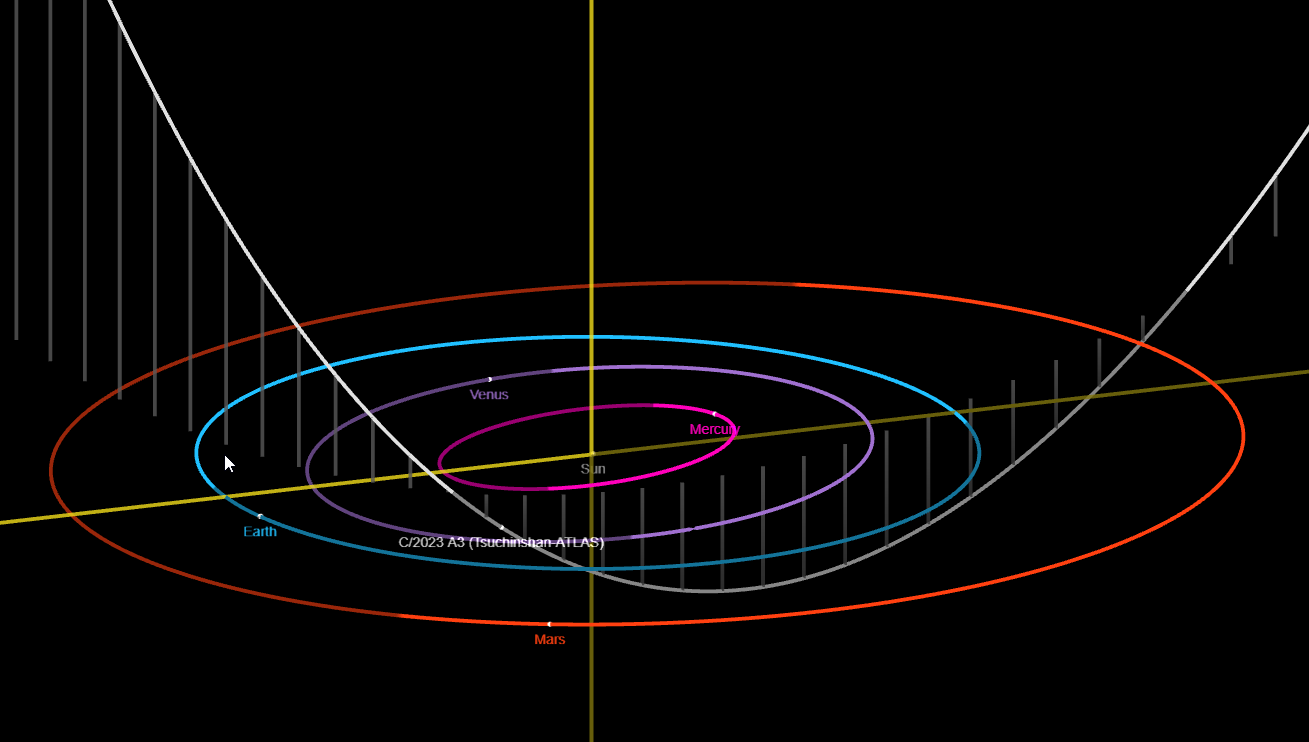
Coloured circles show the orbits of the inner planets around the Sun. A white oval path dives through the plane of the solar system, showing the orbit of Comet 2023 A3.

In September and early October 2024, Comet 2023 A3 was visible from more southerly locations, with the best views coming from the southern hemisphere. This is due to the angle of the comet’s orbit to the plane of the solar system – it came in from the north when still faint, dove down to the southern reaches as it rounded the Sun in late September, and will now be rocketing northward again. The comet passes almost between the Earth and Sun on October 9, and after that will begin to appear in the evening sky.

There are two factors which influence the comets visibility in October: how far away from the Sun it is, and how far away from the Earth it is. In general, the comet is intrinsically brightest when it is closest to the Sun and closest to the Earth, but that doesn’t mean we can see it. When the comet it “brightest”, it will also be so close to the Sun from our point of view that it will be invisible. We have to wait until the comet moves farther from the Sun in our sky so we have a chance to seeing it in a semi-dark sky.

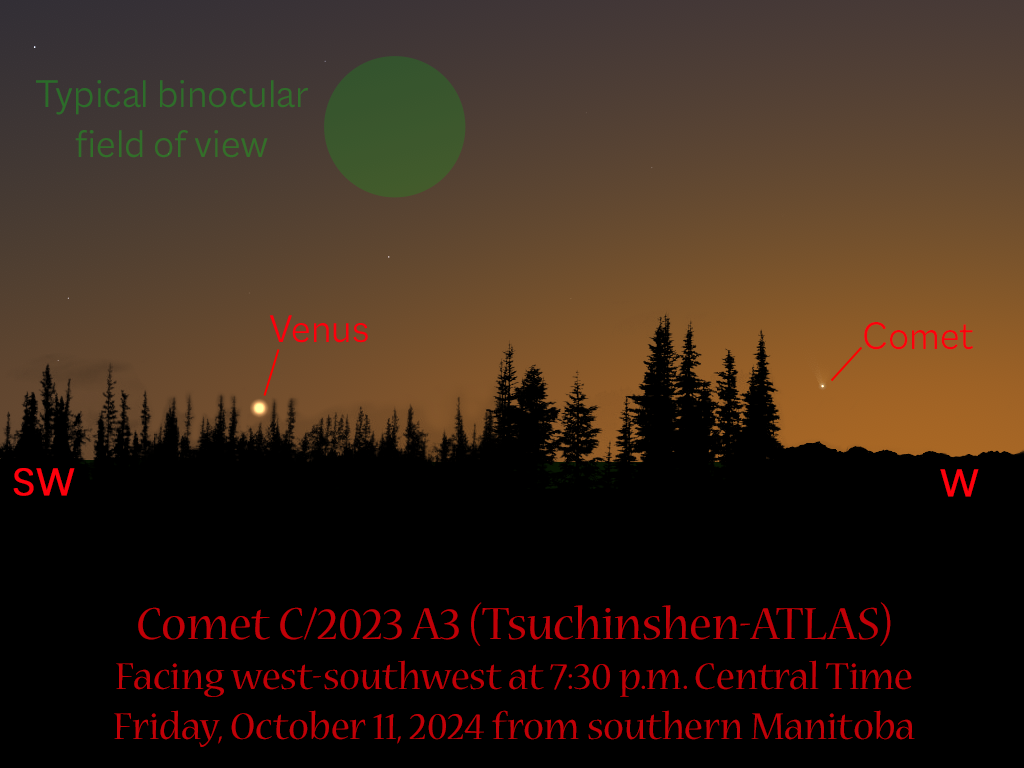
A sunset view of the sky showing the position of Comet Tsuchinshen-ATLAS on October 11, 2024.

Oct 11, 2024: First Glimpse

Baring some unusually outburst from the comet, Manitobans will probably get our first view of Comet Tsuchinshen-ATLAS right after sunset on the evening of October 11th. You’ll need a very flat western horizon, with as few buildings or trees in the way as possible; a flat prairie or even the ocean-like horizon of Lake Winnipeg will be perfect. You’ll also want to be away from any local light pollution – outside the city, and away from any streetlights or houselights that will interfere with your view.

Sunset is a few minutes before 6:30 p.m. local time, and as soon as the Sun is fully below the horizon, start scanning the sky along the horizon with your binoculars. Once they sky darkens a bit, you’ll spot Venus, a useful signpost to the comet for the rest of the week. The comet may become visible as a small fuzzy round spot in the bright twilight sky around 7:15 p.m., but the comet is setting so that as the sky darkens, the comet sinks into the murky air near the horizon. Just spotting it tonight will be an accomplishment and a harbinger of things to come.

Don’t give up once the comet official “sets” about 8 p.m. local time – that time is for the comet’s “head”. The tail is extending roughly straight up from the horizon and may become visible as the sky darkens. The geometry of the comet relative to the Earth and Sun changes daily this week, so it’s hard to say how long the tail will be or whether it is bright enough to see on its own – stayed tuned!

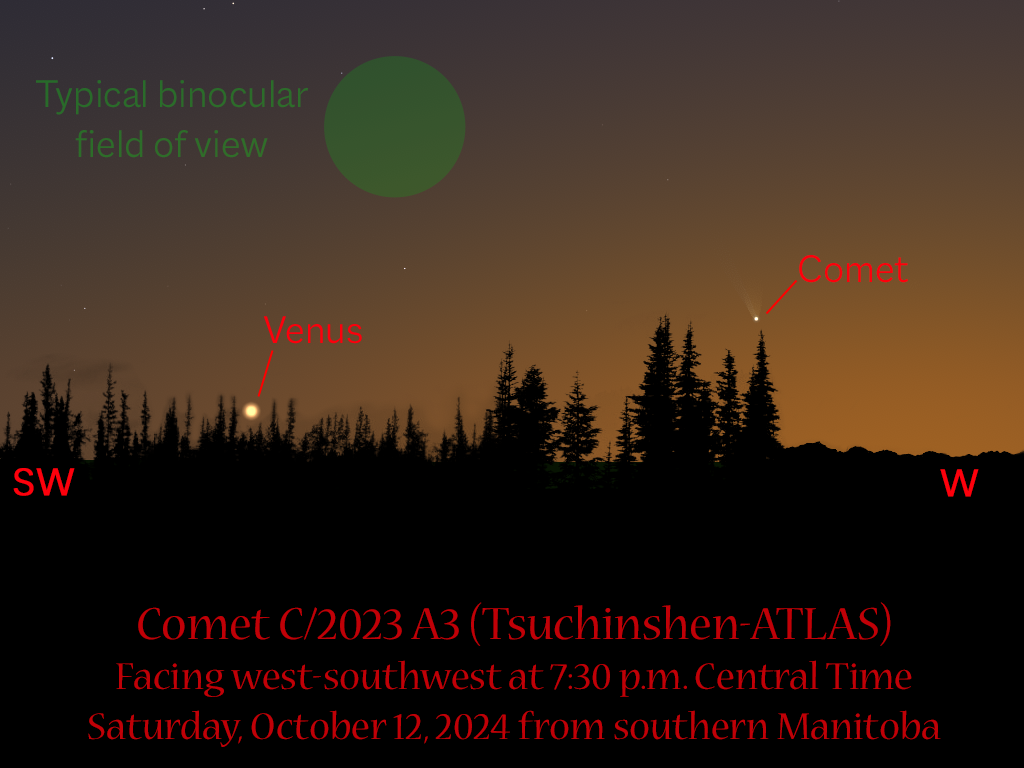
A sunset view of the sky showing the position of Comet Tsuchinshen-ATLAS on October 12, 2024.

Oct. 12, 2024: Easier to Spot

In just a day, the comet has moved higher in our sky. From this point, things just get better in terms of the comet’s elevation, giving us more time to spot the comet before it sets. You’ll be able to see it longer after sunset, which means it will be visible in a darker sky. Darker skies will be required for spotting the comet’s tail visually, but a camera might pull some of the faint tail out of the twilight (see “imaging the Comet” below).

On October 12th, the comet will be higher in the sky than Venus, but you’ll still want a clear western horizon.

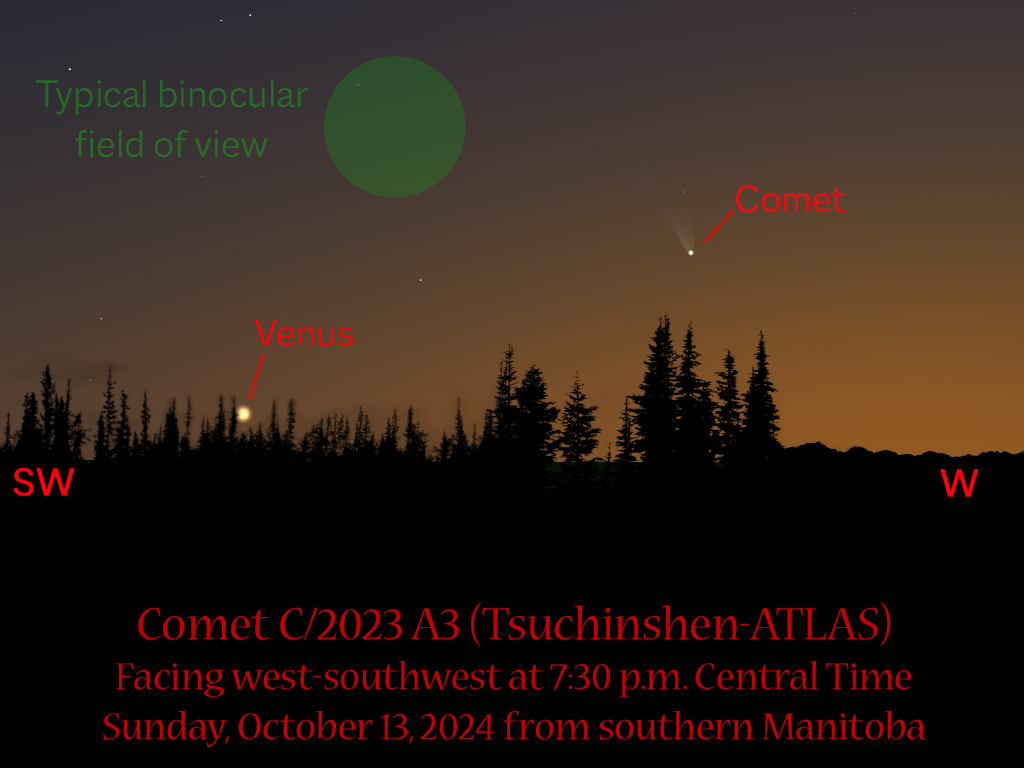
A sunset view of the sky showing the position of Comet Tsuchinshen-ATLAS on October 13, 2024.

Oct. 13, 2024: Getting Better

The comet is more than a binocular field above the horizon tonight, so you’ll have to sweep around a bit to spot it. The comet should still be bright, and you might even see it without binoculars. The image shows the view at 7:30 p.m. local time, but you can afford to wait even later to see if the view improves as the sky darkens. The comet’s tail actually stretches well off the top of the map, and so even after the “head” of the comet has set, the tail may become visible as the sky darkens. Don’t go home too early!

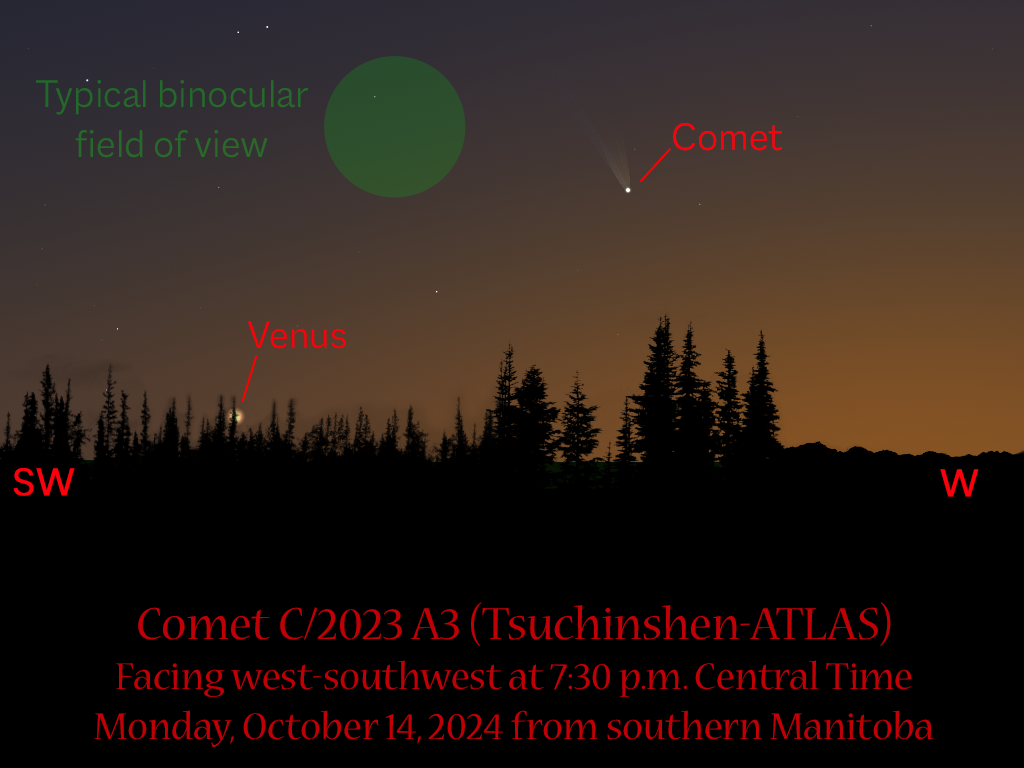
A sunset view of the sky showing the position of Comet Tsuchinshen-ATLAS on October 14, 2024.

Oct. 14, 2024: Elevation versus Distance

From tonight on, we see how the competing factors of the comet’s elevation above our horizon versus its increasing distance will play out. The comet is actually fading as it moves farther away from us and as the tail appears foreshortened (it’s pointing generally towards the earth, which should make it appear shorter but brighter). Improving the situation is the comet’s greater altitude above the horizon, and the chance to see it in a darker sky after sunset.

It’s still worth getting out early to see how early you can spot the comet, but the best views might come slightly later each night, perhaps as late as 8:00 p.m. local instead of 7:30 p.m. There will be a period of best visibility each night that will probably last for 15 minutes or so as the various factors of sky brightness, altitude, and sky conditions align, but forecasting exactly when that will occur is impossible. The more time you are out observing the comet, the more likely you will get a memorable view.

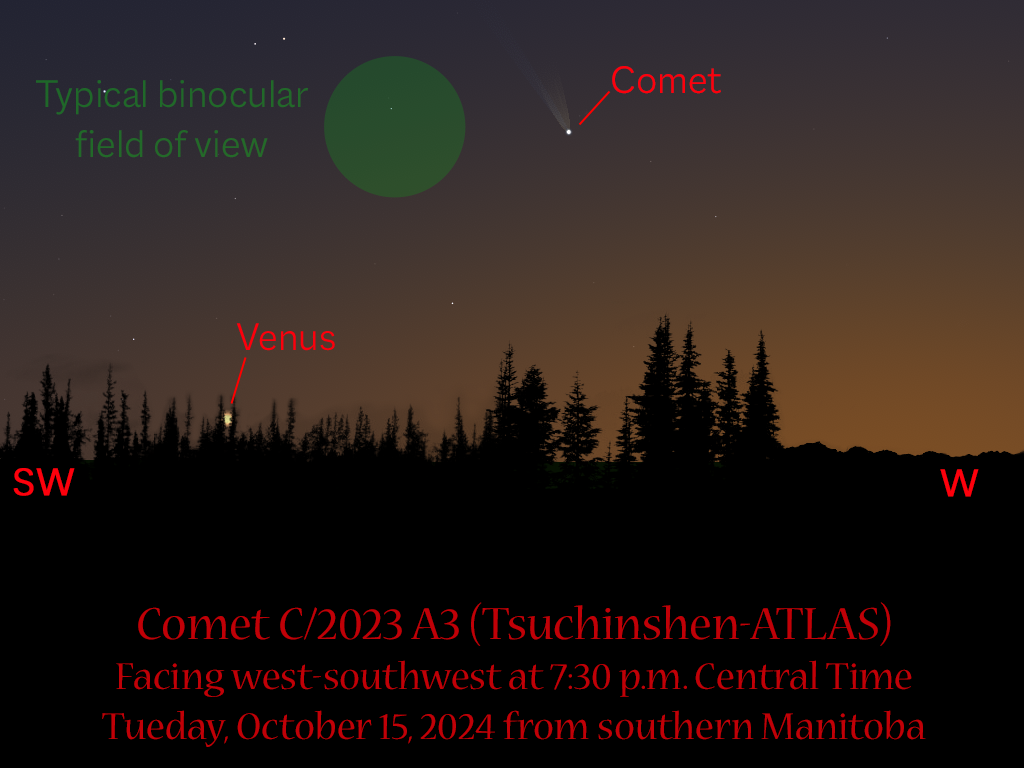
A sunset view of the sky showing the position of Comet Tsuchinshen-ATLAS on October 15, 2024.

Oct. 15, 2024: Fading Away

Comet Tsuchinshen-ATLAS will be visible above the western horizon at sunset until at least December, but at some point it will fade enough that you will need a telescope to see it. It will probably remain visible in binoculars until late October, but the changing angles will mean the tail fades quickly after this date. The comet will be more of a round puffball than the typical “comet with a tail” shape, but may still be fascinating to view. Remember, that puffball has likely never been this close to Earth before and may not return to our vicinity for tens of thousands of years, if ever, so this literally is a once-in-a-lifetime event.

Imaging the Comet

As always, imaging will show more of the comet’s tail than is visible to the eyes, so you might see impressive images flooding your social media feed for days or weeks to come. Just remember, electronic cameras, even those in a typical cellphone, can show much fainter objects than our eyes can see. But there is something magical about viewing the actual light from an object, individual particles of light than have travelled millions of kilometers to end up inside your eyeball and stimulating your brain to see them.

If you manage to record images of Comet Tsuchinshen-ATLAS, we’d love to see them! Email them to space@manitobamuseum.ca. We’ll show the best ones on Dome@Home, our award-winning online astronomy show, which runs the last Thursday of every month on the Manitoba Museum’s Facebook page and YouTube channel.

Scott Young

Scott Young

Planetarium Astronomer

Scott is the Planetarium Astronomer at the Manitoba Museum, developing astronomy and science programs. He has been an informal science educator for thirty years, working in the planetarium and science centre field both at The Manitoba Museum and also at the Alice G. Wallace Planetarium in Fitchburg, Massachusetts. Scott is an active amateur astronomer and a past-President of the Royal Astronomical Society of Canada.

The Sky for October 2024

October is a great month for stargazing. Aside from the cooler temperatures and earlier sunsets, we have at least one reasonably-bright comet expected, and quite possibly two. The planets rise early enough to see before midnight, and the most distant object visible to the unaided eye comes into view.

Comet #1: 2023 A3 (Tsuchinshen-ATLAS)

This is the comet you’ve been hearing about on social media lately. It’s been limited to southern viewers so far, but now that it has rounded the Sun it will be moving into the northern skies quickly.

There is a full article on this comet, with day-by-day details, in preparation, but the short version is most Canadians won’t be able to spot it until after October 10 or so. It is not quite as bright as forecast, and so it won’t become visible in broad daylight or even in the very bright twilight sky. It will become visible in the evening sky after sun is it rockets between Sun and Erath, rapidly moving higher in the evening as it moves farther away.

Click here for more tips on spotting this comet.

Comet #2: A11bP7I (Soon-to-be Comet ATLAS)

This comet was discovered on September 27, and is so new that it doesn’t have a formal name yet – “A11bP7I” is a temporary designation. This comet is a rare kind of comet called a sun-grazer, which gets very close to the Sun and therefore can get very bright. Initial forecasts sound like this one could be even brighter than Comet Tsuchinshen-ATLAS, but we’ll have to wait and see. It will be at its best (whatever taht menas) around the end of october. More informations as it becomes available.

The Solar System

Mercury remains too low to see in the evening sky this month.

Venus is very low in the southwest in the evening sky this month, and remains very low throughout October. It is quite far from the sun, but the angle of the solar system is very close to the angle of Manitoba’s horizon in the fall, keeping the planet low. it is very bright, though, likely the first star you see in the evening if your southwestern horizon is clear.

Mars rises in the northeast before midnight, in the middle of the constellation Gemini the Twins. Mars is slowly approaching our planet and will be at its best this orbit in January 2025.

A simulated view of Saturn and its rings.

Jupiter Rises in the northeast about 10pm at the beginning of October, betweemn the horns of taurus the Bull. The largest planet stands high in the south at dawn, offering clear telescopic views. Its four largest moons are visible in binoculars as tiny “stars” in a line on either side of the planet; their positions change nightly as they orbit the giant planet.

Saturn is low in the southwest at sunset, and is visible all night. It rises only about 30 degrees up in the south at its best, though, so telescope views are still blurred by the Earth’s atmosphere. The rings are nearly edge-on, but visible in a telescope with more than about 30x magnification./

Sky Calendar for October 2024

Click on highlighted dates for a star chart showing the view!

Oct. 2 : New Moon

Oct. 5 (evening): The thin crescent Moon will be below Venus in the evening sky after sunset (likely invisible except with binoculars and very clear skies).

Oct. 6 (evening): The thin crescent Moon will be to the left of Venus in the evening sky after sunset.

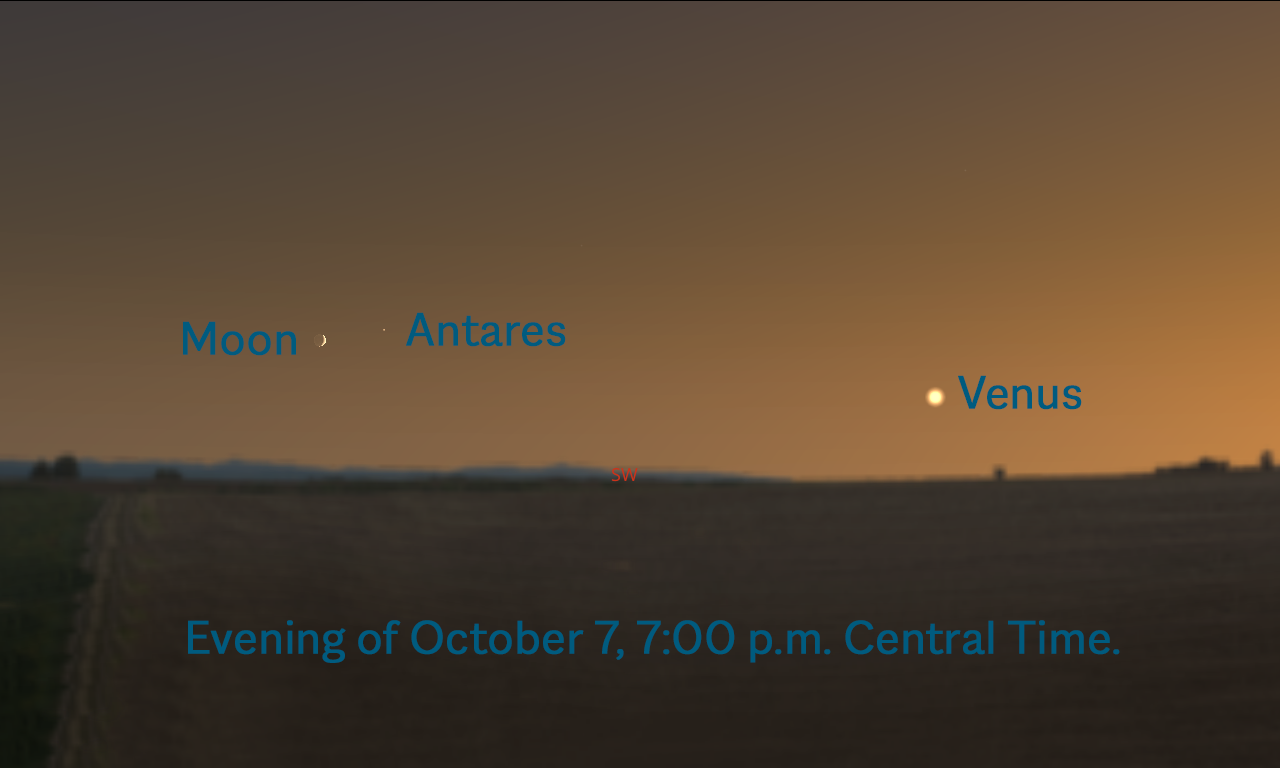
Oct. 7 (evening): The thin crescent Moon will be just to the to the left of the bright star Antares in the evening sky after sunset. Venus stands farther to the right. The sky on October 7, 2024.

Oct. 9 (evening): Comet Tsuchinshen-ATLAS passes between Earth and Sun, passing just above the Sun from our point of view. The comet will likely be at its brightest today, but not visible because of its closeness to the Sun.

Oct. 10 (evening): First Quarter Moon. Also the beginning of likely period of visibility for Comet Tsuchinshen-ATLAS. See day-by-day coverage posts .

Oct. 13 (evening): Saturn will be the brightest “star”, far to the left of the waxing gibbous Moon tonight.

Oct. 14 (evening): Saturn will be the brightest “star” to the right of the waxing gibbous Moon tonight.

Also tonight, Comet Tsuchinshen-ATLAS passes another, much fainter, comet: Comet 13P/Olbers. Olbers is a periodic comet that has been visible in mid-sized telescopes for a while, and the two aren’t physically close4 to each other, but just in our line of sight from Earth.

Oct. 15 (evening): Comet Tsuchinshen-ATLAS passes near the globular cluster M5, a “faint fuzzy” visible in binoculars. Images of the comet on this night will probably also catch the globular cluster, which is a group of several hundred thousand stars which are among the oldest stars visible.

Oct. 17: Full Moon, the Harvest Moon.

Oct. 19 (all night): The waning gibbous Moon sits between the Pleiades and Hyades star clusters tonight, with bright Jupiter nearby to the lower left.The sky on October 19, 2024.

Oct. 20 (all night): The waning gibbous Moon is above Jupiter tonight as the two rise in the northeast about 9 p.m. local time.

Oct. 23 (morning): The nearly last quarter Moon is near a trio of bright stars. From top to bottom they are Castor and Pollux, in the constellation Gemini, and the red planet Mars.

Oct. 24 (morning): A similar view to yesterday morning’s sky, but with the Moon having moved through the trio to sit on the lower left of the scene.

Oct. 24 : Last Quarter Moon.

Oct. 28: The new comet A11bP7I makes its closest approach to the Sun. More updates as they become available.

Oct. 31 (evening): Hallowe’en, a great night to have your telescopes or binoculars out to show trick-or-treaters the sky.

Scott Young

Scott Young

Planetarium Astronomer

Scott is the Planetarium Astronomer at the Manitoba Museum, developing astronomy and science programs. He has been an informal science educator for thirty years, working in the planetarium and science centre field both at The Manitoba Museum and also at the Alice G. Wallace Planetarium in Fitchburg, Massachusetts. Scott is an active amateur astronomer and a past-President of the Royal Astronomical Society of Canada.