


Posted on: Wednesday December 3, 2025
December brings us to the arbitrary “end” of our calendar cycle, one of the few calendar events that aren’t astronomically based. While the number of days in a year comes from the amount of time it takes Earth to revolve around the Sun, there is nothing special about December 31st to mark the “end” of anything.
Because it does mark the last month of the year, though, it’s a good time to look ahead at what’s coming for the next orbit. It’s also the first month this year to be fully back on Standard Time after the Daylight Savings Time excursion of the summer. Finally, December hosts the best meteor shower of the year, the Geminids, which peaks on the evening of the 13th and morning of the 14th in a mostly moonless sky.
The Solar System for December 2025
Mercury begins its best morning appearance of the year, but it still isn’t great for those living in northerly latitudes. It’s at its brightest at the beginning of the month, about 10 degrees above the south-eastern horizon just before dawn, but fades and sinks lower into the twilight over the next few weeks. A clear sky, unobstructed horizon, and perhaps binoculars will be needed to pick it out of the brightening dawn.
Venus sinks into the morning twilight during the first few days of December and is invisible for the rest of this month. It passes between us and the Sun early in 2026, thereafter appearing in the evening sky.
Mars is too close to the Sun to be visible this month.
Jupiter rises soon after sunset in the east-northeast and is visible all night, rising high into the south and then lower into the northwest by sunrise. It is near the two bright stars Castor and Pollux in Gemini, Even a small telescope will show Jupiter as a tiny planet with several tinier “stars” in a line near it – these are Jupiter’s largest moons. Up to four of them can be seen, depending on where they are in their orbit around the giant planet. Often these moons can be glimpsed in binoculars as well.
Saturn is in the southeast as darkness falls, the brightest “star” in that area of the sky and well-placed for telescope viewing. Saturn’s rings are nearly edge-on to our line of sight, making them nearly invisible in a telescope.
Uranus is in the evening sky a few degrees below the famous Pleaides star cluster (also known as the Seven Sisters). It is too faint to easily see without binoculars, and even a telescope shows it as a faint dot that looks just like the other faint stars. A detailed star-charting app like Stellarium or the charts in the Observer’s Handbook is required to track it down.
Neptune requires good binoculars or a small telescope to even spot, and a large telescope to make it out as anything more than a faint dot. As with Uranus, a detailed star chart like those in the Observer’s Handbook or produced software by Stellarium is required to tell which tiny “dot” is Neptune.
Of the five known dwarf planets, only (1) Ceres is close enough to be seen in binoculars or a small telescope. Ceres has faded below easy visibility in binoculars for the year, but will brighten again beginning in late 2026.
The Geminid Meteor Shower
The annual Geminid meteor shower is the best meteor shower of the year, and this year is a perfect year for it. The peak of the event occurs with the Moon mostly out of the sky, so if you drive away from any more local light pollution (like city lights), you can have a dark sky full of stars, and see the best that this shower has to offer.
For details on how to observe this event, check out Scott’s latest blog here.
Sky Calendar for December 2025
All times are given in Central Standard Time, the local time for Manitoba. However, most of these events are visible across Canada at the same local time without adjusting for time zones.
If there’s a little box to the left of the date, you can click on it to see a star map of that event! All images are created using Stellarium, the free planetarium software.
Thursday, December 4th, 2025: Full Moon, occurring just 12 hours after the Moon’s closest point to the Earth in its orbit, a so-called “supermoon”. The difference in size between a “super” moon and a “mini” moon (when the moon is farthest from Earth) is not really noticeable, but the brightness increase may be detectable by careful observers.
Sunday, December 7th, 2025: The waning gibbous Moon forms a nice grouping with Jupiter and the bright stars Castor and Pollux.
Monday, December 8th, 2025: The waning gibbous Moon has passed Jupiter but still is close enough to draw the eye.
Tuesday, December 9th-Wednesday, December 10th, 2026: The Moon occults (eclipses) the bright star Regulus in Leo for much of Canada except the south. In Winnipeg, the Moon skims just north of the bright star, but observers in the northern Interlake and northern Manitoba will see the Moon cover up the star briefly just after midnight. Details for various cities across Canada can be found at the International Occultation Timing Association. (“ZC1487” is a catalogue number referring to Regulus.)
Thursday, December 11th, 2025: Last Quarter Moon
Saturday, December 13th-Sunday, December 14th, 2025 (morning sky): The annual Geminid meteor shower peaks. Decent views are available the night before and after. The Moon is a waning crescent and doesn’t rise until nearly 2 a.m. so it won’t interfere with viewing.
Wednesday, Dec. 17th (morning sky): The thin crescent Moon is about level with Mercury, low in the southeast just before sunrise.
Friday, December 19th, 2025 (morning sky): New Moon
Sunday, December 21st, 2025: Winter Solstice occurs at 9:03 a.m. CST. This marks the first day of winter in the northern hemisphere, astronomically speaking. (The weather tends not to pay attention to the astronomical definitions, of course – it’s just a point in time that can be predicted accurately.)
Monday, December 22nd, 2025 (morning sky): Ursid meteor shower peaks. Usually a minor shower, this shower can still produce 5-10 meteors per hour in the few hours before dawn. It has produced occasional outburst of activity, though, up to 25 meteors per hour for short periods, in a way we can’t yet predict.
Friday, December 26th, 2025: the nearly-first-quarter Moon is near Saturn in the evening sky.
Saturday, December 27th, 2025: First Quarter Moon.
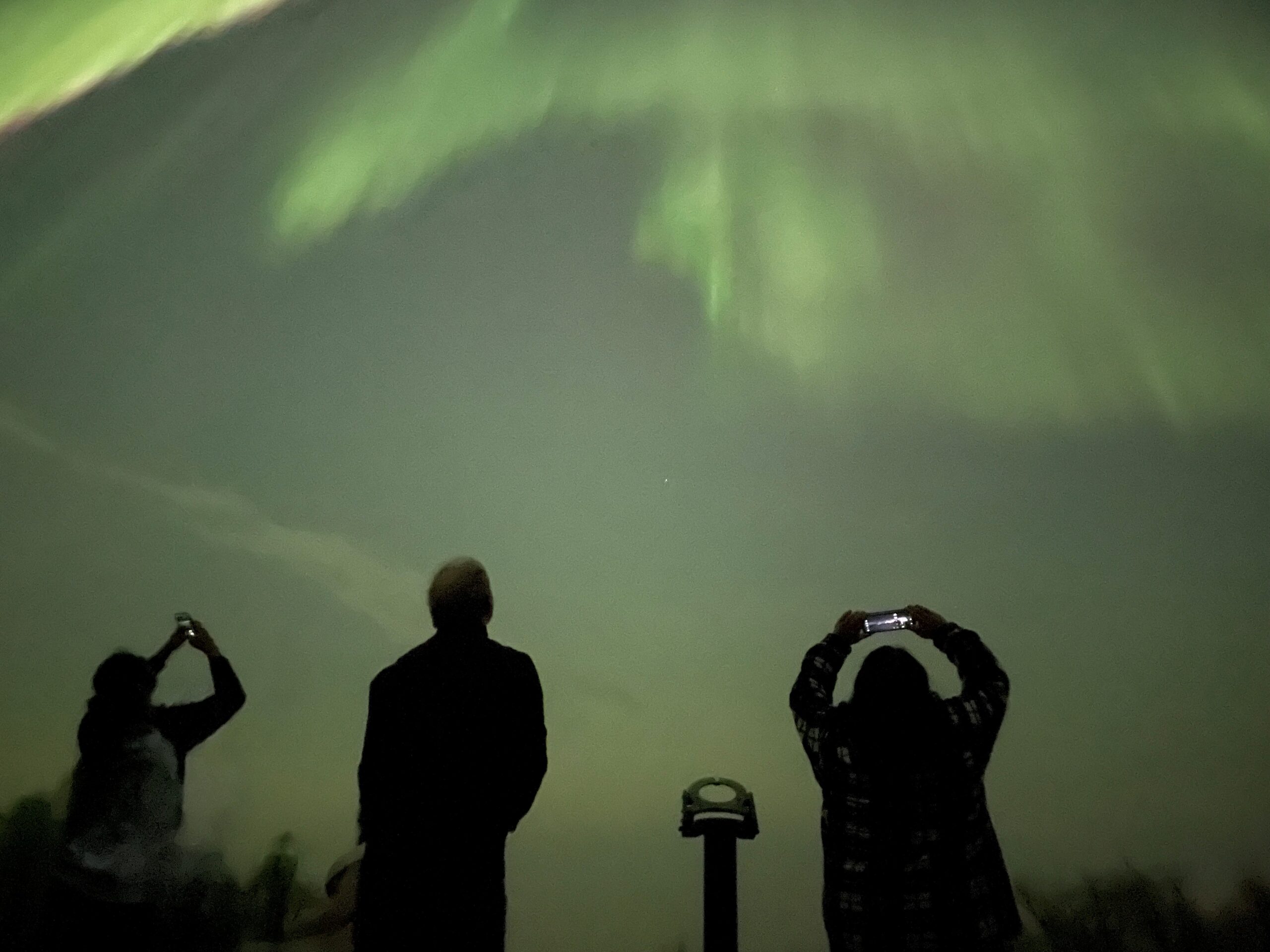
Outside of the regular events listed above, there are other things we see in the sky that can’t always be predicted in advance.
Aurora borealis, the northern lights, are becoming a more common sight again as the Sun goes through the maximum of its 11-year cycle of activity. Particles from the Sun interact with the Earth’s magnetic field and the high upper atmosphere to create glowing curtains of light around the north (and south) magnetic poles of the planet. Manitoba is well-positioned relative to the north magnetic pole to see these displays often, but they still can’t be forecast very far in advance. A site like Space Weather can provide updates on solar activity and aurora forecasts for the next 48 hours. The best way to see the aurora is to spend a lot of time out under the stars, so that you are there when they occur.
Random meteors (also known as falling or shooting stars) occur every clear night at the rate of about 5-10 per hour. Most people don’t see them because of light pollution from cities, or because they don’t watch the sky uninterrupted for an hour straight. They happen so quickly that a single glance down at your phone or exposure to light can make you miss one.
Satellites are becoming extremely common sights in the hours after sunset and before dawn. Appearing as a moving star that takes a few minutes to cross the sky, they appear seemingly out of nowhere. These range from the International Space Station and Chinese space station Tianhe, which have people living on them full-time, to remote sensing and spy satellites, to burnt-out rocket parts and dead satellites. These can be predicted in advance (or identified after the fact) using a site like Heavens Above by selecting your location.