


Watershed of the Future simulator update - Day Three of install

Watershed of the Future simulator update – Day Three of install

Things are shaping up – all of the computers and speakers are connected, and all eight touch screens are working. Basically, the simulator prototype is operational. Today will be spent installing the latest software updates and making sure everything is networked properly.

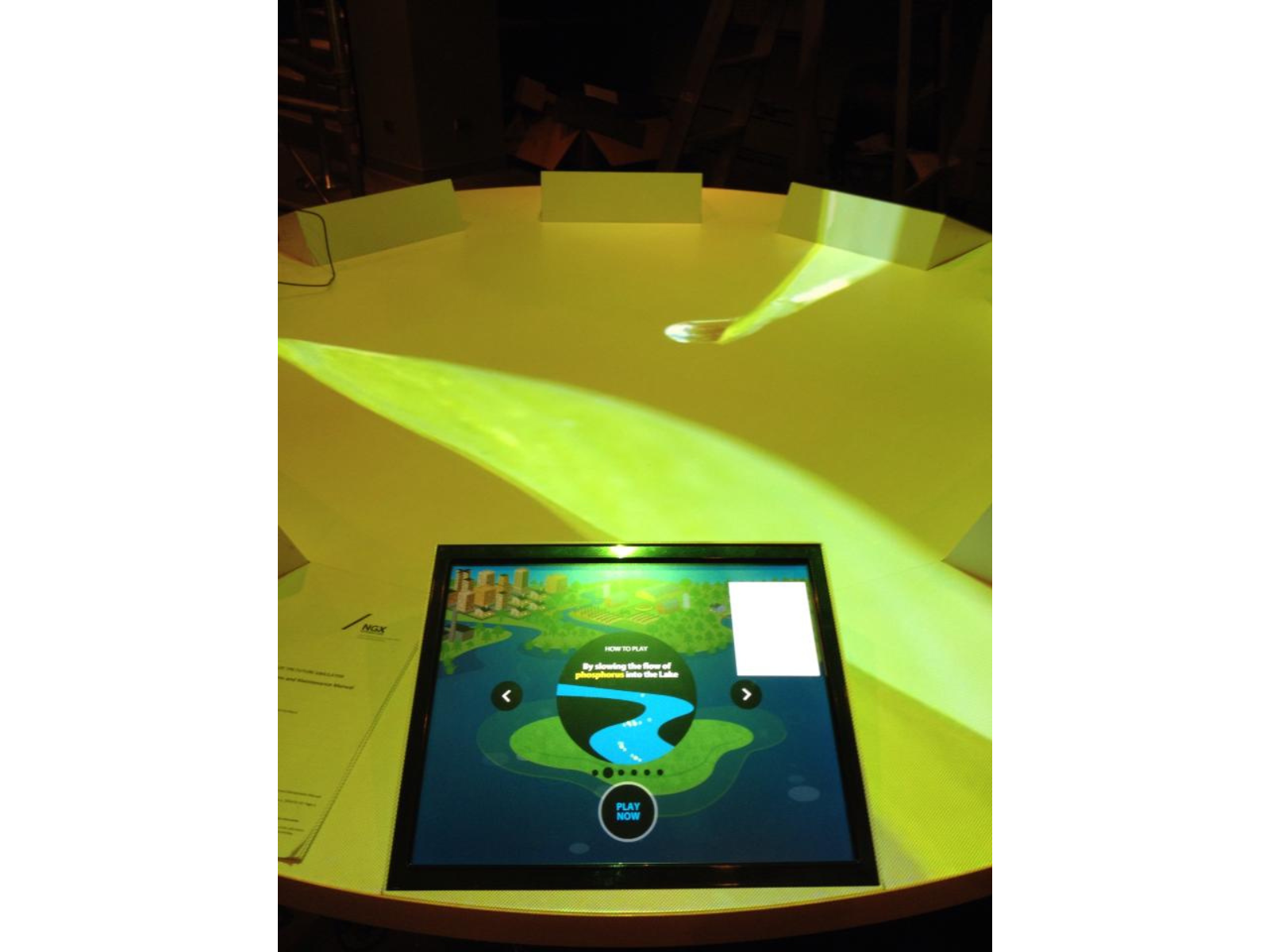
The first image below shows the simulator in “single-player mode” – this is our default experience, where a visitor can come up to the table and use any one of the eight touchscreens to have their own experience. A series of problems are available for you to examine, and each problem has three possible “projects” – these are different ways to address the problem. Each potential project will affect the health of the Lake, and also carry an economic and social cost or benefit. As you make choices, you are shown the results of each choice and warned if you are reaching a critical point.

In single-player mode, everything you do feeds your own version of the Lake, and so your results won’t depend on any other people at the table. It’s a great way to explore some of the issues facing the health of Lake Winnipeg. The central projection surface is used to show various lake images, and also when a big event like a storm or flood occurs – these events hit every player at the table, although your results will depend on what you have done in the game so far.

Looking at a touchscreen embedded in a round table lit with green. The screen shows a "How to Play" graphic.

The “Watershed of the Future” simulator prototype, installed and (almost) ready for testing.

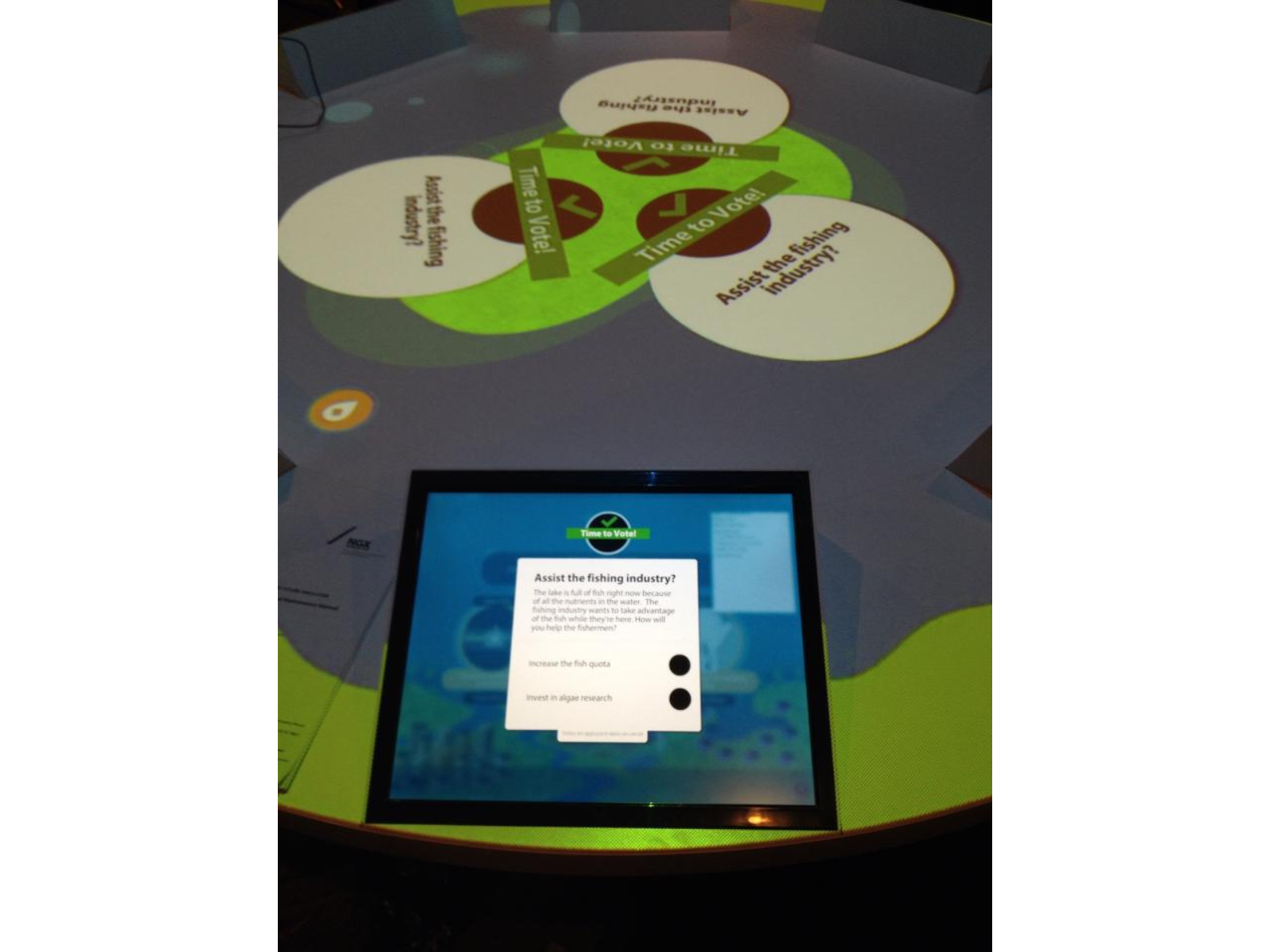
Looking at a touchscreen embedded in a round table., In the centre of the table projections ask the vote question "Assist the fishing industry?". The screen shows the same question with selectable options to "Increase fish quota" or "Invest in algae research.

Watershed of the Future simulator in multi-player mode, showing one of the polls.

The simulator also has a “multi-player mode” – we’ll be using this when we have school groups booked, or when we can have a program leader interpreting the exhibit. In this case, all eight screens feed a single model of the Lake shown using the central projection, and so the results depend not only on what you do, but what others at the table do as well. The program leader can encourage discussion and debate, and just like in real life, good results depend on everyone working together.

In multiplayer mode, there is also a new feature we’re calling “polls”. Some issues are too broad to be narrowed down into projects, and these show up in multi-player mode as a question on the main projection surface. Everyone is asked to vote on a given poll issue, and the majority vote determines which option is fed into the model. Again, having a program leader present can help spark debate and discussion, leading to informed voting and a deeper understanding of the issues.

Once the simulator is installed, we will be running it through testing to make sure it works as intended, and also to make sure it is fun to play. If you are interested in volunteering as a tester, contact me at scyoung@manitobamuseum.ca and I’ll provide more information. This is a volunteer opportunity, but you can help us make this important exhibit the best it can be!

Scott Young

Scott Young

Planetarium Astronomer

Scott is the Planetarium Astronomer at the Manitoba Museum, developing astronomy and science programs. He has been an informal science educator for thirty years, working in the planetarium and science centre field both at The Manitoba Museum and also at the Alice G. Wallace Planetarium in Fitchburg, Massachusetts. Scott is an active amateur astronomer and a past-President of the Royal Astronomical Society of Canada.

First Light on our New Exhibit!

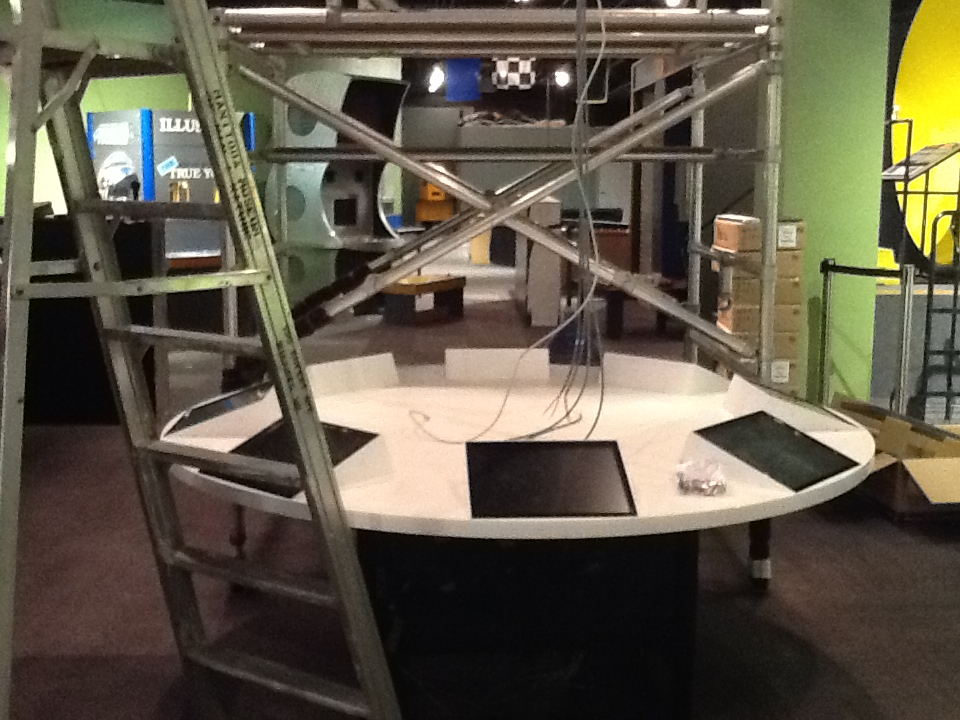
Day Two of the Lake Winnipeg: Shared Solutions simulator installation, and we have first light from the projection system! The simulator comprises a table with eight individual touch-screens, surrounding a large projected image covering the table. In regular mode, visitors can take control of their own version of the Lake at each station, without being affected by what other visitors do. Big shared events like floods and storms will show up on the central projection, and affect everyone at the same time.

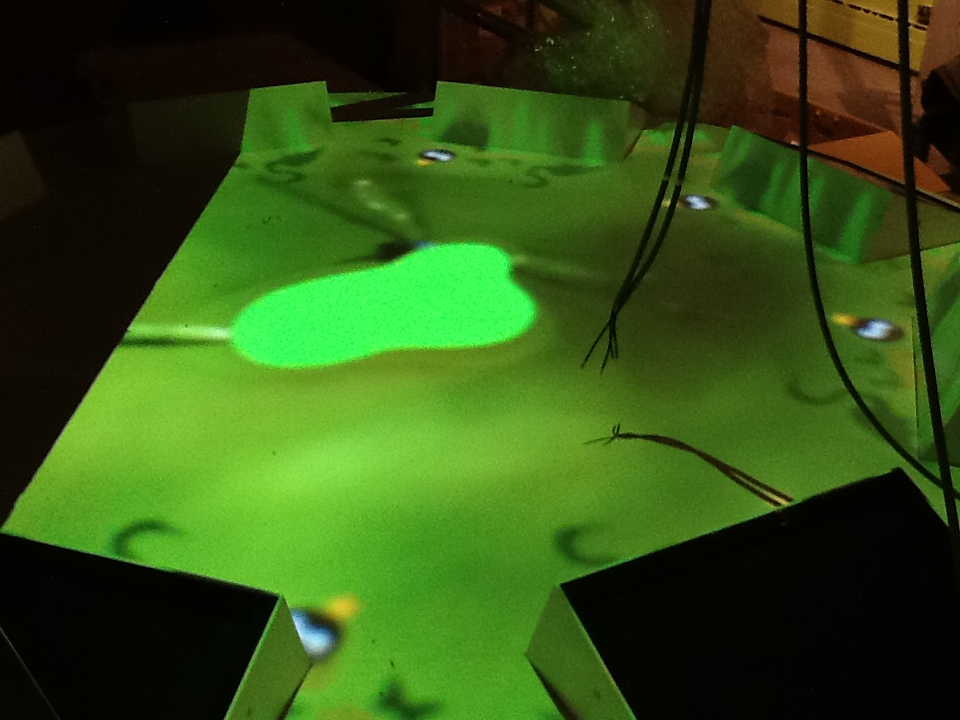
We can also run the experience for a group, where all eight stations are playing in the same Lake. All of their choices will feed into a central lake, and the effects will be displayed using the central projection screen. The “score” is depicted using a green algal bloom. The bigger the algal blob, the worse the health of the Lake.

The second image shared here shows the unfocused, rough, first image from the projector onto the table. The green blob is the algae. None of the touch screens are active yet, but when they are connected, they will form a seamless part of the image.

A circular table with eight digital touchscreens embedded around the surface. Ladders and scaffolding are on either side of the table as wires hang down from above.

Installing the Lake Winnipeg Shared Solutions simulator table in the Science Gallery.

A round table with eight digital touchscreens embedded around the surface. A green light illuminates the tabletop with a "blob" near the centre brighter than the rest.

“First Light” on the simulator table – needs focus and alignment, but it works!

Scott Young

Scott Young

Planetarium Astronomer

Scott is the Planetarium Astronomer at the Manitoba Museum, developing astronomy and science programs. He has been an informal science educator for thirty years, working in the planetarium and science centre field both at The Manitoba Museum and also at the Alice G. Wallace Planetarium in Fitchburg, Massachusetts. Scott is an active amateur astronomer and a past-President of the Royal Astronomical Society of Canada.

New Science Gallery Exhibit Takes Shape!

It’s been a while since I have updated this blog, because I have been working on the next big exhibit for the Science Gallery. “Lake Winnipeg: Shared Solutions” is scheduled to open in March 2014, but a big piece of it is being installed this week so we can do on-site testing and evaluation of the prototype. The exhibit addresses the health of Lake Winnipeg and what feeds into that (complicated) issue.

The exhibit is a partnership between The Manitoba Museum and the International Institute for Sustainable Development, with support from a diverse group of stakeholders. The completed exhibit will have images, text panels, a live aquarium, and insect and plant specimens, but the centrepiece is the Watershed of the Future simulator. Basically, we have built the Lake Winnipeg Watershed in a computer, and visitors will be able to become Lake Stewards, controlling all of the decisions in Manitoba that impact the health of the lake. It’s a hugely complicated piece of exhibitry, with eight touch screens, a giant projector table, and a rack of computers, running custom software developed in concert with a huge group of experts and stakeholders from around the province. To make sure we have gotten it right, and also that it is a fun experience for the average person, the simulator is being installed this week, and we’ll be opening it up for testing over the coming month so we can refine the experience.

This is the first time we’ve been able to do a “Beta” test of an exhibit like this. It’s a great way to make sure the exhibit works properly, but also allows us to refine things like the timing of the experience, clarity of instructions, and complexity of the experience. We’ve spent a long time making this as accurate an exhibit as we can; now we want to make sure it is also as fun and interesting as it can be.

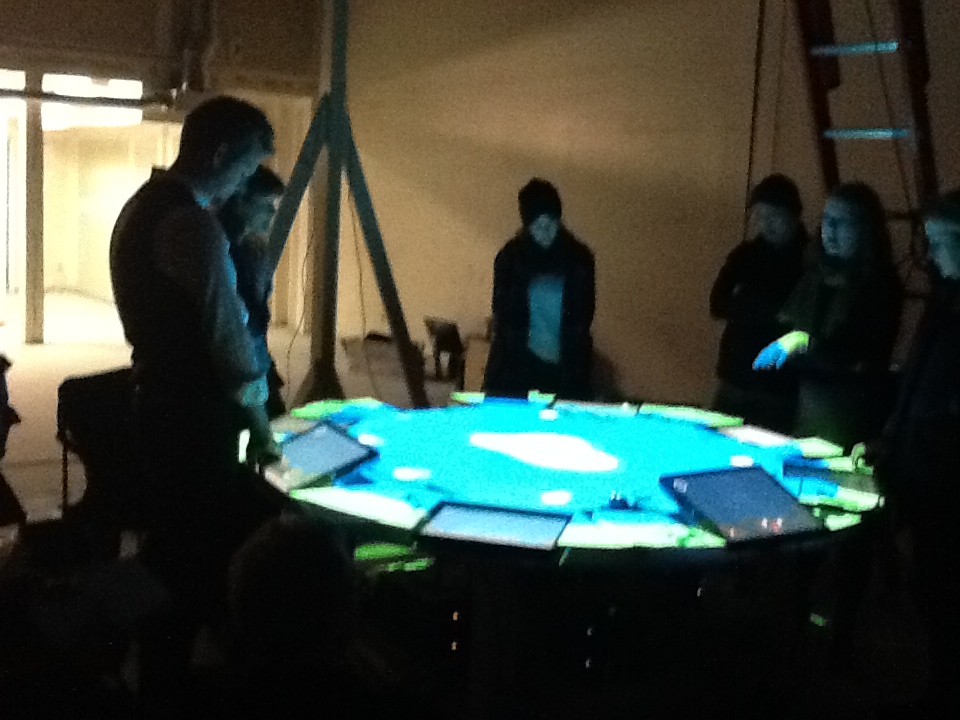
Six people stand around a brightly illuminated round table in a dim room.

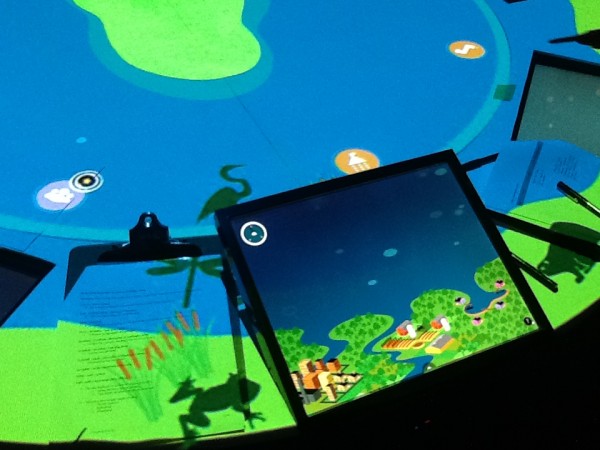
A brightly illuminated section of a rounded table with a digital touchscreen embedded in the surface. On the table itself and the touchscreen, illustrations of a lake and small creatures like frogs, herons, and fish.

The Alpha version of the Watershed of the Future simulator in the workshop in Vancouver.

I’ll be posting more about Lake Winnipeg Shared Solutions in the coming weeks as the exhibit is installed and testing continues. We’ll be bringing in the experts and stakeholders who helped develop the simulator, but we’re also interested in feedback from the Museum’s regular visitors: school groups and the general public. If you’d like to be a part of our testing process, drop me an email and we’ll hook you up.

Scott Young

Scott Young

Planetarium Astronomer

Scott is the Planetarium Astronomer at the Manitoba Museum, developing astronomy and science programs. He has been an informal science educator for thirty years, working in the planetarium and science centre field both at The Manitoba Museum and also at the Alice G. Wallace Planetarium in Fitchburg, Massachusetts. Scott is an active amateur astronomer and a past-President of the Royal Astronomical Society of Canada.

Fireballs over Winnipeg

Over the past week we have had dozens of reports of green fireballs over Manitoba. Here’s the typical description: A flaming object, greenish in colour, flashing into existence and flying in a straight line towards the horizon. Perhaps it explodes; perhaps it heads behind some trees or buildings and disappears. It’s usually visible for only a few seconds, leaving many viewers wondering if they even saw it or imagined it. It usually looks like it is very close overhead, or came to earth just behind the trees nearby.

These are well-known objects, although we seem to be getting a lot of them lately. Called bolides, they are basically large versions of meteors (which are commonly called “shooting stars” or “falling stars”). They are dying gasp of a small piece of rock that has been in space since before the Earth itself was formed.

Back in the day, about 4.6 billion years ago, the solar system itself was just forming from a slowly-spinning disk of gas and dust. Most of the materials went to form the Sun; most of the rest formed the planets. All that was left were tiny pieces of dust and rock, scattered throughout the solar system, orbiting the sun in oval-shaped orbits that carried them across the solar system. Eventually, they crash into a planet, like the Earth as an example.

When a piece of this cosmic dust crashes into earth, there is no danger to us – Earth is significantly larger than a piece of dust, and so we win this particular collision. The dust hits our atmosphere at orbital speeds, without the benefit of the heat shields we put on our returning spacecraft. The friction with the air heats the dust and surrounding air so quickly that the air itself glows in a long trail which marks the dust’s demise. Many kilometers below, we can see the streak of light as a meteor. This happens all the time – if you go outside on a dark, moonless night away from city lights, on average you will see a half-dozen meteors per hour. If the piece of material is bigger – say the size of a grapefruit – it makes a much bigger flash. It may survive long enough to get to the deeper layers of our atmosphere, where it explodes in a bright flash. These are much rarer – you are lucky to see one or two of these in your lifetime, since larger pieces of rock in space are (thankfully) much rarer than dust-sized specks.

Every so often, a comet can go by and leave a big trail of dust in the Earth’s path – a cosmic dustbunny in space. When the Earth goes through this cloud of cometary dust, we can get a lot of meteors in a short period of time – a meteor shower. Meteor showers usually produce a few meteors per hour, with the more active ones producing a few dozen per hour – much more than the average, but still the sort of thing you have to be looking for to see.

It so happens that right now, we are just coming off of the annual Leonid meteor shower – a relatively weak shower that can produce a dozen or so meteors an hour in most years. This is the source of many of the meteors seen over the last week – the bright green fireballs are larger pieces of the cometary dust that Earth encounters at this time of year.

Alas, none of these fireballs are likely to survive all the way down to the ground to become meteorites – cometary materials are made mostly of ice, and so the heat of their passage through the atmosphere completely vaporizes them.

Scott Young

Scott Young

Planetarium Astronomer

Scott is the Planetarium Astronomer at the Manitoba Museum, developing astronomy and science programs. He has been an informal science educator for thirty years, working in the planetarium and science centre field both at The Manitoba Museum and also at the Alice G. Wallace Planetarium in Fitchburg, Massachusetts. Scott is an active amateur astronomer and a past-President of the Royal Astronomical Society of Canada.

Comet PANSTARRS becomes visible in Manitoba Skies!

Beginning March 7, Comet PANSTARRS will become visible in the evening sky for observers in Manitoba. This is a cool chance to see a comet, those mysterious visitors from the ragged edge of the solar system that occasionally grace our skies. But, you’ll need a pair of binoculars (and clear skies) for the best view.


What is Comet PANSTARRS?

It’s a small chunk of ice only a few kilometers in diameter that is in a long, oval-shaped orbit around the sun. Most of the time it is totally invisible, but right now it is swinging close past the sun. The sun’s heat vaporizes some of the ice, and the solar wind blows the dust and gas back into a tail which can stretch for a million kilometers or more.  There are millions of comets out there, but usually they are too far from both the Sun and the Earth to be visible except in large telescopes.


What’s with the name?

PANSTARRS is the name of the program that discovered it – the PANnoramic Survey Telescope and Rapid Response System. Comets are named after their discovers, which in the past meant the person who first saw it. Nowadays, in the realm of automated telescopes making discoveries without human intervention, it often means an acronym instead of a name. You can learn more about the PAN-STARRS system here.


How do I see it?

There is a finder chart from Sky and Telescope magazine here. While the comet is bright enough to be visible to the unaided eye, it is also in very bright twilight skies right after sunset. Most observers will probably need binoculars to see it, and a clear western horizon with no buildings, trees or streetlights to distract. The comet is about second magnitude, which is about as bright as the stars of the Big Dipper, so it should be visible if the sky is clear and haze-free. It will likely look like a faint fuzzy blob, and the tail may or may not be visible. Comets are notoriously unpredictable, and can change their appearance in a matter of hours, especially if they’re as close to the Sun as this one is, so keep checking back for updates.


Can I take a picture of it?

You can try! If you have a digital camera, put it on a tripod or fencepost or something sturdy and point it towards the comet. Set the camera for Manual exposure, and select an exposure time of between 2 and 10 seconds. (Check your camera’s manual for how to do this.) Take a picture and see what it looks like, then take another one with a longer exposure time and see what it looks like. Trial and error will give you a decent chance of recording this celestial interloper. Try zooming in (which usually requires a longer exposure time) and even holding the camera up to your binocular or telescope eyepiece if you have one. Today’s cameras can do some amazing things, so try yours and see what happens.


So what?

Bright comets are beautiful and rare sights. Scientifically they offer a glimpse into the early days of our solar system. They’re basically left-over chunks of material that didn’t get swept up into one of the planets of our solar system, kept in a deep freeze for the last few billion years or so. Comets are responsible for most of the water on our planet, by impacting the Earth during the early days of its formation. And, they’re just cool!


Finally, another comet, Comet ISON, will appear in the sky later this year, and could be even bigger and brighter, so this is a good warm-up for observers.

We’d love to see your pictures of this comet. Send them to SkyInfo@ManitobaMuseum.ca and we’ll post the best ones on our website.

Scott Young

Scott Young

Planetarium Astronomer

Scott is the Planetarium Astronomer at the Manitoba Museum, developing astronomy and science programs. He has been an informal science educator for thirty years, working in the planetarium and science centre field both at The Manitoba Museum and also at the Alice G. Wallace Planetarium in Fitchburg, Massachusetts. Scott is an active amateur astronomer and a past-President of the Royal Astronomical Society of Canada.

Rocket lands in Science Gallery

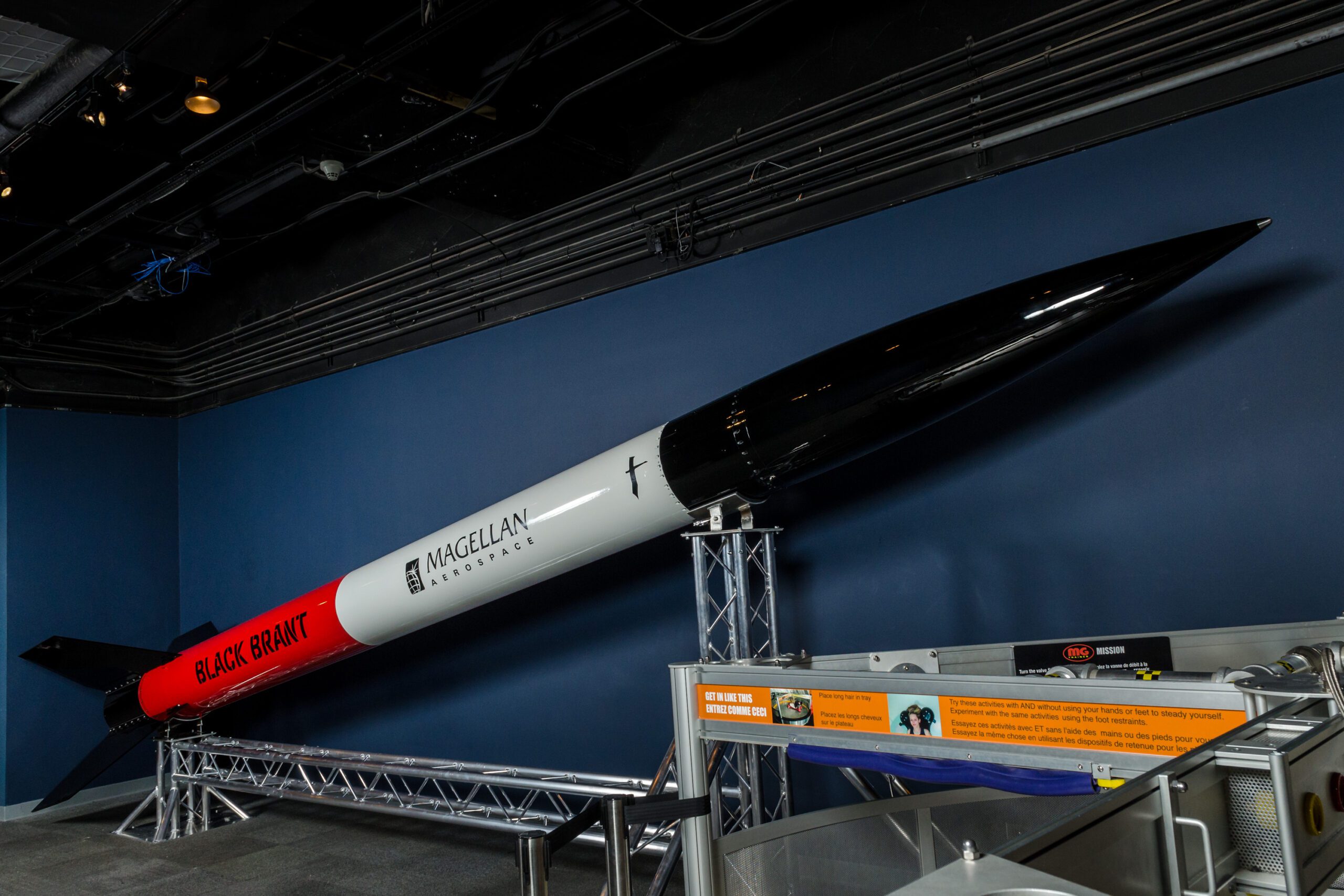
Did you know that one of the most successful small rocket programs in the world is run from right here in Winnipeg? Magellan Aerospace (formerly Bristol Aerospace) builds the Black Brant series of sounding rockets for customers around the world. Payloads launched by Black Brants have been studying the upper atmosphere and near-space environment for over 50 years, and have even been launched from right here in Manitoba (at the Churchill Rocket Range on the northern coast of Manitoba). So it’s no surprise that we’ve always wanted a real rocket for the Science Gallery. Well, now we have one!

Black Brant 5C Rocket in the Science Gallery.

Magellan has loaned the Manitoba Museum a real Black Brant 5C rocket, and it was delivered and installed in the Science Gallery on February 4, 2013. It was a big job getting the rocket into the building, since even disassembled the main motor case wouldn’t fit into the elevator. A team of engineers from Magellan and Museum staff carried it through the parkade and down the stairs to its final resting place. At 9.5-metres (31′) long and nearly 360 kilograms (800 lbs.), this is the single largest artifact in the Science Gallery.

The Black Brant exhibit will officially open this March, with interpretive panels and video footage of the rocket in action. However, you can see the rocket in place now, in the Science Gallery’s space wing next to the Planetarium entrance.

Capturing a Celestial Dance

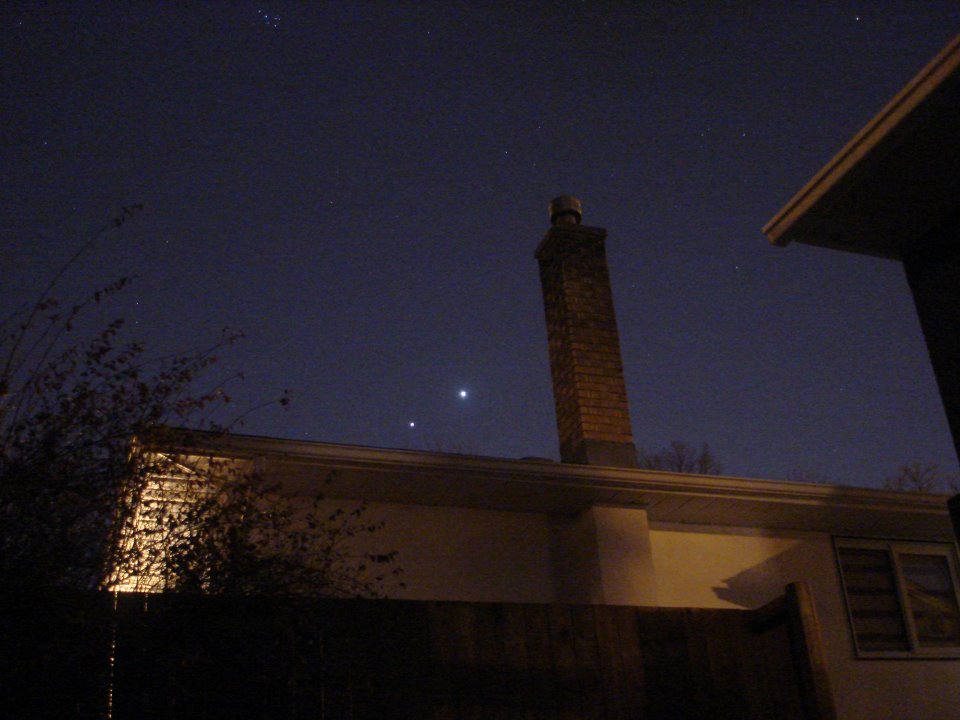
Jupiter and Venus have been engaged in a beautiful dance in the western sky after sunset. With the warm weather, I’ve been running outside in shirtsleeves every few minutes, waiting for the light levels to be at their best for viewing. A little point-and-shoot camera on a tripod is all you need to capture this dramatic dance of the planets.

Two bright lights in the night sky over a rooftop.

Right now, Venus is rising higher and higher each night, while Jupiter is sinking lower into the sunset colours. Still, they’ll be together in the field of view of any camera for a couple of weeks. Set your camera for “twilight portrait” or the closest thing – usually it’s a little moon symbol on the dial – and put it onto a tripod. The tripod is important because the exposure is going to be a second or more long, and you just can’t hold the camera steady enough during that time. If you don’t have a tripod, I have just set it on the ground with a rock under the front to tilt it up towards the correct angle.

Try and put something in the foreground if you have a choice – trees, houses, or whatever provide context and add the third planet into your picture – the planet Earth, our viewing point for the cosmic ballet occurring overhead.


Image: Venus (right) and Jupiter (left) shine just above the artifical horizon of my neighbour’s roof, 12 March 2012. (Image: Scott Young)

If you aren’t happy with the picture your semi-intelligent camera computer comes up with, you can fall back on an old technique from the film days: bracketing. Set the camera for “manual” mode, and start with a 1 second exposure time. Then takes several shots with exposure times on either side of that, both higher and lower. Basically, shoot one image at each setting on the dial or each click of the button. You’ll get a whole range of pictures with different colour, depths, contrast, and definition. In the days of film, this was essential since you couldn’t see your results until after you had developed the film… sometimes a whole night’s work would come back out of focus or underexposed due to an error that went uncorrected under the sky. Nowadays, bracketing is just a way to explore the full depth of the scene before you, and reveal views very different from what your eyes see. Your images won’t replace the view of seeing it live, but they will remind you of your observation, and give you another perspective from which to contemplate the dance of the solar system.

Scott Young

Scott Young

Planetarium Astronomer

Scott is the Planetarium Astronomer at the Manitoba Museum, developing astronomy and science programs. He has been an informal science educator for thirty years, working in the planetarium and science centre field both at The Manitoba Museum and also at the Alice G. Wallace Planetarium in Fitchburg, Massachusetts. Scott is an active amateur astronomer and a past-President of the Royal Astronomical Society of Canada.

Bright Fireball Seen Across Southern Manitoba

On August 23 at about 9:35 pm, a bright fireball was seen across southern Manitoba and several U.S. States. We are collecting reports of the object to determine where it came from and also where any pieces might have landed. If you say this object, please email us at skyinfo@manitobamuseum.ca with the details.

Please include the following information:

  • Where you were when you saw it;
  • The direction you were facing when you first saw it;
  • Whether the object was moving left-to-right, right-to-left, or up-and-down, and at what angle
  • How high above the horizon it was – use the degree scale, where 0 is the horizon, 90 is straight overhead. So, halfway up the sky is 45 degrees, a third of the way up from the horizon is 30 degrees, etc.
  • Any other details – colour, sound, how long you saw it for, etc.

Your reports can help us track down this object, which was probably a small asteroid burning up in the atmosphere.

Scott Young

Scott Young

Planetarium Astronomer

Scott is the Planetarium Astronomer at the Manitoba Museum, developing astronomy and science programs. He has been an informal science educator for thirty years, working in the planetarium and science centre field both at The Manitoba Museum and also at the Alice G. Wallace Planetarium in Fitchburg, Massachusetts. Scott is an active amateur astronomer and a past-President of the Royal Astronomical Society of Canada.

50 years ago today… April 12, 1961

April 12, 1961 – a date that will forever be a part of human history. The date that humanity became a spacefaring species. This achievement ranks amongst the greatest of human accomplishments – fire, the wheel, agriculture, the electric guitar – and its long-reaching effects are still rippling through our future.

On April 12, 1961, Yuri Gagarin boarded the Vostok spacecraft and flew once around the Earth. HIs 108-minute flight was significant only for its newness; the flight would be easily surpassed by both the Soviets and the Americans within a year, Gagarin became a world hero, not just for the Soviet Union but for all of us – he had gone where no one had gone before, and returned safely, blazing a trail that many of us still yearn to follow.

If you want to see what Yuri’s flight was like, watch the film First Orbit – a beautiful real-time recreation of the flight, using out-the-window imagery shot from the International Space Station, which closely mimics the Vostok’s flight path. Premiered on 12 April 2011, the film celebrates the 50 years that we have been leaving Earth for the vacuum of space. I can’t help but wonder what the next 50 years bring, both in spaceflight and in other events. Will we build on Yuri’s flight and push our frontiers ever farther, or remained mired in short-sighted and short-term plans to stay the course in space? We’ll see.

For myself, I echo Yuri’s first words after the Vostok’s carrier rocket lifted off the pad: “Poyekhali!” Translation: “Let’s go!”

Scott Young

Scott Young

Planetarium Astronomer

Scott is the Planetarium Astronomer at the Manitoba Museum, developing astronomy and science programs. He has been an informal science educator for thirty years, working in the planetarium and science centre field both at The Manitoba Museum and also at the Alice G. Wallace Planetarium in Fitchburg, Massachusetts. Scott is an active amateur astronomer and a past-President of the Royal Astronomical Society of Canada.

50 years ago today… April 5, 1961

50 years ago today, Soviet air force pilot Lt. Yuri A. Gagarin didn’t know he would become be the first human into space in just a week’s time. Gagarin and his colleagues, Gherman Titov and Grigori Nelyubov, were all in training for the first flights of the Vostok spacecraft, but the Soviet leadership had not yet formally authorized the flight nor assigned a cosmonaut. What’s more, the United States was racing to put a man in space as well, and although they lagged behind the Soviet Union, a surprise was still possible. Each man trained for the upcoming flight, now only a week away,  as if he would be the pilot.

On April 5, 1961, the cosmonauts flew to the launch centre with their medical team and a film crew. They are greeted by Sergei Korolev, the mastermind behind the Soviet space program. Korolev pushes for a decision on who will fly first, to no avail. General Kaminin, the man in charge of cosmonaut selection and training, will not make a final decision yet. That night, three young cosmonauts go to sleep, not knowing which of them will soon become the most famous person in the world.

Scott Young

Scott Young

Planetarium Astronomer

Scott is the Planetarium Astronomer at the Manitoba Museum, developing astronomy and science programs. He has been an informal science educator for thirty years, working in the planetarium and science centre field both at The Manitoba Museum and also at the Alice G. Wallace Planetarium in Fitchburg, Massachusetts. Scott is an active amateur astronomer and a past-President of the Royal Astronomical Society of Canada.