



October this year features a couple of unusual visitors to the autumn sky: a pair of comets which may become bright enough to see in small telescopes. As usual, the online hype over these comets far outstrips reality. See below for the real deal, including how you can track down these tiny snowballs for the edge of the solar system.

Comets in October 2025
Comets are chunks of ice and dust a few kilometers across that originate from the edge of the solar system. If one moves through the inner solar system closer to the Sun, the ice melts and the dust streams away, blown buy the solar wind into a tail which can sometimes become bright enough to see from Earth. They can be visible for days or weeks as they zoom around the Sun and head back out into deep space.
At any given time there are five or ten comets in the sky that are visible in large telescopes. A comet that reaches binocular visibility is uncommon, maybe one every couple of years. A comet that becomes bright enough to be seen without optical aid is even more rare.
In October, there are actually two comets that are becoming visible in binoculars and small telescopes. Unfortunately, only one is easy to spot from the northern hemisphere. There’s also a rare interstellar comet passing through our solar system, and while it won’t be visible without a telescope it’s generating a lot of media attention. Let’s dive in.
Comet Lemmon (C/2025 A6) is visible in binoculars near the Big Dipper now, although that part of the sky is best seen in the pre-dawn hours. As the comet brightens it will pass into the evening sky and be more conveniently placed for viewing.

Comet SWAN (C/2025 R2) was very bright in the southern hemisphere, but has faded after rounding the sun. It is visible low in the evening sky after sunset. It rises higher into the sky as it moves away, becoming visible in a darker sky but also fading. How these two factors balance out will determine wether this is a good comet or a “meh” comet.

Comet 3I/ATLAS is a different kind of comet – it comes from beyond our solar system. (So, REALLY REALLY REALLY far away instead of just REALLY REALLY far away!) It passes near the planet Mars in early October, where a fleet of Mars probes will turn their cameras towards this target of opportunity. After passing around the Sun this object will head off into deep space, never to return. While never getting bright enough to see even in a good backyard telescope, it’s still an interesting object that is sharing some of the scientific spotlight with the other two comets above.
Update – 6 October 2025: Several images of Comet 3I/ATLAS have been released from the various Mars spacecraft, and frankly they’re disappointing. While the cameras are closer than we are to the comet, and the Sun isn’t in the way, they’re not cameras designed for taking pictures of the sky. So, they look like the pictures of the sky most people get with their cell phones – a short trail that moves during the long exposure required. The various space agencies really overhyped what they’d be able to image in these circumstances.
The Solar System for September 2025
Mercury is too close to the horizon to be seen from Canadian latitudes this month. It reaches greatest elongation from the Sun on October 29, but it sets at sunset and so we won’t catch it this time around. Mercury is in the same area of the sky as Mars, and viewers in the southern hemisphere will be able to catch them just after sunset.
Venus rises in the east as morning twilight begins, and is low in the east-southeast as the sun rises. Venus is bright enough to be seen well into twilight and even after sunrise, if you can keep your eyes focused on it – but as soon as you look away, you’ll lose it because your eyes will defocus and it will be lost in the bright sky. On the morning of the 19th the thin crescent moon passes nearby, a nice morning phot op.
Mars is still too close to the Sun (as seen from Canadian latitudes) to be visible this month. In the same area of the sky as Mercury, and viewers farther south will be able to catch them just after sunset.
Jupiter rises about midnight at the beginning of October, the brightest “star” in the sky until Venus rises. Jupiter stands high in the south by dawn. Jupiter is below the bright stars Castor and Pollux in Gemini, with Pollux being the one closer to Jupiter.
Saturn is low in the southeast as darkness falls and is visible all night, rising to its highest point in the south around midnight. Saturn’s rings are only tilted by a couple of degrees relative to our line of sight, which means they appear very thin and edge-on. The situation gets worse throughout the year, as the rings will nearly disappear from our point of view. They’re still there, but they are so thin that it’s like looking at the edge of a piece of paper. On the plus side, for those with large telescopes, we will be able to see some of Saturn’s moons cast their shadow on the planet as they orbit. Saturn’s largest moon, Titan, casts its shadow on the planet on the nights of October 5-6th, the last such event visible for the next 15 years (although Titan itself will still transit the planet several more times in 2025).
Uranus is in the morning sky a few degrees below the famous Pleaides star cluster (also known as the Seven Sisters). It is too faint to easily see without binoculars, and even a telescope shows it as a faint dot that looks just like the other faint stars. A detailed star-charting app like Stellarium is required to track it down.
Neptune is in the same binocular field of view as Saturn for the entire month, but since it is even farther than Uranus it is invisible without optical aid. Neptune requires good binoculars or a small telescope to even spot, and a large telescope to make it out as anything more than a faint dot. Again, a detailed star chart like those produced by Stellarium is required to tell which tiny “dot” is Neptune.
Of the five known dwarf planets, only (1) Ceres is close enough to be seen in binoculars or a small telescope. Ceres reaches opposition (the point opposite the Sun in the sky) on October 2, below and to the left of Saturn and Neptune, and remains bright enough to spot in binoculars and small telescopes all month. You should be able to spot it as a faint “star” that slowly changes its position each night. Use the attached chart, excerpted from the RASC Observer’s Handbook, to tell which “dot” is the dwarf planet.


Sky Calendar for August 2025
All times are given in the local time for Manitoba: Central Daylight Time (UTC-5). However, most of these events are visible across Canada at the same local time without adjusting for time zones.
If there’s a little box to the left of the date, you can click on it to see a star map of that event! All images are created using Stellarium, the free planetarium software.
Sunday, October 5, 2025: Saturn’s largest moon, Titan, casts its shadow along the north pole of Saturn, while the moon itself transits across Saturn’s mid-northern latitude. (Visible with large telescopes only.) The nearly-Full Moon is nearby tonight as well.
Tuesday, October 6th, 2025: Full Moon occurs at 10:48 p.m. CDT.
Monday, October 13th, 2025: Last Quarter Moon occurs at 1:13 p.m. CDT.
Sunday, October 19th, 2025 (morning sky): The crescent Moon is near Venus just before dawn.
Tuesday, October 21st, 2025 (morning sky): The Orionid meteor shower peaks in the pre-dawn hours this morning, but it produces less than a dozen meteors per hour on average. You’ll need to drive away from bright lights into darker country skies to get a good view. This year, the Orionids peak on the night of New Moon, so no moonlight will interfere.
Wednesday, October 29th, 2025: First Quarter Moon occurs at 11:21 a.m. CDT. Also this morning, the Moon occults (passes in front of) the dwarf planet Pluto, but this event is totally unobservable because of Pluto’s great distance makes it impossible to see without a telescope at the best of times.
Friday, October 31st, 2025: Hallowe’en night is a great night to share sky views with any trick-or-treaters that visit your house. Binoculars on a tripod will show the Moon well, and a telescope can show Saturn’s rings!
Summer Meteor Showers
Outside of the regular events listed above, there are other things we see in the sky that can’t always be predicted in advance.
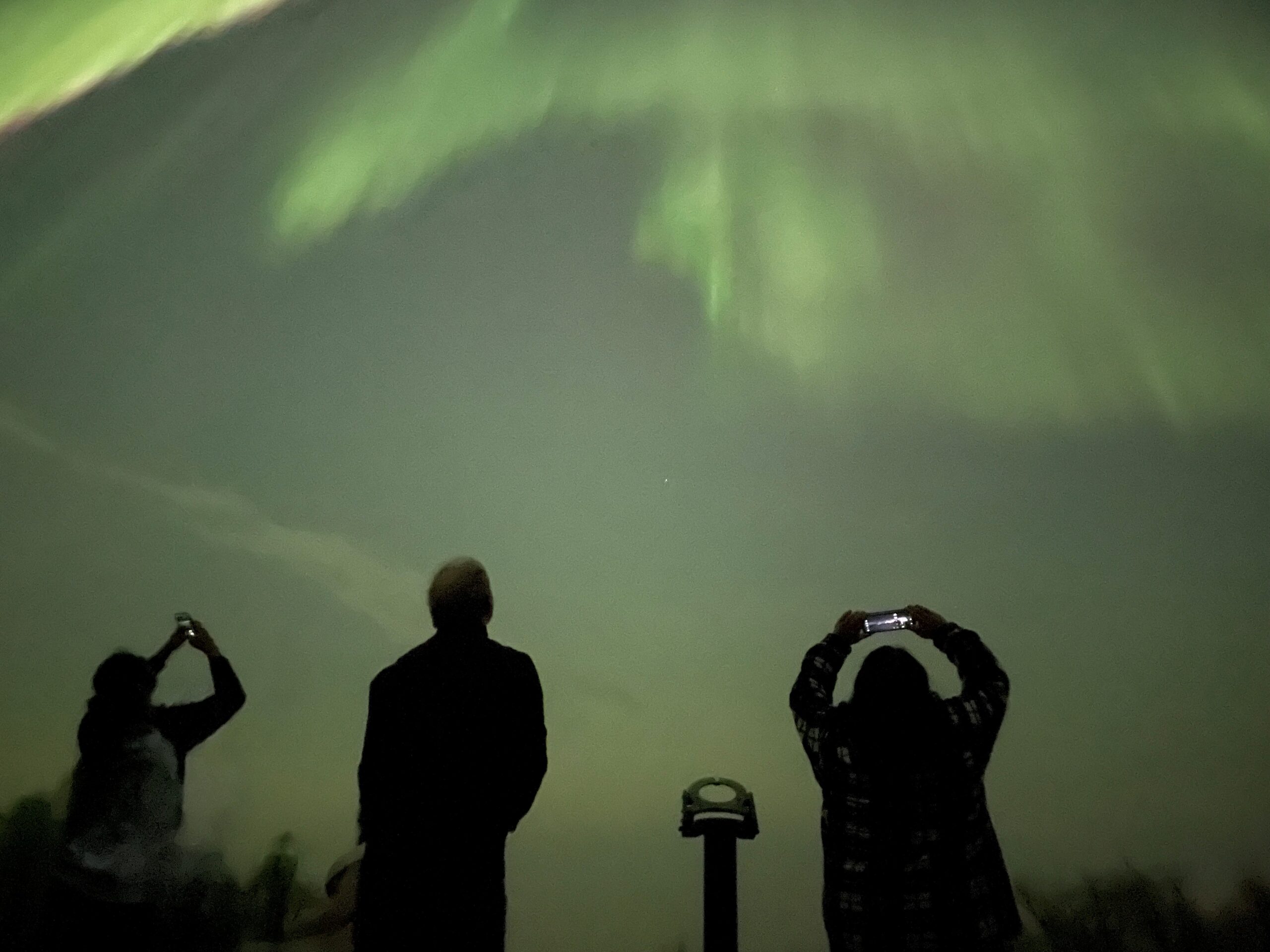
Aurora borealis, the northern lights, are becoming a more common sight again as the Sun goes through the maximum of its 11-year cycle of activity. Particles from the Sun interact with the Earth’s magnetic field and the high upper atmosphere to create glowing curtains of light around the north (and south) magnetic poles of the planet. Manitoba is well-positioned relative to the north magnetic pole to see these displays often, but they still can’t be forecast very far in advance. A site like Space Weather can provide updates on solar activity and aurora forecasts for the next 48 hours. The best way to see the aurora is to spend a lot of time out under the stars, so that you are there when they occur.,
Random meteors (also known as falling or shooting stars) occur every clear night at the rate of about 5-10 per hour. Most people don’t see them because of light pollution from cities, or because they don’t watch the sky uninterrupted for an hour straight. They happen so quickly that a single glance down at your phone or exposure to light can make you miss one.
Satellites are becoming extremely common sights in the hours after sunset and before dawn. Appearing as a moving star that takes a few minutes to cross the sky, they appear seemingly out of nowhere. These range from the International Space Station and Chinese space station Tianhe, which have people living on them full-time, to remote sensing and spy satellites, to burnt-out rocket parts and dead satellites. These can be predicted in advance (or identified after the fact) using a site like Heavens Above by selecting your location.