



Posted on: Thursday April 2, 2026
April’s article is a day late, due to the writer’s time being occupied by the Artemis II launch to the Moon!
Although this article focuses on events visible in Manitoba, most events will also be visible across Canada and most places in the mid-northern hemisphere.
Update: A Bright Comet (or Two?)
Updated: 14 April 2026
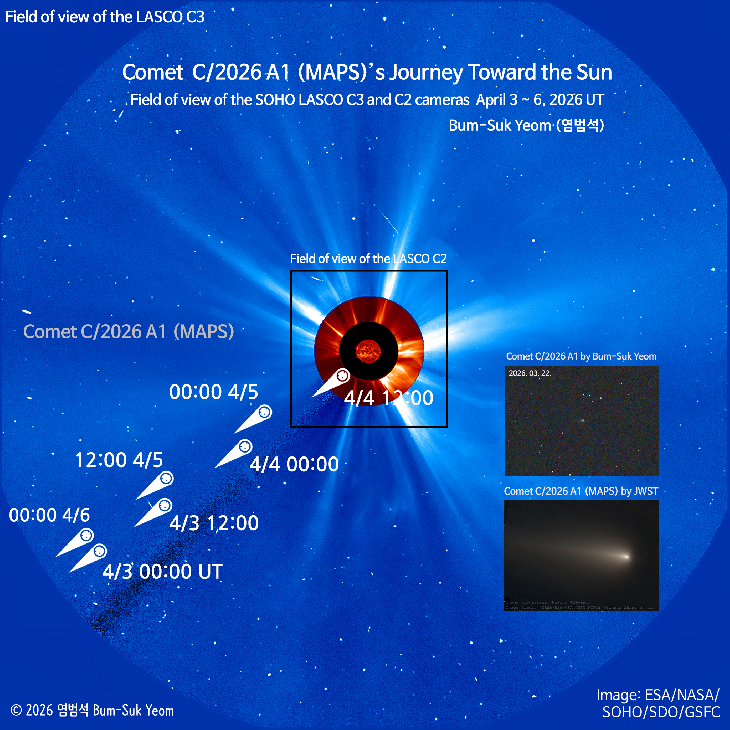
April had two potential comets forecast. Unfortunately, one of them – Comet 2026 A1 (MAPS) – disintegrated as it passed very close to the Sun, and so we never got to see it become bright. However, the other one is becoming a nice photo target in the morning sky in late April, and may become bright enough to see with the unaided eye (barely).
Comet 2025 R3 (PANSTARRS) rises in the morning sky before the Sun, and has become a nice comet with a decent tail for astrophotographers. As of this writing (April 14, 2026) it is bright enough to be seen in binoculars if you know exactly where to look. During the week of April 13-20 it gets brighter but also rises later, so the best day to see it is a balance between the comet’s brightness and that of the morning twilight sky. See detailed entries in the Sky Calendar section below, since the situation changes daily.
How to See the Comet
To spot PANSTARRS, get away from city lights – you likely won’t spot it unless you have a dark sky. Find a place with a clear horizon to the east and northeast. (Avoid areas southwest of Winnipeg or you’ll be looking back through the city lights!) Let your eyes dark-adapt – turn off your phone and any other lights. Starting about 5 am local time, start scanning the sky centered on the east-northeast along the horizon. You’ll first spot a big diamond of four fairly bright stars – the Square of Pegasus. This is the key, since this comet spends much of its time inside the area bounded by the Square. Use binoculars to scan the area inside the Square and look for a softly-glowing, fuzzy round ball that is bigger than a star. Use what’s called “averted vision” – move your eye around the field of view, and you might be able to see it out of the corner of your eye rather than when you look right at it.
Once you spot the comet’s head, look for any sign of the tail which should point up and to the right. Once you know where it is, try it without the binoculars and see if you can see it with just your eyes. It will probably be a challenging observation, but well worth it – bright comets are not very common, and they are pretty much the smallest pieces of the solar system we can ever see without the aid of a telescope. It’s also one of the oldest. That fuzzy ball is a cloud of gas surrounding a tiny icy nucleus that dates back to before the Earth was formed!
You can also try taking a picture of the comet with your phone or (better) with a camera on a tripod. This comet has been very photogenic thus far, and modern cameras do a surprisingly good job of astro-imaging.
While you’re out comet hunting, scan your binoculars to the left of the Square of Pegasus to spot the Andromeda Galaxy (M31 on the daily charts below). It’s also a fuzzy spot, but more elongated than the comet, and a totally different type of object. M31 is a galaxy of up top a trillion stars, located so far away that the light you see tonight has been travelling for nearly 2.5 million years to arrive. (By comparison, the light from the Moon has a bit more than a second’s travel time; the Sun is about 8 light minutes away, and the edge of our solar system is about 4 light hours away.) M31 is the largest and most distant object that can be seen by the unaided eye.
If you spot the comet, let us know! Send your observing report or images to space@manitobamuseum.ca, and we may feature it on our next Dome@Home show.
The Solar System for April 2026
Mercury is too close to the Sun to be easily visible this month.
Venus is low in the west after sunset, getting slightly higher and moving slightly farther north over the course of the month. Head out after sunset when the sky is still fairly bright; Venus is the brightest “star” you can see above the western horizon.
Mars is still too close to the Sun to be visible this month.
Jupiter is high in the south as darkness falls, and sets about 3 a.m. local time in the west-northwest. It’s a great time to look at the planet in binoculars (to see the four largest moons) or a telescope.
Saturn has passed behind the Sun and is still too close to spot this month.
Uranus is in the evening sky a few degrees below the famous Pleaides star cluster (also known as the Seven Sisters). It is too faint to easily see without binoculars, and even a telescope shows it as a faint dot that looks just like the other faint stars. A detailed star-charting app like Stellarium or the charts in the Observer’s Handbook is required to track it down.
Neptune is invisible this month, close to Mars and Saturn in the morning sky.
Of the five known dwarf planets, only (1) Ceres is close enough to be seen in binoculars or a small telescope. It is too close to the Sun to be seen this month.
Sky Calendar for April 2026
All times are given in Central Daylight Time, the local time for Manitoba. However, most of these events are visible across Canada at the same local time without adjusting for time zones.
If there’s a little box to the left of the date, you can click on it to see a star map of that event! All images are created using Stellarium, the free planetarium software.
Wednesday, Apr. 1, 2026: Artemis II launched! The Artemis II crew is on their way to the Moon, after a launch at 5:35:12 p.n. CDT from the Kennedy Space Center in Florida. Unfortunately, we won’t be able to spot the spacecraft in the sky easily without computer-aided telescopes – but that doesn’t mean we’re not going to try!
April 1st is also Full Moon in the Central Time Zone (it occurs at 9:32 p.m. CDT, but many calendars use Greenwich mean Time when they print their moon phases, so your paper calendar might show it as the next day.)
Friday, April 3rd, 2026 (daytime): Comet C/2026 A1 (MAPS) makes its closest approach to the Sun today. While it will likely not be visible to amateur sky-watchers, you can follow it through the SOHO sun-watching satellite.
Thursday, Apr. 9, 2026: Last Quarter Moon
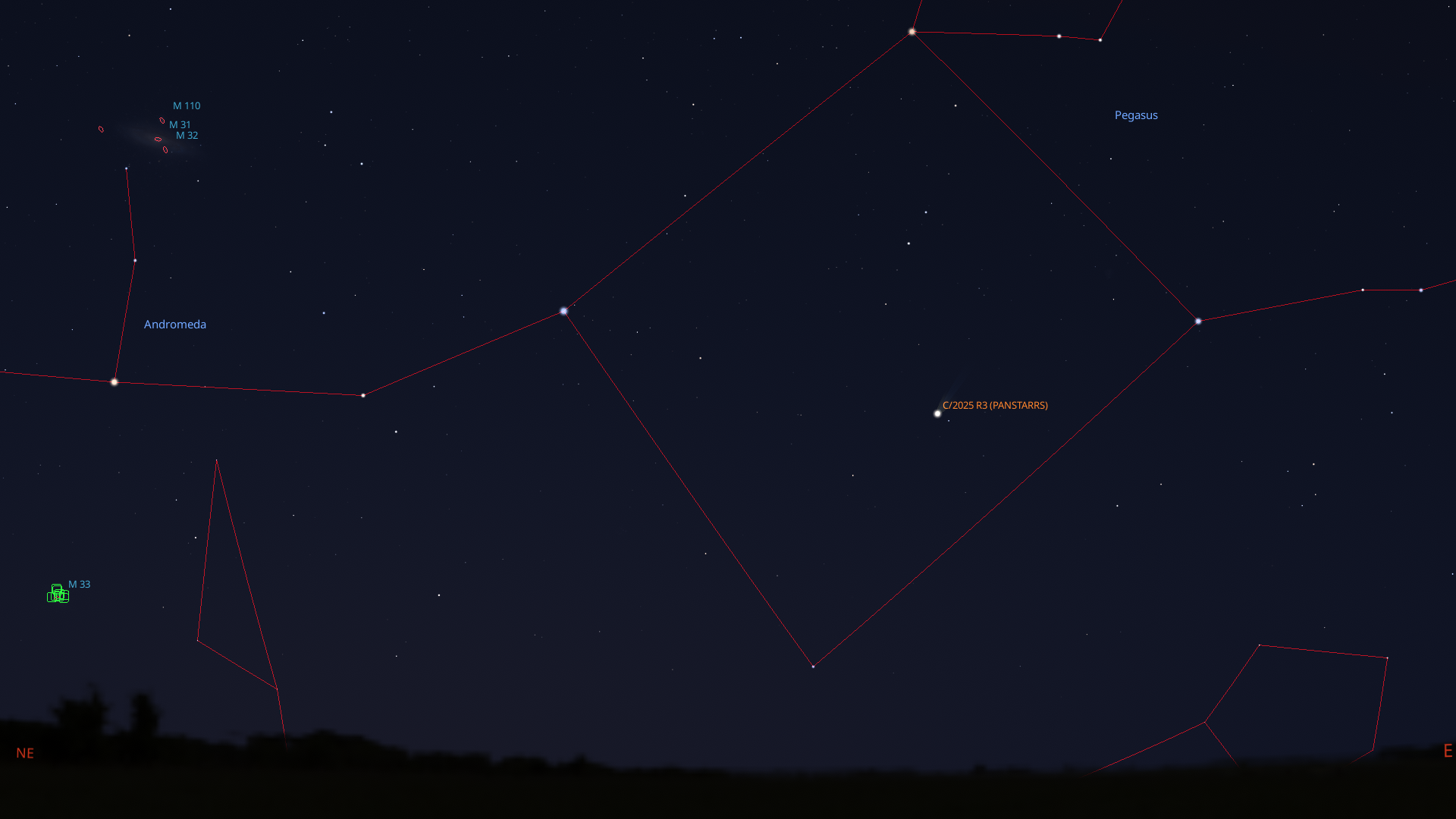 Wednesday, April 15, 2026 (morning sky): Comet 2025 R3 (PANSTARRS) is about 10 degrees above the east-northeast horizon at 5:15 am local time, near the middle of the Square of Pegasus. It will appear as a small, fuzzy ball of light that hovers at the edge of visibility. The tail will point up and to the right (away from the direction of the Sun) but will be much fainter – try binoculars or a camera to catch it.
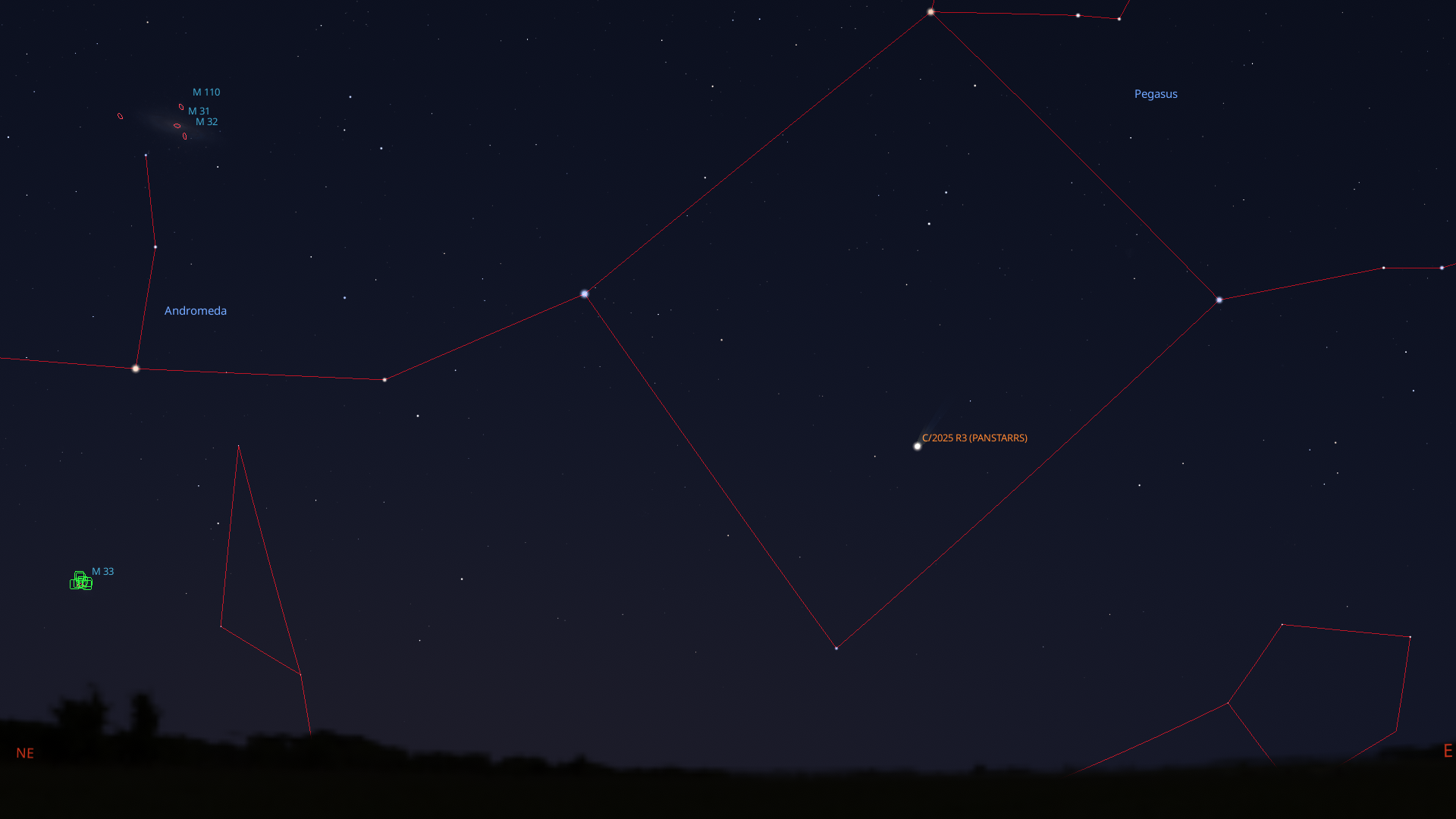 Thursday, April 16, 2026 (morning sky): Comet 2025 R3 (PANSTARRS) will be brighter but lower than yesterday morning, still inside the Square of Pegasus.
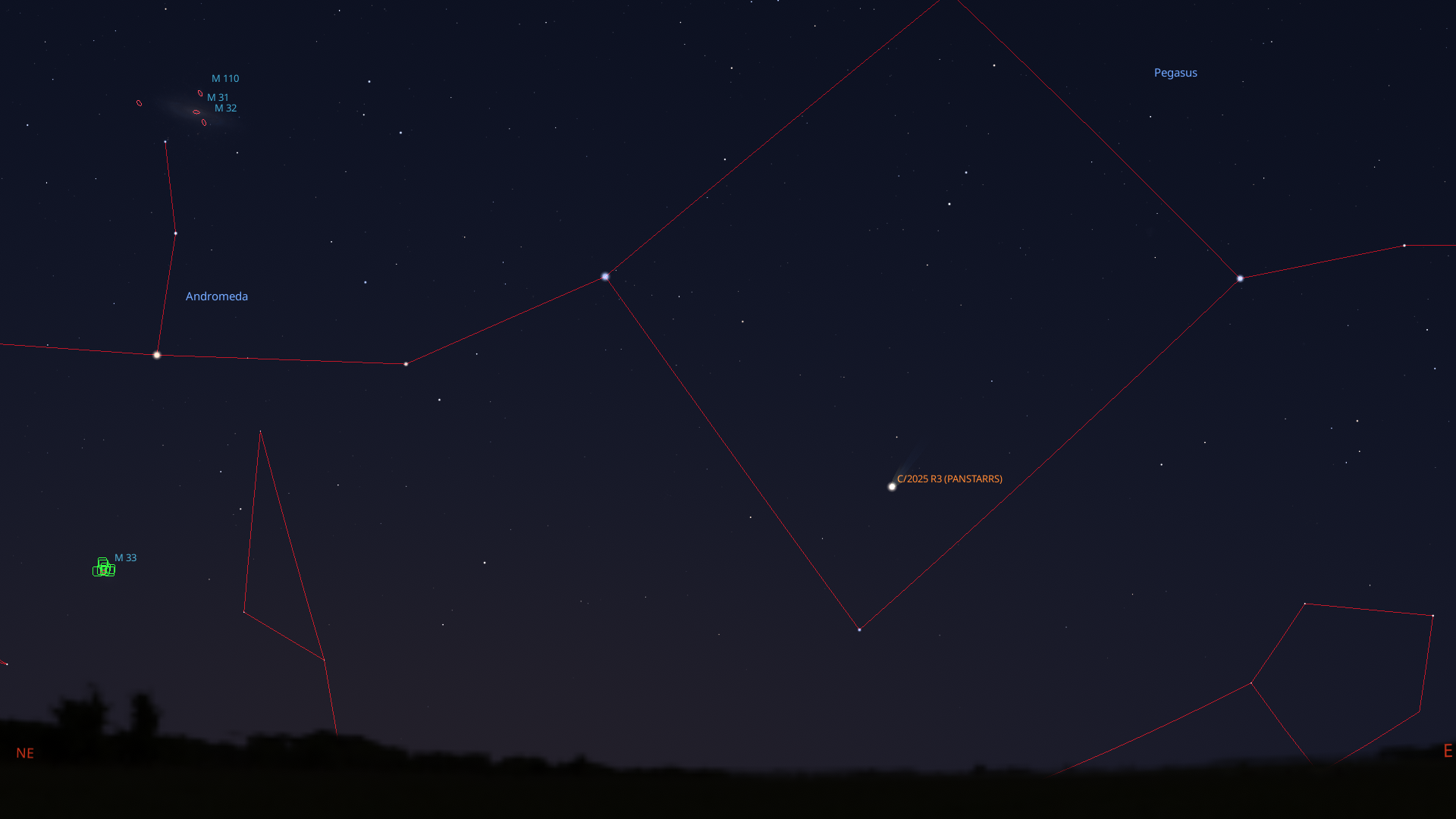
Friday, April 17, 2026 (morning sky): Comet 2025 R3 (PANSTARRS) continues to brighten in the pre-dawn sky, but is low enough that you might not be able to see it until the twilight has already begun to brighten the sky.
Friday, Apr. 17, 2026: New Moon
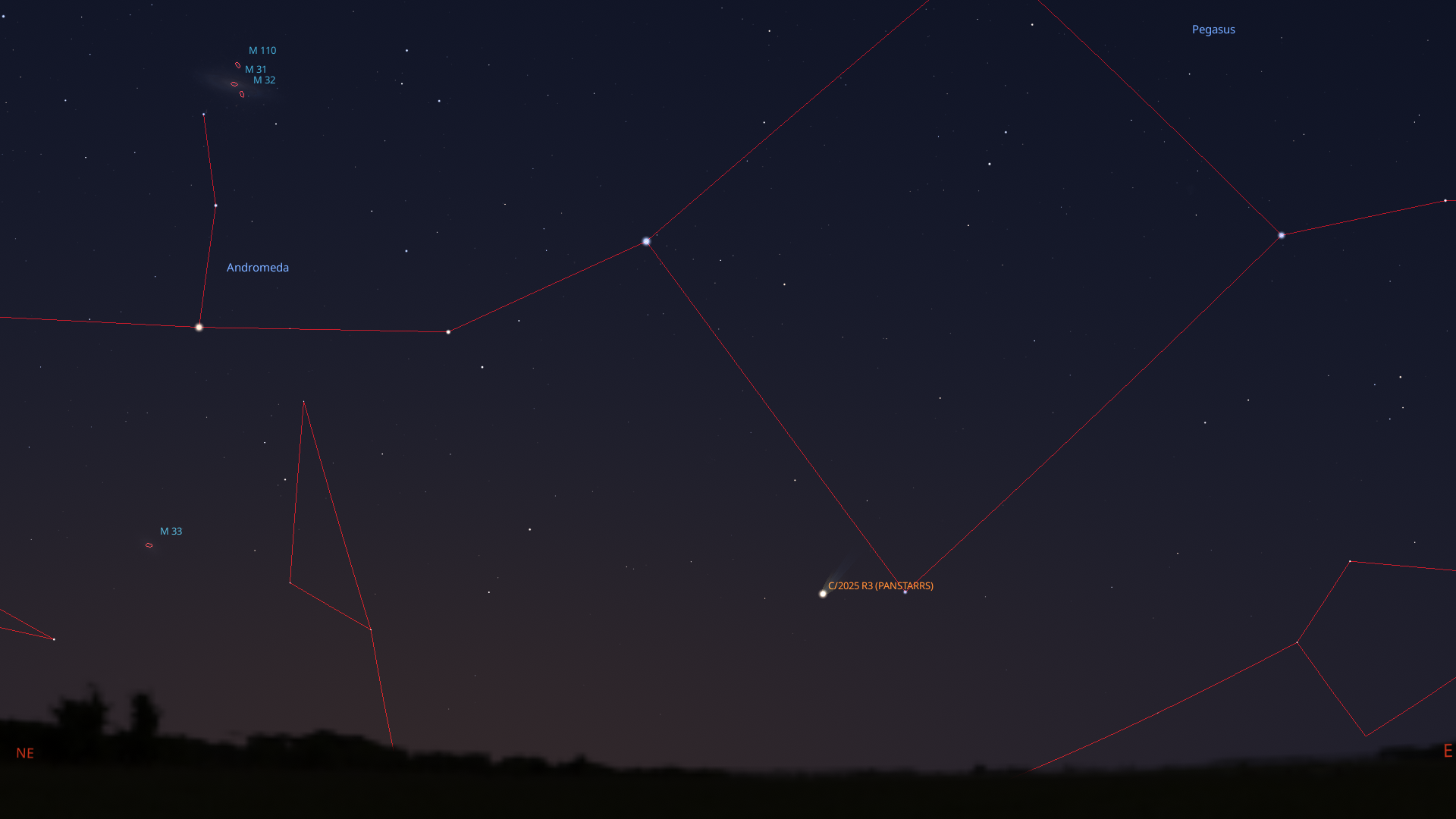 Saturday, April 18, 2026 (morning sky): Comet 2025 R3 (PANSTARRS) is brightening and may be easier to spot even though it is lower in the sky at 5 am local. As it rises and the sky brightens, it may become easier to see – it all depends on exactly how bright the comet gets compared to the dawn twilight background.
Saturday, Apr. 18, 2026 (evening sky): The thin crescent Moon is just to the right of Venus in the evening sky.
 Sunday, April 19, 2026 (morning sky): Comet 2025 R3 (PANSTARRS) has moved outside of the Square of Pegasus and now stands to the left of the bottom star in that asterism. By 5:30 am local it should be high enough to catch with the unaided eye if predictions are correct.
Sunday, Apr. 19, 2026 (evening sky): The waxing crescent Moon stands above Venus in the western evening sky.
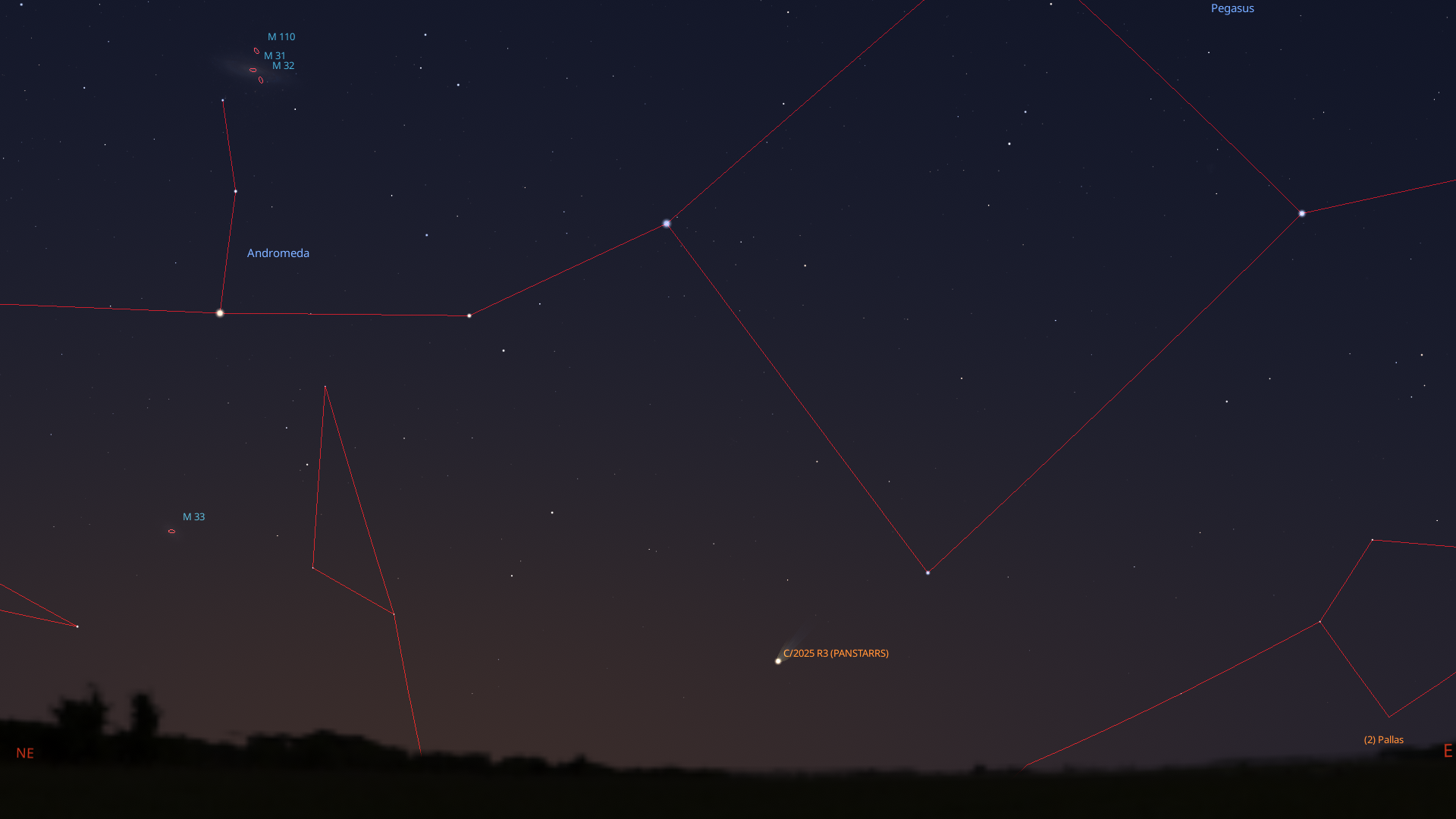 Monday, April 20, 2026 (morning sky): Comet 2025 R3 (PANSTARRS) is low in the east-northeast sky, just a few degrees above the horizon at 5:15 am local time.
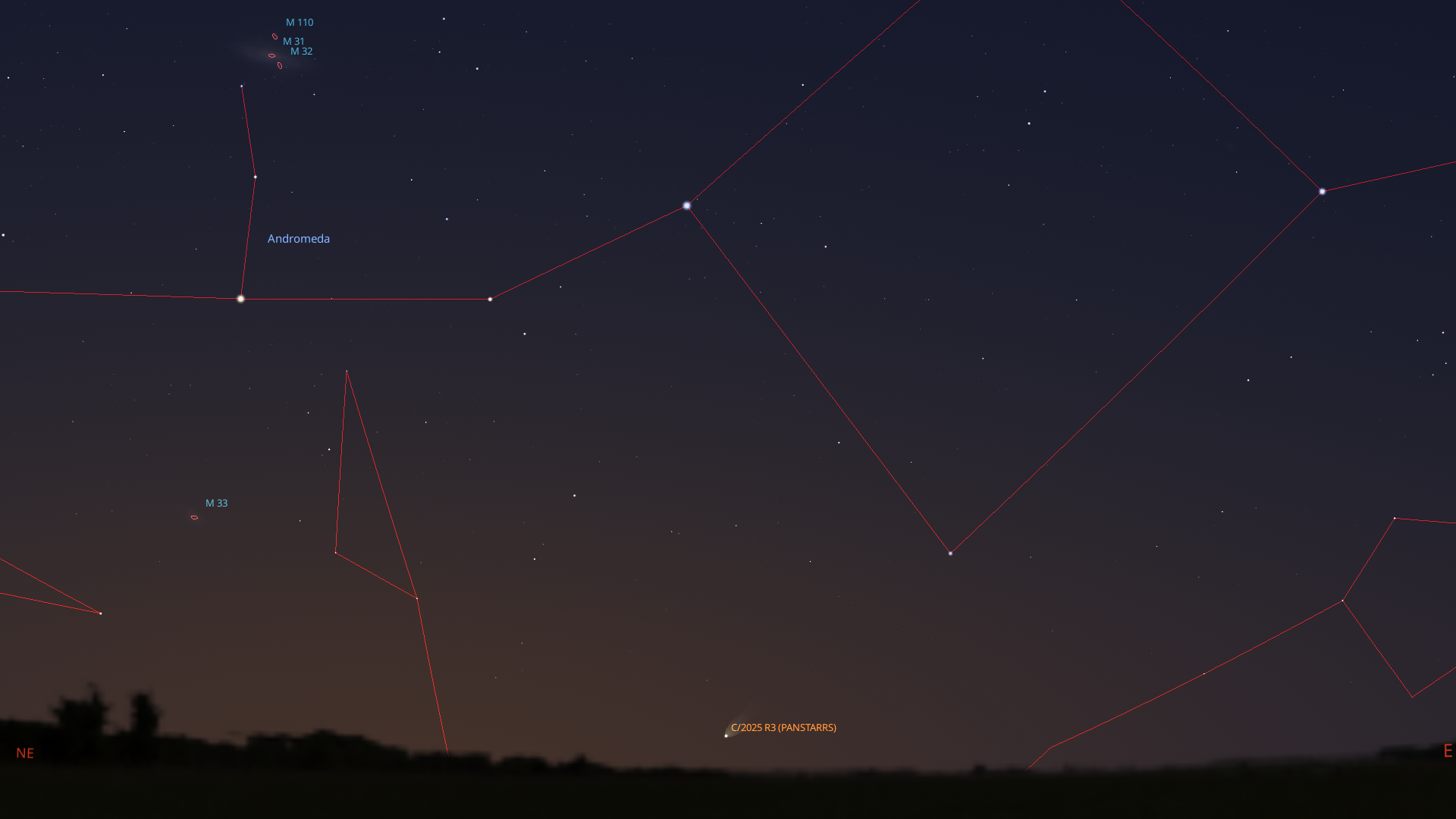 Tuesday, April 21, 2026 (morning sky): Comet 2025 R3 (PANSTARRS) is very low in the east-northeast sky, just a few degrees above the horizon at 5:15 am local time. Probably the last day to catch it.
Tuesday, Apr. 21, 2026 (evening sky): The waxing crescent Moon is off to the right of Jupiter high in the south this evening.
Wednesday, Apr. 22, 2026 (evening sky): The waxing crescent Moon is just above Jupiter high in the south this evening.
Wednesday, Apr. 22, 2026 (morning sky): The peak of the annual Lyrid “meteor shower” occurs in the predawn sky today, but “shower” is misleading. You can expect between 2-10 meteors per hour in the hours before dawn. See more details here.
Thursday, Apr. 23, 2026: First Quarter Moon
Saturday, Apr. 25, 2026 (evening sky): The waxing gibbous moon eclipses the bright star Regulus in the daytime sky for Manitobans. Probably not visible except in a telescope equipped with a camera. The dark side of the Moon will block the star at about 7:15 p.m. CDT for southern Manitoba, with the star disappearing very close to the north pole of the Moon from our view. Regulus will re-appear along the bright top edge of the Moon only about 25 minutes later, but this will be harder to see because of the bright Moon ‘s glare.
Other Celestial Sights
Outside of the events listed above, there are other things we see in the sky that can’t always be predicted in advance.
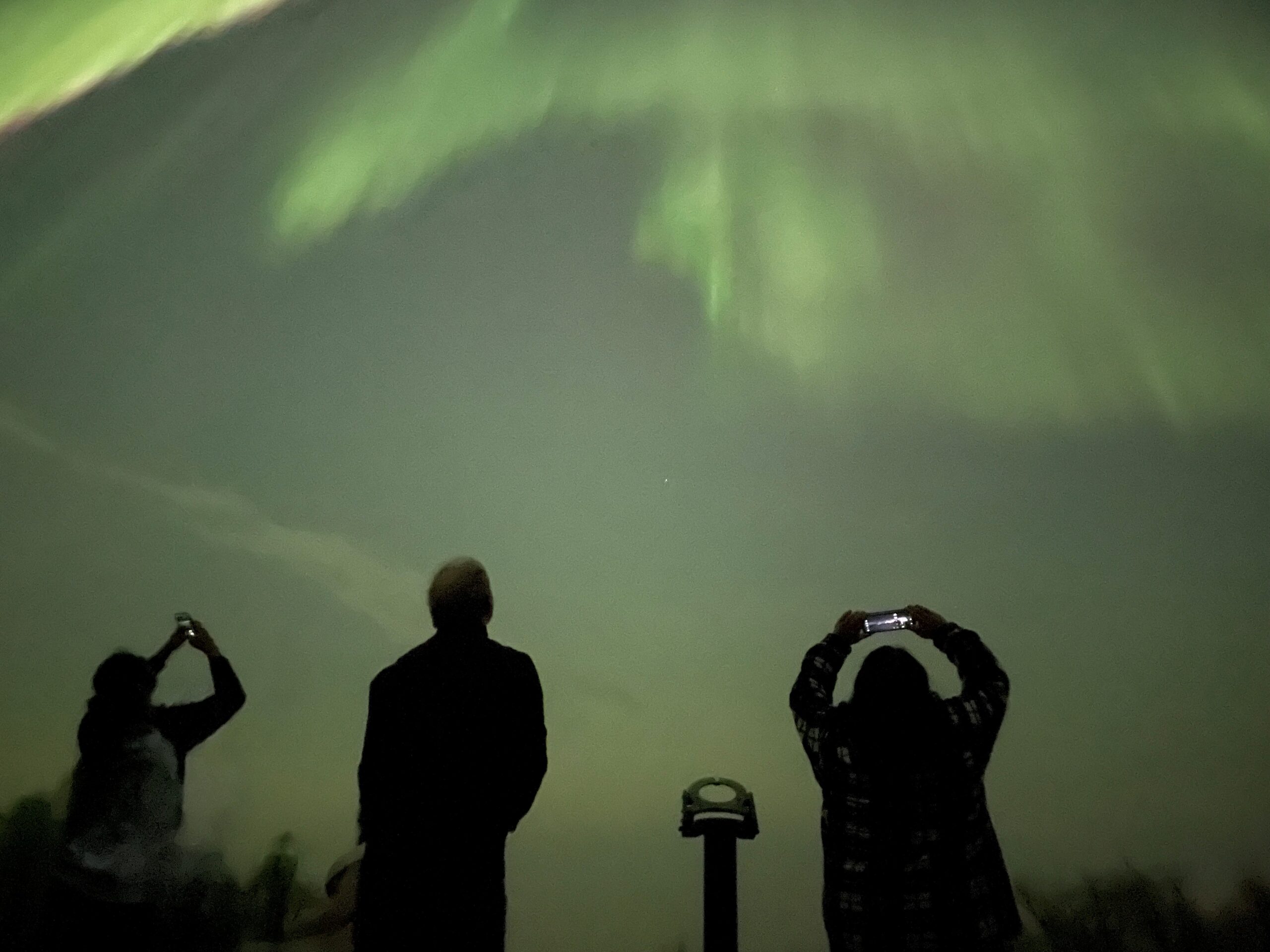
Aurora borealis, the northern lights, are becoming a more common sight again as the Sun goes through the maximum of its 11-year cycle of activity. Particles from the Sun interact with the Earth’s magnetic field and the high upper atmosphere to create glowing curtains of light around the north (and south) magnetic poles of the planet. Manitoba is well-positioned relative to the north magnetic pole to see these displays often, but they still can’t be forecast very far in advance. A site like Space Weather can provide updates on solar activity and aurora forecasts for the next 48 hours. The best way to see the aurora is to spend a lot of time out under the stars, so that you are there when they occur.
Random meteors (also known as falling or shooting stars) occur every clear night at the rate of about 5-10 per hour. Most people don’t see them because of light pollution from cities, or because they don’t watch the sky uninterrupted for an hour straight. They happen so quickly that a single glance down at your phone or exposure to light can make you miss one.
Satellites are becoming extremely common sights in the hours after sunset and before dawn. Appearing as a moving star that takes a few minutes to cross the sky, they appear seemingly out of nowhere. These range from the International Space Station and Chinese space station Tianhe, which have people living on them full-time, to remote sensing and spy satellites, to burnt-out rocket parts and dead satellites. The most common sightings are Starlink satellites, which are being launched dozens at a time to bring internet to remote regions, but which cause trouble with astronomy and pollution. These can be predicted in advance (or identified after the fact) using a site like Heavens Above by selecting your location.