


Norwegian Bear Fight: Folk Furniture of the 18th Century

Norwegian Bear Fight: Folk Furniture of the 18th Century

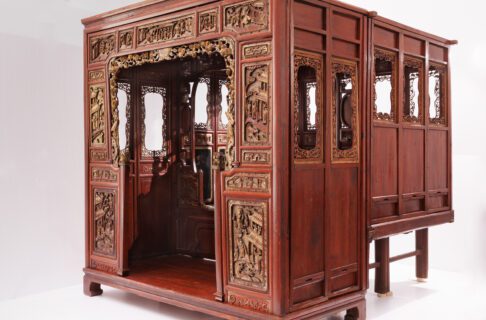
The Manitoba Museum is in possession of a wonderfully decorated Norwegian pine cabinet dated to the late 18th century. This cabinet will be on exhibit in our foyer from May 5 to November 2, 2014.

The cabinet has two sections: an upper cupboard and lower hutch, with a total of 3 doors. On these doors and around them the artist created a series of 10 panels to present us with a narrative of heroic deeds and haughty boasting. This story may represent a local folk tale or clan legend. After spending some time looking at these images I believe there may be two ways to view the story.
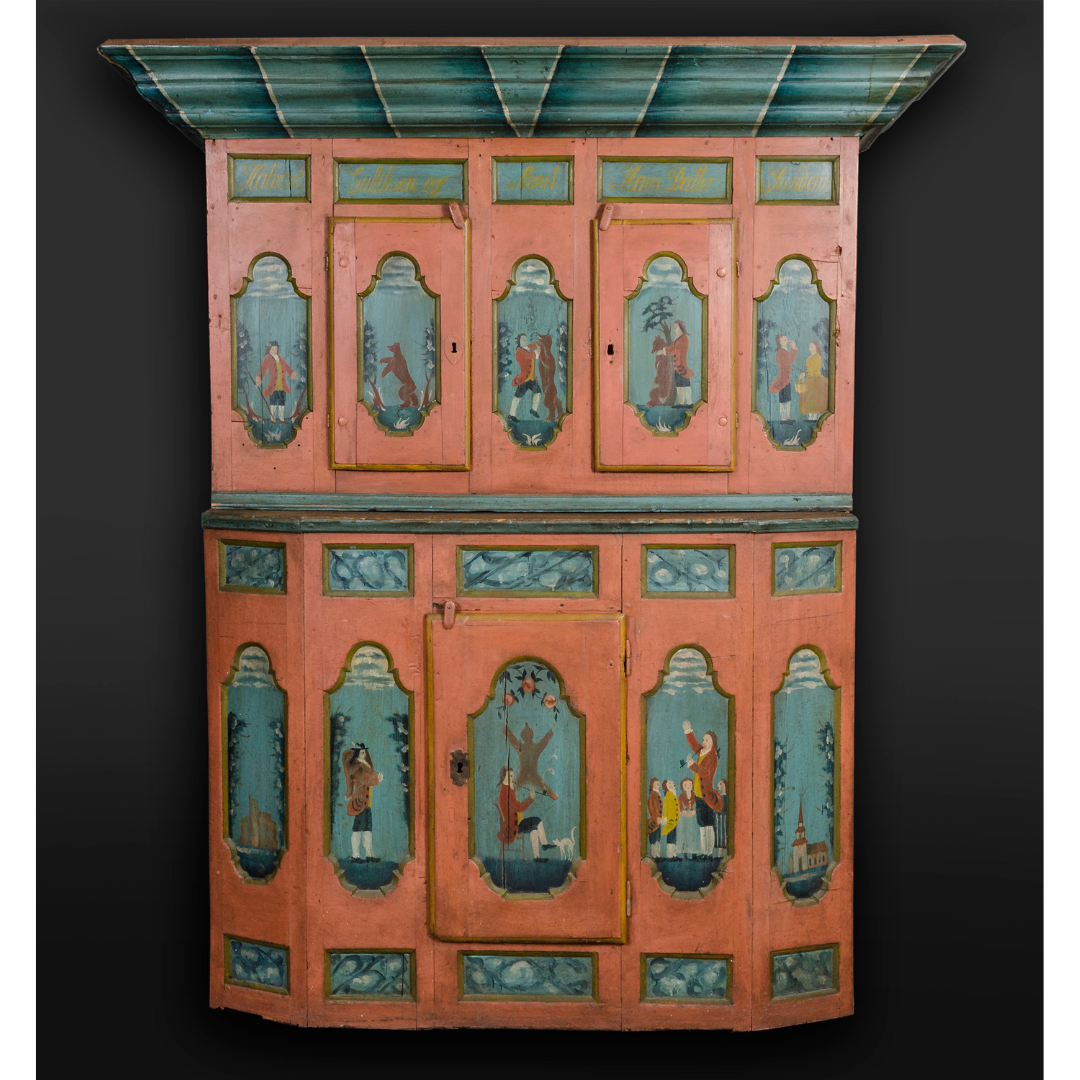
A two-level orange cabinet with two rows of five teal panels portraying the story.
  1. Left-to-right, top-to-bottom (like a comic strip):

    A young man is confronted by a bear and enters into hand-to-hand combat. Not surprisingly, the man vanquishes the bear. He then boasts of his prowess to a young lady, who gives him berries. In the lower portion he carries home and then displays the bear skin, and then again boasts in front of a crowd. The church may represent a wedding to the girl or the righteousness of the man.

  2. Bottom-to-top:

    A young man has acquired a bearskin and then sits in his parlour composing a story about his acquisition. He smokes a pipe, symbolizing inspiration or storytelling. In the next panel to the right he boasts to a crowd while still smoking his pipe and pointing upward (notice how he is twice as large as everyone else – The Big Man).  Above we witness his story – each panel in the top portion has a small grey flame at the bottom. Is this the fire-smoke of his imagination? He tells the tale of the bear fight and for some reason he meets a girl at the end who hands him some berries.

A cabinet of this size and with such high-quality painted details was likely the property of a landowning Norwegian family. The written reference to a married couple and their farm (or village) at the top of the cabinet suggests that it was built for their home, and possibly for the occasion of their marriage.

“Halvord Gulliksen og Marit Arnes Datter Lundem”

Norwegians of the 18th century were identified by their first names and patronymic (father’s name). Sometimes they also added the name of their village or farm. Surnames as we know them were only introduced in 1923. The script written at the top of the cupboard would translate as: “Halvord Gulliksen (son of Gullik) and Marit Arnes Datter (daughter of Arnes), at Lundem.” Halvord and Marit were probably the original owners of the cupboard.

This rare and splendid example of European folk furniture was donated by George and Tannis Richardson, generous supporters of The Manitoba Museum. Mr. Richardson is a Founding Member of the Museum.

Dr. Roland Sawatzky

Dr. Roland Sawatzky

Curator of History

Roland Sawatzky joined The Manitoba Museum in 2011. He received his B.A. in Anthropology from the University of Winnipeg, M.A. in Anthropology from the University of South Carolina, and Ph.D. in Archaeology…
Meet Dr. Roland Sawatzky

Total Lunar Eclipse Visible Over Manitoba Tonight (April 14-15)

Tonight, most of North America will be treated to an uncommon and beautiful celestial event. The Full Moon will rise tonight at sunset, with the bright planet Mars nearby. As they rise, you’ll be able to notice that the Moon is actually moving relative to more distant Mars – the Moon is orbiting the Earth,  from right to left from our point of view. You can see this motion as soon as the moon rises tonight, but that’s not the rare or beautiful part. The real treat is reserved for those who can stay up past midnight – those night owls will see a total lunar eclipse, the first visible from North America since 2011.

(In this article, all times given are Central Daylight Time (CDT), the current clock time for Manitoba.)

Starting about 12:20 a.m. CDT early on the morning of Tuesday, April 15th, the left edge of the moon will start to look a little… shady. Over the next hour or so, the moon will darken noticeably, beginning with the left edge and spreading across the face of the moon. This is the effect of the moon passing through the outer edge of Earth’s shadow, called the penumbra. The penumbra isn’t very dark, so it doesn’t block out all of the moon’s light, but it does dim it considerably.

Then, about 12:58 a.m. CDT, you’ll start to see a much darker and more defined notch taken out of the moon’s left edge. This notch will also spread from left to right, covering the moon’s surface in an arc of darkness. The moon is now passing through the darker central part of the Earth’s shadow, called the umbra. This shadow will slowly creep across the moon’s face for the next hour or so, dimming the moon’s brightness considerably. You’ll be able to see more stars in the sky as the light from the moon dims, especially if you are also away from local light pollution like city streetlights.

At 2:07 a.m. Central Daylight Time, the moon will be completely immersed in the darkest part of the earth’s shadow. Up until now, the bright parts of the moon have washed out any faint details, but now the earth’s shadow shows us its true colours. The only light that is reaching the moon during the total phase of the eclipse has a very special character. It is the light from all of the sunrises and sunsets all around the world at that time. A lunar eclipse is sometimes called a “blood moon” because the moon turns a deep red colour. (Actually, the colour can vary a lot – depending on the clouds, smog, and pollution in the atmosphere, the eclipsed moon can range from deep red to orange to copper, with brighter or darker patches.)

Mid-eclipse occurs at 2:46 a.m. CDT – that’s when the moon should be at its darkest and most colourful. From that point on, the event unwinds itself, with the moon brightening first on the left edge, leaving the Earth’s shadow behind. The total eclipse ends at 3:25 a.m. CDT, and by 5 a.m. the whole thing is mostly over. (See the chart below for times across North America.)

Because of the early-morning timing, no public events are planned, but you can view this eclipse with your unaided eyes. A pair of ordinary binoculars can provide a close-up view. Make sure you look for the red planet Mars, shining just above the moon at its brightest and closest to our planet for this year!

The weather forecast for southern Manitoba is clear and cold, so if you do head out to view the eclipse, make sure you have a way to stay warm! If you opt for an inside view, both NASA and the SLOOH telescope will be live-streaming views of the eclipse. Everyone sees the eclipse at the same physical time no matter where they are, but because of time zones, the clock time it occurs depends on where you live. Whether you’re watching live or online, the ties given above are the milestones to look for.

This eclipse is also a bit unusual because it is the first of a series of four consecutive lunar eclipses. Often, things don’t’ line up exactly, and the moon only skims the edge of the earth’s shadow, providing a partial eclipse – you miss out on the red colour and just see the dark “notch” effect. However, we can see another total lunar eclipse this coming October, and two more next year as well.

For more details on how and why eclipses occur, check out this great article at Sky and Telescope  magazine. Good luck and clear skies!

Scott Young

Scott Young

Planetarium Astronomer

Scott is the Planetarium Astronomer at the Manitoba Museum, developing astronomy and science programs. He has been an informal science educator for thirty years, working in the planetarium and science centre field both at The Manitoba Museum and also at the Alice G. Wallace Planetarium in Fitchburg, Massachusetts. Scott is an active amateur astronomer and a past-President of the Royal Astronomical Society of Canada.

An Act of Kindness: Part 1.5

I’m sure you’re all wondering what’s happened to the blog, I promised a Part 2 for the story of Tullauhiu’s leg and I have yet to deliver!

Truthfully, I’ve fallen down the rabbit hole of research. Although I’ve discovered some interesting tidbits, I want to wait until I’ve uncovered the full story before I present it to you here.

I had some great feedback from Part 1 of this blog post, from a variety of different sources, all of which lead me in different directions. As someone who loves a good mystery I embraced these leads like any research detective would, and this has only led me further and further down the rabbit hole. The further I went, the less I felt I could blog about it until I had the facts straight.

This story entwines archaeology, oral history, and the broken trails of early record-keeping. I think it will be a fascinating tale, and I hope I will find out how we came to acquire this artifact.

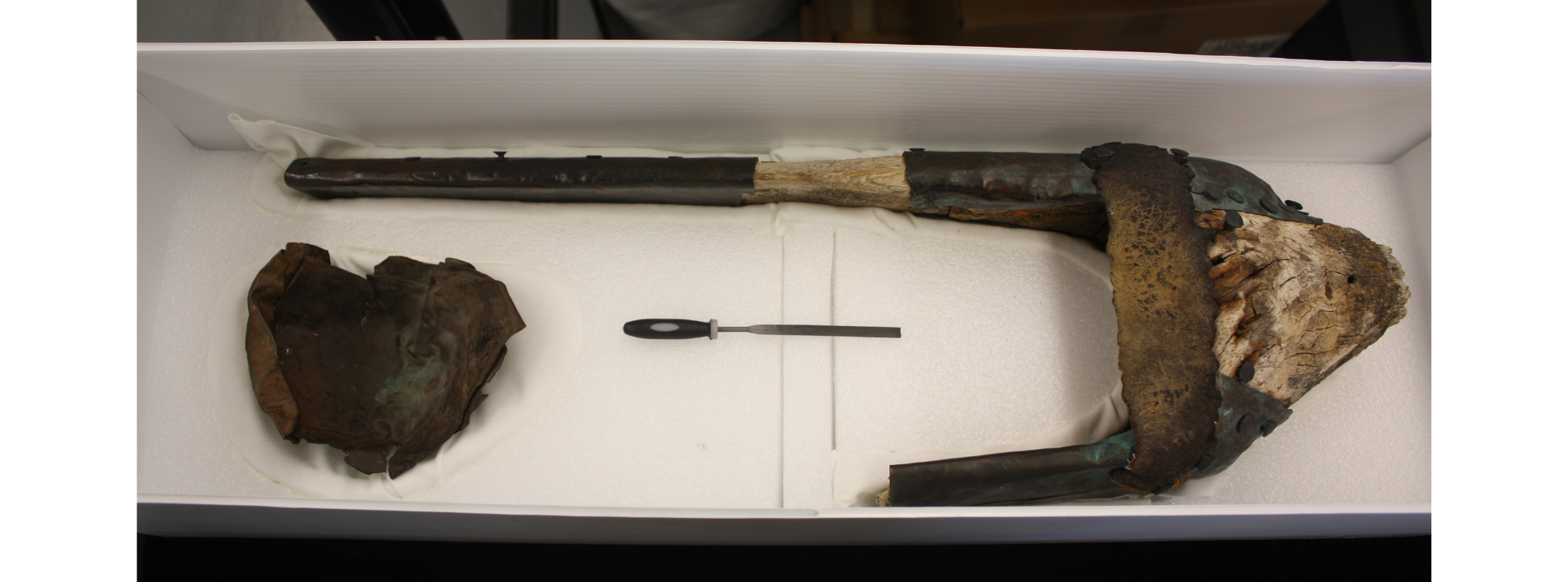
In the meantime, I try to maintain my focus on what this prosthetic leg meant for Tullauhiu. The loss of a limb would be a devastating experience, and within Inuit culture this was felt even deeper. One of my colleagues mentioned that a person with a severed limb was no longer considered whole. She sent me a chapter from her MA thesis which discussed this:

“A person with a severed limb or organ is considered of a lesser kind then other human beings. Only an angakkuq, a shaman, could survive a “disarticulation”.  In fact, going through such an experience was part of the shamanic rite of passage. Angakkut stood at the articulation of the terrestrial and cosmological worlds (Saladin d’Anglure 1983, 2006a; Trott 2006).” (Cloutier-Gelinas 2010:62).

Imagine then what the gift of a prosthetic leg would have meant for Tullauhiu!

After consulting with some folks, I decided that while I sort through the details of this mystery I’d leave something for Tullahuhiu to let him know I understand the importance of this artifact. Although food was suggested, I knew our conservators would not be pleased with me if I left some jerky in the storage areas. Instead I chose something else that could be of some use, a small iron file.

A rudimentary wooden prosthetic leg in an open collections storage box.

Image © Manitoba Museum

References:

Cloutier-Gelinas, M.

2010  Through Space, Time, and Otherness: A Spatial Analysis of 15th to 20th century Labrador Inuit Settlement Patterns.  Unpublished MA thesis, Memorial University, St. John’s, NL.

Saladin d’Anglure, B.

1983 Ijiqqat: voyage au pays de l’invisible inuit. Etudes/Inuit/Studies 7(1): 67-83.

2006a Reflexions anthropologiques a propos d’un 3e sexe social chez les Inuit.  Conjonctures, 41 (42): 177-205.

Trott, C.J.
2006 “The Gender of the Bear”. Etudes/Inuit/Studies 30(1): 89-110

Dr. Amelia Fay

Dr. Amelia Fay

Curator of Anthropology & the HBC Museum Collection

Amelia Fay is Curator of Anthropology and the HBC Museum Collection at the Manitoba Museum. She received her BA in Anthropology from the University of Manitoba (2004), an MA in Archaeology…
Meet Dr. Amelia Fay

Plants That Want to Kill Us

OK I’m exaggerating, plants don’t really want to kill us-they just don’t want us (or any other animal) to eat them. So plants have evolved ways to protect themselves-thorns, spines and prickles come to mind. But instead of physical armaments, many plants use chemical warfare to keep us pesky mammals away.

The native stinging nettle (Urtica dioica) plant possesses nasty little hairs on its leaves with a bulb of poison at the base. When an animal brushes up against the leaves, the hairs inject the poison, causing an itchy rash and discouraging the animal from eating it. Some people still eat stinging nettle though (I’ve eaten it myself in fact), because it is very nutritious: high in protein, iron, and vitamins A and C. But humans have weapons that other animals don’t: rubber gloves and fire! Stinging nettle MUST be cooked to neutralize the toxin (I’d hate to think of what would happen if you tried to eat it raw). Poison ivy (Toxicodendron radicans), another native plant, also produces a rash-inducing poison but it is on the surface of the leaf.

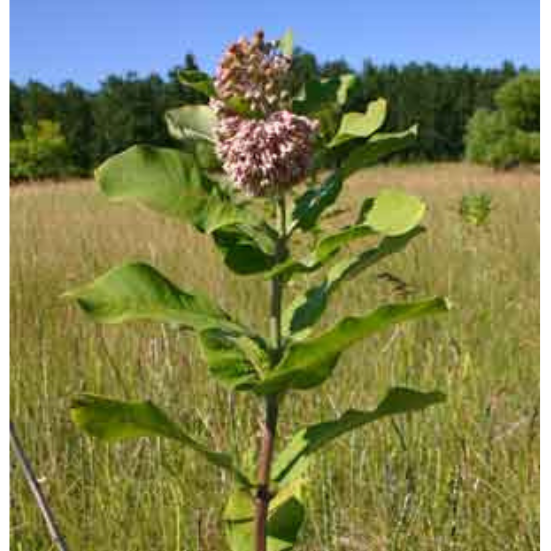
Many plant chemicals will not affect an animal unless they are ingested. Milkweeds (Asclepias spp.) contain cardiac glycosides that make them toxic to most animals. But one ingenious creature has found a way around that: Monarch (Danaus plexippus) caterpillars. Monarchs evolved a method to store those toxins in their bodies, making them poisonous to predators.

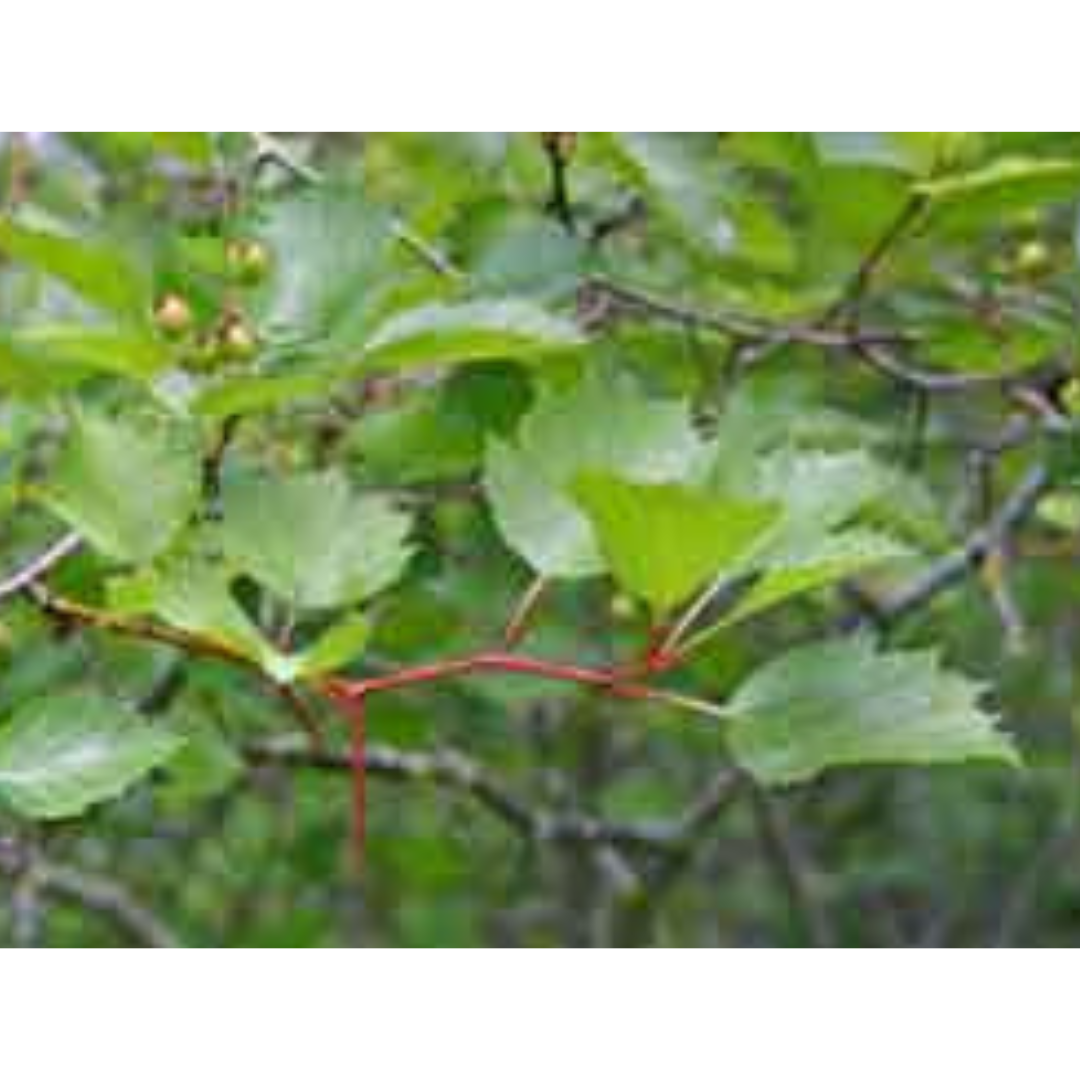
Close-up on a Hawthorn branch with spikey thorns along the branches.

The 5 cm thorns of Hawthorn (Crataegus chrysocarpa) effectively say “don’t touch me!”

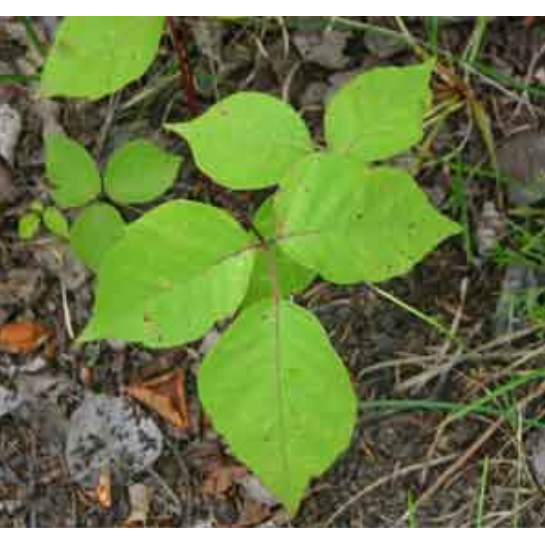
A photograph of the leaves of a poison ivy plant.

Remember the poison ivy (Toxicodendron rydbergii) identification rhyme to avoid this plant: “leaves of three let it be”.

A photograph of a showy milkweed plant in flower.

Showy milkweed (Asclepias speciosa): yucky to most, yummy to monarchs.

Even some of our common grocery store foods are poisonous. Take tapioca for instance. Many people find tapioca bland and boring. In reality the cassava plant that tapioca is made from, is actually pretty exciting. Cassava (Manihot esculenta) is the botanical equivalent of Japanese fugu, a poisonous fish that has to be prepared by expert sushi chefs to render it non-lethal. Cassava roots contain large quantities of cyanide-enough to make a human seriously ill or even kill you if you try to eat it raw (raw foodist-you have been warned). Cassava needs to be soaked, fermented, dried and/or cooked to get rid of the cyanide and make it edible.

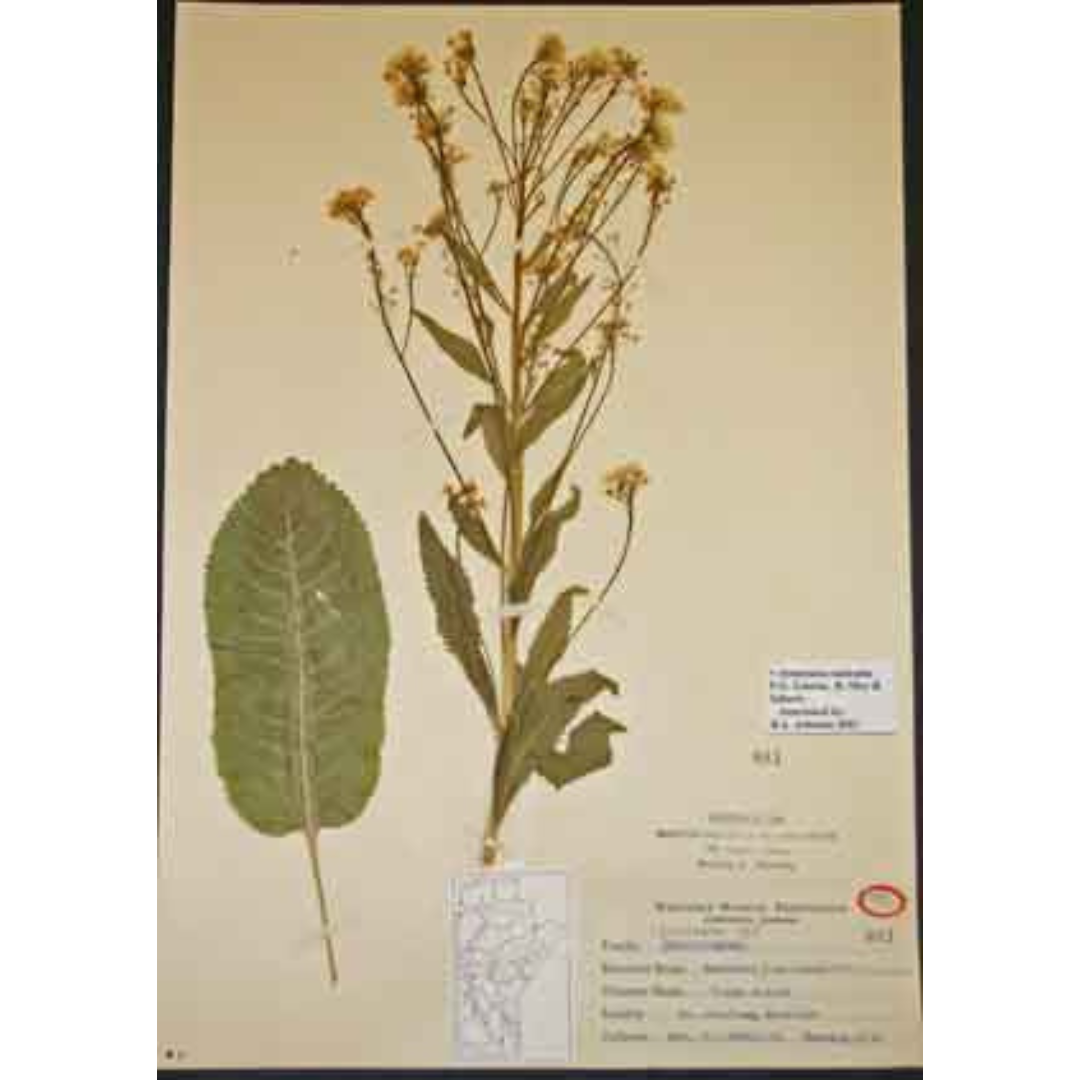
Ironically, some plants have become desirable to humans because of their poisonous nature. I remember the first time I ate wasabi-coated (Wasabia japonica) peas. The first few were fairly mild and tasty. Then I hit the wasabi motherlode-the pain in my sinus cavities was excruciating. But it didn’t last long; soon after I felt a pleasant, relaxing sensation which I learned later was my body releasing endorphins to counteract the pain. A similar effect (although not quite as painful) happens when you eat horseradish (Armoracia rusticana) or black mustard (Brassica niger) because these plants contain the same type of chemical, namely mustard oil glycosides. Hot peppers (Capsicum spp.), such as jalapenos, are also painful to eat because they contain the alkaloid capsaicin. Fortunately for these edible plants, our desire for them has helped them spread throughout the world, to regions they never would have gotten to without humanity’s help.


Image: An herbarium specimen of the popular condiment horseradish (Armoracia rusticana) from The Manitoba Museum (TMM 881).

Now pass the wasabi peas, please. Ouch, ahhhhh, that’s the stuff!

Dr. Diana Bizecki Robson

Dr. Diana Bizecki Robson

Curator of Botany

Dr. Bizecki Robson obtained a Master’s Degree in Plant Ecology at the University of Saskatchewan studying rare plants of the mixed grass prairies. After working as an environmental consultant and sessional lecturer…
Meet Dr. Bizecki Robson

U of W student Kristina Misurska

I’m sure I don’t have to tell anybody this, but this winter has been brutally cold—the coldest winter in 35 years! Every time it seems like we are finally going to get some warmer temperatures, we are plunged back into a deep freeze. Luckily, for most of us, we are able to put on layers of warm clothing to protect ourselves from the elements. Down-filled jackets and Gore-Tex might be considered, quite literally, lifesaving materials. However, even without these innovations, people have survived in North America for thousands of years. Have you ever stopped to think about the clothing people wore in the past to help them to survive such harsh winters?

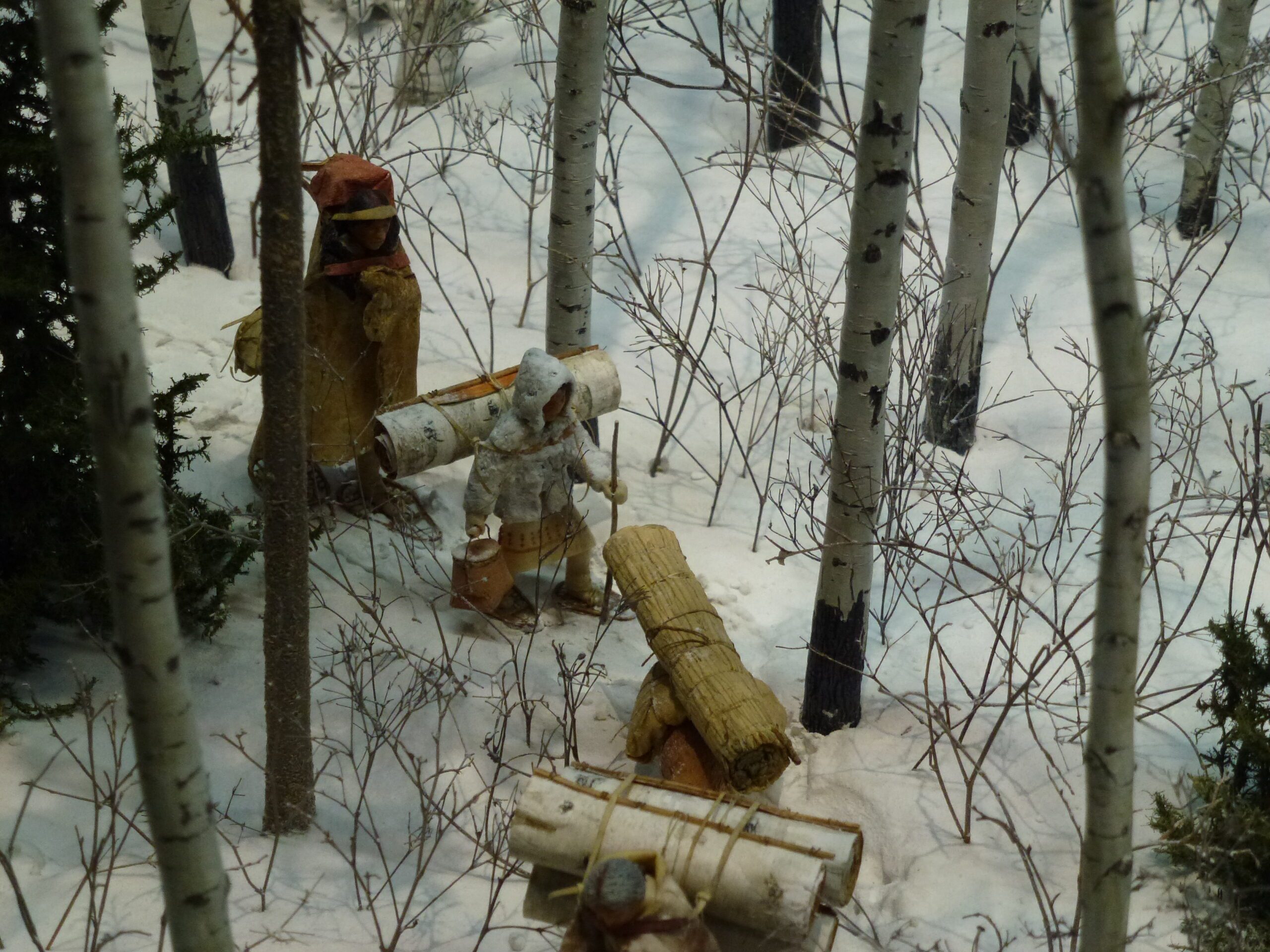
A child figure in a miniature diorama winter scene, wearing traditional winter gear of woven rabbit fur.

As we see in the Aschkibokahn mini-diorama, mobility was essential to survival for many First Peoples. The mini-diorama shows the seasonal movements of an Anishnaabe family. Their clothing had to offer protection against the elements, but also had to be easy to move around in. For much of the year, the clothing didn’t have to be exceptionally warm. A great deal of Anishnaabe clothing used tanned deer and moose hides. Hides were useful for clothing because the material is strong but pliable and resilient. As winter approached, people needed warmer clothing to help survive the elements.


Image: A child wearing woven rabbit skin parka in the Aschkibokahn mini-diorama.

For this purpose they made garments and sleeping bags out of thickly woven rabbit fur. It takes many rabbit hides, cut into thin strips to make these garments but they are very warm. If you take a look at the winter scene in the diorama, you can see that Betsy (the diorama artist) has outfitted some of the family in rabbit fur coats. Betsy’s attention to detail serves to help the visitor accurately imagine what life was like for this family. Further, it goes to show that the people who lived in the area made good use of the materials available to them in order to survive winters in a way. It is remarkable to think that people could not only survive, but thrive in this climate without any of our modern luxuries.

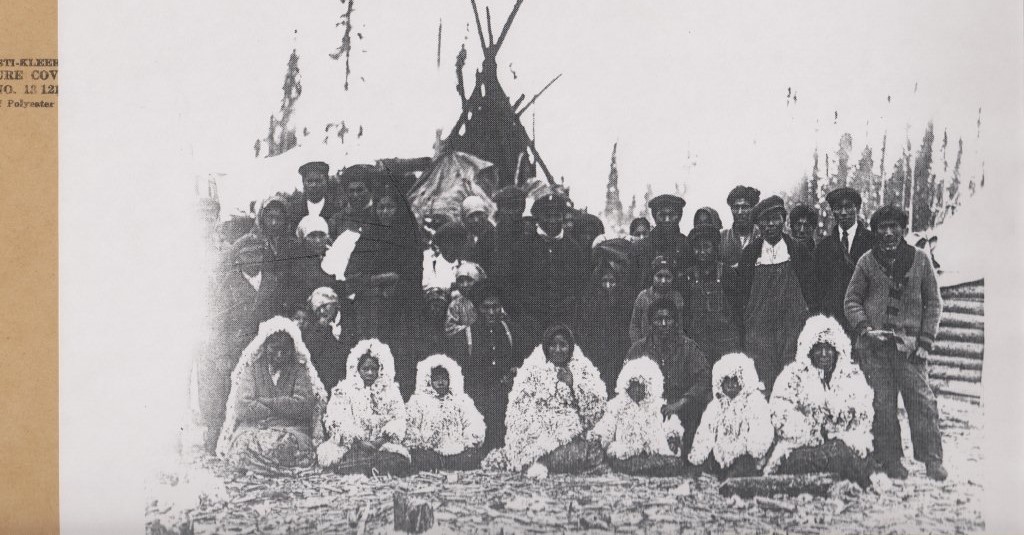
A historical black and white photograph showing a group of people, many wrapped in layers and furs, standing and sitting together for a photo in front of a tipi.

Deer Lake Group, [circa 1925]. Archives of Manitoba, Still Images Section. R. T. Chapin Collection. Negative 15148.


Speaking of harsh winters, ours is still not over yet. While you’re waiting for it to warm outside, why not come inside to the museum to check out the mini-diorama for yourself?