

Posted on: Wednesday December 31, 2025
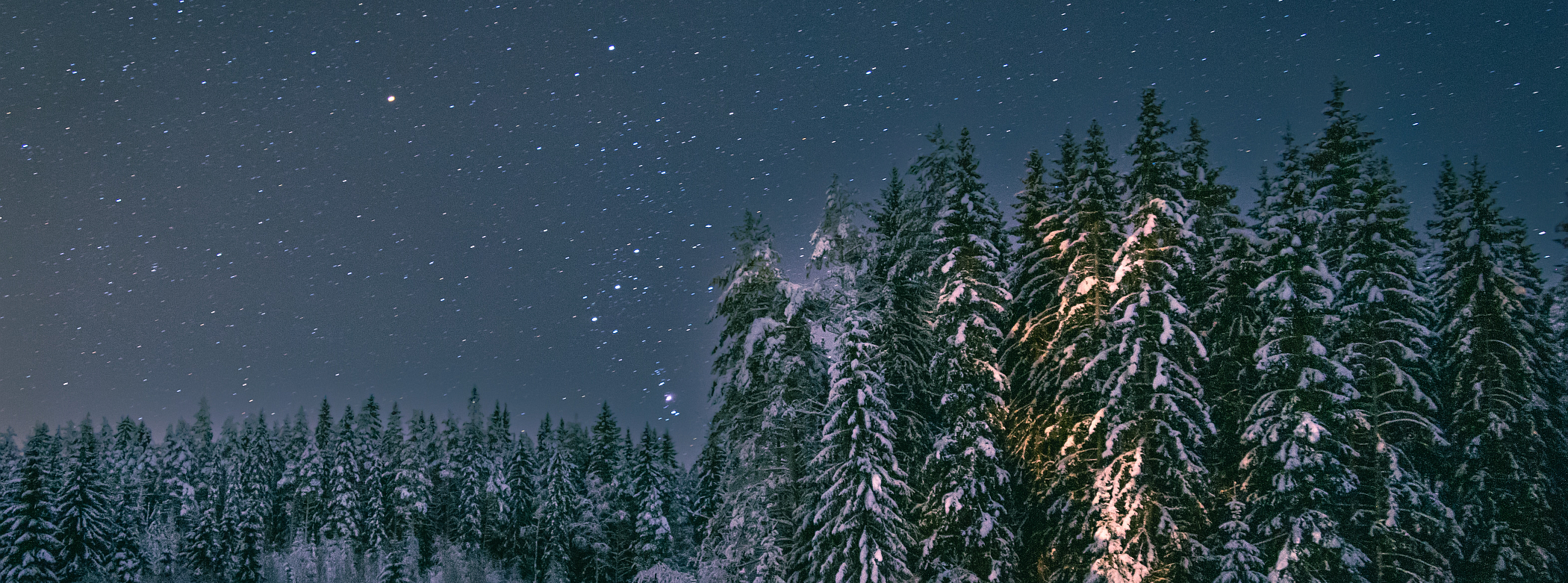
Manitoba’s January skies are usually cold if they are clear, and the long winter nights make stargazing easier. You don’t need to stay up late to spot Orion and his retinue of winter constellations rising in the east after dark, and the crisp winter air can provide remarkably clear views for users of telescopes and binoculars.
Although this article focuses on events visible in Manitoba, most events will also be visible across Canada and most places in the mid-northern hemisphere.
The Solar System for January 2026
Mercury is too close to the Sun to be easily seen from Manitoba this month, although more southerly viewers might catch it very low in the southeast just before sunrise during the first few days of the month. It reaches superior conjunction (in line with and just below the Sun) on January 21st, 2026.
Venus has disappeared into the sun’s glare as well, passing its superior conjunction on January 6th, 2026. It will reappear in the evening sky early in the spring of 2026.
Mars is still too close to the Sun to be visible this month. It passes behind the sun and reaches superior conjunction on January 9th, 2026.
Jupiter is the planetary highlight of the month. The giant planet is low in the east at sunset and is visible all night, rising high into the south and then lower into the northwest by sunrise. Jupiter reaches opposition on January 10th, the date when it is opposite the Sun in the sky. This is also when Jupiter appears near its brightest and largest as seen from Earth, so it’s a great time to break out the binoculars or telescope and take a look.
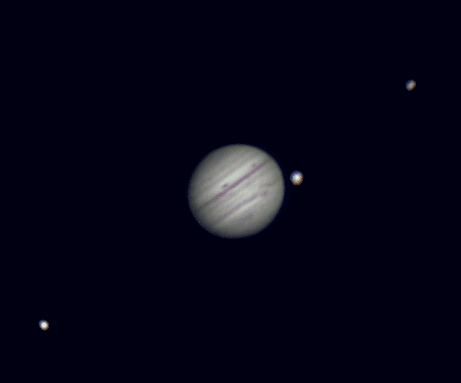
Even a small telescope will show Jupiter as a tiny planet with several tinier “stars” in a line near it – these are Jupiter’s largest moons. Up to four of them can be seen, depending on where they are in their orbit around the giant planet. Often these moons can be glimpsed in binoculars as well.
Saturn is in the south, a third of the way up the sky, as darkness falls. It sets before midnight in the southwest, so catch it early if you want to spot it. Saturn’s rings are nearly edge-on to our line of sight, making them nearly invisible in a telescope. The Moon is nearby on January 22nd and 23rd, 2026.
Uranus is in the evening sky a few degrees below the famous Pleaides star cluster (also known as the Seven Sisters). It is too faint to easily see without binoculars, and even a telescope shows it as a faint dot that looks just like the other faint stars. A detailed star-charting app like Stellarium or the charts in the Observer’s Handbook is required to track it down.
Neptune requires good binoculars or a small telescope to even spot, and a large telescope to make it out as anything more than a faint dot. It spends the month near Saturn, though, which makes it easier to track down than usual. As with Uranus, a detailed star chart like those in the Observer’s Handbook or produced software by Stellarium is required to tell which tiny “dot” is Neptune.
Of the five known dwarf planets, only (1) Ceres is close enough to be seen in binoculars or a small telescope. Ceres has faded below easy visibility in binoculars for the year, but will brighten again beginning in late 2026.
Planetary Spotlight: Jupiter
Jupiter is probably the best planet for amateur astronomers. Being the largest planet, we can see details in the cloud tops (Jupiter is a gas giant planet, and so the “surface” we see is actually the top of the atmosphere). Its four brightest moons are visible in any telescope, and even in binoculars if you can hold them steady enough (try bracing your arms against your body or the arms of a reclining lawn chair, or mount the binoculars on a tripod).
Seeing detail on Jupiter does require some practice, though. The first time you look at Jupiter up close, you’ll probably see a bright white “star” with a few fainter “stars” lined up with it. Don’t just take a quick peek and give up, though. Your eyes will see more if you keep looking. Eventually you’ll see that the bright “star” isn’t a point of light, but a tiny globe. You’ll start to notice some dark lines running across it – those are the big equatorial cloud bands that circle the planet.
The more often you look at Jupiter through a telescope, the more you will see. Our eyes aren’t very good at looking at tiny images through a small tube. It takes practice to train your eye and brain. The tenth night you look at Jupiter, you will see much more than you did on the first night. You can also put your camera at the eyepiece to snap a picture. It takes practice to make it work, but you can get great images through a telescope with just a cell phone or point-and-shoot camera.
Sky Calendar for January 2026
All times are given in Central Standard Time, the local time for Manitoba. However, most of these events are visible across Canada at the same local time without adjusting for time zones.
If there’s a little box to the left of the date, you can click on it to see a star map of that event! All images are created using Stellarium, the free planetarium software.
Friday, January 2nd, 2026: First Friday at the Manitoba Museum includes free telescope viewing this month (weather permitting). Telescopes will be set up outside the Planetarium dome from 6:30 p.m. to 9:00 p.m. for views of the Full Moon and the planets Jupiter and Saturn. Dress warmly!

Saturday, January 3rd, 2026: Full Moon, appearing near Jupiter in the sky. Since Jupiter is near opposition, and the Full Moon is basically what happens when the Moon reaches its own “opposition” (the point opposite the Sun in the sky), this make sense!
Saturday evening is also the peak of the annual Quadrantid meteor shower, but with the full moon and the timing this isn’t a great year for it. You might see a handful of meteors after sunset tonight, but the Moon will overwhelm most of them.
Tuesday, January 6th, 2026: Venus reaches superior conjunction, passing around the far side of the Sun as seen from Earth.
Friday, January 9th, 2026: Mars reaches superior conjunction, passing around the far side of the Sun as seen from Earth.
Saturday, January 10th, 2026: Jupiter reaches opposition, about 634 million kilometers away from Earth. Today is also the Last Quarter Moon.
Sunday, January 18th, 2026: New Moon
Wednesday, January 21st, 2026: The planet Mercury reaches superior conjunction, passing around the far side of the Sun. If this text sounds familiar, it’s because it is the third planet to pass superior conjunction this month – nothing more than a coincidence of cycles that have been going on for billions of years.
 Thursday, January 22nd, 2026: The Moon is to the right of Saturn tonight in the early evening sky.
 Friday, January 23rd, 2026: The Moon is to the left of Saturn tonight in the early evening sky.
 Tuesday, January 27th, 2026: The Moon is beside the Pleaides star cluster this evening. It is closest at dusk, but the Moon’s orbital motion moves it farther away from the star cluster even as the Earth’s rotation carries them both higher into the sky. (The accompanying chart shows the view at 6 p.m., Central time; the Moon will move farther to the left about its own diameter every hour relative to the background stars.)
Wednesday, January 28th, 2026: Mercury and Venus pass close to each other, but this occurs far too close to the Sun to be visible.
Saturday, December 27th, 2025: First Quarter Moon
Other Celestial Sights
Outside of the events listed above, there are other things we see in the sky that can’t always be predicted in advance.
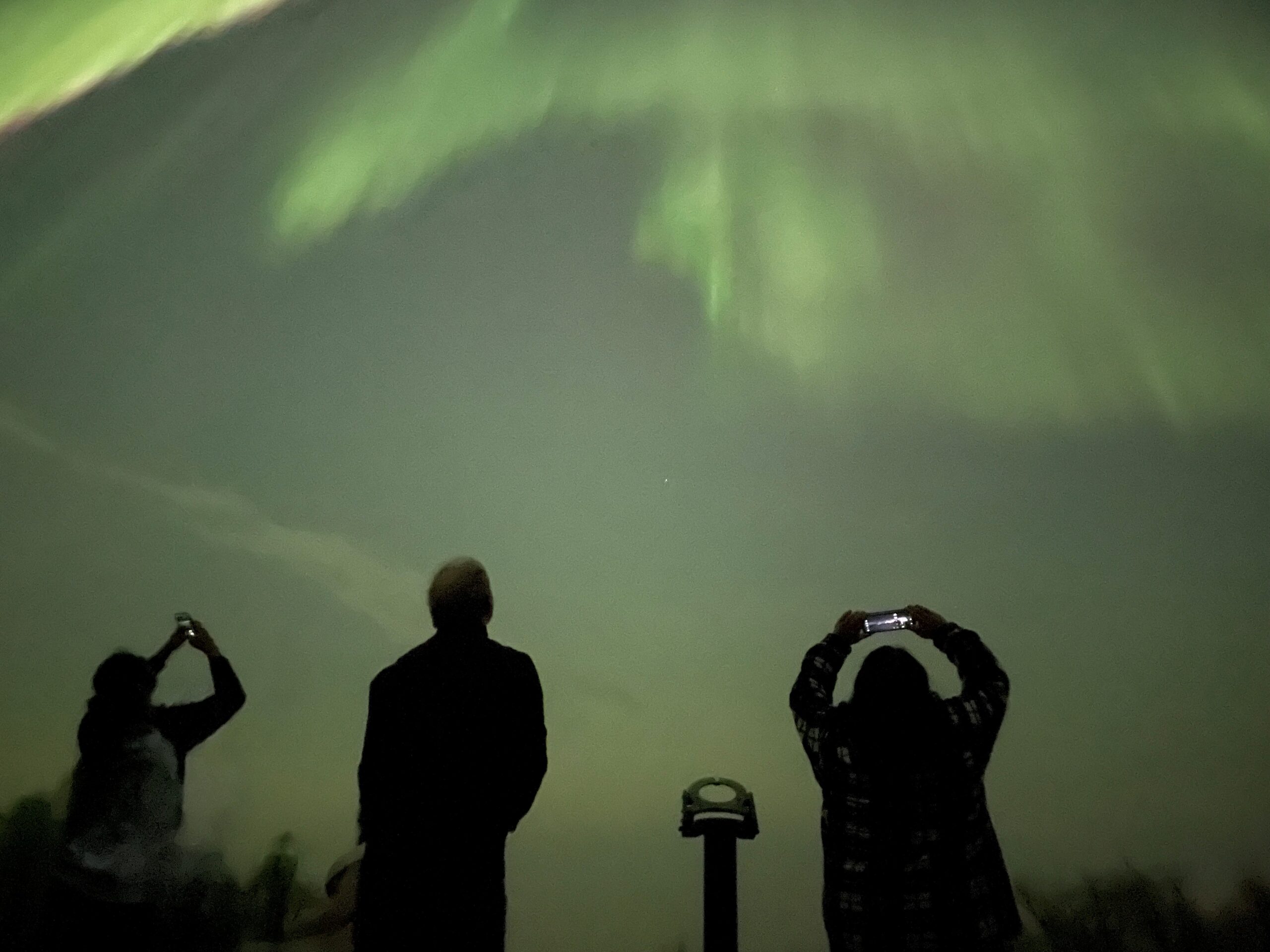
Aurora borealis, the northern lights, are becoming a more common sight again as the Sun goes through the maximum of its 11-year cycle of activity. Particles from the Sun interact with the Earth’s magnetic field and the high upper atmosphere to create glowing curtains of light around the north (and south) magnetic poles of the planet. Manitoba is well-positioned relative to the north magnetic pole to see these displays often, but they still can’t be forecast very far in advance. A site like Space Weather can provide updates on solar activity and aurora forecasts for the next 48 hours. The best way to see the aurora is to spend a lot of time out under the stars, so that you are there when they occur.
Random meteors (also known as falling or shooting stars) occur every clear night at the rate of about 5-10 per hour. Most people don’t see them because of light pollution from cities, or because they don’t watch the sky uninterrupted for an hour straight. They happen so quickly that a single glance down at your phone or exposure to light can make you miss one.
Satellites are becoming extremely common sights in the hours after sunset and before dawn. Appearing as a moving star that takes a few minutes to cross the sky, they appear seemingly out of nowhere. These range from the International Space Station and Chinese space station Tianhe, which have people living on them full-time, to remote sensing and spy satellites, to burnt-out rocket parts and dead satellites. The most common sightings are Starlink satellites, which are being launched dozens at a time to bring internet to remote regions, but which cause trouble with astronomy and pollution. These can be predicted in advance (or identified after the fact) using a site like Heavens Above by selecting your location.