

What is a meteor shower?
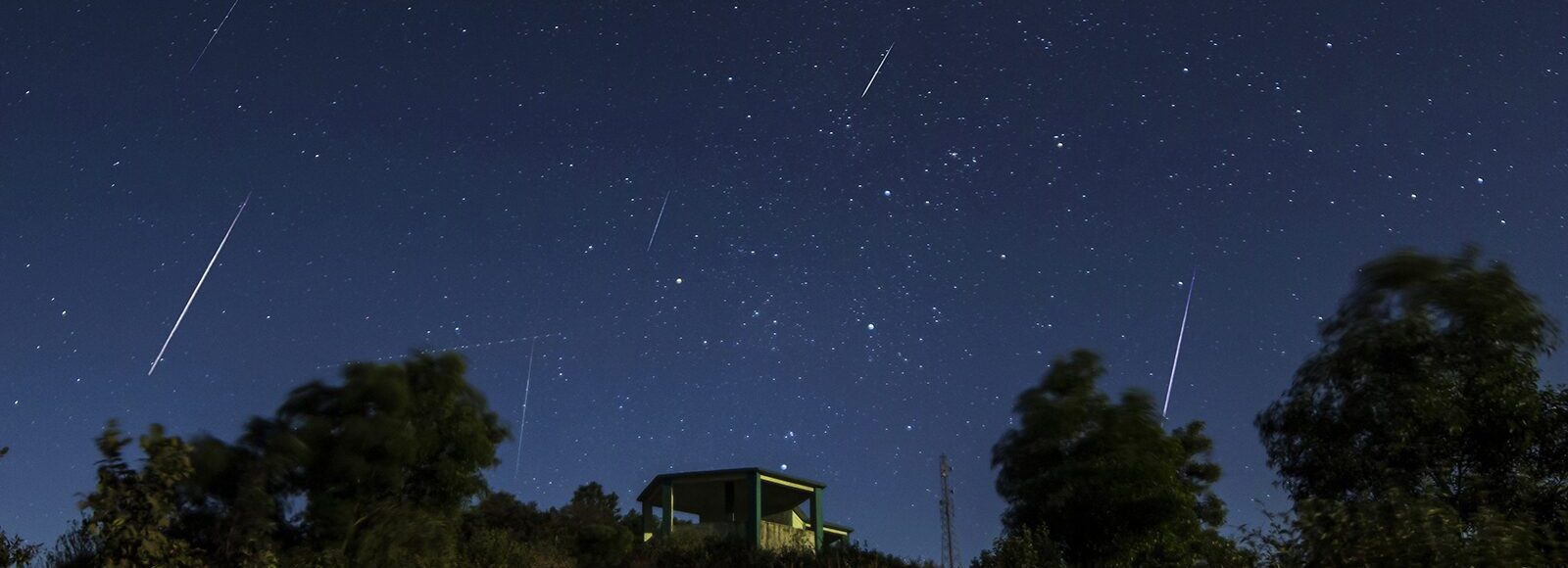
Well, first, a meteor is a flash of light we see in the sky, often called a “shooting star” or “falling star”. They’re not stars at all, though – they are tiny pieces of space dust crashing into the Earth as it orbits the Sun. When the dust (called a “meteoroid” when it’s still out in space) hits the Earth’s atmosphere, friction causes the dust to burn up and create a tunnel of glowing air as it travels.
There’s dust scattered throughout space, left over from the formation of the solar system, and so on any given night you might see a meteor or three. If you were in perfectly dark skies and watched the entire sky for an entire hour, you might see a half-dozen meteors an hour on any given night.
But just like dust in your house, there are places in space where there is more dust than average. One of those places is in the orbit of a comet. A comet is a small body made of dust and ice that orbits the Sun. If a comet’s orbit brings it close enough to the Sun, it starts to melt and the dust forms a long tail behind it. This dust fades away fairly quickly, but it’s still out there in the comet’s orbital path. If that orbital path comes close to the Earth’s orbit, we can run through a big clump of comet dust on the same night each year. That’s a meteor shower.
What are the Geminids?
The Geminid meteor shower is an annual event that peaks around December 13-14 each year. It’s an unusual meteor shower, in that it’s not in the orbit of a comet, but of an asteroid: asteroid (3200) Phaethon. (Maybe Phaethon used to be a comet but the ice has all melted, so it’s just dust. We’re not sure.)
Phaethon has an unusual orbit that takes it very close to the Sun, closer then Mercury, before looping out to the main asteroid belt between Mars and Jupiter. Phaethon’s orbit also comes in at a steep angle compared to the rest of the planets, which is one of the reasons the Geminids are a great meteor shower (more on this later).
On an average year, you can expect to see a meteor a minute or so in the couple of hours between 11 pm and 1 am local time. That’s pretty good – most “meteor showers” are really more of a trickle, with only a dozen or so meteors per *hour*. So, one a minute is a “shower”, relatively speaking. And, almost alone among meteor showers, the peak of activity occurs in the middle of the night, around local midnight, when the constellation Gemini is high in the sky. This is because of the high angle that the meteor orbits make with the plane of the Earth’s orbit. Most meteor showers don’t peak until just before dawn, so they are much less convenient to watch.
How do I see the Geminids in 2025?
Meteor observing involves a lot of laying around and just looking at the sky. You don’t need (or want!) a telescope for this – meteors can happen anywhere in the sky, so you need the wide field of view that your unaided eyes provide. Your most useful piece of equipment is a reclining lawn chair so you can lay back and not be on the cold ground. A blanket or three and a thermos of a warm beverage is also a good addition.
The most important thing is to travel to a location where there are no competing lights, and to keep your eyes dark-adapted. Pick a spot in advance: a park, a parking lot, or some other place where you’re not on private property. (DO NOT just pull over to the side of the highway – not only will passing headlights ruin your night vision, but wandering around in the dark near the road is dangerous.)
Once you find a dark spot, you need to keep it dark. That means to turn off your car. This is especially important in a place where other observers have gathered, since your headlights will ruin everyone else’s view if you leave them on. And, put your phone away. Our eyes take a good five or more minutes to get fully dark-adapted, but as soon as you see a bright-ish light, they immediately flip to “day” mode and you need to re-adapt all over again. Every time a phone turns on in your field of view, even just for a second, you will miss about 10%-15% of the meteors that hour. Don’t drive out of town in the cold and then waste your time doomscrolling instead of watching the sky!
When is the best time to look?
The Geminids slowly ramp up through December to their peak on the 13th-14th, and then decline over the next week or so. Best views will be between about 11pm and 2am on the night of Saturday, December 13th, 2025 and into the morning of Sunday, December 14th, 2025. During peak times, the rate from a really dark sky could be as high as 120 or more an hour – that’s an average of two every minute! Earlier in the evening and after the peak, rates will be about half that number. The night before and the night after will still have reasonable activity, perhaps 1/3 to 1/2 the numbers seen at the peak (so, 40-60 per hour). Before and after that, the rates decline sharply. So, we really want clear skies from December 12-15 this year!
(I guess that should be made clear: if it’s cloudy, you won’t see any, since meteors all burn up much higher in the atmosphere than the clouds.)
Remember, any lights you can see will turn off your eyes’ night mode. So, turn off your car headlights or cover them with a blanket. Keep your phone hidden so you don’t lose your darkvision every time a notification comes in. Dress warmly – a clear December night in Manitoba is going to be frigid! Make sure you are in a place where you are secure. Make sure your vehicle is up to winter driving, and that someone knows where you are if your car doesn’t start. (Don’t depend on a cell phone to call for help – cell service tends to fade in remote areas, and batteries die quickly in the cold.)
The Geminids are a great skywatching event – a relaxed event, no specialized equipment required, and you get to sit and watch the stars while waiting for the next meteor. You can even count meteors for science to help astronomers understand the swarm of particles from this unusual asteroid.
If the weather is clear, we will be attempting a live-stream of the Geminid meteor shower on Saturday night. Follow the Manitoba Museum on Facebook or YouTube to watch – if you “like” or “subscribe” you’ll get a notification when the stream goes live.
Clear Skies!