


Posted on: Friday May 1, 2026
April’s showers bring May flowers, so the saying goes… but here in Treaty One territory in Winnipeg, my flowers have not enjoyed the repeated freeze-thaw cycles of the past several weeks. Hopefully we will return to seasonal temperatures and clearer skies for this month’s celestial line-up.
May’s skies seem to go by so quickly. With the combination of later sunsets and Daylight Savings Time, the sky doesn’t get dark until quite a bit later, and by then the last of the winter constellations have dropped into the west. Even the spring constellations are best seen right after sunset before they also begin to fade away.
However, May is a great time to spot the famous Big Dipper, which is right overhead as darkness falls and moves towards the west throughout the night. It is close enough to the celestial north pole that it never quite sets, but at other times of the year it is much lower or skims the northern horizon.
The seven stars of the Big Dipper are bright enough to spot even under city lights. The second star of the handle, where the handle bends, is actually two stars very close together, and is a test of your eyesight. Those with excellent eyesight can spot the two stars without aid, but for the rest of us, binoculars will do the job easily.
Event of the Month: Venus, Jupiter and the Moon dance in the west
The best event to focus on this month is NOT the Eta Aquariid meteor shower, which you will no doubt hear all about on social media. It’s covered below in the Sky Calendar section, but it’s best seen in the southern hemisphere, and this plus the bright moon during its peak mean that we will see less than 10 meteors per hour at best.
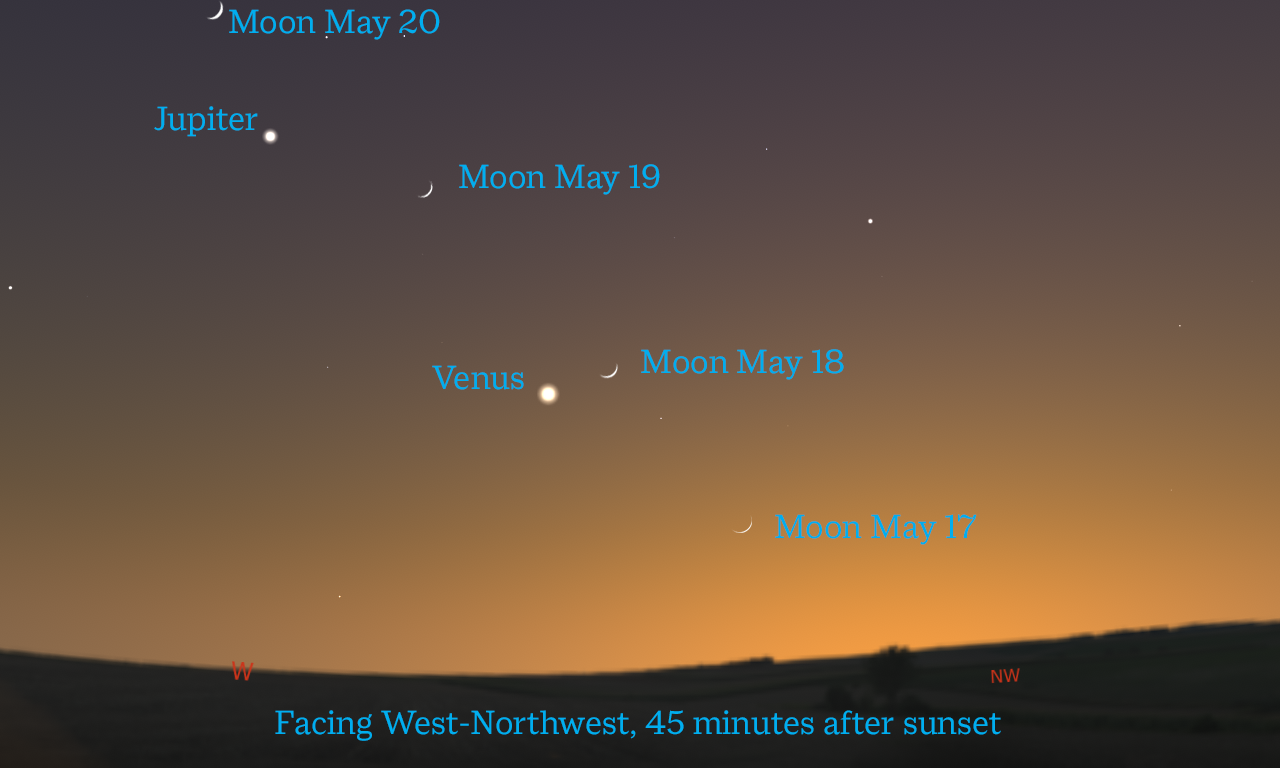
This month, the slow dance of the three brightest objects in the night sky this month. In order of brightness, they are the Moon, Venus, and Jupiter. Go out any night this month after sunset and you’ll spot Venus low in the west, and Jupiter higher in the southwest. Throughout May, Jupiter will sink lower each night, approaching Venus (they’ll reach their closest conjunction in mid-June).
On May 17th, the thin crescent Moon will appear in the evening sky, low in the west after sunset. It will set soon after the Sun, so you’ll need to be out early to catch it, and need a horizon clear of not only clouds but also trees or buildings. On the 18th, the crescent Moon will be higher and sit next to Venus, a striking sight visible after sunset. The following night, on May 19th, the Moon will have moved to a position closer to Jupiter – the result of its orbital motion around our planet. By the evening of May 20th the Moon will have risen above Jupiter. On the 21st, the moon will be farther from Jupiter and closer to a quarter moon, forming a wide line with the other two objects.
Any of these nights will be a great photo opportunity. A phone camera will probably do a decent job with the automatic settings, but if you spend a few minutes to learn how to manually focus and adjust the exposure time you will get better results. A point-and-shoot digital camera or DSLR will provide better results, and any camera will work better if you can mount it on a tripod and adjust the ISO sensitivity and exposure settings. Try setting the ISO to a medium-high number, and then taking exposures from 1/4 second up to a few seconds, and see what works best.
The Solar System for May 2026
Mercury passes behind the Sun on May 14, 2026, and so is invisible until late in the month, when it rockets out of the twilight to join Mercury low in the west after sunset. Much fainter than either Venus or Jupiter, you can find it during the last week of the month if you have *very* clear skies by drawing a line from Jupiter through Venus until it intersects the horizon. Then, sweep with your binoculars above that point beginning 30 minutes after sunset.
Venus dominates the evening sky, shining low in the west after sunset and setting about three hours later. Venus is the brightest “star” and the first star you should be able to see after sunset.
Mars rises before the sun but remains too low to be visible in the growing light of dawn.
Jupiter is is in the west after dark, and sets around midnight – but don’t let that fool you into thinking you have long to catch it. With the late sunset, by the end of the month Jupiter is already sinking low as darkness falls. Any telescope views will need to be early in the month to be able to see it before it sinks into the murky air near the horizon.
Saturn, like Mars, rises before dawn but hugs the horizon and is too low to spot easily this month.
Uranus has disappeared into the evening twilight. This is due mostly to our own planet’s motion around the Sun, which (from Uranus) would appear to be passing behind the Sun.
Neptune is invisible this month, close to Mars and Saturn in the morning sky.
Of the five known dwarf planets, only (1) Ceres is close enough to be seen in binoculars or a small telescope. It is too close to the Sun to be seen this month.
Sky Calendar for May 2026
All times are given in Central Daylight Time, the local time for Manitoba. However, most of these events are visible across Canada at the same local time without adjusting for time zones.
If there’s a little box to the left of the date, you can click on it to see a star map of that event! All images are created using Stellarium, the free planetarium software.
Friday, May 1, 2026: Full Moon
Tuesday, May 5 – Wednesday, May 6, 2026 (early morning sky): The Eta Aquariid meteor shower peaks just before dawn Wednesday morning. Usually a reasonable meteor shower, this year the bright gibbous Moon is up during the peak times. This extra light in the sky will block out most meteors in much the same way as city lights. Observers in the northern hemisphere can expect only a handful of meteors per hour during the peak viewing hours of 2:00 am through dawn local time.
Saturday, May 9, 2026: Last Quarter Moon
Saturday, May 16, 2026: New Moon
Sunday, May 17, 2026 (evening sky): The thin crescent Moon reappears in the evening sky, below and to the right of Venus. Jupiter stands higher in the southwest. This marks the starts of this month’s “Event of the Month” (see above).
Monday, May 18, 2026 (evening sky): The crescent Moon is beside brilliant Venus in the evening sky after sunset. Jupiter stands higher in the southwest. (See “Event of the Month”, above.)
Tuesday, May 19, 2026 (evening sky): The crescent Moon is between Jupiter (to the left) and Venus (to its lower right). (See “Event of the Month”, above.)
Wednesday, May 20, 2026 (evening sky): The crescent Moon has moved to the upper left of Jupiter, with Venus still much lower. The three form a slightly bent line in the evening sky after sunset. (See “Event of the Month”, above.)
Thursday, May 21, 2026 (evening sky): Venus, Jupiter, and the Moon are almost equally-spaced across the western sky after sunset.
Saturday, May 23, 2026: First Quarter Moon
Sunday, May 31, 2026: Full Moon
Other Celestial Sights
Outside of the events listed above, there are other things we see in the sky that can’t always be predicted in advance.
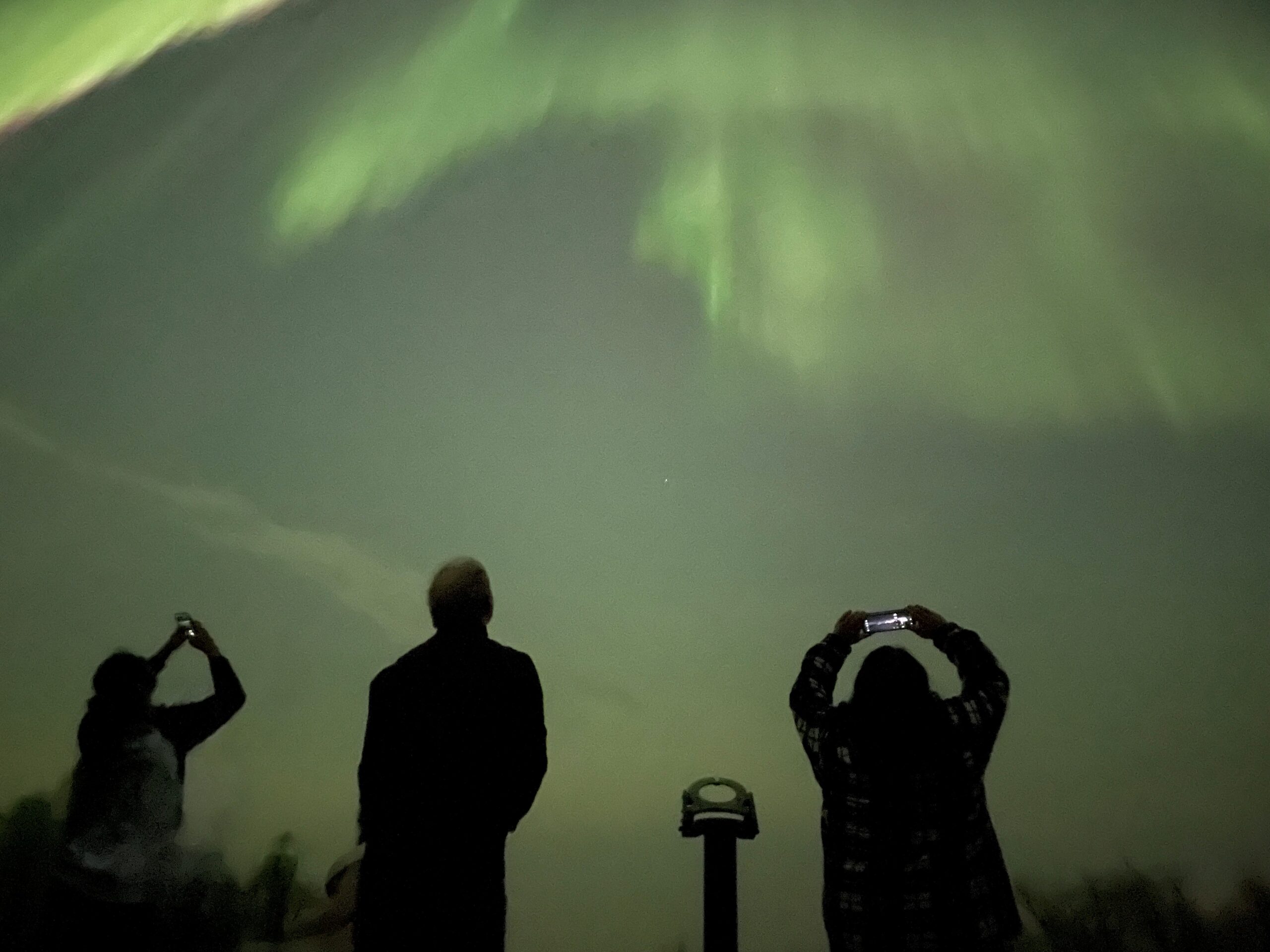
Aurora borealis, the northern lights, are becoming a more common sight again as the Sun goes through the maximum of its 11-year cycle of activity. Particles from the Sun interact with the Earth’s magnetic field and the high upper atmosphere to create glowing curtains of light around the north (and south) magnetic poles of the planet. Manitoba is well-positioned relative to the north magnetic pole to see these displays often, but they still can’t be forecast very far in advance. A site like Space Weather can provide updates on solar activity and aurora forecasts for the next 48 hours. The best way to see the aurora is to spend a lot of time out under the stars, so that you are there when they occur.
Random meteors (also known as falling or shooting stars) occur every clear night at the rate of about 5-10 per hour. Most people don’t see them because of light pollution from cities, or because they don’t watch the sky uninterrupted for an hour straight. They happen so quickly that a single glance down at your phone or exposure to light can make you miss one.
Satellites are becoming extremely common sights in the hours after sunset and before dawn. Appearing as a moving star that takes a few minutes to cross the sky, they appear seemingly out of nowhere. These range from the International Space Station and Chinese space station Tianhe, which have people living on them full-time, to remote sensing and spy satellites, to burnt-out rocket parts and dead satellites. The most common sightings are Starlink satellites, which are being launched dozens at a time to bring internet to remote regions, but which cause trouble with astronomy and pollution. These can be predicted in advance (or identified after the fact) using a site like Heavens Above by selecting your location.