



Posted on: Wednesday February 4, 2026
February skies give us a combination of the winter stars with hopefully less-frigid temperatures than last month, although warmer temps can also bring clouds. Take your clear nights when you can this month to catch some of the celestial sights on offer.
Although this article focuses on events visible in Manitoba, most events will also be visible across Canada and most places in the mid-northern hemisphere.
The Solar System for February 2026
Mercury becomes visible around midmonth in the west-southwest after sunset. Start looking about 30 minutes after sunset low on the horizon – you might need binoculars to spot it before about the 10th. Mercury rises higher above the horizon each night, but also gets fainter which will make it harder to spot. Probably the best date and time to catch it will be the evening of February 18th, when the thin crescent Moon passes just below it (see Sky Calendar entry below).
Venus reappears in the evening sky this month, very low in the west-southwest after sunset. You’ll need a clear horizon, since it remains quite low and sets about an hour after the Sun. Venus will remain in the evening sky for the next several months.
Mars is still too close to the Sun to be visible this month. It passes behind the sun and reaches superior conjunction on January 9th, 2026.
Jupiter is still dominating the evening sky, sitting high in the east-southeast as darkness falls and moving across the southern sky throughout the night. Jupiter is just past its January 10th opposition, when Jupiter appears near its brightest and largest as seen from Earth. It’s a great time to look at the planet in binoculars (to see the four largest moons) or a telescope. See our feature article on Jupiter in last month’s blog.
Saturn is fading into the evening twilight, low in the southwest as darkness falls and setting in mid-evening. Good telescope views are done for the year; Saturn’s main interest this month is its grouping with Neptune and the Moon on February 19th (see Sky Calendar entry below). Saturn will return to the morning sky in mid-2026 for its next apparition.
Uranus is in the evening sky a few degrees below the famous Pleaides star cluster (also known as the Seven Sisters). It is too faint to easily see without binoculars, and even a telescope shows it as a faint dot that looks just like the other faint stars. A detailed star-charting app like Stellarium or the charts in the Observer’s Handbook is required to track it down.
Neptune requires good binoculars or a small telescope to even spot, and a large telescope to make it out as anything more than a faint dot. It spends the month near Saturn, though, which makes it easier to track down than usual. As with Uranus, a detailed star chart like those in the Observer’s Handbook or produced software by Stellarium is required to tell which tiny “dot” is Neptune.
Of the five known dwarf planets, only (1) Ceres is close enough to be seen in binoculars or a small telescope. Ceres has faded below easy visibility in binoculars for the year, but will brighten again beginning in late 2026.
Sky Calendar for February 2026
All times are given in Central Standard Time, the local time for Manitoba. However, most of these events are visible across Canada at the same local time without adjusting for time zones.
If there’s a little box to the left of the date, you can click on it to see a star map of that event! All images are created using Stellarium, the free planetarium software.
Sunday, Feb. 1, 2026: Full Moon
Monday, Feb. 9, 2026: Last Quarter Moon
 Monday, Feb. 16, 2026: Neptune is less than 1 degree from Saturn, low in the western sky after sunset. The accompanying image shows the view through typical household binoculars. It’s pretty much this close all month, since Saturn moves very slowly and Neptune hardly at all over such small timescales.
Tuesday, Feb. 17, 2026: New Moon. There is an annular (ring) solar eclipse at this time, but it is only visible in the extreme southern hemisphere.


Wednesday, Feb. 18, 2026: The Moon eclipses Mercury during the day (not visible from Canada) and is still nearby after sunset.
 Monday, Feb. 23, 2026: The Moon is just above the Pleiades star cluster tonight. The accompanying image shows the view through typical household binoculars at 10:30 p.m. Central Time.
“Planetary Parade” begins – look for Venus, Mercury, and Saturn low in the west after sunset. Jupiter is on the other side of the sky.

Tuesday, Feb. 24, 2026: First Quarter Moon. Also the best night for Venus, Mercury/Saturn grouping in western evening sky. Be outside with a clear western horizon by 6:30 p.m. local time. From this date on, Venus gets higher and easier to see, while Mercury gets lower and harder to see.
 Wednesday, Feb. 25, 2026 (evening sky): Venus, Mercury, and Saturn are together in the western sky after sunset.
 Thursday, Feb. 26, 2026 (evening sky): Venus, Mercury, and Saturn are together in the western sky after sunset. Tonight is also the monthly Dome@Home online planetarium show, where you can discover what’s up in the sky on the Museum’s Facebook page and YouTube channel.
 Thursday, Feb. 26, 2026: Meanwhile, at the other end of the “parade”, the Moon is near Jupiter in the evening sky.
 Friday, Feb. 27, 2026 (evening sky): Venus, Mercury, and Saturn are together in the western sky after sunset.
 Saturday, Feb. 28, 2026 (evening sky): Venus, Mercury, and Saturn are together in the western sky after sunset. Probably your last chance to see Mercury before it fades into the evening twilight.
Monday evening, March 2 to Tuesday morning, March 3: There’s a total lunar eclipse visible from Winnipeg! Keep your eye open for the March 2026 Sky Calendar which will have full details.
Other Celestial Sights
Outside of the events listed above, there are other things we see in the sky that can’t always be predicted in advance.
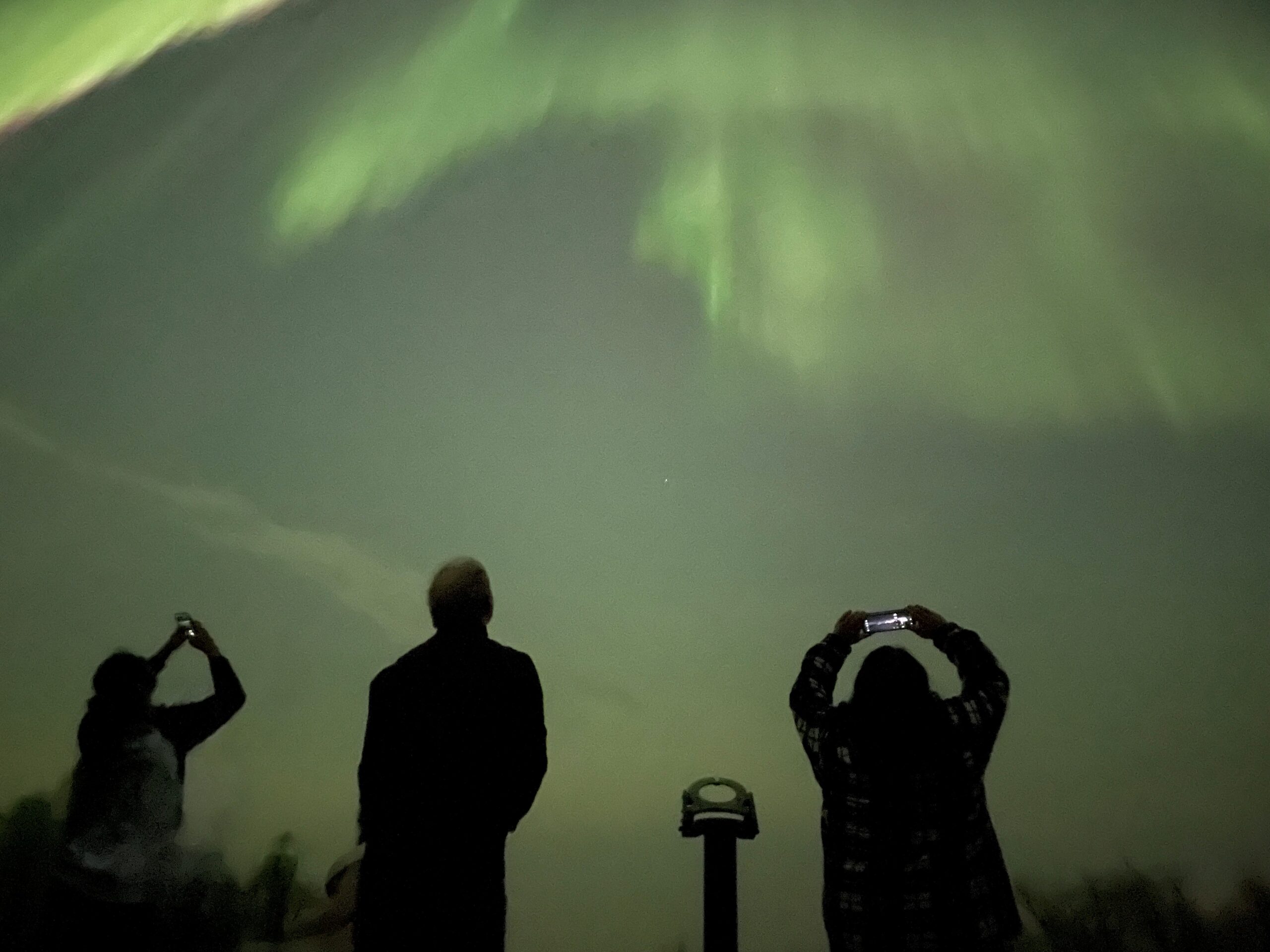
Aurora borealis, the northern lights, are becoming a more common sight again as the Sun goes through the maximum of its 11-year cycle of activity. Particles from the Sun interact with the Earth’s magnetic field and the high upper atmosphere to create glowing curtains of light around the north (and south) magnetic poles of the planet. Manitoba is well-positioned relative to the north magnetic pole to see these displays often, but they still can’t be forecast very far in advance. A site like Space Weather can provide updates on solar activity and aurora forecasts for the next 48 hours. The best way to see the aurora is to spend a lot of time out under the stars, so that you are there when they occur.
Random meteors (also known as falling or shooting stars) occur every clear night at the rate of about 5-10 per hour. Most people don’t see them because of light pollution from cities, or because they don’t watch the sky uninterrupted for an hour straight. They happen so quickly that a single glance down at your phone or exposure to light can make you miss one.
Satellites are becoming extremely common sights in the hours after sunset and before dawn. Appearing as a moving star that takes a few minutes to cross the sky, they appear seemingly out of nowhere. These range from the International Space Station and Chinese space station Tianhe, which have people living on them full-time, to remote sensing and spy satellites, to burnt-out rocket parts and dead satellites. The most common sightings are Starlink satellites, which are being launched dozens at a time to bring internet to remote regions, but which cause trouble with astronomy and pollution. These can be predicted in advance (or identified after the fact) using a site like Heavens Above by selecting your location.