


Capturing a Celestial Dance

Capturing a Celestial Dance

Jupiter and Venus have been engaged in a beautiful dance in the western sky after sunset. With the warm weather, I’ve been running outside in shirtsleeves every few minutes, waiting for the light levels to be at their best for viewing. A little point-and-shoot camera on a tripod is all you need to capture this dramatic dance of the planets.

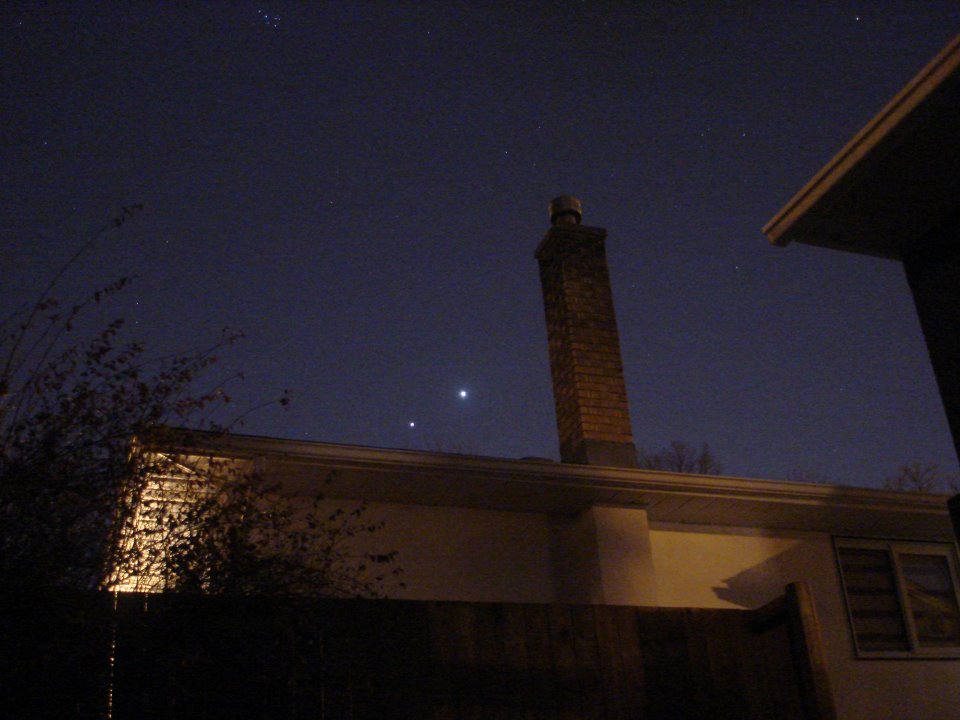
Two bright lights in the night sky over a rooftop.

Right now, Venus is rising higher and higher each night, while Jupiter is sinking lower into the sunset colours. Still, they’ll be together in the field of view of any camera for a couple of weeks. Set your camera for “twilight portrait” or the closest thing – usually it’s a little moon symbol on the dial – and put it onto a tripod. The tripod is important because the exposure is going to be a second or more long, and you just can’t hold the camera steady enough during that time. If you don’t have a tripod, I have just set it on the ground with a rock under the front to tilt it up towards the correct angle.

Try and put something in the foreground if you have a choice – trees, houses, or whatever provide context and add the third planet into your picture – the planet Earth, our viewing point for the cosmic ballet occurring overhead.


Image: Venus (right) and Jupiter (left) shine just above the artifical horizon of my neighbour’s roof, 12 March 2012. (Image: Scott Young)

If you aren’t happy with the picture your semi-intelligent camera computer comes up with, you can fall back on an old technique from the film days: bracketing. Set the camera for “manual” mode, and start with a 1 second exposure time. Then takes several shots with exposure times on either side of that, both higher and lower. Basically, shoot one image at each setting on the dial or each click of the button. You’ll get a whole range of pictures with different colour, depths, contrast, and definition. In the days of film, this was essential since you couldn’t see your results until after you had developed the film… sometimes a whole night’s work would come back out of focus or underexposed due to an error that went uncorrected under the sky. Nowadays, bracketing is just a way to explore the full depth of the scene before you, and reveal views very different from what your eyes see. Your images won’t replace the view of seeing it live, but they will remind you of your observation, and give you another perspective from which to contemplate the dance of the solar system.

Scott Young

Scott Young

Planetarium Astronomer

Scott is the Planetarium Astronomer at the Manitoba Museum, developing astronomy and science programs. He has been an informal science educator for thirty years, working in the planetarium and science centre field both at The Manitoba Museum and also at the Alice G. Wallace Planetarium in Fitchburg, Massachusetts. Scott is an active amateur astronomer and a past-President of the Royal Astronomical Society of Canada.

Bright Fireball Seen Across Southern Manitoba

On August 23 at about 9:35 pm, a bright fireball was seen across southern Manitoba and several U.S. States. We are collecting reports of the object to determine where it came from and also where any pieces might have landed. If you say this object, please email us at skyinfo@manitobamuseum.ca with the details.

Please include the following information:

  • Where you were when you saw it;
  • The direction you were facing when you first saw it;
  • Whether the object was moving left-to-right, right-to-left, or up-and-down, and at what angle
  • How high above the horizon it was – use the degree scale, where 0 is the horizon, 90 is straight overhead. So, halfway up the sky is 45 degrees, a third of the way up from the horizon is 30 degrees, etc.
  • Any other details – colour, sound, how long you saw it for, etc.

Your reports can help us track down this object, which was probably a small asteroid burning up in the atmosphere.

Scott Young

Scott Young

Planetarium Astronomer

Scott is the Planetarium Astronomer at the Manitoba Museum, developing astronomy and science programs. He has been an informal science educator for thirty years, working in the planetarium and science centre field both at The Manitoba Museum and also at the Alice G. Wallace Planetarium in Fitchburg, Massachusetts. Scott is an active amateur astronomer and a past-President of the Royal Astronomical Society of Canada.

50 years ago today… April 12, 1961

April 12, 1961 – a date that will forever be a part of human history. The date that humanity became a spacefaring species. This achievement ranks amongst the greatest of human accomplishments – fire, the wheel, agriculture, the electric guitar – and its long-reaching effects are still rippling through our future.

On April 12, 1961, Yuri Gagarin boarded the Vostok spacecraft and flew once around the Earth. HIs 108-minute flight was significant only for its newness; the flight would be easily surpassed by both the Soviets and the Americans within a year, Gagarin became a world hero, not just for the Soviet Union but for all of us – he had gone where no one had gone before, and returned safely, blazing a trail that many of us still yearn to follow.

If you want to see what Yuri’s flight was like, watch the film First Orbit – a beautiful real-time recreation of the flight, using out-the-window imagery shot from the International Space Station, which closely mimics the Vostok’s flight path. Premiered on 12 April 2011, the film celebrates the 50 years that we have been leaving Earth for the vacuum of space. I can’t help but wonder what the next 50 years bring, both in spaceflight and in other events. Will we build on Yuri’s flight and push our frontiers ever farther, or remained mired in short-sighted and short-term plans to stay the course in space? We’ll see.

For myself, I echo Yuri’s first words after the Vostok’s carrier rocket lifted off the pad: “Poyekhali!” Translation: “Let’s go!”

Scott Young

Scott Young

Planetarium Astronomer

Scott is the Planetarium Astronomer at the Manitoba Museum, developing astronomy and science programs. He has been an informal science educator for thirty years, working in the planetarium and science centre field both at The Manitoba Museum and also at the Alice G. Wallace Planetarium in Fitchburg, Massachusetts. Scott is an active amateur astronomer and a past-President of the Royal Astronomical Society of Canada.

50 years ago today… April 5, 1961

50 years ago today, Soviet air force pilot Lt. Yuri A. Gagarin didn’t know he would become be the first human into space in just a week’s time. Gagarin and his colleagues, Gherman Titov and Grigori Nelyubov, were all in training for the first flights of the Vostok spacecraft, but the Soviet leadership had not yet formally authorized the flight nor assigned a cosmonaut. What’s more, the United States was racing to put a man in space as well, and although they lagged behind the Soviet Union, a surprise was still possible. Each man trained for the upcoming flight, now only a week away,  as if he would be the pilot.

On April 5, 1961, the cosmonauts flew to the launch centre with their medical team and a film crew. They are greeted by Sergei Korolev, the mastermind behind the Soviet space program. Korolev pushes for a decision on who will fly first, to no avail. General Kaminin, the man in charge of cosmonaut selection and training, will not make a final decision yet. That night, three young cosmonauts go to sleep, not knowing which of them will soon become the most famous person in the world.

Scott Young

Scott Young

Planetarium Astronomer

Scott is the Planetarium Astronomer at the Manitoba Museum, developing astronomy and science programs. He has been an informal science educator for thirty years, working in the planetarium and science centre field both at The Manitoba Museum and also at the Alice G. Wallace Planetarium in Fitchburg, Massachusetts. Scott is an active amateur astronomer and a past-President of the Royal Astronomical Society of Canada.

Jupiter and Mercury Visible After Sunset This Week

If you head outside a half-hour after sunset this week, you can spot the largest and smallest* planets in our solar system right next to each other. The giant planet Jupiter is just ending its months-long appearance in the sky, slipping slowly down towards the sun. This week, the tiny planet Mercury is moving upwards from the horizon, putting in a quick appearance before also disappearing into the sun’s glare. On March 14 and 15, the two planets will be about 2 degrees apart – that’s only about the width of four full moons in the sky. They’ll easily fit into the field of view of pretty much any household binoculars.

If you watch them from night to night, you’ll see the clockwork dance of the heavens: Mercury and Jupiter will change their relative positions from night to night, not just due to their own motion but that of our planet as well. The ground you’re standing on is part of this ballet, orbiting the sun along with Mercury and Jupiter.

The best nights to see this are March 14th and 15th, but Mercury should still be visible for another week or so after that. SkyNews Magazine rates this one of the top 11 celestial events this year.


*Yes, Mercury is the smallest planet which orbits the Sun; Pluto is still a “dwarf planet” along with Eris and Ceres.

Scott Young

Scott Young

Planetarium Astronomer

Scott is the Planetarium Astronomer at the Manitoba Museum, developing astronomy and science programs. He has been an informal science educator for thirty years, working in the planetarium and science centre field both at The Manitoba Museum and also at the Alice G. Wallace Planetarium in Fitchburg, Massachusetts. Scott is an active amateur astronomer and a past-President of the Royal Astronomical Society of Canada.

Shuttle Discovery’s Final Flight Today

The space shuttle Discovery is on the pad right now, awaiting its launch at 3:50 pm Central time. Discovery’s flight has been delayed several times, most recently due to cracks in the massive external fuel tank. The cracks were repaired and strengthened, and the tank has been fueled and is holding pressure, so it looks like it was the right decision. We’ll be updating this blog throughout the preparations for launch.

Scott Young

Scott Young

Planetarium Astronomer

Scott is the Planetarium Astronomer at the Manitoba Museum, developing astronomy and science programs. He has been an informal science educator for thirty years, working in the planetarium and science centre field both at The Manitoba Museum and also at the Alice G. Wallace Planetarium in Fitchburg, Massachusetts. Scott is an active amateur astronomer and a past-President of the Royal Astronomical Society of Canada.

50 Years Ago Today: Bold Steps in Space

50 years ago today, during the height of the Cold War, Americans and Russians were head-to-head in a competition to put the first human into space. At the same time, both nations were trying to send robotic probes to the Moon and the other planets. On February 3, 1961 (in North American time zones), the Soviet Union launches a four-stage version of their R-7 rocket. Earlier versions of the R-7 had launched Sputnik and the dog Laika, the first living being to orbit the Earth. With the added fourth stage, the target this time was the planet Venus. The Venera series of robotic probes would eventually land on Venus and provide the first images of its cloud-shrouded surface, but in 1961 the rockets were not up to the task yet.

The R-7 launched into a starry sky, and performed flawlessly throughout its first three stages. The new fourth stage, however, failed to ignite, and the probe remained in Earth orbit. To cover up the failure, the Soviets called the mission “Sputnik 7” and said it was only a test of a heavier spacecraft design, the Iron Curtain equivalent of “I meant to do that”.

Despite being a failed space mission, the launch did prove to the Americans that the Soviet Union could place an 8-tonne payload into orbit – and therefore, could also lob an 8-tonne H-bomb to hit any target in the world.

Scott Young

Scott Young

Planetarium Astronomer

Scott is the Planetarium Astronomer at the Manitoba Museum, developing astronomy and science programs. He has been an informal science educator for thirty years, working in the planetarium and science centre field both at The Manitoba Museum and also at the Alice G. Wallace Planetarium in Fitchburg, Massachusetts. Scott is an active amateur astronomer and a past-President of the Royal Astronomical Society of Canada.

Cosmomania Exhibit Takes Shape

We’re deep in the installation of our upcoming exhibit, “Cosmomania: The Great Space Adventure”. Here are a few images from the exhibit, which opens February 4 and is FREE to the public (thank you to the Canadian Space Agency for supporting its cross-Canada tour).

A sign with writing "cnythnk / spoutnik 57".

Sputnik 1957 banner.

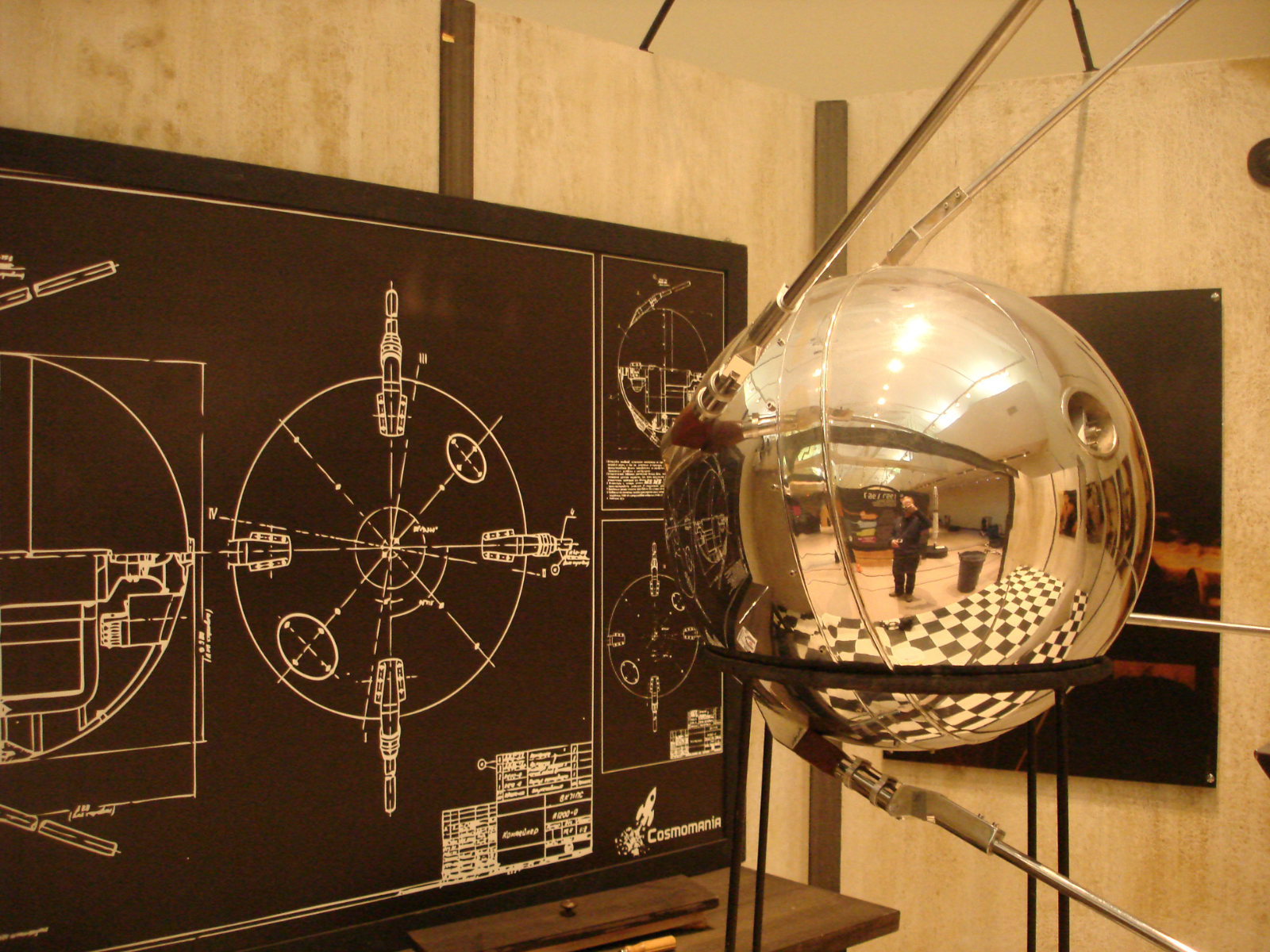
A reflective metal orb on a stand in front of a chalkboard like sign with blueprints on it.

Sputnik workshop, 1957.

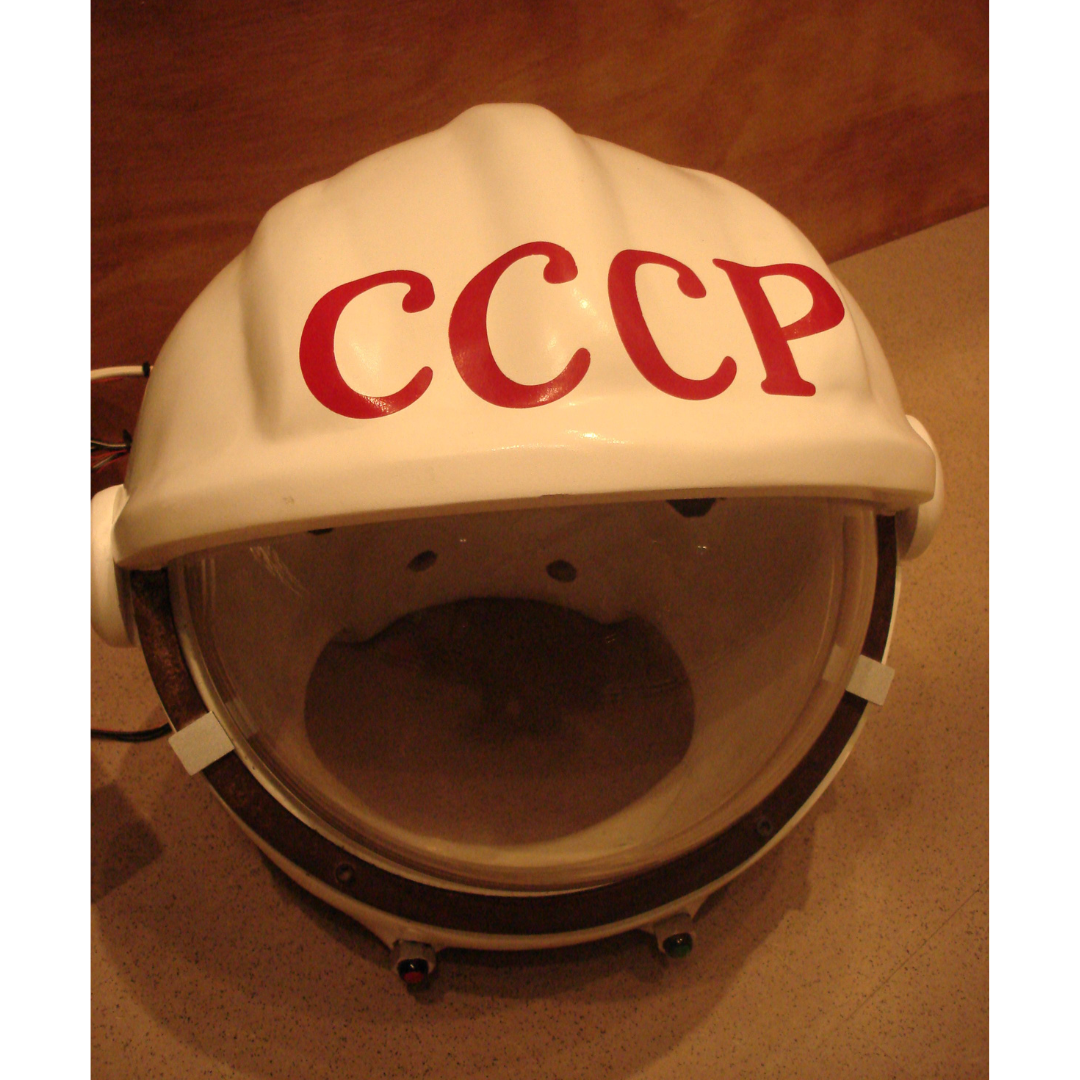
A white space helmet with red letters across the top reading CCCP.

Yuri’s Helmet.

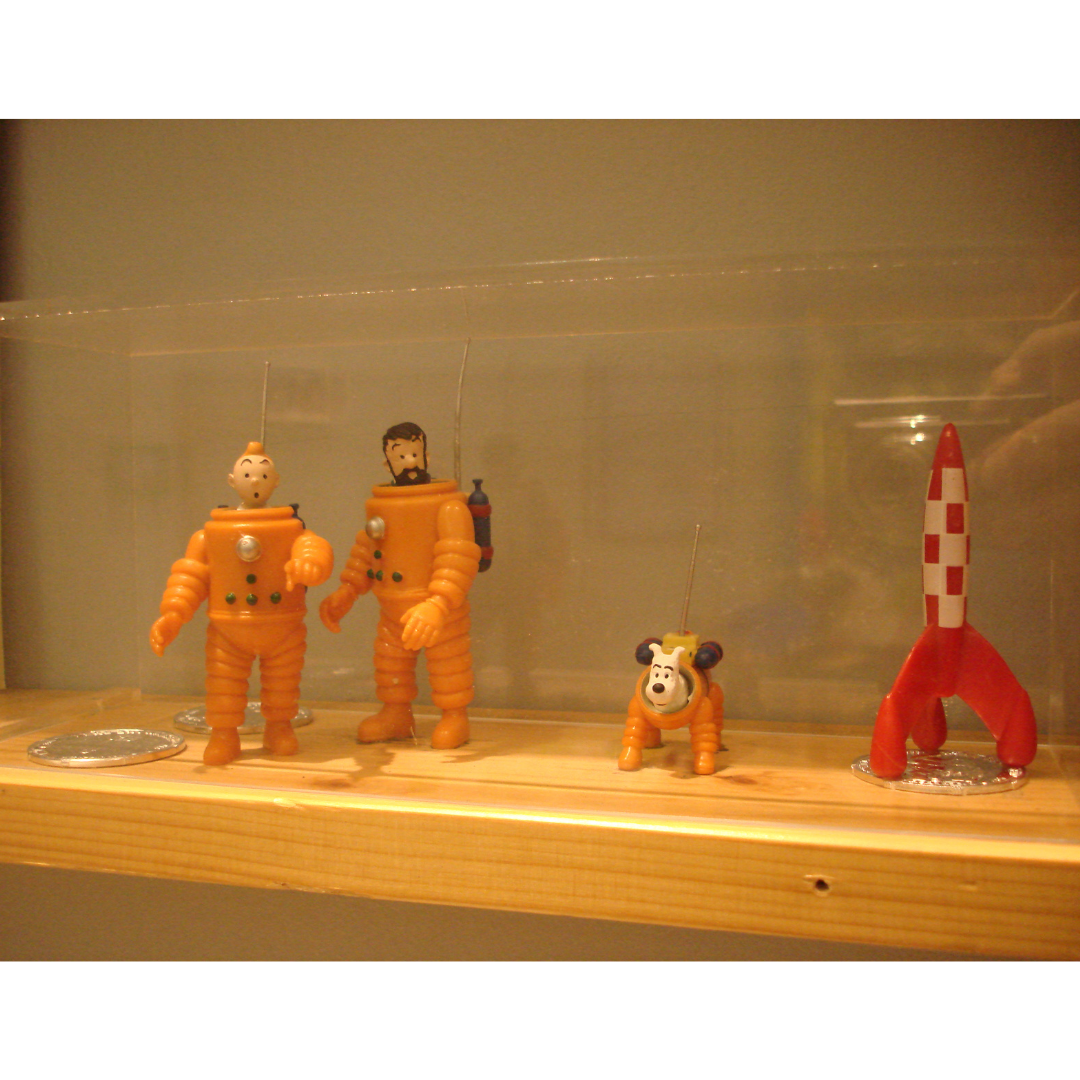
Figures of Tintin, Captain Haddock, and Snowy the dog in orange space suits next to a red rocket.

Tintin astronaut figures.

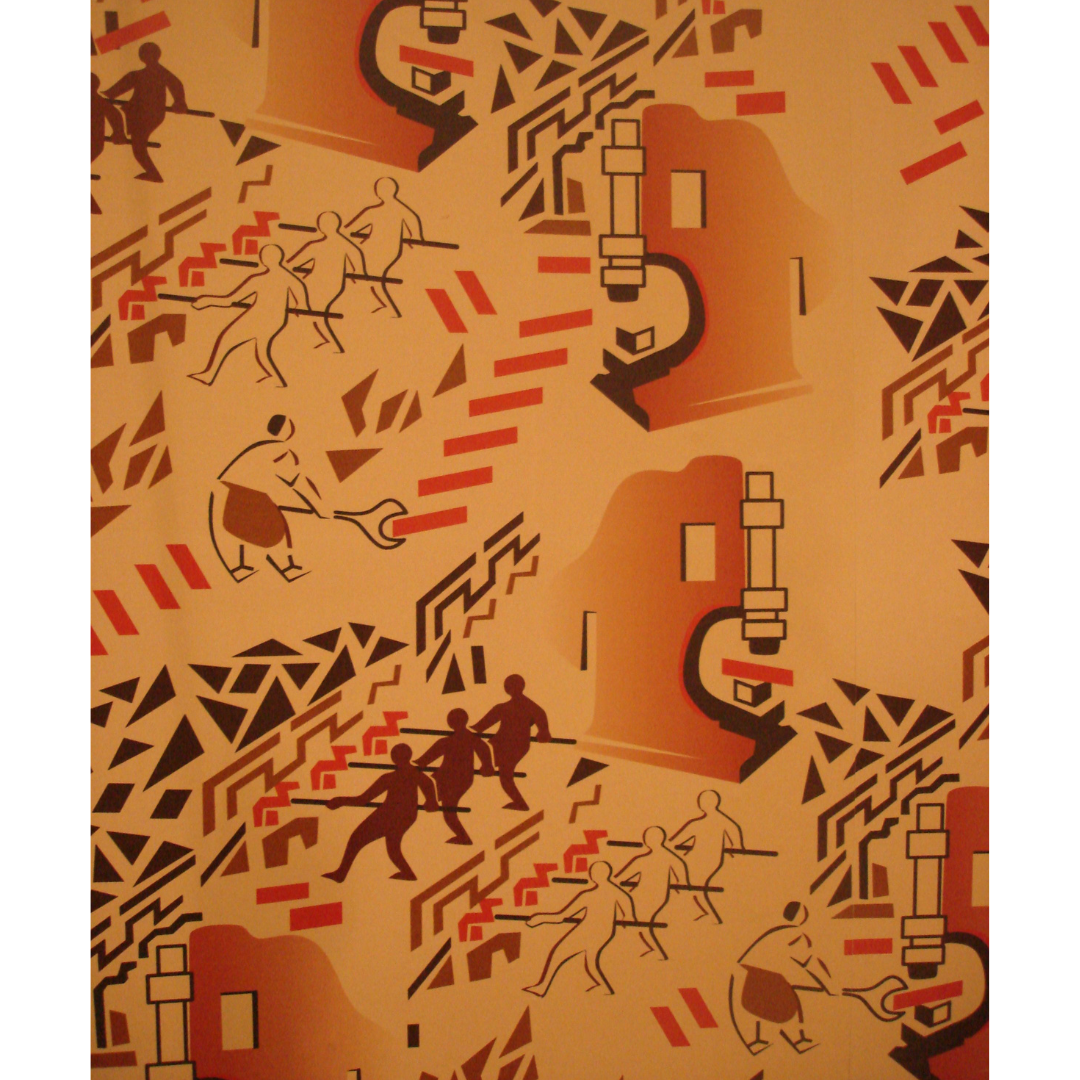
Close up on a wallpaper pattern in reds, oranges, and browns, showing microscopes and humanoid figures working with tools like wrenches and poles.

Communist wallpaper, Soviet Union c. 1961.

Scott Young

Scott Young

Planetarium Astronomer

Scott is the Planetarium Astronomer at the Manitoba Museum, developing astronomy and science programs. He has been an informal science educator for thirty years, working in the planetarium and science centre field both at The Manitoba Museum and also at the Alice G. Wallace Planetarium in Fitchburg, Massachusetts. Scott is an active amateur astronomer and a past-President of the Royal Astronomical Society of Canada.

Goodbye Mars Hoax… for another year, anyway

Yet another August has brought yet another rendition of the Great Mars Hoax. A viral email telling people Mars would be as big as the Moon on August 27 derailed several days of work while I answered hordes of public inquiries about what would be seen. (Short answer: nothing.)

Don’t get me wrong, I love answering questions from the public. It’s a chance to interact one-on-one with people interested in science and astronomy, genuinely curious about the night sky. Unfortunately, in this case I had to tell people that what they read on the internet just wasn’t true. A lot of people were disappointed in the answer, and in the sky in general.

Like any good hoax, this one grew around a nugget of truth. On August 27, 2003 (note the year!), Mars did pass about as close to Earth as it could get. We were out at Bird’s Hill Park for several public telescope nights back in 2003, and we had something over 10,000 people turn up to see the Red Planet. To the unaided eye, it looked like a really bright, reddish-coloured star – nowhere near as big as the moon, though. In fact, about 75 times smaller than the moon.

But somewhere, some astronomer with bad writing skills issued a press release or made a statement that went something like this: “On August 27, if you put a 75x eyepiece in your telescope, then you’ll see Mars appear about as big as the moon does to the unaided eye.” What should have been written was something like this: “On August 27 *2003*, if you put a 75x eyepiece in your telescope, Mars will appear *through your telescope* about as big as the Moon does *to the unaided eye*. ”

Those missing details were then helped along by some malicious person who added pictures of a total lunar eclipse (when the moon turns red), and the undated email now appears every year. It wasn’t true in 2003, and it’s not true now. In fact, it can never be true, since Mars can never get close enough to Earth to appear that big. I mean, the moon is only 374,000km away, and Mars is only about twice as big as the moon is. That means Mars would have to be less than 800,000 km away to appear that big. If Mars somehow broke out of its orbit and was moving closer to Earth, you can bet it would be *the* news item. Even if somehow all the astronomers in the world, professional and amateur, were involved in one of those giant government conspiracies that are always invoked to explain stupid things, we’d STILL find out about it. The tides would be affected, both in timing and size, so you’d have to get all the fishermen and sailors and everyone who lives near the ocean in on the conspiracy as well.

OK, enough ranting. The Mars Hoax does have a silver lining, though – I got to talk with a whole bunch of people who might not have called in otherwise, and I got to tell them where Mars really was in the sky – and Venus and Jupiter as well. Those folks got to see three planets in the sky that they might not have seen otherwise. For some of them, their personal universe got a little bigger because of it.

You can find out where the planets are – for real – on our “The Sky This Month” blog on the Manitoba Museum website. Visit

Yet another August has brought yet another rendition of the Great Mars Hoax. A viral email telling people Mars would be as big as the Moon on August 27th derailed several days of work while I answered hordes of  public inquiries about what would be seen. (Short answer: nothing.)

Don’t get me wrong, I love answering questions from the public. It’s a chance to interact one-on-one with people interested in science and astronomy, genuinely curious about the night sky. Unfortunately, in this case I had to tell people that what they read on the internet just wasn’t true. A lot of people were disappointed in the answer, and in the sky in general.

Like any good hoax, this one grew around a nugget of truth. On August 27th, 2003 (note the year!), Mars did pass about as close to Earth as it could get. We were out at Bird’s Hill Park for several public telescope nights back in 2003, and we had something over 10,000 people turn up to see the Red Planet. To the unaided eye, it looked like a really bright, reddish-coloured star – nowhere near as big as the moon, though. In fact, about 75 times smaller than the moon.

But somewhere, some astronomer with bad writing skills issued a press release or made a statement that went something like this: “On August 27th, if you put a 75x eyepiece in your telescope, then you’ll see Mars appear about as big as the moon does to the unaided eye.” What should have been written was something like this: “On August 27th *2003*, if you put a 75x eyepiece in your telescope, Mars will appear *through your telescope* about as big as the Moon does *to the unaided eye*. ”

Those missing details were then helped along by some malicious person who added pictures of a total lunar eclipse (when the moon turns red), and the undated email now appears every year. It wasn’t true in 2003, and it’s not true now. In fact, it can never be true, since Mars can never get close enough to Earth to appear that big. I mean, the moon is only 374,000km away, and Mars is only about twice as big as the moon is. That means Mars would have to be less than 800,000 km away to appear that big. If Mars somehow broke out of its orbit and was moving closer to Earth, you can bet it would be *the* news item. Even if somehow all the astronomers in the world, professional and amateur, were involved in one of those giant government conspiracies that are always invoked to explain stupid things, we’d STILL find out about it. The tides would be affected, both in timing and size, so you’d have to get all the fishermen and sailors and everyone who lives near the ocean in on the conspiracy as well.

OK, enough ranting. The Mars Hoax does have a silver lining, though – I got to talk with a whole bunch of people who might not have called in otherwise, and I got to tell them where Mars really was in the sky – and Venus and Jupiter as well. Those folks got to see three planets in the sky that they might not have seen otherwise. For some of them, their personal universe got a little bigger because of it.

You can find out where the planets are – for real – on our “The Sky This Month” section of the Planetarium’s website. Visit the Planetarium webpage here – there you’ll find all sorts of information on the sky, telescopes, and of course our shows and programs. Or you can always call me.

Scott Young

Scott Young

Planetarium Astronomer

Scott is the Planetarium Astronomer at the Manitoba Museum, developing astronomy and science programs. He has been an informal science educator for thirty years, working in the planetarium and science centre field both at The Manitoba Museum and also at the Alice G. Wallace Planetarium in Fitchburg, Massachusetts. Scott is an active amateur astronomer and a past-President of the Royal Astronomical Society of Canada.

Astronaut Bob Thirsk Coming to Visit!

Canada’s most experienced astronaut, Dr. Robert Thirsk, will be visiting the Museum tomorrow to give a public presentation on his six months in space aboard the International Space Station. I’m lucky enough to be hosting him – I’ll post some pictures after our event tomorrow. The event is at 10 am in the Auditorium at the Manitoba Museum – you can get in by contacting me through the Museum switchboard to put your name on the list.

Scott Young

Scott Young

Planetarium Astronomer

Scott is the Planetarium Astronomer at the Manitoba Museum, developing astronomy and science programs. He has been an informal science educator for thirty years, working in the planetarium and science centre field both at The Manitoba Museum and also at the Alice G. Wallace Planetarium in Fitchburg, Massachusetts. Scott is an active amateur astronomer and a past-President of the Royal Astronomical Society of Canada.