



July is summer vacation for many students in Canada, and it’s often summer when people can get away from city lights. Whether it’s camping, or to a cabin or cottage, or just a half-hour drive away from city lights, if you time your trip properly you will be rewarded with amazing summer skies.
If you are planning a trip, try to avoid the week or ten days around Full Moon. When the Moon is full, there’s a huge source of light pollution you can’t drive away from. Try to plan your summer vacation around New Moon, or at least in the period after last quarter and before first quarter, so that you will get a view of moon-free dark skies.
Unfortunately, this July the Full Moon is near month end, which is when we finally start getting fully dark nights in Canada. At our mid-northerly latitudes, for a few weeks on either side of the summer solstice, the sun sets so late and rises so early that the sky never gets fully dark. So, July will be a challenging month for stargazing. If you are planning a dark-sky trip, August might be a better bet this year – New Moon and the Perseid Meteor Shower both occur on August 12th, so that’s a great time to be under dark skies!
Event of the Month: The Moon passes Venus
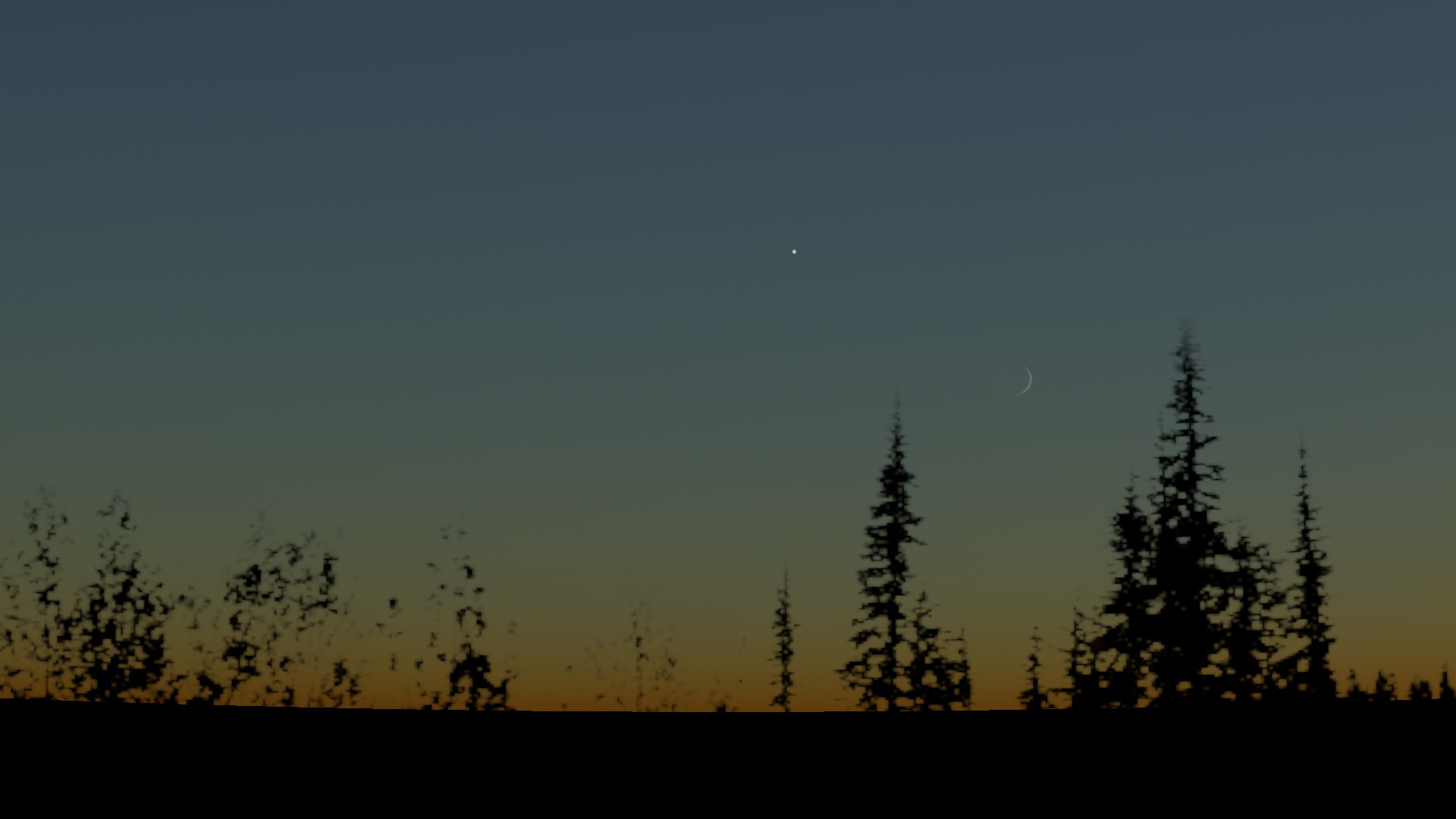
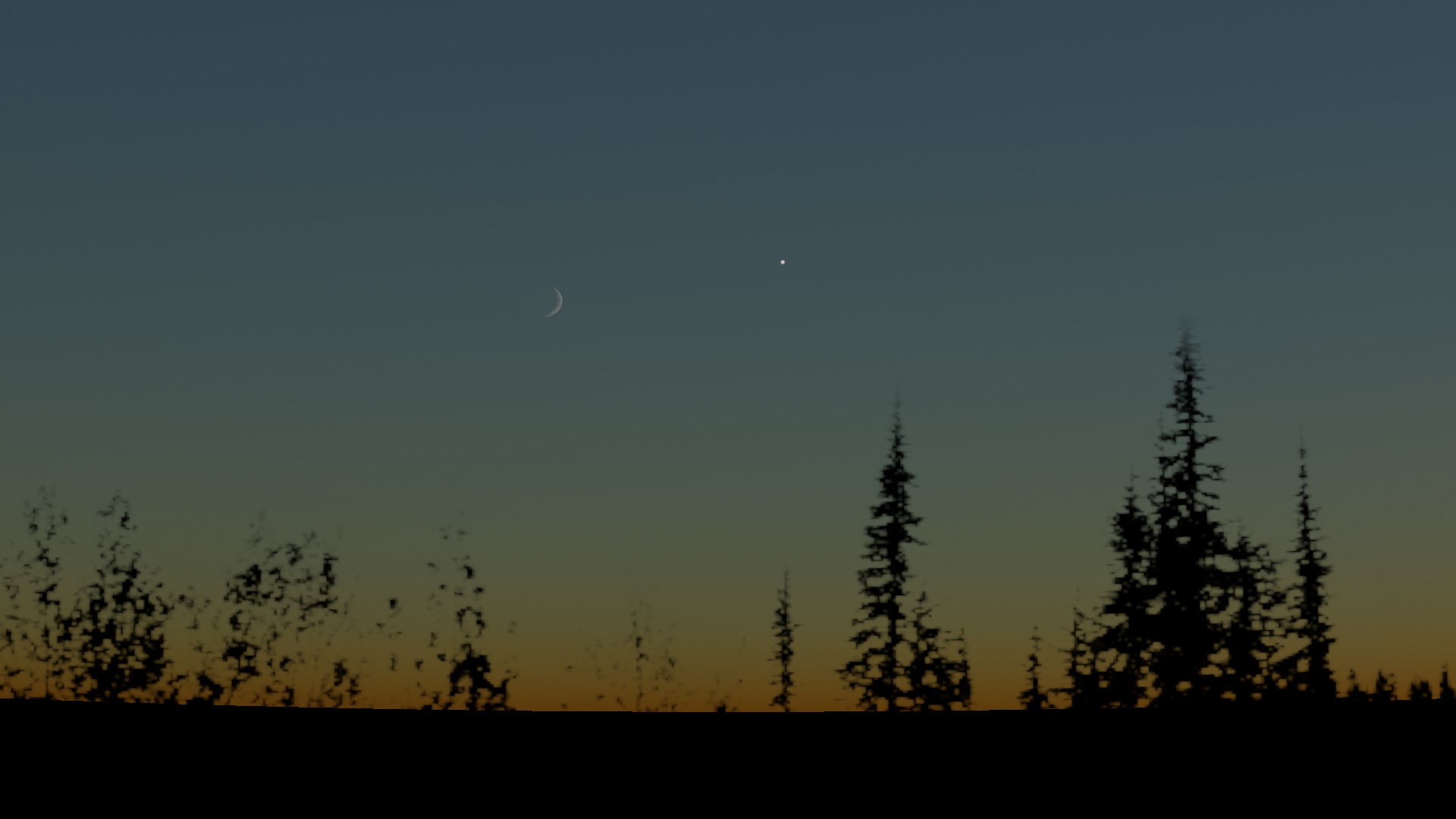
On the evenings of July 16 and 17, 2026, the thin crescent Moon is near Venus in the western sky after sunset. On the 16th, the Moon is very thin and to the lower right of Venus; on the following night it is a bit thicker of a crescent and located to Venus’ left. The sight o a thin crescent moon and Venus pasted against the sunset colours is a great photo opportunity.
The Solar System for July 2026
Mercury passes between us and the Sun this month, and is too close to the Sun to be visible at all from mid-northerly latitudes.
Venus is the bright “evening star” visible at sunset. It shines low in the west after sunset, getting progressively lower each evening throughout the month. The thin crescent Moon passes Venus on the evenings of July 16th and 17th (see “Event of the Month”, above).
Mars rises just before dawn in the east, shining inconspicuously in the east-northeast in central Taurus. Mars will get better as it comes closer over the next several months, growing in brightness. Mars passes Uranus on the morning of July 3-4, but the event happens in in twilight and is unlikely to be observable.
Jupiter passes behind the Sun at the end of July, but is already too low in the sky to be seen at the beginning of the month. It will reappear in the morning sky towards the end of summer.
Saturn rises after midnight and is halfway up the sky in the southeast by dawn. The First Quarter Moon is nearby on the morning of July 7th.
Uranus is technically in the morning sky, but doesn’t rise above our horizon until after the sun rises. Give it a couple of months. Mars passes just below Uranus on the morning of July 3-4, but in twilight it will be difficult to spot the distant planet.
Neptune is located just west (right) of Saturn in the sky, but a small telescope or binoculars and a detailed star chart will be necessary to track it down. It appears as merely a spot dot amongst the myriad other dots in the sky..
Of the five known dwarf planets, only (1) Ceres is close enough to be seen in binoculars or a small telescope. It becomes visible in small telescopes low in the morning sky toward the end of the month.
Sky Calendar for July 2026
All times are given in Central Daylight Time, the local time for Manitoba. However, most of these events are visible across Canada at the same local time without adjusting for time zones.
If there’s a little box to the left of the date, you can click on it to see a star map of that event! All images are created using Stellarium, the free planetarium software.
Friday, July 7th, 2026 (morning sky): The Last Quarter Moon is to the left of Saturn after midnight.
Friday, July 14th, 2026 : New Moon
Sunday, July 16th, 2026 (evening sky): The thin crescent Moon is to the lower right of Venus, 30 minutes after sunset in the western sky.
Monday, July 17th, 2026 (evening sky): The thin crescent Moon is to the left of Venus, 30 minutes after sunset in the western sky.
Friday, July 21st, 2026 : First Quarter Moon
Friday, July 29th, 2026 (morning sky): The Delta Aquariid meteor shower peaks in the early morning hours of July 29th in the few hours before dawn. Unfortunately, this year the light from the full moon will obscure most of the meteors. You might see a handful per hour in the hours between 1am and sunrise.
Friday, July 29th, 2026: Full Moon
Other Celestial Sights
Outside of the events listed above, there are other things we see in the sky that can’t always be predicted in advance.
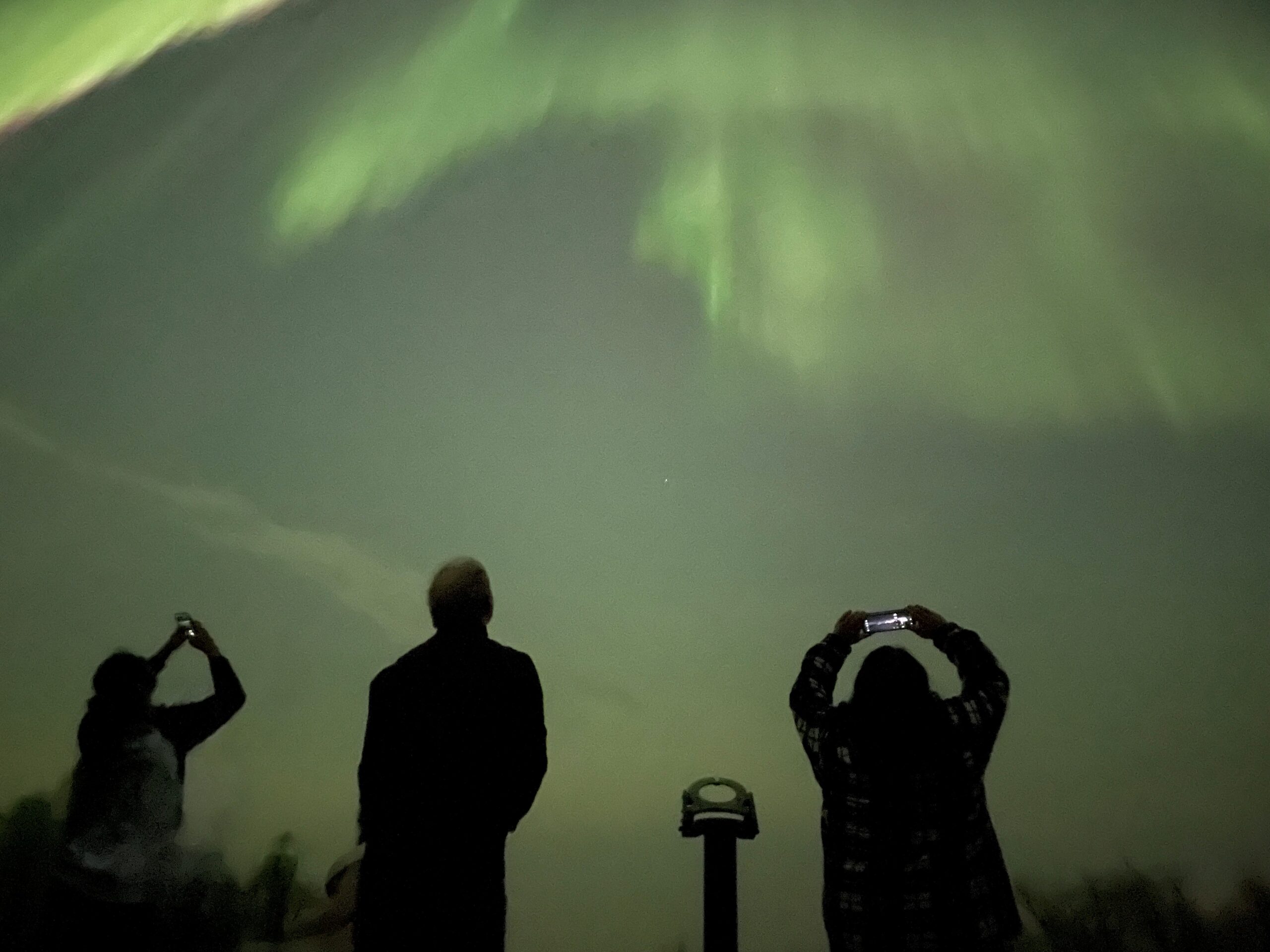
Aurora borealis, the northern lights, are becoming a more common sight again as the Sun goes through the maximum of its 11-year cycle of activity. Particles from the Sun interact with the Earth’s magnetic field and the high upper atmosphere to create glowing curtains of light around the north (and south) magnetic poles of the planet. Manitoba is well-positioned relative to the north magnetic pole to see these displays often, but they still can’t be forecast very far in advance. A site like Space Weather can provide updates on solar activity and aurora forecasts for the next 48 hours. The best way to see the aurora is to spend a lot of time out under the stars, so that you are there when they occur.
Random meteors (also known as falling or shooting stars) occur every clear night at the rate of about 5-10 per hour (from a dark sky with no moonlight interfering). Most people don’t see them because of light pollution from cities, or because they don’t watch the sky uninterrupted for an hour straight. They happen so quickly that a single glance down at your phone or exposure to light can make you miss one.
Satellites are becoming extremely common sights in the hours after sunset and before dawn. Appearing as a moving star that takes a few minutes to cross the sky, they appear seemingly out of nowhere. These range from the International Space Station and Chinese space station Tianhe, which have people living on them full-time, to remote sensing and spy satellites, to burnt-out rocket parts and dead satellites. The most common sightings are Starlink satellites, which are being launched dozens at a time to bring internet to remote regions, but which cause trouble with astronomy and pollution. These can be predicted in advance (or identified after the fact) using a site like Heavens Above by selecting your location.