
Birch Bark Canoe Video

Birch Bark Canoe Video

By Kevin Brownlee, past Curator of Archaeology


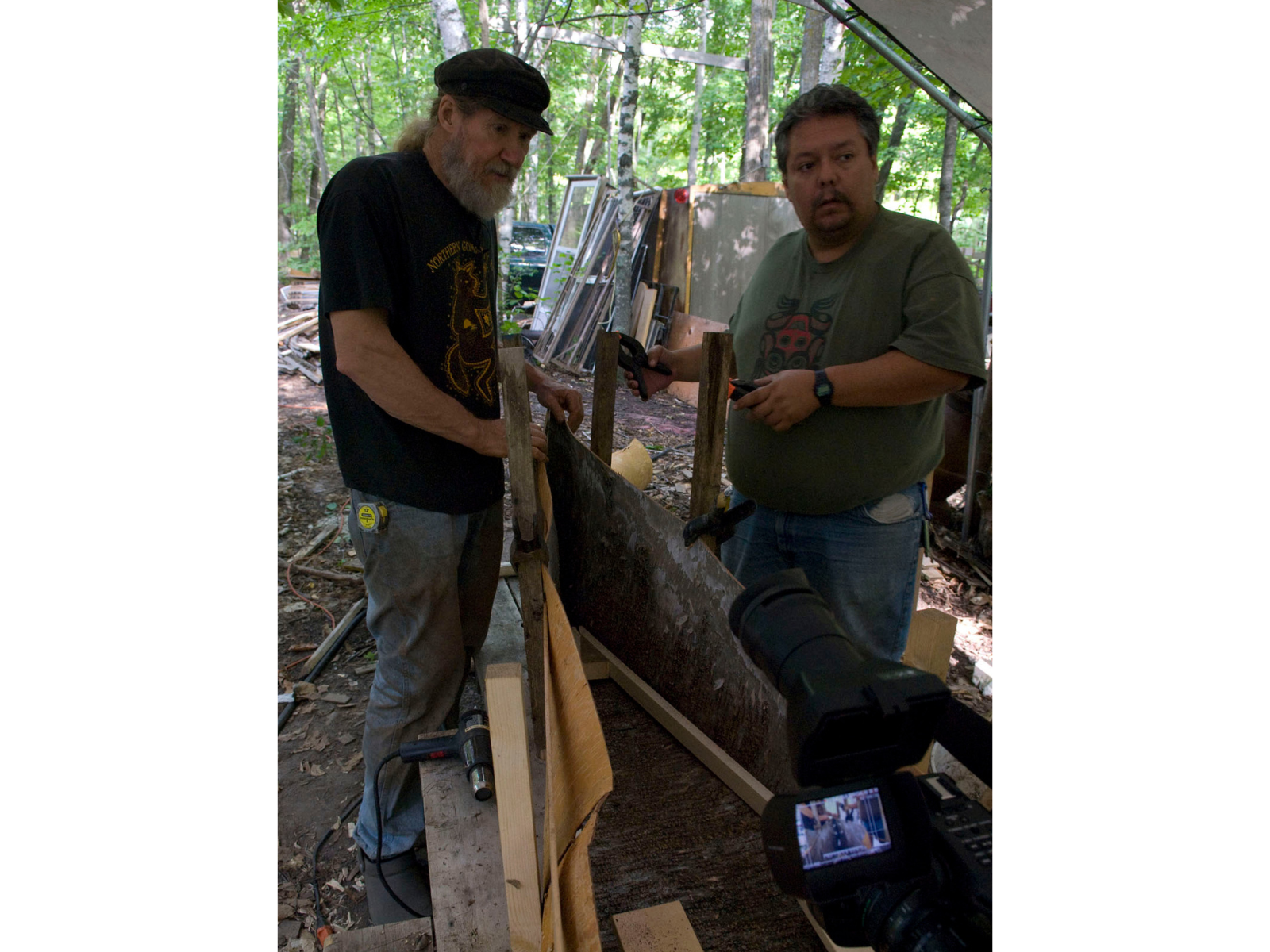
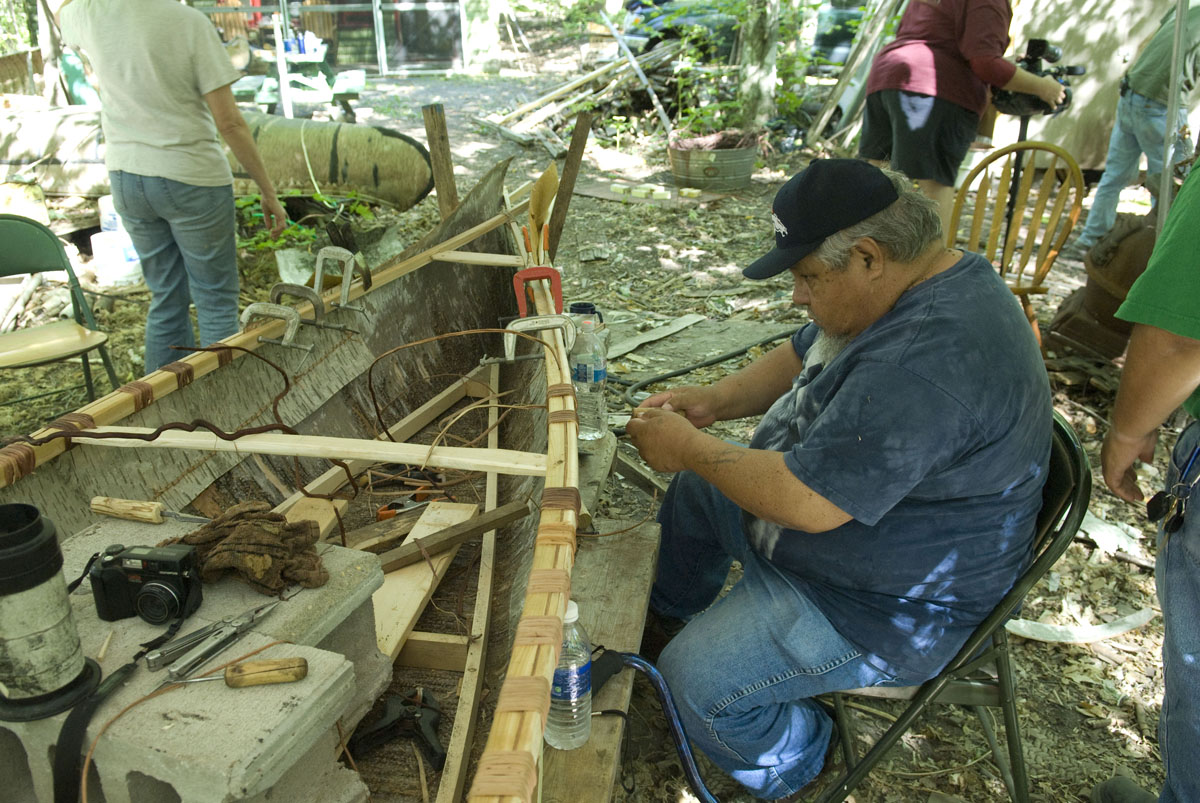
For those of you who have enjoyed my blogs on the creation of the Birch Bark Canoe you will be interested in seeing the video of how it was made. During the intensive 7 days we spent making the canoe Lakeland Public Television documented the construction of the birch bark canoe step by step. Scott Knudson filmed much of the activity and interviewed each of us about the canoe and what it meant to each of us. Scott was one of the producers and edited together a 57:03 minute documentary. The filming was funded under the Minnesota Arts and Culutral Heritage Fund.

You may also be interested in the full un cut interview with Grant Goltz which has also been uploaded to YouTube, above. The interview with Grant Goltz was filmed for audio and video clips used in the full hour documentary (Search Grant Goltz).
Replicating rex

By Dr. Graham Young, past Curator of Palaeontology & Geology


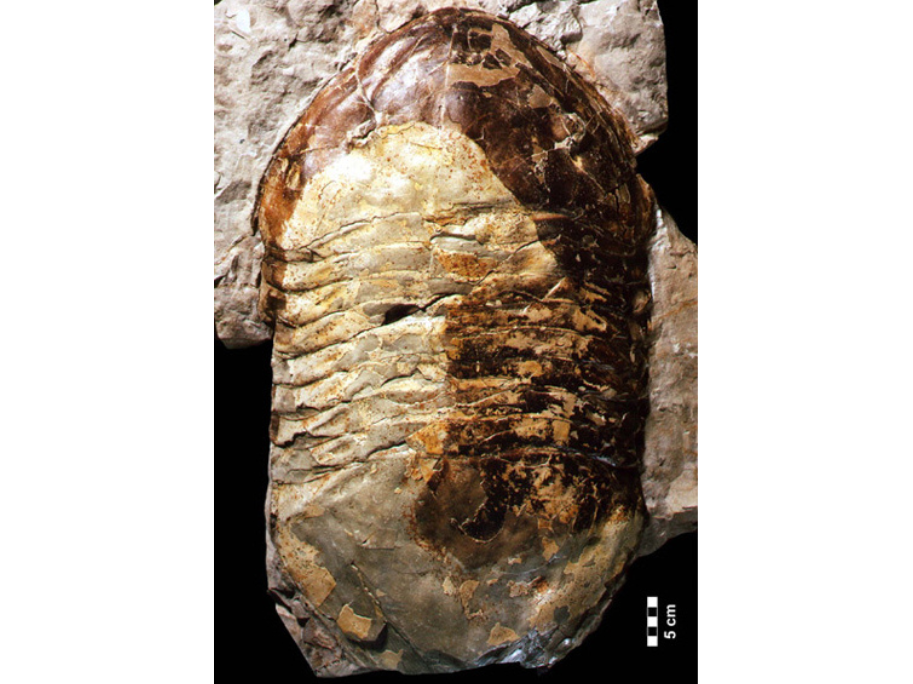
The Manitoba Museum is home to many unusual and unique specimens. Among the most remarkable is the world’s largest complete trilobite, the holotype specimen of the species Isotelus rex. Over the years we have occasionally received requests from other museums for replicas of this striking fossil.

More than a decade ago, before the specimen ever went on exhibit, we had a mould prepared by an outside contractor who also made a number of resin replicas. These were on the shelf and ready to be painted if an order arrived. But eventually those replicas ran out, and when a new order came in from a museum in Japan last year, it was discovered that the original mould was too old and worn to be used again. A new mould was needed, which meant that we would have to remove the specimen from its exhibit in the Earth History Gallery.

A large oblong fossil specimen of a trilobite.

The holotype of Isotelus rex, MM I-2950

A display case containing  a large fossil trilobite specimen along with a fossilized trackway.

The I. rex type specimen, on exhibit with a trackway and other trilobite material.

So we pulled out the case, carefully slid out the fossil (this is tricky, because it weighs about as much as I do!), and wheeled it away to the artists’ studio to be worked on by Debbie Thompson and Betsy Thorsteinson. While the specimen was “on leave” from the exhibit, it was temporarily replaced by one of the existing replicas.

The following photos are Betsy’s documentation of the complex and fascinating replication process. Our artists are tremendously skilled, as indicated by the high quality of work in so many of our galleries, and by the attention to detail in the preparation of these perfect trilobite replicas.

A fossil specimen on a work table encased in latex and cheesecloth.

First, the fossil specimen was coated with layers of latex to precisely replicate its surface. This was strengthened with cheesecloth.

A fossil specimen on a work table encased in a white plaster jacket with two piece of wood bracing the top portion.

A plaster jacket was built up over the latex, and braced with wood.

The formed mould placed upside down on a work table as an individua; wearing a white lab coat, blue gloves, a respirator, and safety glasses uses a paint brush to apply a coat of mould separator on the interior.

Once this had dried, the mould was pulled from the fossil. Debbie painted a layer of mould separator onto the latex prior to casting.

An individual wearing a white jumpsuit, blue gloves, a respirator, and safety glasses leaning over holding a drill with a mixing bit into a basin of polyester resin.

Polyester resin had to be mixed very quickly, as it begins to set within minutes!

An individual wearing a white jumpsuit, blue gloves, a respirator, and safety glasses applies resin with a paint brush on the inside of the large mould.

The resin was applied to the mould.

Fibreglass layered along the interior base of the mould.

Fibreglass was layered in to strengthen the cast.

Lightweight foam filling the form of an upside-down mould. The open end of an air ventilator hangs above the mould.

As a solid resin cast would be extremely heavy, the interior was filled with lightweight foam.

A flat coat of resin on the top of the trimmed foam within the mould. The open nozzle of an air vent hangs above on the left side.

After the foam had been trimmed down, a resin coat was applied to the back of the replica.

Two individuals, both wearing black t-shirts and blue jeans, stand either side of a work table peeling a flexible latex layer off of a replica fossil trilobite specimen.

Bob Peacock and Marc Hébert peeled the latex from the replica.

An individual wearing a white smock paints a beige base coat on a large model trilobite specimen. Further back on the work table is the original trilobite specimen.

Debbie applied the first coats of paint to the replica. Note that the original specimen was nearby for reference.

An individual leans over a work table, painting a large model trilobite specimen. On their right side is the original trilobite specimen and they use their right hand to cup the portion they're replicating on the left.

Painting of the replica was almost finished. As Debbie says, “The detail work takes a lot out of you. I cup it like this to keep my spot while painting.”

An individual traces a large fossil trilobite replica onto brown paper placed beneath it.

Debbie traced the finished replica onto brown paper, so that a precisely fitted crate could be prepared.

The replica carefully encased in a packing crate.

The crated replica, ready to be shipped to Japan!

Step 5 Birch Bark Canoe

By Kevin Brownlee, past Curator of Archaeology


On day 7 Myra and I awoke to another beautiful day. We decided that we would complete all the sewing, attaching the gunwale caps and final trimming but would not pitch the canoe. Grant had offered to complete this last stage after we returned to Winnipeg.

We all marvelled at the beauty of the canoe now that it has the final shape. It is amazing that in one week we could turn bark and wood into such an amazing watercraft. Clearly there is nothing “Printive” about a birch bark canoe. Grant spoke about how when Europeans arrived to North America they came from a long tradition of boat building. However Europeans found them unsuitable to the navigate the waterways of the boreal forest and quickly adopted the birch bark canoe.

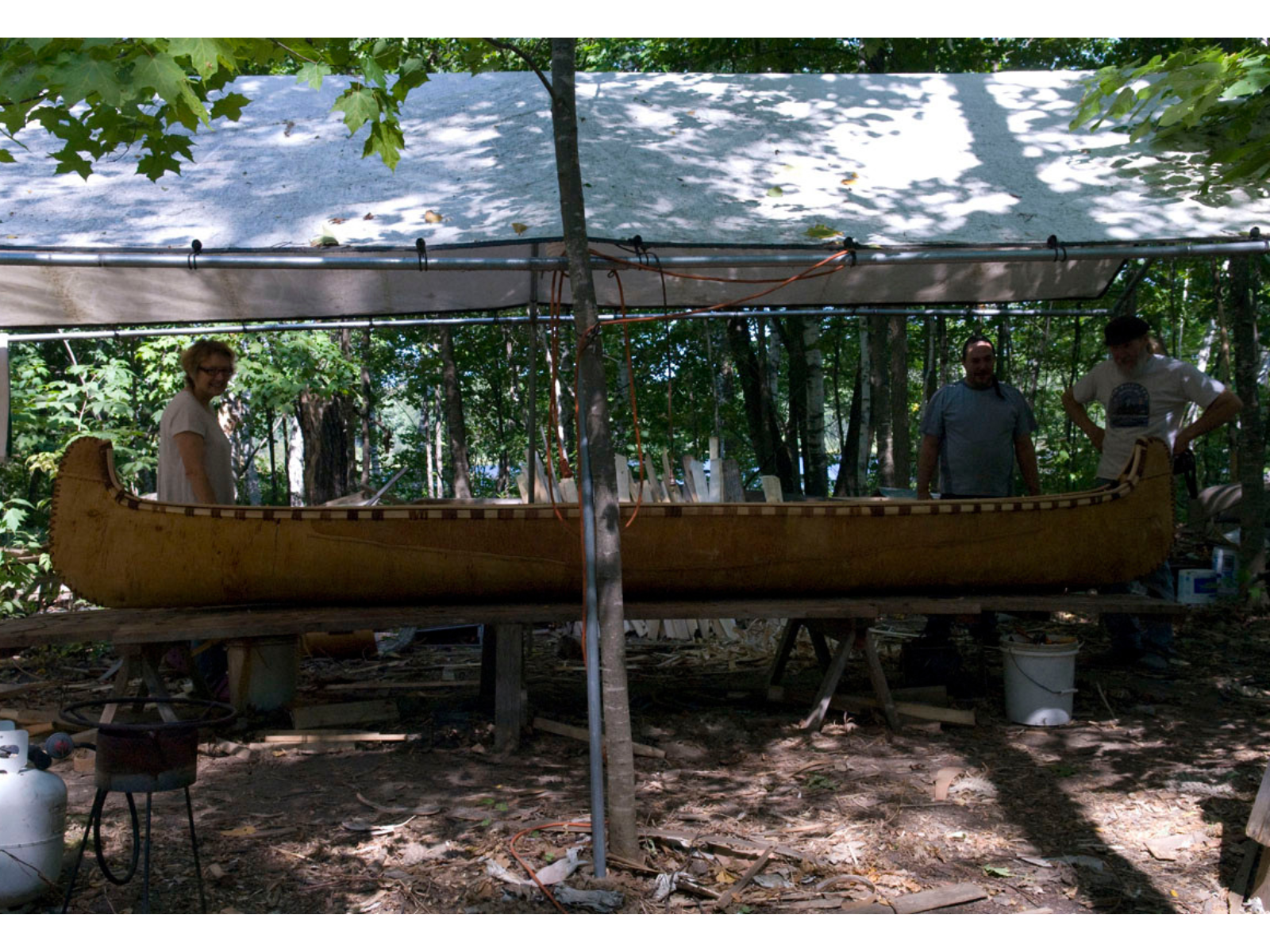
A birch bark canoe on sawhorses under an open sided tent. Three individuals stand at the ends of the canoe.

Unpitched canoe 15 feet long.

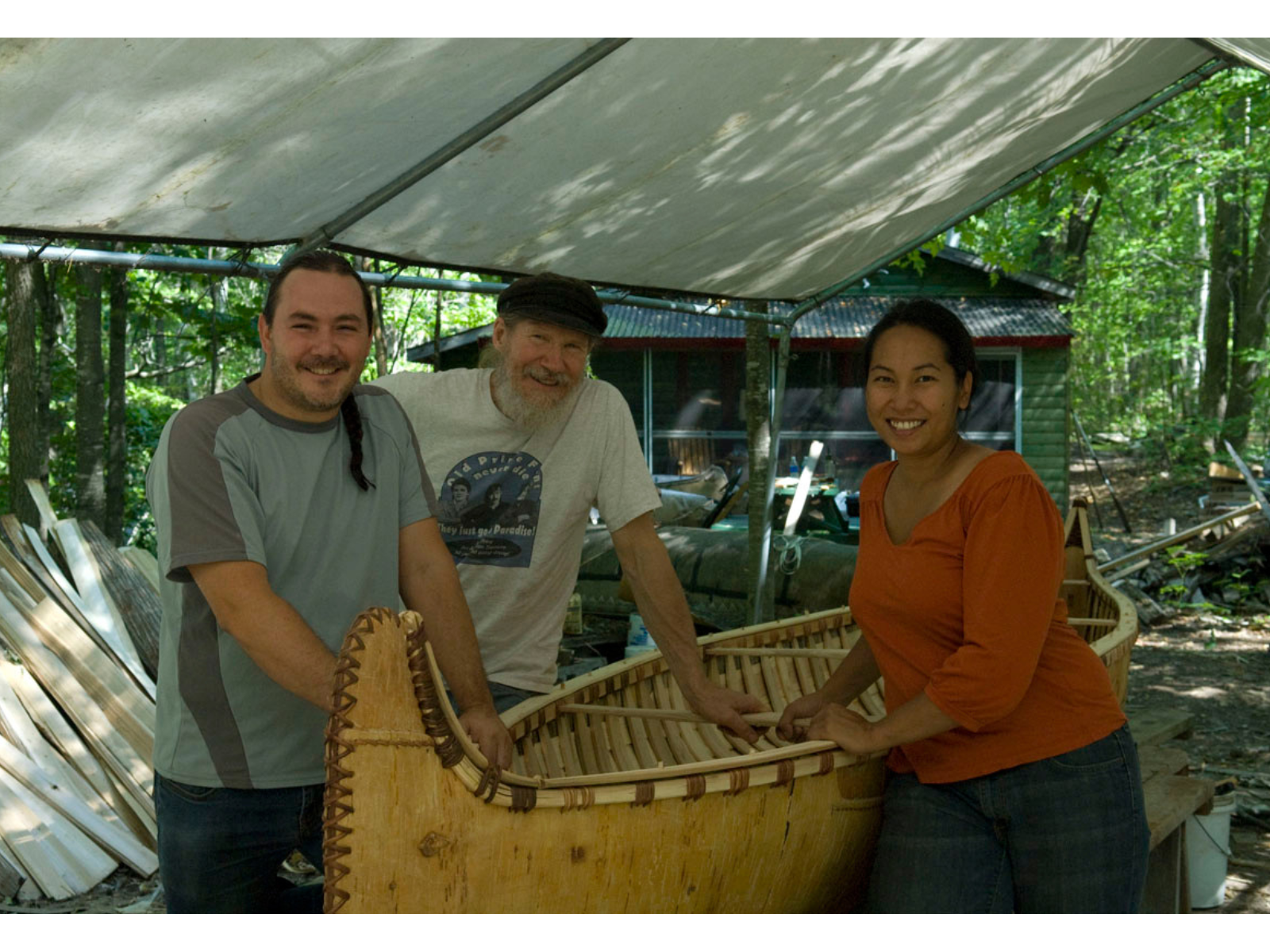
Three smiling individuals posing around a birch bark canoe supported on sawhorses under an open-sided tent.

Kevin, Grant, and Myra by the our canoe.

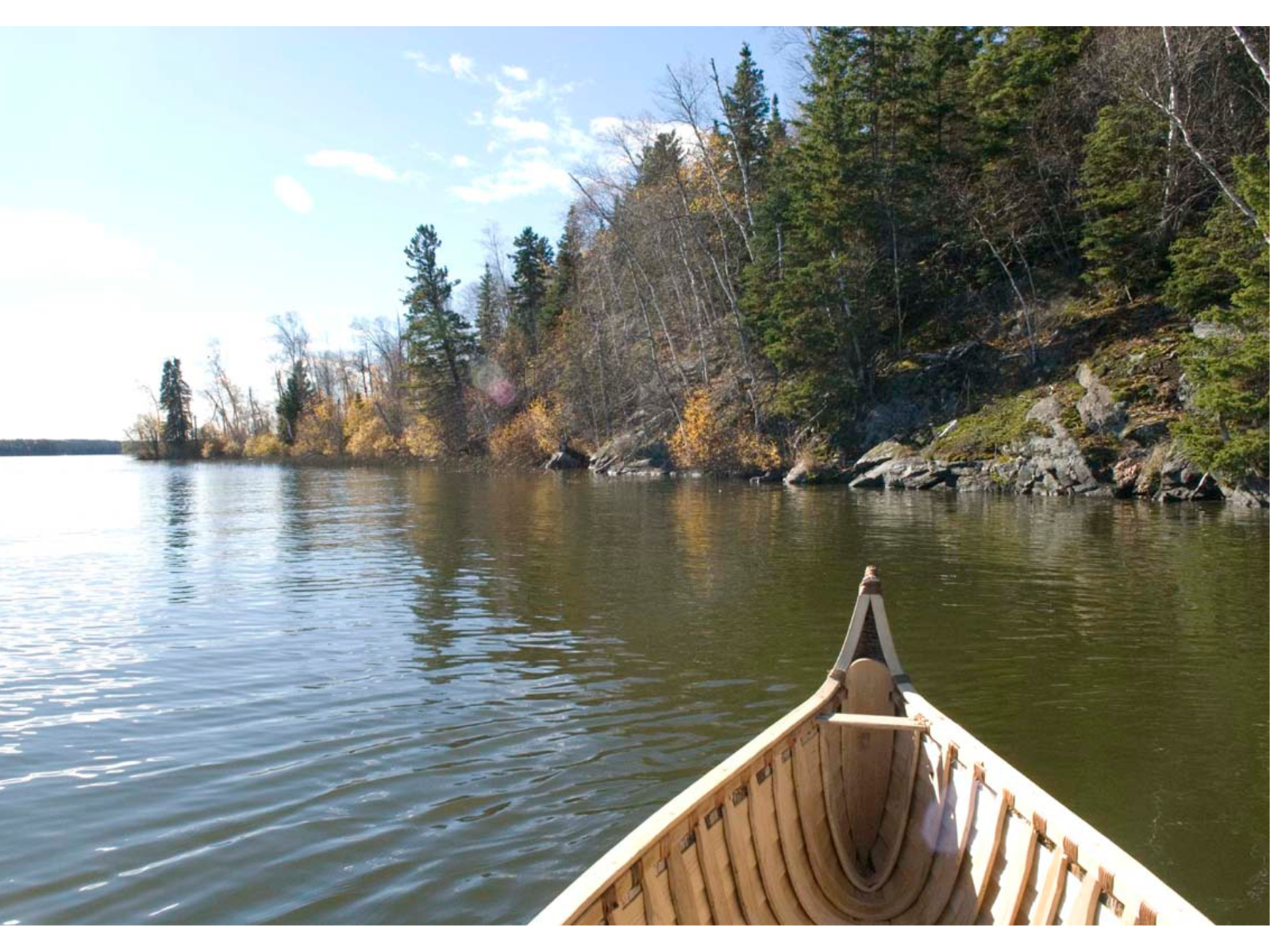
Later that Fall on a vacation from the office I took the canoe into northern Manitoba for the inaugural launch into the clear waters of the Canadian Shield. Paddling on the lake I realized this is probably the first time in over a hundred years that anyone has paddled a birch bark canoe in the area. What an amazing gift from relatives from the south.

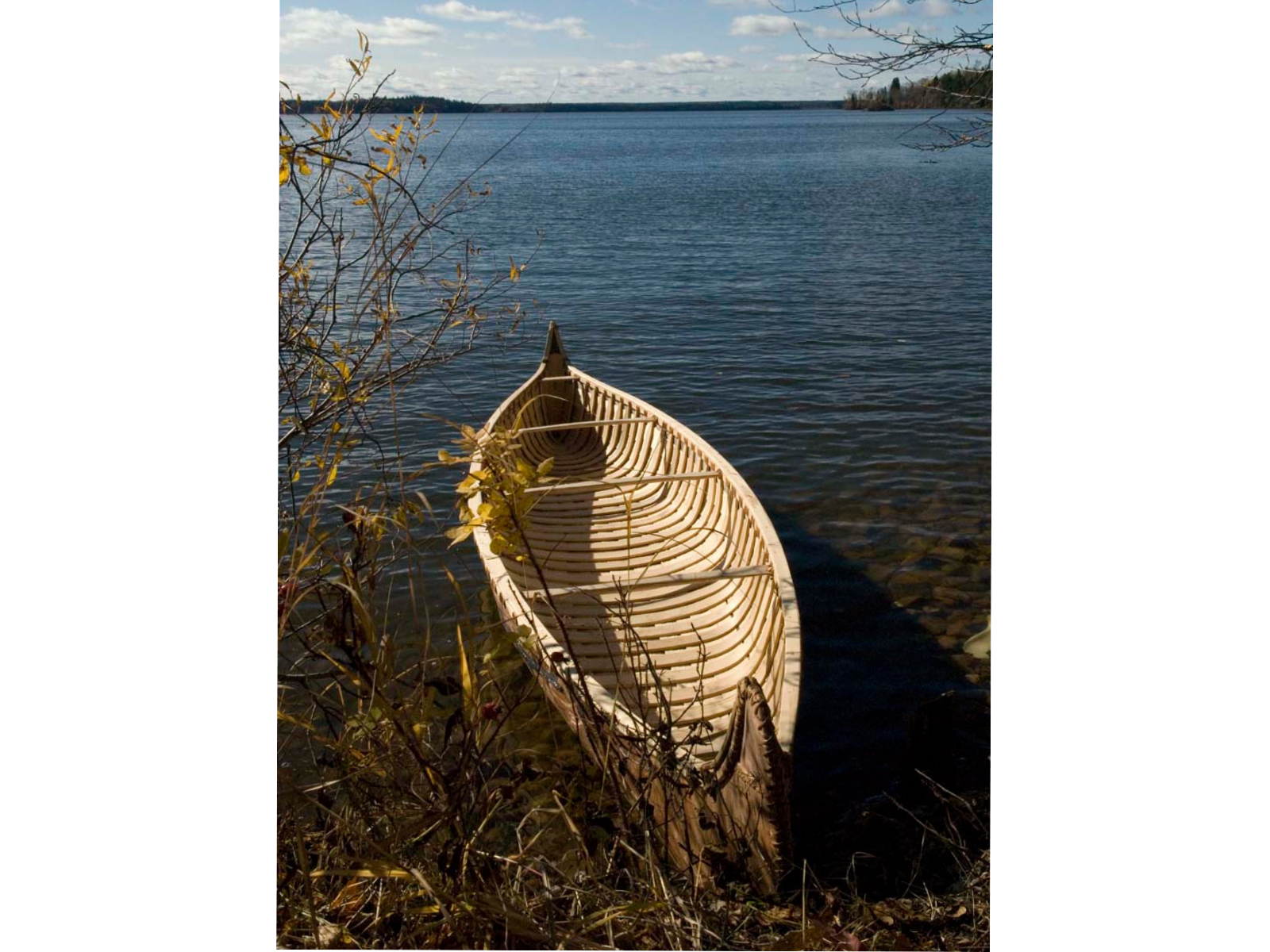
A birch bark canoe partially banked at the side of a body of water.

Canoe pulled up on shore.

The view over the bow of a canoe on a body of water. To the right is a rocky and treed bank.

First Paddle.

Anniversaries and Anthropologists

By Dr. Jamie Morton, past Curator of the Hudson’s Bay Company Museum Collection


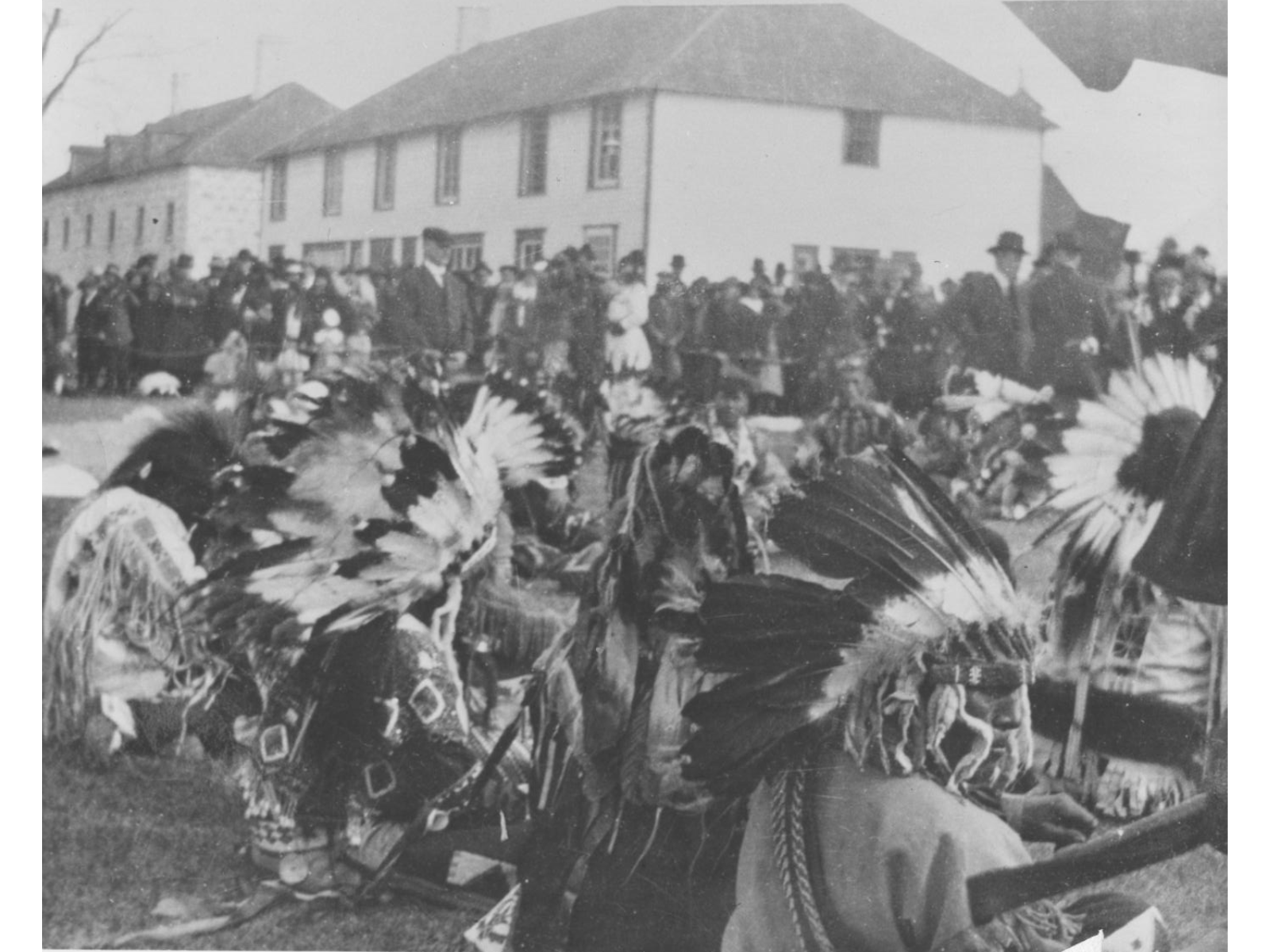
The impetus for the formation of the Hudson’s Bay Company Museum Collection came from the celebrations surrounding the firm’s 250th anniversary in 1920. The HBC was keenly aware of its role in the development of Canada since 1670, and commemorated the event with a variety of special events, re-enactments, and pageants across the western and northern regions of the country. Although the HBC “Historical Exhibit” was not created in time for the 1920 celebrations, the initiative continued, and the Exhibit was opened in the Winnipeg retail store of the HBC in June 1922.

A group of Indigenous people in formal attire seated on a grassy lawn. In the distance groups of people stand in front of a multi-storey building.

A view of some of the HBC’s 250th anniversary celebrations at Lower Fort Garry, May 1920. Photo by M. Lindenberg, TMM HBC 2562.

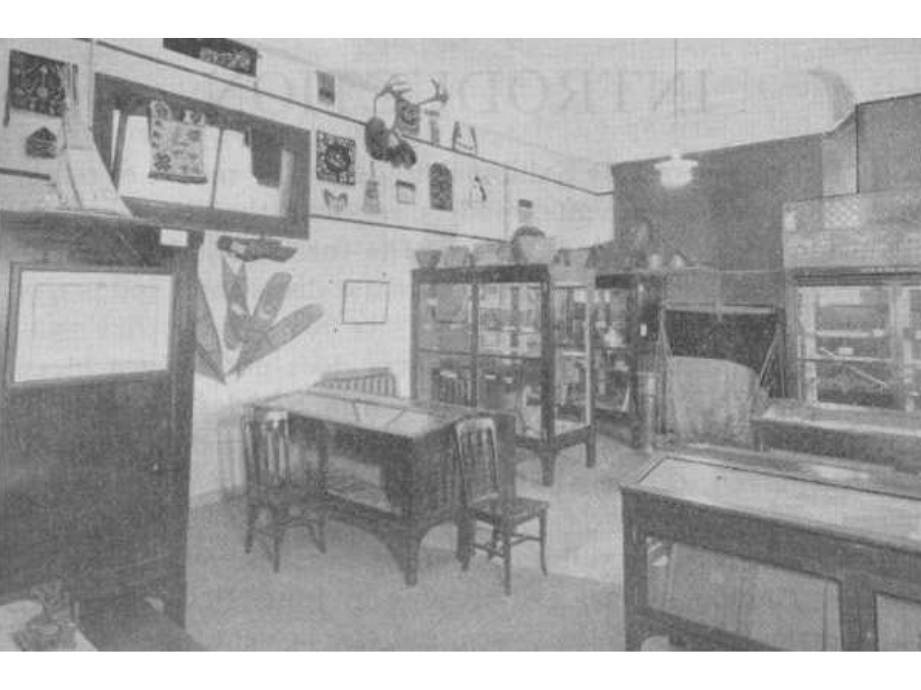
A black and white photograph of a room set up as a museum exhibit with display cases, display tables, and artifacts mounted on the walls.

The HBC Historical Exhibit in 1922. Catalogue of the Hudson’s Bay Company’s Historical Exhibit at Winnipeg, Third Edition, 1923, 1. TMM HBC 007-208.

The object of the Hudson’s Bay Company’s Historical Exhibit at Winnipeg is to depict by means of relics, pictures, documents, models, etcetera, the history of the Hudson’s Bay Company, life in the fur trade, the story of the pioneer settlers, and the customs, dress and industries of the aboriginal tribes. (1921 approved statement, quoted in Hudson’s Bay Company, “Catalogue of Historical Relics,” 1935, 6)


With the cooperation of his employer, the federal Minister of Mines, Harlan I. Smith, an ethnologist at the Victoria Memorial Museum in Ottawa, travelled to Winnipeg in 1921-22 to assist in organizing the Historical Exhibit, selecting objects for display and writing text “to interest visitors.”  The Exhibit’s mandate to depict aboriginal life and culture corresponded well to Smith’s own anthropological work for the federal government.

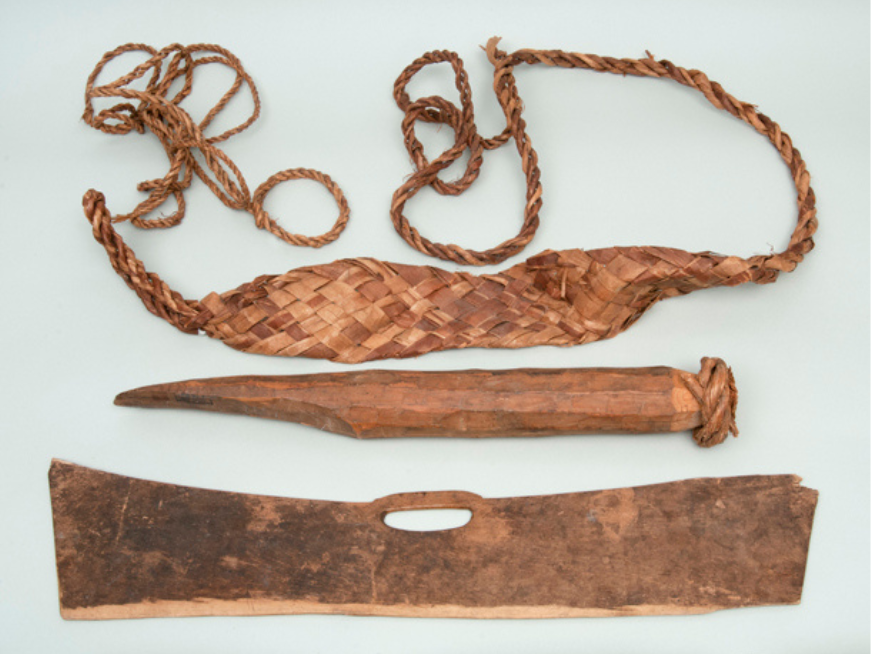
A collection of copper coloured artifacts - a harness, yew wedge, and bark pounder.

These and the following objects were collected by Harlan I. Smith in Bella Coola. At the top is part of a climbing harness, for harvesting the inner bark of hemlock trees, in the middle is a yew wedge, used for splitting planks, and at the bottom is a bark pounder or hackler used to prepare cedar bark. TMM, HBC 1530, HBC 1531, HBC1508.

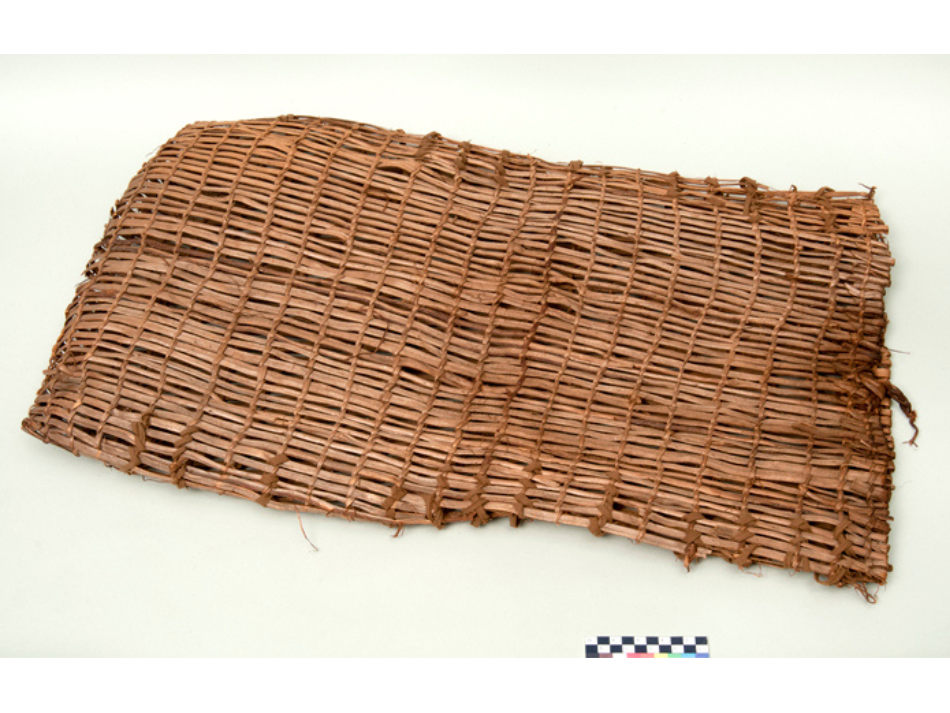
A woven sheet or bag.

Eulachon strainer, used to extract the grease from eulachon, a smelt-like fish. The eulachon grease was a valuable commodity, used as a condiment for various dried foods, such as the inner bark of the hemlock tree. TMM HBC1512.

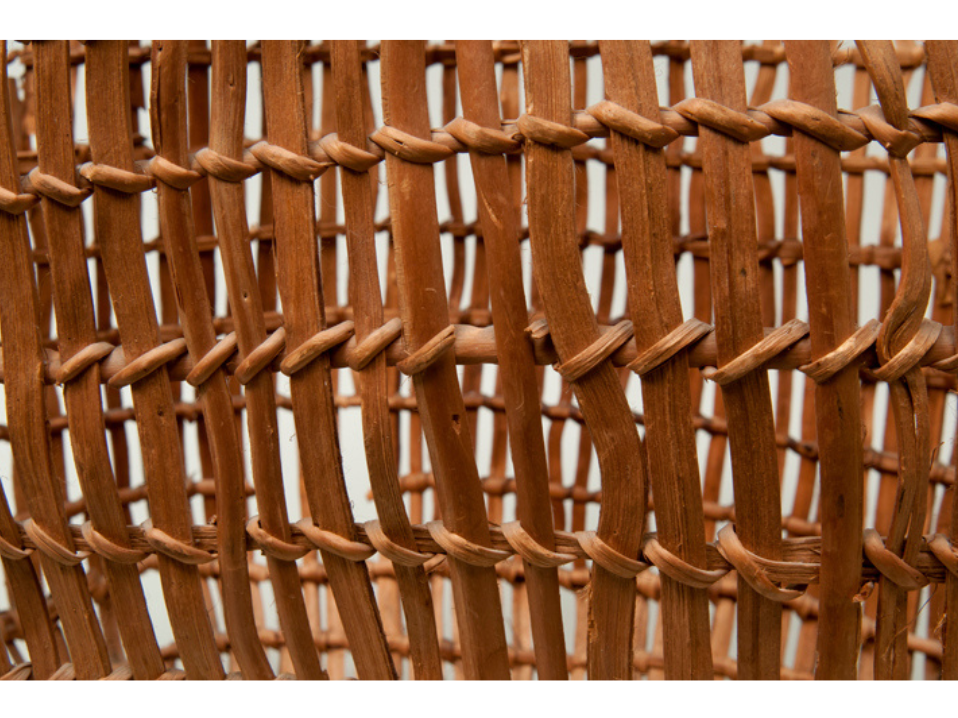
Close up on an open-weave basket side.

Detail of an open weave spruce root basket used to transport fern roots, clams, and other foodstuffs. TMM HBC 1514.

In 1920-21, he was engaged in fieldwork among the Nuxalk and Tsilqot’in people in the Bella Coola Valley of British Columbia, focusing on the traditional uses of plant and animal materials. For his 1922 fieldwork season, Smith “kindly offered to secure for the Hudson’s Bay Historical Exhibit typical specimens of Indian work in that District.” These objects form an interesting assemblage within the HBC collection, reflecting Smith’s interest in traditional Nuxalk culture and society – objects chosen more for their functional than aesthetic value. This is enhanced by the field notes and visual records Smith obtained at the same time. A pioneer in using film in ethnology, the objects he collected for the HBC Museum Collection are complemented by the still and moving images held today in the collections of the Canadian Museum of Civilization in Ottawa. The clear provenance [information about the origin and ownership of an object] and complementary documentation transforms this small collection, assembled to represent everyday life for the Nuxalk people, into another treasure within the HBC Museum Collection.

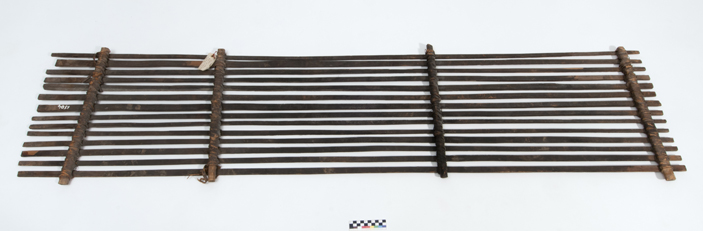
A rack made of cedar branches.

Rack made of red cedar used to dry food such as berry cakes and fish, for preservation. TMM HBC 1504.

Step 4 Birch Bark Canoe

By Kevin Brownlee, past Curator of Archaeology


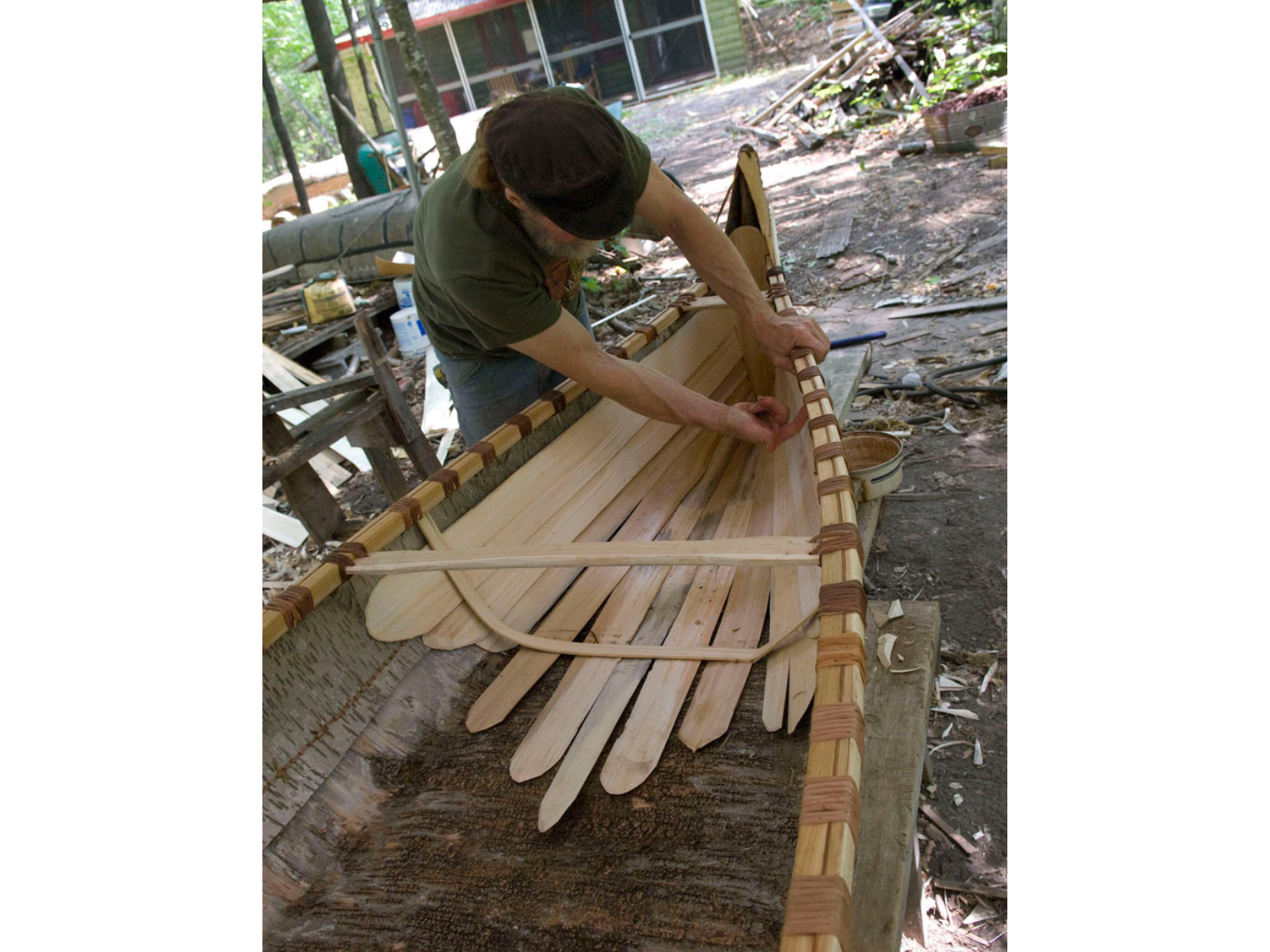
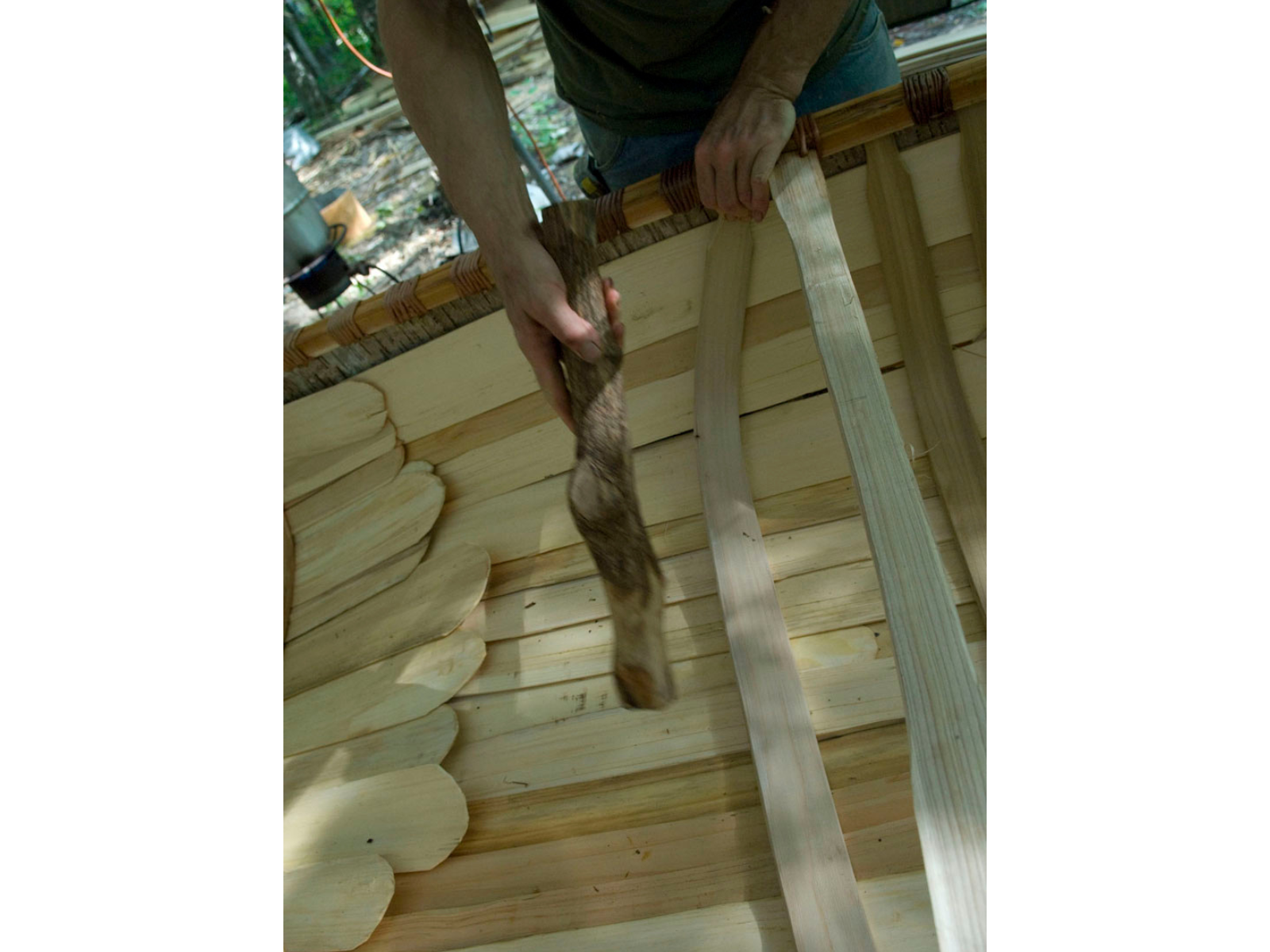
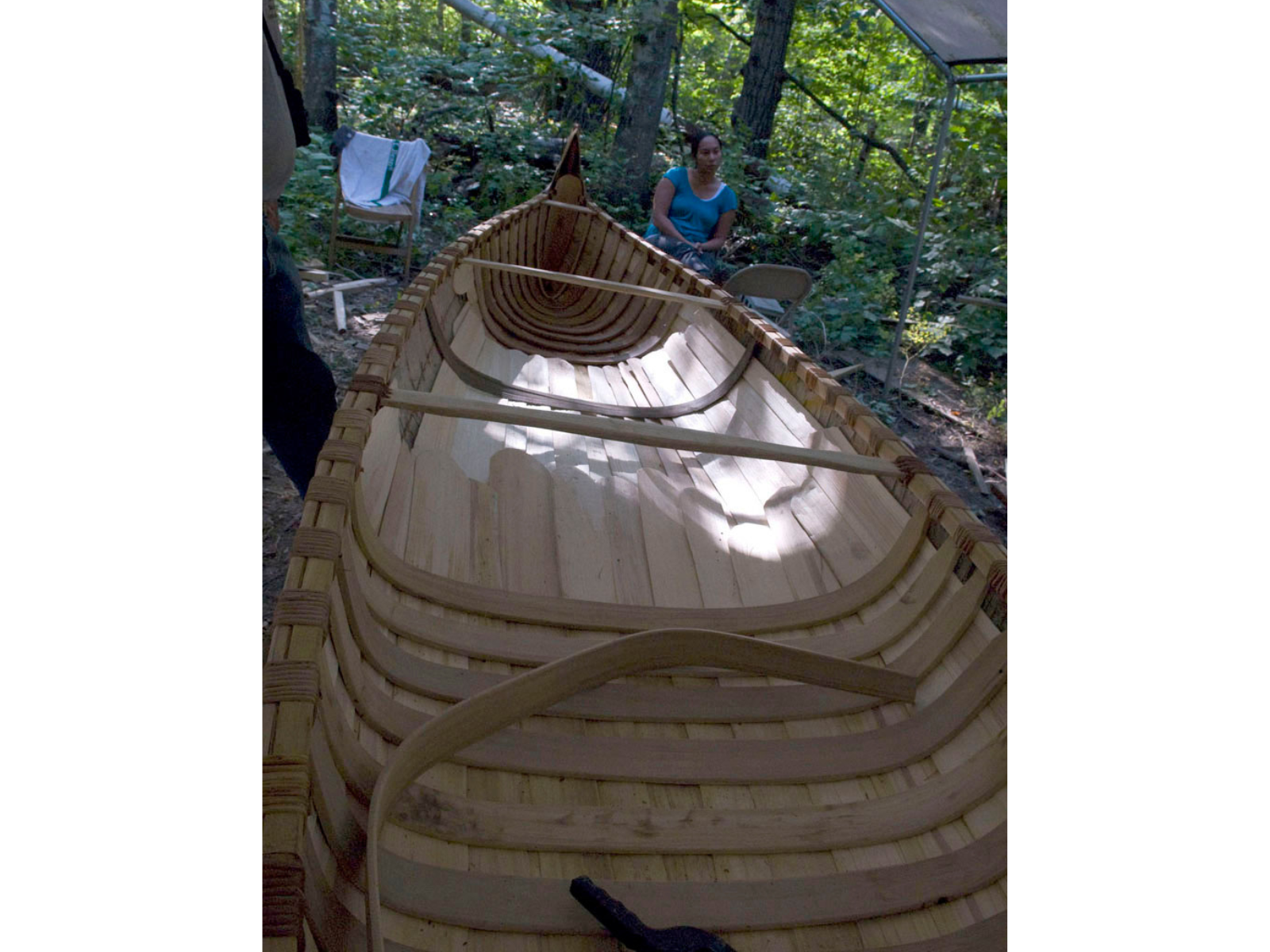
On Sunday we started to insert the planking and ribs into the canoe. We started at the end and worked towards the middle. The pairs of ribs are for either end, keeping the shape identical front to back. A finished birch bark canoe can technically be paddled with either end as the stern or bow. We decided to use two different colours of spruce roots at each end to differentiate, the bow we used light spruce roots and the stern we used dark spruce roots. All photos in this blog are the property of Kevin Brownlee (personal collection).
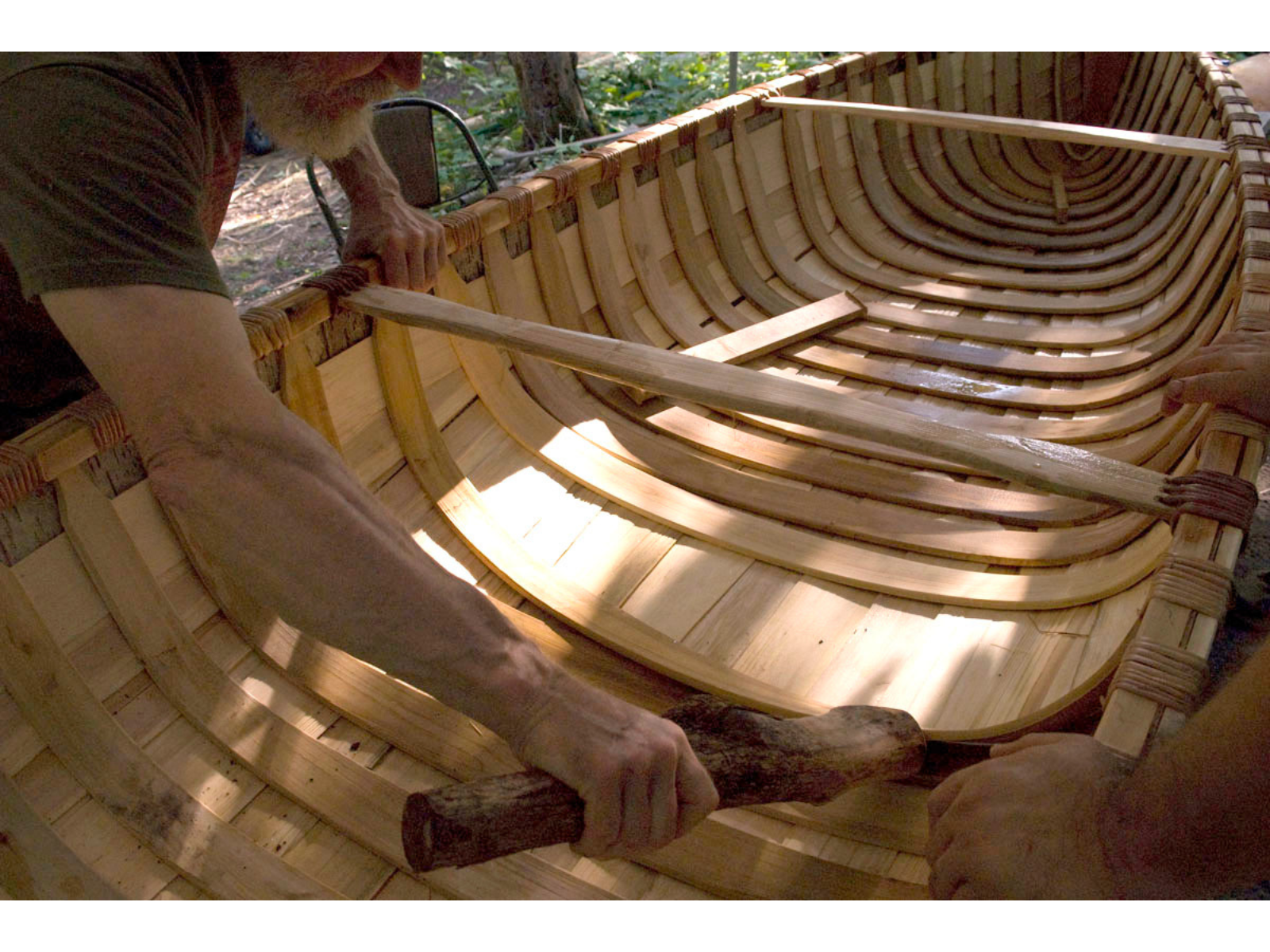
A partially constructed birchbark canoe, with an individual placing planking along the base of the canoe.
Grant places the cedar planking in the canoe before the ribs are added.

A hand reaches into frame holding a tick stick of iron wood as a mallet to place the ribs in the base of the canoe.

Grant hammers in a rib with an iron wood mallet.

Looking down a birchbark canoe under an open-sided tent. Ribs are placed along half of the canoe so far. At the far end an individual rests in a lawn chair.

Starting to add the ribs on the other side. Notice half of the ribs are already in place.

It was truly amazing watching Grant hammer in the ribs. Each was measured, cut to length, the end was tapered and then it was hammered into place. The tension put on the bark as the ribs were inserted is amazing and the canoe truly takes form.

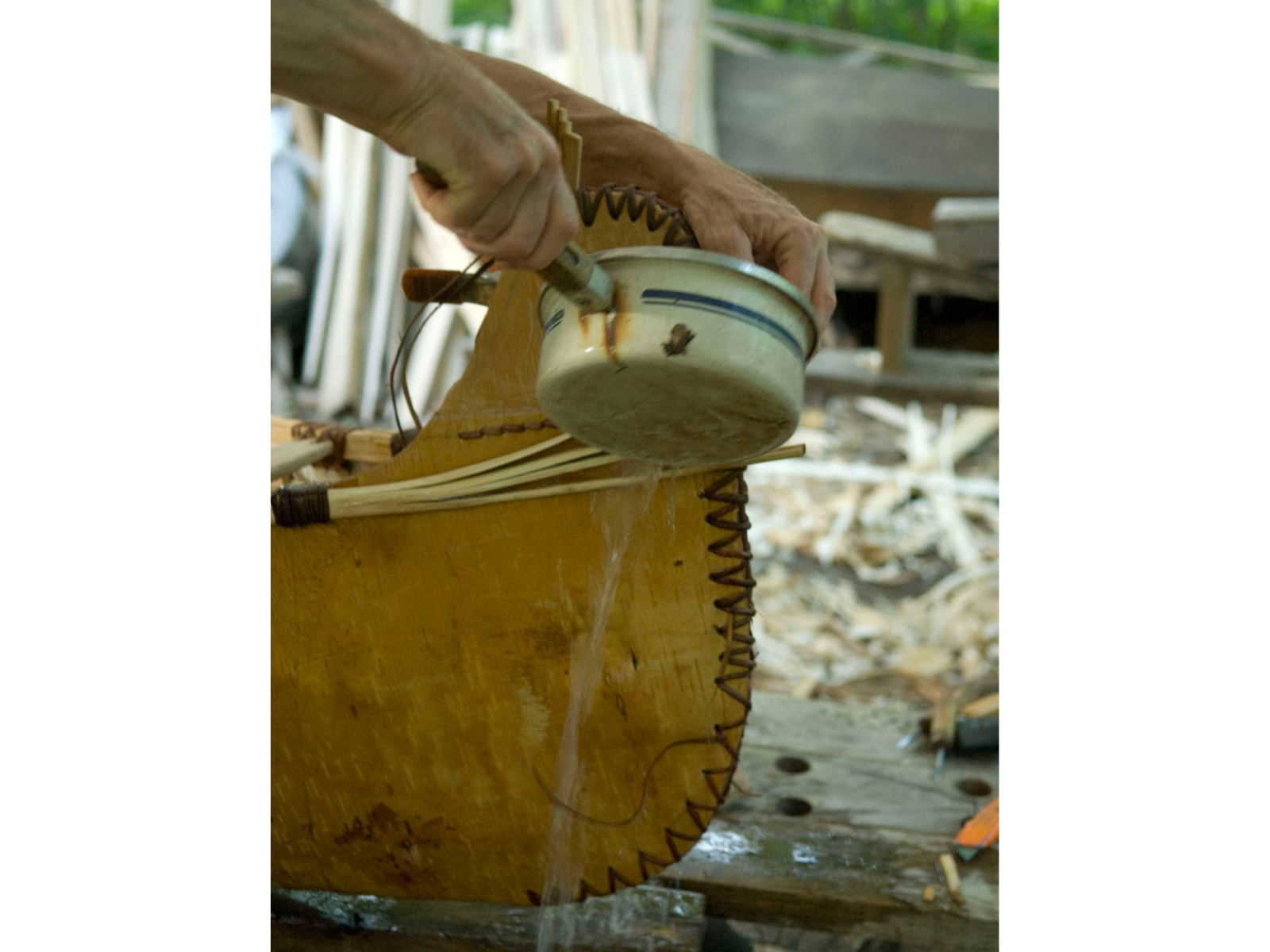
The last rib is in the very middle and the wood was drenched with hot water to help the wood bend. It looks like the rib should break and then it slips into place.

A hand reaches into frame holding a tick stick of iron wood as a mallet to place the final rib in the base of the canoe.

Bending and installing the last rib.

Hands reach into frame holding a small saucepot and pouring water onto the exterior end of a birchbark canoe.

Bending the out wales with hot water.

Hands reach into frame stitching with thick material closing the edge end of a canoe.

Stiching up the out wales.

More Pictures of Canoe Building

By Kevin Brownlee, past Curator of Archaeology

Two individuals working together to bend a strip of wood into a rough, wide horseshoe shape.

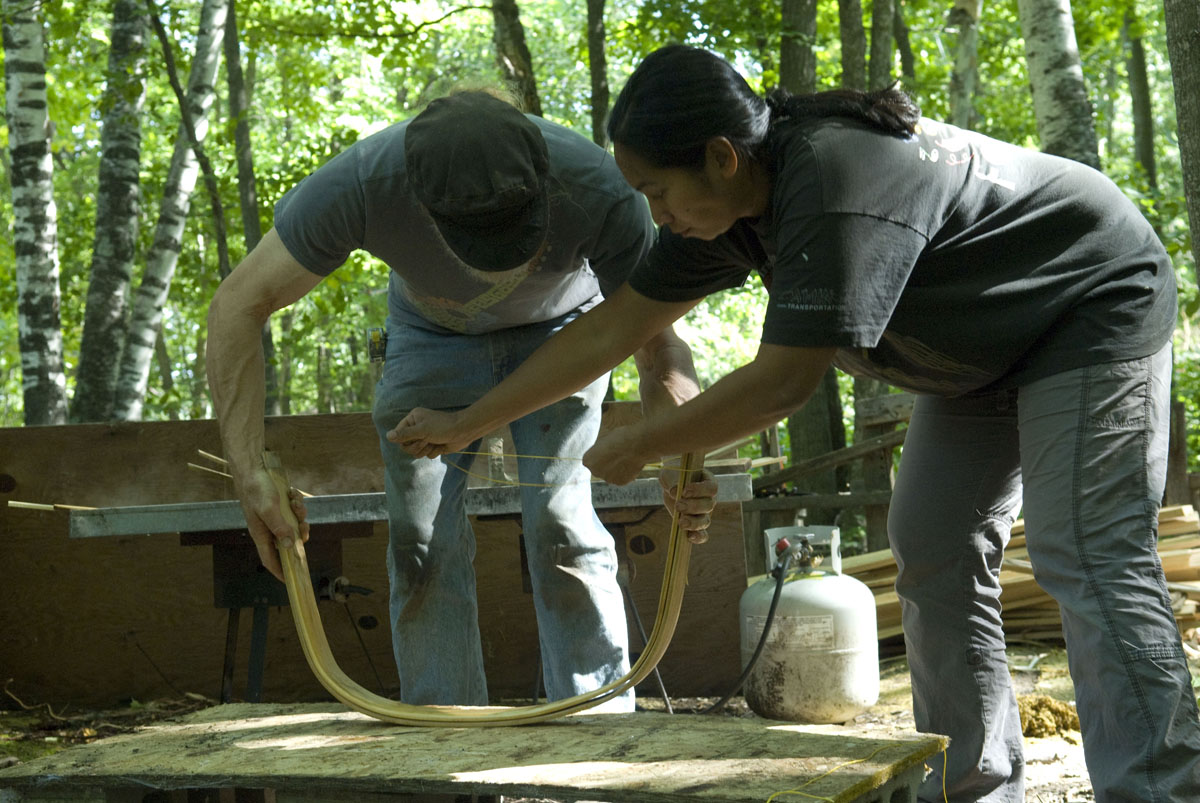
Canoe ribs being bent into shape Grant and Myra.

Close up on the joint of a canoe frame.

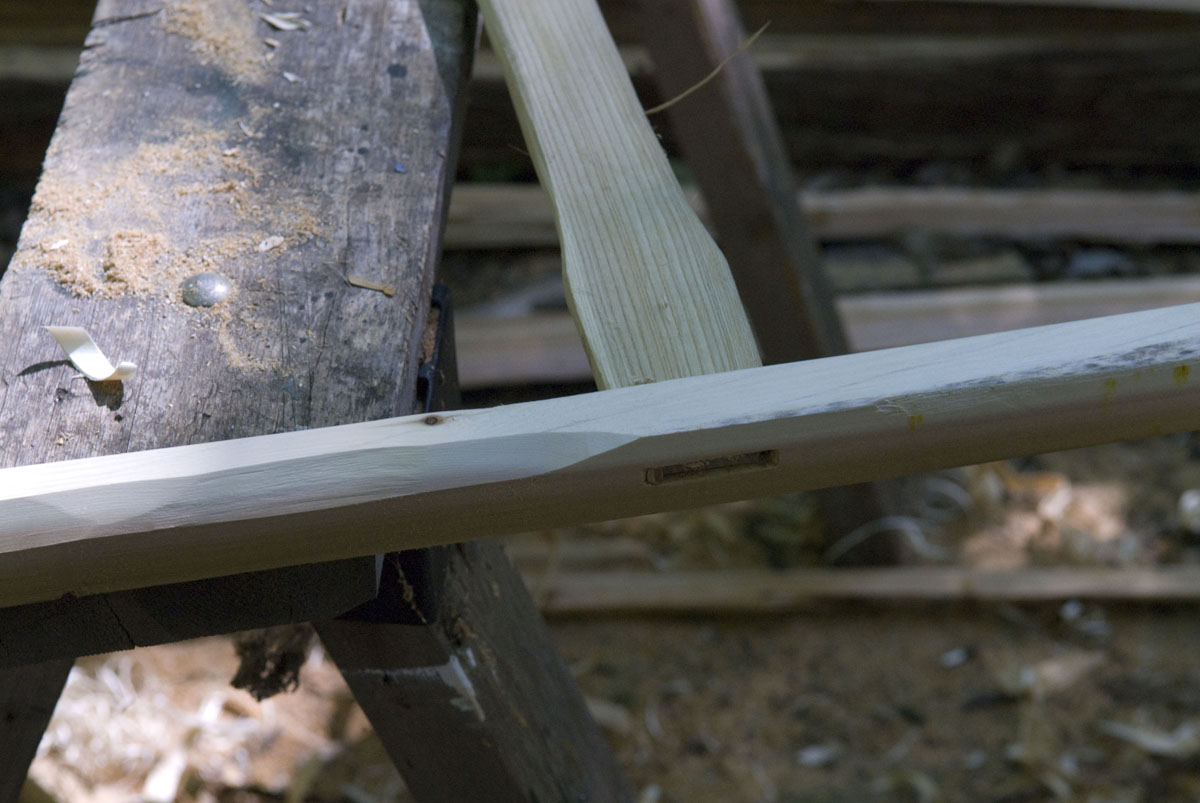
Assembling the wood frame.

An individual splitting one of three pieces of wood coming together out of the right edge of frame.

Splitting cedar stem piece.

The Birch Bark Canoe Step 3

By Kevin Brownlee, past Curator of Archaeology


Over the course of the next 6 days all efforts were on completing the Birch Bark canoe. Each morning I would get up at 6:00 am and review my notes and look at the canoe in order to see if they were complete. Once I updated my notes, and had coffee and breakfast, work would start on the canoe.

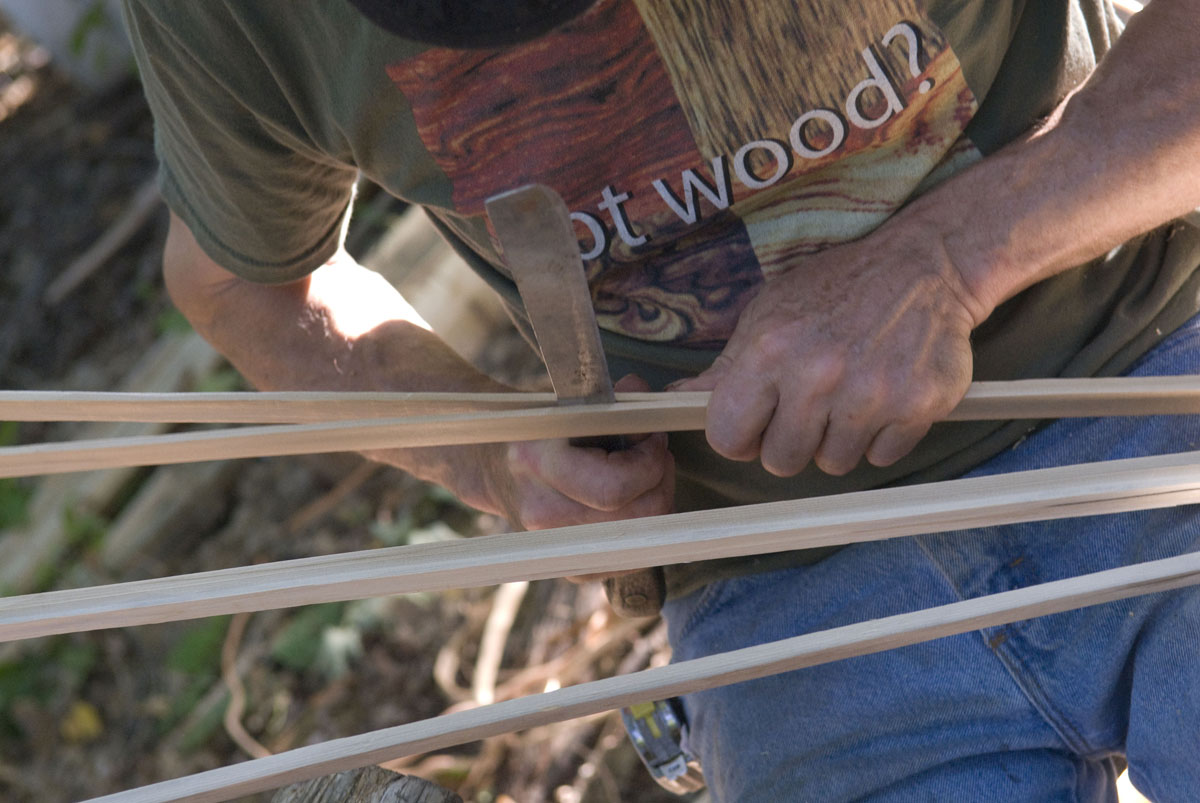
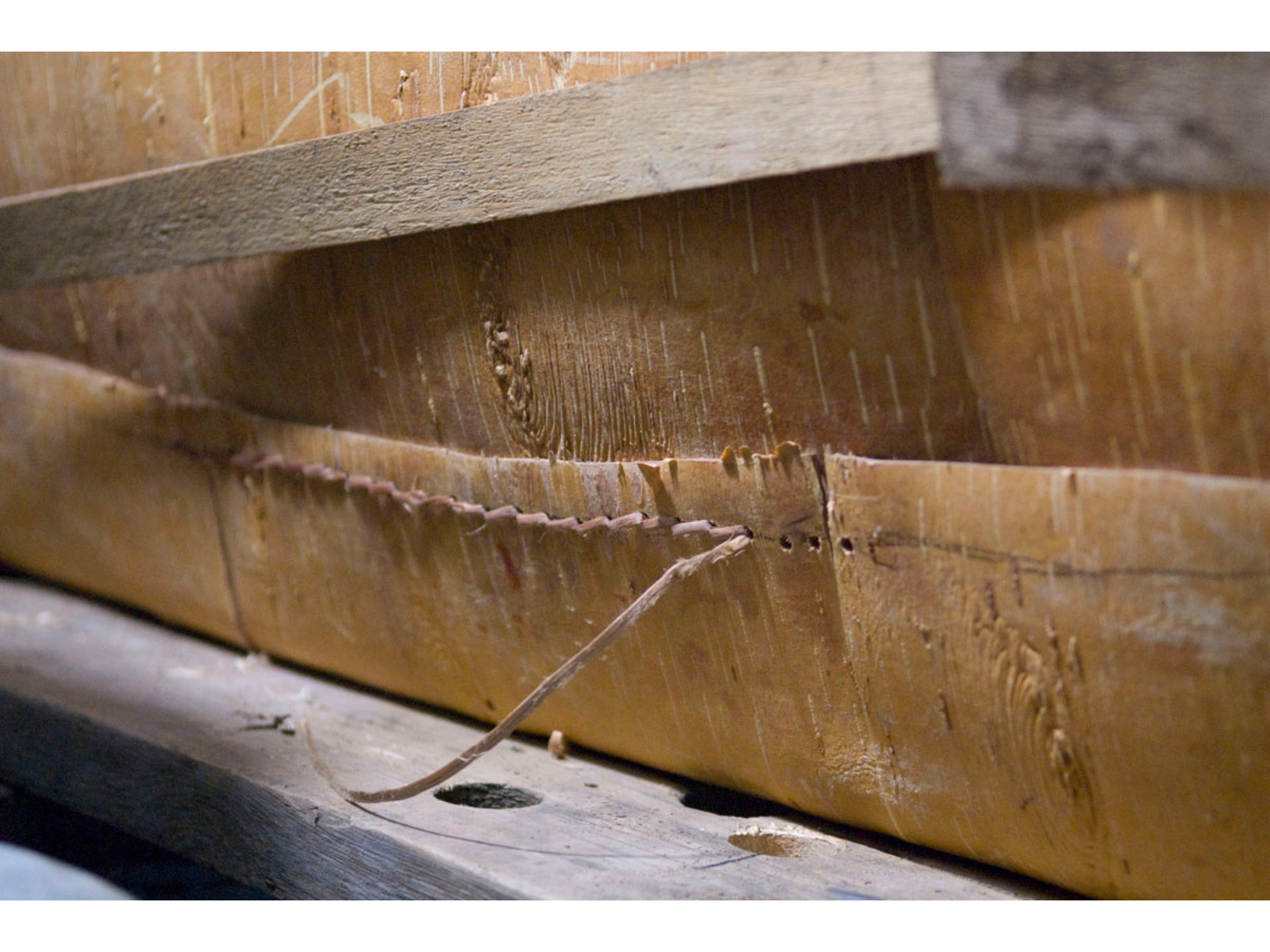
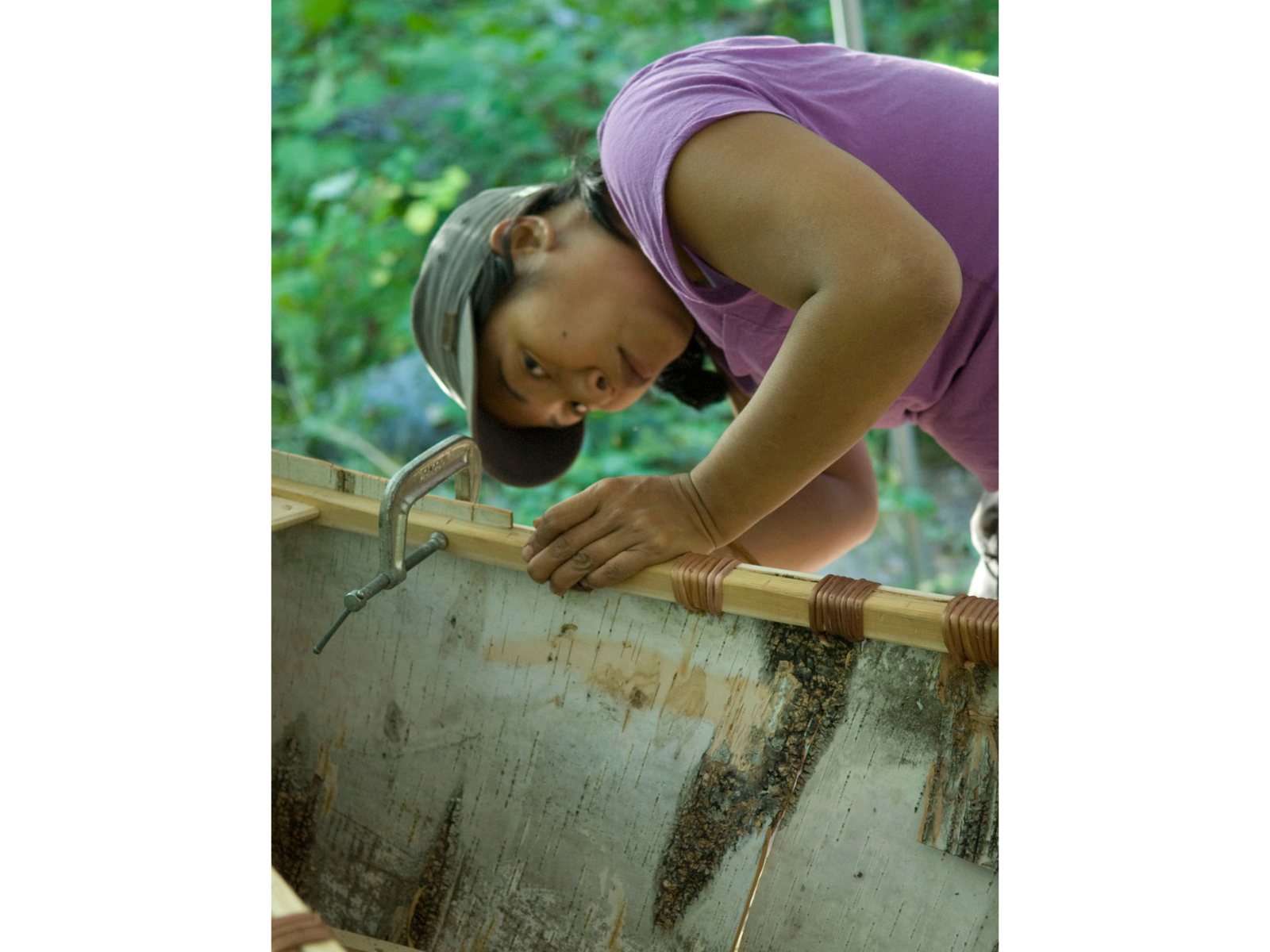
Since Myra and I were both beginners, we were given the task of sewing all the seams together with the 500 feet of finished spruce roots. While we worked on that, Grant focused his attention on the wooden structure of the canoe including the inwales, outwales, gunwale caps, thwarts, ribs, planking, headboard, and stem pieces.

All photographs from this post are the property of Kevin Brownlee (personal collection).

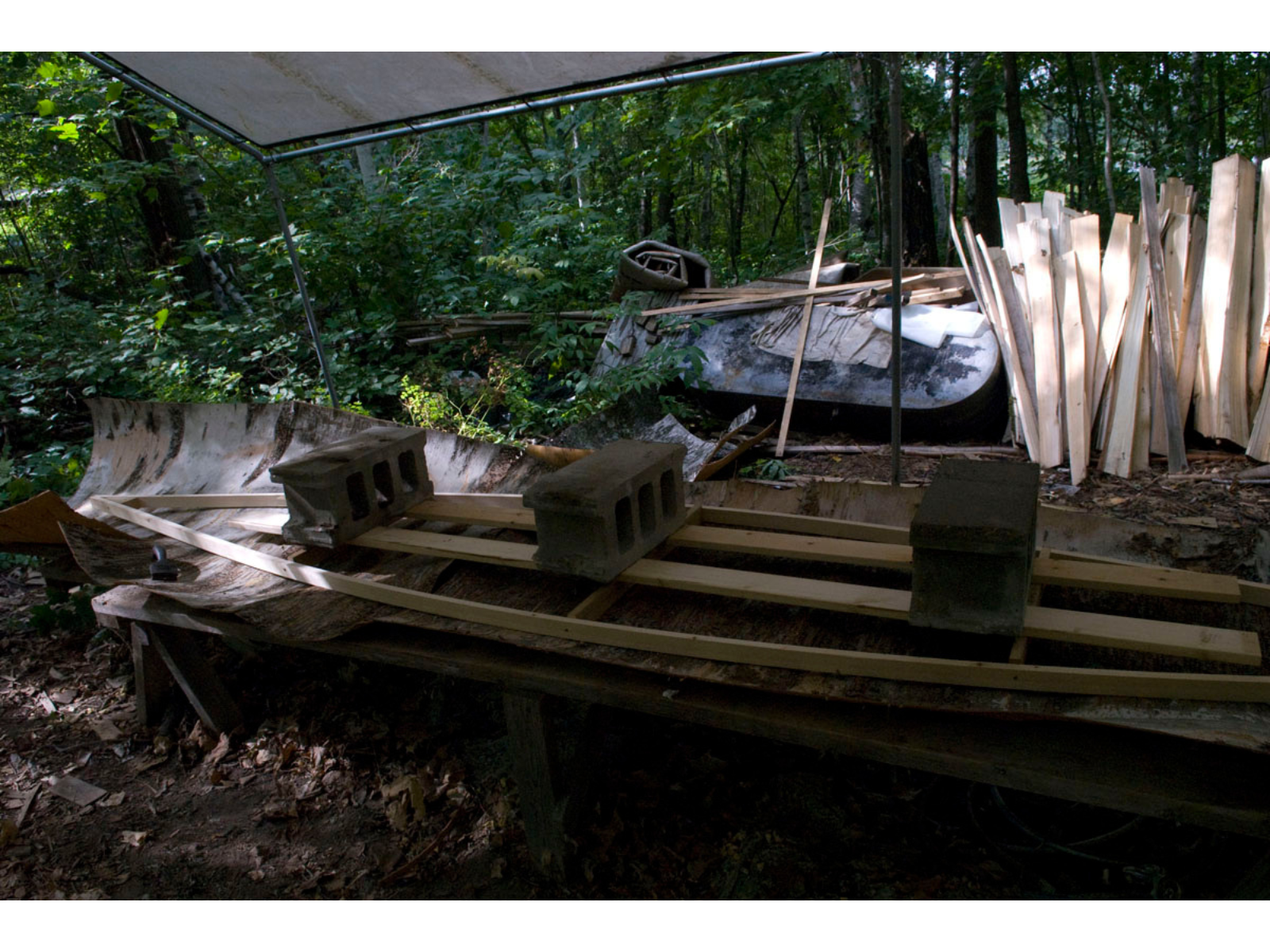
The wooden frame of a canoe laid on top of large strips of birchbark with three large cinderblocks weighing down the wooden frame.

Weighing down the bark.

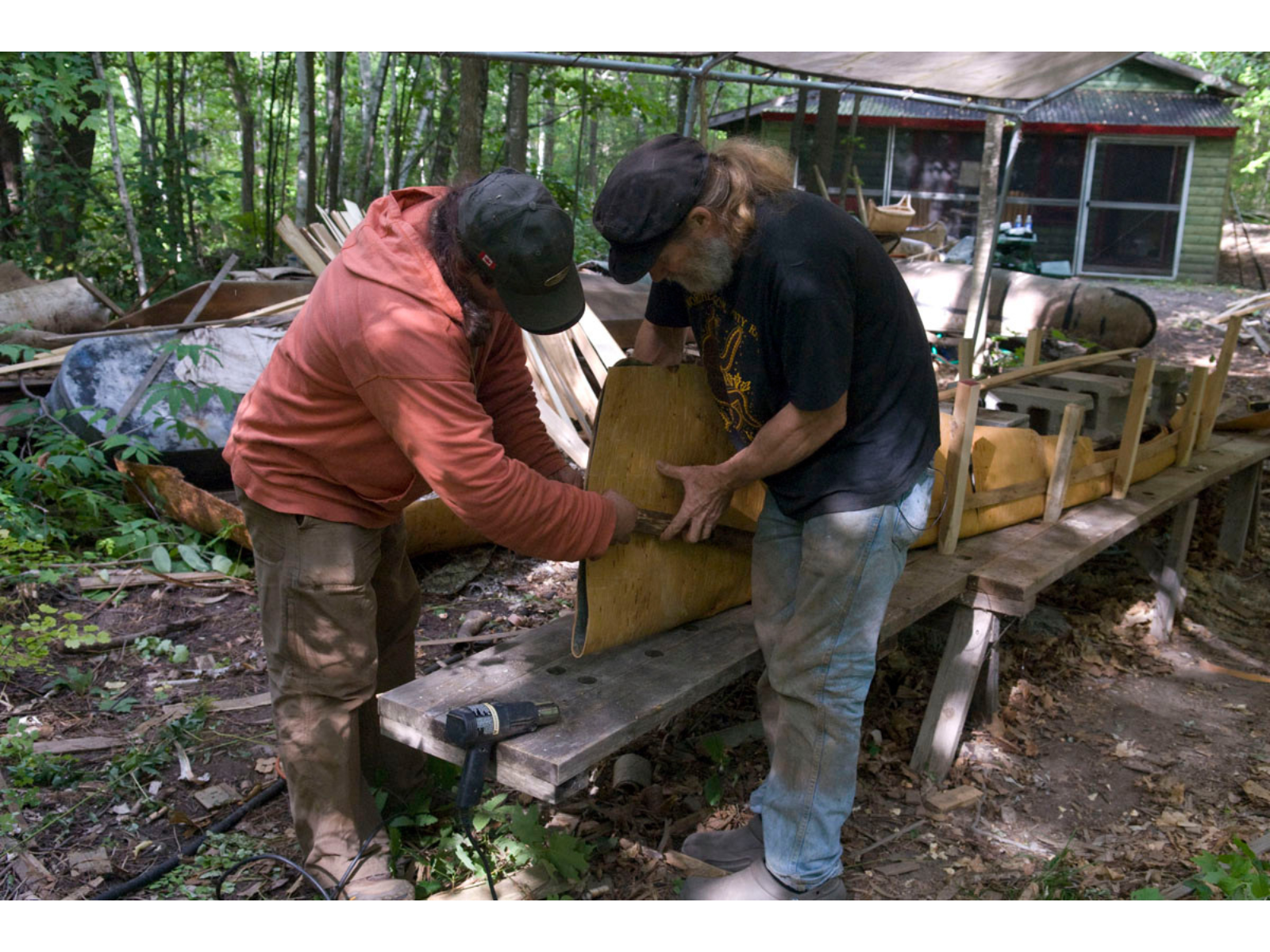
Two individuals working together to wrap and place birch bark strips around the frame of a canoe.

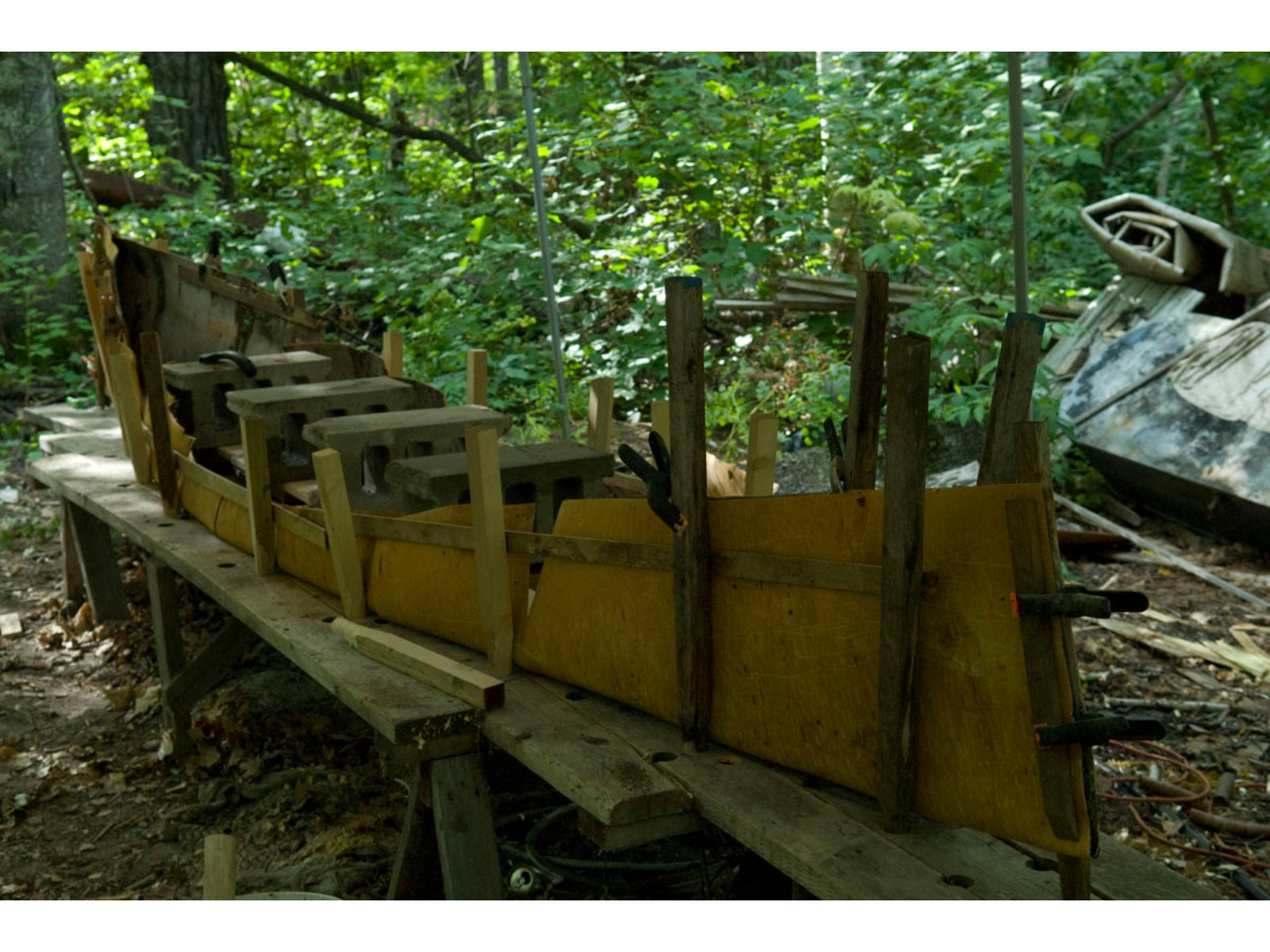
Wooden braces spiked into planks bracing the rough shape of a canoe, holding the birchbark in place, with cinderblocks in the middle weighing it down.

Two individuals inspecting a braced canoe frame from the one end.

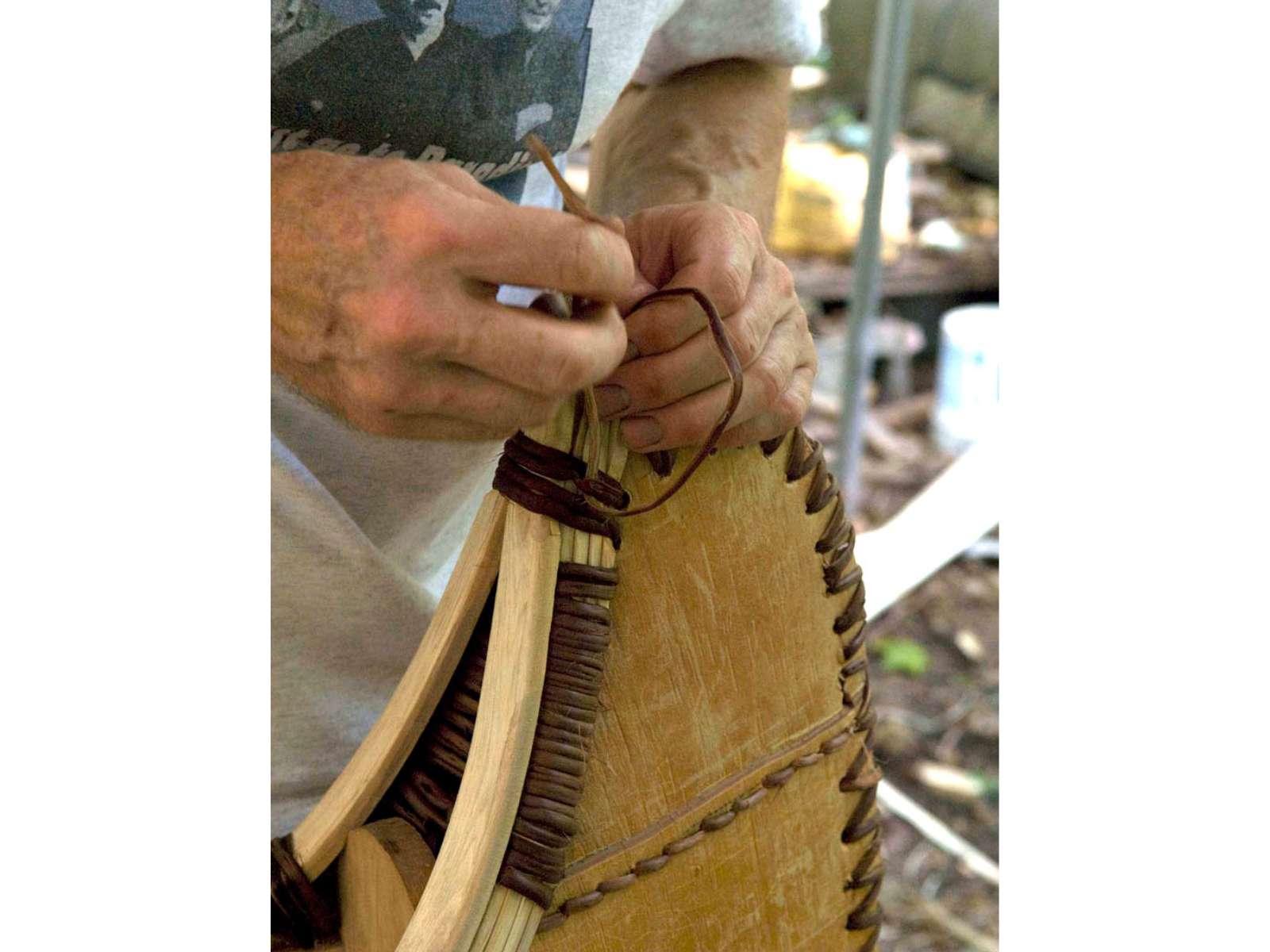
Close up on thick cedar root stitching along the lower side of a birch bark canoe.

Sewing with spruce roots.

An individual leaning over at the side of a in-construction canoe, sewing along the upper part of the frame.

Myra Sewing the gunwales.

The inwales, outwales and gunwales caps were split from a 22 foot long cedar pole. The 40 ribs were made from 3 – 5 foot sections of large cedar logs (60 inches in diameter). Five thwarts needed for the canoe were made Black Ash. Myra and I also made over 80 iron wood pegs for pining the inwale, outwale and gunwale caps together.

The canoe started as flat sheets of birch bark and each day began to the canoe looked more and more like a real canoe. By the end of day 5 the canoe was completely sewn and ready for the ribs and planking.


Image: Jim Jones Senior helps to sew the gunwales.

John Halkett, William Kempt, & the Red River Settlement

By Dr. Jamie Morton, past Curator of the Hudson’s Bay Company Museum Collection


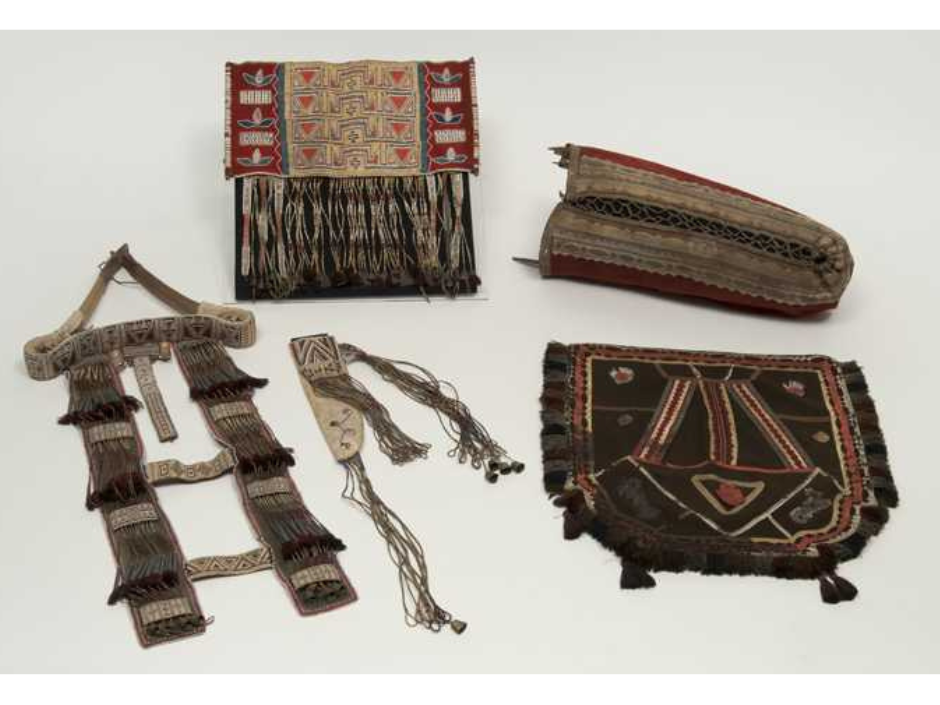
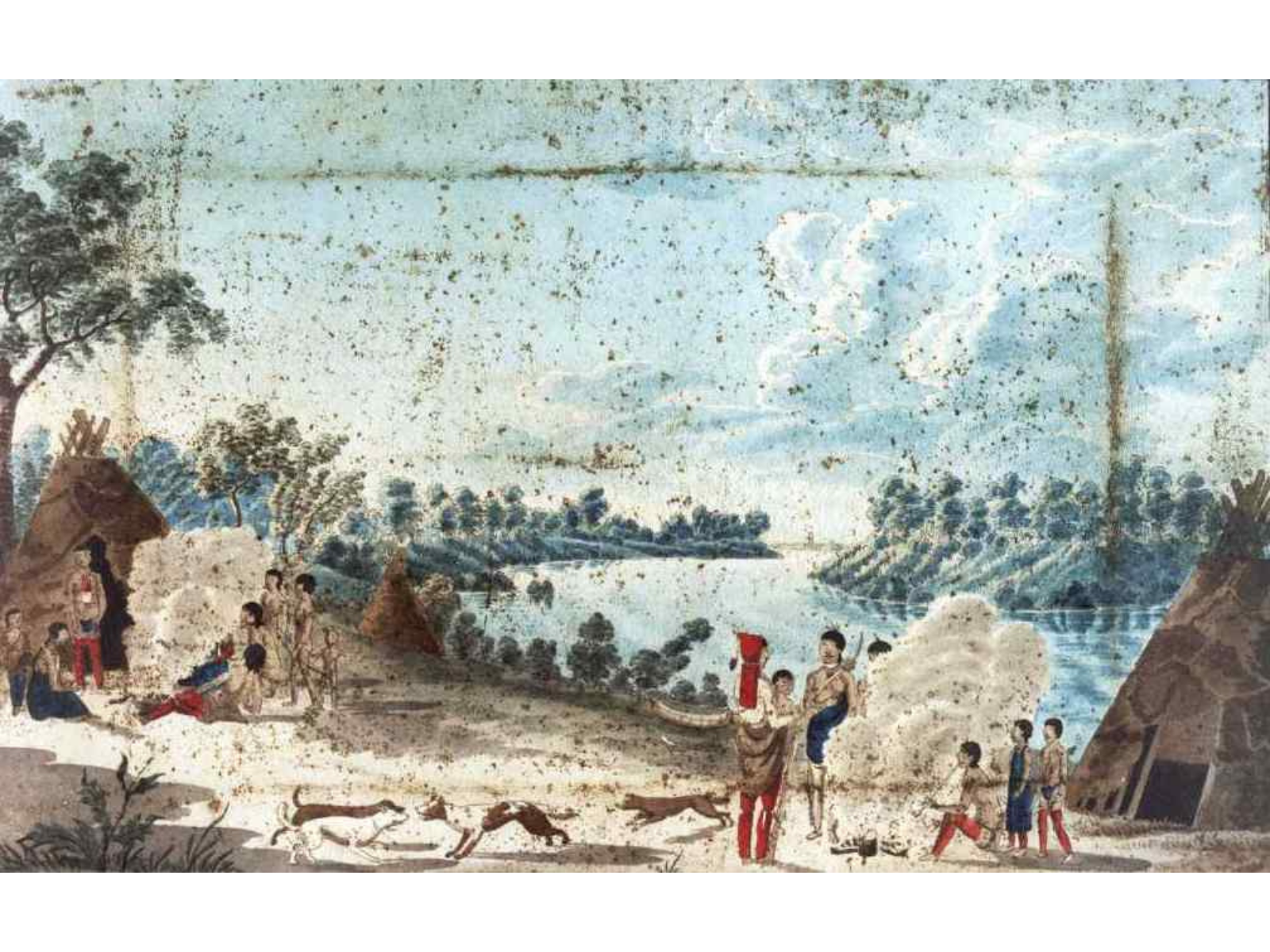
John Halkett’s visit to British North America came just a decade after his brother-in-law, Lord Selkirk, initiated the Red River resettlement scheme – and the bicentenary of the arrival of the Selkirk settlers is being commemorated in many ways in 2012. There is a variety of objects in the HBC Museum Collection that relate to these formative years of the Red River Settlement, starting with the Halkett collection. Another important group in the HBC Collection relating to this place and time was assembled by William Kempt.

A series of artifacts clustered together on a white background.

The fine collection of First Nations objects assembled by William Kempt in the 1820s.

A painting depicting a small group of people interacting along a riverbank near tipis.

Untitled (Scene on River Bank), Peter Rindisbacher, 1822-24, watercolour. This is one of the paintings collected by William Kempt, now in the HBC Museum Collection. TMM HBC 83-23-F.

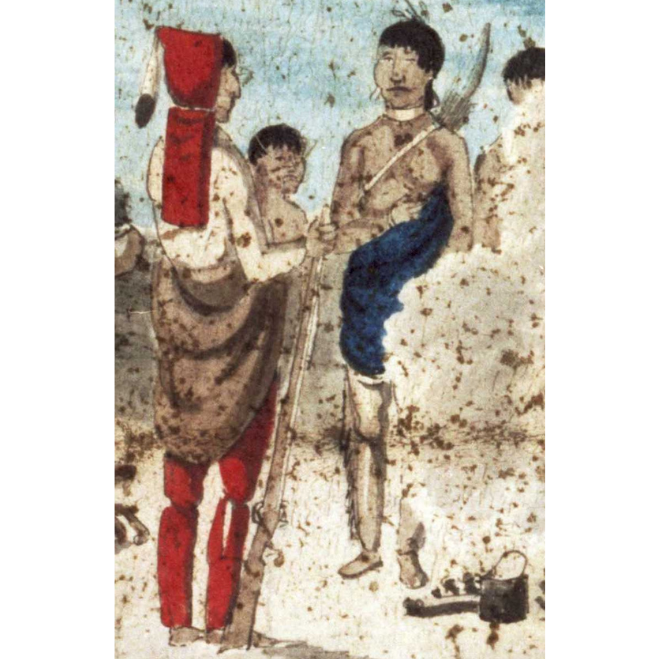
Close-up on the painting in the previous images showing two individuals in discussion, one of whom is holding a child.

He had a keen eye for material culture, and it is fascinating to compare objects collected by individuals like Halkett and Kempt with Rindisbacher’s portrayals of the objects being worn or used by the people of Red River in the 1820s.

One of the things that makes the Hudson’s Bay Company Museum Collection so fascinating is these sorts of stories and connections that exist between the collectors, the collections, and the objects.  Added to the stories of the objects and their creators, this means that the HBC Collection symbolizes and evokes broad historical themes, in a way that may be unique among Canadian museum collections.


Image: Detail of TMM HBC 83-23-F. This portrays some of the material culture of the Red River population in the 1820s. Objects represented by Rindisbacher such as the woolen and hide leggings, woolen hood, iron cooking pot, trade gun, and bow and arrows are found in the HBC Collection at The Manitoba Museum.

Congratulations to Ed!

By Dr. Graham Young, past Curator of Palaeontology & Geology


Ed Dobrzanski is a “fixture” at the Museum. He had been a volunteer here before I started back in in 1993, and he has volunteered continuously for the past 20 years. Ed has done tremendous work as an amateur paleontologist, collecting, preparing, studying, identifying, and cataloguing fossils. He has contributed to paleontological field and laboratory work in a great variety of ways. For his all-round efforts, many of us are delighted that Ed has just been named as the recipient of the Katherine Palmer Award, a North America-wide award for amateur paleontologists, presented annually by the Paleontological Research Institution.

An inveterate collector with interests in a great variety of objects, Ed had a long career as a government meteorologist. When staff reductions resulted in an opportunity for early retirement, Ed took advantage of this to turn his volunteer work into a daily avocation. In his time here, Ed has contributed tremendous knowledge to the organization of fossil collections as varied as brachiopods (lamp shells), fishes, and bivalves. He has also donated many specimens to the Museum (and to other institutions such as the Royal Ontario Museum), has contributed to exhibit development and public programs, and assists with all sorts of tasks in other departments of the Museum!

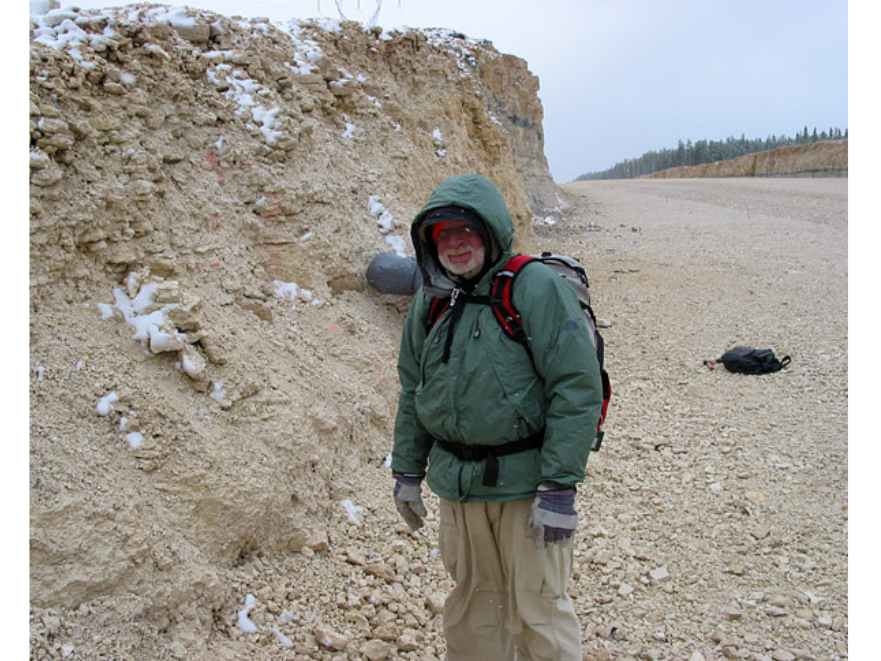
An individual wearing a jacket fully zipped, with hood up, and a backpack stands next to a rocky dune.

My colleagues and I are fortunate to have Ed as a collaborator on many research projects. He is skilled with the essential field and laboratory tools: whether using a hammer, GPS, shotgun, survey equipment, microscope, rock saw, or lapidary grinder, Ed has considerable expertise. He takes wonderfully precise notes, understands maps thoroughly, and maintains a compendious knowledge of obscure fossil localities. Ed has been a key member of my field teams, and has also collaborated in the field with many other scientists such as Bob Elias (University of Manitoba), Dave Rudkin (ROM), Jisuo Jin (University of Western Ontario) and Jan Audun Rasmussen (Natural History Museum of Denmark). His efforts have resulted in the co-authorship of several papers, a guidebook, and many conference abstracts.


Image: Ed suffering through spring snow and winds, during fieldwork on the Grand Rapids Uplands.

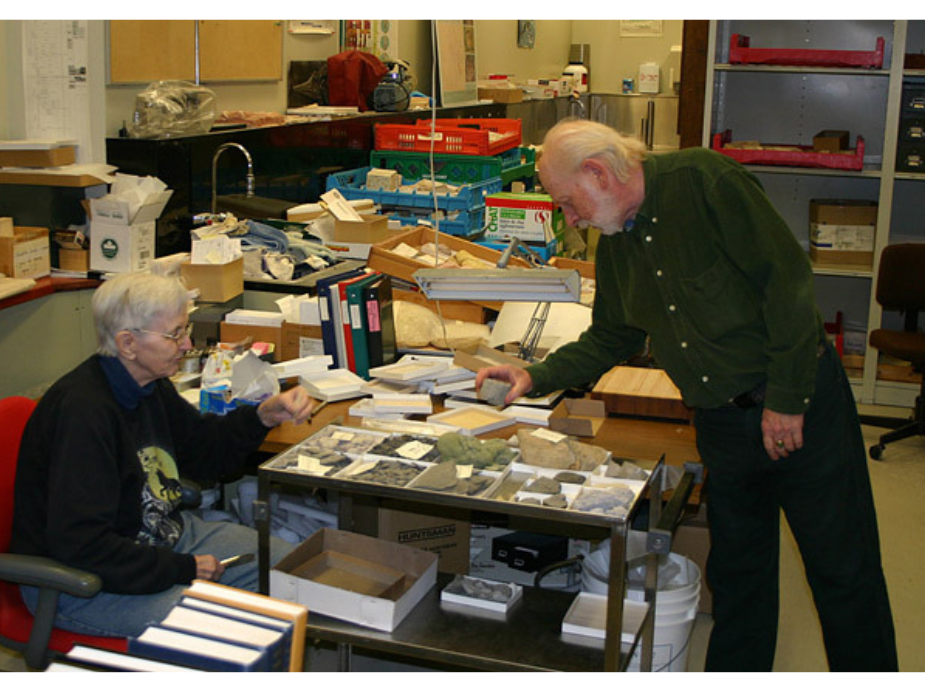
Two individuals standing either end of a work table with a number of specimens laid out across it.

Florence Zawislak (L) and Ed discuss a cartful of specimens.

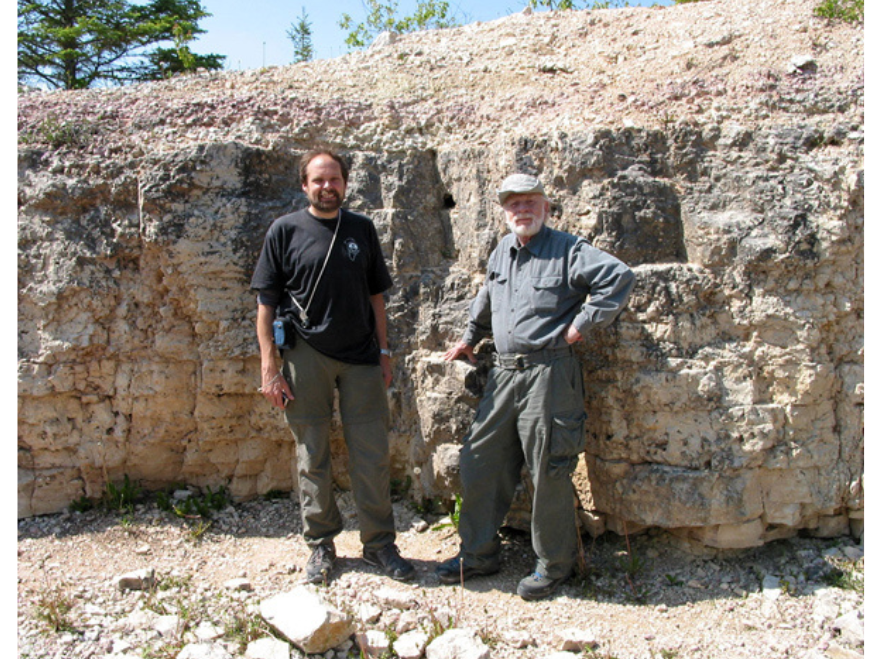
Two individuals standing in front of a large rocky wall.

Ed assisted visiting Danish researcher Dr. Jan Audun Rasmussen, who carried out field research in southern Manitoba.

Ed Dobrzanski is a tremendous asset to the science of paleontology in Manitoba and beyond; it is wonderful to see this recognized!

Display of Detritus and Delight

By Dr. Graham Young, past Curator of Palaeontology & Geology


The spaces that house Museum curators and collections are, perhaps, notorious for appearing to be crammed full of objects. Our work consists of collecting and organizing, and actively-collecting Museum scientists typically have many specimens spread out for study and cataloguing. Our collections rooms contain many thousands of well-organized specimens, but it is tricky to find space for the largest pieces. For this reason, some of our biggest specimens are not stored in the official Natural History storage: ever since I have worked at the Museum, most of our large mammal mounts have been in alcoves along the hallways here. If I wish to, I could say “good morning” to two muskoxen, a grizzly bear, and two mule deer just in the short space between the elevator and my office!

It used to be that, when the elevator stopped at our floor, those inside would glance out to see our creatures, safe in their protective plastic cocoons. Although this may be an interesting sight (if you know what they are), it is hardly a fitting introduction to the great variety of activities here, and it made it look rather like a warehouse. A few years ago, we decided to remedy this; when an old display case came available in the Museum basement, we grabbed it and placed it facing the elevator to house an introductory exhibit.

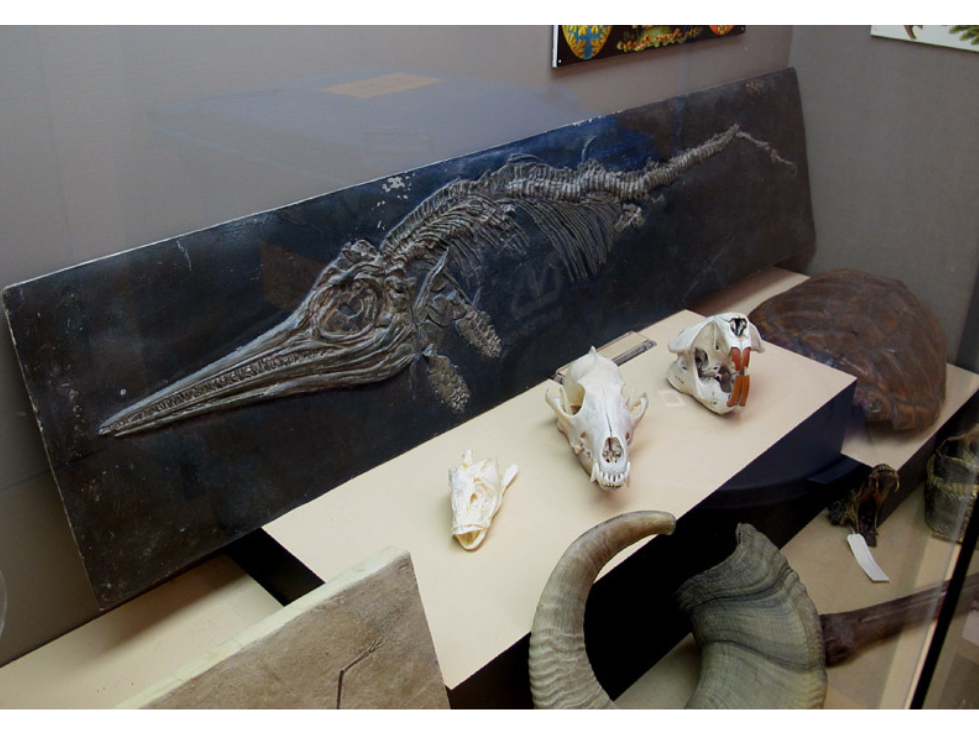
A replica of a fossil specimen in a display case positioned in front of three animal skulls.

A replica ichthyosaur rests behind a variety of skulls: a large fish, a coyote, and a beaver.

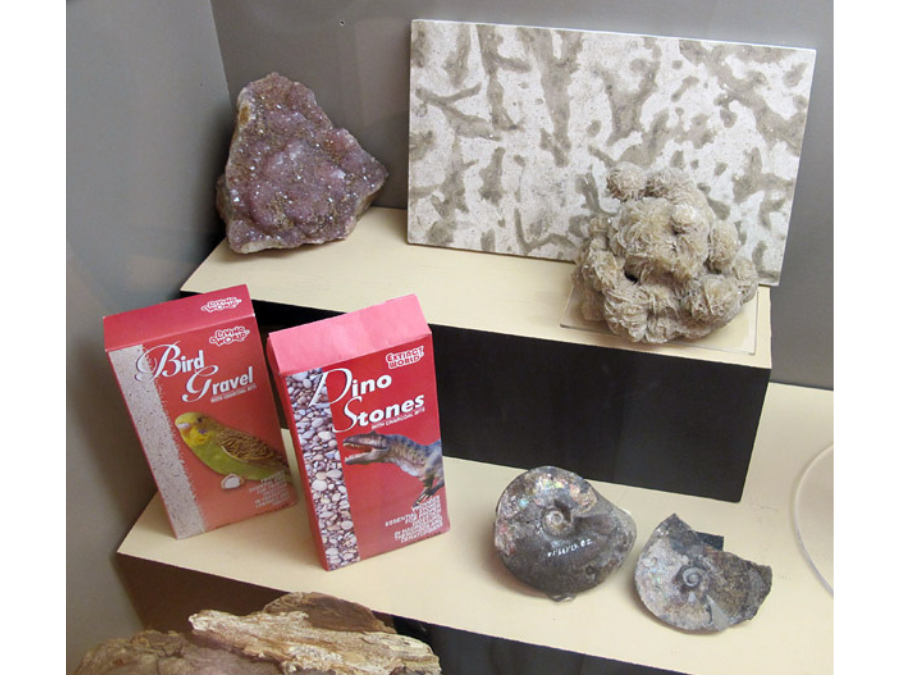
Close up in a display case showing a number of mineral specimens and two red boxes labelled "dino stones".

A grouping of minerals, Tyndall Stone, fossil ammonoids, and bird gravel and “dino stones” (our idea of what pet products would look like if people kept dinosaurs!).

This display has taken years to develop, because we were always getting sidetracked with our real work! We placed a few items into the case right after we moved it, but then it sat untended for some time. Returning to the case a couple of years ago, we added a lot of interesting pieces and planned to include a title explaining what it was about, but again we of course became busy with projects such as the Biodiversity and Colours in Nature exhibits. Then, this past week, we finally managed to “finish” this display, at least for the moment, adding a title panel and several of the wonderful Haeckel posters that had been included in the Biodiversity exhibit.

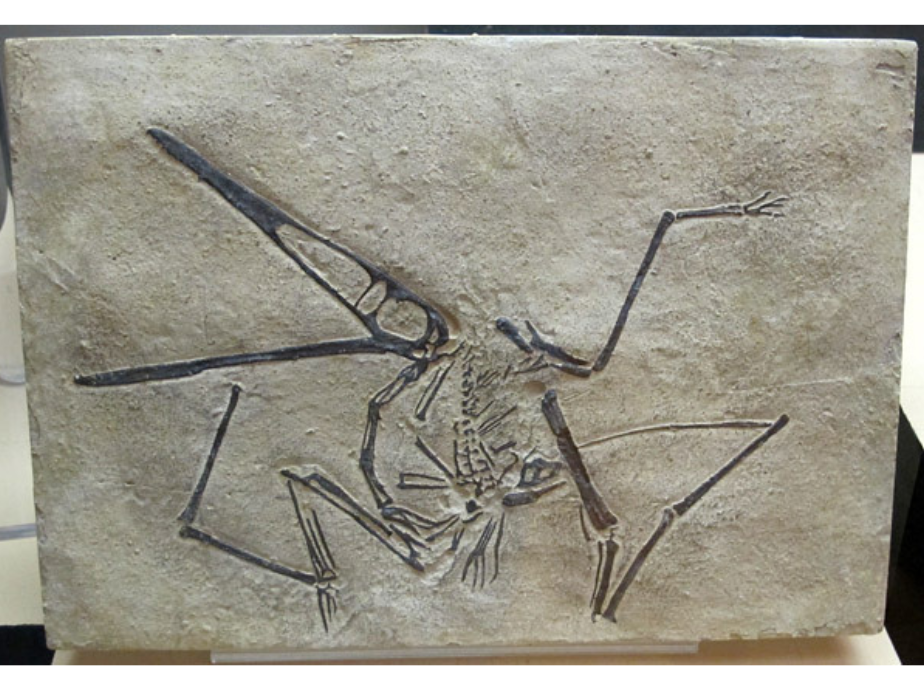
A replica fossil of a pterosaur in stone.

This replica pterosaur was beautifully painted by Debbie Thompson.

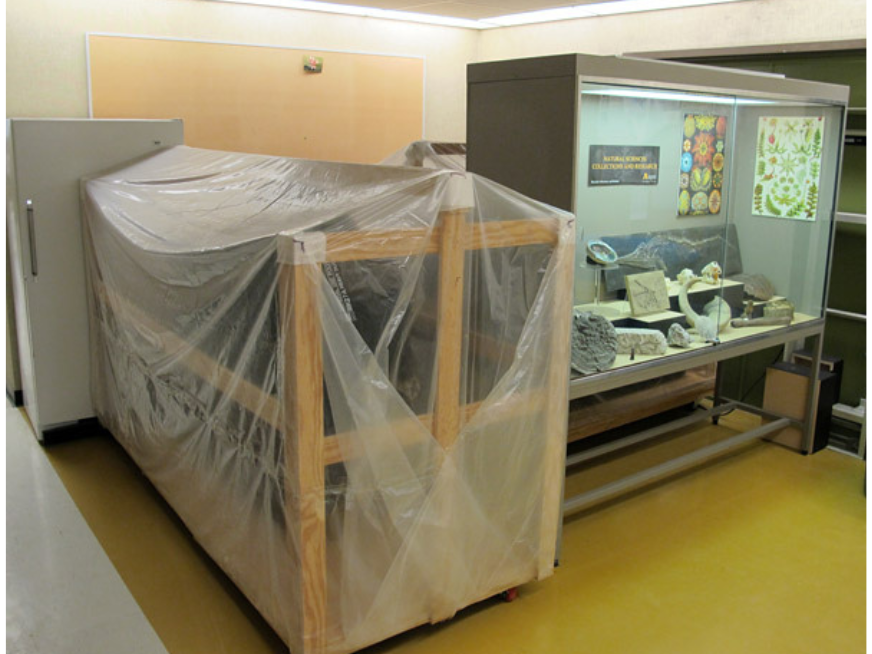
A specimen display case positioned in front of a specimen freezer and next to a mounted muskox specimen on a wrapped cart.

This angled view of the case shows how it is surrounded by large mammal mounts (under the plastic, that is a muskox on a cart), with a specimen freezer behind.

What is the purpose of this case, and why have we decided to feature the particular items that are in there? As well as providing “eye candy” for those who happen to see it from the elevator on their way to other floors, we wanted the case to introduce the basic research and collecting disciplines that occupy this floor: Zoology, Botany, and Geology/Paleontology. Since it is not climate-controlled, and is subjected to dust, light, and vibration, all the items in it are robust. They are generally replicas or are from the stores of “teaching grade” objects lacking basic data.

Although the choices were limited, we were pleased that we could include some of our favourite sorts of items (an ichthyosaur replica, a box of fake “dino stones”), and examples of things related to some of the research that takes place here (Tyndall Stone fossils, snake skin). Undoubtedly the display will continue to evolve in the coming years as we come upon other suitable exhibits for it!