



Goodbye Mars Hoax... for another year, anyway

Goodbye Mars Hoax… for another year, anyway

Yet another August has brought yet another rendition of the Great Mars Hoax. A viral email telling people Mars would be as big as the Moon on August 27 derailed several days of work while I answered hordes of public inquiries about what would be seen. (Short answer: nothing.)

Don’t get me wrong, I love answering questions from the public. It’s a chance to interact one-on-one with people interested in science and astronomy, genuinely curious about the night sky. Unfortunately, in this case I had to tell people that what they read on the internet just wasn’t true. A lot of people were disappointed in the answer, and in the sky in general.

Like any good hoax, this one grew around a nugget of truth. On August 27, 2003 (note the year!), Mars did pass about as close to Earth as it could get. We were out at Bird’s Hill Park for several public telescope nights back in 2003, and we had something over 10,000 people turn up to see the Red Planet. To the unaided eye, it looked like a really bright, reddish-coloured star – nowhere near as big as the moon, though. In fact, about 75 times smaller than the moon.

But somewhere, some astronomer with bad writing skills issued a press release or made a statement that went something like this: “On August 27, if you put a 75x eyepiece in your telescope, then you’ll see Mars appear about as big as the moon does to the unaided eye.” What should have been written was something like this: “On August 27 *2003*, if you put a 75x eyepiece in your telescope, Mars will appear *through your telescope* about as big as the Moon does *to the unaided eye*. ”

Those missing details were then helped along by some malicious person who added pictures of a total lunar eclipse (when the moon turns red), and the undated email now appears every year. It wasn’t true in 2003, and it’s not true now. In fact, it can never be true, since Mars can never get close enough to Earth to appear that big. I mean, the moon is only 374,000km away, and Mars is only about twice as big as the moon is. That means Mars would have to be less than 800,000 km away to appear that big. If Mars somehow broke out of its orbit and was moving closer to Earth, you can bet it would be *the* news item. Even if somehow all the astronomers in the world, professional and amateur, were involved in one of those giant government conspiracies that are always invoked to explain stupid things, we’d STILL find out about it. The tides would be affected, both in timing and size, so you’d have to get all the fishermen and sailors and everyone who lives near the ocean in on the conspiracy as well.

OK, enough ranting. The Mars Hoax does have a silver lining, though – I got to talk with a whole bunch of people who might not have called in otherwise, and I got to tell them where Mars really was in the sky – and Venus and Jupiter as well. Those folks got to see three planets in the sky that they might not have seen otherwise. For some of them, their personal universe got a little bigger because of it.

You can find out where the planets are – for real – on our “The Sky This Month” blog on the Manitoba Museum website. Visit

Yet another August has brought yet another rendition of the Great Mars Hoax. A viral email telling people Mars would be as big as the Moon on August 27th derailed several days of work while I answered hordes of  public inquiries about what would be seen. (Short answer: nothing.)

Don’t get me wrong, I love answering questions from the public. It’s a chance to interact one-on-one with people interested in science and astronomy, genuinely curious about the night sky. Unfortunately, in this case I had to tell people that what they read on the internet just wasn’t true. A lot of people were disappointed in the answer, and in the sky in general.

Like any good hoax, this one grew around a nugget of truth. On August 27th, 2003 (note the year!), Mars did pass about as close to Earth as it could get. We were out at Bird’s Hill Park for several public telescope nights back in 2003, and we had something over 10,000 people turn up to see the Red Planet. To the unaided eye, it looked like a really bright, reddish-coloured star – nowhere near as big as the moon, though. In fact, about 75 times smaller than the moon.

But somewhere, some astronomer with bad writing skills issued a press release or made a statement that went something like this: “On August 27th, if you put a 75x eyepiece in your telescope, then you’ll see Mars appear about as big as the moon does to the unaided eye.” What should have been written was something like this: “On August 27th *2003*, if you put a 75x eyepiece in your telescope, Mars will appear *through your telescope* about as big as the Moon does *to the unaided eye*. ”

Those missing details were then helped along by some malicious person who added pictures of a total lunar eclipse (when the moon turns red), and the undated email now appears every year. It wasn’t true in 2003, and it’s not true now. In fact, it can never be true, since Mars can never get close enough to Earth to appear that big. I mean, the moon is only 374,000km away, and Mars is only about twice as big as the moon is. That means Mars would have to be less than 800,000 km away to appear that big. If Mars somehow broke out of its orbit and was moving closer to Earth, you can bet it would be *the* news item. Even if somehow all the astronomers in the world, professional and amateur, were involved in one of those giant government conspiracies that are always invoked to explain stupid things, we’d STILL find out about it. The tides would be affected, both in timing and size, so you’d have to get all the fishermen and sailors and everyone who lives near the ocean in on the conspiracy as well.

OK, enough ranting. The Mars Hoax does have a silver lining, though – I got to talk with a whole bunch of people who might not have called in otherwise, and I got to tell them where Mars really was in the sky – and Venus and Jupiter as well. Those folks got to see three planets in the sky that they might not have seen otherwise. For some of them, their personal universe got a little bigger because of it.

You can find out where the planets are – for real – on our “The Sky This Month” section of the Planetarium’s website. Visit the Planetarium webpage here – there you’ll find all sorts of information on the sky, telescopes, and of course our shows and programs. Or you can always call me.

Scott Young

Scott Young

Planetarium Astronomer

Scott is the Planetarium Astronomer at the Manitoba Museum, developing astronomy and science programs. He has been an informal science educator for thirty years, working in the planetarium and science centre field both at The Manitoba Museum and also at the Alice G. Wallace Planetarium in Fitchburg, Massachusetts. Scott is an active amateur astronomer and a past-President of the Royal Astronomical Society of Canada.

A Perfectly Miserable Field Day

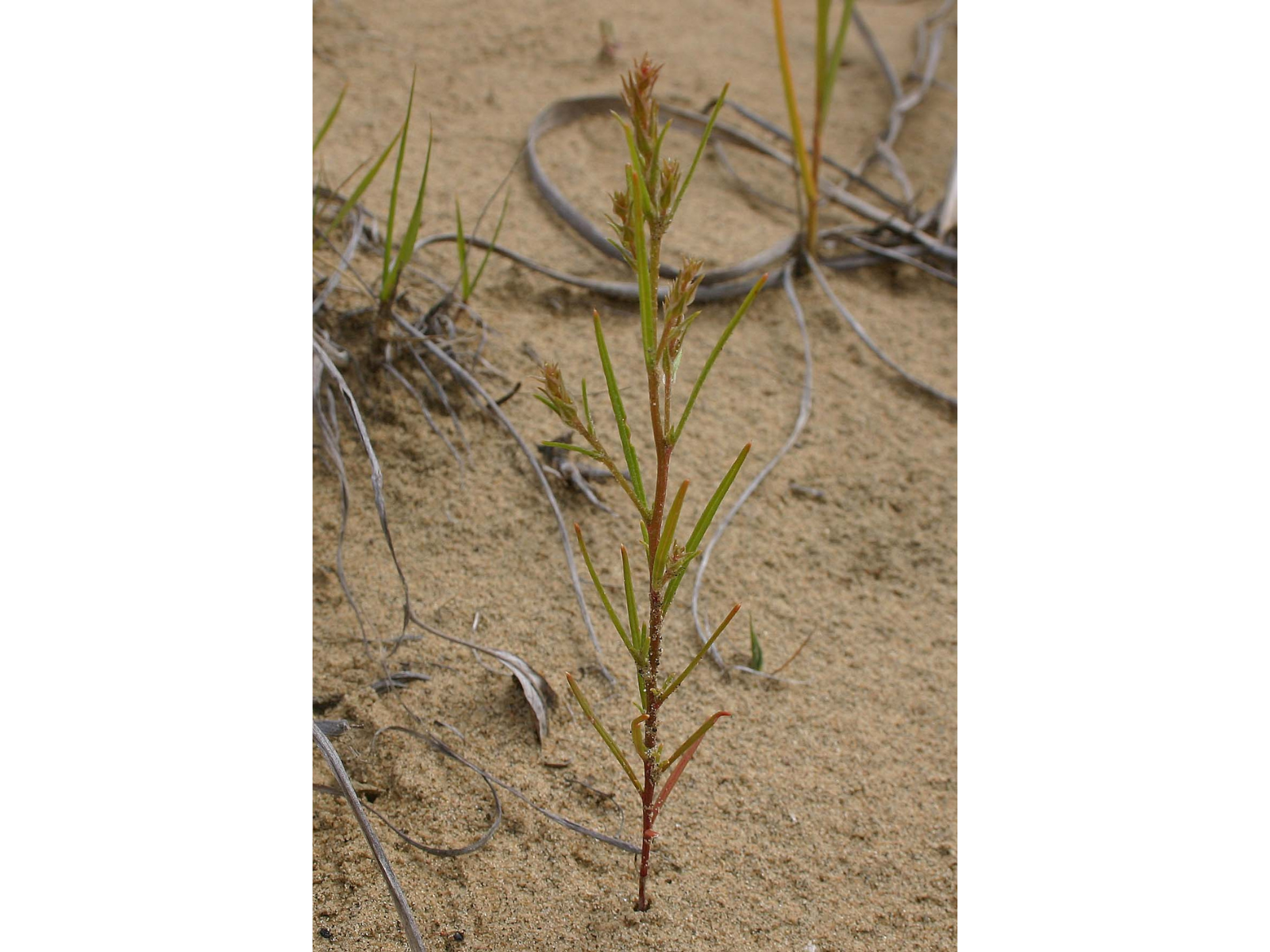
I wrote a blog back in June about perfect field days. Today should have been one of the worst field days of my life. Hiking in the middle of an old gravel pit in 32°C heat (41°C humidex), with no clouds, virtually no wind, while sweating profusely is NOT a recipe for a perfect field day; more like a recipe for heat stroke! My day was salvaged however by making several interesting scientific discoveries. First of all I found a rare plant that I’d been looking for in that old gravel pit I was hiking in, namely American Bugseed. This species had not been collected in Birds Hill since 1929 so finding a population of about 800 plants was a good find.

A small green-yellow plant growing in sandy ground.

American Bugseed.

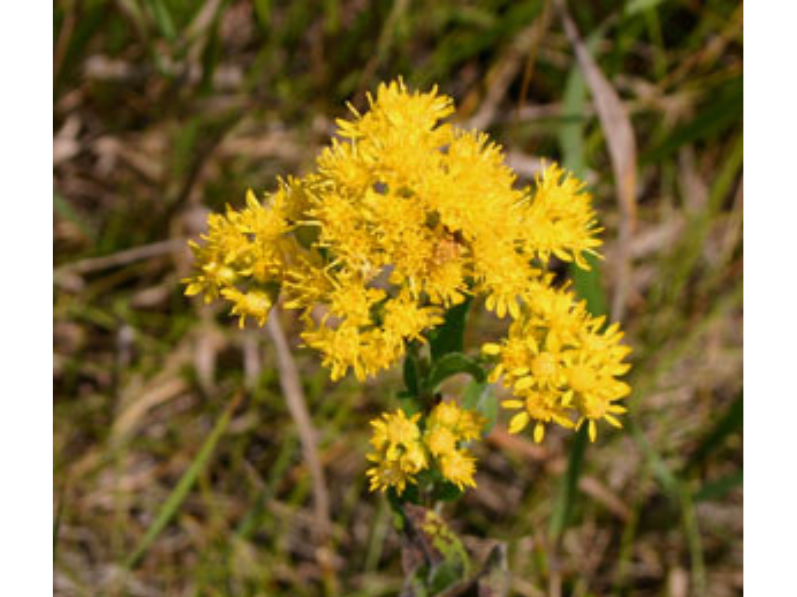
A close up on a cluster of yellow Goldenrod flowers on a yellow background.

Rigid Goldenrod.

My second high point was observing two species of insect (a bee fly and a bumblebee) visiting some of the common plants (Rigid Goldenrod and Hairy Golden Aster) in the park. The whole reason I was out at Birds Hill Park this week was because I needed some hard evidence (e.g. specimens and observations) to support my research hypothesis. I hypothesized that the rare Western Silvery Aster plant shares pollinators with common plants that bloom just before Western Silvery Aster does; the observation that I made today supports this statement. Essentially this means that the common plants in the park facilitate the persistence of Western Silvery Aster via their joint pollinators. The information I collected will be extremely useful in the development of my plant-insect interaction matrix for Manitoba’s tall-grass prairie, which will aid in conservation and restoration plans for this ecosystem.

Although I was way too hot to be excited about my findings at the time (I was too busy looking forward to getting back into the air-conditioned car) they helped to salvage what should have been a completely miserable field day.

Dr. Diana Bizecki Robson

Dr. Diana Bizecki Robson

Curator of Botany

Dr. Bizecki Robson obtained a Master’s Degree in Plant Ecology at the University of Saskatchewan studying rare plants of the mixed grass prairies. After working as an environmental consultant and sessional lecturer…
Meet Dr. Bizecki Robson

Summer…Holidays?

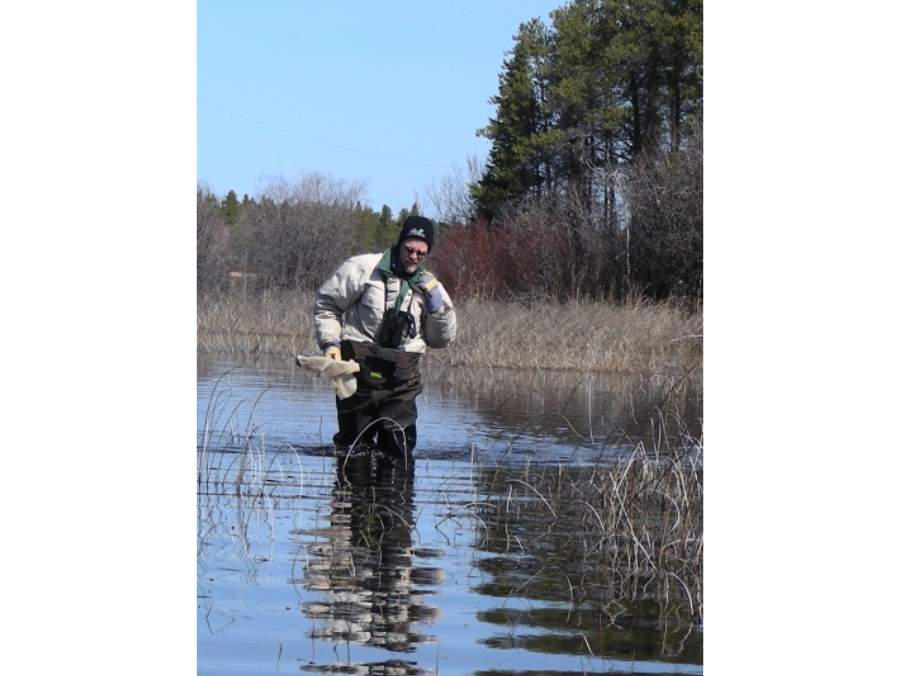
“I will be unavailable until…” has been a frequent message when my number has been dialed over the last two months. And although a couple of days might have been vacation, the majority is explained by time spent on fieldwork, hence the lack of blogging. So what is “fieldwork”? For Museum curators, it means getting out of the office to collect information relevant to our collections or research projects. In zoology, this usually means to be out standing in the field – or sometimes forest, stream, or pond.

As wonderful as it is to be out of the city, away from phones and e-mail, and in a remote part of the province searching for fishes, frogs, toads, and snakes, fieldwork is challenging for all these same reasons. In the city, we have more-or-less regular hours, a family to come home to, and our needs and wants are only a phone call (or mouse-click) away. On remote islands, dirt tracks, or wading muskeg north of 60, you better have all you need in your backpack.

A man wearing hip-waders thigh-deep in a body of water near low-growing reeds and rushes.

Outstanding in the field – or is that out standing in a pond?

A man sitting with piles of luggage and packed boxes and bucks on a sandy beach.

Wonder if we brought enough food if the plane doesn’t show up?

A truck blurred as it drives by across the frame in blue-ish morning low-light.
And you don’t do fieldwork because the hours are good. For frogs and toads, daylight hours are used to scout out potential habitat and to look for eggs and tadpoles. But to find the adults in any numbers, you need to return to these sites when it is dark and males are serenading for lady friends. Up north in June, when the mosquitoes are hungry, many frogs and toads don’t begin calling consistently until about 11 pm! It can make for a long day (and night).

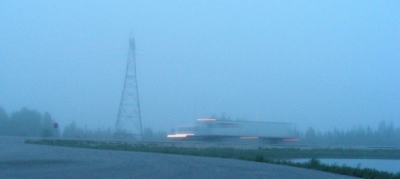
Regardless, we’re crazy enough to enjoy it – the thrill of the chase and of the discovery is alluring. And the beautiful surroundings, fresh air, and the sounds of nature are interrupted only by the occasional late-night/early morning trucker trying to make a deadline.


Image: A truck zooms by a collection site towards Ponton at 4 am.

But why are we out there all hours of  the day and night? Even basic knowledge of many species in Manitoba gets to be pretty thin once you get out of the southern quarter of the province. The distributional limits of even common vertebrates like frogs and toads, never mind invertebrates (like spiders and insects), have not been accurately determined. This kind of basic knowledge is important if Manitobans want to know what kind of impact we might be having on the environment, or if we want to know if climate change might be altering living conditions. If we don’t even know where the animals (or plants) live, how can we know if their distributions are changing?

Two images side by side. On the left, a speckled toad on a mossy rock. On the right, a speckled toad on pavement.

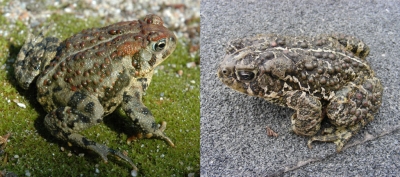
In the south, the American toad (Anaxyrus americanus) and Canadian toad (A. hemiophrys) are reported to have a contact zone just east of Winnipeg running south from Patricia Beach to the Canada/U.S. border. Over the last few decades it appears to be moving westward. Is the same happening in the northern parts of the province? We just can’t say because we don’t even know for sure if there IS a contact zone.


Image: A Canadian toad, left, faces off with an American toad, right.

Two images side by side. On the left, a predominantly light green frog. On the right, a orangey-brown frog.

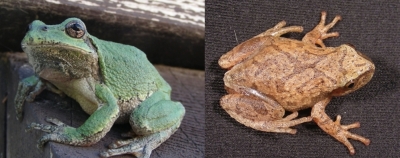
This spring, I extended the known range of Gray Treefrog (Hyla versicolor) northwards to the Saskatchewan River and that of the Spring Peeper (Pseudacris crucifer) westwards to almost the border with Saskatchewan. Are these recent species movements or just an artifact of more thorough searching and finding them where they’ve always been?


Image: Gray treefrog from near Grand Rapids, left, and spring peeper from Naosap Lake, right.

Future fieldwork by Museum personnel and by other scientists will give a clearer picture of where our animals (and plants) live now, and allow us to monitor these species for any changes in distribution. This seemingly basic information is critical to formulating environmental policy and to making informed decisions about the kind of province we want to live in. It also provides the data necessary to investigate the history of how species re-populated Manitoba after the last ice age. And museums, like The Manitoba Museum, play an important role in providing and archiving this information through fieldwork and collections, as well as analyzing it.

So the next time you call a curator and hear, “I will be unavailable until…”, we might just be trying to figure out what lives in your backyard and how it might have gotten there.

Dr. Randy Mooi

Dr. Randy Mooi

Curator of Zoology

Dr. Mooi received his Ph.D. in zoology from the University of Toronto working on the evolutionary history of coral reef fishes. Following a postdoctoral fellowship in the Division of Fishes of the Smithsonian Institution…
Meet Dr. Randy Mooi

Incoming!

By Dr. Graham Young, past Curator of Palaeontology & Geology


At the Museum, events often take place in cycles. Of course we have the cycle of fieldwork and laboratory research, a cycle of exhibit preparation followed by installation, and, like many other workplaces, cycles in which there are periods with many meetings, followed by blessed intervals with very few meetings.

What you may not appreciate is that there are also cycles in our dealings with members of the public. There are quiet periods when I might handle about one inquiry a week, and then there are those other times when it feels like hardly a day passes without at least a couple of calls or e-mails asking me to identify fossils or explain geological phenomena. And invariably, when the inquiries heat up, so do the donations.

The past few weeks have been a very rich period for both inquiries and donations. I have identified some very interesting rocks and fossils, and we have received the three superb donations shown here. It is unusual to receive objects having this sort of quality and significance; to receive three within just a few weeks is quite wonderful!

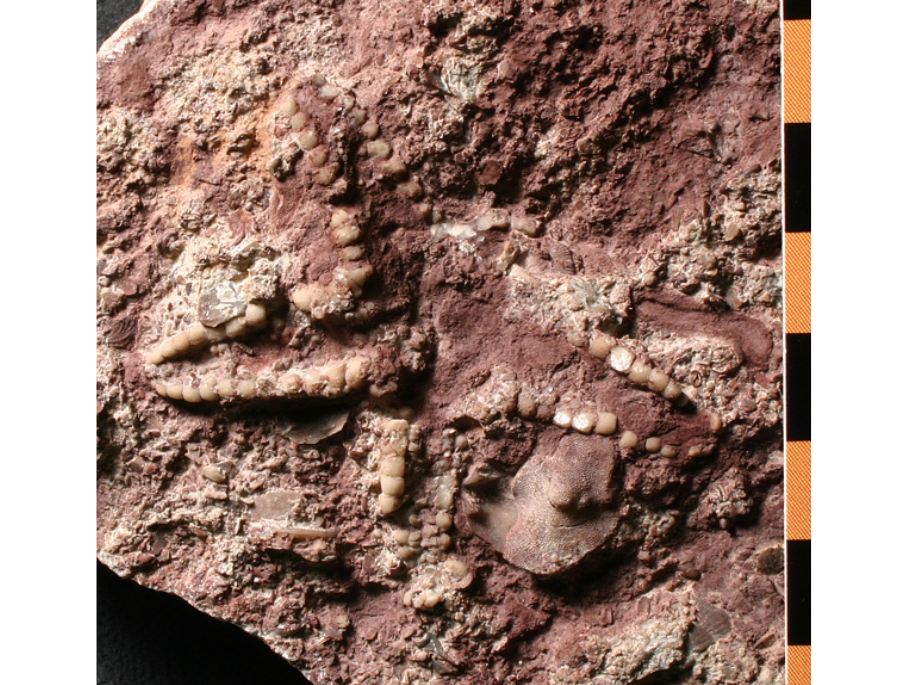
Fossil starfish are about as rare as Archaeopteryx teeth!  Of course an Archaeopteryx had a lot of teeth, but very few specimens of those teeth have ever been found. It is the same with fossil starfish. I’m sure that there were large numbers of starfish in ancient seas, but starfish are broken up very easily after death, by waves, currents, and scavengers.

This is the first proper starfish we have ever seen from Stony Mountain, even though fossil collectors working in that area have found many thousands of (non-starfish) specimens representing about 100 species (Young et al., 2008). The Museum’s collections also have a Stony Mountain ophiuroid (brittle star) and several crinoids, so this find nicely rounds out the echinoderms from that site.

A fossilized starfish.

An Ordovician starfish (asteroid) from the Stony Mountain Formation at Stony Mountain (about 450 million years old).

Black and white photograph of a Ordovician aged trilobite.

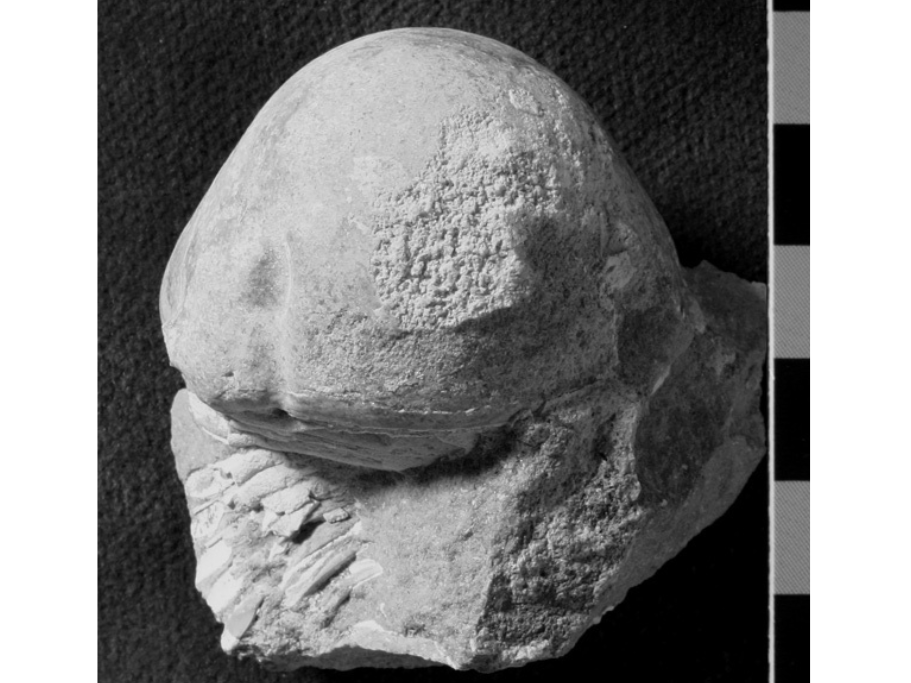
An Ordovician trilobite, possibly Stenopareia garsonensis, from the Red River Formation (Tyndall Stone) at Garson (about 450 million years old).

Tyndall Stone is, of course, one of Canada’s favourite building stones. Trilobites have been found in this rock in the past, but examples that have not disarticulated (gone to pieces) are surprisingly rare (Westrop and Ludvigsen, 1983; Young et al., 2008). The example above is not complete, but the tortuous curve between the cephalon (head) and thorax suggests that the body underwent unusual twisting during or after death. Although trilobites, like other arthropods, grew by moulting, I don’t think this is a moult because the free cheeks (outer parts of the cephalon) are still attached, and they tended to be lost when a trilobite moulted.

PaleoGeo - tusk

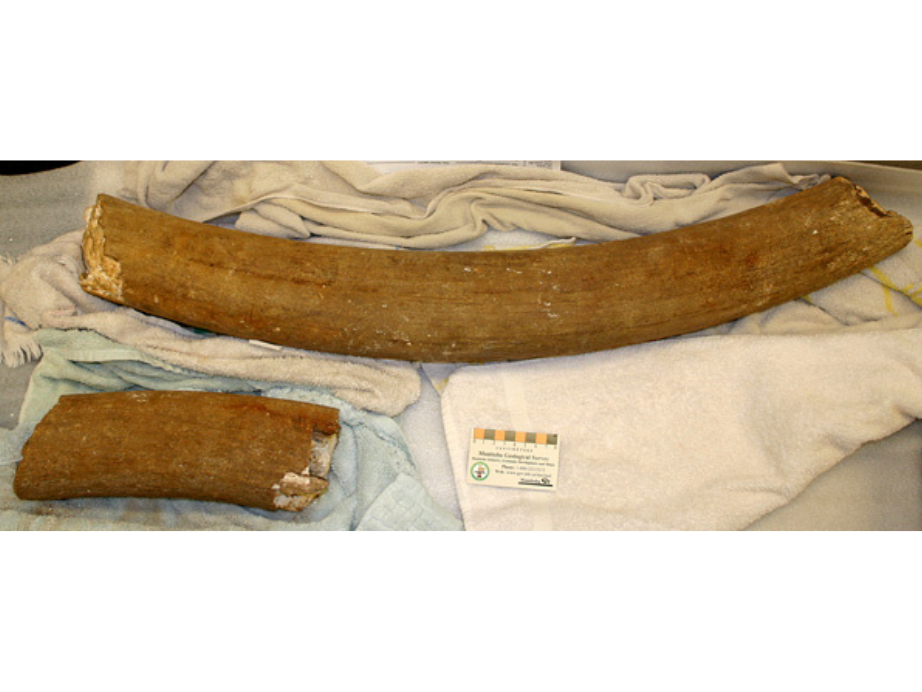
This beautiful mammoth tusk arrived about a week ago. It had only been dug out of the ground the day before, and it was soaking wet!  It is surrounded by towels in this photo because we are keeping it wrapped up so that it dries out very slowly over a period of many weeks. If mammoth tusks and teeth are dried too quickly, they tend to go completely to pieces, and we are trying to keep this one as intact as possible. Mammoth tusks are, of course, common in some regions (such as Siberia and Alaska), but only a few are known from Manitoba, and we are delighted to be adding this example to the Museum’s collection. All mammoth specimens from Manitoba seem to belong to the woolly mammoth (Mammuthus primigenius), but there are also rare examples of mastodons (Mammut americanum) in the province (see Leith, 1949).

Image: Pleistocene mammoth tusk from southeastern Manitoba (tens of thousands of years old).


LEITH, EI. 1949. Fossil elephants of Manitoba. Canadian Field-Naturalist, 63: 135-137.

WESTROP, S.R. AND R. LUDVIGSEN. 1983. Systematics and paleoecology of Upper Ordovician trilobites from the Selkirk Member of the Red River Formation, southern Manitoba. Manitoba Energy and Mines, Geological Report GR 82-2, 51 p.

YOUNG, G.A., R.J. ELIAS, S. WONG, AND E.P. DOBRZANSKI. 2008. Upper Ordovician Rocks and Fossils in Southern Manitoba. Canadian Paleontology Conference, Field Trip Guidebook No. 13, CPC-2008 Winnipeg, The Manitoba Museum, 19-21 September 2008, 97 p.